Lesson 2 of 10 · about 19 minutes
Friedman the Economist
You'll be able to
- Explain the permanent income hypothesis and why it overturned a simple link between current income and spending
- State the argument of A Monetary History of the United States about the Great Contraction, and the objections of Temin, Eichengreen and others
- Explain the natural rate of unemployment and why Friedman said the trade-off between inflation and unemployment is only temporary
- Describe how the Fed under Paul Volcker tested monetarism between 1979 and 1982
- Say which of Friedman's scholarly claims were confirmed and which were revised
On December 29, 1967, in Washington, D.C., Milton Friedman stood up as president of the American Economic Association and told the profession what central banks could not do. They could not peg interest rates for more than very limited periods. They could not peg the rate of unemployment for more than very limited periods either.1 Most of the economists in the room had spent the decade believing the opposite. Within seven years the country would be living through the evidence.
That address, printed in the American Economic Review in March 1968, is one of three pieces of scholarly work that carried Friedman to a Nobel Prize. The other two are the permanent income hypothesis and the monetary history of the United States. This lesson takes each in turn, asks what it claimed, and then asks how it held up. The man's life and his book Capitalism and Freedom are in Lesson 5 of the module on economic systems, and Lesson 3 here covers the policy side of his career. The subject now is the economist at his desk.
The 1976 prize went to Friedman, in the words of the Royal Swedish Academy, "for his achievements in the fields of consumption analysis, monetary history and theory, and for his demonstration of the complexity of stabilization policy."2 Look at the last phrase. The man best known for wanting simple rules was honored for showing how complicated the task of steering an economy is. He would have taken that as a fair description of his own view.
Permanent income: why a raise and a windfall are different
The first piece of work concerns how households decide how much to spend. In the 1930s Keynes had proposed that consumption depends mainly on current income. Spend a fixed fraction of what comes in, and a government that puts money in people's pockets will see most of it spent. That idea underlay much of the fiscal policy of the 1950s and 1960s.
There was a puzzle in the data. Studies that compared families at one moment found that richer families saved a larger share of their income. Studies of the whole country over decades found that the savings rate stayed roughly constant while income rose. Friedman's answer, in A Theory of the Consumption Function (Princeton University Press for the National Bureau of Economic Research, 1957), was that households do not respond to income as it arrives. They respond to what they think their income will be over the long run.3 He called the expected, lasting part permanent income and the rest transitory. A year of unusually good or poor earnings is mostly transitory, and families smooth their spending across it.
The Academy's press release describes the result in plain terms: Friedman separated the temporary part of income from the permanent part and found that a much larger share of temporary income is saved.4 That explains the puzzle. In a cross-section, the families with the highest incomes in a given year include many who are having a lucky year, and they save more of it. Over time, when whole-country income grows steadily, most of the growth is permanent and gets spent.
An example from the farm
A Magic Valley potato grower has a bumper year because the price spikes for one season. If he thinks the price will stay high, he buys the new tractor. If he expects the price to fall back next year, he pays down the note and keeps the cash, and the tractor dealer sees little of the windfall. The same logic works in reverse in a bad year: he dips into savings and keeps the family's spending close to normal. Friedman's point was that what a household spends depends on which story it believes, and that most one-season spikes are read for what they are. A policy that expects a one-time rebate check to be spent like a raise will disappoint.
The policy bite is real. A temporary tax cut, on this view, buys less spending than a permanent one of the same size, because families treat it as a windfall and save most of it. A good deal of later work tested the idea. Robert Hall of Stanford showed in 1978 that if households follow the permanent income logic and look ahead rationally, consumption should change in ways that are hard to predict, close to a random walk.5 Later studies found that some households, especially those with little cash on hand, spend a windfall more freely than the theory says they should. The core of Friedman's idea survived. Its sharpest form did not, and that is how most good hypotheses age.
The monetary history: what happened between 1929 and 1933
The second piece of work took years. Arthur Burns, then research director at the National Bureau of Economic Research, persuaded Friedman after the war to study the role of money in the business cycle.6 Friedman worked on it with Anna J. Schwartz, an economic historian whose command of the archives matched his taste for theory. Their book, A Monetary History of the United States, 1867-1960, came out from Princeton University Press in 1963.7
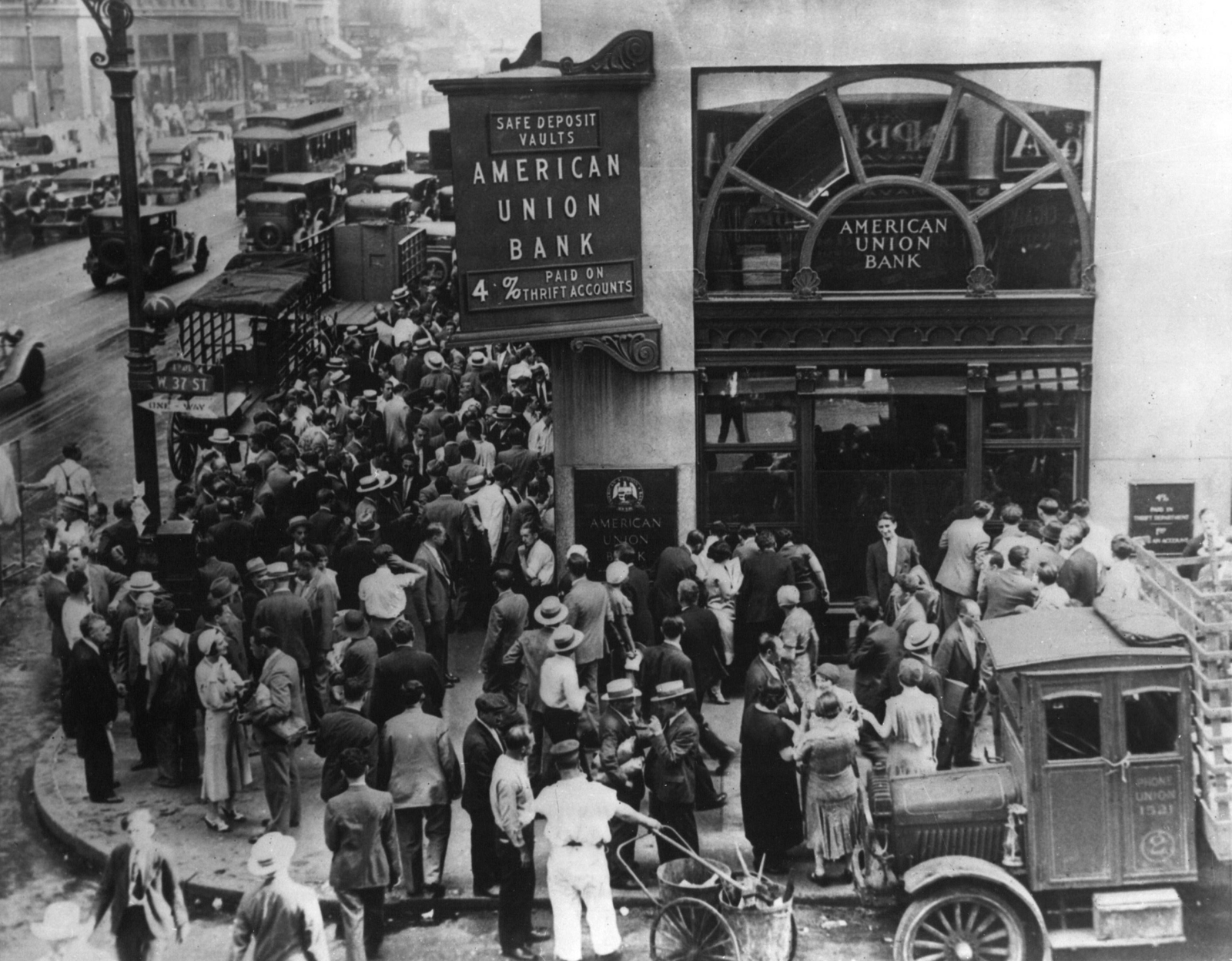
The book's central claim is the one that made it famous. The standard story before it blamed the Great Depression on the collapse of confidence after the stock market crash of 1929, or on an investment boom that burned out. Friedman and Schwartz argued that the Federal Reserve's tight policy after the 1920s boom, and its failure to act as lender of last resort when banks failed, let the money supply shrink, and that the shrinking turned a normal recession into a catastrophe.7 They called the years 1929 to 1933 the Great Contraction. On their count the quantity of money fell by roughly a third.8
"I would like to say to Milton and Anna: Regarding the Great Depression. You're right, we did it. We're very sorry. But thanks to you, we won't do it again."
Ben S. Bernanke, Governor of the Federal Reserve Board, remarks at the University of Chicago, November 8, 2002.9
Early in the same talk, Bernanke had said that the Friedman and Schwartz account had become "the leading and most persuasive explanation of the worst economic disaster in American history."9 The remark is worth keeping in mind in Lesson 9, because in 2008 a Fed chairman who had studied the book decided not to repeat what it described.
Four natural experiments
Bernanke's 2002 remarks give the best short tour of how Friedman and Schwartz built the case. Their method was to look for moments when the Fed changed course for reasons that had little to do with the state of the economy, and then see what followed. Bernanke lists four.9
In 1928 and 1929 the Fed tightened to cool stock market speculation. The discount rate in New York reached 5 percent, and the System cut its holdings of government securities from over $600 million at the end of 1927 to $210 million by August 1928. Output, wholesale prices and personal income then fell. In the autumn of 1931, after Britain left the gold standard, the Fed raised its rediscount rate to 2.5 percent on October 9 and to 3.5 percent on October 16 to defend the dollar. That month 522 commercial banks closed, and the money supply fell.9
The third episode runs the other way. Under pressure from Congress, the Fed bought securities from April to June of 1932. The decline in money slowed, and prices and production began to recover. Then Congress adjourned on July 16, 1932, the program ended, and the economy relapsed. The fourth came in early 1933, when doubts about what Franklin Roosevelt would do about gold set off conversions of dollars into gold and more bank failures before the March banking holiday.9
Underneath the episodes sat a question of institutions and people. Friedman and Schwartz argued that Benjamin Strong, the powerful governor of the Federal Reserve Bank of New York, died in October 1928 and left the System without a leader, and that if he had lived many of the mistakes might have been avoided. Bernanke calls that counterfactual controversial, though he treats the death as a natural experiment of its own. He also reports that some Fed officials accepted Treasury Secretary Andrew Mellon's view that weeding out weak banks was necessary, and that the System had forsworn responsibility for the banking system. Roughly half of American commercial banks failed or merged in the decade.9 Bernanke adds a channel the book did not stress, the damage done when the machinery of credit stops working, and describes it as an embellishment of the Friedman and Schwartz story and no contradiction of it.9
The objections
The book has had serious critics, and a fair account lists them. Peter Temin of MIT asked whether the money supply was really something the Fed controlled, or something that fell because the economy was already collapsing and banks and households wanted less credit.7 Barry Eichengreen, in Golden Fetters (1992), pointed to the gold standard, which tied the hands of the Fed and of central banks abroad, so that the question was less one of bad judgment than of a system that forced the contraction. Paul Krugman has argued, pointing to the 2008 crisis, that during a financial crisis a central bank cannot control broad money. James Tobin praised the rigor of the work and questioned the velocity measures that it relied on.7
An objection from the other side came from Murray Rothbard, of the Austrian school, who argued in America's Great Depression (1963) that the trouble was the credit expansion of the 1920s, which created the boom that had to be corrected. Rothbard also disputed the numbers, arguing that the money supply had actually grown during part of the period in which Friedman and Schwartz saw a contraction, though he agreed with them that the Federal Reserve bore the blame.710 Lesson 5 takes up that argument. Here the point is that the monetary account has critics on the Keynesian left, in the gold-standard history, and on the Austrian right, and that it has survived all three well enough for a sitting Fed governor, who later became chairman, to say he agreed with it.
The 1968 address: the natural rate and the vanishing trade-off
The third piece is the shortest, seventeen pages, and had the most immediate effect. To see why, start with the idea it attacked. In 1958 A. W. Phillips, a New Zealand economist working in London, had plotted a century of British data and found that wages rose faster when unemployment was low. Economists in the 1960s turned the pattern into a menu. A government could choose a little more inflation and get a little less unemployment, as if it were picking a point on a curve. American policy advisers took the menu seriously.
Friedman's reply was that the menu does not exist beyond the short run. He defined what he called the natural rate of unemployment, saying it is "the level that would be ground out by the Walrasian system" of general equilibrium equations, that is, the rate that the real features of the labor market produce when nothing is going wrong with money.1 A central bank can push unemployment below that rate for a while by letting prices rise faster than workers expected. Workers take jobs at wages that look good, because they think prices are stable, and then discover that their pay buys less. When they adjust their expectations, unemployment drifts back up to the natural rate, and now inflation is higher too. To keep unemployment down, the bank would have to accelerate inflation again.
"there is always a temporary trade-off between inflation and unemployment; there is no permanent trade-off."
Milton Friedman, "The Role of Monetary Policy," American Economic Review 58, no. 1 (March 1968), pp. 1-17.1
He drew two lessons. A central bank, he wrote, "cannot peg interest rates for more than very limited periods" and "cannot peg the rate of unemployment for more than very limited periods."1 The first lesson is that the bank's job is to supply a stable monetary background, not to steer the real economy. The second is that the long-run cost of trying is inflation that keeps rising. Edmund Phelps, then at the University of Pennsylvania, reached a similar conclusion independently at about the same time, and the two share the credit in most textbooks.11
The 1970s: a test nobody wanted
The evidence arrived on a schedule. Through the 1970s the United States had both rising inflation and unemployment that did not fall, the combination that the old menu said could not occur and that gave the word stagflation to the language. By the time Paul Volcker became chairman of the Federal Reserve in August 1979, year-over-year inflation was above 11 percent and unemployment was just under 6 percent. The yearly rise in consumer prices peaked at close to 15 percent in March 1980.12 This confirmed the central claim of the 1968 address, that a stable menu of inflation and unemployment does not exist. Few economists dispute that now. The more interesting question was what to do about it, and that is where monetarism was put to work.
The Volcker experiment
In October 1979 the Federal Open Market Committee announced that it would stop targeting the federal funds rate, the price of money, and aim instead at the quantity of nonborrowed reserves.13 That was a monetarist move in form. The committee expected interest rates to swing much more widely than before, and they did. The recession that followed lasted from July 1981 to November 1982, and unemployment "peaked at nearly 11 percent." By the end of it inflation was "back under 5 percent," and over the second half of the 1980s it averaged only 3.5 percent.12 Inflation had been beaten, at a price paid in lost jobs and failed farms and businesses that borrowed at high rates.
Did monetarism win? The answer is split. The Fed accepted Friedman's diagnosis that inflation is caused by too much money, and it accepted his insistence that the central bank bears responsibility for it. But it did not stay with his method. In the fall of 1982 the Fed returned to targeting the price of money, citing "financial market innovation and decreased inflation." New kinds of accounts, such as money market mutual funds and NOW accounts, let households shift balances in ways that made the growth of M1 and M2 jumpy, and the swings were not tied to what the economy was doing.13 Friedman's prescription rested on a stable relation between money and spending. When velocity became unstable, the prescription lost its footing, and many economists who had accepted monetarism in the 1970s dropped it.14
What stood, what was revised
Keep the score honestly, because partisans on every side of Friedman tend to remember only half of it.
| Claim | Source | Verdict today |
|---|---|---|
| Spending follows permanent income, and windfalls are mostly saved | Theory of the Consumption Function (1957) | Core idea accepted; the strict form qualified. Households with little cash spend windfalls more than it predicts. |
| A collapse of the money supply, which the Fed could have stopped, turned a recession into the Great Depression | A Monetary History (1963) | Widely accepted. Bernanke, then a Fed governor, said so in 2002. Debated: the role of the gold standard, and how far the Fed could have acted. |
| There is no permanent trade-off between inflation and unemployment | AEA address (1967) | Confirmed by the 1970s and now the textbook view. |
| Inflation is a monetary phenomenon and the central bank is responsible for it | Many writings | Accepted by central banks in practice. Few treat money growth as a mechanical guide. |
| Steady growth of a chosen money measure is the best policy rule | A Program for Monetary Stability (1960) | Largely abandoned after the money-velocity relation broke down in the 1980s. |
Look at which claims held up. They are the ones about how the economy works, and the claim that fell short is the one about what policy rule to follow. That pattern recurs in the life of many economists. A diagnosis can be right when the cure is a guess. Friedman himself wrote in his 1953 essay on method that a theory "is to be judged by its predictive power" and that "the only relevant test of the validity of a hypothesis is comparison of its predictions with experience."15 By that test he can fairly be graded. He passed on the Depression and on inflation, and he took a failing grade on the money rule, and no one has asked him to pretend otherwise.
Remember: The Nobel citation praised Friedman's "demonstration of the complexity of stabilization policy." That complexity is why he preferred rules to discretion: if no one can steer well, the best policy is the one that does the least harm when the steersman is wrong.
Long and variable lags
One idea from this work needs a sentence of its own. Friedman argued that the effects of monetary policy arrive after a delay that is both long and unpredictable, so that a central bank acting on today's data may be adjusting for last year's problem and adding to next year's. The phrase "long and variable lags" is generally credited to him, and the Academy's 1976 press release singled out his work on the "effect-lags" of monetary policy, which can be long and of varying length.16 It remains the best short argument for humility in anyone who has the power to move interest rates. And it applies to critics of the Fed as well as to the Fed.
Lesson 3 follows Friedman out of the seminar and into public life: vouchers, the volunteer army, floating exchange rates, and the series that took his name to television.
Learn more
- The Role of Monetary Policy: Friedman's 1967 address in full, seventeen pages and readable without a degree.
- Bernanke on Friedman's ninetieth birthday: A Fed governor explains the book and apologizes for the Fed.
- The 1976 Nobel press release: The Academy explains in plain terms what each of the three achievements showed.
- The Great Inflation: The Federal Reserve's own history of the 1965-1982 inflation and the Volcker disinflation.
- How the Fed changed its approach: A short explanation of the 1979 shift to reserves and the 1982 retreat from it.
- Friedman's Nobel autobiography: His own account of the work with Burns and Schwartz.
Notes
- Milton Friedman, "The Role of Monetary Policy," presidential address to the American Economic Association, December 29, 1967, American Economic Review 58, no. 1 (March 1968): 1-17. Read it online. ↩
- "The Prize in Economics 1976," press release, Royal Swedish Academy of Sciences, October 14, 1976. Read it online. ↩
- Milton Friedman, A Theory of the Consumption Function (Princeton: Princeton University Press for the National Bureau of Economic Research, 1957). Friedman refers to the book in his Nobel autobiography as drawing on his 1935 consumer-budget work and his research on professional incomes. Read the autobiography. ↩
- Royal Swedish Academy of Sciences, press release, October 14, 1976, on the permanent income hypothesis and the larger savings share of temporary income. Read it online. ↩
- Robert E. Hall, "Stochastic Implications of the Life Cycle-Permanent Income Hypothesis: Theory and Evidence," Journal of Political Economy 86, no. 6 (December 1978): 971-987. ↩
- Milton Friedman, "Biographical," Nobel Prize in Economic Sciences 1976, on Arthur Burns's persuading him to return to the National Bureau to study the role of money in the business cycle. Read it online. ↩
- "A Monetary History of the United States," Wikipedia: Princeton University Press, 1963; the thesis that tight Fed policy and the failure to act as lender of last resort let the money supply shrink; objections by Peter Temin (on whether the money stock was endogenous), Barry Eichengreen (Golden Fetters, 1992), Paul Krugman (on central banks' control of broad money in a crisis), James Tobin (on velocity) and Murray Rothbard (who argued the money supply had grown). Read it online. ↩
- Milton Friedman and Anna J. Schwartz, A Monetary History of the United States, 1867-1960 (Princeton: Princeton University Press, 1963), chapter 7, "The Great Contraction, 1929-33." The one-third figure is the commonly cited decline in the money stock over those years. ↩
- Ben S. Bernanke, "On Milton Friedman's Ninetieth Birthday," remarks at the Conference to Honor Milton Friedman, University of Chicago, November 8, 2002. Read it online. ↩
- Murray N. Rothbard, America's Great Depression (Princeton: D. Van Nostrand, 1963), as described in "Murray Rothbard," Wikipedia. Read it online. ↩
- Edmund S. Phelps, "Phillips Curves, Expectations of Inflation and Optimal Unemployment over Time," Economica 34 (August 1967): 254-281. ↩
- Federal Reserve History, "The Great Inflation": Volcker becomes chairman in August 1979 with inflation above 11 percent and unemployment just under 6 percent; inflation peaks near 15 percent in March 1980; the 1981-82 recession runs from July 1981 to November 1982 with unemployment at nearly 11 percent; inflation back under 5 percent; 3.5 percent average in the later 1980s. Read it online. ↩
- Federal Reserve Bank of San Francisco, "How did the Fed change its approach to monetary policy in the late 1970s and early 1980s?" Dr. Econ, January 2003. Read it online. ↩
- "Monetarism," Wikipedia, on the breakdown of the stable relation between money and nominal income in the 1980s and 1990s and the decline of monetarist influence. Read it online. ↩
- Milton Friedman, "The Methodology of Positive Economics," in Essays in Positive Economics (Chicago: University of Chicago Press, 1953), part I. Read it online. ↩
- Milton Friedman, A Program for Monetary Stability (New York: Fordham University Press, 1960), on the lag in the effect of monetary policy; see also Friedman, "The Lag in Effect of Monetary Policy," Journal of Political Economy 69, no. 5 (October 1961): 447-466. The phrase "long and variable lags" is generally attributed to his writings of this period. The Royal Swedish Academy's press release of October 14, 1976, describes his terms "observation-lag," "decision-lag" and "effect-lag." Read the press release. ↩
- "Crowd at New York's American Union Bank during a bank run early in the Great Depression," National Archives photograph, 1931, via the Social Security Administration history site; Wikimedia Commons, "File:American union bank.gif." View it online. ↩

Check yourself
1. According to Friedman's permanent income hypothesis, how do households treat a windfall that they regard as temporary?
The Royal Swedish Academy's 1976 press release says Friedman separated temporary from permanent income and found that a much larger share of temporary income is saved.
2. Who, besides Friedman, wrote A Monetary History of the United States (1963)?
Anna J. Schwartz was Friedman's co-author at the National Bureau of Economic Research. Princeton University Press published the book in 1963.
3. What did Friedman say in his 1967 presidential address to the American Economic Association about the trade-off between inflation and unemployment?
Friedman wrote that 'there is always a temporary trade-off between inflation and unemployment; there is no permanent trade-off.' The address was delivered on December 29, 1967, and published in the American Economic Review in March 1968.
4. In October 1979 the Federal Reserve under Paul Volcker changed its operating target from the federal funds rate to what?
The Federal Reserve Bank of San Francisco explains that the FOMC moved from targeting the price of money (the federal funds rate) to targeting its quantity, specifically nonborrowed reserves.
5. What did Ben Bernanke say to Friedman and Schwartz in 2002 about the Great Depression?
Bernanke spoke at the University of Chicago on November 8, 2002, at a conference honoring Friedman's ninetieth birthday.
Terms in this lesson
- Permanent income
- Friedman's term for the income a household expects to last, as against temporary windfalls or shortfalls. He argued that spending follows permanent income.
- Great Contraction
- The name Friedman and Schwartz gave to the collapse of the American economy from 1929 to 1933, which they traced chiefly to the Federal Reserve's failure to stop the money supply from shrinking.
- Phillips curve
- The observed pattern, first drawn for Britain by A. W. Phillips in 1958, that low unemployment goes with higher wage and price inflation and the reverse.
- Natural rate of unemployment
- Friedman's term for the rate of unemployment that the real structure of the labor market would produce when expectations are correct, which monetary policy cannot hold below for long.
- Stagflation
- High inflation together with high unemployment and weak growth, the combination that the 1970s produced and that simple Phillips-curve thinking said could not happen.
- Monetarism
- The view that changes in the quantity of money are the main driver of national income and prices, so that a steady, predictable growth of money is the best policy.
- Velocity of money
- How many times a unit of money is spent in a year. Monetarism works best if velocity is stable and predictable.
Sources
- Nobel Prize in Economics 1976, press release (October 14, 1976) checked 2026-10
- Milton Friedman, Biographical, Nobel Prize 1976 checked 2026-10
- Friedman, The Role of Monetary Policy, American Economic Review (March 1968) checked 2026-10
- Ben Bernanke, On Milton Friedman's Ninetieth Birthday (November 8, 2002) checked 2026-10
- Federal Reserve History, The Great Inflation checked 2026-10
- Federal Reserve Bank of San Francisco, How did the Fed change its approach to monetary policy in the late 1970s and early 1980s? checked 2026-10
- A Monetary History of the United States (Wikipedia) checked 2026-10
- Monetarism (Wikipedia) checked 2026-10
- Friedman, The Methodology of Positive Economics (1953) checked 2026-10