Lesson 9 of 10 · about 25 minutes
The Critics and the Evidence
You'll be able to
- State the best case made by Keynes, Galbraith and Minsky against the self-correcting market, and the answers given by Hayek, Friedman and others
- Explain how the Federal Reserve's response to the 2008 crisis drew on the Friedman and Schwartz account of the Great Depression
- Describe the New Jersey minimum-wage study of 1994, the payroll-data challenge to it, and what later studies and the Congressional Budget Office found
- Summarize the inequality debate over Piketty's Capital, the information economics of Stiglitz, and the behavioral challenge from Kahneman and Thaler
- Explain what Acemoglu, Johnson and Robinson found about institutions and why free-market economists largely welcomed it
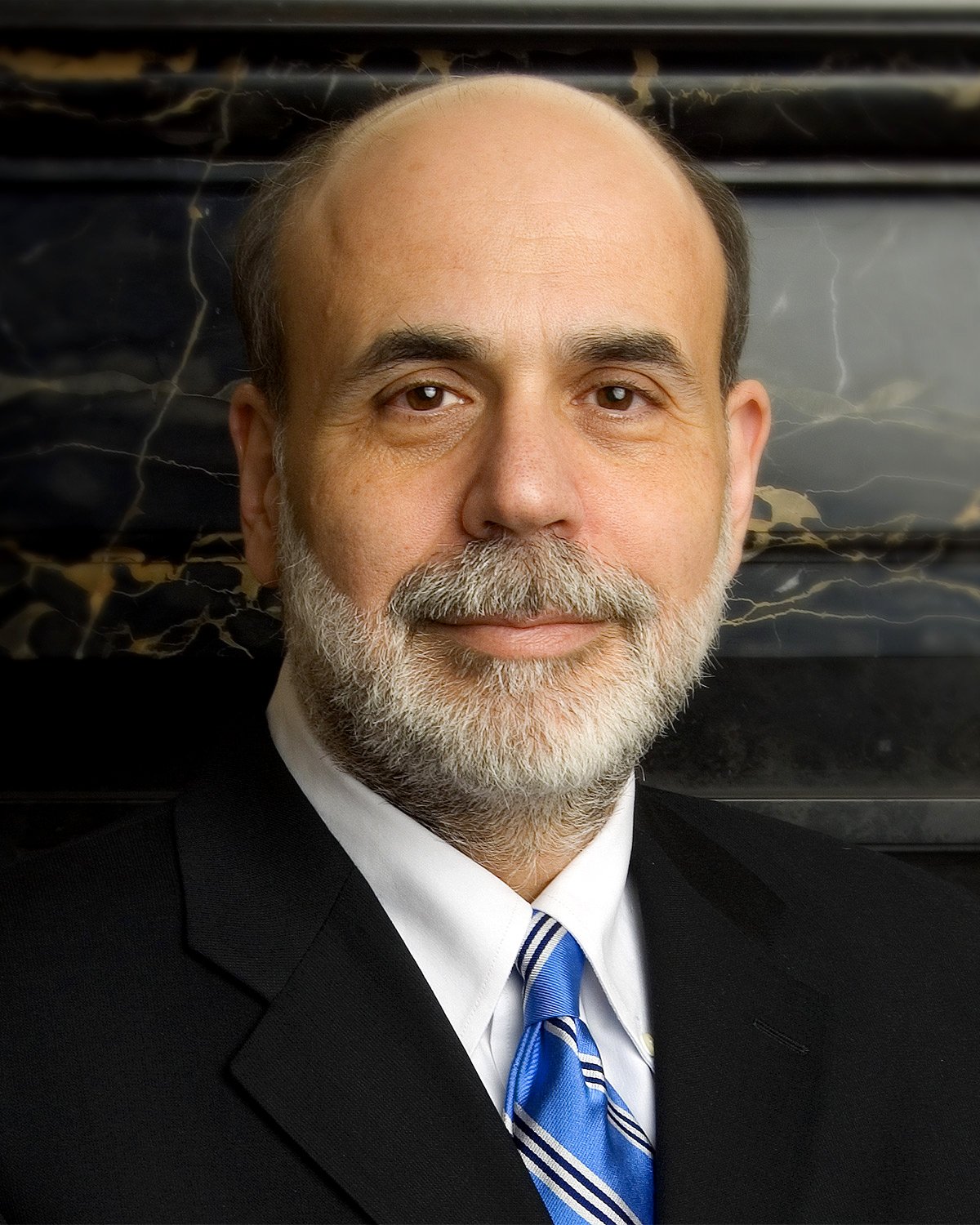
On Monday, September 15, 2008, Lehman Brothers filed for bankruptcy. The next day the Federal Reserve lent to AIG, the insurance giant, to keep it from following Lehman down.1 The man running the Fed that week was Ben Bernanke, a scholar of the Great Depression, who six years earlier had stood up at the University of Chicago and apologized to Milton Friedman and Anna Schwartz for what the Fed did between 1929 and 1933. "You're right, we did it," he had told them. "We're very sorry. But thanks to you, we won't do it again."2 On September 3, 2008, the Fed's balance sheet stood at about $905 billion. By December 10 it was $2.25 trillion.3
That week is a good place to start an honest accounting of the free-market schools, because it cuts both ways. A Chicago monetary history told the Fed what not to do. And yet the crisis itself came out of the most market-driven corner of the economy, the market for mortgage securities, and it revived a set of critics whom the 1980s and 1990s had seemed to retire. This lesson takes the major critics one at a time. Each gets his best case in his own words. Each gets the strongest answer from the free-market side. Then the data get a vote.
Keynes and the case for managing demand
John Maynard Keynes published The General Theory of Employment, Interest and Money in 1936, in the seventh year of the Depression. He opened his last chapter with a sentence that still frames the argument. "The outstanding faults of the economic society in which we live are its failure to provide for full employment and its arbitrary and inequitable distribution of wealth and incomes."4
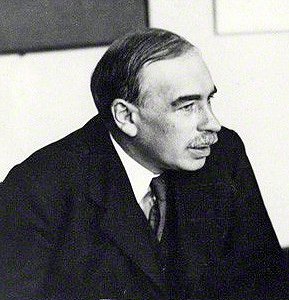
His central claim was that an economy can settle at high unemployment and stay there. Classical economists expected falling wages and interest rates to restore full employment on their own. Keynes argued that when spending collapses, businesses stop investing because they see no buyers, workers lose income and spend less, and the slump feeds itself. Investment, in his account, rests on confidence more than calculation.
"Most, probably, of our decisions to do something positive, the full consequences of which will be drawn out over many days to come, can only be taken as a result of animal spirits"
John Maynard Keynes, The General Theory (1936), ch. 12, sec. VII.5
If private spending fails, Keynes said, public spending can fill the gap. He made the point with a famous provocation. If the Treasury filled old bottles with banknotes, buried them in disused coal mines and let private enterprise dig them up again, he wrote, "there need be no more unemployment," though he added at once that it "would, indeed, be more sensible to build houses and the like."6 He did not ask for state ownership of industry. In the same last chapter he wrote that "no obvious case is made out for a system of State Socialism which would embrace most of the economic life of the community," while arguing that the state should take a large hand in setting the overall rate of investment.4
That is the best case: markets left alone can waste millions of lives in idleness for a decade, and a government that spends in a slump can put them back to work.

The free-market answer
The answer came in several layers. Hayek attacked Keynes in the 1930s for ignoring how the structure of capital is distorted in a boom, a debate covered in Lesson 4. Friedman attacked the consumption theory underneath the Keynesian multiplier and argued that households spend out of permanent income, so a temporary check from Washington buys less spending than the models promised. That is in Lesson 2. Most important, Friedman and Schwartz turned the Depression itself against Keynes. On their account it was a failure of the Federal Reserve, which let the money supply fall by about a third, and not a failure of markets.2 If that is right, the cure for a slump is a central bank that does its job, and the case for large public spending programs is much weaker.
Myth: Friedman said "We are all Keynesians now"
The line was printed in Time on December 31, 1965 and pinned on Friedman. In a letter published February 4, 1966, he said his full remark had been "In one sense, we are all Keynesians now; in another, nobody is any longer a Keynesian." He meant that everyone used Keynes's tools and vocabulary while few still accepted his conclusions. Henry Hazlitt had used the shorter phrase in Newsweek a decade earlier.7
What the data show
The crisis of 2008 gave economists a natural test, and the profession spent a decade on it. Valerie Ramey of the University of California, San Diego, surveyed the work in 2019. She found that most estimates of the spending multiplier "lie in a fairly narrow range, 0.6 to 1," and that tax-change multipliers ran from -2 to -3.8 A spending multiplier below 1 means a dollar of government spending adds less than a dollar to output, because it displaces some private activity. That is closer to Friedman's view than to the textbook Keynesian figure of 1.5 or 2. But Ramey also identified circumstances in which multipliers lie outside that range, and Keynesians argue that a deep slump with interest rates at zero is exactly such a case.8 The 2009 stimulus, the American Recovery and Reinvestment Act, cost nearly $840 billion over 2009 to 2019 by the Congressional Budget Office's estimate, and CBO's own estimates of how many jobs it added span a wide range.9 On the narrow question of whether a dollar spent in a slump pays for itself, the evidence leans against the enthusiasts. On whether slumps can last when the central bank fails, Keynes and Friedman agreed more than their followers admit.
Keynes himself expected his ideas to outlast the argument. "Practical men, who believe themselves to be quite exempt from any intellectual influences," he wrote, "are usually the slaves of some defunct economist."4 He was right about that, and the sentence applies to readers of Friedman as much as to readers of Keynes.
Galbraith and the affluent society
John Kenneth Galbraith of Harvard was the most widely read economist of the 1950s and 1960s, and his target was the consumer economy itself. In American Capitalism (1952) he argued that the competitive model no longer fit most of American industry, and that the power of big firms was checked by the countervailing power of big unions and big buyers. In The Affluent Society (1958) he contrasted the affluence of the private sector with the squalor of the public one: shiny cars on crumbling roads, a phrase later boiled down to "private opulence and public squalor."10
His sharpest argument was what he called the dependence effect. Defenders of the market say it serves what consumers want. Galbraith replied that the market creates the wants it then claims to serve.
"One cannot defend production as satisfying wants if that production creates the wants"
John Kenneth Galbraith, The Affluent Society (1958), p. 124, as quoted in the Concise Encyclopedia of Economics.10
Galbraith was more careful than his fans. He conceded, in his own words, that "an admirable case can still be made" for satisfying even wants with "bizarre, frivolous, or even immoral origins."10 His point was about urgency: if advertising manufactures a desire, the market has no special claim to be meeting a need, and money spent on schools and parks may do more good.
Hayek's answer
Hayek replied in the Southern Economic Journal in April 1961 with an essay titled "The Non Sequitur of the 'Dependence Effect.'"11 His argument was simple and hard to escape. Almost all human wants beyond food and shelter are learned from other people. We learn to want literature, music and religious devotion from our culture. Nobody concludes that a symphony is unimportant because no one was born wanting one. So the fact that a want is created by the producer, or by society, says nothing about whether it is worth satisfying.11 David Henderson of the Hoover Institution adds a practical answer: even the largest firms lose money when they fail to make a product consumers want, and General Motors, which Galbraith treated as a firm able to shape demand, saw its share of the American car market fall from about half to less than half of that by 2005.10
The data side of this debate is thinner, because Galbraith's claims were more moral than measurable. His later prediction in The New Industrial State (1967), that giant corporations had escaped the market and could plan their own futures, aged badly. Henderson notes that the evidence has not supported it, and the fall of General Motors, his favorite example of a planning firm, is the plainest case.10 His complaint about neglected public goods still has force. It is a claim about priorities, and voters, not economists, settle it.
Minsky and the instability of finance
Hyman Minsky spent most of his career at Washington University in St. Louis and was little read outside a circle of admirers until 2008 made him famous. His theory, set out most compactly in a 1992 working paper for the Levy Economics Institute of Bard College, is that a market economy with a modern financial system generates its own crises.12
He sorted borrowers into three kinds. Hedge borrowers can pay both interest and principal out of their income. Speculative borrowers can pay the interest but must roll over the principal. Ponzi borrowers cannot pay even the interest from income and must borrow more or sell assets to keep going. An economy dominated by hedge borrowers, Minsky said, may well seek and hold equilibrium. As speculative and Ponzi finance grow, it becomes a system that amplifies every shock.12
"over periods of prolonged prosperity, the economy transits from financial relations that make for a stable system to financial relations that make for an unstable system."
Hyman P. Minsky, "The Financial Instability Hypothesis," Levy Economics Institute Working Paper No. 74, May 1992, pp. 7-8.12
Read the Federal Reserve's own history of the housing bubble with Minsky in mind. Average home prices more than doubled between 1998 and 2006. Household mortgage debt rose from 61 percent of GDP in 1998 to 97 percent in 2006. Lenders offered subprime loans to buyers who would not have qualified a decade earlier and sold the loans on as securities. Then home prices fell by more than a fifth from early 2007 to mid-2011, and the paper built on them could not be valued.1 A long quiet stretch, a pile of new debt, a collapse. It looks a great deal like the second theorem.
The free-market answer
Free-market economists do not deny the bubble. They dispute its cause. John Taylor of Stanford argued in 2007 that the Fed kept interest rates too low for too long after the 2001 recession and fed the housing boom, a view the Fed's history essay reports alongside the contrary finding, which it attributes to Bernanke (2010) among other analysts, that such factors can account for only a small part of the rise in housing activity.1 On that reading the instability came from a government price, the interest rate, set wrong, and not from markets as such. Austrian economists go further, as Lesson 5 explains: cheap credit creates booms that must end in busts. Others point to federal policy encouraging home ownership and to the implicit guarantee behind Fannie Mae and Freddie Mac, which let lenders expect a rescue. That is a Minsky story with a moral-hazard twist. Rescues teach borrowers to take more risk, which makes the next crisis bigger.
The two camps agree on more than either likes to say. Both see debt piling up in good times. They differ on whether the remedy is tighter regulation of finance, as Minsky wanted, or a central bank and a Congress that stop subsidizing debt.
2008: the Friedman and Schwartz playbook
When the crisis came, the Fed's response followed the lesson of A Monetary History almost line by line. The book's charge against the Fed of 1930 to 1933 was that it let banks fail, let the money supply shrink and kept credit tight. The Fed of 2008 did the reverse on every count. It cut its target for the federal funds rate from 4.5 percent at the end of 2007 to a range of 0 to 0.25 percent by the end of 2008. It lent to primary dealers, money market funds and the commercial paper market. In November 2008 it began buying mortgage-backed securities and longer-term Treasury bonds, the first of the programs that came to be called quantitative easing.1
Friedman himself had urged a version of this on Japan a decade earlier. In 1998 he wrote that "The Bank of Japan can buy government bonds on the open market" to expand the money supply, and that "Low interest rates are generally a sign that money has been tight, as in Japan."13 That second sentence is the key to his thinking. A central bank can have near-zero interest rates and still be starving the economy of money, as the Fed did in 1932.
Did it work? The comparison with the 1930s is stark. From 1929 to 1933 the quantity of money fell by roughly a third and about half of American banks failed or merged over the decade.2 In 2007 to 2009, output fell 4.3 percent from peak to trough and unemployment doubled to 10 percent. That was the deepest and longest recession since the Second World War, at eighteen months. It was not a second Depression.1 Most economists credit the Fed's lending with part of the difference.
The critics of 2008 came from both flanks, and both deserve a hearing. Keynesians said the response was too small and the recovery, averaging about 2 percent growth in its first four years, too slow.1 Free-market critics said the Fed went far beyond anything Friedman proposed. Friedman wanted steady growth in the money supply under a rule. He did not propose that a central bank pick which firms to save, buy trillions in mortgage securities, or hold a balance sheet of nearly $9 trillion. The Fed's assets peaked at $8.97 trillion in April 2022 and were still $6.76 trillion on October 14, 2026.3 And the rescues of Bear Stearns and AIG, in the free-market view, taught Wall Street that the biggest firms would not be allowed to fail, the very moral hazard Minsky's critics warned about. A fair verdict: the monetary half of the 2008 response was Friedman's lesson, and the bailout half was something he never endorsed.
The minimum wage fight
No debate in this lesson has been fought with more data, or more heat, than the minimum wage. The free-market case is the one in every introductory textbook and the one Walter Williams pressed for decades, covered in Lesson 8: set the price of low-skilled labor above what some workers can produce, and those workers lose jobs or never get them.
New Jersey, 1992
On April 1, 1992, New Jersey raised its minimum wage from $4.25 to $5.05 an hour. Neighboring Pennsylvania stayed at $4.25. David Card and Alan Krueger, both then at Princeton, saw a natural experiment. They surveyed 410 fast-food restaurants in New Jersey and eastern Pennsylvania before and after the increase and compared the changes. Their working paper, issued in October 1993, reported that "Relative to stores in Pennsylvania, fast food restaurants in New Jersey increased employment by 13 percent."14 The published article, in the American Economic Review of September 1994, found no indication that the rise in the minimum wage reduced employment.15
The paper shook the profession. Card and Krueger were careful empiricists, and their result contradicted a prediction most economists considered settled.
The payroll challenge
David Neumark and William Wascher went back to the same question with different data. Card and Krueger had collected employment figures by telephone. Neumark and Wascher obtained actual payroll records from 230 Burger King, KFC, Wendy's and Roy Rogers restaurants in the two states. They found that the telephone data showed far more variation than the payroll data, three times the standard deviation of employment change in the full sample, and that the payroll data led "to the opposite conclusion." On their estimate the New Jersey increase led to a 4.6 percent decrease in employment relative to Pennsylvania.16
Card and Krueger answered with a third data source, the Bureau of Labor Statistics ES-202 file of employer tax records. It showed "similar or slightly faster employment growth in New Jersey relative to eastern Pennsylvania," and they traced the gap with Neumark and Wascher's sample largely to a small set of restaurants owned by one franchisee who had supplied the original Pennsylvania data to the Employment Policies Institute.17 Both sides published their final rounds in the American Economic Review in December 2000. Neither conceded.17 In 2021 Card shared the Nobel prize, in part for showing with natural experiments, in the Academy's words, that "increasing the minimum wage does not necessarily lead to fewer jobs."18 Note the word necessarily. The Academy did not say a minimum wage can never cost jobs.
Thirty years of evidence
| Study | Setting | Finding |
|---|---|---|
| Card and Krueger (1994) | New Jersey raises minimum from $4.25 to $5.05, 410 restaurants surveyed | No sign of job loss; working paper reports 13 percent relative gain |
| Neumark and Wascher (1995, 2000) | Same states, payroll records from 230 restaurants | 4.6 percent relative decrease in New Jersey employment |
| Card and Krueger (1998, 2000) | Same states, BLS ES-202 data | Similar or slightly faster growth in New Jersey |
| Jardim and others (2017, revised 2018) | Seattle raises minimum to as much as $13 in 2016 | Hours in low-wage jobs down 6 to 7 percent, wages up 3 percent, pay per job down about $74 a month |
| Cengiz, Dube, Lindner and Zipperer (2019) | 138 state minimum-wage increases, 1979 to 2016 | Number of low-wage jobs essentially unchanged over five years; some job loss in tradable sectors |
| Congressional Budget Office (2019) | Projection of a $15 federal minimum by 2025 | Median estimate 1.3 million fewer jobs (range zero to 3.7 million); 17 million workers get raises; 1.3 million lifted out of poverty |
The Seattle study is the strongest recent evidence on the free-market side. A team at the University of Washington found that when the city's minimum rose to as much as $13 in 2016, employers cut hours in low-wage jobs by 6 to 7 percent while hourly wages in those jobs rose only 3 percent, so total pay in such jobs fell by about $74 per month per job. The same team found an effect of zero when it looked at restaurant employment at all wage levels, "comparable to many prior studies," a clue that the choice of what to measure drives much of the disagreement.20 The bunching study by Cengiz and colleagues, using 138 state increases, found that the number of low-wage jobs "remained essentially unchanged over five years," while noting some reduced employment in tradable sectors.19
So where does that leave the textbook? The plain prediction that any increase destroys jobs has not held up for modest increases. Many labor economists now think employers in some markets have enough power over wages that a small mandated raise does little harm. The free-market warning has held up better for large jumps, where the Seattle results and CBO's projected losses point the same way. CBO's estimate itself shows the trade on both sides of the ledger: about 17 million workers with higher pay and 1.3 million people out of poverty, against a median loss of 1.3 million jobs, with a two-thirds chance that the loss falls anywhere between zero and 3.7 million.21 As of October 2026 the federal minimum is still $7.25 an hour, where it has been since July 24, 2009, and many states set higher rates.22
Piketty and the inequality debate
Thomas Piketty's Capital in the Twenty-First Century reached English readers in 2014 and spent weeks on the New York Times bestseller list, a rare fate for a 700-page economics book. Its claim was that wealth inequality, after falling in the decades around the world wars, is set to rise back toward the levels of the early industrial age. The engine is a simple inequality, r > g: when the return on capital exceeds the growth rate of the economy, inherited wealth grows faster than wages, and the owners of capital pull away.23
Piketty's best case is the data. With Emmanuel Saez and others he assembled long series of top incomes from tax records, and those series showed the top 1 percent's share of income more than doubling in the United States since the 1960s. If that is right, a market economy left to itself concentrates wealth, and Piketty proposed a global tax on capital to stop it.
The answers
Piketty himself softened the slogan. Asked about it at Harvard in March 2015, he said of r > g, "To me, this was more like a marketing trick," and he joked that it had worked. He did not believe one equation could explain three centuries of the history of income and wealth in 20 countries. "If I really believed this, the book would be 10 pages long."24
Matthew Rognlie, then a graduate student at MIT, published the most cited technical answer in the Brookings Papers on Economic Activity in 2015. Once depreciation is subtracted, he found, the only long-term rise in capital's share of income in seven large economies is in housing. Capital income elsewhere had only been recovering from a long fall that lasted from 1948 through the 1970s.25 That points the finger at zoning and land scarcity, which are government policies, more than at capitalism.
The deeper fight is over the numbers themselves. Gerald Auten of the Treasury Department and David Splinter of the congressional Joint Committee on Taxation rebuilt the series in the Journal of Political Economy in 2024. Tax-return income alone suggests the top 1 percent share more than doubled, from 9 to 19 percent, between 1962 and 2019. But about a third of that rise came around the Tax Reform Act of 1986, which changed how high earners reported income, and falling marriage rates outside the top inflated the count of high-income tax units. After their adjustments, the top 1 percent's pretax share rose 4.4 percentage points from 1979 to 2019, about half the tax-return figure, and the after-tax share, counting transfers, rose only 1.4 points.26 Piketty, Saez and Zucman dispute those adjustments, and the argument continues. What can be said is that the scale of the rise in American inequality depends heavily on choices about measurement, and the most dramatic figures are the least secure.
Stiglitz and imperfect information
The textbook proof that competitive markets produce efficient outcomes rests on assumptions, and one of them is that buyers and sellers know what they are trading. Joseph Stiglitz, George Akerlof and Michael Spence shared the 2001 Nobel prize "for their analyses of markets with asymmetric information."27 Akerlof showed how a used-car market where sellers know more than buyers can shrink until mostly lemons are left. Stiglitz showed how insurers and lenders, who know less than their customers, ration credit and sort customers by risk, and argued that such frictions help explain unemployment.27
Stiglitz drew the political conclusion himself in his Nobel lecture of December 8, 2001. The ideas he presented, he said, undermined Adam Smith's theory and the view of government that rested on it. They suggested "that the reason that the hand may be invisible is that it is simply not there."28 He has argued for active regulation of finance, labor markets and trade ever since, and he was a sharp critic of the International Monetary Fund's advice to developing countries in the 1990s.
The free-market answer is that markets invent their own remedies for missing information, and the Nobel committee's own summary shows how. Spence's prize work was about signaling, in which the better-informed side takes costly steps to prove its quality, as a worker does by earning a degree. Stiglitz's own work described screening, in which insurers offer a menu of deductibles so customers sort themselves.27 Warranties, brand names, credit scores, online ratings and inspections all exist because buyers and sellers want to close the gap. The deeper answer is the public-choice point of Lesson 7: a regulator also lacks information, and lacks the profit motive to go and get it. Showing that a market is imperfect does not show that a government agency will do better.
Behavioral economics
Economic models assume people weigh costs and benefits and choose well for themselves. Psychologists Daniel Kahneman and Amos Tversky spent the 1970s documenting how often people do not. They overweight losses, anchor on irrelevant numbers and judge by vivid examples. Kahneman shared the 2002 Nobel prize "for having integrated insights from psychological research into economic science."29 Richard Thaler of the University of Chicago won in 2017 "for his contributions to behavioural economics," including mental accounting and the endowment effect, the finding that people value an item more once they own it.30 That a Chicago professor led this work is one of the ironies of Lesson 6.
The most famous policy result came from retirement saving. Brigitte Madrian and Dennis Shea studied a large company that switched its 401(k) plan from opt-in to automatic enrollment. None of the plan's economic features changed. Participation rose sharply anyway, and many new workers simply kept the default contribution rate and fund.31 Congress took the lesson. Section 101 of the SECURE 2.0 Act of 2022 requires most new 401(k) and 403(b) plans, for plan years beginning after December 31, 2024, to enroll workers automatically at a default of at least 3 percent of pay, rising 1 percent a year, with workers free to opt out.32
Who nudges the nudgers
Free-market economists did not dispute the experiments. They disputed the conclusion that bounded rationality justifies more government. Edward Glaeser of Harvard argued that errors grow largest when people have weak incentives to get things right and when persuaders find it cheap to mislead them. Both conditions, he said, fit voters and officials better than shoppers, because "consumers have stronger incentives to choose well when they are purchasing than when they are voting," and it is cheaper to change the minds of a handful of bureaucrats than of millions of consumers. His conclusion: "recognizing the limits of human cognition may strengthen the case for limited government."33 Vernon Smith, who shared Kahneman's 2002 prize for establishing laboratory experiments as a tool of economics, is known for a second answer from the laboratory: in his experimental markets, ordinary participants with ordinary biases often traded their way close to competitive prices, because the rules of the market did much of the work.29 Individual error and market outcomes are different things.
Acemoglu and Robinson on institutions
The last critics in this lesson are only partly critics. Daron Acemoglu and Simon Johnson of MIT and James Robinson of the University of Chicago won the 2024 Nobel prize "for studies of how institutions are formed and affect prosperity."34 Their work started with colonial history. Where Europeans set up institutions to extract resources from a subject population, those places tended to stay poor. Where they built inclusive political and economic systems for settlers, those places tended to grow rich, even when they had been poor at the start. The Academy summed up the finding: societies with a poor rule of law and institutions that exploit the population do not generate growth or change for the better.34
Free-market readers found much to like. Secure property, enforceable contracts and equal law are what Smith, Hayek and Friedman had been saying all along. The difference is emphasis. Acemoglu and Robinson stress that economic freedom rests on broad political participation and a capable state, and they treat narrow economic elites, including private ones, as a threat equal to a grasping government. In their 2012 book Why Nations Fail they argue that growth under extractive rule, as in the Soviet Union, can be fast for a time but does not last.34 That is less a rebuke to the free-market schools than a reminder that markets do not build their own legal foundations.
Keeping score
| Critic | Best case | Free-market answer | What the evidence shows |
|---|---|---|---|
| Keynes | Slumps can persist; public spending can end them | The Fed caused the Depression; temporary spending buys little | Spending multipliers mostly 0.6 to 1; monetary failure clearly mattered in 1929-33 |
| Galbraith | Producers create the wants they satisfy; public goods starve | Most wants are learned; that does not make them unimportant | Largely a moral dispute; big-firm "planning" did not protect firms from competitors |
| Minsky | Long booms breed debt and crisis | Cheap money and implied bailouts drive borrowing | 2000s housing boom fits the pattern; cause still debated |
| Card and Krueger | Modest minimum-wage increases need not cost jobs | Better data and larger increases show losses | Small effects for modest increases; larger losses likely for big ones |
| Piketty | Capital's return outruns growth; wealth concentrates | Housing and measurement drive the trend | Size of the rise depends heavily on measurement choices |
| Stiglitz | Imperfect information means markets fail | Markets signal and screen; regulators lack information too | Both: real failures, real private remedies |
| Kahneman and Thaler | People err in predictable ways | Officials err too, with weaker incentives | Defaults work; whether government should set them is a political choice |
| Acemoglu and Robinson | Institutions, not markets alone, explain wealth | Agreement on property and rule of law | Strong support for inclusive institutions |
Several of these critics changed the free-market schools for the better. Friedman built his monetary history in part to answer Keynes. The minimum-wage studies forced economists on all sides to collect better data. Behavioral economics made Chicago more honest about human beings. And the institutional economists put the rule of law back at the center of the story, where Adam Smith had it. The free-market case that survives this lesson is narrower than the one in some campaign speeches and stronger than its critics allow. Lesson 10 asks what that case needs from outside economics to stand.
Learn more
- The General Theory, full text: Read chapter 12 on expectations and chapter 24 on social philosophy before reading anyone's summary of Keynes.
- Minsky, The Financial Instability Hypothesis: Nine pages that explain hedge, speculative and Ponzi finance in Minsky's own words.
- The Great Recession and Its Aftermath: The Fed's own history of the housing boom, the crisis and its response.
- Card and Krueger working paper: The original New Jersey study, with the 13 percent figure in the abstract.
- Neumark and Wascher, payroll re-evaluation: The strongest challenge to Card and Krueger, from the restaurants' own records.
- CBO on a $15 minimum wage: A neutral scorekeeper lays out both the raises and the job losses.
- Hayek, The Non Sequitur of the Dependence Effect: A short, sharp reply to Galbraith.
- Glaeser, Paternalism and Psychology: Why bounded rationality may argue for less government, not more.
- The 2024 Nobel prize on institutions: A plain summary of the work of Acemoglu, Johnson and Robinson.
Notes
- John Weinberg, "The Great Recession and Its Aftermath," Federal Reserve History, Federal Reserve Bank of Richmond, on the housing boom (home prices, mortgage debt of 61 and 97 percent of GDP), Lehman's bankruptcy and the AIG support the next day, the cuts in the federal funds rate, the November 2008 asset purchases, the 4.3 percent fall in GDP, unemployment of 10 percent, the eighteen-month length, the slow recovery, and Taylor (2007) and Bernanke (2010) on interest rates. The bankruptcy date of September 15, 2008 is from the public record. Read it online. ↩
- Ben S. Bernanke, "On Milton Friedman's Ninetieth Birthday," remarks at the Conference to Honor Milton Friedman, University of Chicago, November 8, 2002, including the estimate that close to half of U.S. commercial banks failed or merged during the Depression decade. Read it online. The fall of roughly a third in the money stock from 1929 to 1933 is from Milton Friedman and Anna J. Schwartz, A Monetary History of the United States, 1867-1960 (Princeton University Press, 1963), as set out in Lesson 2 of this module. Bernanke's 2022 prize: Royal Swedish Academy of Sciences, press release, October 10, 2022. Read it online. ↩
- Board of Governors of the Federal Reserve System, Assets: Total Assets: Wednesday Level (WALCL), H.4.1 release, via FRED, Federal Reserve Bank of St. Louis, values in millions of dollars: August 1, 2007, 870,261; September 3, 2008, 905,253; December 10, 2008, 2,250,012; November 12, 2014, 4,488,895; April 13, 2022, 8,965,487; October 14, 2026, 6,755,639. Read it online. ↩
- John Maynard Keynes, The General Theory of Employment, Interest and Money (London: Macmillan, 1936), ch. 24, "Concluding Notes on the Social Philosophy towards which the General Theory might Lead," secs. I, III and V. Read it online. ↩
- Keynes, The General Theory, ch. 12, "The State of Long-Term Expectation," sec. VII. Read it online. ↩
- Keynes, The General Theory, ch. 10, "The Marginal Propensity to Consume and the Multiplier," sec. VI. Read it online. ↩
- "We are all Keynesians now," citing Time, December 31, 1965; Friedman's letter, Time, February 4, 1966; and Henry Hazlitt, "The Policy is Inflation," Newsweek, July 5, 1954. Read it online. ↩
- Valerie A. Ramey, "Ten Years after the Financial Crisis: What Have We Learned from the Renaissance in Fiscal Research?" Journal of Economic Perspectives 33, no. 2 (Spring 2019): 89-114, abstract. Read it online. ↩
- Congressional Budget Office, "Estimated Impact of the American Recovery and Reinvestment Act on Employment and Economic Output in 2014," February 20, 2015, giving a total budgetary impact of nearly $840 billion over 2009-2019. Read it online. ↩
- David R. Henderson, "John Kenneth Galbraith," The Concise Encyclopedia of Economics (Liberty Fund, Econlib), on American Capitalism (1952), The Affluent Society (Boston: Houghton Mifflin, 1958), quoting p. 124, and The New Industrial State (1967). The phrase "private opulence and public squalor" is the standard summary of Galbraith's contrast; it was not checked here against the 1958 page. Read it online. ↩
- F. A. Hayek, "The Non Sequitur of the 'Dependence Effect,'" Southern Economic Journal 27, no. 4 (April 1961): 346-348. Read it online. ↩
- Hyman P. Minsky, "The Financial Instability Hypothesis," Working Paper No. 74, Levy Economics Institute of Bard College, May 1992, pp. 6-8. Read it online. ↩
- Milton Friedman, "Reviving Japan," Hoover Digest 1998, no. 2 (April 30, 1998). Read it online. ↩
- David Card and Alan B. Krueger, "Minimum Wages and Employment: A Case Study of the Fast Food Industry in New Jersey and Pennsylvania," NBER Working Paper 4509, October 1993, abstract. Read it online. ↩
- David Card and Alan B. Krueger, "Minimum Wages and Employment: A Case Study of the Fast-Food Industry in New Jersey and Pennsylvania," American Economic Review 84, no. 4 (September 1994): 772-793. Read the abstract. ↩
- David Neumark and William Wascher, "The Effect of New Jersey's Minimum Wage Increase on Fast-Food Employment: A Re-Evaluation Using Payroll Records," NBER Working Paper 5224, August 1995, abstract; published as "Minimum Wages and Employment: A Case Study of the Fast-Food Industry in New Jersey and Pennsylvania: Comment," American Economic Review 90, no. 5 (December 2000): 1362-1396. Read it online. ↩
- David Card and Alan B. Krueger, "A Reanalysis of the Effect of the New Jersey Minimum Wage Increase on the Fast-Food Industry with Representative Payroll Data," NBER Working Paper 6386, January 1998, abstract; published as "Minimum Wages and Employment ... Reply," American Economic Review 90, no. 5 (December 2000): 1397-1420. Read it online. ↩
- Royal Swedish Academy of Sciences, press release, October 11, 2021, on the prize to David Card, Joshua Angrist and Guido Imbens. Read it online. ↩
- Doruk Cengiz, Arindrajit Dube, Attila Lindner and Ben Zipperer, "The Effect of Minimum Wages on Low-Wage Jobs: Evidence from the United States Using a Bunching Estimator," NBER Working Paper 25434, January 2019, abstract. Read it online. ↩
- Ekaterina Jardim, Mark C. Long, Robert Plotnick, Emma van Inwegen, Jacob Vigdor and Hilary Wething, "Minimum Wage Increases, Wages, and Low-Wage Employment: Evidence from Seattle," NBER Working Paper 23532, June 2017, revised May 2018, abstract. Read it online. ↩
- Congressional Budget Office, "The Effects on Employment and Family Income of Increasing the Federal Minimum Wage," July 8, 2019, the $15 option. Read it online. ↩
- U.S. Department of Labor, Wage and Hour Division, "Minimum Wage," and "History of Changes to the Minimum Wage Law," checked October 2026. Read it online. ↩
- Maxim L. Pinkovskiy, "A Discussion of Thomas Piketty's Capital in the Twenty-First Century: By How Much Is r Greater than g?" Liberty Street Economics, Federal Reserve Bank of New York, July 13, 2015, on the book's bestseller status and its central argument. Thomas Piketty, Capital in the Twenty-First Century, trans. Arthur Goldhammer (Cambridge, MA: Belknap Press of Harvard University Press, 2014). Read it online. ↩
- "Explaining Capital," Harvard Gazette, March 2015, reporting Piketty's remarks to the Political Economy of Modern Capitalism Workshop. Read it online. ↩
- Matthew Rognlie, "Deciphering the Fall and Rise in the Net Capital Share," Brookings Papers on Economic Activity, Spring 2015, and the Brookings summary. Read it online. ↩
- Gerald Auten and David Splinter, "Income Inequality in the United States: Using Tax Data to Measure Long-Term Trends," Journal of Political Economy 132, no. 7 (July 2024): 2179-2227, pp. 2179-2182. Read it online. ↩
- Royal Swedish Academy of Sciences, press release, October 10, 2001, on the prize to George A. Akerlof, A. Michael Spence and Joseph E. Stiglitz. Read it online. ↩
- Joseph E. Stiglitz, "Information and the Change in the Paradigm in Economics," Prize Lecture, December 8, 2001, p. 472 of the printed lecture. Read it online. ↩
- Royal Swedish Academy of Sciences, press release, October 9, 2002, on the prize to Daniel Kahneman and Vernon L. Smith. Read it online. ↩
- Royal Swedish Academy of Sciences, press release, October 9, 2017, on the prize to Richard H. Thaler. Read it online. ↩
- Brigitte C. Madrian and Dennis F. Shea, "The Power of Suggestion: Inertia in 401(k) Participation and Savings Behavior," NBER Working Paper 7682, May 2000, abstract; published in the Quarterly Journal of Economics (2001). Read it online. ↩
- Milliman, "SECURE 2.0: IRS Regulations on Mandatory Automatic Enrollment," summarizing SECURE 2.0 Act section 101 and the proposed Treasury and IRS regulations of January 10, 2025. Read it online. ↩
- Edward L. Glaeser, "Paternalism and Psychology," NBER Working Paper 11789, November 2005, abstract; published in University of Chicago Law Review 73, no. 1 (2006): 133-156. Read it online. ↩
- Royal Swedish Academy of Sciences, press release, October 14, 2024, on the prize to Daron Acemoglu, Simon Johnson and James A. Robinson. The book is Daron Acemoglu and James A. Robinson, Why Nations Fail: The Origins of Power, Prosperity, and Poverty (New York: Crown, 2012). Read it online. ↩
Check yourself
1. In the 1994 Card and Krueger study, what happened to fast-food employment in New Jersey after its minimum wage rose from $4.25 to $5.05 in April 1992?
Card and Krueger surveyed 410 restaurants in New Jersey and eastern Pennsylvania and reported no indication that the rise in the minimum wage reduced employment (American Economic Review, September 1994).
2. What did Neumark and Wascher find when they re-estimated the New Jersey effect using payroll records from 230 restaurants?
Their 1995 NBER paper reported that the payroll data suggested a 4.6 percent relative decrease in New Jersey employment, the opposite of Card and Krueger's conclusion. Card and Krueger answered with BLS data in 1998 and 2000.
3. Which of these did Hyman Minsky call the second theorem of his financial instability hypothesis?
Minsky's 1992 Levy Institute paper states that over periods of prolonged prosperity the economy transits from stable to unstable financial relations, as hedge finance gives way to speculative and Ponzi finance.
4. By how much did the Federal Reserve's total assets grow between September 3 and December 10, 2008, according to the Fed's weekly H.4.1 data on FRED?
FRED series WALCL shows $905,253 million on September 3, 2008 and $2,250,012 million on December 10, 2008, as the Fed lent to markets and institutions after Lehman Brothers failed.
5. What did Thomas Piketty say about his famous inequality r > g at Harvard in 2015?
The Harvard Gazette reported Piketty saying 'To me, this was more like a marketing trick' and that if he really believed one equation explained everything, 'the book would be 10 pages long.'
6. What did the 2024 Nobel prize in economics honor Acemoglu, Johnson and Robinson for?
The Royal Swedish Academy cited them 'for studies of how institutions are formed and affect prosperity,' finding that societies with poor rule of law and extractive institutions do not generate growth.
Terms in this lesson
- Aggregate demand
- Total spending in an economy by households, businesses, government and foreign buyers. Keynes argued that a shortfall in it can keep unemployment high for years.
- Fiscal multiplier
- The change in total output caused by one dollar of government spending or tax change. Estimates since 2008 mostly put the spending multiplier between 0.6 and 1.
- Financial instability hypothesis
- Hyman Minsky's theory that long booms push borrowers from safe hedge finance into speculative and Ponzi finance, so that stability itself breeds the next crisis.
- Difference-in-differences
- A method that compares the change in an outcome for a group affected by a policy with the change for a similar group that was not, as Card and Krueger did with New Jersey and Pennsylvania.
- Asymmetric information
- A market in which one side knows more than the other, such as a seller who knows a used car's defects. Stiglitz, Akerlof and Spence shared the 2001 prize for analyzing such markets.
- Default effect
- The finding that people tend to keep whatever option is set for them unless they act, which made automatic enrollment in retirement plans so powerful.
- Inclusive and extractive institutions
- Acemoglu and Robinson's terms for rules that let broad numbers of people own property, trade and take part in politics, versus rules built to let a narrow group take the wealth of others.
- Quantitative easing
- Large-scale purchases of longer-term securities by a central bank once its short-term interest rate is near zero, used by the Fed from November 2008.
Sources
- John Weinberg, The Great Recession and Its Aftermath, Federal Reserve History checked 2026-10
- Ben S. Bernanke, On Milton Friedman's Ninetieth Birthday (2002) checked 2026-10
- John Maynard Keynes, The General Theory of Employment, Interest and Money (1936), Project Gutenberg Australia checked 2026-10
- Hyman P. Minsky, The Financial Instability Hypothesis, Levy Institute Working Paper No. 74 (1992) checked 2026-10
- Card and Krueger, Minimum Wages and Employment (American Economic Review, 1994) checked 2026-10
- Neumark and Wascher, The Effect of New Jersey's Minimum Wage Increase on Fast-Food Employment (NBER, 1995) checked 2026-10
- Congressional Budget Office, The Effects on Employment and Family Income of Increasing the Federal Minimum Wage (2019) checked 2026-10
- Auten and Splinter, Income Inequality in the United States (Journal of Political Economy, 2024) checked 2026-10
- Joseph E. Stiglitz, Information and the Change in the Paradigm in Economics, Nobel lecture (2001) checked 2026-10
- Nobel Prize in Economic Sciences 2017, press release (Thaler) checked 2026-10
- Edward L. Glaeser, Paternalism and Psychology (NBER, 2005; University of Chicago Law Review, 2006) checked 2026-10
- Nobel Prize in Economic Sciences 2024, press release (Acemoglu, Johnson, Robinson) checked 2026-10