Lesson 10 of 10 · about 24 minutes
Markets and Moral Order
You'll be able to
- Explain what Adam Smith argued in The Theory of Moral Sentiments about sympathy, justice and the 'man of system'
- Describe Burke's and Russell Kirk's view that commerce follows natural law but that property carries duties
- Summarize the ordoliberal claim of Ropke and Rustow that the market depends on moral reserves it consumes but cannot produce
- State accurately what Rerum Novarum (1891) and Centesimus Annus (1991) said about private property, socialism, wages and the free economy
- Explain how the ordered-liberty framework distinguishes securing rights from supplying goods, and where it asks markets to accept moral limits
On May 10, 2025, two days after his election, the new pope explained his name to the College of Cardinals. He had chosen to be Leo XIV, he said, because "Pope Leo XIII, with the historic Encyclical Rerum novarum, addressed the social question in the context of the first great industrial revolution." The Church, he went on, now offers its social teaching "in response to another industrial revolution and the developments of artificial intelligence."1 The encyclical he meant was dated May 15, 1891.2 It is still being argued over, and so is the question underneath it: whether a free economy can stand on its own, or whether it needs something it cannot make.
The lessons before this one judged the free-market schools mostly as economics. Did the theory predict? Did the policy work? This lesson asks an older question. A long line of writers, many of them friends of the market, have insisted that commerce rests on moral habits, laws and institutions that commerce did not create and can wear down. Their argument begins with the same man who began modern economics.
Adam Smith's other book
Seventeen years before The Wealth of Nations, Adam Smith published The Theory of Moral Sentiments (1759). He revised it for the rest of his life, and the sixth edition of 1790 carries substantial new material. Module 51 covers The Wealth of Nations. This book is the one Smith's admirers quote less, and it starts in a place that surprises readers who know him only as the patron of self-interest.
"How selfish soever man may be supposed, there are evidently some principles in his nature, which interest him in the fortune of others, and render their happiness necessary to him, though he derives nothing from it except the pleasure of seeing it."
Adam Smith, The Theory of Moral Sentiments, Part I, sec. i, ch. 1, first sentence.3
Smith called that capacity sympathy: the ability to enter into another's feelings by imagining ourselves in his place. From it he built an account of how people come to judge their own conduct, as if through the eyes of an impartial spectator. The market, in the later book, works among people already formed this way. The butcher and the baker serve us from self-love, as the famous line in The Wealth of Nations has it, but they are also neighbors who want to be thought honest.
Justice is the pillar
Smith drew a sharp line between two virtues. Beneficence, doing good to others, cannot be forced, and society can survive without much of it. Justice, refraining from harming others, must be enforced, because without it society collapses.
"Justice, on the contrary, is the main pillar that upholds the whole edifice."
Smith, The Theory of Moral Sentiments, Part II, sec. ii, ch. 3.4
That distinction sits under almost every argument in this lesson. The state enforces justice. It protects persons, property and contracts. Charity belongs mostly to persons, and it loses its character when compelled.
Smith was no flatterer of the rich. A chapter added in 1790 is titled "Of the corruption of our moral sentiments, which is occasioned by this disposition to admire the rich and the great, and to despise or neglect persons of poor and mean condition." The disposition, he wrote, is "the great and most universal cause of the corruption of our moral sentiments."5 And his first use of the invisible hand, in this book, is about distribution: the rich, pursuing their own conveniency, "are led by an invisible hand to make nearly the same distribution of the necessaries of life, which would have been made, had the earth been divided into equal portions among all its inhabitants."6 Whether that is true is an empirical claim. That Smith thought it mattered is a moral one.
The man of system
The passage from Smith that defenders of liberty quote most often comes from the 1790 edition. It describes a reformer who is "so enamoured with the supposed beauty of his own ideal plan of government, that he cannot suffer the smallest deviation from any part of it."
"He seems to imagine that he can arrange the different members of a great society with as much ease as the hand arranges the different pieces upon a chess-board. He does not consider that the pieces upon the chess-board have no other principle of motion besides that which the hand impresses upon them; but that, in the great chess-board of human society, every single piece has a principle of motion of its own, altogether different from that which the legislature might chuse to impress upon it."
Smith, The Theory of Moral Sentiments, Part VI, sec. ii, ch. 2.7
Smith did not say the statesman should have no plan. "Some general, and even systematical, idea of the perfection of policy and law, may no doubt be necessary," he wrote. The fault lay in imposing it "all at once, and in spite of all opposition."7 Hayek's knowledge problem, in Lesson 4, is this passage turned into economics.
Burke and Kirk: commerce under natural law
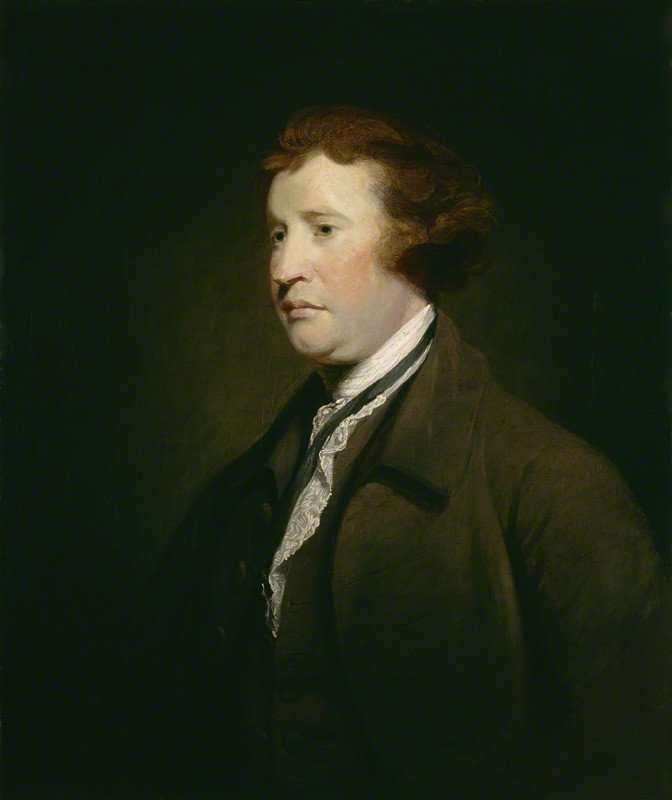
In November 1795, after two poor harvests, Edmund Burke sent Prime Minister William Pitt a memorandum on proposals to have magistrates fix farm wages and regulate the grain trade. It was published after his death, in 1800, as Thoughts and Details on Scarcity. It is the plainest statement of free-market economics by the founder of modern conservatism, and it is harsher than most conservatives remember.
"To provide for us in our necessities is not in the power of government. It would be a vain presumption in statesmen to think they can do it. The people maintain them, and not they the people."
Edmund Burke, Thoughts and Details on Scarcity (written November 1795).8
He urged the people to understand "that it is not in breaking the laws of commerce, which are the laws of Nature, and consequently the laws of God, that we are to place our hope" of relief.8 Read alone, that sounds like a man indifferent to hunger. Read in full, it is a division of labor among duties. Burke asked what happens when a laborer's wage falls short of subsistence in a famine. His answer was that a man who "can claim nothing according to the rules of commerce and the principles of justice" passes out of that department "and comes within the jurisdiction of mercy." The magistrate has no business there. But "charity to the poor is a direct and obligatory duty upon all Christians, next in order after the payment of debts."8 Commerce under justice, enforced by law. Mercy under conscience, owed by everyone. Smith's line between justice and beneficence, in a Christian key.
Russell Kirk's seventh principle
Russell Kirk, whose The Conservative Mind (1953) traced an American conservatism back to Burke, was suspicious of economists of every school. He thought they reduced persons to producers and consumers. Yet his list of conservative principles includes a strong defense of property.
"Seventh, conservatives are persuaded that freedom and property are closely linked. Separate property from private possession, and Leviathan becomes master of all."
Russell Kirk, "Ten Conservative Principles," adapted from The Politics of Prudence (ISI Books, 1993).9
The same paragraph sets the limit. "Getting and spending are not the chief aims of human existence; but a sound economic basis for the person, the family, and the commonwealth is much to be desired." And: "The conservative acknowledges that the possession of property fixes certain duties upon the possessor; he accepts those moral and legal obligations cheerfully." His eighth principle defends "voluntary community, quite as they oppose involuntary collectivism," and warns that when local functions "pass by default or usurpation to centralized authority, then community is in serious danger."9 Kirk's quarrel with the more radical defenders of the market, taken up in Module 71, was over that word duty.
Ropke and Rustow: the humane economy
The sharpest version of this argument came from Germany, from economists who had watched the Weimar Republic fall to the Nazis. Alexander Rustow (1885-1963) and Wilhelm Ropke were part of a group later called ordoliberals, after the Freiburg yearbook ORDO. At the Colloque Walter Lippmann in Paris in August 1938, a meeting of liberal economists that foreshadowed the Mont Pelerin Society of Lesson 1, Rustow popularized the word "neoliberalism" for a liberalism that would defend markets inside a firm legal order.10 The word has since been turned into an insult. Its first users meant something quite specific.
Ropke put the case in Jenseits von Angebot und Nachfrage (1958), published in English as A Humane Economy: The Social Framework of the Free Market (1960). He was a convinced free-marketeer. He argued that free prices and competition mean "health and plenty," while the socialist economy "means sickness, disorder, and lower productivity."11 But he called the theme of his book "the red thread," and it was this: "the vital things are those beyond supply and demand and the world of property."11
"In other words, the market economy is not everything. It must find its place within a higher order of things which is not ruled by supply and demand, free prices, and competition."
Wilhelm Ropke, A Humane Economy (Chicago: Henry Regnery, 1960), ch. 1, pp. 5-6.11
Moral reserves
Ropke's most quoted argument concerns what people bring with them to the market.
"The market, competition, and the play of supply and demand do not create these ethical reserves; they presuppose them and consume them. These reserves have to come from outside the market, and no textbook on economics can replace them."
Ropke, A Humane Economy, ch. 3, p. 125.12
He listed what he meant: "Self-discipline, a sense of justice, honesty, fairness, chivalry, moderation, public spirit, respect for human dignity, firm ethical norms." These are things, he wrote, "which people must possess before they go to market and compete with each other." And he named the sources: "Family, church, genuine communities, and tradition."12
He also warned about the market spreading where it does not belong. "The curse of commercialization," he wrote, "is that it results in the standards of the market spreading into regions which should remain beyond supply and demand." His example was Mother's Day turned into a sales promotion. He wrote with "the intention, not of condemning the market economy, but of stressing the need to circumscribe and moderate it and of showing once more its dependence upon moral reserves."13 In the same pages he answered Galbraith, from Lesson 9. The true "countervailing power" that restrains competition, Ropke said, is moral forces within the people doing business, and not organized buying power.13
Rustow coined the term, rendered "vital policy" in Elizabeth Henderson's translation, for something Ropke had urged since The Social Crisis of Our Time: attention to the conditions of a whole human life, beyond income, that markets alone do not secure. Ropke tied it to private ownership, which he said "principally distinguishes a non-proletarian form of life from a proletarian one."14 Ropke's prescription for mass society was what he called "decentralization and deproletarianization." Spread ownership. Keep communities on a human scale.
The test of 1948
The ordoliberals got a rare chance to see their ideas tried. In June 1948, Ludwig Erhard, a protege of the Freiburg economist Walter Eucken and director of economics for the combined British and American zones of Germany, carried out a currency reform and then abolished most price controls. Industrial production rose 46 percent in the second half of 1948, and by the end of 1949 it stood 81 percent above its level at the reform, by the account of the economist Richard Ebeling.15 West Germany's "social market economy" combined that freedom of prices with antitrust law, a safety net and a strong role for local and church institutions. Free-market economists in the Mises tradition have long argued that the "social" part grew until it smothered the market. The ordoliberals would have answered that the frame was what made the market politically secure.
Catholic social teaching
The Catholic tradition has addressed the market directly for 135 years, and both the left and the right quote it selectively.
Rerum Novarum, 1891
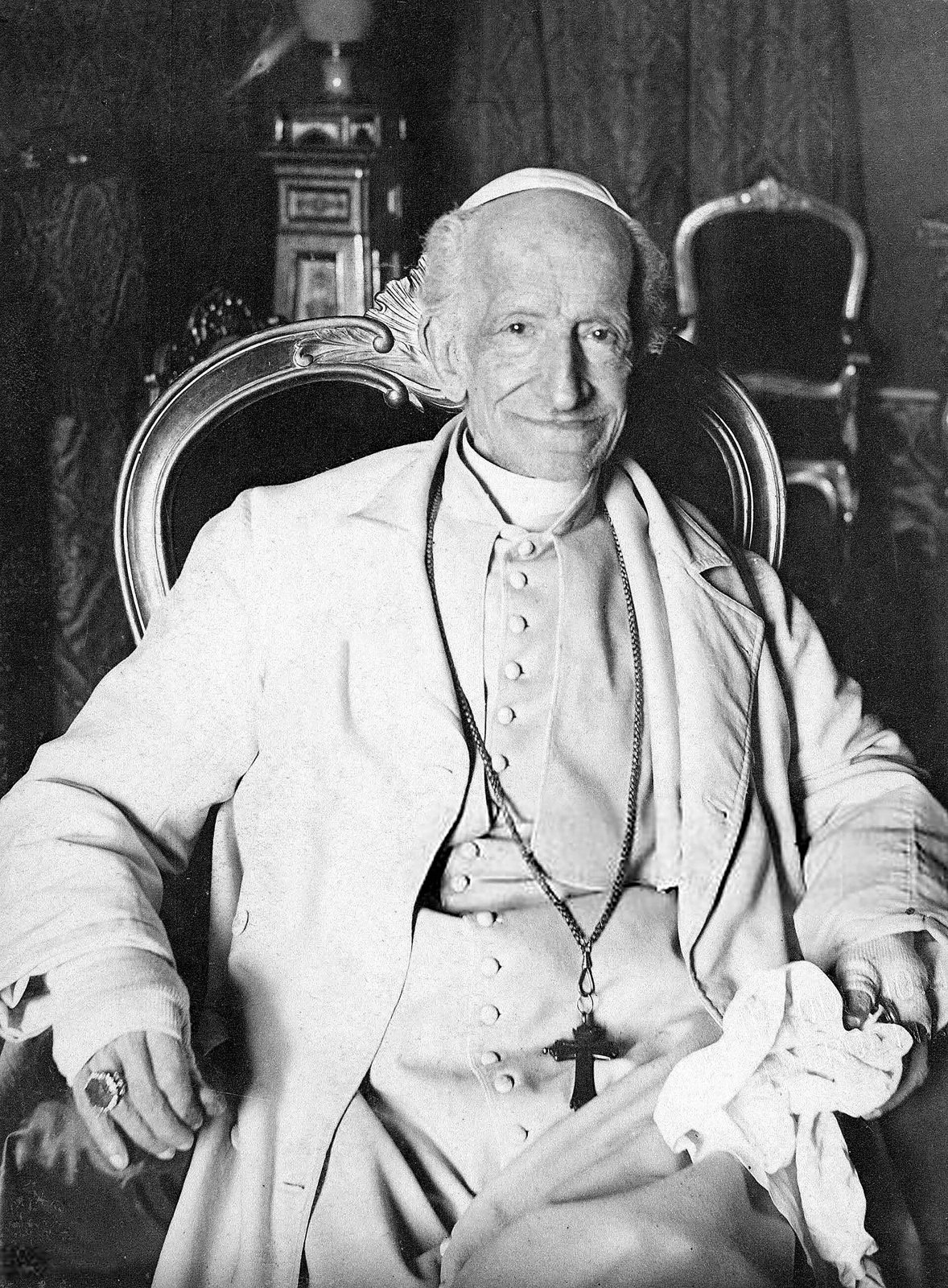
Leo XIII wrote in an age of mass factory labor and rising socialist parties. He rejected socialism without hedging: "the main tenet of socialism, community of goods, must be utterly rejected."2 He defended private property as a natural right. And he denied that whatever wage a worker agrees to is therefore just. Beneath any wage contract, he wrote, "there underlies a dictate of natural justice more imperious and ancient than any bargain between man and man," namely that pay must be enough to support a frugal and well-behaved worker.2 He praised workers' associations, writing that "The most important of all are workingmen's unions."2 A free-market reader will find the property sections congenial and the wage sections troubling. Both are in the text.
Centesimus Annus, 1991
A century later, eighteen months after the Berlin Wall fell, John Paul II marked the anniversary with Centesimus Annus, dated May 1, 1991. He had lived under both Nazi and communist rule in Poland. The encyclical's most quoted section asks whether, after the failure of communism, capitalism should be the goal for the countries rebuilding their economies. He answered with a definition.
"If by "capitalism" is meant an economic system which recognizes the fundamental and positive role of business, the market, private property and the resulting responsibility for the means of production, as well as free human creativity in the economic sector, then the answer is certainly in the affirmative, even though it would perhaps be more appropriate to speak of a "business economy", "market economy" or simply "free economy"."
John Paul II, Centesimus Annus (1991), sec. 42.16
The next sentence gives the other half. "But if by "capitalism" is meant a system in which freedom in the economic sector is not circumscribed within a strong juridical framework which places it at the service of human freedom in its totality, and which sees it as a particular aspect of that freedom, the core of which is ethical and religious, then the reply is certainly negative."16 Elsewhere the encyclical says plainly that "The Church acknowledges the legitimate role of profit as an indication that a business is functioning well."16
Section 48 contains the passage on the welfare state that conservatives cite most. The pope noted that excesses had brought harsh criticism of the welfare state, "dubbed the "Social Assistance State"," and he blamed its malfunctions on "an inadequate understanding of the tasks proper to the State." He restated the principle of subsidiarity: "a community of a higher order should not interfere in the internal life of a community of a lower order, depriving the latter of its functions, but rather should support it in case of need."16 And he described the result when the rule is broken.
"By intervening directly and depriving society of its responsibility, the Social Assistance State leads to a loss of human energies and an inordinate increase of public agencies, which are dominated more by bureaucratic ways of thinking than by concern for serving their clients, and which are accompanied by an enormous increase in spending. In fact, it would appear that needs are best understood and satisfied by people who are closest to them and who act as neighbours to those in need."
Centesimus Annus, sec. 48.16
The same section also says the state has a duty to sustain business activity by creating conditions for jobs, may intervene against monopolies, and may in exceptional cases take a substitute role, so long as the intervention is "as brief as possible."16 Read whole, Centesimus Annus is friendlier to markets than Rerum Novarum and still far from laissez-faire.
Dilexi Te, 2025
The current pope's first apostolic exhortation, Dilexi Te, signed October 4, 2025, leans the other way in tone. It criticizes "the dictatorship of an economy that kills," a phrase Pope Francis had made familiar, and "ideologies that defend the absolute autonomy of the marketplace and financial speculation." It rejects the claim, which it says is supported at times by "pseudo-scientific data," that "a free market economy will automatically solve the problem of poverty."17 It also insists on personal charity: "we Christians must not abandon almsgiving."17 Free-market Catholics answer that no serious economist claims markets solve poverty automatically, and that the fall in world poverty since 1980 came mostly where markets were opened. That debate inside the Church is live as of October 2026.
Michael Novak and democratic capitalism
The writer who did most to argue that Catholic and Protestant Christians could defend markets in good conscience was Michael Novak (1933-2017), a philosopher and former seminarian from Johnstown, Pennsylvania. He began on the left. He supported the presidential campaigns of George McGovern, the Democratic nominee of 1972, and later of Ronald Reagan.18 His 1982 book The Spirit of Democratic Capitalism argued that a free society is three systems in one: a democratic political system, a market economic system, and a moral and cultural system of churches, families and associations. Each checks the other two. Remove any one and the others decay.
The book traveled farther than most works of theology. The Templeton Foundation, awarding Novak its 1994 prize for progress in religion, reported that his works were printed in an illegal underground edition by the Polish union Solidarity in 1985, and that Czech dissidents of Charter 77 used The Spirit of Democratic Capitalism in clandestine study groups. When Centesimus Annus described the free society as a threefold system, "many observers detected the influence of Novak's writings."18 Novak's answer to Ropke's worry about moral reserves was that the moral and cultural system must be tended deliberately, by churches and families, precisely because the market will not tend it.
McCloskey and the bourgeois virtues
Deirdre McCloskey, an economic historian who taught for years at the University of Chicago, turned the argument around in three volumes, The Bourgeois Virtues (2006), Bourgeois Dignity (2010) and Bourgeois Equality (2016). Ropke worried that markets consume virtue. McCloskey argues that markets also require and teach it: prudence, but also honesty, trust, hope and courage in the people who take risks to improve things.
Her starting fact is the size of what happened. The poor of Britain today, she says, are "some three thousand percent better off in food and housing and clothing and health care than the British poor two centuries ago." The Great Enrichment, from 1800 to the present, "was a factor on average of thirty: ten times better food, thirty times better health care, a hundred times better lighting."19 Redistribution of existing wealth, she argues, would add perhaps one or two percent once. What raised the poor was innovation, and innovation followed a change in ideas: Europeans came to accept what she calls the Bourgeois Deal.
"Let me have a go, and I'll make you rich."
Deirdre Nansen McCloskey, "How the Light Really Gets In: The Liberal and Bourgeois Deal," April 28, 2016.19
The equality she defends is equality before the law and equality of social dignity, "Scottish" rather than "French," as she puts it, after Hume and Smith rather than Rousseau and Piketty.19 Her case answers both the Marxist and the romantic conservative: commerce did not degrade the common man, it made him rich and gave him standing. Her critics among conservatives reply that she undervalues what Ropke and Kirk feared to lose, the settled community, the family farm, the parish. The disagreement is real, and it runs through the conservative movement today.
Ordered liberty: markets within moral limits
The author of this site, Jeff A. Pierson, works from a framework he calls ordered liberty. It is his own framework, set out in his essays, and readers should weigh it as one position among those in this lesson. It is a conservative and natural-law position, and it is not the same as the market liberalism of the schools in Lessons 1 through 8. Its relation to markets can be stated in Pierson's own words.
Protection and provision
Pierson builds on the distinction Isaiah Berlin drew in his 1958 lecture "Two Concepts of Liberty," between negative liberty, freedom from interference, and positive liberty, the capacity to act. Berlin meant more by positive liberty than welfare programs, and Pierson says so. Pierson's concern is the political form of it, "the one that arrives with a budget."20 He calls the two views liberty as protection and liberty as provision.
"A government of protection restrains power; its whole vocabulary is prohibition. A government of provision requires power; someone must tax, administer, and distribute the means being promised, and that someone grows with every promise."
Jeff A. Pierson, essay subtitled "How the founders built liberty as a system, and how modern operatives sell its replacement."20
On this view the state has real economic duties, and they are the duties of justice in Smith's and Burke's sense. "Securing rights is not supplying goods," Pierson writes. "A government that punishes theft is performing its duty; a government that promises to provide what you might otherwise earn is rewriting the covenant."20 That is close to Burke's memorandum of 1795 and to the subsidiarity passage of Centesimus Annus. Pierson applies it to welfare spending since 1964 and to the property tax, which he argues makes ownership of a paid-off home conditional on the county's continuing claim.20
The duties that bind the market
Where the framework parts from pure market liberalism is in its list of duties. Pierson grounds liberty in duties that bind persons as well as governments, and several of them bear directly on economic life. Justice, he writes, "is the moral discipline that respects life, property, promises, and reputation." Fidelity "is the duty to keep one's word, honor contracts, and respect covenants."21 Those two are the legal foundations of a market: property and contract. The third is the one that sets limits.
"Natural law teaches that life, power, and resources are entrusted, not owned absolutely. Stewardship means exercising responsibility toward family, community, and creation, mindful that misuse or waste injures others. This duty denies both reckless exploitation and neglectful apathy, insisting that what is given to one must be cared for on behalf of all."
Jeff A. Pierson, The Structure of Ordered Liberty: A Framework for Conscience, Authority, and Resistance (2025), "Duty of Stewardship."21
A property owner on this view has rights against the state and duties to his neighbors and to what he holds. That is Kirk's "possession of property fixes certain duties upon the possessor" stated in natural-law terms. Pierson adds a duty of ethical restraint between neighbors: citizens owe one another "not exploiting another's vulnerability, not weaponizing liberty against the common good."20 A seller who gouges a desperate buyer may break no statute. In this framework he still breaks a duty.
The care of the poor is placed where Burke placed it. "Natural law does not command forced redistribution," Pierson writes; "it calls for voluntary generosity rooted in love."21 And in the liberty essay: "Scripture commands provision for the poor, but it commands it of persons, families, and congregations, as covenant obligation, not as an entitlement administered by strangers with a budget line."20 His example is the gleaning law of the Old Testament, which left the corners of the field to the poor and kept the duty between Boaz and his neighbors.
Where it agrees and where it differs
Set beside the other writers here, the framework accepts markets on the same grounds Smith, Burke and Novak did. Free exchange under just law respects persons and has made ordinary people rich. It shares Ropke's and Kirk's suspicion of concentrated power, whether in a bureaucracy or a corporation, and Ropke's insistence that moral reserves come from family, church and community. It differs from the stricter market liberals in treating duty, and not only consent, as part of liberty itself. And it differs from much of Catholic social teaching, and from Ropke's support for a social safety net, in giving the state a smaller role in provision. Readers who find the Catholic wage teaching persuasive, or who think public programs reach needs that private charity cannot, will weigh it differently. That is the right way to use it.
Pictures, Numbers and Infographics
The timeline below runs from Smith's first book to the present argument. The table that follows sets the thinkers of this lesson side by side.
- 1759 Adam Smith publishes The Theory of Moral Sentiments.3
- 1790 Sixth edition of Moral Sentiments adds the chapter on the corruption of moral sentiments and the "man of system" passage.7
- 1795 Burke writes Thoughts and Details on Scarcity for Pitt (published 1800).8
- 1891 Leo XIII issues Rerum Novarum, May 15.2
- 1938 Colloque Walter Lippmann in Paris; Rustow popularizes "neoliberalism."10
- 1948 Erhard's currency reform and end of most price controls in western Germany.15
- 1953 Russell Kirk publishes The Conservative Mind.9
- 1958 Ropke publishes Jenseits von Angebot und Nachfrage (English, 1960).11
- 1982 Michael Novak publishes The Spirit of Democratic Capitalism.18
- 1991 John Paul II issues Centesimus Annus, May 1.16
- 2016 McCloskey completes her trilogy with Bourgeois Equality.19
- 2025 Leo XIV takes his name from Leo XIII (May 10) and signs Dilexi Te (October 4).117
| Thinker | What markets do well | What markets need from outside | Limit asked of markets |
|---|---|---|---|
| Adam Smith | Coordinate people who each have their own "principle of motion" | Sympathy, an impartial spectator, enforced justice | Do not mistake wealth for virtue |
| Edmund Burke | Follow "the laws of commerce, which are the laws of Nature" | Christian charity, "next in order after the payment of debts" | Mercy lies outside commerce and outside the magistrate |
| Russell Kirk | Secure freedom through private property | Voluntary community, local institutions | Property "fixes certain duties upon the possessor" |
| Wilhelm Ropke | "Health and plenty" through free prices | Moral reserves from family, church, community, tradition | Keep market standards out of what lies beyond supply and demand |
| Catholic social teaching | Recognize "the legitimate role of profit" | A "strong juridical framework"; subsidiarity | Wages answer to natural justice |
| Michael Novak | Create wealth and protect liberty | A moral and cultural system alongside the political and economic | Each system must check the other two |
| Deirdre McCloskey | A thirtyfold enrichment since 1800 | Dignity and liberty for ordinary commercial people | Few: she trusts the bourgeois virtues |
| Ordered liberty (Pierson) | Respect property and contract under just law | Duties of justice, fidelity, charity and stewardship | Resources "entrusted, not owned absolutely"; no exploiting a neighbor's vulnerability |
This module began with a map of the free-market schools and has ended with the people who asked what those schools leave out. The economists showed, with evidence that has held up, that free prices and secure property produce wealth no planner has matched. The writers in this lesson asked what kind of people that wealth requires, and what it can do to them. Both questions are still open, and a citizen who wants to argue about the economy in good faith needs to be able to answer each of them.
Learn more
- The Theory of Moral Sentiments, full text: Start with Part I and the man of system passage in Part VI.
- Burke, Works, volume 5: Contains Thoughts and Details on Scarcity, short and blunt.
- Ropke, A Humane Economy: The free-market economist who wrote the best book on the market's moral limits.
- Rerum Novarum: Read the property sections and the wage sections together.
- Centesimus Annus: Sections 42 and 48 are the heart of the economic argument.
- Kirk, Ten Conservative Principles: A short statement of property, community and duty.
- Novak's Templeton Prize announcement: How his book reached Solidarity and Charter 77.
- McCloskey, The Liberal and Bourgeois Deal: Her whole argument in about 1,500 words.
- Dilexi Te, summary: The current pope's criticism of market ideology, in Vatican News's account.
Notes
- Vatican News, "Pope Leo XIV addresses cardinals," May 10, 2025, quoting the pope's address to the College of Cardinals. Read it online. ↩
- Leo XIII, Rerum Novarum, encyclical on capital and labor, May 15, 1891, secs. 15, 45 and 49. Read it online. ↩
- Adam Smith, The Theory of Moral Sentiments (London: A. Millar, 1759; 6th ed., 1790), Part I, sec. i, ch. 1, para. 1, Econlib edition (Liberty Fund). Read it online. ↩
- Smith, The Theory of Moral Sentiments, Part II, sec. ii, ch. 3, "Of the utility of this constitution of Nature," Econlib edition. Read it online. ↩
- Smith, The Theory of Moral Sentiments, Part I, sec. iii, ch. 3, Econlib edition. Read it online. ↩
- Smith, The Theory of Moral Sentiments, Part IV, ch. 1, as printed in the Dublin edition of 1777 (J. Beatty and C. Jackson), Project Gutenberg eBook 67363. Read it online. ↩
- Smith, The Theory of Moral Sentiments, 6th ed. (1790), Part VI, sec. ii, ch. 2, "Of the order in which Societies are by nature recommended to our beneficence," Econlib edition. Read it online. ↩
- Edmund Burke, "Thoughts and Details on Scarcity, Originally Presented to the Right Hon. William Pitt, in the Month of November, 1795," in The Works of the Right Honourable Edmund Burke, vol. 5 (London: John C. Nimmo, 1887), pp. 131-169, Project Gutenberg eBook 15701. On the date of publication (1800), see the summary at Wikipedia. Read it online. ↩
- Russell Kirk, "Ten Conservative Principles," adapted from The Politics of Prudence (Wilmington, DE: ISI Books, 1993), principles seven and eight, Russell Kirk Center. Kirk's The Conservative Mind was first published by Henry Regnery in 1953. Read it online. ↩
- "Alexander Rustow," on his dates (1885-1963), the Colloque Walter Lippmann of August 1938 and the term "neoliberalism." Read it online. ↩
- Wilhelm Ropke, A Humane Economy: The Social Framework of the Free Market, trans. Elizabeth Henderson (Chicago: Henry Regnery, 1960), ch. 1, "Reappraisal after Fifteen Years," pp. 5-6; first published as Jenseits von Angebot und Nachfrage (Erlenbach-Zurich: Eugen Rentsch, 1958). Mises Institute PDF. Read it online. ↩
- Ropke, A Humane Economy, ch. 3, "The Conditions and Limits of the Market," p. 125. Read it online. ↩
- Ropke, A Humane Economy, ch. 3, pp. 128-129. Read it online. ↩
- Ropke, A Humane Economy, ch. 3, p. 103, on Rustow's "vital policy," and ch. 1, on "decentralization and deproletarianization." Read it online. ↩
- Richard M. Ebeling, "The German Economic Miracle and the Social Market Economy," Foundation for Economic Education, on Erhard, the June 1948 currency reform, the end of price controls and the rise in industrial production. Read it online. ↩
- John Paul II, Centesimus Annus, encyclical on the hundredth anniversary of Rerum Novarum, May 1, 1991, secs. 35, 42 and 48. Read it online. ↩
- Leo XIV, Dilexi Te, apostolic exhortation on love for the poor, given at Saint Peter's, October 4, 2025, the first year of his pontificate, secs. 92 and following (quotations checked against the official English text). Read it online. See also Vatican News, "Pope Leo in 'Dilexi te': Faith cannot be separated from love for the poor," October 2025. Read the summary. ↩
- Templeton Prize, "Michael Novak, 1994 Press Release," March 8, 1994. Michael Novak, The Spirit of Democratic Capitalism (New York: Simon and Schuster, 1982). Novak's dates are from the obituary record. Read it online. ↩
- Deirdre Nansen McCloskey, "How the Light Really Gets In: The Liberal and Bourgeois Deal," talk at Hay-on-Wye, April 28, 2016. Her trilogy: The Bourgeois Virtues (2006), Bourgeois Dignity (2010) and Bourgeois Equality (2016), all University of Chicago Press. Read it online. ↩
- Jeff A. Pierson, essay on the two views of liberty, subtitled "How the founders built liberty as a system, and how modern operatives sell its replacement," sections "The two views," "The covenant," "The record" and "What to do with this" (manuscript, author's collection). Pierson cites Isaiah Berlin, "Two Concepts of Liberty," in Four Essays on Liberty (Oxford University Press, 1969), pp. 118-172, from a lecture first delivered in 1958. ↩
- Jeff A. Pierson, The Structure of Ordered Liberty: A Framework for Conscience, Authority, and Resistance (2025), part II, "The Duties That Anchor Liberty," sections on the duties of justice, fidelity, stewardship and charity (manuscript, author's collection). ↩
Check yourself
1. How does The Theory of Moral Sentiments open?
Smith's first sentence reads: 'How selfish soever man may be supposed, there are evidently some principles in his nature, which interest him in the fortune of others, and render their happiness necessary to him.'
2. In Thoughts and Details on Scarcity (1795), where did Burke place the relief of a laborer who could claim nothing by the rules of commerce?
Burke wrote that such a man 'passes out of that department, and comes within the jurisdiction of mercy,' and that charity to the poor is a direct and obligatory duty upon all Christians, next after the payment of debts.
3. According to Wilhelm Ropke in A Humane Economy, what is the relation between the market and the ethical reserves it needs?
Ropke wrote that 'The market, competition, and the play of supply and demand do not create these ethical reserves; they presuppose them and consume them,' naming family, church, genuine communities and tradition as their sources.
4. In Centesimus Annus (1991), what did John Paul II say about whether capitalism should be the model after communism?
Section 42 answers 'certainly in the affirmative' for an economy recognizing the positive role of business, the market and private property, and 'certainly negative' for one in which economic freedom is 'not circumscribed within a strong juridical framework.'
5. What did Deirdre McCloskey call the Great Enrichment?
McCloskey describes the Great Enrichment from 1800 to the present as 'that three thousand percent,' a factor on average of thirty, and attributes it to liberty and dignity for 'bourgeois commoners.'
6. In the ordered-liberty framework of this site's author, which statement fits his account of the duty of stewardship?
Pierson writes that 'Natural law teaches that life, power, and resources are entrusted, not owned absolutely,' and that the duty 'denies both reckless exploitation and neglectful apathy.'
Terms in this lesson
- Sympathy
- In Adam Smith's moral philosophy, the capacity to share in the feelings of others by imagining ourselves in their place. It is the base of his account of moral judgment.
- Man of system
- Smith's name for the reformer so in love with his plan that he would arrange society like pieces on a chessboard, forgetting that each person has a principle of motion of his own.
- Ordoliberalism
- A German school of economists, centered at Freiburg and including Ropke and Rustow, that defended free markets inside a strong legal order against monopoly and concentrated power. It shaped West Germany's social market economy.
- The postwar West German order of free prices and competition within a legal framework and a social safety net, associated with Ludwig Erhard's 1948 reforms.
- Subsidiarity
- The principle in Catholic social teaching that a higher community should not take over the functions of a lower one, such as the family or a local association, but should support it when needed.
- Centesimus Annus's critical name for a welfare state that takes over society's responsibilities and grows bureaucratic agencies, losing human energies in the process.
- Great Enrichment
- Deirdre McCloskey's term for the roughly thirtyfold rise in real income per person since about 1800.
- Stewardship
- In the ordered-liberty framework, the duty to treat life, power and resources as entrusted and to care for them on behalf of family, community and creation.
Sources
- Adam Smith, The Theory of Moral Sentiments (6th ed., 1790), Econlib checked 2026-10
- Edmund Burke, Thoughts and Details on Scarcity (1795), Works vol. 5, Project Gutenberg checked 2026-10
- Russell Kirk, Ten Conservative Principles, Russell Kirk Center checked 2026-10
- Wilhelm Ropke, A Humane Economy (Regnery, 1960), Mises Institute PDF checked 2026-10
- Leo XIII, Rerum Novarum (1891) checked 2026-10
- John Paul II, Centesimus Annus (1991) checked 2026-10
- Templeton Prize, Michael Novak 1994 press release checked 2026-10
- Deirdre McCloskey, How the Light Really Gets In: The Liberal and Bourgeois Deal (2016) checked 2026-10
- Vatican News, Pope Leo XIV addresses cardinals (May 10, 2025) checked 2026-10
- Leo XIV, Dilexi Te, apostolic exhortation (October 4, 2025) checked 2026-10
- Vatican News, Dilexi Te: faith cannot be separated from love for the poor (October 2025) checked 2026-10