Lesson 5 of 10 · about 19 minutes
Milton Friedman: Capitalism and Freedom
You'll be able to
- Summarize Friedman's life and the work for which he won the 1976 Nobel Memorial Prize
- Explain the argument of Capitalism and Freedom that competitive capitalism is a necessary but not a sufficient condition for political freedom
- Describe Friedman's proposals on school vouchers and the negative income tax, and the role he left for government
- Explain the 1970 essay on the social responsibility of business and the objection raised by the Business Roundtable's 2019 statement
- State accurately what Friedman said and did about Chile, and what he concluded from Hong Kong
On October 14, 1976, the Royal Swedish Academy of Sciences announced that the year's prize in economics would go to Milton Friedman of the University of Chicago "for his achievements in the fields of consumption analysis, monetary history and theory, and for his demonstration of the complexity of stabilization policy."1 The Stockholm ceremony was livelier. Writer Brian Doherty reports that students angry about Friedman's supposed ties to the military government of Chile marred it.2 What he actually said and did about Chile comes near the end of this lesson. First comes the man and the case he made.
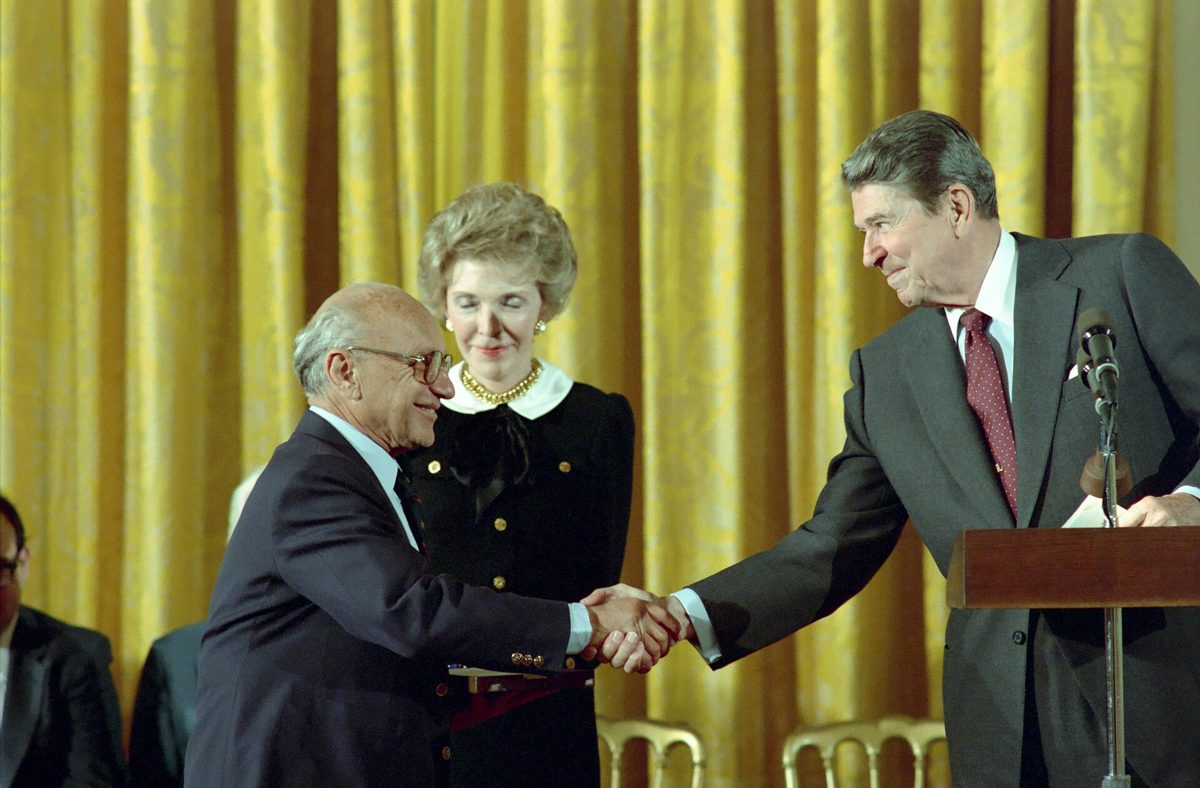
A boy from Rahway
Milton Friedman was born on July 31, 1912, in Brooklyn, the fourth and last child, and the first son, of Jeno Saul and Sarah Ethel Friedman. His parents had come from Carpatho-Ruthenia, then part of Austria-Hungary, and met in New York as teenagers. When he was a year old the family moved to Rahway, New Jersey, where his mother ran a small dry goods store and his father pursued a succession of mostly unsuccessful ventures. Friedman remembered it plainly. "Financial crisis was a constant companion," he wrote in his Nobel autobiography. "Yet there was always enough to eat, and the family atmosphere was warm and supportive."4
His father died during his senior year of high school. Friedman won a competitive scholarship to Rutgers, paid the rest by waiting on tables and clerking in a store, and graduated in 1932. He had meant to become an actuary. Two teachers, Arthur Burns and Homer Jones, steered him to economics, and Jones's recommendation won him a tuition scholarship at the University of Chicago. Money was tight that first year, but Jacob Viner, Frank Knight and Henry Simons were on the faculty. "I have never recovered," he wrote. He also met a fellow student named Rose Director. They married six years later.4
In 1946 he went back to Chicago to teach economic theory, and as he put it, "Chicago has been my intellectual home ever since." At the National Bureau of Economic Research he worked with Anna J. Schwartz, an economic historian whose skill with detail supplemented his own theoretical bent. He moved to the Hoover Institution at Stanford in 1977.4
Capitalism and Freedom
The book began as lectures. Friedman gave them in June 1956 at a conference at Wabash College sponsored by the Volker Foundation, repeated them at other colleges over the next few years, and, with his wife's help in stitching the scraps together, turned them into a book that the University of Chicago Press published in 1962.5 Looking back in 1982, he described the climate. People who worried about the growth of government "were a small beleaguered minority regarded as eccentrics by the great majority of our fellow intellectuals," and the book's views were "so far out of the mainstream that it was not reviewed by any major national publication."6
Its major theme, he said, was the role of competitive capitalism, "the organization of the bulk of economic activity through private enterprise operating in a free market," as a system of economic freedom and a necessary condition for political freedom.5 The argument has three steps, and each is worth stating exactly.
The first step is that economic freedom is part of freedom itself. A man who may not choose his job, his purchases or what he plants has lost something that matters, whatever the ballot box says. The second is that economic arrangements decide how power is spread. "The kind of economic organization that provides economic freedom directly, namely, competitive capitalism, also promotes political freedom because it separates economic power from political power and in this way enables the one to offset the other."7 When one authority owns the factories, the newspapers and the paychecks, nobody is left to oppose it. The third step is the historical record:
"I know of no example in time or place of a society that has been marked by a large measure of political freedom, and that has not also used something comparable to a free market to organize the bulk of economic activity."
Milton Friedman, Capitalism and Freedom (1962), ch. 1.7
Friedman did not oversell this. He added that "the typical state of mankind is tyranny, servitude, and misery," and that the nineteenth and early twentieth centuries in the West were the exception. He then set the limit on his own claim: "History suggests only that capitalism is a necessary condition for political freedom. Clearly it is not a sufficient condition." Fascist Italy and Spain, Germany at various times, Japan before the world wars and tsarist Russia all had private enterprise and no political liberty.7 A reader who thinks he said that markets automatically produce free governments has not read the page.
What government is for
Friedman was no anarchist, and the book says so early. "The existence of a free market does not of course eliminate the need for government. On the contrary, government is essential both as a forum for determining the 'rules of the game' and as an umpire to interpret and enforce the rules decided on."7 What the market does, he argued, is shrink the list of questions that must be settled by political force. Political channels tend "to require or enforce substantial conformity," while the market permits wide diversity. He called the market, in political terms, "a system of proportional representation": each man votes for the color of tie he wants and gets it, without waiting to see what the majority prefers.7 He opened the book by rejecting both halves of Kennedy's inaugural line: "Neither half of the statement expresses a relation between the citizen and his government that is worthy of the ideals of free men in a free society." To the free man, he wrote, government is a means.5
The fourteen
At the close of chapter 2, Friedman gave "a sense of proportion" by listing activities of the federal and state governments that he thought "cannot, so far as I can see, validly be justified in terms of the principles outlined above."8 He numbered fourteen, and he added that the list was far from complete.
| No. | Activity Friedman thought unjustified (1962) |
|---|---|
| 1 | Parity price supports for agriculture |
| 2 | Tariffs and export restrictions, such as oil and sugar quotas |
| 3 | Government control of output, such as the farm program and Texas oil prorationing |
| 4 | Rent control and general wage and price controls |
| 5 | Legal minimum wages and legal maximum prices, including interest-rate ceilings on deposits |
| 6 | Detailed regulation of industries, such as the Interstate Commerce Commission and banking |
| 7 | Federal Communications Commission control of radio and television |
| 8 | Social security as then designed, which compelled the purchase of a government annuity |
| 9 | Occupational and business licensure that goes beyond a tax receipt |
| 10 | Public housing and subsidies for residential construction, such as FHA and VA mortgage guarantees |
| 11 | Peacetime conscription |
| 12 | National parks |
| 13 | The legal ban on carrying mail for profit |
| 14 | Publicly owned and operated toll roads |
Some of these will strike a modern reader as obvious targets and others as shocking. In the late 1960s he debated a collectivist named Leon Keyserling at the University of Wisconsin, and Keyserling, whom Friedman called an unreconstructed collectivist, tried to make fun of his views as utterly reactionary by reading the list aloud to the student audience. It worked until he reached item 11, conscription, and the students applauded. Friedman remarked in 1982 that the draft was the only item to have been eliminated so far.6 As for the rest, he wrote that "in respect of many of the other items, we have moved still farther away from the principles espoused in this book."
What he would keep, and the strongest objection
Anyone who reads the fourteen and concludes that Friedman wanted the poor left to fend for themselves has missed chapter 12. He wrote there that private charity runs into a free-rider problem, since each donor benefits when others give. In large impersonal communities, he wrote, it is much more difficult for public pressure to secure the contribution. "Suppose one accepts, as I do, this line of reasoning as justifying governmental action to alleviate poverty; to set, as it were, a floor under the standard of life of every person in the community." The question was how. His answer was a negative income tax: a person whose income fell below the personal exemption and deductions would receive a cash payment, at a stated rate, in place of the tangle of farm programs, wage laws, tariffs and licensing rules that help particular groups and distort the market.9
He was candid about the weakness of his own plan. "The major disadvantage of the proposed negative income tax is its political implications." The danger, he said, was that instead of a majority taxing itself willingly to help an unfortunate minority, "it will be converted into one under which a majority imposes taxes for its own benefit on an unwilling minority," and his only remedy was "the self-restraint and good will of the electorate."9 Congress never adopted his design. The nearest thing in the law is the Earned Income Tax Credit, created by the Tax Reduction Act of 1975 and signed by President Ford, a credit that at the start went to people with earned income and at least one dependent, so it differs from his idea in that it pays only those who work.10
The strongest objection to his view of fairness comes from his own pages, because he stated it before he answered it. Consider four Robinson Crusoes marooned on four islands. One lands on a large, fruitful island and the others on tiny barren ones. If the lucky one declines to share, "would the other three be justified in joining forces and compelling him to share his wealth with them?" Many readers, he admitted, will say yes. The critic's point is that nobody earns the island they are born on, and that differences in wealth are largely the product of chance. Friedman accepted part of that. He agreed that most differences of position "can be regarded as the product of chance at a far enough remove," and that even the hard work and thrift we call merit "owe much to the genes he was fortunate (or unfortunate?) enough to inherit." His answer is that the facts of luck do not hand anyone the right to force others: "two wrongs do not make a right," and the unwillingness of the rich Crusoe to share "does not justify the use of coercion by the others."11 You can find his reasoning persuasive or not. What you cannot say is that he failed to face the case.
Vouchers: letting parents choose
Friedman first set out the school voucher in a 1955 essay, "The Role of Government in Education," and repeated it in chapter 6 of Capitalism and Freedom.12 He separated two things that are usually bundled. Government may require a minimum level of schooling and may pay for it. That does not mean government must run the schools. "Governments could require a minimum level of schooling financed by giving parents vouchers redeemable for a specified maximum sum per child per year if spent on 'approved' educational services." Parents could add their own money and pick any approved school, run for profit or not. "The role of the government would be limited to insuring that the schools met certain minimum standards... much as it now inspects restaurants to insure that they maintain minimum sanitary standards."12 His working example was the educational program for veterans after World War II, which gave each qualified veteran a maximum sum per year to spend at any institution that met minimum standards.
The idea moved slowly and then quickly. In Idaho, House Bill 93 created the Idaho Parental Choice Tax Credit. It passed the House 42 to 28 and the Senate 20 to 15 and was signed by the governor on February 27, 2025. It is a refundable credit of up to $5,000 per eligible student for qualified expenses, which include nonpublic-school tuition, tutoring and curriculum, and up to $7,500 for a student with disabilities who needs ancillary personnel. The fiscal note put the maximum cost at $50 million in reduced General Fund revenue.1314 Strictly speaking this is a tax credit rather than the voucher Friedman described, but it rests on the same principle of funding families rather than owning every school.
The best case against vouchers is empirical. A voucher works only if parents pick good schools and the schools on offer are good. The economists Atila Abdulkadiroglu, Parag Pathak and Christopher Walters used randomized lotteries to study the Louisiana Scholarship Program, which gave public money to disadvantaged students to attend private schools. They found that participation lowered math scores by 0.4 standard deviations and reduced achievement in reading, science and social studies, results they called "a striking counterexample" to earlier lottery studies that "have almost always reported positive or zero achievement effects." They suggested the effects "may be due in part to selection of low-quality private schools into the program."15 The finding concerns one program in one state, and the authors' own explanation points to which private schools took part, which is a question of how a program is built. Whether Idaho's law has the right design is a question for its voters and legislators, and the Louisiana result is a fair warning to them.
Free to Choose and the free lunch
After moving to California, Friedman accepted an invitation from the producer Bob Chitester to present his philosophy on television. The result, he wrote, was "the most exciting adventure of our lives." Free to Choose ran to ten one-hour programs, each a half-hour documentary followed by a half-hour discussion. The first aired on PBS in January 1980. Friedman worked without a script: "I talked extemporaneously from notes." The book of the same name, written with Rose, appeared in 1980 and was the bestselling nonfiction book of that year.16 It is where he retold Leonard Read's story of the pencil, which Lesson 1 used to show how a market coordinates millions of strangers who never meet.
He also gave American speech one of its handiest economic proverbs. The saying "there's no such thing as a free lunch" was in use by the 1930s and refers to the old saloon custom of offering a free meal to anyone who bought a drink. The phrase is older than Friedman, and his 1975 book There's No Such Thing as a Free Lunch spread it widely.17 Economists use it as shorthand for opportunity cost: whatever is called free is paid for by someone, in taxes, prices or forgone alternatives.
The business of business
On September 13, 1970, The New York Times Magazine printed Friedman's essay "The Social Responsibility of Business Is to Increase Its Profits." Its argument runs as follows. Only people have responsibilities. "In a free-enterprise, private-property system, a corporate executive is an employee of the owners of the business. He has direct responsibility to his employers." Their wish is usually to make as much money as possible while conforming to the basic rules of society, "both those embodied in law and those embodied in ethical custom."18 If the executive spends the company's money on a social goal of his own choosing, he is spending someone else's money, and in effect imposing a tax and deciding how to spend it, which is a government function that our constitutions surround with elections and checks. A businessman who is "self-selected or appointed directly or indirectly by stockholders" should not hold such power. Of his private duties Friedman wrote: "If these are 'social responsibilities,' they are the social responsibilities of individuals, not business."18
The essay repeated a passage from Capitalism and Freedom, where he had put it this way:
"In such an economy, there is one and only one social responsibility of business"
"to use its resources and engage in activities designed to increase its profits so long as it stays within the rules of the game"
Friedman, Capitalism and Freedom, ch. 8. The original is one sentence; the two parts are joined by a dash, which this site does not print, and it goes on to define the rules of the game as open and free competition without deception or fraud.19
Read his words closely. Friedman did not say that executives may lie, pollute in violation of law or cheat customers. The same sentence goes on to require open and free competition without deception or fraud, and the 1970 essay requires obedience to law and to ethical custom. What he rejected was the idea that a manager should pick social ends and pay for them out of shareholders' money.
The strongest reply came from the people he was addressing. On August 19, 2019, the Business Roundtable released a statement signed by 181 chief executives who committed to lead their companies for the benefit of customers, employees, suppliers, communities and shareholders alike. Its own headline said the updated statement "Moves Away from Shareholder Primacy."20 Supporters say firms that ignore workers, customers and neighbors destroy their own long-run value. Friedman's reply is in the essay, where he asks how an executive is to know what action of his will serve a goal such as fighting inflation, when nothing about his selection makes him an expert on it. Those who side with the 181 can note that Friedman's own standard included ethical custom, and that long-run profit often depends on reputation. Those who side with Friedman can ask which of those groups gets to fire the CEO, and by what test the executive's choices will be judged.
Money and the Great Depression
Friedman's scholarly fame rests on money. With Anna Schwartz he wrote A Monetary History of the United States, 1867-1960 (1963), and its central finding is that the collapse of 1929 to 1933 was caused by a failure of the Federal Reserve. In Capitalism and Freedom he put the claim bluntly: "the Great Depression, like most other periods of severe unemployment, was produced by government mismanagement rather than by any inherent instability of the private economy." The Fed, a government agency, "exercised this responsibility so ineptly as to convert what otherwise would have been a moderate contraction into a major catastrophe."21
The weight of the case lies in the 1963 history. Friedman and Schwartz argued that "the contraction is in fact a tragic testimonial to the importance of monetary forces." In 2002, at the conference for Friedman's ninetieth birthday, Governor Ben Bernanke of the Federal Reserve called their account "the leading and most persuasive explanation of the worst economic disaster in American history." He also noted that the book contradicted the received wisdom of its day, which "held that money was a passive player in the events of the 1930s."22 And then he said the sentence that economists still repeat: "I would like to say to Milton and Anna: Regarding the Great Depression. You're right, we did it. We're very sorry. But thanks to you, we won't do it again."22
Friedman's policy advice for the future was less successful, and a fair account has to say so. He urged central banks to keep the money supply growing at a steady, predictable rate. That works only if the link between money and national income is stable. In the 1970s the speed at which money circulated looked predictable. In the 1980s and 1990s it became highly unstable, and many economists who had accepted monetarism in the 1970s dropped the approach.23 The historical finding about the 1930s and the policy rule built on it stand on different footing.
Chile and Hong Kong
In 1975 Friedman spent about a week in Chile, invited by his Chicago colleague Arnold Harberger, who ran an exchange program with the Catholic University of Chile. Chilean economists trained at Chicago, the "Chicago Boys," were advising the military government of General Augusto Pinochet. Friedman met Pinochet for less than an hour. Pinochet asked for a letter, and Friedman wrote one that urged cuts in government spending and inflation and freer trade, adding that the government should "provide for the relief of any cases of real hardship and severe distress among the poorest classes."2 The New York Times columnist Anthony Lewis wrote that year, "if the pure Chicago economic theory can be carried out in Chile only at the price of repression, should its authors feel some responsibility?"2
That is the criticism, and it has force. Friedman's letter did not use the occasion to upbraid Pinochet for his repressive policies, and Doherty, who defends him, writes that many of Friedman's admirers, himself included, "would have felt better if he had." Friedman's later statement was clear: "I have nothing good to say about the political regime that Pinochet imposed. It was a terrible political regime."2 He said that in 1991, and he went on to say that the real miracle of Chile was a military junta willing to go against its principles and support a free-market regime designed by principled believers in free markets, and that the drive for political freedom generated by economic freedom produced a referendum "that introduced political democracy."2 The economic record is a mixed one that cuts both ways. Chile's real GDP per capita fell about 14 percent from 1974 to 1975, rose about 40 percent from that trough to 1981, then fell about 15 percent between 1981 and 1982. It stood at $10,203 in 1990 and $22,741 in 2022, in 2011 international dollars, against $7,857 in 1974.24 Supporters point to the long climb, and critics to the contractions and the price in liberty.
Hong Kong taught Friedman a different lesson, and he said so in his last preface to the book. "After I finished the book, Hong Kong, before it was returned to China, persuaded me that while economic freedom is a necessary condition for civil and political freedom, political freedom, desirable though it may be, is not a necessary condition for economic and civil freedom."25 That revision concedes that economic freedom can exist under a government that does not answer to its people. He therefore proposed to replace his two-part scheme of economic and political freedom with three: economic freedom, civil freedom and political freedom. Hong Kong's real GDP per capita rose from $4,082 in 1950 to $33,386 in 1997, about eightfold, in the decades before it was returned to China.24 Friedman's own summary was that the relationship was "complex and by no means unilateral," a sentence from chapter 1 of the 1962 text.7
Reading Friedman
Friedman used the word liberal in its older sense, as in his phrase "the role that a liberal would assign government," and this course says classical liberal. His ideas are best tested by asking who decides, who pays and who bears the loss, three questions that return in the closing lesson of this module.
In Lesson 6 the module turns to the systems Friedman argued against, starting with socialism.
Learn more
- Friedman's Nobel autobiography: Friedman tells his own story, from Rahway to Hoover.
- The 1976 Nobel press release: The Academy's account of his scientific achievements.
- Bernanke on Friedman and Schwartz: A clear guide to the Great Contraction argument.
- The Economist and the Dictator: The Chile story, sympathetic to Friedman but candid about his critics.
- Business Roundtable's 2019 statement: The best-known reply to Friedman's 1970 essay.
- The Louisiana voucher study: The strongest empirical case against vouchers, from economists who study them.
- Idaho House Bill 93: The Idaho Parental Choice Tax Credit, with full text and fiscal note.
- Capitalism and Freedom: The book itself, in the University of Chicago Press edition.
Notes
- "The Prize in Economics 1976," press release, Royal Swedish Academy of Sciences, October 14, 1976. Read it online. ↩
- Brian Doherty, "The Economist and the Dictator," Reason, December 15, 2006, quoting Anthony Lewis (1975) and Friedman (1991) and describing the 1975 trip and letter. Read it online. ↩
- Wikimedia Commons, "President Ronald Reagan and Nancy Reagan in The East Room Congratulating Milton Friedman Receiving The Presidential Medal of Freedom" (Digital Public Library of America record). The Medal of Freedom year, 1988, is from the file caption in the Wikipedia article "Milton Friedman." Read it online. ↩
- Milton Friedman, "Biographical," Nobel Lectures, Economics 1969-1980, ed. Assar Lindbeck (World Scientific, 1992), with a 2005 addendum. Read it online. ↩
- Milton Friedman, Capitalism and Freedom, 40th Anniversary Edition (Chicago: University of Chicago Press, 2002), Preface and Introduction. The edition reprints the 1962 text with prefaces of 1982 and 2002. Publisher page. ↩
- Friedman, Capitalism and Freedom, Preface, 1982, in the 40th Anniversary Edition (University of Chicago Press, 2002). Publisher page. ↩
- Friedman, Capitalism and Freedom, ch. 1, "The Relation between Economic Freedom and Political Freedom." Publisher page. ↩
- Friedman, Capitalism and Freedom, ch. 2, "The Role of Government in a Free Society," closing list of fourteen items. Publisher page. ↩
- Friedman, Capitalism and Freedom, ch. 12, "The Alleviation of Poverty." Publisher page. ↩
- "Earned income tax credit," on the 1975 enactment under the Tax Reduction Act of 1975, proposed by Russell Long and signed by President Gerald Ford. Read it online. ↩
- Friedman, Capitalism and Freedom, ch. 10, "The Distribution of Income," the Robinson Crusoe and $20 bill examples. Publisher page. ↩
- Friedman, Capitalism and Freedom, ch. 6, "The Role of Government in Education," a revision of his 1955 essay of the same title in Robert A. Solo, ed., Economics and the Public Interest (Rutgers University Press, 1955). Publisher page. ↩
- Idaho Legislature, House Bill 93 (2025) and bill text: Idaho Parental Choice Tax Credit; House vote 42-28 (February 7), Senate vote 20-15 (February 19), signed by the Governor February 27, 2025. Read it online. ↩
- Idaho Legislature, Revised Statement of Purpose and Fiscal Note, RS32116 / H0093, giving the $5,000 and $7,500 limits, the priority for families under 300 percent of the federal poverty level and the $50 million maximum General Fund impact. Read it online. ↩
- Atila Abdulkadiroglu, Parag A. Pathak and Christopher R. Walters, "Free to Choose: Can School Choice Reduce Student Achievement?" American Economic Journal: Applied Economics (2018), doi:10.1257/app.20160634. Read the abstract. ↩
- Friedman, Nobel autobiography, 2005 addendum, on the Free to Choose television series and book. Read it online. ↩
- "No such thing as a free lunch," on the use of the phrase by the 1930s, its saloon origin and Friedman's 1975 book title. Read it online. ↩
- Milton Friedman, "The Social Responsibility of Business Is to Increase Its Profits," The New York Times Magazine, September 13, 1970. Quoted from a reproduction of the text, with line-end hyphenation removed. Read it online. ↩
- Friedman, Capitalism and Freedom, ch. 8, "Monopoly and the Social Responsibility of Business and Labor." Publisher page. ↩
- Business Roundtable, "Business Roundtable Redefines the Purpose of a Corporation to Promote 'An Economy That Serves All Americans,'" August 19, 2019. Read it online. ↩
- Friedman, Capitalism and Freedom, ch. 3, "The Control of Money." Publisher page. ↩
- Ben S. Bernanke, "On Milton Friedman's Ninetieth Birthday," remarks at the Conference to Honor Milton Friedman, University of Chicago, November 8, 2002, quoting Friedman and Schwartz, A Monetary History of the United States, 1867-1960 (1963), p. 300. Read it online. ↩
- "Monetarism," section on the breakdown of the stable relation between money and nominal GDP in the 1980s and 1990s. Read it online. ↩
- Maddison Project Database 2023, Groningen Growth and Development Centre; Bolt and van Zanden, Journal of Economic Surveys (2024). Real GDP per capita in 2011 international dollars for Chile (1974: $7,857; 1975: $6,731; 1981: $9,427; 1982: $8,016; 1990: $10,203; 2022: $22,741) and China, Hong Kong SAR (1950: $4,082; 1997: $33,386). Percentages are computed from these values. Read it online. ↩
- Friedman, Capitalism and Freedom, Preface, 2002 (dated March 11, 2002). Publisher page. ↩
Check yourself
1. What did Friedman say in Capitalism and Freedom about the relation between capitalism and political freedom?
Friedman wrote that 'history suggests only that capitalism is a necessary condition for political freedom. Clearly it is not a sufficient condition,' and he cited fascist Italy, Germany at various times and tsarist Russia as capitalist but unfree.
2. Which item on Friedman's list of fourteen unjustified government activities had been eliminated by 1982?
In his 1982 preface he wrote that 'the draft is the only item on my list of fourteen unjustified government activities that has so far been eliminated.'
3. In his 1955 essay and in Capitalism and Freedom, what did Friedman propose for schooling?
Friedman proposed that governments could finance a minimum level of schooling through vouchers redeemable at approved schools, public or private, while the government's role would be to see that schools met minimum standards.
4. According to the 1976 Nobel citation, what had Friedman demonstrated about stabilization policy?
The Royal Swedish Academy cited his achievements in consumption analysis, monetary history and theory, and 'his demonstration of the complexity of stabilization policy.'
5. What did Ben Bernanke say to Friedman and Anna Schwartz at Friedman's ninetieth birthday conference in 2002?
Bernanke, then a Federal Reserve governor, spoke at the University of Chicago on November 8, 2002, and credited Friedman and Schwartz with the leading explanation of the Great Contraction of 1929-33.
Terms in this lesson
- Classical liberal
- A person who holds that individual liberty, limited government, private property and free exchange are the foundation of a good society. Friedman used 'liberal' in this older sense.
- Necessary and sufficient condition
- A necessary condition must be present for an outcome to occur. A sufficient condition guarantees it. Friedman said capitalism is the first for political freedom but not the second.
- Neighborhood effects
- Friedman's term for costs or benefits that fall on third parties who cannot be charged or paid, and one of the justifications he accepted for some government action.
- Voucher
- A government payment redeemable for a service, such as schooling, from any approved provider the family chooses.
- Negative income tax
- Friedman's proposal that families with income below a set level receive a cash supplement through the tax system, in place of many separate programs.
- Monetarism
- The view that changes in the quantity of money are the main driver of changes in national income and prices, so that steady, predictable money growth is the best policy.
- Great Contraction
- Friedman and Schwartz's name for the collapse of the American economy from 1929 to 1933, which they traced chiefly to the failure of Federal Reserve policy.
- The view that the corporate executive's duty is to the owners of the company, within the law and ethical custom.
Sources
- Milton Friedman, Biographical, Nobel Prize checked 2026-10
- Nobel Prize in Economics 1976, press release (October 14, 1976) checked 2026-10
- Milton Friedman, Capitalism and Freedom, 40th Anniversary Edition (University of Chicago Press, 2002) checked 2026-10
- Friedman, The Social Responsibility of Business Is to Increase Its Profits (New York Times Magazine, 1970) checked 2026-10
- Ben Bernanke, On Milton Friedman's Ninetieth Birthday (2002) checked 2026-10
- Brian Doherty, The Economist and the Dictator (Reason, 2006) checked 2026-10
- Business Roundtable, Statement on the Purpose of a Corporation (2019) checked 2026-10
- Idaho Legislature, House Bill 93 (2025), Idaho Parental Choice Tax Credit checked 2026-10
- Abdulkadiroglu, Pathak and Walters, Free to Choose: Can School Choice Reduce Student Achievement? checked 2026-10
- Maddison Project Database 2023, Groningen Growth and Development Centre checked 2026-10
- No such thing as a free lunch checked 2026-10
- Monetarism checked 2026-10