Lesson 9 of 10 · about 24 minutes
The Critics and the Answers
You'll be able to
- State the case from externalities, public goods, monopoly and inequality as its defenders would state it
- Explain Keynes's argument about demand and the Friedman-Schwartz reply, including what Ben Bernanke said in 2002
- Describe what the majority and the dissenters on the Financial Crisis Inquiry Commission concluded about 2008
- Summarize Sowell's arguments in Knowledge and Decisions, The Vision of the Anointed and Basic Economics
- Explain public choice, Stigler's theory of regulatory capture and the sugar program as a worked example
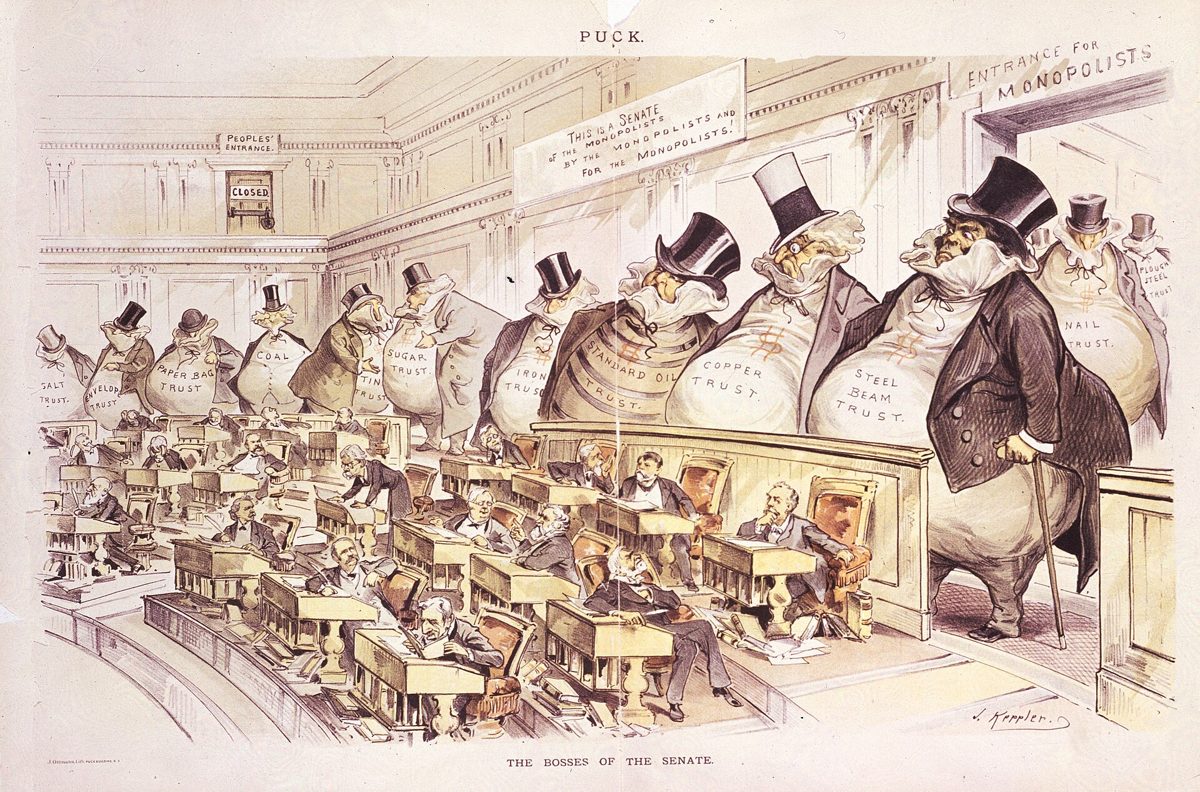
On 23 January 1889 the magazine Puck printed a cartoon by Joseph Keppler called The Bosses of the Senate. It shows trust leaders from different industries as swollen money bags with human heads, looming over the senators, who look small and obedient by comparison.1 It became one of the best-known political images of the Gilded Age and is credited with feeding the movement that produced the Sherman Antitrust Act.1
Anyone who thinks the case for markets is simple should look at that picture and take it seriously. Voters in 1889 had seen what concentrated private power could do. The argument for limits on markets has been made by serious people ever since, and it has many strands. This lesson sets out each of the main strands at its strongest, then gives the replies of Milton Friedman, Friedrich Hayek and Thomas Sowell, and then turns the same scrutiny on government.
Externalities: costs that someone else pays
The best case
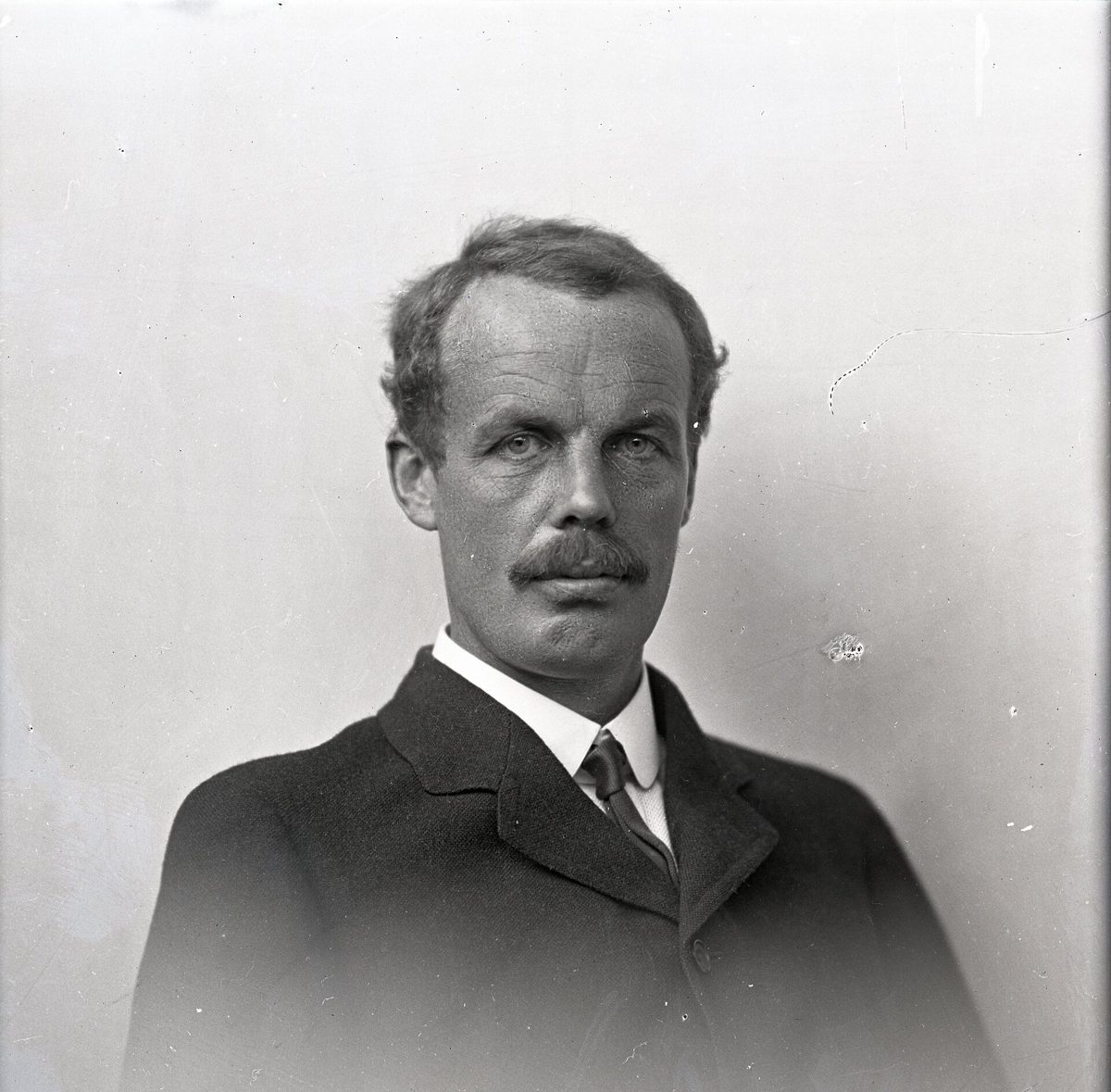
Markets price what buyers and sellers agree on. They miss costs imposed on people who are not in the deal. A factory that dumps waste in a river pays for coal and labor, and the town downstream pays for the dirty water. The economist Arthur Cecil Pigou made the point systematic in The Economics of Welfare (1920) and proposed what is now called a Pigovian tax, a tax equal to the harm, so that the polluter faces the full cost of what he does.2
The answer
Friedman did not deny the problem. In Capitalism and Freedom he gave it a name, "neighborhood effects," and offered the same example: "The man who pollutes a stream is in effect forcing others to exchange good water for bad."3 He accepted that such cases can justify government action. But he added two cautions. First, "when government engages in activities to overcome neighborhood effects, it will in part introduce an additional set of neighborhood effects by failing to charge or to compensate individuals properly." Second, "every act of government intervention limits the area of individual freedom directly," and so freedom has to be entered on the cost side of any proposed remedy.3
Ronald Coase added a different reply in 1960. In "The Problem of Social Cost" he argued that where property rights are clear and bargaining is cheap, the parties can often settle externalities themselves. The "Coase theorem" is hard to apply when many people are involved and transaction costs are high, as with air pollution.2 The honest summary is that the critics of pure markets win this round in part. Few economists on any side deny that a smoking factory chimney is a problem a court or an agency may have to handle. The argument continues over how much to do and how.
Public goods and the free rider
The best case
Some goods are hard to sell. If a neighbor pays for a levee, everyone in the valley is protected whether they paid or not. Each person has a reason to let the others pay. Experiments in which players decide how much of their tokens to put into a shared pot show the pattern: contributions tend to decline over rounds as people see others free-riding, though a core of givers usually remains.4 National defense is the textbook case, and Friedman used it himself: "I cannot get the amount of national defense I want and you, a different amount."3
The answer
Friedman agreed that this is a proper role for government. He wrote that such indivisible matters, "protection of the individual and the nation from coercion" first among them, are what prevent exclusive reliance on the market.3 He wanted the line drawn carefully. In his discussion of parks he wrote that neighborhood effects may justify a city park but "they do not justify a national park, like Yellowstone National Park or the Grand Canyon," where entrance fees can be collected.3 The test, for him, was whether the benefit could be charged for. Where it could, he preferred the market. Where it could not, he allowed government, with the second caution above. The same experiments that show free riding also show that punishing free riders and making contributions visible raises cooperation, which is why local arrangements often do better than distant ones.4
Monopoly
The best case
Keppler's cartoon is the case in one image. Competition protects consumers only while competitors exist, and the successful firm has every reason to buy, undercut or collude with rivals until none remain. Defenders of antitrust law say that a market economy needs referees as much as any game does.
The answer
Hayek and Friedman both agreed that monopoly is a problem. They differed from the trust-busters on its source and its cure. Hayek argued that monopoly is "frequently the product of factors other than the lower costs of greater size" and "is attained through collusive agreement and promoted by public policies." Anyone who has watched aspiring monopolists, he wrote, "regularly seek and frequently obtain the assistance of the power of the state to make their control effective" can doubt that monopoly is inevitable.5 Friedman distinguished real "technical monopoly," where one firm is cheapest because of the nature of the business, and offered the choice among three evils: private monopoly, public monopoly or public regulation. Henry Simons preferred public monopoly, Walter Eucken preferred regulation, and Friedman wrote, "Having learned from both, I reluctantly conclude that, if tolerable, private monopoly may be the least of the evils."3 His reason was that the conditions behind a technical monopoly change in a changing society, and public monopolies and regulatory agencies are slow to notice.
He gave the Interstate Commerce Commission as the example. It had "some justification on technical monopoly grounds when initially introduced for railroads," he wrote, but "it has none now for any means of transport."3 A reader may find that too relaxed. Hayek's own prescription was firmer than it sounds: "When these agreements are invalidated and when these policies are reversed, competitive conditions can be restored."5 The target was collusion and the state policies that prop it up.
What government is for
None of this makes Friedman an enemy of government. He wrote that "the existence of a free market does not of course eliminate the need for government," because government is "essential both as a forum for determining the 'rules of the game' and as an umpire to interpret and enforce the rules decided on."3 The market, in his view, shrinks the range of issues that have to be settled by political means, and a political decision "tends to require or enforce substantial conformity," while the market "permits wide diversity."3 He listed the core duties of government as protection from foreign enemies and from fellow citizens, the preservation of law and order, and the enforcement of private contracts. Beyond that, he wrote, government may enable people at times to do jointly what would be harder to do separately, but "any such use of government is fraught with danger."3
A critic of that position should hold it to its own terms. It is a defense of a government with real powers, a court system, police, a military and a currency, and a case for caution about every power beyond them. Whether a given program clears the bar is the argument. The passage belongs in any fair account of what he believed.
Inequality
The best case
The French economist Thomas Piketty argued in Capital in the Twenty-First Century (French edition 2013, English edition 2014) that when the return on capital (r) exceeds the rate of economic growth (g) for a long time, wealth concentrates in a few hands. He drew on data on wealth and income in Europe and the United States since the eighteenth century.6 For a reader worried about an economy where fortunes pass from parents to children, that is a powerful claim.
The answer
Economists have tested the claim. Daron Acemoglu and James Robinson argued that inequality depends far more on institutions than on the gap between r and g. Matthew Rognlie argued that rising house prices account for almost all the rise in returns to capital. Lawrence Summers argued that Piketty underestimates diminishing returns, and observed that top incomes are now mostly salaries, not capital income.6 Piketty himself said in 2014 that r above g is not the primary tool for explaining changes in inequality.6
Friedman did not argue that inequality is of no concern. He argued about method. If the goal is to help the poor, he wrote, "the arrangement that recommends itself on purely mechanical grounds is a negative income tax."3 That meant a single cash payment that phases out as earnings rise, replacing the maze of separate programs. He also favored removing barriers that keep poor people out of work, among them occupational licenses and the minimum wage, and the next lesson returns to licensing.
Keynes and the Depression
The best case
John Maynard Keynes thought economists were too patient. In A Tract on Monetary Reform (1923) he wrote that "this long run is a misleading guide to current affairs. In the long run we are all dead," and added: "Economists set themselves too easy, too useless a task if in tempestuous seasons they can only tell us that when the storm is long past the ocean is flat again."7 In The General Theory of Employment, Interest and Money, published by Macmillan in February 1936, he argued that employment is set by aggregate demand, that an economy need not return on its own to full employment, and that government spending can fill a gap.8 Many economists took the Depression as support for the argument.
The answer
Friedman and Anna Schwartz offered a different account in A Monetary History of the United States (1963). They argued, in Ben Bernanke's summary, that the collapse of 1929 to 1933 "was the product of the nation's monetary mechanism gone wrong," and they wrote that "the contraction is in fact a tragic testimonial to the importance of monetary forces."9 On this view the Federal Reserve let the money stock shrink and turned a recession into a depression. Bernanke, then a Fed governor, ended a speech at a conference for Friedman's ninetieth birthday on 8 November 2002 by saying: "You're right, we did it. We're very sorry. But thanks to you, we won't do it again."9
The 1970s added a second argument. Britain's inflation neared 25 percent in 1975 while its economy stalled, and the 1976 IMF loan followed (Lesson 6). The Wikipedia summary of Keynes's reception notes that the stagflation of the 1970s was associated with the fall of Keynesian theory from favor.8 The two accounts are not mutually exclusive. Government can lean against a downturn, and a central bank must not starve the economy of money.
2008
The financial crisis of 2008 is cited both by those who say markets failed and those who say governments did. The Financial Crisis Inquiry Commission released its final report on 27 January 2011. The six Democratic appointees voted for the majority report and the four Republican appointees dissented.10 The majority concluded that the crisis was avoidable. It faulted widespread failures in financial regulation and supervision, failures of corporate governance and risk management at major firms, excessive borrowing, collapsing mortgage-lending standards, over-the-counter derivatives and credit rating agencies.10
The dissenters disagreed on emphasis. The commissioners Hennessey, Holtz-Eakin and Thomas wrote a dissent that called the majority report an "account of bad events" and argued that tighter regulation would not have prevented the crisis. They put the credit and housing bubbles at the center and noted its global reach. Peter Wallison wrote a separate dissent blaming government housing policy, in particular the affordable-housing goals of Fannie Mae and Freddie Mac. The Wikipedia summary adds that later analyses of mortgage market data have not supported Wallison's view.10 Both a market-skeptic and a market-defender can find material in the report. For readers of this course, the lesson is that regulators were present and failed, which goes to the next section.
Sowell's replies
Thomas Sowell has made the case for markets with less theory and more attention to what people do. Basic Economics (Basic Books, 2000; many later editions) opens with scarcity and trade-offs and explains prices, incentives, the effects of price controls, and the working of profit and loss, without charts or graphs.11 His Knowledge and Decisions (1980) builds on Hayek's essay on dispersed knowledge. Its argument is that persistent failure in an agency or industry usually reflects its incentives, not the character of the people in it, and that rent control, minimum wages, price fixing and subsidies disrupt the signals consumers and producers use to coordinate. He also points out that officials at unelected agencies face few consequences for outcomes.12
In The Vision of the Anointed (1995) Sowell turned to the people who propose such policies. He argues that a "prevailing vision" shields itself from contrary evidence, and he calls its holders "the anointed."13 Readers who disagree with him should test the cases he cites against the record. That is the fair way to read any polemic.
Government failure and public choice
The next step in the argument came from economists who asked why governments should be assumed wiser than firms. James Buchanan and Gordon Tullock published The Calculus of Consent in 1962. They used methodological individualism, treating collective action as the sum of individual actions, and applied it to voting and legislating. In that analysis, politics resembles a market in which voters with strong preferences can compensate others, so vote trading, or logrolling, is expected and not surprising. They also treated the choice of decision rules as a question of external costs and decision-making costs, which led them to want supermajority or unanimity rules where the stakes for dissenters are high.14
The Constitution's authors would have recognized the idea. In Federalist 51 James Madison wrote:
"If men were angels, no government would be necessary. If angels were to govern men, neither external nor internal controls on government would be necessary."
James Madison, The Federalist No. 51, 1788.15
Friedman put the practical problem in terms of who has reason to show up. A few producers who want a tariff or a license are "concentrated groups to whom the issue makes a great deal of difference," while the public interest is "widely dispersed," so that "producer groups will invariably have a much stronger influence on legislative action and the powers that be than will the diverse, widely spread consumer interest."3
The sugar program
The U.S. sugar program is a clean example of concentrated benefits and dispersed costs. In a 2023 report the Government Accountability Office found that the program guarantees relatively high prices for domestic sugar and estimated, from research it reviewed, additional benefits to producers of $1.4 billion to $2.7 billion a year. Some studies estimate that consumers pay $2.5 billion to $3.5 billion a year, a net cost to the economy of about $1 billion. In 2022 U.S. consumers, including food manufacturers, paid twice the world price for sugar.16 A handful of growers know what the program is worth to them. Nearly everyone else pays a few dollars a year and does not notice. Lesson 10 returns to it.
Regulatory capture
In 1971 George Stigler, of the University of Chicago, published "The Theory of Economic Regulation" in The Bell Journal of Economics and Management Science. He began from the observation that the machinery and power of the state is a potential resource or threat to every industry in the society. His central thesis was this: "as a rule, regulation is acquired by the industry and is designed and operated primarily for its benefit."17 The thesis turns the usual story upside down. Rules written in the name of the public, on his account, tend to end up serving the regulated.
The idea explains a lot. Friedman's discussion of the Interstate Commerce Commission fits it. So does his account of licensing boards: the body that grants licenses, he wrote, "is almost invariably made up largely of plumbers or pharmacists or physicians or whatever may be the particular occupation licensed," and he quoted Walter Gellhorn's finding that "seventy-five per cent of the occupational licensing boards at work in this country today are composed exclusively of licensed practitioners in the respective occupations."3 It does not explain everything. The 2008 majority report faulted regulators for failing to use their powers, which is a different problem from capture. Some agencies serve the public for long stretches. Stigler's thesis is best taken as a warning that any rule meant to protect the public can be turned to the benefit of the protected, not as a law of nature.
That warning gives the market critics and the market defenders a common starting point. Keppler's senators and Stigler's regulators are the same story, and a citizen who has read both is harder to fool than one who has read only one. The question to ask of any proposed rule, whether it restrains a firm or helps one, is the same: who decides, who pays, and who bears the loss when it goes wrong.
Learn more
- Bernanke on Friedman and Schwartz: A Federal Reserve governor explains the Monetary History and apologizes for the Fed's part in the Depression.
- Stigler, The Theory of Economic Regulation: The 1971 article, a classic of public choice.
- Buchanan and Tullock, The Calculus of Consent, chapter 1: The opening chapter of the founding book of public choice.
- Federalist No. 51: Madison on controlling the controllers.
- GAO report on the sugar program: A federal watchdog's findings on a program with concentrated benefits.
- Financial Crisis Inquiry Commission: A summary of the majority report and both dissents.
- The Bosses of the Senate: The cartoon and its context.
Notes
- "The Bosses of the Senate," Wikipedia, on the cartoon by Joseph Keppler in Puck, 23 January 1889, and its role in the movement behind the Sherman Antitrust Act. Read it online. Image record: Wikimedia Commons, "File:The Bosses of the Senate by Joseph Keppler.jpg." ↩
- "Externality," Wikipedia, on Pigou, The Economics of Welfare (1920), the Pigovian tax, Coase, "The Problem of Social Cost," Journal of Law and Economics (1960), pp. 1-44, and the Coase theorem. Read it online. ↩
- Milton Friedman, Capitalism and Freedom (Chicago: University of Chicago Press, 1962; Fortieth Anniversary Edition, 2002), chapters 2, 9 and 12 (passages on neighborhood effects, parks, technical monopoly, the Interstate Commerce Commission, special interests and the negative income tax). Read a scan online. ↩
- "Public goods game," Wikipedia, on contributions declining over repeated rounds and on the effect of punishment and transparency. Read it online. ↩
- F. A. Hayek, The Road to Serfdom (London: Routledge, 1944), chapter 4, "The Inevitability of Planning." Read a scan online. ↩
- "Capital in the Twenty-First Century," Wikipedia, on Piketty's claim, the data scope and the criticisms of Acemoglu and Robinson, Rognlie and Summers. Thomas Piketty, Le Capital au XXIe siecle (Paris: Editions du Seuil, 2013); English translation by Arthur Goldhammer (Cambridge, Mass.: Harvard University Press, 2014). Read it online. ↩
- John Maynard Keynes, A Tract on Monetary Reform (London: Macmillan, 1923), chapter 3, as excerpted in David Glasner, "In the General Theory Keynes First Trashed and then Restated the Fisher Equation." Read the excerpt online. ↩
- "The General Theory of Employment, Interest and Money," Wikipedia, on the February 1936 publication by Macmillan, the core argument, and reception in the 1970s. Read it online. ↩
- Ben S. Bernanke, "On Milton Friedman's Ninetieth Birthday," remarks at the Conference to Honor Milton Friedman, University of Chicago, 8 November 2002, quoting Milton Friedman and Anna J. Schwartz, A Monetary History of the United States, 1867-1960 (1963), p. 300. Read it online. ↩
- "Financial Crisis Inquiry Commission," Wikipedia, on the final report of 27 January 2011, its conclusions and the dissents of Hennessey, Holtz-Eakin and Thomas and of Peter Wallison. Read it online. ↩
- "Basic Economics," Wikipedia, on Thomas Sowell, Basic Economics (Basic Books, 2000; later editions), its scope and its themes. Read it online. ↩
- "Knowledge and Decisions," Wikipedia, on Thomas Sowell, Knowledge and Decisions (Basic Books, 1980; reissued 1996). Read it online. ↩
- "The Vision of the Anointed," Wikipedia, on Thomas Sowell, The Vision of the Anointed: Self-Congratulation as a Basis for Social Policy (Basic Books, 1995). Read it online. ↩
- James M. Buchanan and Gordon Tullock, The Calculus of Consent: Logical Foundations of Constitutional Democracy (1962), chapter 1; summary in the Wikipedia article of the same name. Read chapter 1 online. ↩
- James Madison, The Federalist No. 51 (1788). Read it online. ↩
- U.S. Government Accountability Office, Sugar Program: Alternative Methods for Implementing Import Restrictions Could Increase Effectiveness, GAO-24-106144 (31 October 2023). Read it online. ↩
- George J. Stigler, "The Theory of Economic Regulation," The Bell Journal of Economics and Management Science 2, no. 1 (Spring 1971): 3-21. Read it online. ↩
Check yourself
1. What is a negative externality?
Pollution is the standard example. Pigou argued in 1920 for taxes equal to the external cost. Friedman called these 'neighborhood effects' and accepted that they justify some government action.
2. Which quotation expresses Stigler's thesis in his 1971 article?
Stigler wrote that a central thesis of his paper was that, as a rule, regulation is acquired by the industry and is designed and operated primarily for its benefit. The claim is contested, but it set off the study of regulatory capture.
3. What did Ben Bernanke say to Milton Friedman and Anna Schwartz in 2002?
At a conference for Friedman's ninetieth birthday, Bernanke, then a Fed governor, said this about the Fed's role in the Great Depression. It endorsed Friedman and Schwartz's finding that a collapse in the money supply turned a downturn into a catastrophe.
4. According to the Government Accountability Office's 2023 review, what does the U.S. sugar program do?
GAO found that U.S. consumers, including food manufacturers, paid about twice the world price in 2022. Studies it reviewed put consumer costs at $2.5 to $3.5 billion a year against $1.4 to $2.7 billion of producer benefits.
5. Which sentence from Federalist 51 supports the public-choice view that rulers need checks?
Madison wrote that if men were angels no government would be necessary, and that if angels were to govern men, neither external nor internal controls on government would be necessary. Public choice economists make the same point in the language of incentives.
Terms in this lesson
- Externality
- A cost or benefit that falls on people who are not part of a transaction and that is not reflected in its price.
- Public good
- A good, such as national defense, that people can use without paying and that one person's use does not reduce for others, which makes it hard to supply by sale alone.
- Free rider
- A person who benefits from something others pay for and contributes nothing.
- Public choice
- The study of government and voters using the same assumptions of self-interest economists apply to markets. Associated with James Buchanan and Gordon Tullock.
- Regulatory capture
- A situation in which an agency created to regulate an industry ends up serving that industry.
- Negative income tax
- Friedman's proposal to replace many welfare programs with one cash payment that phases out as earnings rise.
- Logrolling
- Trading votes: a legislator supports another's project in return for support on his own.
Sources
- Friedman, Capitalism and Freedom, Fortieth Anniversary Edition (scan) checked 2026-10
- Hayek, The Road to Serfdom (scan) checked 2026-10
- Bernanke, On Milton Friedman's Ninetieth Birthday (Federal Reserve, 8 November 2002) checked 2026-10
- Stigler, The Theory of Economic Regulation (1971) checked 2026-10
- Madison, Federalist No. 51 (Avalon Project) checked 2026-10
- GAO, Sugar Program (GAO-24-106144, 31 October 2023) checked 2026-10
- Buchanan and Tullock, The Calculus of Consent, chapter 1 (Econlib) checked 2026-10
- Keynes, A Tract on Monetary Reform, passage on the long run, as excerpted by David Glasner checked 2026-10
- Wikipedia, Financial Crisis Inquiry Commission checked 2026-10
- Wikipedia, Capital in the Twenty-First Century checked 2026-10
- Wikipedia, Knowledge and Decisions checked 2026-10
- Wikipedia, The Bosses of the Senate checked 2026-10