Lesson 1 of 10 · about 17 minutes
What Every Economic System Must Decide
You'll be able to
- State Robbins's definition of economics and explain why scarcity makes choice unavoidable
- Name the questions every economy must answer: what to produce, how to produce it, for whom, who owns, who decides and who bears the loss
- Explain what Leonard Read's pencil and Friedrich Hayek's essay say about knowledge no single mind holds
- Describe in a sentence how mercantilism, capitalism, socialism and communism each answer the ownership question
In December 1958 the readers of a small monthly magazine called The Freeman met a narrator who was a pencil.1 It spoke in the first person, a bit pleased with itself, and it made a claim that sounds like a bar bet. "Not a single person on the face of this earth knows how to make me."2 The pencil meant it. Nobody, it said, from the logger to the company president, holds the whole recipe.
Leonard Read, the founder of the Foundation for Economic Education, wrote the essay to make a point about freedom. He was also, without quite saying so, asking the question that sits under every economics course ever taught. A pencil gets made. Somebody wants it, somebody cuts the wood, somebody mines the graphite, and the thing shows up in a store for a few cents. Who arranged that? And what would change if someone tried to arrange it on purpose?
The pencil nobody can make
Read let the pencil list its ancestors. The cedar comes from Northern California and Oregon. Think of the saws, the trucks, the rope, the logging camps, the cooks who feed the loggers. The logs go by rail to a mill in San Leandro, California, where they are cut into slats, tinted and waxed. The "lead" contains no lead at all. Its graphite is mined in Ceylon and mixed with clay from Mississippi. Candelilla wax comes from Mexico. The eraser holds an ingredient made from rape-seed oil from the Dutch East Indies, and the pumice in it comes from Italy.3 Each of those names stands for hundreds of people, and each of those people depended on still others who made their tools.
The pencil factory alone, Read said, held four million dollars of machinery and building, all of it "capital accumulated by thrifty and saving parents" of the pencil.3 Add the brass ferrule, the black nickel ring, the coffee a Brazilian picker grew for a trucker. The list never ends because the web never ends.
Then Read made his sharpest observation. Not one of those millions works because he wants a pencil. In the pencil's own words, some of them "never saw a pencil nor would they know how to use one." Each sees a way to trade his small piece of know-how for the goods he does want.4 And behind it all, Read wrote, there is "the absence of a master mind, of anyone dictating or forcibly directing these countless actions which bring me into being."4
Milton Friedman thought the essay was the best short statement of the idea. He wrote that he knew of no other piece that so well illustrates both Adam Smith's invisible hand, "the possibility of cooperation without coercion," and Hayek's emphasis on dispersed knowledge.5 He and Rose Friedman retold the pencil story in the first chapter of Free to Choose and in the first episode of the television series. Their summary reads:
"No one sitting in a central office gave orders to these thousands of people. No military police enforced the orders that were not given. These people live in many lands, speak different languages, practice different religions, may even hate one another"
"none of these differences prevented them from cooperating to produce a pencil."
Milton and Rose Friedman, Free to Choose (1980), as quoted in Milton Friedman's introduction to "I, Pencil." The two parts are joined by a dash in the original. 5
Read and the Friedmans described something that had already happened, billions of times a year, in a country where almost nobody was in charge of it.
Why there is an economy at all
The pencil gets made because pencils are wanted and the means of making them are limited. That second fact is the one economists start with. In 1932 the British economist Lionel Robbins gave the definition that most of the profession came to accept: "Economics is the science which studies human behaviour as a relationship between ends and scarce means which have alternative uses."6
Every word is working. Ends are the things we want. Scarce means there is not enough to satisfy all of them. Alternative uses means the same wood, the same hour, the same acre can go to more than one end, so choosing one gives up another. That given-up thing is what economists call opportunity cost.
Thomas Sowell, in Basic Economics, puts Robbins in plain English: "scarce" means "that what everybody wants adds up to more than there is."7 He adds a point that Christian readers will recognize at once. The Garden of Eden, he writes, was a system for producing and distributing goods and services, but it was not an economy, because everything was available in unlimited abundance. "Without scarcity, there is no need to economize," he writes, and so there is no economics.7 The first lesson of the principles of liberty course starts in that Garden. After the fall, God tells Adam that the ground will bring forth thorns and thistles and that "in the sweat of thy face shalt thou eat bread."8 Scarcity is the condition outside Eden.
Sowell also insists that economics has nothing to do with money as such. His example is a military medical team arriving at a battlefield with more wounded than hands. Some of the wounded will die whatever anyone does. Some will live if treated at once. Some will recover without help. The team must decide who gets the scarce time and medicine first, Sowell calls it an economic problem "though not a dime changes hands."9
What, how and for whom
Once you accept scarcity, three questions follow for any society, from a household to a nation.
What gets produced
A farmer with a section of ground and a limited supply of water can grow wheat, beans, sugar beets or hay. A town with a vacant lot can build a school, a grocery or a parking structure. A country with steel can make tractors or tanks. Every answer to "what" is also an answer to "what will not be made."
How it gets produced
The same bread can come from a hundred home ovens or one big bakery. The same road can be built by many men with shovels or a few with a grader. Methods differ in how much labor, land and capital they use, and a society that picks wasteful methods ends up poorer than it had to be.
For whom
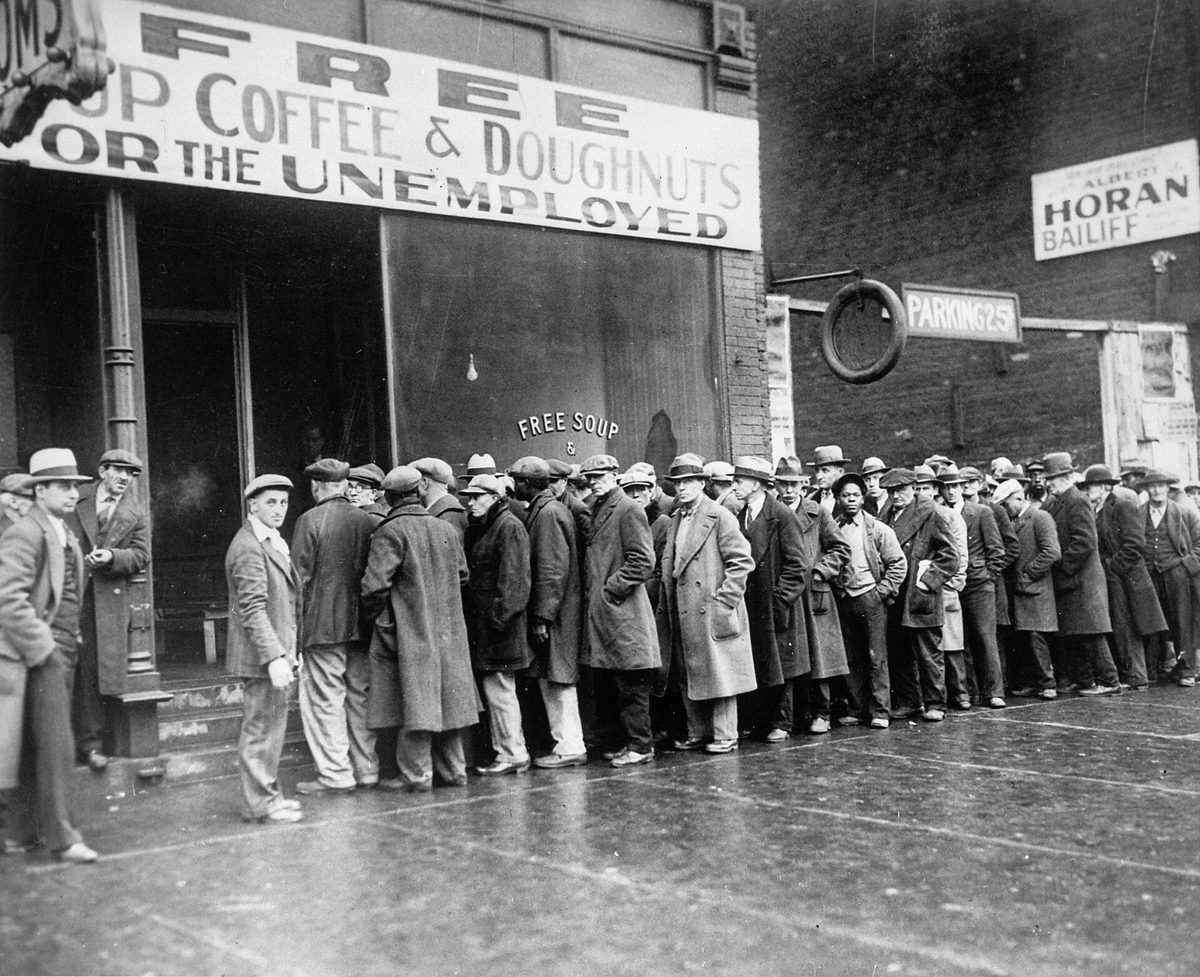
Once goods exist, someone gets them. The answer might be whoever can pay, whoever the ruler favors, whoever stands in the line, whoever is in need, or some mix. The Depression-era photograph below shows one answer to the question, a charity line, and it also shows how much hangs on the answer.
Who owns, who decides, who bears the loss
Those three questions describe what happens. Three more describe the arrangements behind it, and these are the ones that separate the systems in this module.
The first is ownership. Who holds title to the land, the tools and the factories, called the means of production? Private persons, a king, a company with a royal charter, or the people as a whole acting through the state?
The second is decision. Who chooses what to make and how? Individual owners and buyers, an official with a plan, or custom handed down from grandparents?
The third is loss. When a decision turns out wrong, who pays? A baker who bakes bread nobody buys eats the cost himself. If an official orders ten million left shoes, the cost lands on whoever in the system has no way to refuse it. How a system treats failure tells you a lot about whether it can learn from it.
The economist Friedrich Hayek, writing in 1945, argued that these arrangements matter because they decide how a society uses knowledge. His essay "The Use of Knowledge in Society" appeared in the American Economic Review.10 The usual picture of the economic problem, he said, is that someone has all the facts about resources and wants and works out the best use. That is a puzzle for a single mind, and Hayek thought it the wrong puzzle. In his words:
"The economic problem of society is thus not merely a problem of how to allocate 'given' resources"
"It is rather a problem of how to secure the best use of resources known to any of the members of society, for ends whose relative importance only these individuals know."
Friedrich Hayek, "The Use of Knowledge in Society," American Economic Review 35, no. 4 (September 1945): 519-530. The original joins the two sentences with a dash and a further clause. 10
Hayek's reason is that the knowledge we need "never exists in concentrated or integrated form but solely as the dispersed bits of incomplete and frequently contradictory knowledge which all the separate individuals possess."10 The grain buyer knows the elevator. The welder knows which shop is behind on orders. The mother knows what her children will eat this week. No office can collect all of that, and by the time it tried, half of it would have changed.
Prices, plans and tradition
Societies have used three broad ways to coordinate all this. Tradition fixes roles and shares by custom: the son takes up the father's plow and the guild sets the price of a loaf. Sowell notes that the basic principles of economics apply in "capitalist, socialist, feudal, or whatever" economies, which is a reminder that the questions come before any system's answers.11 Plans put the answers in the hands of an authority who decides, from the center, what will be made and for whom. Prices let millions of buyers and sellers adjust to each other through offers and counteroffers.
Hayek's famous illustration is tin. Suppose a new use for tin appears somewhere in the world, or a source of tin dries up. Users everywhere need to economize on it, but "there is no need for the great majority of them even to know where the more urgent need has arisen, or in favor of what other needs they ought to husband the supply." The price rises, and that is enough.12 He called the price system "a kind of machinery for registering change," and wrote:
"The marvel is that in a case like that of a scarcity of one raw material, without an order being issued, without more than perhaps a handful of people knowing the cause, tens of thousands of people whose identity could not be ascertained by months of investigation, are made to use the material or its products more sparingly."
Friedrich Hayek, "The Use of Knowledge in Society," 1945. 12
That is Read's pencil again, told by an economist. It is also a claim that can be tested, and the rest of this module tests it against the record.
Four systems as a map
The four systems in this module give different answers to the ownership, decision and loss questions. The table below is a simplified map, not a verdict. Real countries mix elements, and the lessons ahead show how. But the pure types are useful because the arguments in history were fought over them.
| System | Who owns the means of production | Who decides what is made | How prices are set | Who bears the loss | Where it goes in this module |
|---|---|---|---|---|---|
| Mercantilism | Mostly private owners, many holding state-granted monopolies | The state steers trade and industry toward national wealth in treasure | Often by regulation, tariffs and chartered monopoly | Consumers and excluded rivals pay for protected producers | Lesson 2 |
| Capitalism | Private persons and firms | Owners, workers and buyers, through exchange | By buying and selling in markets | The owner or investor who made the choice | Lessons 3, 4 and 5 |
| Socialism | Society as a whole, in forms from state to cooperative | Public bodies or worker groups, in some forms with markets | Varies: administered in some forms, market-based in others | The public treasury, in the forms with state ownership | Lesson 6 |
| Communism | The abolition of private property in the means of production | A central authority, by plan | Fixed by the plan | Falls on the public, since no private owner exists to absorb it | Lesson 7 |
A word on the labels. "Capitalism" is not a name the system's defenders chose. Robert Hessen, in the Concise Encyclopedia of Economics, writes that the word is "a term of disparagement coined by socialists in the mid-nineteenth century" and that it is a misnomer for "economic individualism," which Adam Smith had called "the obvious and simple system of natural liberty."13 Smith's phrase is in The Wealth of Nations in Book 4, Chapter 9, where he writes that when systems of preference or restraint are taken away, that system "establishes itself of its own accord."17 Neither "capitalism" nor "laissez-faire" appears anywhere in Smith's book. This module uses "capitalism" because that is the word readers know, with the understanding that its defenders mean by it private property, voluntary exchange and the rule of law.
The communist answer is the most radical on ownership. In the Communist Manifesto of 1848 Marx and Engels wrote that "the theory of the Communists may be summed up in the single sentence: Abolition of private property."16 The socialist family is wider. In its broad sense socialism means social ownership of the means of production, which can take public, community, collective, cooperative or employee forms, and its types vary on the role of markets and planning.15 And mercantilism, the oldest of the four, was less a theory of ownership than a theory of national power: it let people own things while directing where the nation's trade should flow.
The problem that sorts them
If you take one idea from this lesson to the rest of the module, take Hayek's. The old debate between planning and markets turned on whether the facts a planner needs can be gathered in one place at all.
In 1920 the Austrian economist Ludwig von Mises argued that without private ownership of capital goods and the market prices that come from trading them, a planner has no way to calculate which uses of resources are rational. Hayek later recast the problem as a question of knowledge: the relevant information is dispersed, tacit and always changing, so it cannot be centralized.18 The argument became known as the economic calculation problem, and lessons 4, 6 and 7 return to it.
Its defenders do not claim markets are perfect. Hayek himself wrote that the adjustments prices produce are "probably never 'perfect' in the sense in which the economist conceives of them in his equilibrium analysis."19 They claim that nothing else uses scattered knowledge better. Serious replies exist. Markets can leave out costs that fall on bystanders, they reward some talents and not others, and people who lose their jobs to change are real people. Lesson 9 takes up those cases at full strength.
Mercantilism sits oddly on this map because it lets private people own and trade, then overlays orders from the state about whom to trade with and on what terms. That is the next lesson. It matters now because it was the system Adam Smith's generation lived under, and the system the American colonists wrote into their grievance list in 1776.
Questions to carry through the module
Whenever you read an argument about economics, in this course or in the news, put three questions to it. Who decides? Who pays? Who bears the loss when the decision is wrong?
Take a plain case. A state legislature caps the price of some good it thinks is too dear. Who decided the right price? A legislator, using the facts available to the committee. Who pays? Producers who can no longer cover costs, and buyers who find the shelf empty, and sometimes people who pay in line time or favors instead of money. Who bears the loss if the price was wrong? Usually not the legislator. Compare a grocer who prices milk too high: he sells less milk and loses money until he lowers the price. The first arrangement is easy to start and slow to learn from. The second is the reverse.
A fourth question sits behind the other three: under what rules? Even Smith, the great enemy of the mercantile system, did not leave the market without law. "Every man, as long as he does not violate the laws of justice, is left perfectly free to pursue his own interest his own way," he wrote.17 Someone has to write and enforce the laws of justice, which is the work of government, and the arguments in this module are largely about how far past that point governments should go and what happens when they try.
Learn more
- I, Pencil: The whole essay, about fifteen minutes, with Friedman's introduction on the next page.
- Hayek, The Use of Knowledge in Society: The 1945 essay in full. Dense in places, but the tin example and the section on prices read easily.
- Sowell, Basic Economics, chapter 1: A short, plain-spoken start on scarcity, trade-offs and incentives.
- Hessen, Capitalism: A defender's account of what the system is, how the word arose and what critics have said.
- Smith, The Wealth of Nations: The full text. Start with Book 1, chapters 1 to 3, then Book 4, chapter 2.
- Marx and Engels, Communist Manifesto: Short enough to read in one sitting. Read section II for the answer on property.
- I, Pencil at FEE: The Foundation for Economic Education's page, with the essay, a video and teaching materials.
Notes
- Leonard E. Read, "I, Pencil: My Family Tree as Told to Leonard E. Read," The Freeman, December 1958 (Irvington-on-Hudson, NY: Foundation for Economic Education; reprint 1999). Read it online. ↩
- Read, "I, Pencil," section "Simple?". Read it online. ↩
- Read, "I, Pencil," section "Innumerable Antecedents." Read gives the cedar as Northern California and Oregon, the mill at San Leandro, graphite from Ceylon, clay from Mississippi, candelilla wax from Mexico, rape-seed oil from the Dutch East Indies and pumice from Italy, and puts the pencil factory's machinery and building at $4,000,000. Read it online. ↩
- Read, "I, Pencil," sections "No One Knows" and "No Master Mind." Read it online. ↩
- Milton Friedman, Introduction to "I, Pencil" (Foundation for Economic Education, 1999). Friedman writes that he knows of no other piece of literature that so well illustrates both Adam Smith's invisible hand (he calls it "the possibility of cooperation without coercion") and Friedrich Hayek's emphasis on dispersed knowledge. He also quotes the passage on the pencil from Free to Choose, chapter 1 and the first episode of the series, and the quotation in this lesson comes from that introduction. The original joins two phrases with a dash. Read it online. ↩
- Lionel Robbins, An Essay on the Nature and Significance of Economic Science (London: Macmillan, 1932; 2nd ed. 1935), ch. 1. The definition as quoted in the biographical article on Robbins. Read it online. ↩
- Thomas Sowell, Basic Economics, 5th ed. (New York: Basic Books, 2015), ch. 1, "What Is Economics?" Read the chapter excerpt. ↩
- Genesis 3:17-19, King James Version. Read it online. ↩
- Sowell, Basic Economics, ch. 1, the passage on the military medical team. Read the chapter excerpt. ↩
- F. A. Hayek, "The Use of Knowledge in Society," American Economic Review 35, no. 4 (September 1945): 519-530, part I. Read it online. ↩
- Sowell, Basic Economics, ch. 1: the basic principles apply in many very different kinds of economies, "capitalist, socialist, feudal, or whatever." Read the chapter excerpt. ↩
- Hayek, "The Use of Knowledge in Society," part III, the tin illustration. Read it online. ↩
- Robert Hessen, "Capitalism," in The Concise Encyclopedia of Economics (Indianapolis: Liberty Fund). Read it online. ↩
- Adam Smith, An Inquiry into the Nature and Causes of the Wealth of Nations (1776), Book 4, chs. 1 to 8, on the "commercial or mercantile system." Read it online. ↩
- "Socialism," overview of definitions: an economic ideology characterized by social ownership of the means of production, which may be public, community, collective, cooperative or employee; types vary by the role of markets and planning. Read it online. ↩
- Karl Marx and Friedrich Engels, Manifesto of the Communist Party (1848), section II, "Proletarians and Communists." Read it online. ↩
- Smith, Wealth of Nations, Book 4, ch. 9: "the obvious and simple system of natural liberty establishes itself of its own accord." A text search of the Gutenberg edition finds neither "laissez" nor "capitalism" in the book. Read it online. ↩
- "Economic calculation problem," summarizing Ludwig von Mises, "Economic Calculation in the Socialist Commonwealth" (1920), and Hayek's later reframing as a problem of dispersed knowledge. Read it online. ↩
- Hayek, "The Use of Knowledge in Society," part III, after the passage on "a kind of machinery for registering change." Read it online. ↩
Check yourself
1. Lionel Robbins defined economics as the science that studies human behaviour as a relationship between what two things?
Robbins, in his 1932 Essay on the Nature and Significance of Economic Science, defined economics as the study of behaviour as a relationship between ends and scarce means which have alternative uses.
2. What is the central claim of Leonard Read's 1958 essay 'I, Pencil'?
The pencil says that not a single person on the face of the earth knows how to make it, and that it exists because millions of people each supply a small piece of know-how with no master mind giving orders.
3. Thomas Sowell uses the Garden of Eden to make which point?
Sowell writes that the Garden was a system for producing and distributing goods but was not an economy, because everything was available in unlimited abundance. Without scarcity there is no need to economize.
4. According to Friedrich Hayek's 1945 essay, why is the economic problem of society not simply a matter of allocating given resources?
Hayek argued that the knowledge needed 'never exists in concentrated or integrated form but solely as the dispersed bits of incomplete and frequently contradictory knowledge which all the separate individuals possess.'
5. Who coined the word 'capitalism' as a term of disparagement?
Robert Hessen writes that 'capitalism' was a term of disparagement coined by socialists in the mid-nineteenth century. Adam Smith had called the same arrangement 'the obvious and simple system of natural liberty.'
Terms in this lesson
- Scarcity
- The condition in which what people want adds up to more than exists. It is why every society must choose.
- Opportunity cost
- What you give up when you pick one use of a scarce thing over the next best use.
- Means of production
- The land, tools, factories and other capital used to make goods. Who owns them is the dividing question among the four systems.
- Price system
- The network of prices set by buying and selling, which tells people what is scarce and what is plentiful.
- Central planning
- A system in which officials decide what is produced and how it is shared out, rather than letting prices and private choices decide.
- Dispersed knowledge
- Hayek's term for the facts about local conditions, skills and preferences that exist only in the heads of millions of separate people.
- Invisible hand
- Adam Smith's phrase for the way people pursuing their own interests can end up serving others without intending to.
Sources
- Leonard Read, I, Pencil (Library of Economics and Liberty) checked 2026-10
- Milton Friedman, Introduction to I, Pencil (Library of Economics and Liberty) checked 2026-10
- Friedrich Hayek, The Use of Knowledge in Society (1945) checked 2026-10
- Thomas Sowell, Basic Economics, chapter 1 (publisher excerpt) checked 2026-10
- Lionel Robbins (biography, with the 1932 definition) checked 2026-10
- Robert Hessen, Capitalism (Concise Encyclopedia of Economics) checked 2026-10
- Adam Smith, The Wealth of Nations (Project Gutenberg 3300) checked 2026-10
- Marx and Engels, Manifesto of the Communist Party (Project Gutenberg 61) checked 2026-10
- Socialism (overview of definitions) checked 2026-10
- Economic calculation problem checked 2026-10