Lesson 3 of 10 · about 20 minutes
Adam Smith and The Wealth of Nations
You'll be able to
- Summarize Adam Smith's life and the two books he published, The Theory of Moral Sentiments and The Wealth of Nations
- Explain the division of labor using Smith's pin factory and why he thought it raised wages and output
- State what Smith meant by the invisible hand and where it appears in his writing
- List the duties Smith gave to government in a system of natural liberty, including justice, defense and public works
- Identify and correct at least four common misreadings of Smith
In a small pin factory that Adam Smith once visited, ten men made upwards of forty-eight thousand pins in a day. That is 4,800 pins apiece. Smith did the other half of the sum too. If the same ten men had each worked alone, without training in the trade, "they certainly could not each of them have made twenty, perhaps not one pin in a day."1
The gap between twenty and 4,800 is the heart of his book. It explains, he thought, why a nation grows rich: its people divide their work and trade the results. Hoarded treasure, the mercantilists' idea of wealth, has little to do with it. Everything else in The Wealth of Nations grows from that.
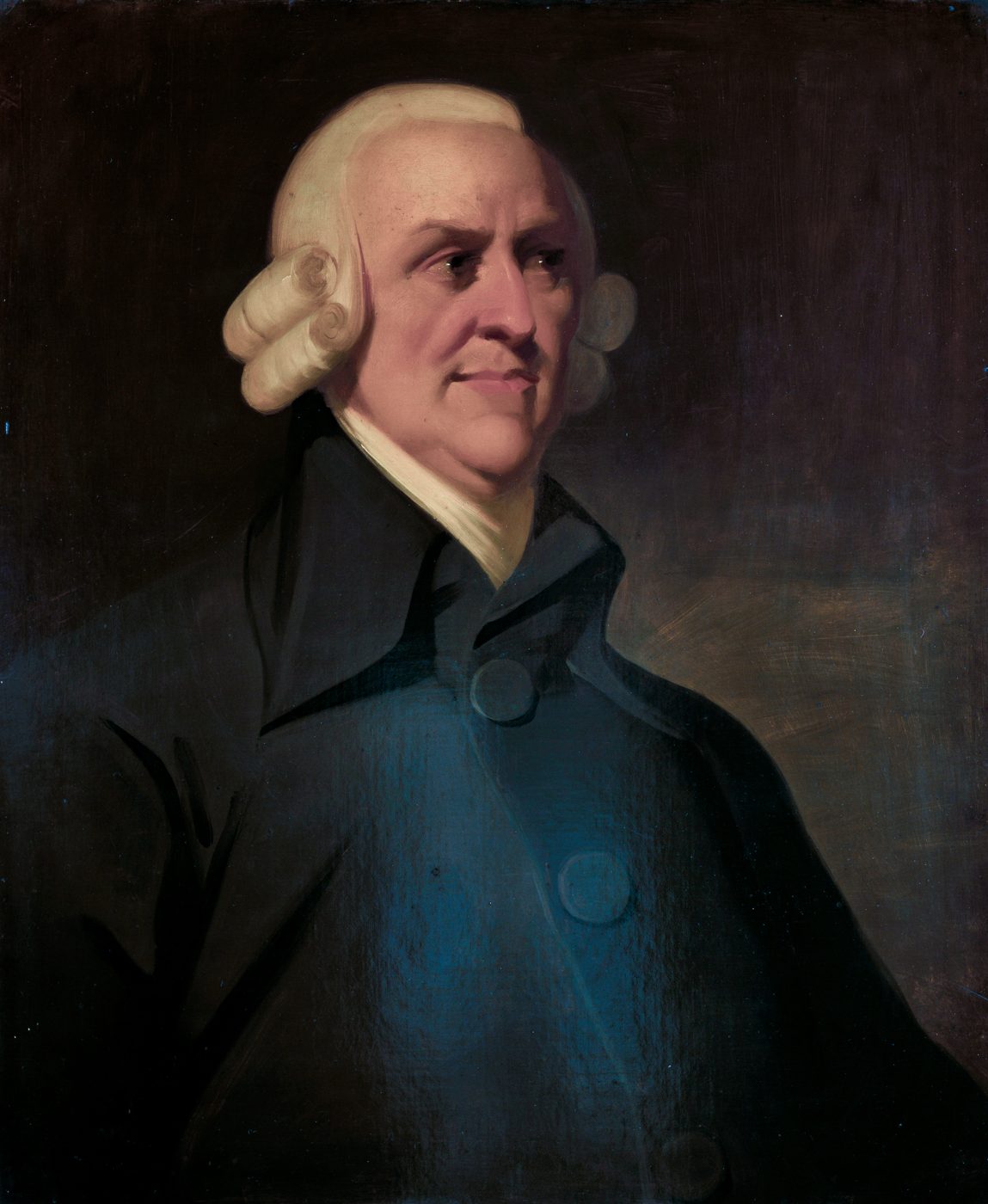
A professor from Kirkcaldy
Smith was born in Kirkcaldy, a small port on the Firth of Forth in Fife, Scotland, and baptised on June 5, 1723 (June 16 by the modern calendar).2 His widowed mother raised him. He entered the University of Glasgow at fourteen and later attended Balliol College, Oxford, graduating with, as the Library of Economics and Liberty's biography puts it, "an extensive knowledge of European literature and an enduring contempt for English schools."3 He returned to Scotland, gave lectures, and was made professor of logic at Glasgow in 1751 and of moral philosophy in 1752. His lecture subjects, in the order he preferred them, were natural theology, ethics, jurisprudence and political economy.3
In 1764 he resigned his chair to tutor the young Duke of Buccleuch, which meant two years or more of travel through France and Switzerland. He met Voltaire, Rousseau, François Quesnay and Anne-Robert-Jacques Turgot, men whose ideas about trade and government he took in and often disputed.3 The duke's family gave him a life pension. He used it to retire to Kirkcaldy and write.3
The Wealth of Nations came out in 1776, the year of the Declaration and the year his close friend David Hume died.3 In 1778 Smith became a commissioner of customs. The irony is plain: in his book he had defended smuggling in the face of "unnatural" legislation, and now he was paid to help enforce the laws against it.3 He never married. He lived with his mother in Panmure House in Edinburgh's Canongate until her death in 1784, and he died in Edinburgh in July 1790.2
The first book: sympathy
The man who wrote the most famous defense of self-interest in the English language began his career as a moral philosopher. His first book, The Theory of Moral Sentiments (1759), opens like this:
"How selfish soever man may be supposed, there are evidently some principles in his nature, which interest him in the fortune of others, and render their happiness necessary to him, though he derives nothing from it, except the pleasure of seeing it."
Adam Smith, The Theory of Moral Sentiments, Part I, Section I, ch. 1, "Of Sympathy." 4
That sentence belongs in any account of what Smith thought about human beings. The book argues that conscience works by a sort of imaginative sympathy: we picture how an impartial observer would judge our conduct, and we are troubled when that observer would disapprove. Smith called this figure the impartial spectator.4 It is a moral theory, and it shapes the later book, because a society of traders needs trust, honesty and some regard for others to keep functioning. Smith never imagined a market of strangers who owe each other nothing.
He also used the phrase "invisible hand" here, in a passage on the rich who, in spite of "their natural selfishness and rapacity," divide with the poor the produce of their improvements. They "are led by an invisible hand to make nearly the same distribution of the necessaries of life, which would have been made, had the earth been divided into equal portions among all its inhabitants."5 The phrase turns up again seventeen years later in The Wealth of Nations, and there it carries a different load.
The pin factory and the division of labor
An Inquiry into the Nature and Causes of the Wealth of Nations opens with a claim: "The greatest improvements in the productive powers of labour, and the greater part of the skill, dexterity, and judgment, with which it is anywhere directed, or applied, seem to have been the effects of the division of labour."6 Smith then picks a deliberately small example to make the point, the making of pins.
A workman who has not been trained to the trade, he says, "could scarce, perhaps, with his utmost industry, make one pin in a day, and certainly could not make twenty." But the trade is a collection of operations: "One man draws out the wire; another straights it; a third cuts it; a fourth points it; a fifth grinds it at the top for receiving the head." The head takes two or three more operations. Putting the head on is a trade of its own, whitening the pins is another, and even papering them is a trade by itself. The important business of making a pin "is, in this manner, divided into about eighteen distinct operations."1 In the small factory he had seen, ten men worked, some performing two or three of the operations. That is where the 48,000 comes from.1
Why specialization pays
Smith gave three reasons for the gain: the increase of dexterity in every workman, the saving of the time lost in passing from one kind of work to another, and the invention of machines that shorten labor.7 The third came from the workmen themselves, he thought, since a man who spends his days on one simple operation will think about how to do it more easily. He tells a story about it. In the early steam engines a boy was kept to open and shut the valve between the boiler and the cylinder, and one of those boys, who "loved to play with his companions," tied a string from the handle of the valve to another part of the machine so that the valve opened and shut without his help. "One of the greatest improvements that has been made upon this machine," Smith wrote, "was in this manner the discovery of a boy who wanted to save his own labour."8
What limits it: the extent of the market
In chapter 3 he added the condition. "As it is the power of exchanging that gives occasion to the division of labour, so the extent of this division must always be limited by the extent of that power, or, in other words, by the extent of the market."9 A village of a few families cannot support a specialist pin maker. A country with roads, ports and trading partners can support thousands. That is one reason Smith was so hard on laws that cut off trade.
The butcher, the brewer and the baker
Chapter 2 asks where the division of labor comes from. Smith traces it to no foresighted wisdom. It comes from "a certain propensity in human nature," the "propensity to truck, barter, and exchange one thing for another."10 Animals do not trade. A man "stands at all times in need of the co-operation and assistance of great multitudes, while his whole life is scarce sufficient to gain the friendship of a few persons." He cannot get what he needs from benevolence alone. He must offer something in return: "Give me that which I want, and you shall have this which you want."11 And then the line everyone remembers:
"It is not from the benevolence of the butcher, the brewer, or the baker that we expect our dinner, but from their regard to their own interest. We address ourselves, not to their humanity, but to their self-love, and never talk to them of our own necessities, but of their advantages."
Adam Smith, The Wealth of Nations, Book 1, ch. 2. 11
Read in context, the passage describes how strangers in a large society get what they need from people who will never love them. Smith goes on to say that "nobody but a beggar chooses to depend chiefly upon the benevolence of his fellow-citizens," and that even a beggar does not depend upon it entirely.11 The baker does not need to be a saint. He needs customers.
This is where Leonard Read's pencil from lesson 1 comes from. The logger in Oregon and the graphite miner in Ceylon never met. Each followed his own interest and each depended on the rest.
The invisible hand, used once
The phrase most readers know best from Smith appears exactly once in The Wealth of Nations. A text search of the whole book finds it a single time, in Book 4, chapter 2, in a chapter about restraints on imports.12 Smith was arguing that a merchant, left alone, prefers to employ his capital in domestic rather than foreign industry, where it is more secure. Then comes the sentence:
"By preferring the support of domestic to that of foreign industry, he intends only his own security; and by directing that industry in such a manner as its produce may be of the greatest value, he intends only his own gain; and he is in this, as in many other cases, led by an invisible hand to promote an end which was no part of his intention. Nor is it always the worse for the society that it was no part of it. By pursuing his own interest, he frequently promotes that of the society more effectually than when he really intends to promote it. I have never known much good done by those who affected to trade for the public good."
Adam Smith, The Wealth of Nations, Book 4, ch. 2. 12
The words are careful. The merchant "frequently" promotes the public interest, and, Smith adds, it is not "always the worse for the society" that the good was no part of his intent. Smith offers an observation about a pattern and uses it against the mercantile planners. He makes no claim that good outcomes are guaranteed. The planners' belief that a statesman could direct private capital better than its owner was, in Smith's words, an authority "which could safely be trusted, not only to no single person, but to no council or senate whatever, and which would nowhere be so dangerous as in the hands of a man who had folly and presumption enough to fancy himself fit to exercise it."13
Hayek would later make the same point in knowledge terms, that the man on the spot knows what the planner cannot. Smith had it in 1776 in the language of prudence.
What government is for
If Smith was no friend of the mercantile state, was he an enemy of the state? Read Book 4, chapter 9, where he sums up the alternative to the systems of preference and restraint he has been attacking. When these are taken away, "the obvious and simple system of natural liberty establishes itself of its own accord. Every man, as long as he does not violate the laws of justice, is left perfectly free to pursue his own interest his own way, and to bring both his industry and capital into competition with those of any other man, or order of men."14 Then he lists what the sovereign still has to do:
"According to the system of natural liberty, the sovereign has only three duties to attend to; three duties of great importance, indeed, but plain and intelligible to common understandings: first, the duty of protecting the society from the violence and invasion of other independent societies; secondly, the duty of protecting, as far as possible, every member of the society from the injustice or oppression of every other member of it, or the duty of establishing an exact administration of justice; and, thirdly, the duty of erecting and maintaining certain public works, and certain public institutions, which it can never be for the interest of any individual, or small number of individuals to erect and maintain; because the profit could never repay the expense to any individual, or small number of individuals, though it may frequently do much more than repay it to a great society."
Adam Smith, The Wealth of Nations, Book 4, ch. 9. 14
Defense, justice and public works. The third duty is not small. In Book 5 Smith says the works and institutions of this kind are chiefly those for facilitating the commerce of the society and those for promoting the instruction of the people.15 On education he wrote that "for a very small expense, the public can facilitate, can encourage and can even impose upon almost the whole body of the people, the necessity of acquiring those most essential parts of education," and described a little parish school where the master was paid partly, but not wholly, by the public.15 He worried that the division of labor he had praised could leave a man who spends his life on a few simple operations "as stupid and ignorant as it is possible for a human creature to become." That is where the labouring poor of a civilized society fall, he wrote, "unless government takes some pains to prevent it."15
He went further than a minimalist would. In the same book that celebrates natural liberty he allows that "those exertions of the natural liberty of a few individuals, which might endanger the security of the whole society, are, and ought to be, restrained by the laws of all governments." The regulation of banking is his example, and he compares it to "the obligation of building party walls, in order to prevent the communication of fire."16 Rules that stop one man's imprudence from burning down his neighbor's house are, for Smith, part of justice.
Smith on merchants and masters
Anyone who reads Smith as the merchants' champion has not read Book 1, chapter 10. In a passage that is quoted less often than the butcher and the baker, he writes: "People of the same trade seldom meet together, even for merriment and diversion, but the conversation ends in a conspiracy against the public, or in some contrivance to raise prices."17 No law could prevent such meetings and remain consistent with liberty and justice, he adds. But the law "ought to do nothing to facilitate such assemblies, much less to render them necessary."17
On wages he was just as direct. "Masters are always and everywhere in a sort of tacit, but constant and uniform, combination, not to raise the wages of labour above their actual rate." Workers' combinations draw attention, he said, but the masters' combinations are the natural state of things, "which nobody ever hears of."18 In the same chapter he gave a moral argument for good wages: "No society can surely be flourishing and happy, of which the far greater part of the members are poor and miserable. It is but equity, besides, that they who feed, clothe, and lodge the whole body of the people, should have such a share of the produce of their own labour as to be themselves tolerably well fed, clothed, and lodged."18
He distrusted the corporation too. Of the directors of a joint-stock company, "being the managers rather of other people's money than of their own," he wrote that "it cannot well be expected that they should watch over it with the same anxious vigilance with which the partners in a private copartnery frequently watch over their own."19 On slavery he argued from cost. He wrote that "the work done by slaves, though it appears to cost only their maintenance, is in the end the dearest of any."20 A person who can acquire no property, he explained, "can have no other interest but to eat as much and to labour as little as possible."
Closing Book 1 with a warning
Book 1 ends with the warning quoted in lesson 2. Of any new law or regulation of commerce coming from merchants and manufacturers, Smith said, it "ought always to be listened to with great precaution, and ought never to be adopted till after having been long and carefully examined, not only with the most scrupulous, but with the most suspicious attention." Such men have "generally an interest to deceive and even to oppress the public."21
Those who know Smith only from the invisible hand will find it a surprise. The man who defended free exchange also warned, more sharply than most of his successors, that the people who talk most loudly about free enterprise are sometimes the ones asking for a favor.
Common misreadings of Smith
"Smith taught that greed is good"
The butcher's self-interest is a fact about how strangers cooperate, not a recommendation. The same Smith wrote the book on sympathy and the impartial spectator, and in the same book as the butcher he insisted that "justice" sets the limits within which a man may pursue gain. Self-love is ordinary and often useful. It does not excuse injustice.
"The invisible hand is Smith's big idea"
The phrase appears once in The Wealth of Nations, in a passing remark. The book's weight rests on the division of labor, the extent of the market and the folly of restraints on trade. The phrase carries far less of the argument than its fame suggests.
"Smith wanted no government"
He wanted a government held to its work: defense, justice, and public works and institutions. That job is wider than the nightwatchman role some of his admirers assign him. He supported public help for schools, rules for banking and a shipping law he judged worth its cost for defense.
"Smith was the voice of business"
He warned that merchants conspire, that masters combine to depress wages, that corporate managers are careless with other people's money and that laws proposed by dealers deserve suspicion.
"Smith coined capitalism and laissez-faire"
Neither word appears in The Wealth of Nations. "Capitalism" was coined by socialists in the mid-nineteenth century, Robert Hessen notes. Smith's own name for what he defended was "the obvious and simple system of natural liberty."22
The best case against Smith, and a reply
The best case against an economy built on Smith's lines is in Smith. He saw that the division of labor can dull the people who perform it. He saw that employers hold the advantage in bargaining and that they combine. He saw that tradesmen conspire against the public when they get together, and that the directors of large companies guard other people's money carelessly. Anyone who wants to argue that markets cannot be trusted to protect workers and consumers can quote him, and many have.
His answer to those problems was never to hand the economy to the statesman. He wanted public schooling to repair what specialization damages, a law of justice enforced against the strong as well as the weak, and the removal of the privileges that let producers shut out rivals. He asked of every proposed rule who gains, who is shut out and who bears the cost. That habit is Smith's real inheritance, and Friedman and Sowell put it to work in the lessons ahead. Where his critics have a better answer, lesson 9 gives it room.
Learn more
- The Wealth of Nations: The full text. Book 1, chapters 1 to 3 and 10, Book 4 chapters 2 and 9, and Book 5 chapter 1 are the most useful for this course.
- The Theory of Moral Sentiments: Smith's first book. Part I, Section I, chapter 1 is a good place to start.
- Adam Smith, biography: A short, clear life of Smith from the Library of Economics and Liberty.
- Adam Smith: A long overview with sections on his life, beliefs and legacy.
- Hessen, Capitalism: On the word and the system, with Smith's phrase for it.
- I, Pencil: Smith's division of labor and invisible hand, told by a pencil.
Notes
- Adam Smith, An Inquiry into the Nature and Causes of the Wealth of Nations (London, 1776), Book 1, ch. 1, "Of the Division of Labour." Read it online. ↩
- "Adam Smith," overview article: baptised June 5, 1723 (O.S.), Kirkcaldy; Panmure House; died 1790. Read it online. ↩
- "Adam Smith," in The Concise Encyclopedia of Economics and the Library of Economics and Liberty biographies: education, professorships (logic 1751, moral philosophy 1752), the Buccleuch tutoring, the pension, 1776, Hume, the 1778 customs post. Read it online. ↩
- Adam Smith, The Theory of Moral Sentiments (1759), Part I, Section I, ch. 1, "Of Sympathy," and the discussion of the impartial spectator in Part III. Read it online. ↩
- Smith, The Theory of Moral Sentiments, Part IV, ch. 1, on the rich dividing with the poor. Read it online. ↩
- Smith, Wealth of Nations, Book 1, ch. 1. Read it online. ↩
- Smith, Wealth of Nations, Book 1, ch. 1: the increase in the work done is "owing to three different circumstances." Read it online. ↩
- Smith, Wealth of Nations, Book 1, ch. 1, the passage on the boy who tied a string to the valve of an early steam engine. Read it online. ↩
- Smith, Wealth of Nations, Book 1, ch. 3, "That the Division of Labour Is Limited by the Extent of the Market." Read it online. ↩
- Smith, Wealth of Nations, Book 1, ch. 2, "Of the Principle Which Gives Occasion to the Division of Labour." Read it online. ↩
- Smith, Wealth of Nations, Book 1, ch. 2. Read it online. ↩
- Smith, Wealth of Nations, Book 4, ch. 2, "Of Restraints upon Importation from Foreign Countries of such Goods as can be produced at Home." A text search of the Gutenberg edition finds the phrase "invisible hand" once. Read it online. ↩
- Smith, Wealth of Nations, Book 4, ch. 2, the passage on the statesman who would direct private people in how they employ their capitals. Read it online. ↩
- Smith, Wealth of Nations, Book 4, ch. 9, "Of the Agricultural Systems, or of Those Systems of Political Economy Which Represent the Produce of Land as either the Sole or the Principal Source of the Revenue and Wealth of Every Country." Read it online. ↩
- Smith, Wealth of Nations, Book 5, ch. 1, on the expense of public works and public institutions, including the education of youth. Read it online. ↩
- Smith, Wealth of Nations, Book 2, ch. 2, "Of Money, Considered as a Particular Branch of the General Stock of the Society." Read it online. ↩
- Smith, Wealth of Nations, Book 1, ch. 10, "Of Wages and Profit in the Different Employments of Labour and Stock," part 2. Read it online. ↩
- Smith, Wealth of Nations, Book 1, ch. 8, "Of the Wages of Labour." Read it online. ↩
- Smith, Wealth of Nations, Book 5, ch. 1, on joint-stock companies. Read it online. ↩
- Smith, Wealth of Nations, Book 3, ch. 2, "Of the Discouragement of Agriculture in the Ancient State of Europe after the Fall of the Roman Empire." Read it online. ↩
- Smith, Wealth of Nations, Book 1, ch. 11, concluding paragraph. Read it online. ↩
- Robert Hessen, "Capitalism," The Concise Encyclopedia of Economics. Read it online. ↩
Check yourself
1. In Smith's pin factory, about how many pins could ten workers make in a day?
Smith wrote that ten persons could make among them upwards of forty-eight thousand pins in a day, or 4,800 each. Working alone and untrained, he said, each could scarcely make twenty and perhaps not one.
2. How many times does the phrase 'invisible hand' appear in The Wealth of Nations?
It appears once, in Book 4, chapter 2, in a passage about why a merchant prefers to invest at home. Smith also used the phrase in The Theory of Moral Sentiments (1759).
3. Which of these is one of the three duties Smith gave the sovereign under the system of natural liberty?
Smith's three duties were defense against other societies, the administration of justice, and erecting and maintaining certain public works and institutions that private profit would never pay for.
4. What did Smith say happens when people of the same trade meet, even for merriment and diversion?
Book 1, chapter 10. Smith added that no law could prevent such meetings consistent with liberty and justice, but that the law ought to do nothing to facilitate them.
5. Which statement about Smith is accurate?
Smith closed Book 1 with that warning. Neither 'capitalism' nor 'laissez-faire' appears in The Wealth of Nations, and in Book 5 he proposed that the public could facilitate and even require basic education.
6. What was the subject of Smith's first book, published in 1759?
The Theory of Moral Sentiments opens with sympathy: 'How selfish soever man may be supposed, there are evidently some principles in his nature, which interest him in the fortune of others.'
Terms in this lesson
- Division of labor
- Splitting a job into specialized tasks so that each worker does one thing well. Smith said it was the main cause of rising productivity.
- Invisible hand
- Smith's phrase for the way a person pursuing his own gain can end up serving a wider good that was no part of his intention.
- System of natural liberty
- Smith's name for an arrangement in which, once preferences and restraints are removed, each person is free to pursue his own interest within the laws of justice.
- Impartial spectator
- In The Theory of Moral Sentiments, the imagined fair observer whose judgment a conscience takes into account.
- Mercantile system
- The set of policies Smith attacked, built on the idea that wealth is money and that exports should exceed imports.
- Joint-stock company
- A company owned by many shareholders and run by directors, which Smith distrusted because directors manage other people's money.
- Combination
- Smith's word for an agreement among sellers or among employers, often secret, to hold up prices or hold down wages.
Sources
- Adam Smith, The Wealth of Nations (Project Gutenberg 3300) checked 2026-10
- Adam Smith, The Theory of Moral Sentiments (Project Gutenberg 67363) checked 2026-10
- Adam Smith (Biography, Library of Economics and Liberty) checked 2026-10
- Adam Smith (overview article) checked 2026-10
- Capitalism, by Robert Hessen (Concise Encyclopedia of Economics) checked 2026-10
- Friedrich Hayek, The Use of Knowledge in Society checked 2026-10
- Leonard Read, I, Pencil checked 2026-10