Lesson 9 of 12 · about 60 minutes · Updated November 22, 2026
Pregnancy, Postpartum and Family Planning
You'll be able to
- Explain Idaho's pregnancy income limit, how the unborn child is counted, and how hospital presumptive eligibility and emergency Medicaid work for births.
- Describe how Idaho Code section 56-270 and state plan amendments ID-25-0001 and ID-25-0002 created 12 months of continuous postpartum coverage from Jan. 1, 2025.
- Compare the share of births financed by Medicaid in Idaho with the U.S. and six neighboring states, 2016 to 2024, and explain why figures from KFF and CDC differ slightly.
- Summarize what the Idaho Maternal Mortality Review Committee found for 2020 to 2024 and why small counts limit what the ratios can show.
- Identify which Idaho hospitals report deliveries to CMS, which stopped delivering babies in 2023 and 2024, and what the competing obstetric workforce counts measure.
- Describe family planning, sterilization, midwife and doula coverage rules in IDAPA 16.03.26 and the pregnancy provisions of P.L. 119-21.
Start here: the short version
- Idaho covers pregnancy up to 138 percent of poverty. IDAPA 16.03.01.400 sets the limit at 133 percent of the federal poverty guidelines after a 5 percent disregard, which KFF reports as 138 percent (January 2026). That is the lowest pregnancy limit among Idaho and its six neighbors; KFF's U.S. figure is 201 percent.12
- Postpartum coverage now lasts 12 months. House Bill 633 (2024), signed March 25, 2024 (session law chapter 186), added Idaho Code section 56-270 and told Health and Welfare to seek the 12-month option. CMS approved Medicaid state plan amendment ID-25-0001 on Jan. 17, 2025, effective Jan. 1, 2025, with a matching CHIP amendment.345
- Medicaid paid for about 1 in 4 Idaho births in 2024. KFF's analysis of CDC natality data counts 6,411 Medicaid-financed births out of 23,276, or 27.5 percent, down from 36.9 percent in 2016. The U.S. share was 39.8 percent.67
- Idaho's maternal death review panel lapsed and came back. The committee sunset July 1, 2023. House Bill 399 (2024), signed March 18, 2024, moved the work to the Board of Medicine. Its 2024 report (approved Jan. 27, 2026) found 6 pregnancy-associated deaths and 1 pregnancy-related death in 2024.8910
- Three Idaho hospitals stopped delivering babies in 2023 and 2024. Bonner General Health in Sandpoint announced its decision March 17, 2023; Valor Health in Emmett stopped after June 1, 2023; West Valley Medical Center in Caldwell closed labor and delivery April 1, 2024.111213
- Family planning gets a 90 percent federal match. Social Security Act section 1903(a)(5) pays states 90 percent of family planning costs. Idaho has no separate family-planning-only eligibility group (KFF, July 2026); all six neighbors except Nevada do.1415
- The 2025 federal law exempts pregnant and postpartum people from work requirements. P.L. 119-21 (July 4, 2025), section 71119, lists people who are pregnant or entitled to postpartum coverage among those exempt.16
Law: Social Security Act titles XIX and XXI and 42 CFR as amended through Nov. 22, 2026, including P.L. 119-21 (2025); Idaho Code sections 56-270, 54-1806 and 18-622 and IDAPA 16.03.01 and 16.03.26 as published through the 2026 session; 2026 poverty guidelines from the Jan. 15, 2026, Federal Register; birth data from CDC natality files through 2024 as compiled by KFF; maternal death data from the Idaho Board of Medicine's 2024 report; hospital data from CMS files released Oct. 29, 2026; checked Nov. 22, 2026. Limits and rules change; check with Idaho Health and Welfare.
About one in four babies born in Idaho arrives with Medicaid paying the bill. For those families, Medicaid is the prenatal visits, the ultrasound, the hospital stay for the delivery, the newborn's first checkups and, since Jan. 1, 2025, a full year of coverage for the parent after the birth. Pregnancy coverage is also one of the few parts of the program where the federal government sets a firm floor that every state must meet.
This lesson explains how pregnancy coverage works in Idaho: the income limit and how it is figured, who can be covered on the spot at a hospital, what happens to people who are not citizens, how newborns are enrolled, and how the 2024 Legislature and CMS moved postpartum coverage from 60 days to 12 months. It then follows the numbers: the share of Idaho births Medicaid pays for, compared with the U.S. and the six neighboring states; what Idaho's Maternal Mortality Review Committee has found about deaths during and after pregnancy; which Idaho hospitals deliver babies and which have stopped; the count of obstetricians in the state; and what Idaho Medicaid covers for family planning, midwives and doulas. Idaho's abortion laws are covered only as far as they touch emergency hospital care and the obstetric workforce, and only from court and agency records, with each side's position stated.
This is general education. It describes the rules and the choices that exist. It gives no medical, legal, insurance or financial advice and does not tell any reader whether to apply for coverage or which provider to use. Any household or income figure made up to illustrate a rule is labeled as a hypothetical example.
Other lessons carry the background. Why long-term care, not births, takes most Medicaid dollars is in lesson 01, Medicaid's Second Job: Long-Term Care. Children's coverage after the first year, CHIP and the EPSDT benefit are in lesson 06, Children, CHIP, EPSDT and Katie Beckett. Pregnancy care for tribal members through the Indian Health Service and tribal clinics is in lesson 10, Tribal Health and Medicaid, and the rest of the 2025 federal law is in lesson 12, What the 2025 Federal Law Does Beyond Work Requirements. Basic eligibility rules for adults and children, and the 2023 to 2024 unwinding, are in module 74's Who Qualifies and Who Is Covered.
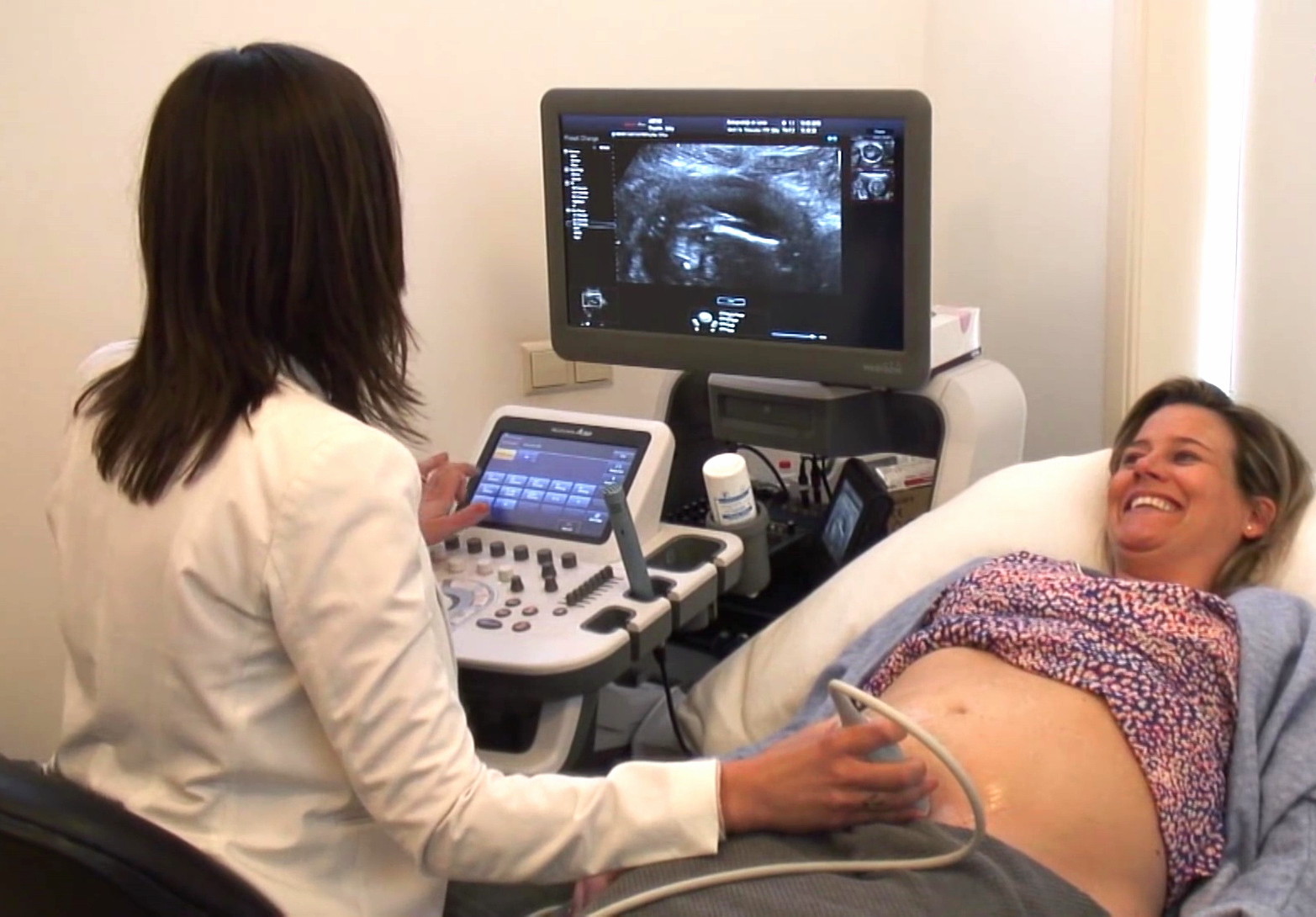

How Medicaid covers pregnancy in Idaho
The federal floor
Pregnancy coverage is one of Medicaid's mandatory groups. Federal rules require every state to cover pregnant women with household income up to at least 133 percent of the federal poverty guidelines, under 42 CFR 435.116, and allow states to set a higher limit.17 Coverage for a pregnant woman is not limited to obstetric care. Once enrolled, she receives the state's full Medicaid benefit package, and the federal rule keeps her covered through the end of the postpartum period even if her income rises.18
Two features set pregnancy apart from other Medicaid groups. First, there is no asset test: savings, a car or a house do not count. Second, the unborn child is counted as a member of the household when income is compared with the poverty guideline, so a pregnant woman living alone is treated as a household of two, and a woman expecting twins as a household of three. Idaho's own rule says the same thing in plain terms: IDAPA 16.03.01.400 lists "a pregnant woman" among adults eligible for Medicaid and defines an eligible dependent child to include "the unborn child of a pregnant woman."1
Idaho's income limit for 2026
Idaho sets the limit at the federal minimum. IDAPA 16.03.01.400.03 says individuals "with MAGI not greater than" 133 percent of poverty, "after applying a five per cent (5%) disregard to income," are eligible. MAGI means modified adjusted gross income, the same income figure used for federal tax credits on the health insurance marketplace. The 5 percent disregard, which IDAPA 16.03.01.395 applies when it is needed to make someone eligible, lifts the working limit to 138 percent of poverty.1 CMS's Medicaid.gov eligibility table lists Idaho's pregnancy limit as 133 percent (the figure without the disregard, as of Dec. 1, 2023), and KFF's January 2026 table lists it as 138 percent (with the disregard). Both describe the same rule.219
The 2026 federal poverty guidelines, published by the Department of Health and Human Services in the Federal Register on Jan. 15, 2026, are $21,640 a year for a household of two, $27,320 for three and $33,000 for four in the 48 contiguous states.20 The table below converts Idaho's limit into monthly dollars. These are our own calculations; Health and Welfare publishes its own income charts and may update them on a different date than HHS.
| Household size (unborn child counted) | 2026 poverty guideline (yearly) | 138 percent, yearly | 138 percent, monthly | Example |
|---|---|---|---|---|
| 2 | $21,640 | $29,863 | $2,489 | A pregnant woman living alone |
| 3 | $27,320 | $37,702 | $3,142 | A pregnant woman and her spouse, or a single mother with one child |
| 4 | $33,000 | $45,540 | $3,795 | A married couple with one child, expecting a second |
Sources: HHS 2026 poverty guidelines; IDAPA 16.03.01.400.03 and 395; our calculation.201
How we figured it: the monthly income limit
Inputs. The 2026 HHS poverty guideline for each household size (Federal Register, Jan. 15, 2026) and Idaho's limit of 133 percent plus a 5 percentage point disregard (IDAPA 16.03.01.400.03 and 395), which works out to 138 percent.
Method. Yearly guideline times 1.38, then divided by 12, rounded to the nearest dollar. For a household of two: $21,640 times 1.38 is $29,863.20 a year; divided by 12 is $2,488.60, or about $2,489 a month.
Limits. Health and Welfare counts MAGI income for the household as defined in IDAPA 16.03.01 sections 300 to 303 and 42 CFR 435.603, which has its own rules on whose income counts (for example, a spouse's income counts; a parent's income may or may not count for a pregnant teen, depending on tax filing). The household sizes and examples in the table are hypothetical illustrations, not eligibility decisions.
How Idaho compares
Idaho's pregnancy limit is the lowest in its region. KFF's January 2026 state table, which includes the 5 percent disregard, lists Utah at 144 percent of poverty, Wyoming at 159, Montana at 162, Oregon at 190, Nevada at 205 and Washington at 215. The U.S. figure in the same KFF table is 201 percent.2 A family of three earning $40,000 in 2026 (a hypothetical example) would be over Idaho's limit of $37,702 a year but under the limits in every neighboring state except Utah. Idaho's limit is the federal minimum; the state has not used its option to set a higher one.19
In Idaho, the pregnancy limit and the Medicaid expansion limit are the same number: expansion adults ages 19 to 64 also qualify up to 133 percent plus the 5 percent disregard (the expansion itself is covered in module 74's How Idaho Got Expansion). That matters in two ways. A low-income woman who is already on expansion Medicaid when she becomes pregnant is moved to the pregnancy group, which carries extra protections. And most women who qualify for pregnancy Medicaid in Idaho would also qualify for expansion coverage if they were not pregnant, which may help explain why Idaho's 2024 statement of purpose for the postpartum bill said the change had no fiscal impact (discussed below).21
Presumptive eligibility: coverage on the spot at a hospital
Federal law lets states allow "qualified" providers to grant short-term Medicaid on the spot, before the state finishes a full application. This is called presumptive eligibility. Many states let prenatal clinics or health departments grant it to pregnant women so that prenatal care can start at the first visit. Idaho's rule is narrower. IDAPA 16.03.01.545 says presumptive eligibility "can only be provided by a qualified hospital," and section 546 requires each qualified hospital to sign a memorandum of understanding with Health and Welfare.1 This is the hospital presumptive eligibility option that the Affordable Care Act created for all states in 2014, now in 42 CFR 435.1110.22
Under the Idaho rule, the presumptive period starts the day the hospital files the online presumptive application and ends either when Health and Welfare completes the full eligibility decision or at the end of the month after the month the hospital made its decision, whichever comes first.1 The rule covers anyone who appears to meet a MAGI-based group, which includes pregnant women. We found no Idaho rule allowing prenatal clinics, federally qualified health centers or public health districts to grant presumptive eligibility for pregnancy.
Emergency Medicaid and births to non-citizen parents
People who meet every Medicaid rule except citizenship or qualified immigration status can still receive Medicaid for an emergency medical condition. IDAPA 16.03.01.250 says such a person "may receive medical services necessary to treat an emergency medical condition, including labor and delivery," and section 270 waives the Social Security number requirement for a person eligible only for that emergency coverage.1 Prenatal care and postpartum care are not covered under this limited benefit in Idaho, but the delivery is. A baby born in the United States is a U.S. citizen, and IDAPA 16.03.01.530 covers a newborn as a "deemed eligible child" even when the mother "qualifies for coverage only for the delivery because of her alien status."1 The 2025 federal law changes the federal matching rate for emergency Medicaid for some adults; that is in lesson 12.
Newborns are enrolled automatically for a year
A baby born to a mother who is on Medicaid on the day of birth is "deemed" eligible for Medicaid until the baby's first birthday under 42 CFR 435.117, with no separate application and no income test during that year.23 Idaho applies the same rule in IDAPA 16.03.01.530 and waives the Social Security number requirement for a deemed newborn under section 270.1 After the first year, the child's coverage depends on household income and Idaho's children's limits (142 percent of poverty for Medicaid under age 6 and up to 185 percent in CHIP), which lesson 06 explains.
Pregnant teens and CHIP
Idaho runs a separate CHIP program for children in families above the Medicaid limit, up to 185 percent of poverty (IDAPA 16.03.01.520).1 A pregnant teenager can be enrolled in CHIP as a child. When CMS approved Idaho's CHIP postpartum amendment, ID-25-0002, on Jan. 17, 2025, it noted that Idaho "provides 12 months of continuous postpartum coverage to individuals enrolled in its separate CHIP" and asked the state to fix two system problems so that pregnant and postpartum enrollees who turn 19 move correctly from CHIP into Medicaid.5 The same approval letter shows that Idaho did not elect the CHIP "unborn child" option, sometimes called "from conception to end of pregnancy," which lets a state cover prenatal care regardless of the pregnant woman's own immigration status by treating the unborn child as the CHIP enrollee.5
The 12-month postpartum extension
From 60 days to 12 months
For decades, federal law ended pregnancy Medicaid at the end of the month in which the 60th day after the pregnancy ended. A woman who qualified only because she was pregnant then had to qualify under some other group or lose coverage. Idaho's eligibility rule still contains that older language: IDAPA 16.03.01.421 says a pregnant woman whose income rises "will continue to receive coverage through the end of the month in which the sixtieth day of her postpartum period falls."1 That rule text, dated July 1, 2024, has not caught up with the later state law and federal approval described below; the state plan and Idaho Code section 56-270 now govern how long postpartum coverage lasts.
Congress created a 12-month option in the American Rescue Plan Act of 2021 (P.L. 117-2, signed March 11, 2021), section 9812, which added paragraph (16) to section 1902(e) of the Social Security Act. The option became available on April 1, 2022, and was first written to last five years.2425 The Consolidated Appropriations Act, 2023 (P.L. 117-328, signed Dec. 29, 2022), made the option permanent.26 A state that takes it must cover the full Medicaid benefit, not just pregnancy-related care, for 12 months after the pregnancy ends, and must do the same in CHIP.5
Idaho's law: House Bill 633 (2024)
Idaho took the option by statute. House Bill 633, introduced Feb. 22, 2024, by the House Health and Welfare Committee, passed the House 42 to 26 on March 7 and the Senate 24 to 10 on March 19, and was signed by Gov. Brad Little on March 25, 2024, as session law chapter 186.3 The bill status page lists Rep. Megan Blanksma as the House floor sponsor and Sen. Lee as the Senate floor sponsor.3 The bill added Idaho Code section 56-270, which:
- Directs the state to amend its Medicaid state plan to extend eligibility for "twelve (12) months postpartum" for people who were eligible for and received Medicaid while pregnant, citing ARPA section 9812 and Social Security Act section 1902(e)(16).4
- Requires Health and Welfare to begin the federal application "no later than July 1, 2024," and to seek the most federal matching money possible.4
- Builds in a review: if the federal share of the cost for this group drops by more than 10 percent after approval, the Senate and House Health and Welfare committees must review the effects and recommend to the Legislature whether the extension should stay.4
The bill's statement of purpose, filed by Rep. Blanksma, said the bill "causes no additional expenditure of funds at the state or local government" level.21 The reason given in debate is not in the statement, but the eligibility math above suggests one: because Idaho's pregnancy limit equals its expansion limit, most women whose pregnancy coverage ended at 60 days could already move to expansion Medicaid. That is our reading of the two rules, not a finding from a Health and Welfare cost estimate; we did not find a separate fiscal analysis for the extension.
The vote was not unanimous: 26 House members and 10 senators voted no.3 Before the bill, the Maternal Mortality Review Committee had found that women covered by Medicaid were overrepresented in Idaho maternal deaths and had recommended extending postpartum coverage to 12 months, as KFF Health News reported in 2023.10 The bill status page records the votes but not the reasons members gave; the floor debate is in the House and Senate journals for March 7 and 19, 2024.
CMS approval and the start date
CMS approved Idaho Medicaid state plan amendment ID-25-0001 on Jan. 17, 2025, with an effective date of Jan. 1, 2025. Its summary says Idaho will provide "12 months of continuous postpartum coverage."27 The companion CHIP amendment, ID-25-0002, was submitted Jan. 10, 2025, and approved the same day, Jan. 17, 2025, also effective Jan. 1, 2025.5 That was about two years and nine months after the federal option opened on April 1, 2022. The statute's July 1, 2024, deadline was for starting the application; we could not confirm from the public record when Health and Welfare first submitted the Medicaid amendment.
What "continuous" means is spelled out in the CHIP approval letter: coverage continues through the pregnancy and the 12-month postpartum period even if the person would otherwise lose eligibility because of a change in circumstances, such as a raise. The listed exceptions are voluntary disenrollment, moving out of Idaho, eligibility granted by agency error or by fraud, abuse or perjury, and death.5 In practice, a mother whose income goes up after the birth keeps Medicaid until the postpartum year ends, and is then checked for other groups.
What postpartum coverage includes
The 12-month period carries the full Idaho Medicaid benefit, not a pregnancy-only package. A few pregnancy-specific add-on services still follow the older 60-day clock. IDAPA 16.03.26.362, in Idaho's rewritten Medicaid benefits rule effective July 1, 2026, covers "pregnancy-related services" from confirmation of pregnancy "through the end of the month in which the sixtieth day following delivery occurs." Those add-ons are:
- up to two individual and family social services visits with a licensed social worker;
- maternity nursing visits, up to nine, only for women who cannot find a provider for prenatal care, ending when a primary physician is found;
- up to two home nursing visits by a registered nurse;
- a prior-authorized risk assessment and plan of care for women who cannot find a primary care provider; and
- risk reduction follow-up, a monthly case management service to help a woman reach medical, educational and social services.28
Mental health and substance use treatment, primary care, prescriptions, contraception and specialty care are covered during the whole 12 months through the regular benefit. Behavioral health services in Idaho Medicaid run through the Idaho Behavioral Health Plan, described in lesson 05.
What the 2025 federal law changes for pregnancy
P.L. 119-21, signed July 4, 2025, touches pregnancy coverage in four places. Most of the law is covered in lesson 12; the work requirement itself and Idaho's House Bill 913 (2026) are in module 74's The 2027 Work Requirements.
| Section | What it does | Start | Effect on pregnancy coverage |
|---|---|---|---|
| 71119, community engagement | Requires expansion adults to show 80 hours a month of work or other activities | No later than Jan. 1, 2027 (the first quarter beginning after Dec. 31, 2026); a state may start earlier | Exempts a person "who is pregnant or entitled to postpartum medical assistance under paragraph (5) or (16)" of section 1902(e)16 |
| 71112, retroactive coverage | Cuts retroactive coverage before the application month from three months to one for expansion adults and two for other groups | Applications from the first quarter beginning after Dec. 31, 2026 (Jan. 1, 2027) | A pregnant applicant, who is not in the expansion group, can get two months back instead of three29 |
| 71120, cost sharing | Requires states to charge expansion adults above 100 percent of poverty some cost sharing (more than $0, up to $35 per item or service) | Oct. 1, 2028 | Bars charges for services already exempt under section 1916(a)(2)(B) through (J), a list that includes services to pregnant women related to the pregnancy (1916(a)(2)(B)) and family planning services and supplies (1916(a)(2)(D))30 |
| 71113, prohibited entities | Bars federal Medicaid payments for one year to certain nonprofit family planning providers that also provide abortions and received more than $800,000 in Medicaid in fiscal 2023 | July 4, 2025, to July 3, 2026 | Affects which clinics could bill Medicaid for family planning during that year; see the family planning section below31 |
The retroactive coverage change is the one most likely to reach pregnant Idahoans directly. A woman who gives birth before she applies, for example because she did not know she qualified, can currently have the delivery covered if she applies within three months; for applications from Jan. 1, 2027, the window shrinks to two months before the application month. Hospital presumptive eligibility, described above, is one way hospitals cover that gap at the time of service.
A timeline: pregnancy coverage, Idaho and federal
| Year | Law or event | What changed | Source |
|---|---|---|---|
| 1965 | Social Security Amendments of 1965 (title XIX), signed July 30, 1965 | Medicaid created; low-income pregnant women covered mainly if they also qualified for cash welfare | Social Security Act title XIX32 |
| 1972 | Social Security Amendments of 1972 | Family planning made a required benefit with a 90 percent federal match (now section 1903(a)(5)) | Social Security Act section 1903(a)(5)14 |
| 1986 | Emergency Medical Treatment and Labor Act (EMTALA) | Medicare hospitals must screen and stabilize emergency patients, including women in labor | 42 U.S.C. 1395dd33 |
| 1989 | Omnibus Budget Reconciliation Act of 1989 | States required to cover pregnant women to at least 133 percent of poverty | 42 CFR 435.116 (current rule)17 |
| 2014 | Affordable Care Act rules take effect | MAGI income counting; hospital presumptive eligibility in every state | 42 CFR 435.603, 435.111022 |
| 2019 | Idaho Maternal Mortality Review Committee created by law, with a sunset date | State begins reviewing deaths during and within a year of pregnancy | KFF Health News, 202310 |
| 2021 | American Rescue Plan Act, section 9812, signed March 11, 2021 | Creates the 12-month postpartum option, available April 1, 2022 | P.L. 117-224 |
| 2022 | Consolidated Appropriations Act, 2023, signed Dec. 29, 2022 | Makes the postpartum option permanent | P.L. 117-32826 |
| 2022 | Idaho Code section 18-622 takes effect; federal court enjoins it as applied to EMTALA care (August 2022) | Abortion becomes a felony except as the statute allows | St. Luke's v. Labrador order, 202534 |
| 2023 | Bonner General Health (March 17) and Valor Health (June 1) end deliveries | Two rural hospitals stop labor and delivery | CBS News; Boise State Public Radio1112 |
| 2023 | Maternal Mortality Review Committee sunsets July 1, 2023 | Idaho becomes the only state without a review committee | KFF Health News10 |
| 2024 | House Bill 399 signed March 18; House Bill 633 signed March 25 | Review committee restored under the Board of Medicine; 12-month postpartum required by state law | Idaho Legislature83 |
| 2024 | West Valley Medical Center closes labor and delivery and its NICU, April 1 | Caldwell hospital stops births | Idaho Statesman13 |
| 2024 | Moyle v. United States, June 27 | Supreme Court dismisses Idaho's appeal as improvidently granted; injunction back in force | U.S. Supreme Court35 |
| 2025 | 12-month postpartum coverage effective Jan. 1 (approved Jan. 17) | Full Medicaid for a year after pregnancy | CMS SPA ID-25-000127 |
| 2025 | United States dismisses its EMTALA suit March 5; St. Luke's wins a preliminary injunction March 20 | Emergency care protection continues for St. Luke's and its providers | D. Idaho No. 1:25-cv-0001534 |
| 2025 | P.L. 119-21 signed July 4 | Work requirement exemption for pregnant and postpartum adults; retroactive coverage and cost sharing changes | P.L. 119-2116 |
| 2026 | Board of Medicine approves 2024 maternal mortality report Jan. 27 | One pregnancy-related death found for 2024 | Idaho MMRC9 |
| 2027 | Retroactive coverage cut, Jan. 1 | Two months back for pregnant applicants | P.L. 119-21, section 7111229 |
How many Idaho births Medicaid pays for
The 2024 numbers
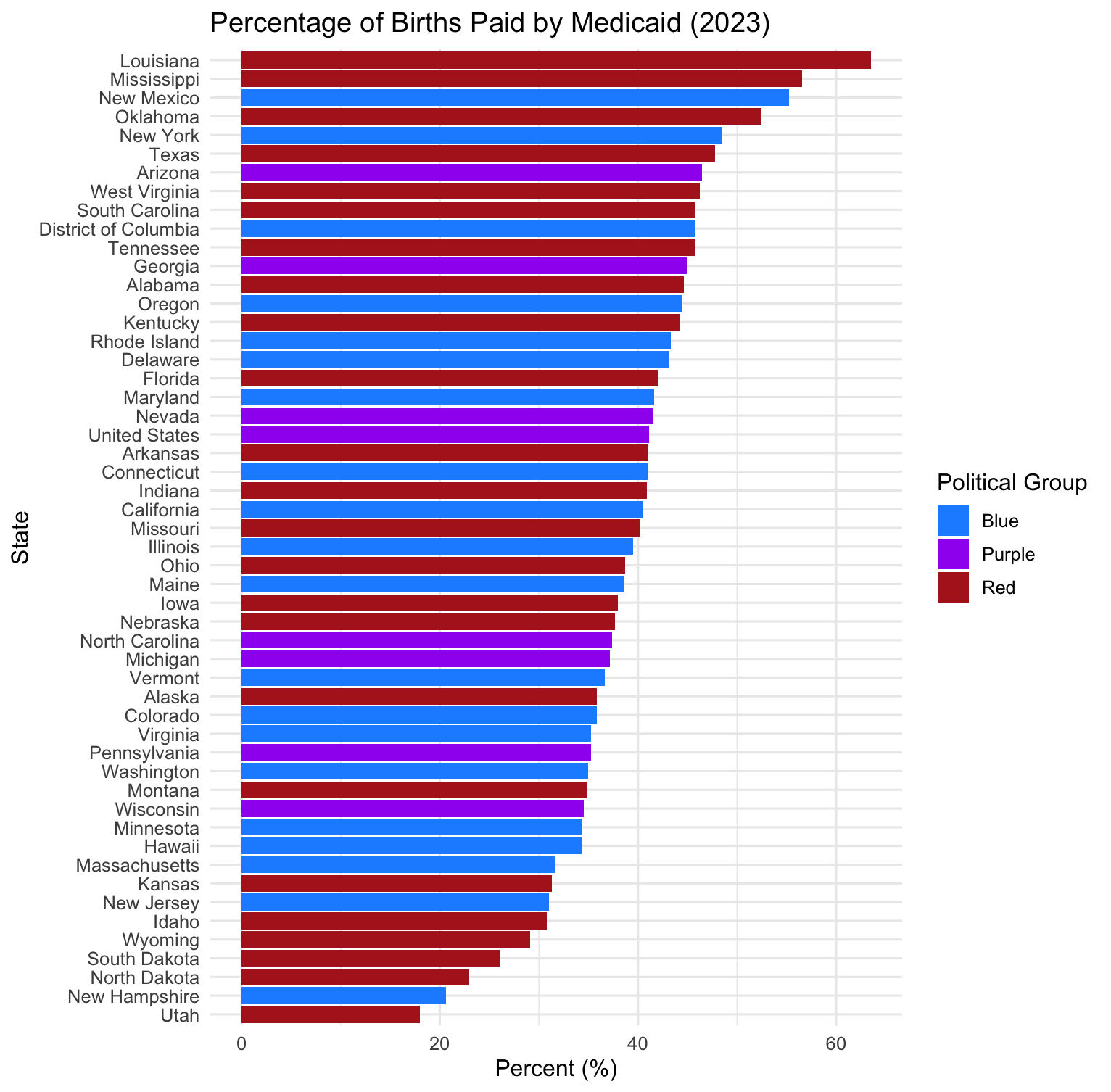
Every U.S. birth certificate records the expected "source of payment for this delivery": Medicaid, private insurance, self-pay, or another source. The National Center for Health Statistics at CDC compiles those records into the National Vital Statistics System natality files, which can be queried on CDC WONDER. KFF, a nonprofit health research group, publishes a yearly state table from that data. For 2024, the newest final year, it counts 6,411 Idaho births financed by Medicaid, 27.5 percent of the state's 23,276 births. Nationally, Medicaid financed 1,445,210 births, 39.8 percent of 3,628,934.67
CDC's own report, Births: Final Data for 2024 (National Vital Statistics Reports vol. 75, no. 2, June 9, 2026), puts the national Medicaid share at 40.2 percent, down from 41.5 percent in 2023, with private insurance at 51.8 percent and self-pay at 4.7 percent.7 The small difference between 39.8 and 40.2 comes from the denominator: KFF divides by all births, while CDC's percentages are based on births where the payer was reported. Both are correct for what they measure; the point is to compare like with like.

Idaho and its neighbors
Idaho's share is below the U.S. share and in the lower middle of its region. In 2024, by KFF's count from CDC data, Medicaid financed 16.8 percent of births in Utah, 30.0 percent in Wyoming, 30.7 percent in Montana, 34.7 percent in Washington, 41.7 percent in Nevada and 45.2 percent in Oregon.6 KFF's table does not explain the differences. Oregon's and Nevada's higher shares line up with their higher pregnancy income limits (190 and 205 percent of poverty), while Utah has both a low limit and the lowest share. Idaho has the lowest pregnancy limit in the group but not the lowest share, because the share also depends on how many families have low incomes and how many have job-based insurance.
| State | Births financed by Medicaid, 2024 | Share of all births, 2024 | Pregnancy income limit, Jan. 2026 | Family planning eligibility group (July 2026) |
|---|---|---|---|---|
| Idaho | 6,411 | 27.5% | 138% | No |
| Utah | 7,831 | 16.8% | 144% | Yes, to 185% (waiver) |
| Wyoming | 1,827 | 30.0% | 159% | Yes, for women losing postpartum coverage, to 159% (waiver) |
| Montana | 3,478 | 30.7% | 162% | Yes, to 216% (waiver) |
| Washington | 28,830 | 34.7% | 215% | Yes, to 265% (waiver) |
| Nevada | 13,501 | 41.7% | 205% | No |
| Oregon | 17,597 | 45.2% | 190% | Yes, to 255% (waiver) |
| United States | 1,445,210 | 39.8% | 201% (KFF figure) | Not applicable |
Sources: KFF analysis of CDC WONDER natality data, 2024; KFF pregnancy income limits, January 2026; KFF family planning eligibility table, July 2026 (KFF is labeled nonprofit research).6215
The trend since 2016
Idaho's Medicaid birth share has fallen by about a quarter since 2016, faster than the national share. KFF's yearly tables show these Idaho and U.S. shares:6
| Year | Idaho births financed by Medicaid | Idaho share | U.S. share |
|---|---|---|---|
| 2016 | 8,301 | 36.9% | 42.3% |
| 2017 | 8,196 | 37.0% | 42.7% |
| 2018 | 7,490 | 35.0% | 42.1% |
| 2019 | 7,547 | 34.2% | 41.8% |
| 2020 | 7,574 | 35.2% | 41.7% |
| 2021 | 7,447 | 33.2% | 40.7% |
| 2022 | 7,099 | 31.7% | 41.0% |
| 2023 | 6,899 | 30.8% | 41.2% |
| 2024 | 6,411 | 27.5% | 39.8% |
Why the share fell: what the data can and cannot say
The birth records do not explain the drop, and no Idaho agency report we found has analyzed it. Several facts in the public record fit with it, each of which is a possible contributor, not a proven cause:
- Fewer births overall did not drive the share. Idaho births were about 22,500 in 2016 (8,301 divided by 0.369, our calculation) and 23,276 in 2024, so the total rose slightly while Medicaid-financed births fell by 1,890, or 22.8 percent.67
- Medicaid enrollment fell sharply in 2023 and 2024. After the federal continuous enrollment rule ended in 2023, Idaho reviewed every enrollee and removed many; that unwinding is covered in module 74's Who Qualifies and Who Is Covered. Births in 2024 to women who lost coverage and did not return would be recorded under another payer.
- Payer is recorded at the time of birth. A woman who was uninsured at delivery but later approved for retroactive Medicaid may appear as self-pay on the certificate. CDC's 2024 report shows self-pay rising nationally to 4.7 percent.7
- Income and job-based coverage may have changed. If more new parents have employer coverage, the private share rises. We did not find an Idaho-specific study testing this.
Rural births are more likely to be paid by Medicaid. KFF's 2024 table splits Idaho births by county type: Medicaid financed 26.4 percent of births in metropolitan counties (4,088 births) and 29.9 percent in nonmetropolitan counties (2,323 births), using the 2013 NCHS urban-rural county classes. The U.S. figures were 39.0 percent metro and 45.1 percent nonmetro.6 For a hospital in a nonmetropolitan county, Medicaid's delivery payment rate therefore affects close to a third of its births.
How we figured it: the birth share numbers
Inputs. KFF's table of births financed by Medicaid, 2016 to 2024, which KFF built from CDC WONDER natality records for all 57 vital statistics jurisdictions; CDC's Births: Final Data for 2024 for total Idaho births (23,276) and the national payer shares.
Calculations. Change in Idaho Medicaid births, 2016 to 2024: 8,301 minus 6,411 is 1,890; 1,890 divided by 8,301 is 22.8 percent. Estimated 2016 total births: 8,301 divided by 0.369 is about 22,500 (rounded, because KFF's share is rounded). Change in share: 36.9 minus 27.5 is 9.4 percentage points. Gap with the U.S.: 42.3 minus 36.9 is 5.4 points in 2016; 39.8 minus 27.5 is 12.3 points in 2024.
Caveats. The payer field is filled in at the hospital, often from admission paperwork, and can be wrong or unknown; births to Idaho residents that occur in other states are counted by state of residence in CDC's files. County-level counts are suppressed in CDC WONDER when they are small.
Maternal deaths in Idaho and the review committee
What a review committee does
A maternal mortality review committee is a panel of doctors, nurses, midwives, coroners and others who read the records of every death during pregnancy or within one year after, decide whether the pregnancy caused or contributed to the death, judge whether the death could have been prevented, and recommend changes. Idaho's committee uses two terms defined in its reports. A pregnancy-associated death is "death of a woman while pregnant OR within one year of pregnancy, regardless of cause." A pregnancy-related death is one resulting from pregnancy complications, a chain of events started by the pregnancy, or the aggravation of an unrelated condition by the pregnancy.369
The committee lapses and returns
Idaho created its committee in 2019 in a law with a sunset date. In February 2023, House Bill 81, sponsored by Rep. Dori Healey, would have extended it; the bill did not advance out of the House Health and Welfare Committee. KFF Health News reported that members cited the panel's cost, though committee members said a federal Title V grant paid for it, and that House Health and Welfare Committee Vice Chair Rep. Marco Erickson said the same data could come from existing Health and Welfare reports. The committee ended July 1, 2023, leaving Idaho, by KFF Health News's count, the only state without one.10
In 2024 the Legislature brought it back in a different home. House Bill 399 (2024) amended Idaho Code section 54-1806 to authorize the Idaho Board of Medicine, the state's physician licensing board, to "collect and review data and information concerning maternal mortality," to require the production of records about any maternal death, and to send the Legislature an annual summary report by Jan. 31 each year. The House passed it 52 to 17 on Feb. 12, 2024, the Senate 25 to 10 on March 13, and Gov. Little signed it March 18, 2024, as session law chapter 67, effective July 1, 2024.837 The Board of Medicine, now part of the Division of Occupational and Professional Licenses, hired a coordinator who started Aug. 5, 2024, and named an 11-member committee chaired by Dr. John Eck, a Boise family physician; four members had served on the earlier committee.38 The report states that the committee "operates independently of any disciplinary actions," and that no disciplinary proceedings will be recommended from its findings.9
The rebuilt committee has since reviewed the 2022, 2023 and 2024 deaths and published annual reports and two-page summaries on the Division of Occupational and Professional Licenses website.39
What the reports show
The 2024 report, approved Jan. 27, 2026, says the Bureau of Vital Records and Health Statistics referred six pregnancy-associated deaths for 2024, and the committee found one was pregnancy-related. With 23,285 live births, that gives a pregnancy-related mortality ratio of 4.29 deaths per 100,000 live births, which the report calls an 80 percent reduction in pregnancy-related deaths from 2023.9 The report also warns that its findings "are statistically insignificant due to the infrequency of maternal deaths compared to live births in the state" and "should not serve as the only basis for changes to healthcare delivery or legislative initiatives."9
| Death year | Pregnancy-associated deaths | Pregnancy-related deaths | Idaho pregnancy-related ratio per 100,000 live births (committee chart) |
|---|---|---|---|
| 2018 | Not in the 2024 report table | Not in the 2024 report table | 18.7 |
| 2019 | Not in the 2024 report table | Not in the 2024 report table | 13.6 |
| 2020 | 11 | 9 | 41.8 |
| 2021 | 16 | 9 | 40.1 |
| 2022 | 10 | 2 | 8.94 |
| 2023 | 11 | 5 | 22.6 |
| 2024 | 6 | 1 | 4.29 |
Source: Idaho Board of Medicine, Maternal Mortality Review Committee, Annual Report 2024, pages 4 and 5.9 The same report gives a second set of ratios using the CDC Pregnancy Mortality Surveillance System method, which excludes injury deaths (Idaho 32.5 in 2020, 22.3 in 2021, 8.94 in 2022, 13.58 in 2023 and 4.29 in 2024), and compares them with U.S. figures of 24.9 (2020), 33.2 (2021), 21.5 (2022) and 18.7 (2023). Different definitions give different ratios for the same year, so any comparison has to use the same method on both sides.9
Causes, timing and insurance
Across 2020 to 2024, the committee's 26 pregnancy-related deaths break down by cause as follows: mental health conditions 34.6 percent (9 deaths), infection or sepsis 26.9 percent (7), hemorrhage 11.5 percent (3), neurologic or neurovascular conditions 11.5 percent (3), cardiovascular conditions 7.7 percent (2), amniotic fluid embolism 3.8 percent (1) and injury 3.8 percent (1). The death counts are our conversion of the report's percentages; they add to 26, the sum of the yearly pregnancy-related counts (9, 9, 2, 5 and 1).9
Timing matters for Medicaid because postpartum coverage used to end at about two months. Of 54 pregnancy-associated deaths from 2020 to 2024, 22, or 40.7 percent, occurred 43 days to one year after the pregnancy, which is after the old Medicaid postpartum period would have ended. In 2024, five of six (83.3 percent) fell in that window.9 Of the 54 cases reviewed since 2020, the committee judged 94.4 percent to have "some level of preventability."9
On insurance, the 2024 report says five of the six pregnancy-associated deaths involved insured women, "two (2) privately and three (3) through Medicaid," and coverage was unclear for the sixth; the one pregnancy-related death in 2024 involved a woman with private insurance.9 The earlier committee found that women covered by Medicaid during pregnancy were overrepresented among maternal deaths and recommended extending postpartum coverage to 12 months.10 With six deaths in a year, no conclusion about Medicaid and private coverage can be drawn from a single year's split.
By place, the report uses Idaho's seven public health districts. South Central Public Health District, which serves the Magic Valley counties of Twin Falls, Gooding, Lincoln, Minidoka, Cassia, Camas and Blaine, recorded 3, 1, 5, 1 and 1 pregnancy-associated deaths in 2020 through 2024, or 11 of the 54 (20.4 percent, our calculation).9 The report notes that all six 2024 deaths involved women who lived in urban counties.
The committee's 2024 recommendations include several aimed at payers and the Legislature: that "both public and private payers should consider reviewing their birthing reimbursement policies" so rural hospitals can carry newer hemorrhage treatments; that birthing facilities with limited resources have a contact hospital for consultation and transfer; that providers screen pregnant and postpartum patients for suicide risk with a validated tool; and that lawmakers consider allocating future federal grant money for rural communities to critical access hospitals "to ensure appropriate birthing care."9

Where Idahoans give birth: hospitals and rural maternity care
Three closures in two years
Three Idaho hospitals stopped delivering babies in 2023 and 2024, each giving its own reasons in public statements:
- Bonner General Health, Sandpoint (Bonner County). Announced March 17, 2023, that it would end labor and delivery. The hospital delivered 265 babies in 2022. Its statement cited the "political climate," said "highly respected, talented physicians are leaving," and also cited staffing shortages and changing demographics, according to CBS News. Patients were directed to Coeur d'Alene or Spokane.1112
- Valor Health, Emmett (Gem County). A county-owned critical access hospital, it stopped delivering babies after June 1, 2023. It cited the COVID-19 pandemic, nurse shortages and long-running rural revenue problems, saying it had become "increasingly difficult and unsustainably expensive to recruit and retain a full team of high quality, broad-spectrum nurses," and projected only about 50 deliveries in the coming year.12
- West Valley Medical Center, Caldwell (Canyon County). Announced Feb. 22, 2024, that it would close its labor and delivery unit and its neonatal intensive care unit on April 1, 2024, citing a decline in births and "challenges in securing consistent coverage." The hospital did not say whether Idaho's abortion law played a part, the Idaho Statesman reported.13
The CMS hospital data released Oct. 29, 2026, now lists West Valley Medical Center as "Not Applicable (our hospital does not provide inpatient labor/delivery care)" for calendar 2025.40 Nationally, March of Dimes counts at least 96 publicly reported labor and delivery closures across 35 states between 2024 and early 2026, and finds that 1 in 3 U.S. counties (34.6 percent) is a maternity care desert, meaning it has no hospital or birth center offering obstetric care and no obstetric clinicians (labeled advocacy group; report no. 5, 2026).41
Which Idaho hospitals report deliveries
CMS's "Maternal Health: Hospital" file, updated Oct. 29, 2026, reports two maternity measures for calendar 2025 that work as a rough census of where Idahoans deliver. The PC-07 severe obstetric complications measure counts every delivery hospitalization at hospitals that report it, and the structural measure (SM-7) asks each hospital whether it takes part in a perinatal quality improvement program. Nineteen Idaho hospitals reported PC-07 results, together counting 20,712 delivery hospitalizations in 2025 (our sum).40 That is close to Idaho's roughly 23,000 yearly births; the rest are at hospitals that did not report the measure, at birth centers or at home. Critical access hospitals, small rural hospitals with 25 or fewer beds, often do not report these electronic measures, so a blank in the file does not mean a hospital has no births.
| Area (map order, north to south) | Hospital and city | Delivery hospitalizations reported, 2025 | Cesarean rate, first-birth low-risk (NTSV), 2025 |
|---|---|---|---|
| North | Kootenai Health, Coeur d'Alene | 2,304 | 25% |
| North | Gritman Medical Center, Moscow | 55 | Too few cases |
| North central | St. Joseph Regional Medical Center, Lewiston | 615 | 10% |
| North central | Syringa General Hospital, Grangeville (Idaho County) | 39 | Too few cases |
| West central | St. Luke's McCall | 106 | 17% |
| Treasure Valley | St. Luke's Regional Medical Center, Boise (system reports its Boise and Meridian sites together) | 5,777 | 21% |
| Treasure Valley | Saint Alphonsus Regional Medical Center, Boise | 1,458 | 22% |
| Treasure Valley | St. Luke's Nampa Medical Center | 1,361 | 16% |
| Treasure Valley | Saint Alphonsus Medical Center, Nampa | 1,048 | 14% |
| Southwest | St. Luke's Elmore Medical Center, Mountain Home | 187 | 25% |
| Magic Valley | St. Luke's Magic Valley Medical Center, Twin Falls | 1,771 | 24% |
| Magic Valley | Cassia Regional Hospital, Burley | 459 | 19% |
| Magic Valley | St. Luke's Wood River Medical Center, Ketchum (Blaine County) | 165 | 27% |
| Southeast | Portneuf Medical Center, Pocatello (Bannock County) | 1,092 | 21% |
| Southeast | Grove Creek Medical Center, Blackfoot (Bingham County) | 299 | 19% |
| Southeast | Caribou Medical Center, Soda Springs | 31 | Too few cases |
| East | Mountain View Hospital, Idaho Falls (Bonneville County) | 1,902 | 18% |
| East | Madison Memorial Hospital, Rexburg | 1,087 | 15% |
| East | Eastern Idaho Regional Medical Center, Idaho Falls (Bonneville County) | 956 | 16% |
Source: CMS Provider Data Catalog, Maternal Health: Hospital, Idaho rows, Jan. 1 to Dec. 31, 2025, released Oct. 29, 2026; delivery counts are the PC-07 measure denominator.40 The CMS state file puts Idaho's NTSV cesarean rate at 20 percent for 2025, against 26 percent nationally, 20 percent in Utah, Montana and Wyoming, 23 percent in Oregon, 24 percent in Nevada and 28 percent in Washington.42 (NTSV means first births of a single baby, head down, at full term. March of Dimes reports Idaho's overall cesarean rate, all births, at 24.5 percent in 2024; the two figures measure different groups.)43
The Magic Valley
In the Magic Valley, St. Luke's Magic Valley Medical Center in Twin Falls is the largest delivery hospital, with 1,771 delivery hospitalizations reported for 2025, and answered "Yes" to CMS's perinatal quality question. Cassia Regional Hospital in Burley reported 459 and St. Luke's Wood River in Ketchum reported 165; both also answered "Yes."40 Two other Magic Valley hospitals, Minidoka Memorial Hospital in Rupert and North Canyon Medical Center in Gooding, show no reported results for these measures in the 2025 file (CMS footnotes 5 and 7, meaning results not available or no cases met the criteria). The file alone does not show whether they offer labor and delivery, and we could not confirm their current status from a primary record. Buhl, Kimberly, Hagerman and Wendell have no hospital of their own in the CMS maternal file, and Camas and Lincoln counties have no hospital listed in it at all; for those towns and counties, the nearest delivery hospitals in the file are in Twin Falls, Burley and Ketchum.
South Central Public Health District, which covers the same counties, had 11 of Idaho's 54 pregnancy-associated deaths from 2020 to 2024, as noted above.9 The MMRC report does not break down deaths by hospital or by distance to care.
The CMS "Birthing-Friendly" designation
CMS marks hospitals as "Birthing-Friendly" when they report on the maternal morbidity structural measure that they take part in a statewide or national perinatal quality improvement collaborative and have put evidence-based maternal safety practices in place. The Idaho MMRC's 2024 report says Idaho had 16 hospitals with the designation.9 In the Oct. 29, 2026, CMS file, 17 Idaho hospitals answered "Yes" for calendar 2025 (our count), and Madison Memorial Hospital in Rexburg answered "No."40 The designation is a process measure; it does not rate outcomes.
The obstetric workforce
The 2025 Boise State study
The most detailed count of Idaho obstetricians is a peer-reviewed research letter by J. Edward McEachern of St. Luke's Health Plan, T. Allen Traylor of Boise State University and Deb Roman of the Ada County Medical Society, "Change in Number of OB/GYN Physicians Practicing Obstetrics After the Dobbs Decision," in JAMA Network Open (vol. 8, no. 7, e2524893), published July 31, 2025, with approval from Boise State University's research review board.44 The authors built three censuses of every OB/GYN physician practicing obstetrics in Idaho, in August 2022, November 2023 and December 2024, from credentialing files, licensing boards, the Idaho Medical Association, the Idaho section of the American College of Obstetricians and Gynecologists and direct confirmation with physicians. They excluded family physicians who deliver babies and temporary (locum tenens) doctors.44
Their findings:
- 268 OB/GYN physicians were practicing obstetrics in Idaho in August 2022.
- 114 of them (43 percent) stopped practicing obstetrics, left the state, closed their Idaho practices or retired by December 2024, while 20 new obstetricians arrived, for a net loss of 94 (35 percent).
- Of 55 who left obstetrics in 2024, 23 moved out of state, 12 retired, 9 became gynecology-only, 7 left rural practice for urban sites and 4 moved within Idaho.
- None moved to a state with abortion restrictions like Idaho's; Washington was the most common destination.
- Idaho's 7 most populous counties had 151 obstetric OB/GYNs; the other 37 counties had 23 serving about 569,000 residents.44
The authors list limits: a small sample, one state, and a method that depends on direct confirmation. They also note that Idaho has no OB/GYN residency program, which makes recruitment harder.44 An earlier February 2024 report by the Idaho Physician Well-Being Action Collaborative, a group within the Idaho Coalition for Safe Healthcare (labeled physician advocacy group), reported a 22 percent loss of practicing obstetricians in the 15 months after the abortion laws took effect, from 227 in 2022 to about 176 in 2023, as the Idaho Statesman reported; its baseline count differs from the 2025 study's.45
The dispute over the numbers
The count is contested. In August 2026 the Idaho Family Policy Center, a Christian advocacy group that lobbied for Idaho's abortion laws, published a graph of Idaho Board of Medicine licensing data showing active OB/GYN licenses rising from about 280 in 2022 to just under 340 in 2024, and argued that the state had not lost obstetricians. Its president, Blaine Conzatti, called the licensing data "admittedly imperfect" but "the best data available," and said the Boise State data showed two counties with negative totals, which he called impossible. Rep. Clint Hostetler of Twin Falls and Rep. Tammy Nichols of Middleton shared the group's posts. The group also sued Boise State University in Ada County District Court on July 24, 2026, over a public records request about the study.46
On the other side, the Idaho Medical Association's chief executive, Susie Keller, said the study was a direct count of individuals: "It wasn't an extrapolation." A spokesperson for the Division of Occupational and Professional Licenses, Bob McLaughlin, said licenses run two years, specialty is self-reported, and the division has no reliable way to count practicing physicians, and St. Luke's said licensing figures do not show how many doctors actually provide obstetric care.46 A license count and a practice count measure different things: a physician who moves to Minnesota but keeps an Idaho license appears in the first and not the second.
For Medicaid, the workforce question matters because every pregnant Medicaid enrollee needs a clinician who accepts Medicaid. The Idaho Medical Association's president-elect, Dr. Megan Kasper, an OB/GYN in Nampa, said in 2025 that "strain on the maternal workforce is impacting patients," especially in rural communities.47 Idaho Medicaid's payment rates for physicians, including the 2026 rate actions, are part of module 74's Follow the Money; the rural hospital picture is in module 88's Medicare and Rural Idaho.

Idaho's abortion law and emergency pregnancy care: the court record
This module does not cover abortion policy. It covers the law here only because it bears on hospital emergency care for pregnant patients, including Medicaid patients, and on the obstetric workforce. What follows is limited to court and agency records.
The state law and the federal law
Idaho Code section 18-622, the Defense of Life Act, makes performing or attempting an abortion a felony punishable by two to five years in prison and requires suspension or revocation of a health professional's license. It exempts an abortion by a physician who determines "in his good faith medical judgment" that it "was necessary to prevent the death of the pregnant woman," and, in the first trimester, an abortion after a reported rape or incest, with conditions.48 The federal Emergency Medical Treatment and Labor Act (EMTALA), 42 U.S.C. 1395dd, requires every hospital that takes Medicare to screen anyone who comes to its emergency department and to provide stabilizing treatment for an emergency medical condition, including for women in labor.33 The dispute is whether EMTALA requires a hospital to end a pregnancy when that is the treatment needed to prevent serious harm short of death, and if so whether federal law overrides Idaho's statute in those cases.
The cases, in order
- United States v. Idaho (D. Idaho No. 1:22-cv-00329). The federal government sued in 2022. In August 2022, U.S. District Judge B. Lynn Winmill enjoined Idaho from enforcing section 18-622 to the extent it conflicts with EMTALA-required care.34
- Moyle v. United States (U.S. Supreme Court Nos. 23-726 and 23-727). The Supreme Court took the case before the Ninth Circuit ruled and stayed the injunction on Jan. 5, 2024. On June 27, 2024, it dismissed the case "as improvidently granted" and vacated its stay, which put the injunction back in force without deciding the main question.35
- Dismissal. The case returned to the Ninth Circuit. On March 5, 2025, the United States filed a stipulation to dismiss its suit.34
- St. Luke's Health System v. Labrador (D. Idaho No. 1:25-cv-00015-BLW). St. Luke's, which operates eight of the 39 Idaho hospitals that receive Medicare, sued Attorney General Raul Labrador on Jan. 14, 2025. Judge Winmill issued a temporary restraining order when the federal case was dropped, and on March 20, 2025, granted a preliminary injunction barring the Attorney General from enforcing section 18-622 "against St. Luke's or any of its medical providers" for care that EMTALA requires. He denied the Attorney General's motion to dismiss.34
- Status. As of the most recent docket entries we found (a scheduling order dated Sept. 23, 2026), the case is in pretrial discovery and briefing, with no final judgment, and the plaintiff's expert disclosures are due Dec. 22, 2026.49
Each side's position, as stated in the record
St. Luke's argued that EMTALA's stabilization requirement conflicts with Idaho law in a narrow set of emergencies and that federal law must control under the Supremacy Clause. The court's order recounts St. Luke's evidence that during the six months of 2024 when Idaho's law was in full effect (while the Supreme Court's stay was in place), St. Luke's airlifted six pregnant patients with emergency conditions to other states, compared with one in all of 2023.34
The Attorney General argued in court that "there is no conflict between EMTALA and the Idaho Defense of Life Act," that the six airlifts show EMTALA does not require abortion as a stabilizing treatment, that St. Luke's lacked standing for parts of its claims, that he is immune from the suit, and that any order should be limited to St. Luke's rather than all hospitals. The court rejected most of these arguments at the preliminary stage but did narrow the order to St. Luke's and its providers.34
The court's findings are preliminary, made without live testimony; the order itself says such findings "are not final."34 Medicaid's role is indirect: EMTALA applies to every Medicare hospital regardless of the patient's insurance, and Medicaid pays for the emergency care of enrolled patients under its normal rules.
Family planning in Idaho Medicaid
What is covered
Family planning services and supplies are a required Medicaid benefit, and Congress pays 90 percent of their cost, more than Idaho's regular federal match. Social Security Act section 1903(a)(5) sets the federal share for family planning at "90 per centum of the sums expended" each quarter.14 Idaho's regular match and the expansion match are explained in lesson 01.
Idaho's benefit rule, IDAPA 16.03.26, effective July 1, 2026, says family planning "includes counseling and medical services prescribed or performed by a provider," and lists "diagnosis, treatment, contraceptive supplies, related counseling, and restricted sterilization" (section 222). Contraceptive products "may be dispensed in a quantity sufficient for up to six (6) months" (section 212). Elective procedures generally need Department approval, "except for family planning services" (the rule's list of treatments not covered).28
Sterilization is covered "only" when it meets federal rules in 42 CFR 441.253, 441.257 and 441.258 (IDAPA 16.03.26.221). Those federal rules require, among other things, that the person be at least 21 years old at consent, be mentally competent, and give informed consent on a federal form at least 30 days, and not more than 180 days, before the procedure, with exceptions for premature delivery and emergency abdominal surgery. A hysterectomy is paid only if the person was told orally and in writing that it would end the ability to bear children and signed a form.2850
On abortion, IDAPA 16.03.26.111 says the Department "will fund abortions under circumstances where the abortion is necessary to save the life of the woman," and section 113 requires a licensed physician to certify in writing "that the woman may die if the fetus is carried to term."28 Federal law, through the Hyde Amendment in yearly appropriations acts, bars federal Medicaid money for abortion except in cases of rape, incest or danger to the woman's life. We did not find a public Health and Welfare or CMS document that addresses how Idaho's rule text, which names only the life exception, lines up with the federal rape and incest exceptions.
No family-planning-only eligibility group
Some states use a state plan option or a section 1115 waiver to cover family planning only, for people with income above the full Medicaid limit. KFF's July 2026 table shows Idaho without such a program. Among the neighbors, Utah covers family planning to 185 percent of poverty, Montana to 216, Oregon to 255 and Washington to 265, all by waiver, and Wyoming covers women losing postpartum coverage up to 159 percent; Nevada, like Idaho, has none.15 In Idaho, a woman whose income is above 138 percent of poverty after her 12-month postpartum year ends has no Medicaid route to contraception. Federal Title X family planning grants, which pay clinics on a sliding fee scale, are a separate program outside Medicaid.
The 2025 law's one-year funding bar
Section 71113 of P.L. 119-21 barred federal Medicaid payments for one year from July 4, 2025, to any "prohibited entity," defined as a nonprofit essential community provider "primarily engaged in family planning services, reproductive health, and related medical care" that provides abortions other than in cases of rape, incest or danger to the woman's life, and that received more than $800,000 in federal and state Medicaid payments in fiscal year 2023, counting its affiliates.31 The bar ran through July 3, 2026. We did not find an Idaho Health and Welfare notice naming any Idaho provider affected. Federal court litigation over the section is outside the scope of this lesson.
Midwives, doulas and other maternity providers
Idaho Medicaid pays several kinds of maternity providers:
| Provider | Idaho Medicaid coverage | Rule |
|---|---|---|
| Obstetricians, family physicians, nurse practitioners, physician assistants | Covered as physician and practitioner services | IDAPA 16.03.26, medical services sections28 |
| Certified nurse midwives | Covered as practitioners; listed in the rule's definition of "provider" | IDAPA 16.03.26, definitions28 |
| Licensed midwives (non-nurse midwives licensed by the state) | "The Department will reimburse LMs for maternal and newborn services performed within the scope of their practice": antepartum, delivery and postpartum care and newborn care, plus medications on the licensed midwife formulary in IDAPA 24.26.01. Care after the postpartum period by a certified professional midwife is not covered. | IDAPA 16.03.26.140 to 14228 |
| Registered nurses, social workers | Maternity nursing visits, home visits, social services and risk reduction follow-up during pregnancy and to day 60 | IDAPA 16.03.26.360 to 36528 |
| Doulas (non-clinical birth support workers) | No doula benefit appears in IDAPA 16.03.26 as published effective July 1, 2026, and we found no Idaho state plan amendment adding one | IDAPA 16.03.26 (text search)28 |
Both the old and the new Idaho maternal mortality committees have included licensed and certified nurse midwives among their members, and the 2024 committee roster lists one of each.9 Whether Idaho Medicaid should add a doula benefit is a policy question for the Legislature and Health and Welfare; we found no published Idaho cost estimate for one.
Pictures, Numbers and Infographics
The key numbers, rules and dates from this lesson, each with its year and source.
| Measure | Idaho | U.S. or other states | Year | Source |
|---|---|---|---|---|
| Pregnancy income limit, percent of poverty (with 5 point disregard) | 138% | U.S. figure 201%; UT 144, WY 159, MT 162, OR 190, NV 205, WA 215 | January 2026 | KFF; IDAPA 16.03.01.40021 |
| 138% of poverty, household of 2, monthly | About $2,489 | Same federal guideline in the 48 contiguous states | 2026 | HHS guidelines; our calculation20 |
| Postpartum Medicaid length | 12 months | Federal option since April 1, 2022; permanent since CAA 2023 | Effective Jan. 1, 2025 | SPA ID-25-0001; Idaho Code 56-270274 |
| Births financed by Medicaid | 6,411 (27.5%) | U.S. 39.8%; UT 16.8, WY 30.0, MT 30.7, WA 34.7, NV 41.7, OR 45.2 | 2024 | KFF from CDC WONDER6 |
| Medicaid birth share, metro vs. nonmetro counties | 26.4% vs. 29.9% | U.S. 39.0% vs. 45.1% | 2024 | KFF from CDC WONDER6 |
| Total births | 23,276 | U.S. 3,628,934 | 2024 | CDC NVSR vol. 75 no. 27 |
| Pregnancy-associated deaths / pregnancy-related deaths | 6 / 1 | Not comparable by count | 2024 | Idaho MMRC report 20249 |
| Pregnancy-related deaths, CDC PMSS method, per 100,000 births | 13.58 | U.S. 18.7 | 2023 | Idaho MMRC report 20249 |
| Share of 2020 to 2024 pregnancy-associated deaths 43 days to 1 year after pregnancy | 40.7% (22 of 54) | Not reported | 2020 to 2024 | Idaho MMRC report 20249 |
| OB/GYNs practicing obstetrics | 268 to 174 (net loss 94, 35%) | Not measured | Aug. 2022 to Dec. 2024 | JAMA Network Open, 202544 |
| Hospitals reporting delivery data to CMS; deliveries counted | 19; 20,712 | Not compared | 2025 | CMS Maternal Health: Hospital; our sum40 |
| NTSV cesarean rate | 20% | U.S. 26%; UT, MT, WY 20; OR 23; NV 24; WA 28 | 2025 | CMS Maternal Health: State and National42 |
| Federal match for family planning | 90% | 90% in every state | Current law | Social Security Act 1903(a)(5)14 |
| Family-planning-only eligibility group | None | UT, MT, OR, WA, WY have one; NV none | July 2026 | KFF15 |
| Counties that are maternity care deserts | Not reported by county in the national text | U.S. 34.6% | 2024 data, 2026 report | March of Dimes (advocacy group)41 |
Other graphics in this lesson: the pregnancy income limit chart and the coverage timeline (in the first two sections), the births-paid bar chart and the 2016 to 2024 trend line, the maternal mortality ratio columns, the map-style delivery diagram and the obstetric workforce flow.
Common mistakes
- Reading "133 percent" and "138 percent" as two different limits. They are the same rule. CMS's table lists Idaho's pregnancy limit as 133 percent of poverty; KFF lists 138 percent because it adds the 5 percentage point MAGI disregard that IDAPA 16.03.01.395 applies.192
- Thinking Idaho postpartum coverage still ends at 60 days. It ended at 60 days until Dec. 31, 2024. Since Jan. 1, 2025, it lasts 12 months (SPA ID-25-0001). IDAPA 16.03.01.421 and 16.03.26.362 still mention the 60th day, but section 421 is older rule text and section 362 governs only the add-on pregnancy services.27128
- Comparing a pregnancy-related ratio with a pregnancy-associated count. Idaho's 2024 report shows six pregnancy-associated deaths but one pregnancy-related death. The first counts every death within a year of pregnancy, including car crashes and cancer; the second counts deaths caused or worsened by the pregnancy. National "maternal mortality" figures under the Healthy People MICH-04 measure use a third definition that stops at 42 days.9
- Treating one year's maternal death ratio as a trend. With 1 to 9 pregnancy-related deaths a year, one death more or less moves Idaho's ratio by about 4.3 points per 100,000 births. The committee itself calls the 2024 findings "statistically insignificant."9
- Comparing KFF's 39.8 percent with CDC's 40.2 percent as if one were wrong. KFF divides Medicaid births by all births; CDC's report divides by births with a known payer. Use one source for all states and years.67
- Counting licenses as practicing doctors. A medical license count includes physicians who live elsewhere or no longer deliver babies; the Division of Occupational and Professional Licenses says it cannot count practicing physicians from license data.46
- Reading a blank in the CMS hospital file as "no births." Many small critical access hospitals do not report the electronic maternity measures; CMS footnotes such as "results not available" mean the data was not submitted or was too small, not that the unit is closed.40
- Assuming the 2025 federal work requirement applies to new mothers. P.L. 119-21 section 71119 exempts people who are pregnant or entitled to postpartum coverage, and cost sharing under section 71120 cannot be charged for pregnancy-related services or family planning.1630
What we know, what we don't, and what the data can show
What we know
- Idaho covers pregnancy to 133 percent of poverty plus a 5 percent disregard, the federal minimum and the lowest pregnancy limit in its region (IDAPA 16.03.01.400; KFF January 2026).12
- Idaho law (Idaho Code 56-270, 2024) and CMS approval (ID-25-0001, Jan. 17, 2025) give 12 months of continuous postpartum Medicaid from Jan. 1, 2025, with the same in CHIP.4275
- Medicaid financed 27.5 percent of Idaho births in 2024, down from 36.9 percent in 2016.6
- The Board of Medicine's committee found 1 pregnancy-related death in 2024 and 26 from 2020 to 2024, with mental health conditions the leading cause.9
- Three Idaho hospitals ended deliveries in 2023 and 2024, and the number of OB/GYNs practicing obstetrics fell by a net 94 from August 2022 to December 2024, by the 2025 study's count.11121344
What we don't know
- How many Idahoans are enrolled in postpartum Medicaid at any time, and how many kept coverage because of the 12-month rule who would otherwise have lost it. Health and Welfare has not published this count in the documents we reviewed.
- Why Idaho's Medicaid birth share dropped from 30.8 percent in 2023 to 27.5 percent in 2024. The unwinding of pandemic-era enrollment is a likely factor but has not been measured for births.
- How much of the obstetric workforce loss is due to the abortion laws versus pay, burnout, retirement and rural economics; the 2025 study counted departures and their type (moved, retired, gynecology only), not their reasons, and the count itself is disputed.
- The current labor and delivery status of every small Idaho hospital; no state agency publishes a list of hospitals with obstetric units, and the CMS file has gaps.
- Whether the 12-month extension has changed maternal deaths or postpartum care use in Idaho. The first full year of data, 2025, has not been reviewed by the committee yet.
What the data can show
- CDC WONDER natality data (expanded natality, 2016 onward) can show births by payer, county of residence (where not suppressed), mother's age, prenatal care start and cesarean status for Idaho and any comparison state.6
- Idaho MMRC annual reports (2021 to 2024 deaths) show counts, causes, timing, insurance, public health district and preventability for each year reviewed.39
- CMS Maternal Health files (hospital, state and national, yearly) show delivery counts, cesarean rates, severe obstetric complication rates and participation in quality programs.4042
- Medicaid.gov state plan amendments show exactly what Idaho elected for pregnant and postpartum coverage and when.27
- CMS Medicaid and CHIP Core Set reporting (prenatal and postpartum care timeliness measures) can show whether enrollees get a postpartum visit, if Idaho reports the measures for the year in question.
Questions people ask
Does Idaho pregnancy Medicaid cover only obstetric care?
No. A woman enrolled in the pregnancy group receives the full Idaho Medicaid benefit during pregnancy and for 12 months after, including primary care, prescriptions, mental health and substance use treatment, and family planning. A few add-on services, such as risk reduction follow-up, stop at the end of the month of the 60th day after delivery under IDAPA 16.03.26.362.28
What happens if a pregnant enrollee's income goes up?
Under the continuous coverage rule in Idaho's 2025 state plan amendments, coverage continues through the pregnancy and the 12 months after even if income rises. The exceptions listed in CMS's CHIP approval letter are voluntary withdrawal, moving out of Idaho, eligibility granted by agency error or fraud, and death.5
Does postpartum coverage apply after a miscarriage or stillbirth?
Federal law ties the postpartum period to the end of the pregnancy, not to a live birth: section 1902(e)(16), as cited in Idaho Code 56-270, extends coverage for 12 months beginning on the last day of the pregnancy.424 The 12 months apply however the pregnancy ended.
How is the baby covered?
A baby born to a mother on Idaho Medicaid on the date of birth is deemed eligible until age 1 under 42 CFR 435.117 and IDAPA 16.03.01.530, without a separate application; the hospital or family still reports the birth to Health and Welfare so the baby gets a Medicaid number. After the first birthday, the child's eligibility is checked under the children's income limits explained in lesson 06.231
Where do people apply?
Health and Welfare's pregnancy coverage page says applications for Medicaid, including pregnancy coverage, are made online through idalink, the state's benefits portal. At a qualified hospital, staff can file a presumptive eligibility application that starts coverage the same day.511 Denials and fair hearings are covered in module 74's If You Are Denied or Cut Off.
Are there different rules for tribal members?
The eligibility rules are the same. American Indians and Alaska Natives can also receive prenatal and delivery care through the Indian Health Service and tribal clinics, and Medicaid pays those clinics at a 100 percent federal match for care received through them. Lesson 10 explains the money. The Idaho MMRC's 2024 report noted that American Indian and Alaska Native women accounted for 1 of 6 pregnancy-associated deaths in 2024 (16.7 percent) while making up 1.7 percent of the population.9
Will Idaho's move to managed care change pregnancy coverage?
The eligibility rules and the 12-month period are set by the state plan and Idaho Code, not by the payment model. How care is arranged and paid, including any prior approval rules and provider networks for obstetric care, could change under managed care contracts. That transition is covered in module 74's Managed Care and Privatization.
Hard questions
Should Idaho raise its pregnancy income limit above the federal minimum?
The case for: Idaho's 138 percent limit is the lowest among its neighbors, and a family of three earning $40,000 (a hypothetical example) is covered in most neighboring states but not in Idaho. Prenatal care that starts early can catch problems such as high blood pressure and diabetes, and the committee's reports stress access to care for pregnant and postpartum women.29
The case against: Families above 138 percent of poverty can buy marketplace plans with federal premium tax credits, and pregnancy is covered by those plans and by employer plans; a higher Medicaid limit could move some families from private coverage to Medicaid and increase state general fund costs at a time when the Legislature is trying to hold down Medicaid spending.
What the evidence shows: We found no Idaho fiscal estimate for raising the pregnancy limit. KFF's U.S. figure of 201 percent indicates that the typical state sets its limit well above the federal minimum. Whether a higher limit would change Idaho outcomes is not measurable from the small number of Idaho maternal deaths.
Where should maternal death reviews sit, and who should serve?
The case for the Board of Medicine: The 2024 law gave the Board power to require the production of records about any maternal death and an annual reporting deadline, and the reconstituted committee had issued reports on 2022, 2023 and 2024 deaths by early 2026.3739
The concerns: The Board is a licensing and discipline body, though the report says the committee operates independently of discipline. Two former members with long service, Dr. Stacy Seyb and Dr. Caitlin Gustafson, applied and were not chosen; Boise State Public Radio noted both had been involved in lawsuits against Idaho or state agencies over its abortion laws; the Board said public records law kept it from giving reasons for specific selections, and the article does not say the lawsuits were a reason.38
What the evidence shows: The reports are public and follow CDC definitions. The 2023 lapse left a gap in the timing of reviews, which the new committee filled by reviewing 2022 and 2023 deaths after the fact.39
Are Idaho's abortion laws driving obstetricians away?
One side: The 2025 JAMA Network Open study counts a 35 percent net loss of obstetric OB/GYNs and found that none of those who moved went to states with similar laws; Bonner General Health cited the "political climate"; and St. Luke's told a federal court it airlifted six pregnant emergency patients out of state in six months of 2024.441134
The other side: The Idaho Family Policy Center points to rising license counts and to errors in the study's county data, and has sued for the study's records. Valor Health and West Valley Medical Center gave staffing, falling births and finances as their reasons, not the abortion law.461213
What the evidence shows: The direct count and the license count measure different things. Workforce loss is documented in the study; its causes are mixed, and the study tracked where doctors went, not why.
Should Idaho add a family-planning-only Medicaid group?
The case for: Five of Idaho's six neighbors have one, and family planning is paid at a 90 percent federal match, so the state share is 10 percent.1514
The case against: A new eligibility group adds administrative cost and enrollment, and opponents of new eligibility groups argue against expanding public coverage on cost grounds and, for some, on moral grounds about contraception; federal Title X grants and private insurance already pay for contraception for many people above the Medicaid limit.
What the evidence shows: We found no Idaho bill or fiscal note proposing such a group in the 2024 to 2026 sessions in the records we reviewed.
For reporters and advocates
Records that exist. Idaho's Medicaid and CHIP state plan amendments on Medicaid.gov (ID-25-0001 and ID-25-0002 for postpartum coverage); IDAPA 16.03.01 and 16.03.26 on the Idaho Administrative Rules site; the Idaho Legislature's bill pages, statements of purpose and journals (House Bills 633 and 399 of 2024); the Board of Medicine's maternal mortality reports and meeting minutes; CDC WONDER natality data; CMS Maternal Health hospital, state and national files; federal court dockets in D. Idaho Nos. 1:22-cv-00329 and 1:25-cv-00015; and March of Dimes and KFF tables (labeled).275394049
Questions to ask. Of Health and Welfare: How many people were enrolled in postpartum Medicaid each month of 2025 and 2026? How many would have been closed at 60 days under the old rule? When will IDAPA 16.03.01.421 be updated to match the 12-month law? Which hospitals hold presumptive eligibility agreements? Of hospitals: Do you deliver babies, how many in 2025, and what share were paid by Medicaid? What does Idaho Medicaid pay for a vaginal delivery and a cesarean compared with commercial insurers? Of the Board of Medicine: When will the 2025 deaths be reviewed, and how many involved women in their postpartum Medicaid year?
How to get records. Idaho public records requests under Idaho Code Title 74 are explained in module 47, Idaho Public Records Requests. Death certificates and individual case records reviewed by the committee are confidential, but aggregate counts, contracts, rate schedules, emails about policy and budget documents generally are not. Federal records, such as CMS correspondence on Idaho's amendments, can be requested under the federal Freedom of Information Act. Data handling and privacy rules for health records are in module 69, Privacy and Data Security Laws, and basic statistics methods are in Data and Statistics.
The Idaho angle. Watch the Magic Valley, where St. Luke's Magic Valley and Cassia Regional carry most births and South Central Public Health District recorded one in five pregnancy-associated deaths from 2020 to 2024; the 2026 rural health money from the federal Rural Health Transformation Program described in lesson 12; physician rate decisions by the Legislature; and the St. Luke's case, which will decide whether the current injunction becomes permanent. Testimony on bills and rules is covered in module 49, Testifying and Public Comment.
Where to go next
- idalink (Idaho Health and Welfare benefits portal): The state's online portal for Medicaid applications, including pregnancy coverage, and for reporting changes. Free; requires creating an account.
- Idaho Health and Welfare: Pregnancy Coverage: The Department's page describing Medicaid for pregnant Idahoans and the 12-month postpartum period. Free; read online.
- Idaho Board of Medicine: Maternal Mortality Review: Annual reports, two-page summaries and meeting minutes of the Maternal Mortality Review Committee. Free; useful for anyone tracking maternal deaths and recommendations.
- CDC WONDER natality data: The federal query tool for birth certificate data, including payer, by state and (where not suppressed) county. Free; requires agreeing to data use terms.
- Idaho 211 CareLine: A free statewide information and referral service run by Health and Welfare that lists local programs, including prenatal and family services.
- 988 Suicide and Crisis Lifeline (Idaho Crisis and Suicide Hotline): A free 24-hour call and text line; the Idaho MMRC lists it as a resource because mental health conditions were the leading cause of pregnancy-related deaths in 2020 to 2024.
- Idaho Legal Aid Services: A nonprofit that publishes free self-help information on public benefits for low-income Idahoans.
Still being checked (9 items)
These points could not be fully confirmed against a primary source when this lesson was written and fact checked in November 2026. The text above states each one as uncertain.
- The section number of the Consolidated Appropriations Act, 2023 provision that made the postpartum option permanent (commonly cited as section 5113 of Division FF) was not checked against the enrolled text; the lesson cites the act and division only.
- The years in the timeline for the 1972 family planning match and the 1989 requirement to cover pregnant women to 133 percent of poverty come from general legislative history and were not re-read in the original public laws for this lesson.
- The date Health and Welfare first submitted Medicaid state plan amendment ID-25-0001 to CMS (Idaho Code 56-270 required starting the application by July 1, 2024) was not found in the public record.
- Whether Minidoka Memorial Hospital (Rupert) and North Canyon Medical Center (Gooding) currently offer labor and delivery could not be confirmed; the CMS 2025 maternal file shows no reported results for them.
- The exact month in 2023 when Bonner General Health delivered its last baby was not confirmed; the announcement date was March 17, 2023.
- Medicaid.gov and CDC PDF files (SPA ID-25-0001, CHIP SPA ID-25-0002, NVSR 75-2) blocked downloads to Jeff's PC (HTTP 403); their content was read online but local copies were not saved.
- How Idaho's abortion funding rule (IDAPA 16.03.26.111, life exception only) aligns with the federal Hyde Amendment exceptions for rape and incest was not found in any public Health and Welfare or CMS document.
- The February 2024 Idaho Physician Well-Being Action Collaborative report (22 percent figure) is cited from Idaho Statesman coverage republished by The Spokesman-Review; the report itself was not read.
- The federal court status of litigation over P.L. 119-21 section 71113 (prohibited entities) and whether any Idaho provider was affected were not verified.
Last verified November 22, 2026. General education, not legal, medical, insurance or financial advice; every figure names its source and year in the Notes and Sources below. Data is revised: check the newest release before relying on any number.
Notes
- Idaho Department of Health and Welfare, IDAPA 16.03.01, Eligibility for Health Care Assistance for Families and Children, sections 250 (emergency medical condition, including labor and delivery), 270, 395 (5 percent disregard), 400 (Medicaid for adults; unborn child counted; 133 percent after disregard), 421 (pregnant woman ineligible because of excess income, 60th day language), 520 (children's income limits), 530 (newborn deemed eligible child) and 545 to 546 (hospital presumptive eligibility), sections dated July 1, 2024 (read Nov. 22, 2026). Read it online. ↩
- KFF (nonprofit research), Medicaid and CHIP Income Eligibility Limits for Pregnant Women as a Percent of the Federal Poverty Level, as of January 2026: Idaho 138, Utah 144, Wyoming 159, Montana 162, Oregon 190, Nevada 205, Washington 215, U.S. figure 201 (read Nov. 22, 2026). Read it online. ↩
- Idaho Legislature, House Bill 633 (2024), bill status: introduced Feb. 22, 2024; passed House 42 to 26 on March 7 and Senate 24 to 10 on March 19; signed by the governor March 25, 2024; session law chapter 186; effective March 25, 2024 (read Nov. 22, 2026). Read it online. ↩
- Idaho Code section 56-270, State plan amendment: postpartum Medicaid coverage (added 2024, ch. 186, sec. 1, p. 674) (read Nov. 22, 2026). Read it online. ↩
- Centers for Medicare & Medicaid Services (CMS), approval letter for Idaho CHIP state plan amendment ID-25-0002 (continuous postpartum coverage in separate CHIP under ARPA section 9822), submitted Jan. 10, 2025, approved Jan. 17, 2025, effective Jan. 1, 2025; the template shows Idaho did not elect the from-conception-to-end-of-pregnancy option (read Nov. 22, 2026). Read it online. ↩
- KFF (nonprofit research), Births Financed by Medicaid, 2016 to 2024, including metro and nonmetro splits; KFF analysis of CDC National Vital Statistics System natality data on CDC WONDER (read Nov. 22, 2026). Read it online. ↩
- Osterman MJK, Hamilton BE, Martin JA, Driscoll AK, Valenzuela CP, Births: Final Data for 2024, National Vital Statistics Reports vol. 75 no. 2, National Center for Health Statistics, June 9, 2026: source of payment (Medicaid 40.2 percent, private 51.8, self-pay 4.7) and Tables 5 and 6 (Idaho 23,276 births; U.S. 3,628,934) (read Nov. 22, 2026). Read it online. ↩
- Idaho Legislature, House Bill 399 (2024), Maternal Mortality, bill status: House passed 52 to 17 on Feb. 12, 2024; Senate 25 to 10 on March 13; signed March 18, 2024; session law chapter 67; effective July 1, 2024 (read Nov. 22, 2026). Read it online. ↩
- Idaho Board of Medicine, Division of Occupational and Professional Licenses, Idaho MMRC Annual Report 2024, final approval Jan. 27, 2026 (deaths by year, ratios, causes 2020 to 2024, timing, public health district, race and ethnicity, insurance, preventability, recommendations, committee roster) (read Nov. 22, 2026). Read it online. ↩
- KFF Health News, "Idaho Drops Panel Investigating Pregnancy-Related Deaths as US Maternal Mortality Surges," 2023 (committee created 2019, sunset July 1, 2023, House Bill 81 of 2023, prior findings on Medicaid and the 12-month recommendation) (read Nov. 22, 2026). Read it online. ↩
- CBS News, "Idaho hospital to stop labor and delivery services citing 'political climate' and doctor shortages," March 18, 2023 (Bonner General Health, 265 births in 2022) (read Nov. 22, 2026). Read it online. ↩
- Audrey Dutton, Idaho Capital Sun, republished by Boise State Public Radio, "Another Idaho hospital announces it can no longer deliver babies," March 31, 2023 (Valor Health, Emmett, deliveries end after June 1, 2023; Bonner General announcement March 17, 2023) (read Nov. 22, 2026). Read it online. ↩
- Idaho Statesman (Angela Palermo), "Boise-area hospital will close labor, delivery units. What it's saying, and not saying," Feb. 2024, as republished by Yahoo News (West Valley Medical Center, Caldwell, closure April 1, 2024) (read Nov. 22, 2026). Read it online. ↩
- Social Security Act section 1903(a)(5) (42 U.S.C. 1396b(a)(5)), 90 percent federal payment for family planning services and supplies (read Nov. 22, 2026). Read it online. ↩
- KFF (nonprofit research), Medicaid Family Planning Eligibility Expansions (state table), as of July 2026 (read Nov. 22, 2026). Read it online. ↩
- P.L. 119-21 (July 4, 2025), section 71119, community engagement requirement, new Social Security Act section 1902(xx), including the exemption for an individual "who is pregnant or entitled to postpartum medical assistance under paragraph (5) or (16) of subsection (e)," 139 Stat. 313, and the start date "not later than the first day of the first quarter that begins after December 31, 2026" (read Nov. 22, 2026). Read it online. ↩
- 42 CFR 435.116, Pregnant women (mandatory coverage group and income standard) (read Nov. 22, 2026). Read it online. ↩
- 42 CFR 435.170, Pregnant individuals: continued eligibility through the postpartum period (read Nov. 22, 2026). Read it online. ↩
- CMS, Medicaid.gov, Medicaid, Children's Health Insurance Program, & Basic Health Program Eligibility Levels (Idaho pregnant women Medicaid 133 percent; neighbors), as of Dec. 1, 2023 (read Nov. 22, 2026). Read it online. ↩
- U.S. Department of Health and Human Services, "Annual Update of the HHS Poverty Guidelines," 91 Federal Register (Jan. 15, 2026), document 2026-00755 (read Nov. 22, 2026). Read it online. ↩
- Idaho Legislature, Statement of Purpose and Fiscal Note RS31444 / House Bill 633 (2024), contact Rep. Megan Blanksma (read Nov. 22, 2026). Read it online. ↩
- 42 CFR 435.1110, Presumptive eligibility determined by hospitals (read Nov. 22, 2026). Read it online. ↩
- 42 CFR 435.117, Deemed newborn children (read Nov. 22, 2026). Read it online. ↩
- American Rescue Plan Act of 2021, P.L. 117-2 (March 11, 2021), section 9812, adding Social Security Act section 1902(e)(16) (12-month postpartum option), cited in Idaho Code section 56-270 (read Nov. 22, 2026). Read it online. ↩
- KFF (nonprofit research), Medicaid Postpartum Coverage Extension Tracker, current as of July 15, 2026 (option took effect April 1, 2022; made permanent by the Consolidated Appropriations Act, 2023) (read Nov. 22, 2026). Read it online. ↩
- Consolidated Appropriations Act, 2023, P.L. 117-328 (Dec. 29, 2022), Division FF, title V (Medicaid and CHIP provisions), which made the postpartum option permanent (read Nov. 22, 2026). Read it online. ↩
- CMS, Medicaid.gov, Idaho state plan amendment ID-25-0001, approved Jan. 17, 2025, effective Jan. 1, 2025 (12 months of continuous postpartum coverage) (read Nov. 22, 2026). Read it online. ↩
- Idaho Department of Health and Welfare, IDAPA 16.03.26, Medicaid Plan Benefits, sections dated July 1, 2026: 111 and 113 (abortion funding), 140 to 142 (licensed midwife services), 212 (contraceptive supply up to six months), 221 to 222 (family planning and sterilization), 360 to 365 (pregnancy-related services to the 60th day) and definitions (read Nov. 22, 2026). Read it online. ↩
- P.L. 119-21 (July 4, 2025), section 71112, amending Social Security Act section 1902(a)(34) (retroactive coverage: one month for expansion adults, two months for others; applications from the first quarter beginning after Dec. 31, 2026) (read Nov. 22, 2026). Read it online. ↩
- P.L. 119-21 (July 4, 2025), section 71120, new Social Security Act section 1916(k) (cost sharing for expansion adults from Oct. 1, 2028, $35 cap, exclusion of services in section 1916(a)(2)(B) through (J)); and Social Security Act section 1916(a)(2) (exemptions including pregnancy-related services and family planning) (read Nov. 22, 2026). Read it online. ↩
- P.L. 119-21 (July 4, 2025), section 71113, Federal payments to prohibited entities (one-year bar; definition including the $800,000 fiscal year 2023 Medicaid threshold) (read Nov. 22, 2026). Read it online. ↩
- Social Security Act title XIX, Grants to States for Medical Assistance Programs (enacted by the Social Security Amendments of 1965, signed July 30, 1965) (read Nov. 22, 2026). Read it online. ↩
- 42 U.S.C. 1395dd, Examination and treatment for emergency medical conditions and women in labor (EMTALA) (read Nov. 22, 2026). Read it online. ↩
- St. Luke's Health System, Ltd. v. Labrador, No. 1:25-cv-00015-BLW (D. Idaho), Memorandum Decision and Order, Dkt. 49, March 20, 2025 (background on United States v. Idaho, No. 1:22-cv-00329, and its March 5, 2025 dismissal; findings on airlifts; the Attorney General's arguments; injunction text) (read Nov. 22, 2026). Read it online. ↩
- Moyle v. United States, Nos. 23-726 and 23-727, 603 U.S. ___ (June 27, 2024) (per curiam), writs dismissed as improvidently granted and the Jan. 5, 2024 stays vacated (read Nov. 22, 2026). Read it online. ↩
- Idaho Board of Medicine, 2024 Maternal Deaths in Idaho, summary of findings by the Maternal Mortality Review Committee (two pages, posted June 2026), definitions of pregnancy-associated and pregnancy-related death (read Nov. 22, 2026). Read it online. ↩
- Idaho Code section 54-1806(7), Board of Medicine powers and duties (the Board's 2024 report cites it as 54-1806(12); the current statute, last amended 2026, numbers it (7)): collect and review maternal mortality data, require production of information, annual report by Jan. 31 (as amended by House Bill 399, 2024) (read Nov. 22, 2026). Read it online. ↩
- Kyle Pfannenstiel, Idaho Capital Sun, republished by Boise State Public Radio, report on the reconstituted Idaho maternal mortality review committee, Nov. 27, 2024 (coordinator start Aug. 5, 2024; 11 members; chair Dr. John Eck; former members not selected) (read Nov. 22, 2026). Read it online. ↩
- Idaho Division of Occupational and Professional Licenses, Maternal Mortality Review page (annual reports for 2021 to 2024 deaths, summaries and meeting minutes) (read Nov. 22, 2026). Read it online. ↩
- CMS Provider Data Catalog, Maternal Health: Hospital (dataset nrdb-3fcy), modified Oct. 29, 2026, Idaho rows, reporting period Jan. 1 to Dec. 31, 2025 (PC-02 cesarean birth, PC-07a/07b severe obstetric complications and denominators, SM-7 maternal morbidity structural measure) (read Nov. 22, 2026). Read it online. ↩
- March of Dimes (labeled advocacy group), Stoneburner A, et al., Nowhere to Go: Maternity Care Deserts Across the U.S., Report No. 5, 2026 (read Nov. 22, 2026). Read it online. ↩
- CMS Provider Data Catalog, Maternal Health: State (dataset by6q-6tc4) and Maternal Health: National (dataset anxg-51lp), modified Oct. 29, 2026, reporting period 2025 (read Nov. 22, 2026). Read it online. ↩
- March of Dimes PeriStats (labeled advocacy group), Idaho state summary (cesarean 24.5 percent, 2024; preterm 9.1 percent, 2024) (read Nov. 22, 2026). Read it online. ↩
- McEachern JE, Traylor TA, Roman D (J. Edward McEachern, St. Luke's Health Plan; T. Allen Traylor, Boise State University; Deb Roman, Ada County Medical Society), "Change in Number of OB/GYN Physicians Practicing Obstetrics After the Dobbs Decision," JAMA Network Open 2025;8(7):e2524893, published July 31, 2025, doi:10.1001/jamanetworkopen.2025.24893 (read Nov. 22, 2026). Read it online. ↩
- The Spokesman-Review, "Idaho has lost 22% of its practicing obstetricians in the last 15 months, report says," Feb. 20, 2024 (Angela Palermo, Idaho Statesman, republished; on the report of the Idaho Physician Well-Being Action Collaborative, a group within the Idaho Coalition for Safe Healthcare; 227 obstetricians in 2022 to about 176 in 2023) (read Nov. 22, 2026). Read it online. ↩
- Laura Guido, Idaho Capital Sun, "Legislators, anti-abortion group promote data that says Idaho hasn't lost OB-GYNs. Doctors push back," Aug. 12, 2026, as republished by East Idaho News (read Nov. 22, 2026). Read it online. ↩
- Rachel Sun, Northwest Public Broadcasting, "Idaho lost over a third of OB-GYNs since enacting abortion laws," OPB, Aug. 3, 2025 (quotes from Susie Keller and Dr. Megan Kasper of the Idaho Medical Association) (read Nov. 22, 2026). Read it online. ↩
- Idaho Code section 18-622, Defense of Life Act (read Nov. 22, 2026). Read it online. ↩
- Georgetown University O'Neill Institute litigation tracker, St. Luke's Health System Ltd v. Labrador, docket listing through the Sept. 23, 2026 scheduling order (status as of Sept. 30, 2026) (read Nov. 22, 2026). Read it online. ↩
- 42 CFR 441.253, Sterilization of a mentally competent individual aged 21 or older (consent and waiting period), with 441.257 and 441.258 (informed consent and consent form) (read Nov. 22, 2026). Read it online. ↩
- Idaho Department of Health and Welfare, Pregnancy Coverage page (coverage up to 12 months postpartum; apply through idalink), last updated March 31, 2026 (read Nov. 22, 2026). Read it online. ↩
Check yourself
1. What is Idaho's Medicaid income limit for pregnancy, counting the 5 percent disregard?
IDAPA 16.03.01.400.03 sets 133 percent after a 5 percent disregard (138 percent), as KFF's January 2026 table shows.
2. When did Idaho's 12-month postpartum Medicaid coverage take effect?
CMS approved state plan amendment ID-25-0001 on Jan. 17, 2025, effective Jan. 1, 2025.
3. Which 2024 bill added Idaho Code section 56-270 requiring the 12-month postpartum option?
House Bill 633 (2024), signed March 25, 2024, session law chapter 186, added section 56-270.
4. About what share of Idaho births did Medicaid finance in 2024?
KFF's analysis of CDC WONDER natality data counts 6,411 of 23,276 Idaho births (27.5 percent) in 2024; 39.8 percent is the U.S. figure.
5. Who reviews maternal deaths in Idaho since House Bill 399 (2024)?
House Bill 399 amended Idaho Code section 54-1806 to give the Board of Medicine the review and an annual report due Jan. 31.
6. How many pregnancy-related deaths did the committee find for 2024?
The Idaho MMRC Annual Report 2024 found 6 pregnancy-associated deaths, of which 1 was pregnancy-related (ratio 4.29 per 100,000 live births).
7. Who can grant presumptive eligibility for Medicaid in Idaho under IDAPA 16.03.01.545?
IDAPA 16.03.01.545 says presumptive eligibility can only be provided by a qualified hospital with an agreement under section 546.
8. What federal matching rate applies to Medicaid family planning services?
Social Security Act section 1903(a)(5) pays 90 percent of state spending on family planning services and supplies.
9. Under P.L. 119-21 section 71119, who is exempt from the Medicaid work requirement?
Section 71119 exempts an individual who is pregnant or entitled to postpartum medical assistance under section 1902(e)(5) or (16).
10. What did the 2025 JAMA Network Open study find about Idaho OB/GYNs practicing obstetrics from August 2022 to December 2024?
McEachern, Traylor and Roman counted 268 at baseline, 114 departures and 20 arrivals: a net loss of 94 (35 percent).
Terms in this lesson
- A death during pregnancy or within one year after, caused by pregnancy complications, a chain of events started by the pregnancy, or a condition the pregnancy made worse (Idaho MMRC definition).
- Pregnancy-associated death
- Any death of a woman while pregnant or within one year of the end of a pregnancy, from any cause.
- Pregnancy-related deaths per 100,000 live births in a year.
- Postpartum coverage
- Medicaid or CHIP coverage after a pregnancy ends; in Idaho, 12 continuous months since Jan. 1, 2025.
- Continuous eligibility
- A rule that keeps a person enrolled for a set period even if income or circumstances change, with limited exceptions such as moving out of state.
- Presumptive eligibility
- Temporary Medicaid granted on the spot by a qualified provider before the state decides a full application; in Idaho, only qualified hospitals may grant it.
- Deemed newborn
- A baby born to a mother on Medicaid, who is automatically eligible until the first birthday under 42 CFR 435.117.
- MAGI disregard
- A deduction of 5 percentage points of the poverty guideline applied to income when needed to make someone eligible, which turns a 133 percent limit into 138 percent.
- Emergency Medicaid
- Limited Medicaid for people who meet every rule except citizenship or immigration status, covering emergency conditions including labor and delivery.
- Family planning services
- Counseling, exams, contraceptive supplies and sterilization (with federal consent rules), paid at a 90 percent federal match.
- Licensed midwife
- A non-nurse midwife licensed by Idaho; Idaho Medicaid pays licensed midwives for maternity and newborn care within their scope.
- Doula
- A trained, non-clinical worker who gives physical and emotional support before, during and after birth; Idaho Medicaid's benefit rule has no doula benefit.
- EMTALA
- The federal Emergency Medical Treatment and Labor Act, 42 U.S.C. 1395dd, which requires Medicare hospitals to screen and stabilize emergency patients, including women in labor.
- NTSV cesarean rate
- The cesarean rate for first births of a single, head-down baby at full term, a CMS quality measure (PC-02).
- Maternity care desert
- March of Dimes term for a county with no hospital or birth center offering obstetric care and no obstetric clinicians.
Sources
- Idaho Code section 56-270, postpartum Medicaid coverage (2026-11-22) checked 2026-11
- CMS, Idaho state plan amendment ID-25-0001 (12-month postpartum coverage) (2026-11-22) checked 2026-11
- CMS, Idaho CHIP state plan amendment ID-25-0002 approval letter (2026-11-22) checked 2026-11
- IDAPA 16.03.01, Eligibility for Health Care Assistance for Families and Children (2026-11-22) checked 2026-11
- IDAPA 16.03.26, Medicaid Plan Benefits (2026-11-22) checked 2026-11
- Idaho Board of Medicine, Idaho MMRC Annual Report 2024 (2026-11-22) checked 2026-11
- CDC NCHS, Births: Final Data for 2024 (NVSR vol. 75 no. 2) (2026-11-22) checked 2026-11
- KFF, Births Financed by Medicaid, 2016 to 2024 (2026-11-22) checked 2026-11
- CMS, Maternal Health: Hospital data, 2025 (2026-11-22) checked 2026-11
- P.L. 119-21 (July 4, 2025), text (2026-11-22) checked 2026-11
- HHS 2026 Poverty Guidelines, 91 FR (Jan. 15, 2026) (2026-11-22) checked 2026-11
- St. Luke's Health System v. Labrador, preliminary injunction order, March 20, 2025 (2026-11-22) checked 2026-11
- McEachern et al., JAMA Network Open, July 31, 2025 (2026-11-22) checked 2026-11