Lesson 6 of 12 · about 65 minutes · Updated November 22, 2026
Children: CHIP, EPSDT and Katie Beckett
You'll be able to
- Describe how Idaho's combination CHIP program and Medicaid split coverage of children by age and income under IDAPA 16.03.01.520, and convert the limits to 2026 dollars.
- Read CMS monthly enrollment data to describe the drop in Idaho children's enrollment from March 2023 to June 2026 and compare Idaho with the U.S. and neighbor states.
- Explain what Social Security Act section 1905(r) and CMS's SHO 24-005 require of EPSDT, and how Idaho's 2026 rule and therapy session limits fit with them.
- Interpret Idaho's 2025 Child Core Set results on well-child visits, lead screening, developmental screening, vaccines and dental care against the state median.
- Explain the Katie Beckett (TEFRA) option, Idaho's IDAPA 16.03.05.785 criteria and premium schedule, and the children's DD 1915(i) benefit in SPA ID-26-0001.
- Identify which sections of P.L. 119-21 reach children and which do not, and the records that would show their effect in Idaho.
Start here: the short version
- Almost half of Idaho's Medicaid and CHIP enrollees are children. CMS's monthly enrollment data count 148,513 Idaho children in Medicaid and CHIP in June 2026, 48.4 percent of the 307,060 people enrolled, against 47.8 percent for the 50 states and D.C. combined (our calculation).1
- Idaho's child count fell 30.3 percent after the pandemic rules ended. It dropped from 213,027 in March 2023 to 157,417 in September 2023 and stood at 148,513 in June 2026. Separate CHIP enrollment fell by about half over the same period, from 39,447 to 19,076 (our calculations from CMS data).1
- Income limits are set by age in IDAPA 16.03.01.520. Medicaid covers children under 6 to 142 percent of the federal poverty guideline and ages 6 to 18 to 133 percent; CHIP covers all children under 19 up to 185 percent. A 5 percent disregard is added, so a family of four could have up to $5,225 a month in 2026 for CHIP.23
- Children keep coverage for 12 months at a time. Section 5112 of the Consolidated Appropriations Act, 2023 (P.L. 117-328) made 12-month continuous eligibility mandatory for children in every state from Jan. 1, 2024; Idaho wrote it into IDAPA 16.03.01.524.42
- EPSDT is the broadest benefit in Medicaid. Social Security Act section 1905(r) (42 U.S.C. 1396d(r)) requires states to cover any Medicaid-coverable service a child under 21 needs to "correct or ameliorate" a condition, even if the state plan does not cover it for adults. CMS's Sept. 26, 2024 letter SHO 24-005 says states may not put hard limits on those services.56
- Katie Beckett lets some children with disabilities qualify on their own income. Social Security Act section 1902(e)(3), added by section 134 of the Tax Equity and Fiscal Responsibility Act of 1982, lets states ignore parents' income for a child who needs an institutional level of care but can be cared for at home. Idaho's version is IDAPA 16.03.05.785, with a family premium above 150 percent of poverty.78
- Idaho trails on lead tests and shots, not on baby visits. In CMS's 2025 Child Core Set, 34.8 percent of Idaho Medicaid and CHIP children had a blood lead test by age 2 (state median 63.3 percent), but 63.9 percent of infants had six or more well-child visits in their first 15 months (median 60.6 percent).9
Law: Social Security Act titles XIX and XXI and 42 CFR parts 435, 441 and 457 as amended through Nov. 22, 2026, including P.L. 117-328 (2022) and P.L. 119-21 (2025); Idaho Code and IDAPA 16.03.01, 16.03.05 and 16.03.26 (Medicaid Plan Benefits, effective July 1, 2026) through the 2026 session; 2026 poverty guidelines (HHS, Jan. 15, 2026) and Health and Welfare's January 2026 income table; enrollment from CMS's June 2026 updated and July 2026 preliminary reports; quality data from CMS's 2025 Child Core Set (posted Sept. 22, 2026); checked Nov. 22, 2026. Limits, premiums and covered services change every year; check with Idaho Health and Welfare.


Children are the largest group of people in Idaho Medicaid by headcount and one of the cheapest per person. They are also the group with the strongest federal benefit guarantee. A low-income adult in Idaho gets the services the state chooses to cover, within the limits the state sets. A child on the same program gets EPSDT: the federal promise that Medicaid will pay for whatever a child needs to correct or ameliorate a health condition, as long as the service is something Medicaid can cover at all.
This lesson follows Idaho's children through four doors. The first is income: Medicaid and the Children's Health Insurance Program (CHIP) by age and family income, and what happened to children's enrollment when pandemic-era protections ended in 2023. The second is the benefit: EPSDT, the well-child schedule, dental care and the data that show whether children actually get screened. The third is disability: the Katie Beckett option, Idaho's children's developmental disability services and the Youth Empowerment Services (YES) program for children with serious emotional disturbance. The fourth is the places children get care outside a clinic: schools that bill Medicaid for special education services, and the child welfare system. The lesson ends with what the 2025 federal law (P.L. 119-21) does and does not change for children.
Basic eligibility rules for children (who counts in the household, how income is figured, how to apply) are explained in Idaho Medicaid lesson 03, Who qualifies and who is covered. This lesson does not repeat them. Long-term care for adults is in lesson 01; home and community-based services are in lesson 03; adult developmental disability services are in lesson 04; children's mental health and the behavioral health plan are in lesson 05; and pregnancy and postpartum coverage, which decides whether a baby starts life insured, is in lesson 09.
How many Idaho children are covered
CMS publishes a monthly count of Medicaid and CHIP enrollment for every state, built from reports each state Medicaid agency files. The dataset, "State Medicaid and CHIP Applications, Eligibility Determinations, and Enrollment Data," lists children enrolled in Medicaid and CHIP combined, separate CHIP enrollment, total enrollment and (since late 2024) adult enrollment. Each month is first posted as "preliminary" and later replaced with an "updated" figure.1
The newest count
The newest updated month is June 2026. That month Idaho reported 148,513 children in Medicaid and CHIP, out of 307,060 people in both programs, or 48.4 percent. Of all enrollees, 19,076 were in CHIP. The July 2026 preliminary report shows 147,941 children and 306,334 total.1
Across the 50 states and the District of Columbia, the June 2026 reports add up to 35,242,443 children out of 73,654,215 enrollees, or 47.8 percent. Idaho's share is close to the national share. The neighbors range from 36.6 percent in Oregon to 67.5 percent in Wyoming, the one neighbor that has not expanded Medicaid to low-income adults, so its enrollment is mostly children, parents, pregnant women and people who are elderly or disabled.110
| State | Children in Medicaid and CHIP, June 2026 | All Medicaid and CHIP enrollees, June 2026 | Children's share (our calculation) | Separate CHIP enrollees, June 2026 |
|---|---|---|---|---|
| Idaho | 148,513 | 307,060 | 48.4% | 19,076 |
| Utah | 162,060 | 327,026 | 49.6% | 34,042 |
| Oregon | 464,034 | 1,269,346 | 36.6% | 179,497 |
| Washington | 811,084 | 1,781,187 | 45.5% | 62,680 |
| Montana | 89,233 | 205,414 | 43.4% | 20,729 |
| Wyoming | 40,321 | 59,759 | 67.5% | 6,186 |
| Nevada | 309,332 | 711,617 | 43.5% | 44,476 |
| 50 states and D.C. | 35,242,443 | 73,654,215 | 47.8% | not summed |
Source: CMS, data.medicaid.gov, State Medicaid and CHIP Applications, Eligibility Determinations, and Enrollment Data, June 2026 updated reports.1 States run CHIP under different structures (a Medicaid expansion, a separate program, or both) and report CHIP enrollment under those structures, so the CHIP column is not a like-for-like comparison.
The unwinding drop
From March 2020 to March 2023, the Families First Coronavirus Response Act paid states a higher federal match on the condition that they keep almost everyone enrolled. Children's enrollment in Idaho rose from 175,309 in February 2020 to 213,027 in March 2023. When the condition ended on March 31, 2023, states had to redetermine everyone (a process CMS called "unwinding"). Idaho moved faster than most states. Basic eligibility and the unwinding itself are covered in Idaho Medicaid lesson 03; the children's numbers are below.1
Between March and September 2023 the count of Idaho children fell by 55,610, or 26.1 percent. By June 2026 it was 64,514 below the March 2023 peak, a 30.3 percent drop, and 26,796 below February 2020, before the pandemic rules began. Separate CHIP enrollment fell from 39,447 to 19,076, a 51.6 percent drop.1
How we figured it: the enrollment drop
Inputs. CMS updated reports for Idaho: children in Medicaid and CHIP, 175,309 (February 2020), 213,027 (March 2023), 157,417 (September 2023), 148,513 (June 2026); separate CHIP, 39,447 (March 2023) and 19,076 (June 2026). For June 2026 we summed the 51 updated state reports (50 states and D.C.) for the national share.1
Math. 213,027 minus 157,417 is 55,610; divided by 213,027 is 26.1 percent. 213,027 minus 148,513 is 64,514; divided by 213,027 is 30.3 percent. 175,309 minus 148,513 is 26,796; divided by 175,309 is 15.3 percent. CHIP: 39,447 minus 19,076 is 20,371; divided by 39,447 is 51.6 percent. Share: 148,513 divided by 307,060 is 48.4 percent; 35,242,443 divided by 73,654,215 is 47.8 percent.
Limits. These are point-in-time counts of people enrolled in a month, not counts of people who lost coverage. A child who left Medicaid and came back is counted only in the months enrolled. A drop in enrollment can mean a child lost coverage, moved, aged out at 19, got private insurance, or moved between Medicaid and CHIP. CMS's dataset does not say which. Preliminary months are often revised.
Who lost coverage, and what happened next
The CMS enrollment file cannot say how many children became uninsured. Two other sources come closer. Idaho Voices for Children, an advocacy group, told the Idaho Capital Sun that nearly 50,000 children lost Medicaid during unwinding and that almost three-quarters of them were removed for not responding to renewal paperwork. Health and Welfare spokesperson AJ McWhorter told the paper that "Idaho was one of the first in the nation to begin and finish the required Medicaid Unwinding process."11
The Georgetown University Center for Children and Families (CCF), a policy research center, reported on June 1, 2026 that 7.9 percent of Idaho children under age 6 were uninsured in 2024, up from 5.8 percent in 2022, about 10,700 young children, an increase of 2,800. That was the fifth-highest rate among the states for that age group, according to the Capital Sun's account of the report, which uses Census Bureau American Community Survey data.11 The survey data lag the enrollment data by about two years, so they cannot yet show what happened in 2025 and 2026.
Enrollment fell in every state after unwinding. What sets Idaho apart in the CMS data is that the drop came fast (most of it within six months) and that children's enrollment has kept edging down since: from 164,661 in March 2024 to 148,513 in June 2026.1 The data alone do not show whether that later slide reflects children leaving for private coverage as family incomes rose, renewals that ended for paperwork reasons, or a smaller number of new applications. Those are questions for Health and Welfare's own renewal data, discussed in the reporting box at the end of this lesson.
County and regional counts
CMS publishes state totals only. Health and Welfare has released county counts of Medicaid participants by age in response to public records requests; the Annie E. Casey Foundation's Kids Count Data Center posts Idaho tables of Medicaid participants ages 0 to 5 and 6 to 17 drawn from those releases, counted as of June 30 of each state fiscal year, Medicaid only (not CHIP).12 We could not download the county-level tables for this lesson, so it does not give county numbers for Ada, Canyon, Twin Falls, Minidoka, Cassia or other counties. Anyone who needs Treasure Valley or Magic Valley counts can request them from Health and Welfare under the Idaho Public Records Act (see the reporting box).
Medicaid and CHIP: how Idaho fits them together
Two federal laws pay for children's coverage. Title XIX of the Social Security Act is Medicaid, created in 1965: an entitlement, which means every child who meets the rules must be covered and the federal government matches whatever the state spends. Title XXI is the Children's Health Insurance Program, created by the Balanced Budget Act of 1997 (P.L. 105-33, signed Aug. 5, 1997) for children in families with incomes too high for Medicaid. CHIP is a capped block grant: each state gets a yearly federal allotment, and the federal share is higher than Medicaid's.13
A state can use CHIP money in three ways: to enlarge Medicaid (a "Medicaid expansion CHIP," where CHIP children get the full Medicaid benefit including EPSDT), to run a separate CHIP program with its own benefit package, or both (a "combination" program). Idaho runs a combination program. Its federal annual report for federal fiscal year 2021 shows both kinds of enrollment: 1,882 children in Medicaid expansion CHIP and 38,098 in separate CHIP.14 Families do not see the difference: in Idaho, children in both are enrolled through the same application and use the same Medicaid card and provider network. The difference matters for the money and for some rules, such as premiums, which Idaho charges only in the separate CHIP range.
The income ladder by age
IDAPA 16.03.01.520, effective July 1, 2024, sets the limits. Title XIX (Medicaid) covers children under age 6 with household income up to 142 percent of the federal poverty guideline and children 6 through 18 up to 133 percent. Title XXI (CHIP) covers children of all ages above those lines up to 185 percent. A standard disregard of 5 percent of the poverty guideline is subtracted from income when that is what it takes to qualify, which lifts each line by 5 points in practice.2 CMS's eligibility table, as of Dec. 1, 2023, lists the same base percentages for Idaho.10
The 2026 poverty guideline for a family of four in the 48 contiguous states is $33,000 a year (HHS, published Jan. 15, 2026).15 Health and Welfare's January 2026 income table lists the CHIP limit for a family of four as $5,225 a month, which is 190 percent of the guideline (185 plus the 5 point disregard), and the Youth Empowerment Services limit as $8,250 a month, which is 300 percent.3 Health and Welfare's table does not list a dollar figure for children's Medicaid; the dollar amounts in the graphic below for the Medicaid rungs are our calculation from the rule.
The neighbors draw their lines in different places. CMS's Dec. 1, 2023 table shows the base percentages (before the 5 point disregard) for each state's highest children's limit: Idaho 185 percent, Utah 200, Nevada 200, Wyoming 200 (all in Medicaid; Wyoming has no separate CHIP), Montana 261, Oregon 300 and Washington 312.10 Idaho has the lowest top line for children of the seven states.
| State | Medicaid, under 1 | Medicaid, ages 1 to 5 | Medicaid, ages 6 to 18 | Separate CHIP |
|---|---|---|---|---|
| Idaho | 142% | 142% | 133% | 185% |
| Utah | 139% | 139% | 133% | 200% |
| Oregon | 185% | 133% | 133% | 300% |
| Washington | 210% | 210% | 210% | 312% |
| Montana | 143% | 143% | 143% | 261% |
| Wyoming | 200% | 200% | 200% | none |
| Nevada | 160% | 160% | 133% | 200% |
Source: CMS, Medicaid, CHIP and BHP Eligibility Levels, as of Dec. 1, 2023, percent of the federal poverty level, not counting the 5 point disregard; children's Medicaid columns include CHIP-funded Medicaid expansions.10 Newer CMS tables may exist; Idaho's own rule (IDAPA 16.03.01.520) matched these percentages as of Nov. 22, 2026.2
Who pays: the federal match for children
The federal government pays most of the cost of every Idaho child on Medicaid or CHIP. For Medicaid it pays the regular federal medical assistance percentage (FMAP); for CHIP it pays the higher "enhanced" FMAP (eFMAP), which by formula cuts the state's share by 30 percent. HHS sets both each year in the Federal Register.
| Federal fiscal year | Idaho FMAP (Medicaid) | Idaho eFMAP (CHIP) | State share of a $100 Medicaid claim | State share of a $100 CHIP claim | Source |
|---|---|---|---|---|---|
| FY2026 (Oct. 1, 2025 to Sept. 30, 2026) | 66.91% | 76.84% | $33.09 | $23.16 | Federal Register, Nov. 29, 202416 |
| FY2027 (Oct. 1, 2026 to Sept. 30, 2027) | 67.31% | 77.12% | $32.69 | $22.88 | Federal Register, Nov. 28, 202517 |
For FY2027 the neighbors' rates are: Utah 61.95 and 73.37 percent, Montana 60.01 and 72.01, Nevada 59.31 and 71.52, Oregon 58.18 and 70.73, and Washington and Wyoming at the 50 percent floor (65 percent eFMAP).17 Idaho's match is the highest of the seven because the formula is based on per capita income, and Idaho's is the lowest of the group. The state share columns in the table are our arithmetic (100 minus the federal rate). The Idaho share is paid from the state general fund and other state funds through Health and Welfare's appropriation; the budget process is in Idaho Medicaid lesson 05 and in the Idaho State Budget course.
CHIP premiums in Idaho
Idaho charges a monthly premium for children in the separate CHIP income range. The schedule in IDAPA 16.03.18.200 (Medicaid Cost-Sharing), in the version effective July 1, 2024, is $10 a month for households above 133 percent and up to 150 percent of the poverty guideline and $15 a month above 150 percent and up to 185 percent. The rule says premiums are recalculated at each annual renewal and waived for a child who becomes eligible for regular Medicaid.18 Under the new Medicaid Plan Benefits rule, IDAPA 16.03.26.190 to 193 (effective July 1, 2026), a child in CHIP can use Preventive Health Assistance points (worth $1 each, up to 120 a year for the "Wellness" benefit, no more than 10 a month) to offset the premium; Health and Welfare's children's page says a child who is current on well-child checkups and immunizations gets a $10 monthly reduction.1920
Federal CHIP rules limit what happens when a family does not pay. Since the April 2, 2024 federal eligibility rule, 42 CFR 457.570(c) says a state may not impose a "lockout" period before a child with unpaid premiums can re-enroll and may not require past-due premiums to be paid as a condition of re-enrolling.21 The 2025 federal law froze several parts of that 2024 rule until Sept. 30, 2034 (see the federal law section below), but section 457.570 is not on the list of frozen sections.22 We could not confirm that the 2024 premium amounts in IDAPA 16.03.18 are still the current ones after Idaho reorganized its Medicaid rules in 2026; the rule chapter was not posted among current rules on Nov. 22, 2026, and this is listed as unverified.
What CHIP children get
Health and Welfare enrolls children in either the Medicaid "Basic Plan" or the "Enhanced Plan." The LSO budget summary for the 2026 session describes the Basic Plan as covering pregnant women and children, family Medicaid and CHIP, "assumed to be in average health," and the Enhanced Plan as covering children and non-elderly adults with disabilities or special health needs, "such as" children in state custody.23 Health and Welfare's children's page lists covered services: physicals and well-child checkups, immunizations, doctor and hospital care, prescriptions, durable medical equipment, home health, therapy, vision, mental health services through Magellan, dental care through MCNA, non-emergency medical transportation, and EPSDT services with prior authorization.20
CHIP's history and how long its funding runs
| Year | Law or event | What changed | Source |
|---|---|---|---|
| 1967 to 1968 | Social Security Amendments of 1967 (P.L. 90-248, signed Jan. 2, 1968) | Added early and periodic screening, diagnosis and treatment for Medicaid children | 42 U.S.C. 1396d legislative notes5 |
| 1982 | TEFRA (P.L. 97-248, signed Sept. 3, 1982), section 134 | Created the Katie Beckett option, Social Security Act 1902(e)(3) | 42 U.S.C. 1396a(e)(3)7 |
| 1989 | OBRA 1989 (P.L. 101-239), section 6403 | Required states to cover any 1905(a) service needed to correct or ameliorate a condition found in screening, "whether or not" covered for adults; required yearly EPSDT reports | 42 U.S.C. 1396d(r)(5), 1396a(a)(43)5 |
| 1997 | Balanced Budget Act of 1997 (P.L. 105-33), title XXI | Created CHIP; Idaho's plan took effect Oct. 1, 1997, covering children to 160 percent of poverty | CMS Idaho CHIP fact sheet13 |
| 2004 | Idaho CHIP amendment 4 | Created "CHIP B," Idaho's separate CHIP, effective July 1, 2004 | CMS Idaho CHIP fact sheet13 |
| 2009 | CHIP Reauthorization Act (P.L. 111-3, signed Feb. 4, 2009) | Renewed CHIP funding and added dental and quality requirements | HHS CHIP guidance24 |
| 2010 | Affordable Care Act (P.L. 111-148) | Moved children 6 to 18 to at least 133 percent in Medicaid; added coverage to 26 for youth who were in state custody at 18 | 42 U.S.C. 1396a(a)(10)(A)(i)(IX)7 |
| 2018 | HEALTHY KIDS Act (P.L. 115-120) and Bipartisan Budget Act of 2018 (P.L. 115-123) | Extended CHIP funding; HHS described the combined extension as running through Sept. 30, 2027 | HHS CHIP guidance24 |
| 2022 to 2024 | Consolidated Appropriations Act, 2023 (P.L. 117-328, signed Dec. 29, 2022), sections 5112 and 5131 | Ended pandemic continuous enrollment on March 31, 2023; required 12-month continuous eligibility for children from Jan. 1, 2024 | P.L. 117-3284 |
| 2024 | CMS SHO 24-005 (Sept. 26, 2024) | Federal EPSDT guidance: no hard limits, case-by-case prior authorization | CMS6 |
| 2025 | P.L. 119-21 (July 4, 2025) | Immigrant eligibility, retroactive coverage and enrollment checks that reach children; work requirements and six-month renewals that do not | P.L. 119-2122 |
| 2026 | IDAPA 16.03.26 (July 1, 2026) and SPA ID-26-0001 | Idaho's new Medicaid Plan Benefits rule; five-year renewal of the children's DD 1915(i) benefit | IDAPA; CMS1925 |
CHIP's federal funding is not permanent. HHS described the 2018 extension as funding the program "through September 30, 2027."24 The Congressional Budget Office's February 2026 CHIP baseline says title XXI now "provides funding through September 2029" and projects about 7 million average monthly enrollees nationally through 2029, with federal outlays of $25 billion in FY2026 and $26 billion in FY2027.26 We did not identify the law that moved the end date from 2027 to 2029; it is listed as unverified. Medicaid, unlike CHIP, has no end date.
Twelve months of continuous eligibility
Before 2024, a state could end a child's Medicaid in the middle of the year if the family reported a raise or another change. Section 5112 of the Consolidated Appropriations Act, 2023 made a 12-month continuous eligibility period mandatory for children under 19 in Medicaid and CHIP in every state, starting Jan. 1, 2024. The law is now Social Security Act section 1902(e)(12) (42 U.S.C. 1396a(e)(12)): a child found eligible "shall remain eligible" until the earliest of the end of the 12-month period, the child's 19th birthday, or the date the child stops being a state resident.47
The federal regulation, 42 CFR 435.926 (as amended Nov. 27, 2024), adds two more exits: a voluntary request to end coverage, and a finding that eligibility was granted by agency error or because of fraud, abuse or perjury. It also covers a child's death.27 Idaho's rule, IDAPA 16.03.01.524 (effective July 1, 2024), follows the same list: the 12-month period ends only if the child leaves Idaho, dies, the family asks to close the case, or the child turns 19, and it does not apply when eligibility "was determined incorrectly." Children approved only for emergency services or only for pregnancy-related services are not covered by the 12-month guarantee.2
Two points are easy to miss. First, continuous eligibility protects a child already enrolled; it does not change who qualifies at renewal. Second, it applies to the child, not the family: a parent on Medicaid can still lose coverage mid-year while the child keeps it. The 2025 federal law requires six-month renewals only for expansion adults (section 71107) and leaves the 12-month rule for children in place.22
Health and Welfare has not published the effect of the rule on Idaho children's enrollment. The CMS monthly data show the slide in children's enrollment slowed after January 2024 but did not stop: 166,319 in January 2024, 158,620 in January 2025, 153,016 in January 2026.1
EPSDT: the children's benefit
EPSDT stands for Early and Periodic Screening, Diagnostic and Treatment. Congress added it to Medicaid in the Social Security Amendments of 1967 (P.L. 90-248, signed Jan. 2, 1968, effective July 1, 1969) and made it far stronger in the Omnibus Budget Reconciliation Act of 1989 (P.L. 101-239, signed Dec. 19, 1989).5 It applies to every Medicaid-enrolled person under 21, including children in Idaho's Medicaid expansion CHIP. It does not, by federal law, apply to separate CHIP, which has its own benefit rules; Health and Welfare's children's page lists EPSDT among the services for children without separating the two groups.20
What federal law requires
Social Security Act section 1905(r) (42 U.S.C. 1396d(r)) defines the benefit in five parts:5
- Screening services at intervals that meet "reasonable standards of medical and dental practice," set by the state after consulting medical and dental organizations, and at other times when medically necessary. Each screen must include at least a full health and developmental history (physical and mental), an unclothed physical exam, immunizations on the federal pediatric vaccine schedule, lab tests "including lead blood level assessment appropriate for age and risk factors," and health education.
- Vision services, including diagnosis and treatment and eyeglasses.
- Dental services, including at least "relief of pain and infections, restoration of teeth, and maintenance of dental health."
- Hearing services, including diagnosis, treatment and hearing aids.
- "Such other necessary health care" described in section 1905(a) "to correct or ameliorate defects and physical and mental illnesses and conditions discovered by the screening services, whether or not such services are covered under the State plan."
Part 5 is what makes EPSDT different. Section 1905(a) is the list of everything Medicaid may pay for: hospital care, physician services, home health, private duty nursing, therapies, prescribed drugs, dental care, rehabilitative services, personal care and more. A state may leave some of those services out for adults or cap them. For a child, if a service is on the 1905(a) list and is medically necessary to correct or ameliorate a condition, the state must cover it.
Section 1902(a)(43) adds the administrative duties: states must inform families of children under 21 that EPSDT exists, provide or arrange screening when requested, arrange corrective treatment, and report each year to CMS on how many children were screened, referred and given dental care.7 The federal regulation, 42 CFR 441.56, requires the state to inform families through written and oral methods, generally within 60 days of a child's first eligibility determination and every year for families that have not used EPSDT, and to offer transportation and scheduling help on request.28
"Correct or ameliorate," and no hard limits
CMS restated the federal reading of EPSDT in a letter to state health officials, SHO 24-005, "Best Practices for Adhering to Early and Periodic Screening, Diagnostic, and Treatment (EPSDT) Requirements," dated Sept. 26, 2024. Three points in it bear directly on Idaho:6
- No hard caps. A state may set limits on adult services (for example, a fixed number of visits a year), but "states are not permitted to apply these kinds of limits to any service covered under EPSDT." Limits can work as a point where review starts, not as a ceiling.
- Prior authorization is allowed but limited. It "must be conducted on a case-by-case basis" and "must not delay the delivery of needed treatment services." States may not require prior authorization for EPSDT screens themselves.
- Maintenance counts. "A service need not cure a condition in order to be covered." Services that keep a child's condition from getting worse, such as physical or occupational therapy with "an ameliorative, maintenance purpose," are covered.
Idaho's EPSDT rule
Idaho's rule is in IDAPA 16.03.26, sections 350 to 354, effective July 1, 2026. EPSDT is available from birth "through the month of their twenty-first birthday." Periodic screens follow "the American Academy of Pediatrics periodicity schedule," and interperiodic (extra) screens are covered when medically necessary. The key sentence is section 352.01: "Idaho Medicaid will cover services under the scope of the program as a result of an EPSDT screen regardless of inclusion in this rule or any existing amount, scope, and duration. Services must meet any applicable Department criteria and be prior authorized." Screens must be done by a physician, nurse practitioner or physician assistant.19
That rule matches the federal requirement in principle. The pressure point is how prior authorization works in practice, which brings up the 2026 therapy change.
The 2026 therapy session limits
According to the Idaho Statesman (Jan. 23, 2026, republished by The Spokesman-Review), Health and Welfare told providers in a Jan. 8, 2026 memo that, effective Jan. 1, 2026, Medicaid would cover 20 sessions a year each of occupational, speech and physical therapy, with more sessions available only with prior authorization from the department. Before the change, Health and Welfare spokesperson AJ McWhorter told the paper, providers ordered sessions without a medical necessity authorization. The department said the change was part of a regular review of Medicaid policies and that other states use similar caps; it had no estimate of savings. The paper quoted parents of children with Down syndrome and apraxia, and pediatric therapists in Boise and Idaho Falls, who called the change sudden; one clinic, Kaleidoscope Pediatric Therapy in Boise, said about 70 percent of its more than 400 weekly visits are paid by Medicaid.29
For children, the federal question is whether 20 sessions works as a review point or as a ceiling. Under SHO 24-005 it may be the first and not the second.6 Idaho's own rule (section 352.01) says services found necessary through EPSDT are covered regardless of "any existing amount, scope, and duration" once prior authorized.19 We did not find published Health and Welfare data on how many children's requests for more than 20 sessions were filed, approved or denied in 2026. That is a records request worth making (see the reporting box).
How an EPSDT treatment request moves
This is the general path under the federal and Idaho rules; specific forms and timelines vary by service and by which contractor handles it (for example, Magellan for behavioral health and MCNA for dental).
- A screening visit (or an interperiodic visit) by a physician, nurse practitioner or physician assistant finds a condition and documents a recommended service. (IDAPA 16.03.26.352, 354)19
- The treating provider submits a prior authorization request with records showing the service is medically necessary to correct or ameliorate the condition. Screens themselves do not need prior authorization.6
- Health and Welfare or its contractor reviews the request case by case against department criteria. A service not otherwise in the state plan can be approved if it is on the federal 1905(a) list.5
- The family receives a written notice of the decision. A denial or reduction must state the reason and the right to a fair hearing.
- A family that disagrees can ask for a fair hearing. The hearing process, deadlines and continued benefits during an appeal are explained in Idaho Medicaid lesson 08.
The well-child schedule
Idaho uses the Bright Futures periodicity schedule of the American Academy of Pediatrics (AAP), a professional association of pediatricians. The current schedule was approved in December 2024 and published in February 2025. It calls for visits in the first week, by 1 month, at 2, 4, 6, 9, 12, 15, 18, 24 and 30 months, and then every year from age 3 through 21. Standardized developmental screening is recommended at 9, 18 and 30 months, autism screening at 18 and 24 months, and depression and suicide risk screening every year from 12. At 12 and 24 months the AAP schedule calls for a lead risk assessment or a blood test, and its footnote points to "universal screening requirements for patients with Medicaid."30 CMS's lead policy is direct: children on Medicaid, whether funded under title XIX or title XXI, "are required to receive blood lead screening tests at ages 12 months and 24 months"; a child between 24 and 72 months with no record of a test must get one; and a risk questionnaire "does not meet the Medicaid requirement."31
What the well-child data show
Two federal data sources measure whether children on Medicaid actually get EPSDT. The older one is Form CMS-416, the yearly EPSDT participation report every state files under section 1902(a)(43)(D). CMS posts the state files on Medicaid.gov; the newest is federal fiscal year 2024, last updated Aug. 6, 2025.32 The CMS-416 files were not downloadable for this lesson, so it does not report Idaho's CMS-416 "participant ratio."
The newer source is the Child Core Set, a set of quality measures states have been required to report to CMS since 2024 under the Bipartisan Budget Act of 2018. CMS posted the 2025 Core Set data on data.medicaid.gov on Sept. 22, 2026, based on a Mathematica analysis of state reports as of April 28, 2026. Most 2025 measures count services in calendar year 2024. Each measure is reported by population; the table below uses the row each state reported for all of its Medicaid and CHIP children where one exists.9
| Measure (2025 Child Core Set) | Idaho | Median of reporting states | Utah | Oregon | Washington | Montana | Wyoming | Nevada |
|---|---|---|---|---|---|---|---|---|
| 6 or more well-child visits in first 15 months (W30) | 63.9% | 60.6% | 54.4% | 60.2% | 54.0% | 49.0% | 37.3% | 59.9% |
| At least one well-care visit, ages 3 to 21 (WCV) | 51.8% | 52.0% | 46.3% | 45.6% | 50.1% | 40.2% | 36.8% | 47.7% |
| Blood lead test by 2nd birthday (LSC) | 34.8% | 63.3% | 35.5% | 36.1% | 39.4% | 19.9% | 35.3% | 27.1% |
| Developmental screening, ages 0 to 3 (DEV) | 26.8% | 40.4% | 38.1% | 67.6% | 38.4% | 29.4% | 30.1% | 32.8% |
| Up to date on shots (Combination 3) by 2nd birthday (CIS) | 35.1% | 60.2% | 33.9% | 60.1% | 57.3% | 44.3% | 29.9% | 57.9% |
| Oral evaluation by a dental provider, under 21 (OEV) | 53.5% | 46.8% | 52.3% | 41.6% | 55.3% | 52.6% | 47.0% | 44.8% |
Source: CMS, 2025 Child and Adult Health Care Quality Measures, data.medicaid.gov (dataset updated Sept. 22, 2026), state rates and medians as published.9 Populations differ: Utah and Washington reported Medicaid plus separate CHIP; Wyoming and (for some measures) Oregon reported Medicaid and Medicaid expansion CHIP only. Medians are across the 51 or 52 states and territories reporting each measure.
Three patterns stand out. Idaho does well on the earliest visits: 63.9 percent of babies had six or more well-child visits in their first 15 months, above the median and every neighbor. It is near the median on yearly well-care visits for older children and above the median on dental exams. It is far below the median on three things the well-child schedule is supposed to deliver at those visits: blood lead tests (28.5 points below), developmental screening (13.6 points below) and the Combination 3 vaccine series (25.1 points below). Those gaps are our arithmetic from the CMS figures.9
The data do not say why. Administrative Core Set measures count billing codes, so a screening that happened but was not billed with the expected code does not count; states differ in how they code bundled well-child visits. The lead gap is partly a policy question: CMS requires a blood test at 12 and 24 months for every Medicaid child, while the AAP schedule allows a risk assessment instead of a test for other children.3130 The number does not by itself show that Idaho children have more lead exposure; it shows that most did not get the blood test federal Medicaid policy calls for.
Dental care for children
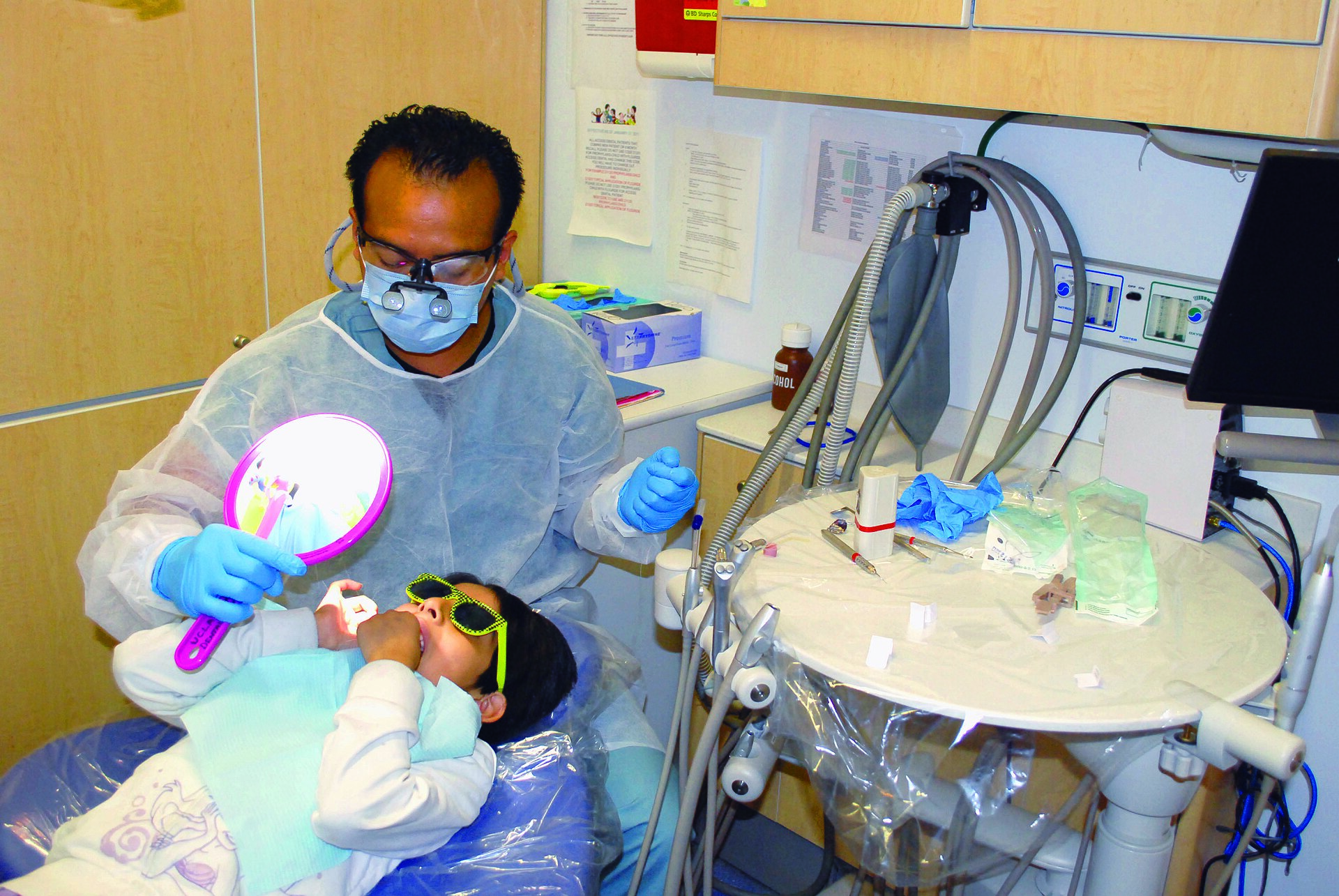

Idaho Medicaid buys dental care through a single statewide dental plan, Idaho Smiles, run by MCNA Dental. MCNA announced on Oct. 17, 2016 that it had won the contract through a competitive procurement as "sole dental benefits administrator" and would begin serving members statewide on Feb. 1, 2017; the company then described the program as covering about 280,000 children and adults.33 Health and Welfare's dental page, updated April 9, 2026, still names MCNA as "the Medicaid dental plan for the entire state of Idaho."34 The plan is a prepaid ambulatory health plan (PAHP): a managed care arrangement that covers only one kind of service. Idaho's FFY2021 CHIP report lists a dental PAHP among the delivery systems for CHIP children as well.14 Medicaid managed care contracts in general are the subject of Idaho Medicaid lesson 07.
On the Core Set dental measures, Idaho is above the median. In the 2025 reports, 53.5 percent of Idaho Medicaid and CHIP children under 21 had a periodic or full oral evaluation by a dental provider during the year (median 46.8 percent), including 59.9 percent of children 3 to 5 and 64.5 percent of children 6 to 14. Among children who turned 10, 60.5 percent had a sealant on at least one permanent first molar (median 53.7 percent) and 41.9 percent on all four (median 37.6 percent).9 Infants and toddlers are the weak spot everywhere: only 24.7 percent of Idaho children under 3 had an oral evaluation, which is still slightly above the 23.1 percent median.
These measures count children with a dental visit; they do not measure whether a child with a cavity got it filled, how far a family drove, or how long the wait was. Dentist participation and travel distance in rural counties such as Camas, Lincoln and Idaho County are not in the federal data. MCNA's network files and appointment-availability reports to Health and Welfare would be the records to request.
Katie Beckett: children with disabilities at home
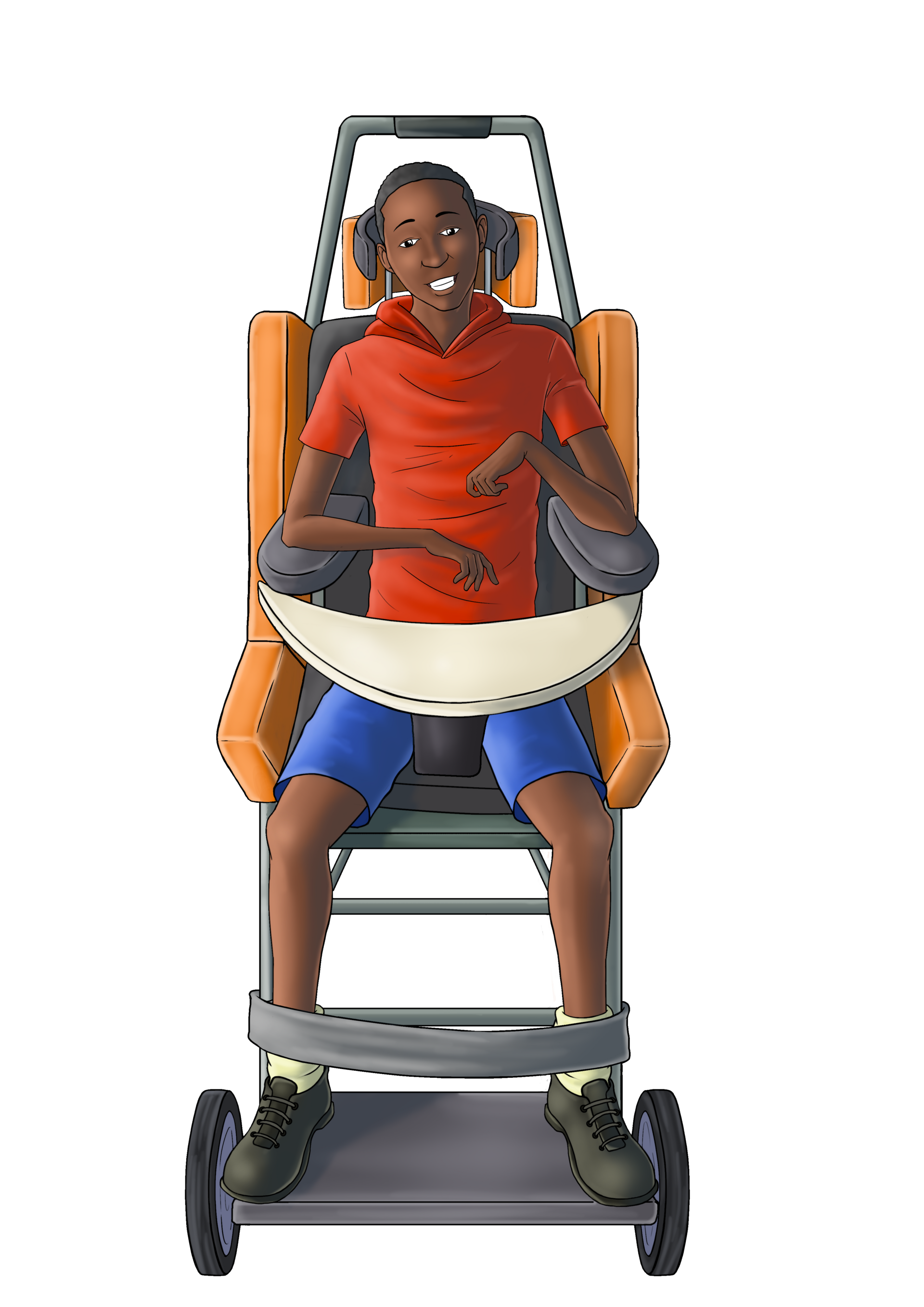

Where the name comes from
Katie Beckett was born in 1978 in Iowa. At about 5 months old she developed viral encephalitis and became dependent on a ventilator. Medicaid paid for her care while she was a hospital inpatient but, under the rules then, would not pay for the same care at home, even though home care cost less, because her parents' income would be counted once she left the hospital.35 NPR reported that she spent more than two years at St. Luke's Methodist Hospital in Cedar Rapids, and that President Ronald Reagan raised her case at a Nov. 10, 1981 news conference, saying hospital care cost about six times as much as care at home.36 Federal officials waived the rules for her just before Christmas 1981. Congress then wrote a general option into the Tax Equity and Fiscal Responsibility Act of 1982 (TEFRA, P.L. 97-248, signed Sept. 3, 1982), section 134. Katie Beckett died in 2012 at age 34.35
What federal law allows
Social Security Act section 1902(e)(3) (42 U.S.C. 1396a(e)(3)) lets a state cover a child who:
- is 18 or younger and meets the SSI definition of disability;
- has been found by the state to need "a level of care provided in a hospital, nursing facility, or intermediate care facility" for people with intellectual disabilities (ICF/IID);
- can appropriately be cared for outside the institution; and
- would cost Medicaid no more at home than in the institution.
If the child "were in a medical institution, would be eligible," the child is treated as if receiving SSI.7 In practice that is the whole point: for a child in a medical institution for a long stay, eligibility is generally figured on the child's own income and resources, and parents' income is not "deemed" (counted) to the child. The TEFRA option carries that rule home. The option is sometimes called the TEFRA group or, in Idaho rules, "Home Care for Certain Disabled Children" (HCCDC). It is a state plan option, not a waiver, so there are no slots or waiting lists: every child who meets the test must be covered. States that want a cap can use a 1915(c) waiver instead, and some do.
How Idaho's version works
Idaho's rule is IDAPA 16.03.05.785, "Certain Disabled Children" (effective July 1, 2024). A child qualifies if the child:8
- is under 19;
- meets the Aid to the Aged, Blind and Disabled (AABD) disability or blindness criteria;
- meets the AABD single-person resource limit (the child's own resources);
- has monthly income of no more than three times the federal SSI benefit for one person (the child's own income);
- meets the medical conditions for long-term care in IDAPA 16.03.26;
- can be appropriately cared for outside an institution under a physician's plan of care; and
- can be cared for at home at a cost no greater than care in a hospital, nursing facility or ICF/IID.
Section 785.08 adds a share of cost: "The financially responsible adult of a certain disabled child, who has family income above one hundred fifty percent (150%) of the federal poverty guidelines, is required to share in the cost of the child's Medicaid benefits" under the Idaho Medicaid State Plan and Idaho Code section 56-2203.8 Health and Welfare's Katie Beckett page (updated April 23, 2025) says the program is for children "living at home with long-term disabilities or complex medical needs," who may qualify "even if their family income is above Medicaid federal poverty guidelines," that "a premium will be assessed based on your family's income," and that if the family cannot pay, "your child's eligibility won't be impacted."37
The page lists two kinds of qualifying need. For a developmental disability: a chronic condition such as autism, intellectual disability, seizure disorder or cerebral palsy; substantial limits in at least three major life activities; and a need for lifelong or extended services. For a complex medical need or physical disability: a chronic condition, a disability that meets SSI criteria, a need for the level of care provided in a medical institution, a physician's evaluation of the services needed at home, and appropriate home accommodations.37
The income test is the child's own income, not the family's. Health and Welfare's January 2026 table lists the Katie Beckett limits as $3,002 a month of income and $2,000 of resources for the child.3 Three times the 2026 SSI federal benefit rate is $2,982 (3 times $994; SSA lists the 2026 individual amount as $11,929.46 a year, which is $994 a month rounded down); the $3,002 figure is Health and Welfare's and its derivation is not explained on the page.38 For 2027, SSA's published individual SSI amount is $1,029 a month, which would put three times SSI at $3,087 if Idaho keeps the same rule; Health and Welfare had not posted 2027 figures on Nov. 22, 2026.38 Very few children have income of their own, so for most families the income test is met and the questions that decide the case are disability and level of care.
How a Katie Beckett application moves
Health and Welfare's "Apply for Katie Beckett" page (updated Jan. 15, 2026) describes three stages:39
- Medicaid application. The family applies for Medicaid (online at idalink, by phone, in person, or by mail, email or fax) and writes "Katie Beckett" at the top of a paper form. The page lists what to have ready: identification, household income and immigration status if it applies.
- Katie Beckett packet. Health and Welfare mails a packet after the Medicaid application. The family returns it to Liberty Healthcare Corporation, Idaho's Independent Assessment Services contractor in Boise.
- Level of care determination. Liberty Healthcare decides whether the child meets the institutional level of care, using information from the child's doctors and other providers; some children need an in-person appointment and some do not. The family gets two notices: one on Medicaid financial eligibility and one on the medical determination.
- Annual review. Eligibility is re-evaluated every year by mailed notice that the family must answer.
- Appeals. A denial can be appealed through Health and Welfare's fair hearing process (see Idaho Medicaid lesson 08).
The Katie Beckett premium
The premium schedule is in IDAPA 16.03.18.205 (version effective July 1, 2024). Families with household income above 150 percent and up to 185 percent of the poverty guideline pay $15 a month, with a maximum of $30 a month. Above 185 percent, the monthly premium is a fixed percentage of household income:18
| Household income, percent of poverty guideline | Monthly premium | 2026 annual income range, family of four (our calculation) |
|---|---|---|
| Up to 150% | None | Up to $49,500 |
| Above 150% to 185% | $15 (maximum $30) | $49,501 to $61,050 |
| Above 185% to 250% | 1.0% of household income | $61,051 to $82,500 |
| Above 250% to 300% | 1.5% | $82,501 to $99,000 |
| Above 300% to 400% | 2.0% | $99,001 to $132,000 |
| Above 400% to 500% | 2.5% | $132,001 to $165,000 |
| Above 500% to 600% | 3.0% | $165,001 to $198,000 |
| Above 600% to 700% | 3.5% | $198,001 to $231,000 |
| Above 700% to 800% | 4.0% | $231,001 to $264,000 |
| Above 800% to 900% | 4.5% | $264,001 to $297,000 |
| Above 900% | 5.0% | Above $297,000 |
The rule also says that failure to pay "will not cause the participant to lose coverage or eligibility for services"; that the premium is waived for "undue hardship" (when an unexpected expense would force the household to go without basic food or shelter); that a family that does not provide the information needed to set the premium may be charged the average monthly cost of Enhanced Plan coverage for HCCDC children; and that the premium is recalculated each year or sooner when income drops.18 In 2025 the Legislature passed House Bill 345 (session law chapter 118, signed March 19, 2025), which added Idaho Code section 56-2203 directing Health and Welfare to seek federal approval, starting no later than July 1, 2026, for participant cost-sharing "at least to the levels developed by other states and up to the maximum charged by other states," to the extent federal law allows.40 Whether that has changed or will change any children's premium was not public on Nov. 22, 2026; it is listed as unverified.
How we figured it: a hypothetical Katie Beckett premium
Hypothetical example. A family of four in Twin Falls has household income of $90,000 a year in 2026, and one child qualifies for Katie Beckett. This family is made up for illustration.
Where the family falls. The 2026 poverty guideline for four is $33,000.15 $90,000 divided by $33,000 is 272.7 percent, inside the "above 250 percent to 300 percent" band, where the premium is 1.5 percent of household income under IDAPA 16.03.18.205 (2024 version).18
Math. Monthly household income is $90,000 divided by 12, or $7,500. 1.5 percent of $7,500 is $112.50 a month, or $1,350 a year.
Limits. This assumes the 2024 schedule is still in force and that Health and Welfare counts household income the way the example does; the rule does not say in this section whether income is gross or after deductions. It is not an estimate of any real family's bill.
How many Idaho children use Katie Beckett
We did not find a current published count. Health and Welfare's Katie Beckett pages do not give one, and CMS's monthly enrollment data do not separate the TEFRA group. The count, the cost per child, the number of families paying a premium, and the premium revenue collected are all records Health and Welfare would hold; this lesson lists them as unverified and as a records request in the reporting box. Nationally, NPR reported in 2010 that more than 500,000 children had been covered under Katie Beckett-type rules since 1982; that figure is the network's, not a federal count.36
Children with developmental disabilities
Health and Welfare defines a developmental disability, following Idaho law, as a chronic disability that appears before age 22, is attributable to an impairment such as intellectual disability, cerebral palsy, epilepsy, autism or a similar condition, results in substantial functional limits in three or more major life activities, and requires services of lifelong or extended duration. A child must first be on Medicaid and then be found eligible by an independent assessor.41 Adult services, the K.W. v. Armstrong settlement and the 2026 cuts to adult residential habilitation are in lesson 04.
From waivers to a state plan benefit
Idaho used to run two 1915(c) waivers for children with developmental disabilities who met an ICF/IID level of care: the Children's Developmental Disabilities Waiver (control number 0859) for ages 0 to 17 and the Act Early Waiver (0887) for ages 3 to 6. CMS's waiver list shows both terminated June 30, 2019.42 Children's home and community-based DD services now run under a 1915(i) state plan benefit. Section 1915(i) lets a state offer home and community-based services through its state plan, to people who need them but do not have to meet an institutional level of care; unlike a waiver, there are no enrollment caps, but the federal law limits it to people with income up to 150 percent of poverty unless the state elects an optional group.
CMS approved Idaho's renewal of the children's DD 1915(i) benefit as SPA ID-26-0001: submitted Dec. 29, 2025, approved in June 2026 (the cover letter is dated June 2, 2026 and the CMS-179 form shows June 26, 2026), effective July 1, 2026, for five years to June 30, 2031. The SPA covers children from birth through 17 with a developmental disability under state law and income up to 150 percent of the federal poverty line; Idaho did not elect the optional higher-income group. It projects 4,847 children served in the first year (July 1, 2026 to June 30, 2027).25 Children who qualify for Medicaid through Katie Beckett are counted on their own income, so they can meet the 1915(i) income test even when their families' income is higher.
| Service in the children's DD 1915(i) benefit (SPA ID-26-0001) | What it is (IDAPA 16.03.26.582 where defined) |
|---|---|
| Respite | Short-term supervision to relieve an unpaid caregiver or respond to a family emergency; not to let a caregiver work; no more than 14 consecutive days |
| Community-based supports | Help practicing skills in typical community activities; may not replace school, therapy or a parent's role |
| Family education | Professional help for caregivers on the child's disability and behavior strategies; groups of up to five families |
| Home modification | Changes to the home tied to the child's needs |
| Adaptive and therapeutic equipment | Equipment tied to the service plan |
| Family-directed personal support; goods and services; non-medical transportation | Family-Directed Community Supports (FDCS): the family directs an individual budget and acts as the employer |
| Financial management services; support broker services | Payroll and budget help, and planning help, for families who direct services |
Source: CMS, SPA ID-26-0001; IDAPA 16.03.26.580 to 586 (effective July 1, 2026).2519
Each child gets an individual budget set by category. IDAPA 16.03.26.581.02 sets four levels: Level I for children who meet DD criteria; Level II for children with functional limits shown by a composite standard score under 50, or up to 53 with a moderate maladaptive behavior score; Level III for children with a composite score under 50 and an autism diagnosis; and Level IV for children whose maladaptive behavior score is two or more standard deviations from the mean. Budgets are re-evaluated every year. Paid plan development is provided by the department.19 Intensive habilitative services for children, which the rules abbreviate as CHIS, are provided "in accordance with EPSDT" rather than inside the 1915(i) budget, according to the school-based services section of the same rule (IDAPA 16.03.26.322.02).19
The budget documents for the 2026 session show one structural change: as of state fiscal year 2026, the Medicaid administration program includes "children's developmental disability services (formerly in DD Services)."23 How the move changed staffing, wait times for assessments, or the number of children served is not in those documents.
For very young children, Idaho also runs the Infant Toddler Program under Part C of the federal Individuals with Disabilities Education Act, which serves children from birth to 3 with developmental delays. It is a separate early intervention program with its own federal rules, and its details are outside this lesson.
Youth Empowerment Services for children with serious emotional disturbance
Youth Empowerment Services (YES) is Idaho's system of mental health care for children with serious emotional disturbance (SED). It grew out of Jeff D. v. Otter (now v. Little), a federal class action filed in 1980 over the treatment of children with mental illness in Idaho. After mediation from September 2013 through December 2014, the parties reached a settlement agreement; the court ordered an Idaho Implementation Plan in 2016 and approved a new Implementation Assurance Plan in January 2022, which remains the active framework. The YES website gives the approval date as Jan. 25, 2022; the state's 2025 report to the court, citing the docket, gives Jan. 24, 2022.4344 The state's 2024-2025 annual report to the court is posted on the YES website.44
For Medicaid, YES works through a 1915(i) state plan option described in IDAPA 16.03.26.640 to 642: a Department-designated independent assessor does a clinical assessment of the child's needs and functional impairment, eligibility is redetermined every 12 months, and services include respite care for unpaid caregivers (paid through managed care contracts) and person-centered planning.19 Health and Welfare's 2026 income table lists the YES limit as $8,250 a month for a family of four, which is 300 percent of the poverty guideline.3 Most outpatient mental health services for Medicaid children run through the Idaho Behavioral Health Plan, managed by Magellan.20 The behavioral health plan, crisis centers and the full YES story are in lesson 05.
School-based Medicaid


Federal special education law, the Individuals with Disabilities Education Act (IDEA), requires public schools to provide the services in each student's Individualized Education Program (IEP), whether or not anyone else pays. Medicaid can pay for the health-related part of those services when the student is on Medicaid, which lets schools recover part of what they spend.
What Idaho schools can bill
Idaho's rules are IDAPA 16.03.26.320 to 327 (effective July 1, 2026). School-based services are "health-related and rehabilitative services provided by Idaho public school districts and charter schools under" IDEA. A student is eligible through age 21 (through the end of the semester in which the student turns 21), with a one-time parental consent to bill public benefits. Billable services, when recommended by a qualified provider and identified on the IEP, include behavioral intervention and consultation (consultation is limited to 36 hours a year), crisis intervention (usually no more than 30 school days), habilitative skill building, occupational, physical and speech therapy, psychological evaluation, psychotherapy, personal care, skills building for students with serious emotional disturbance or serious mental illness, social history and evaluation, and equipment for the student's exclusive use. Routine nursing, first aid and non-routine medications not on the plan are not reimbursed. Services for a student who is an inpatient in a hospital or nursing home are excluded.19
Health and Welfare's school-based services page (updated March 31, 2026) adds three protections: parents are notified that the school intends to bill Medicaid, schools that choose not to bill must still provide every IDEA service, and a child's loss of Medicaid should not affect the IEP.45
Who pays the state share
Idaho does not pay the state share of school-based Medicaid from Health and Welfare's budget. IDAPA 16.03.26.326.02 says "Federal funds cannot be used as the State's portion of match for Medicaid service reimbursement," and sets up the process: each district estimates its monthly billings, sends the matching funds to Health and Welfare by check or electronic transfer, and the department holds them in an interest-bearing trust account. Payments to the district "include both the federal and non-federal share." If a district's match is not posted before the weekly payment cycle, "all Medicaid payments to the school district will be suspended" until it is.19 In other words, the district puts up the state share from its own (state or local) money and gets the federal share as new money.
How we figured it: the school claim
Inputs. Idaho's FY2027 FMAP, 67.31 percent, applies to Medicaid services from Oct. 1, 2026 to Sept. 30, 2027.17 The $100 claim is a hypothetical example.
Math. Federal share: $100 times 0.6731 is $67.31. Non-federal share: $100 minus $67.31 is $32.69, supplied by the district under IDAPA 16.03.26.326.02.19 In FY2026 (FMAP 66.91 percent) the same claim would have split $66.91 and $33.09.16
Limits. Real payments use Health and Welfare's fee schedule for each service, not a round $100. Administrative claiming (the cost of school staff time spent on Medicaid outreach and enrollment) uses a separate method not covered here.
How much Idaho schools receive
The Idaho State Department of Education told the Legislature's Medicaid Managed Care Task Force on Nov. 7, 2023 that Medicaid reimbursement to schools, labeled "after match," was $32,395,579 in school year 2019-2020, $29,748,212 in 2020-2021, $36,091,837 in 2021-2022 and $38,968,536 in 2022-2023. For 2021-2022 it compared Medicaid's $36.1 million with $57.0 million in IDEA Part B section 611 grants and $219.3 million of district state funds spent on special education. Its slides note that "School-Based Medicaid pays before IDEA funding."46 By our calculation, the 2022-2023 figure is 20.3 percent above 2019-2020. District-by-district amounts were not in the slides; they would be in Health and Welfare's payment records and in district budgets.
Federal guidance on school-based services changed in 2023. On May 18, 2023, CMS released a guide, "Delivering Service in School-Based Settings," and an informational bulletin explaining that schools may bill Medicaid for covered services to Medicaid-enrolled students whether or not the service is in an IEP and whether or not it is offered free to other students, and describing ways to simplify billing.47 Idaho's 2026 rule still ties school billing to services identified on the IEP (and, for some services, a recommendation or referral within 365 days).19 Whether Idaho will widen school billing beyond IEP services is a policy choice for Health and Welfare and the Legislature.
Children in state custody and young adults who aged out
Children in the custody of Idaho's child welfare system are covered by Medicaid through several routes. Children for whom the state receives federal title IV-E payments (for out-of-home care, adoption assistance or guardianship assistance) are eligible for Medicaid by federal law; Health and Welfare's children's page lists Title IV-E out-of-home care (which it says reaches ages up to 26) and non-IV-E out-of-home care, adoption and guardianship among its covered services.20 The LSO budget summary places such children in the Enhanced Plan, along with children who have disabilities or special health needs.23
The Affordable Care Act added a mandatory Medicaid group for young adults under 26 who were in state custody and on Medicaid when they turned 18, regardless of income: Social Security Act section 1902(a)(10)(A)(i)(IX).7 Idaho's rule, IDAPA 16.03.01.525, covers a person between 18 and 26 who was in out-of-home care and became ineligible for that Medicaid group because of age: "There are no financial eligibility criteria. The only non-financial criteria are the receipt of" those services "and age."2 The 2025 federal law lists this group among the people excluded from Medicaid work requirements (new Social Security Act section 1902(xx)(9)(A)(ii)(I), added by P.L. 119-21 section 71119).22
Health and Welfare does not publish, on the pages reviewed for this lesson, how many former youth in state custody are enrolled in this group or how many eligible young adults are not. Those counts, and the number of children in out-of-home care who are on Medicaid, are records requests.
What the 2025 federal law does to children's coverage
P.L. 119-21, signed July 4, 2025, is the subject of lesson 12, and its work requirements and Idaho's House Bill 913 are in Idaho Medicaid lesson 06. Most of the Medicaid provisions are aimed at expansion adults. A few reach children directly. The table sorts them.22
| Section of P.L. 119-21 | What it does | Start | Does it reach children? |
|---|---|---|---|
| 71109, alien Medicaid eligibility | Limits federal Medicaid and CHIP payment to citizens and nationals, lawful permanent residents, Cuban and Haitian entrants and people living here under a Compact of Free Association | Oct. 1, 2026 | Yes. Applies to children and to CHIP (except for payments for services under section 2105(a)(1)(D)(ii) of the Social Security Act) |
| 71112, retroactive coverage | Cuts coverage before the application month from 3 months to 1 for expansion adults and to 2 for everyone else; adds a 2-month limit for CHIP if the state offers retroactive CHIP | Applications on or after Jan. 1, 2027 | Yes. A child's coverage can reach back 2 months instead of 3 |
| 71103, duplicate enrollment | States must have a process to get updated addresses by Jan. 1, 2027 and must send enrollees' Social Security numbers to a federal system monthly by Oct. 1, 2029; applies to CHIP | Jan. 1, 2027 and Oct. 1, 2029 | Yes, as an administrative check |
| 71102, 2024 eligibility rule moratorium | Blocks HHS from enforcing listed parts of the April 2, 2024 enrollment rule, including five CHIP sections (42 CFR 457.344, 457.960, 457.1140(d)(4), 457.1170 and 457.1180) | Through Sept. 30, 2034 | Yes, for the listed sections only; 457.570 (no CHIP lockouts) is not on the list |
| 71107, six-month renewals | Redeterminations every 6 months | Renewals on or after Jan. 1, 2027 | No. Expansion adults only; children keep 12-month continuous eligibility |
| 71119, work requirements | Community engagement for expansion adults 19 to 64 | See Idaho Medicaid lesson 06 | No. Also exempts parents and caretakers of a child 13 or under or of a disabled person, and young adults under 26 who aged out of state custody |
| 71120, cost sharing | Up to $35 per service for expansion adults above 100% of poverty | Oct. 1, 2028 | No |
| 71115 and 71116, provider taxes and state directed payments | Limits on how states raise the state share and pay hospitals | Phased, FY2028 onward | Indirectly, through the state budget and hospital finances (lesson 12) |
Source: P.L. 119-21 (July 4, 2025), sections as named, from the enrolled text on govinfo.gov.2221
The immigrant eligibility change is the one most likely to end some children's federally funded coverage. Children who are U.S. citizens, including U.S.-born children of immigrant parents, are not affected by section 71109. Children with some humanitarian statuses who could get Medicaid before may lose federal coverage unless they also hold one of the listed statuses; how many Idaho children that is, Health and Welfare has not published. Emergency Medicaid is a separate category; section 71110 changes its federal match for expansion adults, not its availability.22
Pictures, Numbers and Infographics
The key numbers in this lesson, with their year and source. Shares, differences and dollar conversions marked as ours are our calculations from the cited figures.
| Measure | Idaho | U.S. or other states | Year | Source |
|---|---|---|---|---|
| Children in Medicaid and CHIP | 148,513 | 35,242,443 (50 states and D.C.) | June 2026 | CMS enrollment data1 |
| Children's share of all Medicaid and CHIP enrollees | 48.4% (ours) | 47.8% (ours); Utah 49.6%, Wyoming 67.5%, Oregon 36.6% | June 2026 | CMS enrollment data1 |
| Drop in children's enrollment from the March 2023 peak | 64,514, or 30.3% (ours) | not computed | March 2023 to June 2026 | CMS enrollment data1 |
| Separate CHIP enrollment | 19,076 (down 51.6% from 39,447, ours) | Utah 34,042; Montana 20,729 | June 2026 | CMS enrollment data1 |
| Uninsured children under 6 | 7.9% (about 10,700) | Fifth-highest rate among states | 2024 | Georgetown CCF, as reported by Idaho Capital Sun11 |
| Top children's income limit (before 5-point disregard) | 185% of poverty | Utah, Nevada, Wyoming 200%; Montana 261%; Oregon 300%; Washington 312% | Dec. 1, 2023 | CMS eligibility table10 |
| CHIP income limit, family of four | $5,225 a month (190%) | not compared | 2026 | Health and Welfare table3 |
| CHIP premium | $10 (133% to 150%); $15 (150% to 185%) | not compared | Rule effective July 1, 2024 | IDAPA 16.03.18.20018 |
| Federal share, Medicaid / CHIP | 67.31% / 77.12% | Utah 61.95% / 73.37%; Washington and Wyoming 50% / 65% | FY2027 | Federal Register, Nov. 28, 202517 |
| Blood lead test by age 2 | 34.8% | Median 63.3% | 2025 Core Set | CMS9 |
| Six or more well-child visits by 15 months | 63.9% | Median 60.6% | 2025 Core Set | CMS9 |
| Up to date on Combination 3 vaccines by age 2 | 35.1% | Median 60.2% | 2025 Core Set | CMS9 |
| Dental oral evaluation, under 21 | 53.5% | Median 46.8% | 2025 Core Set | CMS9 |
| Children's DD 1915(i), projected children | 4,847 | not compared | July 2026 to June 2027 | SPA ID-26-000125 |
| Katie Beckett child income limit | $3,002 a month (DHW); 3 x SSI = $2,982 (ours) | not compared | 2026 | DHW table; SSA338 |
| Medicaid reimbursement to Idaho schools | $38,968,536 | not compared | School year 2022-2023 | Idaho State Dept. of Education46 |
| Continuous eligibility for children | 12 months | 12 months in every state | Since Jan. 1, 2024 | P.L. 117-328 section 5112; IDAPA 16.03.01.52442 |
Common mistakes
- "CHIP is a different card and a different network." In Idaho, children in Medicaid and CHIP apply through the same process and use Medicaid's providers; the difference is mostly in the federal funding stream and in premiums for the separate CHIP income band.1418
- "A raise in the middle of the year ends the child's coverage." Since Jan. 1, 2024, a child found eligible keeps coverage for 12 months unless the child turns 19, moves out of state, dies, the family asks to end it, or eligibility was granted in error.4272
- "If the state plan does not list a service, Medicaid will not pay for it for my child." For a Medicaid child under 21, EPSDT requires coverage of any service on the federal 1905(a) list that is medically necessary to correct or ameliorate a condition, "whether or not" the state plan covers it, subject to prior authorization.519
- "A visit limit is a hard cap for children." CMS's SHO 24-005 says states may not apply hard limits to EPSDT services; a limit can trigger review, not end coverage.6
- "A lead questionnaire counts as lead screening." For Medicaid children, CMS says a risk questionnaire "does not meet the Medicaid requirement"; a blood test at 12 and 24 months does.31
- "Katie Beckett is a waiver with a waiting list." The TEFRA option in section 1902(e)(3) is a state plan option, so every child who meets the test must be covered; Idaho's version is a rule in IDAPA 16.03.05.785, not a capped waiver. Some other states use waivers with slots, which is where the confusion comes from.78
- "Not paying the Katie Beckett premium ends coverage." Idaho's rule says failure to pay "will not cause the participant to lose coverage or eligibility for services," and Health and Welfare's page says the same.1837
- "Idaho still has a children's DD waiver." The Children's DD Waiver and the Act Early Waiver ended June 30, 2019; children's DD home and community-based services now run under the 1915(i) state plan benefit renewed in SPA ID-26-0001.4225
- "School Medicaid money comes out of Health and Welfare's budget." Under IDAPA 16.03.26.326, the district supplies the non-federal match and gets back the federal share.19
- "The 2025 federal law's six-month renewals and work requirements apply to families with children." Six-month renewals apply to expansion adults, and work requirements exempt parents and caretakers of children 13 and under; children's 12-month continuous eligibility is unchanged.22
- Reading enrollment drops as uninsured counts. CMS's monthly counts show how many children are enrolled, not how many became uninsured; Census survey data, which lag by about two years, are the source for uninsured rates.111
What we know, what we don't, and what the data can show
What we know
- Idaho covered 148,513 children in Medicaid and CHIP in June 2026, down 30.3 percent from March 2023, with separate CHIP down about half.1
- Idaho's children's income limits (142, 133 and 185 percent of poverty plus a 5 point disregard) are the lowest top line among the seven states compared here.210
- EPSDT in Idaho follows the AAP schedule and covers services beyond the state plan when prior authorized (IDAPA 16.03.26.352).19
- Idaho beats the median on early infant visits and dental exams and trails it badly on lead tests, developmental screening and vaccines in CMS's 2025 Core Set.9
- Idaho's Katie Beckett group is in rule, with a sliding premium above 150 percent of poverty that does not end coverage if unpaid.818
- The children's DD 1915(i) benefit is renewed to June 30, 2031, with 4,847 children projected in its first year.25
What we don't know
- How many Idaho children are enrolled through Katie Beckett, what they cost, and how many families pay a premium.
- Whether the 2024 CHIP and Katie Beckett premium amounts are still the ones in force after the 2026 rule reorganization, and whether the cost-sharing plan required by Idaho Code 56-2203 will change them.40
- How many children's therapy requests above the 2026 session limits were approved or denied.29
- Why Idaho's lead, developmental screening and vaccine rates are low: missed services, coding, parental choice, or provider practice.
- How many Idaho children will lose federally funded coverage under section 71109's immigrant eligibility limits.22
- How children's enrollment breaks down by county in 2026.
What the data can show
- CMS monthly enrollment data (data.medicaid.gov) can show the month-by-month trend in children's and CHIP enrollment for Idaho and every other state.1
- The Child Core Set (data.medicaid.gov, yearly) can show whether Idaho's lead, vaccine and screening rates improve, and how they compare with the median and neighbors.9
- Form CMS-416 (Medicaid.gov, yearly by federal fiscal year) can show EPSDT screening and dental counts by age group.32
- Idaho's CHIP annual reports on Medicaid.gov can show CHIP enrollment by type, premiums and dental use.14
- Census Bureau American Community Survey and CCF analyses can show the share of Idaho children with no insurance, with a lag of about two years.11
- Health and Welfare records (by public records request) can show county counts, Katie Beckett enrollment and premiums, therapy prior authorization decisions, and school district Medicaid payments.
Questions people ask
Is CHIP free in Idaho?
Not for every family. Under the 2024 version of IDAPA 16.03.18.200, families in the separate CHIP range pay $10 a month (above 133 percent to 150 percent of poverty) or $15 a month (above 150 percent to 185 percent), and Health and Welfare's children's page describes a $10 monthly reduction for a child who is current on well-child checkups and immunizations. Children in the Medicaid income range pay no premium.1820 The amounts in force after the 2026 rule changes should be confirmed with Health and Welfare.
Does Katie Beckett count the parents' income?
Not for eligibility. Federal law (Social Security Act 1902(e)(3)) and Idaho's rule (IDAPA 16.03.05.785) look at the child's own income and resources. Parents' household income is used to set the premium for families above 150 percent of poverty.7837
Can a child with private insurance also have Medicaid?
For Medicaid, including Katie Beckett, yes: private insurance pays first and Medicaid pays after it, as the "payer of last resort." Separate CHIP is different. IDAPA 16.03.01.523 makes a child ineligible for CHIP if the child is covered by creditable health insurance when applying, is eligible for Medicaid, or is eligible for Idaho's state employee health plan.2
Until what age does EPSDT apply?
Under 21. Idaho's rule makes EPSDT available "from birth through the month of their twenty-first birthday." CHIP and children's Medicaid eligibility, by contrast, end at 19; EPSDT continues for 19- and 20-year-olds who are on Medicaid in another group, such as expansion adults or young adults who aged out of state custody.195
Who decides whether a child's service is medically necessary?
The screening provider documents the need, and Health and Welfare or its contractor decides prior authorization requests case by case against department criteria. Under federal law the test is whether the service corrects or ameliorates the condition, and a service need not cure the condition to qualify. A family can ask for a fair hearing on a denial (Idaho Medicaid lesson 08).196
Does a school need a parent's permission to bill Medicaid?
Yes. Idaho's rule requires "a one-time parental consent to access public benefits or insurance" before a district bills Medicaid, and Health and Welfare says parents are notified of the school's intent to bill. A parent's refusal does not change the school's duty to provide the services in the IEP.1945
Will CHIP run out of federal money?
CHIP's federal funding is set by Congress for a fixed period. CBO's February 2026 baseline says title XXI provides funding through September 2029 and, under budget scoring rules, assumes it continues after that.26 Whether Congress extends it, and on what terms, has not been decided. Medicaid coverage for children below the Medicaid limits does not depend on CHIP funding.
Hard questions
Should Idaho raise its children's income limit?
The case for: Idaho's top limit, 185 percent of poverty, is the lowest of the seven states compared; the federal government pays 77.12 percent of CHIP costs in FY2027, so each state dollar draws about $3.37 in federal money; and Idaho's uninsured rate for children under 6 rose to 7.9 percent in 2024.101711 The case against: families above 185 percent of poverty usually have access to job-based coverage or subsidized marketplace plans; a higher limit adds state cost when the Legislature is cutting Medicaid provider rates; and CHIP's federal funding is not permanent.26 What the evidence shows: the 2024 uninsured data predate most of the post-unwinding changes, and no Idaho-specific study we found estimates how many uninsured children are above 185 percent versus eligible but unenrolled. The first number decides whether a higher limit or better enrollment would reach more of them. (The $3.37 is our arithmetic: 77.12 divided by 22.88.)
Do the 2026 therapy session limits square with EPSDT?
Health and Welfare's side: the department told the Statesman that the change came from a regular policy review and that other states use similar caps; children can get more than 20 sessions with prior authorization, which lets the state check medical necessity it did not check before.29 Families' and therapists' side: the change took effect before providers were told, added paperwork for children whose need is lifelong, and, if requests are slow or denied, can interrupt therapy that federal guidance says must be covered when it maintains a child's function.296 What the evidence shows: a limit with a working exception process is allowed under SHO 24-005; a limit that operates as a ceiling is not. Whether Idaho's works one way or the other depends on approval rates and decision times that have not been published.
Should families pay premiums for Katie Beckett?
The case for: Katie Beckett covers children regardless of family income, including higher-income families; a sliding premium asks those families to share costs, and the 2025 Legislature directed Health and Welfare to seek cost sharing up to the levels of other states (Idaho Code 56-2203).40 The case against: these families often face large costs Medicaid does not pay (lost work hours, home changes, travel to specialists), and premiums add paperwork and billing for the state. What the evidence shows: Idaho's rule already avoids the harshest result by not ending coverage for nonpayment and by allowing hardship waivers.18 How much the premiums bring in, and what it costs to collect them, has not been published.
Was Idaho's fast unwinding good policy for children?
Health and Welfare's side: the state was "one of the first in the nation to begin and finish" unwinding, as federal law required, and removing people who no longer qualified saved state money.11 Advocates' side: Idaho Voices for Children said most children removed were dropped for not returning paperwork, not because they were found ineligible.11 What the evidence shows: the CMS data show children's enrollment fell 26.1 percent in six months and kept drifting down; the uninsured rate for young children rose between 2022 and 2024.111 Neither source can sort out how many removed children were still eligible; Health and Welfare's renewal outcome data by age would.
For reporters and advocates
Records that exist. CMS's monthly enrollment data and the yearly Child Core Set on data.medicaid.gov; Form CMS-416 files and Idaho's CHIP annual reports on Medicaid.gov; Idaho's state plan amendments, including SPA ID-26-0001 for children's DD services; IDAPA 16.03.01, 16.03.05 and 16.03.26 and the rulemaking dockets behind them; Health and Welfare's budget requests and the Legislative Services Office budget documents presented to JFAC; the MCNA and Magellan contracts and their required reports; the Jeff D. annual reports and court filings for YES; and school district budgets showing Medicaid revenue and match.193214252344
Questions to ask Health and Welfare. How many children are enrolled through Katie Beckett, by region, and how many families pay a premium; how much premium revenue was collected in state fiscal year 2026; are the IDAPA 16.03.18 premium schedules still in force, and what has the department submitted to CMS under Idaho Code 56-2203; how many children's therapy requests above 20 sessions were submitted, approved, partly approved and denied in 2026, and how long decisions took; what is the department doing about the lead screening and vaccine rates in the Core Set; how many children were removed at renewal for procedural reasons in 2023 to 2026; how many children will be affected by section 71109 on Oct. 1, 2026; and how many young adults who aged out of state custody are enrolled under IDAPA 16.03.01.525.
Questions for school districts. How much did the district bill Medicaid last year, how much match did it deposit, and which services did it bill? Treasure Valley districts (Boise, West Ada, Nampa, Caldwell) and Magic Valley districts (Twin Falls, Kimberly, Buhl, Gooding, Minidoka County, Cassia County) are public bodies whose budgets and Medicaid trust account statements are public records.
Getting records. Health and Welfare and school district records can be requested under the Idaho Public Records Act, Idaho Code Title 74, chapter 1; module 47, Idaho Public Records Requests, explains how. Health and Welfare's rules note that some records are confidential under IDAPA 16.05.01, so ask for counts and totals rather than case files. CMS records can be requested under the federal Freedom of Information Act. Public comment on rule changes and state plan amendments is explained in module 49, Testifying and Public Comment, and how rules are made is in module 27, Laws and Rules. For reading the numbers, see Data and Statistics and Idaho Medicaid lesson 09.
The Idaho angle. Idaho's children's story has three numbers that do not fit together yet: a child enrollment count that fell faster than most states', a young-child uninsured rate that rose to fifth-highest, and Core Set rates showing babies get their visits but not their lead tests and shots. Each has a record behind it that has not been published. Data on duals, nursing homes and long-term care for the same families are in lesson 07 and lesson 08.
Where to go next
- idalink (Idaho Health and Welfare online benefits portal): The state's official site for applying for and renewing Medicaid and CHIP, reporting changes and reading notices. Free; requires an account.
- Idaho Health and Welfare: About Medicaid for Children: The department's plain-language page on children's Medicaid and CHIP benefits, dental and mental health contractors, and contact numbers. Free.
- Idaho Health and Welfare: Katie Beckett Program: The department's description of Katie Beckett criteria, premiums and the application steps with Liberty Healthcare's assessment. Free; for families and case managers.
- Youth Empowerment Services (YES): The state's site for the children's mental health system created under the Jeff D. settlement, with reports to the court and governance meeting materials. Free.
- CMS data.medicaid.gov: Federal open data portal with monthly enrollment and yearly Core Set quality measures by state; files download as CSV. Free; useful for reporters and researchers.
- DisAbility Rights Idaho: Idaho's federally designated protection and advocacy organization for people with disabilities, an advocacy group that publishes information on Medicaid services for children and adults. Free.
- Idaho Council on Developmental Disabilities: A state council that tracks developmental disability policy, including Medicaid rule changes, and posts plain-language summaries. Free.
- Idaho 211 CareLine: A free statewide information and referral line run by Health and Welfare that lists health and social service programs by area, including Treasure Valley and Magic Valley listings.
Still being checked (11 items)
These points could not be fully confirmed against a primary source when this lesson was written and fact checked in November 2026. The text above states each one as uncertain.
- Whether the CHIP premium amounts ($10 and $15) and the Katie Beckett (HCCDC) sliding premium schedule in the July 1, 2024 version of IDAPA 16.03.18 are still in force after Idaho's 2026 Medicaid rule reorganization; IDAPA 16.03.18 was not posted among current rules on Nov. 22, 2026, although Health and Welfare's pages still describe both premiums.
- How Health and Welfare derives its $3,002 Katie Beckett child income limit for 2026; three times SSA's 2026 individual SSI amount is $2,982 by our calculation.
- The number of Idaho children enrolled through Katie Beckett, their cost, and premium revenue; no current published count was found.
- Whether Idaho has submitted or will submit a cost-sharing state plan amendment under Idaho Code 56-2203 (2025) that would change any children's premiums.
- The law that moved CHIP's federal funding end date from Sept. 30, 2027 (HHS description of the 2018 laws) to September 2029 (CBO February 2026 baseline).
- Idaho's CMS-416 EPSDT participant ratio for FY2024; the CMS-416 files on Medicaid.gov could not be downloaded.
- County-level counts of children on Medicaid for Ada, Canyon, Twin Falls, Minidoka, Cassia and other counties; the Kids Count tables could not be downloaded.
- How many children's therapy requests above the 20-session limits that took effect Jan. 1, 2026 were approved or denied; reported only in news coverage of the Jan. 8, 2026 memo, not in a published Health and Welfare report.
- The exact measurement period of each 2025 Child Core Set measure (most count calendar year 2024 services) and whether Idaho's low lead and vaccine rates reflect coding as well as missed services.
- The number of Idaho children who will lose federally funded coverage under P.L. 119-21 section 71109 from Oct. 1, 2026.
- The neighboring states' 2025 Child Core Set rates in the comparison table; only Idaho's rows were in the downloaded CMS file, so the other states' figures were not rechecked against the dataset.
Last verified November 22, 2026. General education, not legal, medical, insurance or financial advice; every figure names its source and year in the Notes and Sources below. Data is revised: check the newest release before relying on any number.
Notes
- CMS, "State Medicaid and CHIP Applications, Eligibility Determinations, and Enrollment Data," data.medicaid.gov, Idaho reports February 2020 to June 2026 (updated) and July 2026 (preliminary), and all-state reports for June 2026; columns for Medicaid and CHIP child enrollment, total CHIP enrollment and total Medicaid and CHIP enrollment; shares and changes are our calculations (read Nov. 22, 2026). Read it online. ↩
- IDAPA 16.03.01, Eligibility for Health Care Assistance for Families and Children, sections 520 (financial eligibility for children), 523 (other coverage and CHIP), 524 (continuous eligibility for children under 19) and 525 (former foster child), effective July 1, 2024 (read Nov. 22, 2026). Read it online. ↩
- Idaho Department of Health and Welfare, "Medicaid Program Income Limits," January 2026 figures for CHIP, Youth Empowerment Services and the Katie Beckett program, page last updated April 20, 2026 (read Nov. 22, 2026). Read it online. ↩
- Consolidated Appropriations Act, 2023, P.L. 117-328 (Dec. 29, 2022), division FF, title V, section 5112 (12-month continuous eligibility for children in Medicaid and CHIP from Jan. 1, 2024) and section 5131 (end of the pandemic continuous enrollment condition on March 31, 2023); codified at Social Security Act section 1902(e)(12) (read Nov. 22, 2026). Read it online. ↩
- Social Security Act section 1905 (42 U.S.C. 1396d), subsections (a)(4)(B) and (r), with statutory notes showing EPSDT added by P.L. 90-248, section 302(a) (Jan. 2, 1968) and expanded by P.L. 101-239, section 6403 (Dec. 19, 1989), Legal Information Institute (read Nov. 22, 2026). Read it online. ↩
- CMS, Center for Medicaid and CHIP Services, SHO letter #24-005, "Best Practices for Adhering to Early and Periodic Screening, Diagnostic, and Treatment (EPSDT) Requirements," Sept. 26, 2024 (read Nov. 22, 2026). Read it online. ↩
- Social Security Act section 1902 (42 U.S.C. 1396a), subsections (a)(10)(A)(i)(IX) (former foster youth to 26), (a)(43) (EPSDT informing and reporting), (e)(3) (optional coverage of certain disabled children, added by section 134 of the Tax Equity and Fiscal Responsibility Act of 1982, P.L. 97-248, Sept. 3, 1982) and (e)(12) (continuous eligibility), Legal Information Institute (read Nov. 22, 2026). Read it online. ↩
- IDAPA 16.03.05, Eligibility for Aid to the Aged, Blind, and Disabled (AABD), section 785, Certain Disabled Children, subsections 01 to 08, effective July 1, 2024 (read Nov. 22, 2026). Read it online. ↩
- CMS, "2025 Child and Adult Health Care Quality Measures," data.medicaid.gov (dataset modified Sept. 22, 2026; source note: Mathematica analysis of Quality Measure Reporting system reports for the 2025 Core Set as of April 28, 2026); rows for Idaho, Utah, Oregon, Washington, Montana, Wyoming and Nevada, measures W30-CH, WCV-CH, LSC-CH, DEV-CH, CIS-CH, OEV-CH and SFM-CH, with state means and medians; differences from the median are our calculations (read Nov. 22, 2026). Read it online. ↩
- CMS, "Medicaid, Children's Health Insurance Program, and Basic Health Program Eligibility Levels," data as of Dec. 1, 2023, Medicaid.gov (read Nov. 22, 2026). Read it online. ↩
- Kyle Pfannenstiel, "Idaho has the fifth-highest rate of uninsured young kids, report finds," Idaho Capital Sun, June 1, 2026 (reporting on a Georgetown University Center for Children and Families analysis of 2022 and 2024 Census data; quotes from Ivy Walker of Idaho Voices for Children and AJ McWhorter of Health and Welfare) (read Nov. 22, 2026). Read it online. ↩
- Annie E. Casey Foundation, Kids Count Data Center, Idaho indicators 5207 and 5208, Medicaid participants ages 0 to 5 and 6 to 17 (Medicaid only, not CHIP; counted June 30 of each state fiscal year; source: Idaho Department of Health and Welfare public records request), updated December 2025 (read Nov. 22, 2026). Read it online. ↩
- CMS, Idaho CHIP fact sheet, last updated Dec. 1, 2009 (original plan effective Oct. 1, 1997 at 160 percent of poverty; amendment 4 creating CHIP B effective July 1, 2004), Medicaid.gov (read Nov. 22, 2026). Read it online. ↩
- Idaho Department of Health and Welfare, CHIP Annual Report, Federal Fiscal Year 2021 (Medicaid expansion CHIP 1,882 and separate CHIP 38,098 children; delivery systems including a dental PAHP), Medicaid.gov (read Nov. 22, 2026). Read it online. ↩
- U.S. Department of Health and Human Services, ASPE, "Poverty Guidelines," 2026 guidelines for the 48 contiguous states and D.C. ($33,000 for a family of four), published in the Federal Register Jan. 15, 2026 (read Nov. 22, 2026). Read it online. ↩
- HHS, "Federal Financial Participation in State Assistance Expenditures; Federal Matching Shares for Medicaid, the Children's Health Insurance Program, and Aid to Needy Aged, Blind, or Disabled Persons for October 1, 2025, Through September 30, 2026," Federal Register, Nov. 29, 2024, FR Doc. 2024-27910 (Idaho FMAP 66.91, eFMAP 76.84) (read Nov. 22, 2026). Read it online. ↩
- HHS, "Federal Financial Participation in State Assistance Expenditures; Federal Matching Shares ... for October 1, 2026, Through September 30, 2027," 90 Fed. Reg. 54696 (Nov. 28, 2025), FR Doc. 2025-21332 (Idaho FMAP 67.31, eFMAP 77.12; neighbor states) (read Nov. 22, 2026). Read it online. ↩
- IDAPA 16.03.18, Medicaid Cost-Sharing, sections 200 (CHIP premiums), 205 (Home Care for Certain Disabled Children premiums and Table 205.02) and 207 (YES premiums), version effective July 1, 2024, Idaho Administrative Code 2024 archive (read Nov. 22, 2026). Read it online. ↩
- IDAPA 16.03.26, Medicaid Plan Benefits, effective July 1, 2026: sections 190 to 193 (Preventive Health Assistance), 320 to 327 (school-based services, including 326.02 on matching funds), 350 to 354 (EPSDT), 530 (HCBS), 580 to 586 (children's DD HCBS state plan option and Family-Directed Community Supports) and 640 to 642 (YES HCBS state plan option) (read Nov. 22, 2026). Read it online. ↩
- Idaho Department of Health and Welfare, "About Medicaid for Children," page last updated May 28, 2026 (read Nov. 22, 2026). Read it online. ↩
- 42 CFR 457.570, Disenrollment protections, paragraph (c), as amended at 89 FR 22876 (April 2, 2024), eCFR (read Nov. 22, 2026). Read it online. ↩
- P.L. 119-21 (July 4, 2025), title VII, subtitle B, chapter 1, sections 71102 (eligibility rule moratorium), 71103 (duplicate enrollment), 71107 (eligibility redeterminations), 71109 (alien Medicaid eligibility), 71110 (emergency Medicaid FMAP), 71112 (retroactive coverage), 71115 and 71116 (provider taxes; state directed payments), 71119 (community engagement) and 71120 (cost sharing), enrolled text, govinfo.gov (read Nov. 22, 2026). Read it online. ↩
- Idaho Legislative Services Office, Budget and Policy Analysis, Department of Health and Welfare, Division of Medicaid budget presentation, JFAC minutes, Jan. 22, 2026, attachment 1 (program descriptions of the Basic, Enhanced and Coordinated plans; children's developmental disability services in Medicaid administration as of FY2026) (read Nov. 22, 2026). Read it online. ↩
- HHS guidance page, "Key Provisions of Legislation Extending Federal Funding for CHIP" (summarizing the HEALTHY KIDS Act, P.L. 115-120, and the Bipartisan Budget Act of 2018, P.L. 115-123; funding "through September 30, 2027"), issued Oct. 5, 2018 (read Nov. 22, 2026). Read it online. ↩
- CMS, Idaho State Plan Amendment ID-26-0001, renewal of the section 1915(i) state plan HCBS benefit for children with developmental disabilities (submitted Dec. 29, 2025; CMS letter June 2, 2026; CMS-179 approval June 26, 2026; effective July 1, 2026 to June 30, 2031; 4,847 projected participants in year 1; income up to 150 percent of the federal poverty line), Medicaid.gov (read Nov. 22, 2026). Read it online. ↩
- Congressional Budget Office, "Children's Health Insurance Program," CBO's February 2026 baseline (funding through September 2029; enrollment and outlay projections) (read Nov. 22, 2026). Read it online. ↩
- 42 CFR 435.926, Continuous eligibility for children, as amended at 89 FR 94591 (Nov. 27, 2024), eCFR (read Nov. 22, 2026). Read it online. ↩
- 42 CFR 441.56, Required activities (EPSDT informing, screening and treatment), eCFR (read Nov. 22, 2026). Read it online. ↩
- Sarah Cutler and Becca Savransky, "Idaho changes rules on therapy. What will it mean for kids with disabilities?" Idaho Statesman, Jan. 23, 2026, republished by The Spokesman-Review (read Nov. 22, 2026). Read it online. ↩
- American Academy of Pediatrics (professional association) and Bright Futures, "Recommendations for Preventive Pediatric Health Care" (periodicity schedule), approved December 2024 and published February 2025, including footnote 26 on lead screening (read Nov. 22, 2026). Read it online. ↩
- CMS, Medicaid.gov, "Lead Screening" (Medicaid EPSDT lead screening policy, citing the June 2012 and November 2016 informational bulletins) (read Nov. 22, 2026). Read it online. ↩
- CMS, Medicaid.gov, "EPSDT Data" (Form CMS-416 annual files FY2010 to FY2024; FY2024 file last updated Aug. 6, 2025) (read Nov. 22, 2026). Read it online. ↩
- MCNA Dental (company), news release on its Idaho Smiles contract with the Idaho Department of Health and Welfare, PRWeb, Oct. 17, 2016 (service to begin Feb. 1, 2017; about 280,000 members) (read Nov. 22, 2026). Read it online. ↩
- Idaho Department of Health and Welfare, managed care providers, "Dental" (Idaho Smiles, MCNA Dental), page last updated April 9, 2026 (read Nov. 22, 2026). Read it online. ↩
- CMS, Medicaid.gov, Medicaid 50th anniversary timeline entry on Katie Beckett (born 1978; encephalitis at 5 months; rules waived before Christmas 1981; TEFRA 1982, P.L. 97-248; died 2012 at 34) (read Nov. 22, 2026). Read it online. ↩
- NPR, "Katie Beckett: Patient Turned Home-Care Advocate," Nov. 8, 2010 (read Nov. 22, 2026). Read it online. ↩
- Idaho Department of Health and Welfare, "About the Katie Beckett Program," page last updated April 23, 2025 (read Nov. 22, 2026). Read it online. ↩
- Social Security Administration, Office of the Chief Actuary, "SSI Federal Payment Amounts" (2026 unrounded annual amount for an individual $11,929.46; 2027 monthly amount for an individual $1,029); the 2026 monthly figure and the three-times amounts are our calculations (read Nov. 22, 2026). Read it online. ↩
- Idaho Department of Health and Welfare, "Apply for Katie Beckett," page last updated Jan. 15, 2026 (read Nov. 22, 2026). Read it online. ↩
- Idaho Code section 56-2203, legislative approval, Medicaid cost-sharing (added 2025, ch. 118, sec. 2); House Bill 345 (2025), bill status: House 61-9, Senate 29-6, signed March 19, 2025, session law chapter 118 (read Nov. 22, 2026). Read it online. ↩
- Idaho Department of Health and Welfare, "About Children's Developmental Disabilities," page last updated Sept. 22, 2026 (read Nov. 22, 2026). Read it online. ↩
- CMS, Medicaid.gov, Idaho waiver fact sheets (Adult DD Waiver 0076 and Aged and Disabled Waiver 1076 current; Children's Developmental Disabilities Waiver 0859 and Act Early Waiver 0887 terminated June 30, 2019) (read Nov. 22, 2026). Read it online. ↩
- Idaho Youth Empowerment Services, "YES History," yes.idaho.gov (lawsuit began 1980; mediation September 2013 to December 2014; Implementation Plan 2016; Implementation Assurance Plan approved Jan. 25, 2022, per this page; the state's 2025 report to the court gives Jan. 24, 2022), page modified Oct. 15, 2026 (read Nov. 22, 2026). Read it online. ↩
- Idaho Department of Health and Welfare and partner agencies, Jeff D. settlement, 2024-2025 Annual Report to Court, posted January 2026, yes.idaho.gov (read Nov. 22, 2026). Read it online. ↩
- Idaho Department of Health and Welfare, "Medicaid School-Based Services," page last updated March 31, 2026 (read Nov. 22, 2026). Read it online. ↩
- Idaho State Department of Education (Chynna Hirasaki and Lisa Pofelski-Rosa), "School-Based Medicaid and Special Education," slides presented to the Legislature's Medicaid Managed Care Task Force, Nov. 7, 2023; the percent change is our calculation (read Nov. 22, 2026). Read it online. ↩
- CMS, fact sheet, "Delivering Service in School-Based Settings: A Comprehensive Guide to Medicaid Services and Administrative Claiming," May 18, 2023, and CMCS Informational Bulletin of the same date (read Nov. 22, 2026). Read it online. ↩
Check yourself
1. In June 2026, about what share of Idaho's Medicaid and CHIP enrollees were children, according to CMS's monthly enrollment data?
CMS's June 2026 updated report shows 148,513 children out of 307,060 Idaho enrollees, 48.4 percent (our calculation), close to the 47.8 percent for the 50 states and D.C.
2. Under IDAPA 16.03.01.520, what is the base CHIP income limit for Idaho children of any age, before the 5 percent disregard?
The rule sets the Title XXI (CHIP) limit between the Medicaid line and 185 percent of the poverty guideline; with the 5 point disregard, Health and Welfare's 2026 table lists $5,225 a month for a family of four (190 percent).
3. Since what date has 12-month continuous eligibility for children been mandatory in every state?
Section 5112 of the Consolidated Appropriations Act, 2023 (P.L. 117-328) made it mandatory from Jan. 1, 2024; it is Social Security Act section 1902(e)(12) and IDAPA 16.03.01.524.
4. What does EPSDT require a state to cover for a Medicaid child under 21?
Social Security Act section 1905(r)(5) requires coverage of 1905(a) services needed to correct or ameliorate conditions found in screening, whether or not covered under the state plan.
5. According to CMS's SHO 24-005 (Sept. 26, 2024), may a state apply a hard annual cap to an EPSDT-covered service such as physical therapy?
SHO 24-005 says states are not permitted to apply hard limits to EPSDT services; prior authorization is allowed if done case by case and does not delay needed treatment.
6. In CMS's 2025 Child Core Set, what share of Idaho Medicaid and CHIP children had a blood lead test by their second birthday?
Idaho reported 34.8 percent on LSC-CH against a state median of 63.3 percent; 63.9 percent is Idaho's rate for six or more well-child visits in the first 15 months.
7. What does the Katie Beckett option in Social Security Act section 1902(e)(3) change for an eligible child?
Section 1902(e)(3), added by TEFRA section 134 (1982), lets states cover a disabled child who needs an institutional level of care at home, deeming the child eligible as if receiving SSI, without counting parents' income.
8. Under the 2024 version of IDAPA 16.03.18.205, what happens if a family does not pay its Katie Beckett (HCCDC) premium?
Section 205.04 says failure to pay the premium will not cause the participant to lose coverage or eligibility for services; Health and Welfare's Katie Beckett page says the same.
9. Who supplies the non-federal share when an Idaho school district bills Medicaid for a student's IEP services?
IDAPA 16.03.26.326.02 requires districts to send matching funds to Health and Welfare, which holds them in an interest-bearing trust account and pays districts both shares.
10. Which provision of P.L. 119-21 reaches children directly?
Section 71112 limits retroactive coverage to 2 months before application for everyone except expansion adults (1 month), for applications from the first quarter after Dec. 31, 2026; sections 71107, 71119 and 71120 apply to expansion adults.
Terms in this lesson
- CHIP
- Children's Health Insurance Program, title XXI of the Social Security Act (1997): a capped federal grant with a higher federal match than Medicaid, for children in families with incomes above Medicaid limits.
- Medicaid expansion CHIP
- Use of CHIP money to cover children inside Medicaid, with full Medicaid benefits including EPSDT.
- Separate CHIP
- A CHIP program run outside Medicaid with its own benefit and cost-sharing rules; Idaho's covers children above the Medicaid line up to 185 percent of poverty (190 percent with the disregard).
- Combination program
- A state CHIP program that uses both a Medicaid expansion and a separate CHIP; Idaho runs one.
- eFMAP
- Enhanced federal medical assistance percentage, the higher federal match for CHIP (77.12 percent for Idaho in FY2027).
- 5 percent disregard
- An amount equal to 5 percent of the poverty guideline subtracted from MAGI income when needed to qualify, which raises each limit by 5 points in practice.
- Continuous eligibility
- A guarantee that a child found eligible keeps coverage for 12 months unless the child turns 19, leaves the state, dies, the family asks to end it, or eligibility was granted in error.
- EPSDT
- Early and Periodic Screening, Diagnostic and Treatment, the Medicaid benefit for people under 21 defined in Social Security Act section 1905(r).
- Correct or ameliorate
- The EPSDT test for treatment: a service needed to fix, improve, or keep a child's condition from getting worse must be covered if it is on the federal 1905(a) list.
- Periodicity schedule
- The schedule of well-child visits and screenings by age; Idaho uses the American Academy of Pediatrics Bright Futures schedule.
- Interperiodic screen
- An extra screening visit outside the regular schedule when medically necessary.
- Katie Beckett (TEFRA) option
- Social Security Act section 1902(e)(3), which lets a state cover a disabled child who needs institutional-level care at home based on the child's own income; Idaho calls it Home Care for Certain Disabled Children.
- Level of care
- A finding that a person needs the care provided in a hospital, nursing facility or ICF/IID; for Idaho's Katie Beckett group it is made by an independent assessor.
- 1915(i) state plan HCBS
- Home and community-based services offered through a state's Medicaid plan without enrollment caps or an institutional level-of-care requirement; Idaho uses it for children's DD services and YES.
- School-based services
- Health-related services in a student's IEP that a school district bills to Medicaid, supplying the state share itself under IDAPA 16.03.26.326.
- Child Core Set
- CMS's set of children's health care quality measures that states report each year, such as well-child visits and lead screening.
Sources
- CMS, State Medicaid and CHIP Applications, Eligibility Determinations, and Enrollment Data (2026-11-22) checked 2026-11
- CMS, 2025 Child and Adult Health Care Quality Measures (2026-11-22) checked 2026-11
- Social Security Act section 1905, 42 U.S.C. 1396d (EPSDT, subsection (r)) (2026-11-22) checked 2026-11
- Social Security Act section 1902, 42 U.S.C. 1396a (subsections (a)(43), (e)(3), (e)(12)) (2026-11-22) checked 2026-11
- CMS SHO #24-005, Best Practices for Adhering to EPSDT Requirements (Sept. 26, 2024) (2026-11-22) checked 2026-11
- IDAPA 16.03.01, Eligibility for Health Care Assistance for Families and Children (2026-11-22) checked 2026-11
- IDAPA 16.03.05, Eligibility for Aid to the Aged, Blind, and Disabled (section 785) (2026-11-22) checked 2026-11
- IDAPA 16.03.26, Medicaid Plan Benefits (effective July 1, 2026) (2026-11-22) checked 2026-11
- IDAPA 16.03.18, Medicaid Cost-Sharing (2024 archive) (2026-11-22) checked 2026-11
- CMS, Idaho SPA ID-26-0001 (children's DD 1915(i) renewal) (2026-11-22) checked 2026-11
- P.L. 119-21 (July 4, 2025), enrolled text (2026-11-22) checked 2026-11
- HHS, FMAP and eFMAP for FY2027 (Federal Register, Nov. 28, 2025) (2026-11-22) checked 2026-11
- Idaho Department of Health and Welfare, Medicaid Program Income Limits (January 2026) (2026-11-22) checked 2026-11
- CMS, Medicaid, CHIP and BHP Eligibility Levels (Dec. 1, 2023) (2026-11-22) checked 2026-11