Lesson 2 of 12 · about 65 minutes · Updated November 14, 2026
Risk Management in Plain Terms: Assessments, Registers and Who Decides
You'll be able to
- Define asset, threat, vulnerability, likelihood, impact, inherent risk, residual risk, risk appetite and risk tolerance using NIST's terms
- Describe the NIST SP 800-30 assessment process, the SP 800-37 Risk Management Framework, CSF 2.0's GV.RM and ID.RA outcomes and the December 2025 NIST IR 8286 revisions
- Compare qualitative heat maps with quantitative methods such as FAIR, three-point estimates and Monte Carlo simulation, and say when each fits
- Choose among accept, mitigate, transfer and avoid, and set up written risk acceptance authority with expiration dates
- State what HIPAA, the FTC Safeguards Rule, 23 NYCRR 500, SEC Item 106, PCI DSS and Idaho ITA Policy P2045 require of a risk assessment and how often
- Build and maintain an enterprise risk register that rolls up to the board and ties each risk to controls, owners and evidence
Start here: the short version
- Risk management is how an organization decides what to protect first, how much to spend, and which dangers it will live with. Nearly every security rule for regulated organizations starts here: HIPAA, the FTC Safeguards Rule, New York's DFS cybersecurity regulation, the SEC's disclosure rules, PCI DSS and NIST's own frameworks all expect a written risk assessment that drives the rest of the program.1234
- The vocabulary is short: an asset worth protecting, a threat that could harm it, a vulnerability the threat could use, the likelihood it happens and the impact if it does. Risk before controls is inherent risk; what is left after controls is residual risk. Leaders decide how much residual risk is acceptable (the risk appetite) and how far results may stray from that (the risk tolerance).56
- For every risk there are four choices: mitigate it with controls, transfer part of the money loss (insurance, contracts), avoid it by not doing the risky thing, or accept it in writing. NIST's December 2025 revision of its enterprise risk guidance uses exactly those four words.6
- The working tool is the risk register: one row per risk, with a description, an owner, likelihood and impact scores, the response chosen, its cost, and a status. New York regulators said in September 2026 that they expect every risk to be traceable to the controls that address it and every acceptance to be written down with its reason.3
- Most organizations score risk on a color-coded grid (a qualitative heat map). Larger ones increasingly add quantitative methods such as FAIR that state risk in dollars and probabilities, which NIST now calls "preferred" where the data allow. Both have limits; the lesson explains when each one earns its keep.67
- When regulators punish a security failure, a missing or shallow risk assessment is one of the most common findings. The OCC fined Capital One $80 million in 2020 partly for failing to assess risk before moving to the cloud, and HHS has brought a run of HIPAA settlements under its Risk Analysis Initiative through 2026.8910
- The lesson ends with a worked risk register for a fictional organization (all numbers illustrative) and a sample register template you can adapt.
Rule and standard versions described: NIST SP 800-30 Rev. 1, Guide for Conducting Risk Assessments (Sept. 2012); NIST SP 800-37 Rev. 2, Risk Management Framework (Dec. 20, 2018); NIST SP 800-39 (March 2011); NIST Cybersecurity Framework 2.0 (published Feb. 26, 2024); NIST IR 8286 Rev. 1, 8286A Rev. 1 and 8286C Rev. 1 (final, December 2025) with IR 8286B-upd1 and 8286D-upd1; The Open Group Risk Taxonomy (O-RT) Version 3.0.1 and Risk Analysis (O-RA) Version 2.0.1 (the Open FAIR standards); ISO 31000:2018 (a revised draft, ISO/DIS 31000, was registered Nov. 3, 2026) and ISO/IEC 27005:2022, described but not reproduced; the HIPAA Security Rule at 45 CFR 164.308 (the January 2025 proposed update is not final); the FTC Safeguards Rule at 16 CFR 314.4 (eCFR current as of Oct. 23, 2026); 23 NYCRR Part 500 and the DFS industry letter on risk assessments of Sept. 10, 2026; SEC Regulation S-K Item 106 (eCFR current as of Oct. 23, 2026); and Idaho Technology Authority policies P2045 (revised November 2025) and P4140 (revised Aug. 20, 2024). All read Nov. 13, 2026. Every figure is labeled with its report year. Rules and standards change; check the regulator's current text before relying on any point.
Before you change anything. Plan changes to production systems, test them first, keep a way back, and follow your change management process. For clinical, plant-floor or other safety systems, involve the vendor, your safety lead and qualified engineers (see modules 109 and 111).
Every organization already manages cyber risk. It just may not know it. When a hospital decides to keep a 15-year-old imaging system running because replacing it would cost $2 million, it has accepted a risk. When a bank buys a $50 million cyber insurance tower, it has transferred one. When a county decides not to put its election management system on the internet at all, it has avoided one. When a manufacturer requires a hardware key to sign in to its engineering workstations, it has mitigated one. The question is never whether these choices get made. The question is whether they get made on purpose, by the right people, with the facts in front of them, and written down so that someone can check later.
That is what risk management means in this lesson: a repeatable way to find what could go wrong, estimate how likely and how bad it would be, decide what to do about it, assign someone to do it, and come back to see whether it worked. It is not a technical skill. Most of it is judgment, arithmetic and record keeping, and the people who most need to understand it are executives, board members, compliance officers, auditors and public officials, not only security engineers.
This lesson is written for regulated and large organizations: hospitals and health systems, banks and credit unions, insurers, law and accounting firms, manufacturers, utilities, government contractors, school districts, cities and counties, and any company with hundreds or thousands of employees. The small and medium business version, with a simpler scale, a data map and a payroll example, is in module 73, Risk Assessment and Data Mapping. Read that first if the basic idea is new. This lesson does not repeat it. It goes further: how risk assessment fits inside enterprise risk management, the NIST methods federal agencies and their contractors use, the quantitative methods large companies adopt, what each major regulator expects to see on paper, who has authority to accept which risks, and how the board gets a picture it can act on.
Inside this module, lesson 1 describes the threats and costs that feed a risk assessment; lesson 3 maps the control frameworks you pick controls from once you know your risks; lesson 4 covers board duties and SEC disclosure of risk management processes; and lesson 8 applies the same method to vendors. Healthcare readers should pair this lesson with The Risk Analysis in module 109, which covers the HIPAA version in full.

Why risk management comes first
Security programs can be built two ways. One way starts with a checklist: buy the tools a framework lists, write the policies an auditor asks for, and hope the result fits the organization. The other starts with the organization: what it does, what it cannot afford to lose, who wants to hurt it and how, and then picks controls in proportion. Every serious standard and regulation now asks for the second way, because the first way spends money on low risks and leaves high ones open.
The rules that require a written assessment
For many organizations a written risk assessment is not optional. Here is what the main rules say, in their own words where the text is short.
| Rule (version checked) | Who it covers | What it requires |
|---|---|---|
| HIPAA Security Rule, 45 CFR 164.308(a)(1)(ii)(A) and (B) | Health plans, most providers, clearinghouses and their business associates | An "accurate and thorough assessment of the potential risks and vulnerabilities" to electronic protected health information, then security measures "sufficient to reduce risks and vulnerabilities to a reasonable and appropriate level."1 |
| FTC Safeguards Rule, 16 CFR 314.4(b) (eCFR current Oct. 23, 2026) | Non-bank financial institutions: mortgage brokers, auto dealers that finance, tax preparers, many fintechs and others | A written risk assessment with criteria for evaluating and categorizing risks, criteria for assessing confidentiality, integrity and availability and the adequacy of existing controls, and "requirements describing how identified risks will be mitigated or accepted"; repeated periodically. The Qualified Individual reports risk assessments and risk management decisions to the board in writing at least annually under 314.4(i).2 |
| NYDFS Cybersecurity Regulation, 23 NYCRR 500.9 | Banks, insurers and other companies licensed by New York's Department of Financial Services | A risk assessment "sufficient to inform the design of" the cybersecurity program, reviewed and updated at least annually and whenever a business or technology change materially changes cyber risk, carried out under written policies.3 |
| SEC Regulation S-K Item 106(b) (Form 10-K Item 1C) | Public companies | Describe "processes, if any, for assessing, identifying, and managing material risks from cybersecurity threats in sufficient detail for a reasonable investor to understand those processes," and whether cyber risks have materially affected or are reasonably likely to materially affect the company.4 |
| NIST SP 800-171 Rev. 3 (May 2024), Risk Assessment family | Contractors handling Controlled Unclassified Information for federal agencies; the basis of CMMC Level 2 | Periodic assessment of the risk to operations, assets and individuals from operating systems that handle CUI, plus vulnerability monitoring and response.11 |
| PCI DSS v4.0.1 (June 2024), Requirement 12.3.1 | Merchants and service providers that store, process or transmit payment card data | A documented "targeted risk analysis" for each requirement that lets the organization set its own frequency, reviewed at least every 12 months (described, not reproduced; PCI DSS is a copyrighted standard).12 |
| Idaho Technology Authority Policy P2045 (revised November 2025) | Idaho state agencies | A risk management program with risk and security assessments for all information systems, assessments of projects at concept, design and pre-launch, a risk register, and a recorded response for each risk (mitigate, transfer, accept or avoid).13 |
Banking regulators, state insurance regulators (through laws modeled on the National Association of Insurance Commissioners' Insurance Data Security Model Law), the Defense Department, and federal agencies under FISMA all add their own versions. The details differ, but the pattern does not: find the risks, rate them by a written method, decide what to do, record who decided, and repeat on a schedule and whenever something big changes.
What regulators find when they look
Regulators do look, and what they find is often thin. In its last published HIPAA audit round (2016 to 2017, report released December 2020), the HHS Office for Civil Rights rated 63 covered entities on the risk analysis requirement. None received the top rating and only 9 (14 percent) received the second-best. Auditors said organizations generally failed to identify and assess the risks to all of the electronic health information they held, and in a separate finding said some business associates assumed that buying a security product satisfied the rule.14
Federal enforcement since then has kept circling back to the same gap. In October 2024 OCR announced the first settlement under a new Risk Analysis Initiative: Bryan County Ambulance Authority in Oklahoma paid $90,000 after a ransomware attack and agreed to a three-year plan that begins with a risk analysis covering a complete inventory of its equipment, data systems and applications.15 By June 18, 2026, when an employer's group health plan (Spencer Gifts LLC's benefit plans) paid $450,000 after a ransomware attack, OCR counted that as its 14th Risk Analysis Initiative action.9 On Sept. 17, 2026, Ambry Genetics paid $700,000 after a 2020 phishing attack exposed records of 225,370 people; OCR again found a potential failure to conduct an accurate and thorough risk analysis, and OCR Director Paula M. Stannard called a compliant risk analysis and risk management the foundation of effective cybersecurity.10
New York's Department of Financial Services published unusually detailed findings on Sept. 10, 2026. In an industry letter to every company it regulates, DFS listed the gaps it keeps finding in examinations and investigations: incomplete asset inventories and not knowing where nonpublic information sits or flows; weak or inconsistent methods, including failing to tell inherent risk from residual risk; ignoring interdependencies, concentration risk and single points of failure; no named owners and no documented decisions; and risk assessments that do not actually drive the program's policies, controls and budgets.3 That list is as good a checklist of common failures as any in print, and the rest of this lesson is organized to avoid each one.
The vocabulary in plain terms
Risk professionals argue about definitions, and different standards use slightly different words. This lesson uses NIST's terms because they are free, widely adopted and used by federal regulators, and notes where others differ.
Assets, threats and vulnerabilities
- Asset: anything of value the organization needs to protect. That includes data (patient records, card numbers, trade secrets, payroll), systems (the electronic health record, the core banking platform, the plant's control system), services (email, the public website, 911 dispatch), people and their knowledge, facilities, and reputation. A risk assessment that skips assets it does not know about is the most common failure regulators report, so it starts with an inventory.
- Threat: anything that could cause harm. NIST SP 800-30 sorts threat sources into four kinds: hostile cyber or physical attacks; human errors of omission or commission; structural failures of the organization's own resources (hardware, software, environmental controls such as cooling); and natural and man-made disasters, accidents and failures outside the organization's control.5 A ransomware gang, a tired administrator who deletes the wrong database, a failed storage array and a flood in the server room are all threats.
- Threat event: the specific thing the threat does, such as "a criminal group uses a stolen password to sign in to the remote access portal" or "a power failure takes the primary data center offline." NIST notes that many different sources can cause the same event: a server can go down because of an attack, a malicious insider, a mistake, a hardware fault or a power cut.5
- Vulnerability: a weakness the threat could use. Some are technical (an unpatched server, a portal without multifactor sign-in, a misconfigured cloud storage bucket). Many are not: a help desk that resets passwords for anyone who sounds confident, one person who knows how the backup system works, a vendor contract with no security terms. NIST also uses the phrase predisposing condition for things that make harm more likely without being a flaw, such as a hospital's need to keep systems running around the clock.5
- Control: a safeguard that reduces likelihood, impact or both: a technical setting, a procedure, a contract clause, a training program, a backup.
Likelihood, impact and risk
NIST SP 800-30 says risk "is a function of the likelihood of a threat event's occurrence and potential adverse impact should the event occur."5 The Open FAIR standard puts it in money terms: risk is "the probable frequency and probable magnitude of future loss."7 Both say the same thing: a risk has two parts, how likely and how bad, and you need both to rank it.
- Likelihood is how probable the event is within a stated time, usually a year. It can be a word (rare, likely), a score (1 to 5) or a probability (10 percent a year, or once in ten years).
- Impact is how bad the harm would be: dollars lost, days of downtime, number of people whose records are exposed, patients diverted, regulatory penalties, safety consequences. It too can be a word, a score or a dollar range.
- Risk exposure combines them. NIST's 2025 guidance gives the simplest formula: the total loss if the risk occurs multiplied by the probability that it will happen.6
Two cautions apply from the start. First, likelihood must always have a time period. "High likelihood" means nothing unless everyone knows whether it means this week or this decade. Second, impact should be measured against what the organization cares about, which is rarely the cost of the server. A stolen laptop worth $1,200 can cost millions if it holds unencrypted patient records; a ransomware attack on a hospital is measured in diverted ambulances and delayed surgeries as well as dollars.
Inherent and residual risk
Inherent risk is the risk before you count the controls you have (or, in some methods, with only the most basic ones). Residual risk is what remains after the controls you have actually put in place and confirmed are working. The gap between the two is what your security program buys. Regulators want to see both: CSF 2.0 asks organizations to use threats, vulnerabilities, likelihoods and impacts "to understand inherent risk and inform risk response prioritization" (ID.RA-05), and DFS named the failure to distinguish inherent from residual risk as a common weakness.163
Two habits keep residual risk honest. Count a control only if it is in place now, not if it is planned or purchased. And count it only to the degree you have evidence it works: a backup that has never been restored, or a multifactor rule with 400 exceptions, does not reduce risk as much as the policy says. OCR's auditors made the same point about business associates that assumed a purchased product took care of the rule.14
Risk appetite and risk tolerance
These two terms are often confused, and NIST's own older documents used one word for both.6
- Risk appetite is "the amount and type of risk that an organization is willing to take in meeting its objectives." It is set by the most senior leaders and the board, and it is broad.
- Risk tolerance is narrower: the readiness to bear the remaining risk after responding to it, or for federal agencies, "the acceptable level of variance in performance relative to the achievement of objectives."
NIST's own example, from the December 2025 revision of IR 8286, makes the difference concrete. An appetite statement: "Email service shall be available during the large majority of a 24-hour period." A tolerance statement under it: "Email services shall not be interrupted for more than five minutes during core hours."6 The appetite says what kind of organization we want to be; the tolerance gives a number someone can measure and report against. CSF 2.0 makes this an explicit outcome: "Risk appetite and risk tolerance statements are established, communicated, and maintained" (GV.RM-02).16
Good appetite and tolerance statements for a large organization look like these (illustrative, not quoted from any source):
- "We have no appetite for risks that could compromise patient safety. Any clinical system risk rated High or above must have a funded plan within 90 days." (a health system)
- "We accept moderate risk in adopting new cloud services to serve members faster, but we will not accept any service that stores member account data without encryption, multifactor sign-in for administrators, and contract terms giving us 72-hour notice of incidents." (a credit union)
- "Core payment processing may be unavailable for no more than 4 hours in any month and no more than 24 hours in any single incident." (a bank's tolerance statement)
- "Unpatched vulnerabilities listed in CISA's Known Exploited Vulnerabilities catalog on internet-facing systems: tolerance of 14 days, measured weekly." (a county IT department)
Statements like these give the security team permission to say no, and give the board a yardstick. Without them, every risk decision becomes a negotiation from scratch.
The methods: NIST, ISO and COSO
There is no single official way to manage cyber risk, but most methods in use in the United States come from three families. NIST publications are free, written for federal agencies, and adopted far beyond government because regulators cite them. ISO standards are international, sold rather than free, and common in multinational companies and anywhere ISO/IEC 27001 certification matters. COSO's enterprise risk framework comes from the accounting and internal audit world and is what many boards and chief financial officers already know. They fit together better than their vocabularies suggest.
NIST SP 800-39: the four-part cycle and three tiers
NIST SP 800-39, Managing Information Security Risk (March 2011), is the oldest of the current NIST risk documents and still the clearest statement of the cycle everything else follows.17 It has four parts:
- Frame: set the context. What are our objectives, constraints, assumptions, appetite and tolerance, and what method will we use? This is a leadership job.
- Assess: find and rate the risks using the agreed method.
- Respond: decide what to do about each risk and do it.
- Monitor: watch whether the responses work, whether the risks change, and whether new ones appear.
SP 800-39 also describes three tiers where these decisions happen: Tier 1, the organization as a whole; Tier 2, missions and business processes; and Tier 3, individual information systems.175 The tiers matter in large organizations because the people who know the most about a system (Tier 3) are rarely the people who can decide how much risk the organization should carry (Tier 1). A good program moves information up and direction down.
NIST SP 800-30 Rev. 1: how to do the assessment
SP 800-30 Rev. 1, Guide for Conducting Risk Assessments (September 2012), is the detailed how-to for the Assess step, and it is the method HHS points HIPAA entities to.518 Its process has four steps:
- Prepare: state the purpose, scope, assumptions and constraints; pick the sources of threat and vulnerability information; choose the risk model and the analysis approach.
- Conduct: identify threat sources and threat events, identify vulnerabilities and predisposing conditions, determine likelihood, determine impact, and determine risk.
- Communicate: share the results with the people who make decisions, in a form they can use.
- Maintain: keep the assessment current as threats, systems and the organization change.
Three features of SP 800-30 are especially useful for large organizations. First, it allows three starting points, called analysis approaches: threat-oriented (start with who might attack and how), asset or impact-oriented (start with what would hurt most to lose) and vulnerability-oriented (start with known weaknesses). NIST says combining two of them "can improve the rigor and effectiveness of the analysis."5 A hospital board usually thinks in impacts; a security team usually thinks in threats and vulnerabilities; using both catches what each misses.
Second, its appendices offer ready-made assessment scales with five levels, from Very Low to Very High, each paired with a semi-quantitative range (0 to 4, 5 to 20, 21 to 79, 80 to 95 and 96 to 100) and a score (0, 2, 5, 8 and 10).5 Many organizations adopt these scales whole rather than invent their own, which makes their results easier for auditors and examiners to follow.
Third, it separates the likelihood that a threat event is initiated (for an attacker) or occurs (for an accident or failure) from the likelihood that it results in harm given the controls in place.5 That separation is the honest way to credit controls: attackers will keep trying, but strong controls lower the chance that a try succeeds.
SP 800-30 Rev. 1 is now 14 years old, and NIST had not released a revision as of Nov. 13, 2026, according to its risk management publications list.19 Its threat examples are dated, but its structure is not, and NIST's newer documents still cite it.
NIST SP 800-37 Rev. 2: the Risk Management Framework
The Risk Management Framework (RMF), SP 800-37 Rev. 2 (Dec. 20, 2018), is how federal agencies and many contractors manage risk for each system across its life.20 It has seven steps: Prepare, Categorize the system by the impact of losing it (low, moderate or high, under FIPS 199), Select controls (usually from an SP 800-53 baseline), Implement them, Assess whether they work, Authorize the system, and Monitor it continuously.
The Authorize step is the part private organizations should borrow even if they never use the rest. In the RMF a named senior official, the authorizing official, reviews the assessment results and the remaining risk and decides in writing whether to accept that risk and let the system operate. The resulting authorization to operate (ATO) puts one accountable person's name on each acceptance. The plan of action and milestones (POA&M) lists every known weakness with a date to fix it. Banks, hospitals and manufacturers that adopt even a light version of this (a named business owner signs off on each major system's residual risk once a year) get most of the benefit.
NIST keeps the RMF family current around the edges: in June 2026 it finalized SP 800-18 Rev. 2, which broadens system security plans to include privacy and supply chain risk management plans.19 For organizations with fewer people, NIST's free RMF Small Enterprise Quick Start Guide (SP 1314, July 2024) condenses the steps.19
CSF 2.0: Govern and Identify
The NIST Cybersecurity Framework 2.0 (published Feb. 26, 2024) added a sixth function, Govern, mainly to pull risk management up to the leadership level.16 Its Risk Management Strategy category (GV.RM) asks that the organization's "priorities, constraints, risk tolerance and appetite statements, and assumptions are established, communicated, and used to support operational risk decisions." The outcomes under it include agreed risk management objectives (GV.RM-01), appetite and tolerance statements (GV.RM-02), cyber risk included in enterprise risk management (GV.RM-03), a strategic direction on risk response options (GV.RM-04), lines of communication including for supplier risk (GV.RM-05), "a standardized method for calculating, documenting, categorizing, and prioritizing cybersecurity risks" (GV.RM-06), and treating some risks as opportunities (GV.RM-07).16 The Oversight category (GV.OV) asks leaders to review the strategy's results and adjust.
The Risk Assessment category (ID.RA) under the Identify function covers the assessment itself, from recording vulnerabilities (ID.RA-01) and threats (ID.RA-03) to recording "potential impacts and likelihoods" (ID.RA-04), understanding inherent risk (ID.RA-05), choosing and tracking responses (ID.RA-06), and managing changes and exceptions (ID.RA-07).16 If you want one sentence to give a board on what CSF 2.0 expects about risk, GV.RM-06 is it: one standard method, used everywhere, so results can be compared and added up.
Idaho state agencies are required to use the current NIST Cybersecurity Framework as the basis for assessing their programs under Idaho Technology Authority Policy P4140, revised Aug. 20, 2024, whose resources section names CSF 2.0.21
The NIST IR 8286 series: cyber risk meets enterprise risk
The documents above were written by security people for security programs. The NIST IR 8286 series, first published from 2020 to 2022 and substantially revised in December 2025, is written for the harder problem large organizations face: getting cyber risk into the same conversation as financial, legal, operational and strategic risk, so the board sees one picture instead of a separate "IT slide."22
| Report (status as of Nov. 13, 2026) | What it covers |
|---|---|
| IR 8286 Rev. 1, Integrating Cybersecurity and Enterprise Risk Management (final, December 2025) | The overall model: appetite and tolerance, the cybersecurity risk register (CSRR) template, how registers at system and department level roll up into an enterprise risk register and risk profile.6 |
| IR 8286A Rev. 1, Identifying and Estimating Cybersecurity Risk for ERM (final, December 2025) | Finding risks and estimating them, including bias, three-point estimates and Monte Carlo simulation.23 |
| IR 8286B-upd1, Prioritizing Cybersecurity Risk for ERM | Using enterprise objectives to rank risks and choose responses.6 |
| IR 8286C Rev. 1, Staging Cybersecurity Risks for ERM and Governance Oversight (final, December 2025) | Combining and normalizing many registers into what senior leaders see.24 |
| IR 8286D-upd1, Using Business Impact Analysis to Inform Risk Prioritization and Response | Using business impact analysis to put numbers on how a compromised system hurts the organization and enterprise.6 |
NIST said the December 2025 revisions align the series with CSF 2.0 and put more weight on governance.22 Three ideas from the series are worth taking to any large organization:
- The register is a summary. IR 8286 Rev. 1 says the register should be "a summary rather than a large, detailed report," with the detailed analysis kept in a separate risk detail record or a governance, risk and compliance (GRC) system.6 Boards cannot read 400-row spreadsheets; they can read the top 15 risks with owners and trends.
- Registers roll up. Each system or department keeps its own register; risk managers normalize the scales, combine duplicates and pass the most important risks up to an enterprise risk register and risk profile, where cyber risks sit next to credit, market, legal and operational risks.624
- Quantify where you can. The 2025 revision says "Quantitative methods are preferred, given the wide variety of data available," while acknowledging they "may not always be possible in certain contexts," and that qualitative analysis "is helpful as an initial assessment or when considering intangible aspects of risk."6 It cites The Open Group's Open FAIR standards as one method.
ISO 31000 and ISO/IEC 27005
ISO 31000:2018, Risk management: Guidelines, is the general international standard for managing any kind of risk, not just cyber. It is short, principle-based and not certifiable: it describes principles, a framework built on leadership commitment, and a process of establishing scope and context, assessing risk (identification, analysis, evaluation), treating it, monitoring and reviewing, recording and reporting, with communication throughout. Its 2018 edition emphasized top management leadership and treating the process as iterative.25 A revision is under way: a national standards body's catalog shows ISO/DIS 31000 registered as a draft international standard on Nov. 3, 2026, so a new edition may follow in 2027 or later.25
ISO/IEC 27005:2022 (fourth edition, October 2022), Guidance on managing information security risks, applies ISO 31000's principles to information security and supports the risk assessment and risk treatment clauses of ISO/IEC 27001.26 Organizations that hold or want ISO/IEC 27001 certification usually follow it, and its 2022 edition describes two ways to identify risks: an event-based approach (start from scenarios and sources of risk) and an asset-based approach (start from assets, threats and vulnerabilities). Both ISO documents are sold, not free; this lesson describes them and does not reproduce them. Lesson 3 explains where ISO/IEC 27001 fits among the other frameworks.
COSO ERM and federal enterprise risk management
COSO (the Committee of Sponsoring Organizations of the Treadway Commission) published Enterprise Risk Management: Integrating with Strategy and Performance in 2017, updating its 2004 framework.27 It is organized around five components (governance and culture; strategy and objective setting; performance; review and revision; and information, communication and reporting) and 20 principles. Public company boards, audit committees and chief financial officers often know COSO better than any security framework, so translating cyber risk into COSO terms (risk to strategy and objectives, measured against appetite) is one of the quickest ways to get a board's attention. NIST IR 8286 Rev. 1 draws on the same ideas, describing objectives in four kinds: strategic, operations, reporting and compliance.6
Federal agencies have had to run enterprise risk management since OMB updated Circular A-123 in July 2016 (OMB Memorandum M-16-17), which requires each agency to maintain a risk profile and to set risk appetite and tolerance.28 The definition of risk tolerance that NIST quotes ("the acceptable level of variance in performance relative to the achievement of objectives") comes from that circular.6 State and local governments are not bound by A-123, but many state auditors and inspectors general use it as a model.
Measuring risk: heat maps and numbers
Once you have a list of risks you have to rank them, and that means putting some kind of value on likelihood and impact. There are two broad ways to do it, and most large organizations end up using both.
Qualitative scales and the heat map
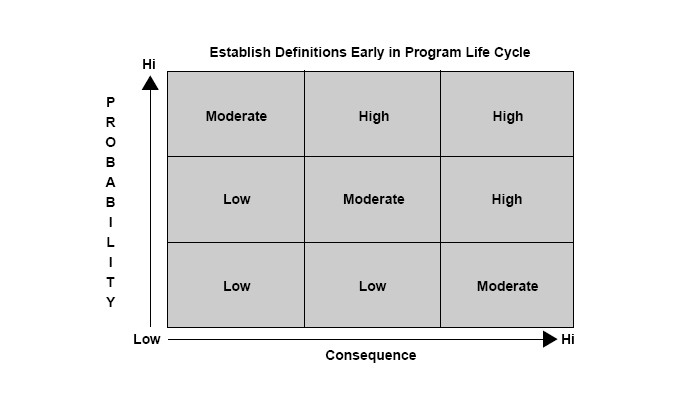
A qualitative method rates likelihood and impact with words or ordinal scores, usually 1 to 5, and plots each risk on a grid colored green, yellow, orange and red: the heat map. It is fast, needs no special data, and gives a picture that executives grasp at once. NIST IR 8286 Rev. 1 shows a likelihood and impact matrix derived from SP 800-30's tables as its own example of qualitative scoring.6
The heat map's weaknesses are just as real, and anyone who presents one to a board should know them:
- The numbers are labels, not quantities. A risk scored 4 times 4 equals 16 is not twice as bad as one scored 8. Multiplying ordinal scores produces numbers that look precise but are not.
- Ranges hide differences. If "Impact 5" means "more than $10 million," a $12 million loss and a $400 million loss land in the same box.
- Different people read the words differently. One manager's "likely" is another's "possible." Without written definitions tied to numbers, scores drift.
- The grid can rank risks wrongly. In a widely cited 2008 paper, risk analyst Louis Anthony Cox Jr. showed mathematically that risk matrices can assign identical ratings to risks that differ greatly and, in some cases, rank a smaller risk above a larger one, so that decisions based on them can be "worse than random" for some kinds of risks.29
None of this means heat maps should be thrown out. It means they should be used as a first sort, with written definitions for every level that include numbers ("Likely: expected to occur at least once in the next 1 to 3 years"; "Severe: more than $5 million, or more than 72 hours of outage of a critical service, or exposure of more than 100,000 people's records"), and that the biggest risks deserve a closer look with better tools.
FAIR in plain terms
FAIR (Factor Analysis of Information Risk) is the most widely used quantitative method for cyber risk. It began as a model developed by risk practitioner Jack Jones and is now published as two Open Group standards, together called Open FAIR: the Risk Taxonomy (O-RT), currently Version 3.0.1, and the Risk Analysis standard (O-RA), Version 2.0.1 (November 2021).730 The FAIR Institute, a nonprofit, promotes it and offers training; the standards themselves can be read online.
FAIR's core idea is to break risk into parts you can estimate separately, each as a range rather than a single number:
- Loss Event Frequency: "the probable frequency, within a given timeframe, that a Threat Agent will inflict harm upon an Asset." It depends on:
- Threat Event Frequency: how often a threat acts against the asset (how often attackers try), which depends on how often they come into contact with it and how likely they are to act; and
- Vulnerability, which in FAIR has a special meaning: "the probability that a Threat Event will become a Loss Event," judged by comparing the attacker's capability with the strength of the controls.
- Loss Magnitude: "the probable magnitude of loss resulting from a Loss Event," split into primary loss (what happens directly, such as response costs, lost productivity and replacing equipment) and secondary loss (what follows when customers, regulators, plaintiffs and the media react, such as fines, judgments and lost business).7
The taxonomy lists six forms of loss: productivity, response, replacement, fines and judgments, competitive advantage, and reputation.7 That list is a useful checklist even for organizations that never run a FAIR model, because qualitative assessments often count only the first three.
Ranges, three-point estimates and Monte Carlo
Quantitative methods do not pretend to know the future. They work with ranges and probability. The simplest version, which NIST IR 8286A Rev. 1 walks through, is the three-point estimate: ask people who know the system for an optimistic, a most likely and a pessimistic value.23 NIST's own example is the impact of a successful phishing attack: optimistic $35,000, most likely $50,000 and pessimistic $80,000. A simple average of the three (the triangular method) gives $55,000. A common weighted version (the PERT method, which counts the most likely value four times) gives ($35,000 + 4 x $50,000 + $80,000) / 6 = $52,500. NIST adds that better estimates come from polling several experts and averaging their answers, to reduce individual bias.23
Larger organizations run Monte Carlo simulation: a computer draws thousands of random values from each range (how often attackers try, how often they succeed, how much each loss costs), combines them, and produces a distribution of possible annual losses. The result is usually shown as a loss exceedance curve, which answers the question boards actually ask: what is the chance we lose more than a given amount this year? NIST's example curve shows a notional organization with "approximately 38% chance of losing $5 million or more each year," which it says signals a strong reason to invest in mitigation.6 Spreadsheet tools, open-source libraries and commercial platforms can run these simulations; the hard part is the inputs, not the math.
NIST IR 8286A also lists the biases that distort estimates, quantitative or not: overconfidence ("our users are too smart to fall for a phishing attack"), group think, following trends and hype, and availability (overweighting whatever was in the news last week). Its suggested countermeasures include collecting individual estimates before group discussion, as in the Delphi technique.23 Douglas Hubbard and Richard Seiersen's book How to Measure Anything in Cybersecurity Risk (Wiley, first published 2016) makes the case that people can be trained, or "calibrated," to give ranges that contain the true value about as often as they claim, and that even rough quantitative estimates beat unaided expert scoring.31
Where the numbers come from
The common objection to quantitative methods is "we do not have the data." Often an organization has more than it thinks: its own incident tickets, downtime records, insurance claims, audit findings and the cost of past outages. Public sources fill gaps, with care:
- Breach costs. The IBM and Ponemon Institute Cost of a Data Breach Report 2025, based on 600 organizations breached from March 2024 to February 2025, put the global average cost at $4.44 million and the U.S. average at a record $10.22 million, with healthcare the costliest sector at $7.42 million.32 The 2026 report put the global average at $4.99 million, a 12 percent rise and a record.33 These are averages from a sponsored survey of organizations that had a breach, not a census, so use them for rough bounds, not as your impact estimate.
- How attackers get in. Verizon's 2026 Data Breach Investigations Report, released May 19, 2026 and based on 2025 data, found that exploitation of vulnerabilities was the initial entry point in 31 percent of breaches, passing stolen credentials as the top entry point for the first time in the report's 19 years, and that a third party was involved in 48 percent of breaches.34 Figures like these help set threat event frequency and point to which controls cut likelihood the most.
- Fraud losses. The FBI's Internet Crime Report 2025 (released April 2026) counted 1,008,597 complaints and $20.877 billion in reported losses; business email compromise alone accounted for $3,046,598,558.35 Reported losses are a floor, since many victims never report.
- Public company disclosures. Companies sometimes report what an attack cost. Merck's 2017 annual report, for example, put the NotPetya attack's 2017 sales effect at about $260 million, with $285 million in expenses net of about $45 million in insurance recoveries.36 Disclosures like these are rare real data points for impact ranges in a given industry.
Lesson 1 covers these reports and their limits in more detail.
Choosing a method
| Question | Qualitative heat map | Quantitative (FAIR and similar) |
|---|---|---|
| Speed to first result | Days to weeks | Weeks to months for the first models |
| Data needed | Expert judgment with written scale definitions | Ranges for frequency and loss, from internal records, public data and calibrated experts |
| Best use | Sorting hundreds of risks; first assessments; risks with mostly intangible harm | The top 10 to 20 risks; comparing spending options; sizing insurance; board decisions on large investments |
| Answers the board's "how much?" | Only indirectly | Yes, in dollars and probabilities |
| Main weakness | False precision from multiplying labels; inconsistent scoring | False precision from confident-looking outputs built on weak inputs; skills and tooling cost |
| What regulators accept | Accepted by HIPAA, NYDFS, FTC and NIST if written and consistent | Accepted; NIST IR 8286 Rev. 1 calls it preferred where possible |
A practical approach for a large organization: score everything qualitatively with well-defined scales, then run quantitative analysis on the risks that land in the top two bands and on any decision that involves more than a set amount of money (for example, $1 million). That keeps the register manageable and puts the analysis where the money is.
Responding to risk: accept, mitigate, transfer, avoid
NIST's 2025 guidance names "four types of actions available ... for responding to negative cybersecurity risks: accept, transfer, mitigate, and avoid," while noting that frameworks vary in their words (ISO calls the step "risk treatment" and uses "share" for transfer).6
Mitigate
Mitigation means applying controls that lower likelihood, impact or both until the residual risk is within tolerance. It is the response for most risks and the subject of most of this module: identity and access controls in lesson 5, network and cloud controls in lesson 6, backups and encryption in lesson 7, and detection and response in lesson 10. NIST makes a point that experienced practitioners learn the hard way: responses themselves can create new risks. Its example: adding multifactor sign-in to a business system can create a new risk of lower productivity when users struggle with the technology.6 Count those side effects when you choose. Where a mitigation means changing production systems, plan the change, test it, and keep a way to roll it back.
Transfer
Transfer shifts part of the financial consequence to someone else, mainly through cyber insurance and contracts (indemnities, limits of liability, vendor insurance requirements). NIST's wording is careful: transfer reduces risk "by sharing a portion of the consequences with another party," and "there are often consequences that cannot be transferred, like the loss of customer trust."6 You cannot transfer downtime, patient harm, regulatory duties or the board's oversight duty. Two cases show the limits:
- Exclusions. After the 2017 NotPetya attack, Mondelez International sought about $100 million from Zurich under a property policy (it had no separate cyber policy); Zurich invoked the policy's exclusion for "hostile or warlike action" by a "government or sovereign power." The parties settled in late October 2022 on undisclosed terms after years of litigation.37
- Applications. In July 2022 Travelers sued to rescind a $1 million cyber policy it had issued to International Control Services, alleging the company's application said it required multifactor sign-in for email, remote access and administrative systems when in fact it used multifactor only on its firewall; the servers hit by ransomware were not protected. In August 2022 the two sides filed a joint stipulation asking the court to declare the policy void from the start, with no coverage for any claim, and to dismiss the case.38 An insurance application is, in effect, a written statement about your controls. If the risk register and the application do not match, the transfer you think you bought may not exist.
Treat insurance as one control among many, review exclusions and sublimits with your broker every year, and make sure the person who signs the application has checked each answer with the security team. Module 73 covers insurance basics in Continuity, Recovery and Cyber Insurance.
Avoid
Avoidance means not doing the risky thing: not collecting data you do not need, retiring a legacy system rather than securing it, declining to enter a market whose data rules you cannot meet, or keeping a safety system off the network. NIST notes avoidance "may be the best option if there is not a cost-effective method for reducing the cybersecurity risk to an acceptable level," and that the lost opportunity has a cost too.6 Data minimization, covered in lesson 7, is avoidance in practice: data you deleted cannot be stolen.
Accept
Acceptance means deciding, on purpose, to live with a risk because it is within tolerance or because reducing it further costs more than it saves. NIST says accepted risks need "no additional risk response action ... except for monitoring."6 Acceptance is legitimate. Undocumented acceptance is not: it is just neglect with a better name. A sound acceptance has five parts:
- A clear description of the risk and its residual rating.
- The reason for accepting (cost, business need, a compensating control, a planned replacement).
- The name and title of someone with authority to accept a risk of that size.
- An expiration date, usually no more than 12 months, after which it must be renewed or fixed.
- Any conditions (extra monitoring, a compensating control, a date by which the system will be replaced).
The FTC Safeguards Rule requires the written risk assessment to say how identified risks "will be mitigated or accepted," and New York's DFS said in 2026 that documentation should "capture instances where management elects to accept a risk, including the justification for risk acceptance and any residual risk considerations."23
Who may accept which risks
Large organizations need a written risk acceptance authority table so that a system administrator cannot accept a risk that could sink the company, and so the board is not asked to approve every minor exception. A typical structure (illustrative):
| Residual risk rating | Who may accept | Maximum term | Who is told |
|---|---|---|---|
| Low (1 to 4) | System or business process owner | 12 months | Security team (recorded in register) |
| Moderate (5 to 9) | Department head with the CISO's written review | 12 months | Risk committee in quarterly report |
| High (10 to 16) | Executive risk committee or chief risk officer | 6 months | Board committee in next report |
| Critical (20 to 25) | Chief executive, with the board committee informed before acceptance | 90 days | Full board |
Two rules make the table work. The person accepting a risk should own the business activity that benefits from taking it, not just the IT system, because that is who weighs benefit against harm. And the CISO's role is to make sure the decision is informed (the risk is described accurately and the options are clear), not to accept business risks on the business's behalf. Lesson 4 covers reporting lines and board oversight in more depth.

Running the program at scale
A one-time risk assessment is a snapshot. Regulated and large organizations need a program: a method, a calendar, owners, a register that stays current, and reporting that reaches the people who decide.
Scope: start with what you have
Every regulator that has published findings says the same thing first: organizations do not know all their assets. DFS's 2026 letter calls the asset inventory "the foundational input" to the risk assessment and lists cloud environments, third-party service providers and critical business processes among the things commonly left out.3 OCR's first Risk Analysis Initiative agreement required a complete inventory of equipment, data systems, off-site storage and applications holding health data before the risk analysis itself.15 In a large organization, the inventory comes from several places that rarely agree: the configuration management database, endpoint management tools, cloud account listings, the accounts payable list of software subscriptions, and interviews with business units about the spreadsheets and outside services they use. Reconciling them is tedious and indispensable.
Scope also means deciding the unit of analysis. Most large organizations assess at three levels at once: the enterprise (a top-down scenario analysis of the 10 to 20 events that would hurt most), each business process or department, and each critical system. The enterprise view catches risks no single system owner sees, such as the dependence of every department on one identity provider or one managed service provider.
How often to reassess
The rules set floors, not targets:
- NYDFS: at least annually and whenever a business or technology change causes a material change to cyber risk.3
- FTC Safeguards Rule: "periodically," with a written report to the board at least annually that covers risk assessment and risk management decisions.2
- HIPAA: the current rule requires the analysis to be reviewed and updated as needed; HHS's January 2025 proposal would make an annual review explicit, but it is not final, and the federal regulatory agenda now projects final action no earlier than July 2027.3940
- Idaho state agencies: ITA Policy P2045's November 2025 revision moved away from a fixed assessment cycle toward a risk-based approach with continuous evaluation, while requiring assessments of cyber threats, of projects at concept, design and go-live, of emerging risks, and of audit findings, with assessment dates recorded in each agency's Annual IT Security Plan.13
Beyond the calendar, certain events should trigger a fresh look, and the enforcement record shows why. Moving major systems to the cloud is one: the OCC's 2020 penalty against Capital One cited the bank's "failure to establish effective risk assessment processes" before "migrating significant information technology operations to the public cloud environment."8 Retiring systems is another: the OCC's $60 million penalty against Morgan Stanley in October 2020 said the banks "failed to effectively assess or address risks associated with decommissioning its hardware" in two data centers in 2016, including the risk of the vendor doing the work.41 Other triggers: a merger or acquisition (you inherit the other company's risks on closing day), a new regulation, a major incident at your organization or a peer, a new critical vendor, a big change in how people work, and adopting a new technology such as generative AI tools. DFS's letter names AI adoption and "advances in quantum computing that may affect future cryptographic protections" among the emerging risks a 2026 assessment should consider.3
The register in practice
NIST's cybersecurity risk register template has these columns: ID, priority, risk description, risk category, current likelihood, current impact, exposure rating, risk response type, risk response cost, risk response description, risk owner and status.6 Many organizations add the inherent rating, the target residual rating, the controls relied on, the date of the last review and the next review, and links to evidence. A few rules keep a register useful:
- Write risks as events, not as missing controls. "No MFA on VPN" is a vulnerability. "A criminal group uses a stolen password to sign in to the remote access portal and deploys ransomware across the clinical network, causing a multi-day outage" is a risk. The second version tells a board what could happen and lets several controls be credited against it.
- One owner per risk, by name. NIST defines the risk owner as the party "responsible and accountable for ensuring that the risk is maintained in accordance with enterprise requirements."6 A committee is not an owner.
- Link each risk to its controls and evidence. DFS expects records "that link each identified cybersecurity risk to the specific controls or compensating measures implemented."3 That linkage also tells internal audit what to test.
- Keep the history. Ratings over time show whether the program is working. A risk rated High for three straight years with no funded plan is a governance finding waiting to happen.
- Use a tool that fits the size. A spreadsheet works for a few dozen risks; organizations with hundreds of systems usually move to a GRC platform so that registers can roll up and evidence can be linked.
Key risk indicators and reporting to the board
A key risk indicator (KRI) is a measurement that warns when a risk is growing, tied to a tolerance. Examples: percentage of internet-facing systems with known exploited vulnerabilities older than the tolerance; percentage of privileged accounts with phishing-resistant multifactor sign-in; days since the last successful full restore test of critical systems; number of critical vendors without a current security review; number of risk acceptances past their expiration date. Each KRI should have a green, yellow and red threshold that comes straight from the tolerance statements, so that a red KRI automatically means "outside appetite" and goes to the people who set the appetite.
Board reporting should be short and decision-oriented. A useful quarterly cyber risk report for a board or its risk or audit committee usually fits on four pages: the top 10 to 15 risks with owner, trend and whether each is within appetite; KRIs against tolerance; risk acceptances made since the last report at the High level and above; major changes (new systems, acquisitions, incidents, regulatory changes); and decisions or funding requested. Public companies describe their board's oversight and management's role in Form 10-K Item 1C under Regulation S-K Item 106(c), so the report the board actually receives should match what the company tells investors it receives.4 The SEC sued SolarWinds and its chief information security officer in 2023 alleging that public statements about its security practices did not match internal assessments; the SEC voluntarily dismissed the case with prejudice on Nov. 20, 2025, saying the decision did not necessarily reflect its position in other cases.42 Whatever the legal outcome, the lesson for governance is plain: internal risk assessments and public statements should tell the same story. Module 73's board reporting lesson has a smaller-scale template.
Third parties, concentration and the risks nobody owns
Verizon's 2026 report found a third party involved in 48 percent of breaches.34 DFS asks risk assessments to weigh each service provider's criticality, the sensitivity of the data it holds, its connectivity to your systems and the effect of its failure, and to look for concentration risk: technologies or vendors that seem minor alone but together create a single point of failure for many critical functions.3 The February 2024 attack on Change Healthcare, which processes a large share of U.S. health care claims, began, according to its parent company's chief executive's prepared congressional testimony, with stolen credentials used on a remote access portal that did not have multifactor sign-in; HHS later put the number of people affected at about 192.7 million.43 Thousands of providers that had no direct relationship with the weak portal lost their cash flow for weeks. A risk register that listed "Change Healthcare outage" as a low-likelihood vendor risk would have been accurate in likelihood and badly wrong in impact. Lesson 8 applies the risk method to vendors and fourth parties.
The Idaho angle
Idaho's executive branch agencies work under Idaho Technology Authority policies issued under Idaho Code 67-831 to 67-833.13 ITA Policy P2045, first established July 7, 2023, requires every agency to keep a risk management program, document each identified risk in a risk register or equivalent, have it formally acknowledged by the responsible people, and record a response (mitigate, transfer, accept or avoid). Its November 2025 revision shifted from a fixed cycle to a risk-based one, and the dates of each assessment go in the agency's Annual IT Security Plan, with procedures in ITA Guideline G525.13 Policy P4140 requires agencies to use the current NIST Cybersecurity Framework.21 Idaho hospitals, banks, credit unions and insurers fall under the federal and state rules in the table above, and every Idaho organization that holds residents' personal information is subject to the breach notice duties in Idaho Code 28-51-104 to 28-51-107, which turn a realized risk into a public event (covered in lesson 11).44


Worked example: a risk register for a regional health system
Everything in this example is illustrative. The organization is fictional, and the scores, dollar figures and probabilities were made up for teaching. They are not estimates for any real organization.
Example Regional Health (ERH) is a fictional nonprofit health system with two hospitals, 30 clinics, 4,000 employees, a self-insured employee health plan, and a captive foundation that takes donations by card. It is a HIPAA covered entity, takes card payments under PCI DSS, has bonds outstanding, and its state's insurance regulator oversees its health plan arm. Its board has adopted three appetite statements: no appetite for risks to patient safety; low appetite for exposure of patient or member data; moderate appetite for risk in adopting new technology that improves care, if security reviews are completed first. It has set two tolerances among others: the electronic health record (EHR) may be down no more than 8 hours per incident, and no more than 10,000 patients' records may be exposed in any single event.
The scales ERH uses
ERH scores likelihood and impact from 1 to 5 with written definitions. Likelihood: 1 Rare (less than once in 20 years), 2 Unlikely (once in 5 to 20 years), 3 Possible (once in 2 to 5 years), 4 Likely (about once a year), 5 Almost certain (more than once a year). Impact is the highest of four measures: money (1 under $100,000; 2 up to $1 million; 3 up to $5 million; 4 up to $25 million; 5 over $25 million), EHR or critical service downtime (1 under 1 hour to 5 over 72 hours), people's records exposed (1 under 100 to 5 over 100,000) and patient safety (any credible risk of harm is a 5). Score equals likelihood times impact, with bands Low 1 to 4, Moderate 5 to 9, High 10 to 16 and Critical 20 to 25. ERH's risk committee knows the multiplication is a sorting convenience, not math, and runs a quantitative analysis on anything rated High or Critical.
Eight rows from the register
| ID | Risk (written as an event) | Inherent L x I | Key controls in place | Residual L x I | Response and owner |
|---|---|---|---|---|---|
| R1 | Ransomware delivered through a stolen remote access credential encrypts the EHR and clinical systems; multi-day outage and ambulance diversion | 4 x 5 = 20 Critical | MFA on most remote access; EDR on 90% of servers; nightly backups (not immutable) | 3 x 5 = 15 High | Mitigate: phishing-resistant MFA for all remote and admin access; immutable backups; restore test of EHR. Owner: chief operating officer. Target 2 x 4 = 8. |
| R2 | Business email compromise diverts a vendor or construction payment | 4 x 3 = 12 High | Callback rule for payment changes; dual approval over $25,000 | 2 x 3 = 6 Moderate | Accept with monitoring; quarterly test of callback rule. Owner: chief financial officer. |
| R3 | Outage at the claims clearinghouse stops billing and cash flow for 2 to 6 weeks | 2 x 4 = 8 Moderate | Contract security terms; no second clearinghouse | 2 x 4 = 8 Moderate | Mitigate: pre-contract a backup clearinghouse; Transfer: confirm business interruption coverage for vendor outages. Owner: revenue cycle vice president. |
| R4 | Legacy imaging system (unsupported operating system) is compromised and used to move through the network | 3 x 4 = 12 High | Placed on an isolated network segment; vendor remote access through a monitored gateway | 2 x 4 = 8 Moderate | Accept until replacement in fiscal 2028, with conditions; CISO review; expires in 12 months. Owner: chief medical officer. |
| R5 | Misconfigured cloud storage exposes a research data set of 60,000 patients | 3 x 5 = 15 High | Cloud configuration scanning; data owner approvals | 2 x 5 = 10 High | Mitigate: block public storage by policy at the account level; Avoid: remove direct identifiers from research copies. Owner: chief research officer. |
| R6 | Insider in the billing office looks up and sells patient records | 3 x 3 = 9 Moderate | Role-based access; access logging; quarterly access reviews | 2 x 3 = 6 Moderate | Mitigate: automated alerts on unusual record lookups. Owner: chief compliance officer. |
| R7 | Card data stolen from the foundation's donation web page through a malicious script | 3 x 3 = 9 Moderate | Hosted payment page from the processor | 1 x 3 = 3 Low | Accept; PCI scope review yearly. Owner: foundation director. |
| R8 | Primary data center loses power and cooling for more than 24 hours after a regional storm | 2 x 5 = 10 High | Generator with 72 hours of fuel; no tested failover for the EHR | 2 x 4 = 8 Moderate | Mitigate: test EHR failover to the secondary site twice a year. Owner: chief information officer. |
Putting a dollar figure on the top risk
R1 is ERH's highest residual risk and the one that touches patient safety, so the risk committee asks for a quantitative estimate before approving the $900,000 a year that the mitigation plan would cost (illustrative). The analyst works with the security, clinical and finance teams to set ranges:
- Today: the team estimates a successful ransomware event of this kind about once in five years (a loss event frequency of 0.2 a year). If it happens, losses range from $3 million (contained in two days) to $40 million (two weeks of diversion, lawsuits and penalties), with $9 million most likely. The PERT average is ($3 million + 4 x $9 million + $40 million) / 6, about $13.2 million, so the expected annual loss is about 0.2 x $13.2 million, or roughly $2.6 million.
- After the plan: with phishing-resistant MFA the team estimates the event at about once in 12 years (0.08 a year), and with immutable backups and a tested restore the loss range falls to $1 million to $15 million, most likely $4 million. PERT average: ($1 million + 4 x $4 million + $15 million) / 6, about $5.3 million; expected annual loss about 0.08 x $5.3 million, or roughly $0.43 million.
- The comparison: the plan cuts expected annual loss by about $2.2 million for $900,000 a year, and, just as important to this board, it shrinks the worst case. A Monte Carlo run on the same ranges would show the chance of a loss over $25 million in a year falling sharply.
The committee approves the plan, and the board's next report shows R1's target, its funding, the date each control is due, and a KRI (percentage of remote and administrative accounts on phishing-resistant MFA) to track it. Note what the analysis did not do: it did not prove the numbers right. It made the assumptions visible, so people who disagree can argue about the specific range they doubt instead of about colors.
Sample: risk register template and method statement
The template below turns the ideas in this lesson into a document a risk committee can adopt. Module 73 has a simpler register for smaller organizations; this one adds acceptance authority, roll-up and evidence fields for regulated and large organizations.
Sample only. Adapt it to your organization's risks, systems and laws, have qualified people review it, and do not treat it as a substitute for a risk assessment.
Follows: NIST SP 800-30 Rev. 1 (Sept. 2012) Chapter 3 and Appendices G to I; NIST IR 8286 Rev. 1 (Dec. 2025) Table 1 and Table 2; NIST CSF 2.0 GV.RM and ID.RA; 16 CFR 314.4(b) and (i); 23 NYCRR 500.9 and the DFS industry letter of Sept. 10, 2026; 45 CFR 164.308(a)(1); Idaho Technology Authority Policy P2045 (Nov. 2025).
Part 1: Cyber risk assessment method statement
1. Purpose. [Organization name] identifies, estimates, prioritizes and responds to cybersecurity risks using the method in this statement so that results are consistent across [business units, hospitals, branches, plants, agencies] and can be combined into the enterprise risk register.
2. Scope. All information systems, data, services, facilities and third-party services that create, store, process or transmit [the organization's data types, for example protected health information, nonpublic personal information, Controlled Unclassified Information, card data], including cloud services and systems run by vendors on our behalf. The asset inventory maintained by [role] is the starting point.
3. Approval and ownership. This method is approved by [the executive risk committee] and reviewed at least annually. The [CISO / information security officer] runs the assessment process. Each risk has one named risk owner at the level of [department head or above] who owns the business activity the risk affects.
4. Frequency and triggers. A full assessment is completed at least every [12] months. A targeted assessment is completed before go-live of any new critical system or vendor, before a major cloud migration or data center retirement, within [60] days after closing a merger or acquisition, after any incident rated [High] or above, and when [the CISO or the risk committee] determines that a change in threats or law materially changes risk.
5. Scales. Likelihood is rated 1 to 5 over a 12-month period using these definitions: [1 Rare: less than once in 20 years; 2 Unlikely: once in 5 to 20 years; 3 Possible: once in 2 to 5 years; 4 Likely: about once a year; 5 Almost certain: more than once a year]. Impact is the highest of: financial [bands]; downtime of critical services [bands]; number of individuals' records exposed [bands]; safety [any credible risk of physical harm rates 5]; regulatory and legal [bands]. Exposure score = likelihood x impact, banded Low [1 to 4], Moderate [5 to 9], High [10 to 16], Critical [20 to 25].
6. Inherent and residual. Each risk is rated inherent (before controls) and residual (after controls that are in place and supported by current evidence). Planned or partly deployed controls are not credited until verified.
7. Quantitative analysis. Risks rated High or Critical residual, and any proposed response costing more than [$ amount], receive a quantitative estimate using [Open FAIR / three-point estimates / Monte Carlo simulation], with ranges and assumptions recorded in the risk detail record.
8. Responses. For each risk the owner selects and records one or more responses: mitigate, transfer, avoid or accept. Risks outside tolerance must have a mitigation, transfer or avoidance plan with dates, or a risk acceptance under section 9.
9. Risk acceptance. Acceptances are written and state the risk, its residual rating, the reason, any conditions and compensating controls, and an expiration date. Authority: Low, [system or process owner], up to 12 months; Moderate, [department head with CISO review], up to 12 months; High, [executive risk committee], up to 6 months; Critical, [chief executive with prior notice to the board committee], up to 90 days. Expired acceptances are reported as overdue.
10. Reporting. The [CISO] reports to the [executive risk committee] [monthly / quarterly] and to the [board risk or audit committee] at least [quarterly], covering the top risks, key risk indicators against tolerance, new High and Critical acceptances, overdue actions and acceptances, and significant changes. The [Qualified Individual / CISO] provides the written annual report required by [16 CFR 314.4(i) / 23 NYCRR 500.4].
11. Records. Assessments, the register, risk detail records, acceptances and supporting evidence are kept for [6 years / the period required by applicable rules], in [GRC system name], with access limited to [roles].
Part 2: Register fields
| Field | What to enter |
|---|---|
| Risk ID | [Unit code]-[number], for example [ERH-CLIN-014] |
| Risk statement | Written as an event: [threat] uses or exploits [vulnerability] affecting [asset], causing [impact] |
| Category | [Ransomware and extortion / fraud / data exposure / outage / third party / insider / physical and environmental / regulatory] |
| Assets and data affected | [Systems, services, data types, number of records] |
| Inherent likelihood, impact, score | [1 to 5], [1 to 5], [product and band] |
| Controls relied on | [Control IDs mapped to the organization's framework, for example CSF 2.0 subcategories or SP 800-53 controls] with evidence links |
| Residual likelihood, impact, score | [1 to 5], [1 to 5], [product and band]; within appetite? [yes / no] |
| Quantitative estimate (if required) | [Annualized loss estimate; 90th percentile annual loss; link to analysis] |
| Response type | [Mitigate / transfer / avoid / accept] |
| Response description, cost and due dates | [Actions, owner of each action, budget, dates] |
| Target residual score | [Score and band expected after the response] |
| Risk owner | [Name and title] |
| Acceptance record (if accepted) | [Approver, date, conditions, expiration] |
| Key risk indicator | [Measure, green / yellow / red thresholds, current value] |
| Status and history | [Open / in treatment / accepted / closed]; prior ratings with dates |
| Last reviewed / next review | [Dates] |


Pictures, Numbers and Infographics
The numbers below are the ones this lesson relies on. Each is labeled with its source and year.
| Number | What it is | Source |
|---|---|---|
| 4 responses | Accept, transfer, mitigate, avoid: NIST's response types for negative cyber risks | NIST IR 8286 Rev. 1, December 20256 |
| 4 steps | Prepare, conduct, communicate, maintain: the risk assessment process | NIST SP 800-30 Rev. 1, September 20125 |
| 7 steps | Prepare, categorize, select, implement, assess, authorize, monitor: the Risk Management Framework | NIST SP 800-37 Rev. 2, Dec. 20, 201820 |
| 7 outcomes | GV.RM-01 to GV.RM-07, Risk Management Strategy | NIST CSF 2.0, Feb. 26, 202416 |
| At least annually | NYDFS risk assessment review, plus after material changes | 23 NYCRR 500.9; DFS letter Sept. 10, 20263 |
| At least annually | FTC Safeguards Rule written report to the board, including risk assessment | 16 CFR 314.4(i)2 |
| 9 of 63 (14%) | Covered entities rated 1 or 2 on HIPAA risk analysis in OCR's 2016 to 2017 audits (none rated 1) | HHS OCR audit report, December 202014 |
| $90,000 | First Risk Analysis Initiative settlement (Bryan County Ambulance Authority) | HHS OCR, Oct. 31, 202415 |
| 14th | Risk Analysis Initiative action count at the Spencer Gifts plan settlement ($450,000) | HHS OCR, June 18, 20269 |
| $700,000 | Ambry Genetics settlement; 225,370 people; potential risk analysis failure | HHS OCR, Sept. 17, 202610 |
| $80 million | OCC penalty on Capital One, citing risk assessment before cloud migration | OCC, Aug. 6, 20208 |
| $60 million | OCC penalty on Morgan Stanley, citing risk assessment of data center decommissioning | OCC, Oct. 8, 202041 |
| $4.44 million / $10.22 million | Average cost of a breach, global and U.S. | IBM and Ponemon, 2025 report32 |
| $4.99 million (up 12%) | Average cost of a breach, global | IBM, 2026 report33 |
| 31% / 48% | Breaches starting with vulnerability exploitation / involving a third party | Verizon DBIR 2026 (2025 data)34 |
| $20.877 billion | Losses reported to the FBI's IC3 in 2025 | IC3 Internet Crime Report 202535 |
| About $100 million | Mondelez's NotPetya claim contested under a war exclusion; settled 2022 | The Record, Oct. 31, 202237 |
| $1 million | Cyber policy Travelers sought to rescind over MFA answers on the application | Reed Smith, July 202238 |
| About 38% | NIST's notional example: chance of losing $5 million or more in a year, read from a loss exceedance curve | NIST IR 8286 Rev. 16 |
| $52,500 | PERT average of NIST's three-point phishing example ($35,000, $50,000, $80,000) | Calculated from NIST IR 8286A Rev. 123 |
| July 2027 | Projected final action on the HIPAA Security Rule update | Unified Agenda, RIN 0945-AA2240 |
| Nov. 3, 2026 | ISO/DIS 31000 registered as a draft international standard | Standards catalog record25 |
Common mistakes
Each of these is drawn from a regulator's findings or a documented case.
Assessing only the assets you know about
DFS's first listed deficiency in 2026 was "incomplete asset scope and visibility," including not knowing where nonpublic information resides or flows and omitting vendors and cloud environments.3 OCR's audit report found organizations "generally failed to" identify the risks to all of the electronic health information they held, and OCR's corrective action plans routinely start with a complete inventory.1415 Fix: reconcile the inventory from several sources before scoring anything, and include shadow IT and vendor-run systems.
Treating a product or a checklist as the assessment
OCR's auditors reported that some business associates ("Entities," in the report's words) "incorrectly assumed that a purchased security product satisfied all Security Rule requirements."14 A gap assessment against a framework (are these 100 controls in place?) is useful, but it is not a risk assessment unless it asks what could happen to what, how likely and how bad. Fix: start from events and impacts, then map controls.
Skipping the assessment before a big change
Capital One's $80 million OCC penalty cited the failure to establish effective risk assessment processes before moving major operations to the public cloud, a migration that preceded the bank's 2019 breach.8 Morgan Stanley's $60 million penalty cited the failure to assess the risks of decommissioning data center hardware and of the vendor hired to do it.41 Fix: make migrations, retirements, acquisitions and new critical vendors formal triggers in the method statement.
A shallow risk analysis, discovered after the breach
In nearly every HIPAA ransomware and hacking settlement of 2024 to 2026, OCR found a potential failure to conduct an accurate and thorough risk analysis, from small practices to Ambry Genetics' $700,000 settlement in September 2026.109 The breach is what brings OCR in; the missing analysis is what turns an investigation into a settlement. Fix: treat the risk analysis as the first document you would hand an investigator, and make sure it would hold up.
A register that does not drive the program
DFS's fifth deficiency was programs whose "policies, controls, and resource decisions" are "not demonstrably based on" the identified risks.3 The common symptom is a register reviewed once a year and filed, while the budget is set by vendor pitches and last year's line items. Fix: tie every budget request and every exception to a register entry, and report to the board on risks, not on tool deployments.
Insurance answers that do not match reality
Travelers alleged that International Control Services told it multifactor sign-in protected email, remote access and administrative systems when only the firewall had it.38 Fix: have the security team verify every control answer on insurance applications and keep the evidence, and treat the application as part of the risk record.
Assuming transfer covers the worst case
Mondelez's NotPetya claim of about $100 million went to litigation over a war exclusion.37 Policies have exclusions, sublimits, waiting periods and conditions. Fix: model the worst case with the policy's actual terms, and count the parts insurance never covers, such as downtime of patient care, regulatory duties and lost trust.6
Letting concentration risk hide in plain sight
Many health care organizations did not list a single claims clearinghouse as a top risk until the Change Healthcare attack of February 2024 stopped claims processing across the country.43 DFS now asks every regulated company to look for single points of failure and shared dependencies.3 Fix: run an enterprise scenario for the failure of each of your five most widely used vendors and platforms, even if each looks safe alone.
Questions people ask
Is a risk assessment the same as an audit or a penetration test?
No. An audit checks whether controls exist and work as described, against a standard or policy. A penetration test (an authorized simulated attack by qualified testers) checks whether specific systems can be broken into. A vulnerability scan lists known technical weaknesses. All three feed a risk assessment, which asks the broader question: what could happen to the organization, how likely and how bad, and what should we do about it? DFS lists threat intelligence, incident trends, vulnerability scans, penetration tests and audit findings as inputs to the methodology.3
Who should own the risk register?
The CISO or the risk management function usually maintains it, but the risks belong to the business owners who benefit from the activity that creates them. NIST defines the risk owner as the party accountable for keeping the risk within enterprise requirements.6 In organizations with a chief risk officer, cyber risks usually flow into the enterprise risk register that office maintains, as the NIST IR 8286 series describes.24
Do we need to buy ISO 31000 or ISO/IEC 27005?
Only if you are pursuing or keeping ISO/IEC 27001 certification or a customer contract requires ISO alignment. NIST SP 800-30, SP 800-39, CSF 2.0 and the IR 8286 series are free, cover the same ground, and are the documents U.S. regulators cite. Some organizations buy ISO/IEC 27005 to align with an ISO/IEC 27001 program and use NIST documents for the details.265
How long does the first enterprise assessment take?
For an organization with thousands of employees, expect three to six months for a first full cycle: a month or more to reconcile the asset and vendor inventory, several weeks of workshops with each business unit, and time to calibrate scales and get owners to accept their risks. Later cycles go much faster because they update rather than start over. A useful shortcut is to do the top-down enterprise scenario analysis first (the 10 to 20 worst events) so leaders have something to act on while the detailed work continues.
What if the assessment finds more than we can afford to fix?
That is normal, and it is the point. A risk assessment exists to put limited money where it reduces the most risk. Rank by residual exposure, fix what is outside appetite first, and accept the rest in writing with expiration dates. What regulators punish is not having unfixed risks; it is not knowing about them, or knowing and having no record of a decision. The FTC rule and DFS both expect written decisions on how each risk is mitigated or accepted.23
Can we use industry breach-cost averages for our impact estimates?
Use them as a sanity check, not as your number. IBM's 2025 report put the U.S. average at $10.22 million, but averages hide huge spread, and a 600-organization sample of breached companies may look nothing like yours.32 Build your own impact ranges from your revenue per hour of downtime, your record counts, your notification and call center costs, your regulators' penalty ranges and your insurance retention, then compare them with the averages.
Should privacy and safety risks be in the same register?
Yes, or in registers that use the same scales and roll up to the same place. DFS observed that mature programs "apply consistent risk criteria" across third-party risk, IT operations and business continuity.3 For manufacturers and utilities, safety consequences must be on the impact scale; module 111's lesson on patching and safety together shows why. For privacy, CSF 2.0's risk outcomes cover risks to individuals as well as to the organization.16
Does following a recognized framework help if HHS investigates?
Yes. A 2021 amendment to the HITECH Act requires HHS to consider whether a covered entity or business associate had "recognized security practices," such as the NIST Cybersecurity Framework, in place for the prior 12 months when it decides fines and audit outcomes.45 A current, documented risk assessment and risk management program is the clearest evidence of such practices.
Hard questions
Should boards be shown dollar estimates of cyber risk, or are they false precision?
The case for numbers: Boards decide in dollars. A heat map cannot say whether a $3 million control is worth buying or how much insurance to carry, and research such as Cox's shows matrices can rank risks wrongly.29 NIST now calls quantitative methods preferred where possible, and calibrated estimates with honest ranges make assumptions visible and arguable.631
The case against: Cyber loss data are thin and change fast as attackers adapt. A loss exceedance curve looks authoritative even when its inputs are guesses, and boards may anchor on a single number such as "expected loss $2.6 million." Quantitative programs need skilled analysts and tools that many organizations lack, and qualitative scales are accepted by every major U.S. regulator.
What the evidence shows: Both camps agree that undefined words and multiplied labels are the weakest option. NIST's guidance supports a mix: qualitative for breadth and intangible harms, quantitative where decisions are large and data exist.6 Showing ranges rather than single numbers, and stating the assumptions on the same page, answers most of the false-precision concern.
Does writing down every risk create legal exposure?
One side: A register full of known, unfixed High risks can become evidence in a lawsuit or enforcement action that the organization knew and did nothing. Some organizations therefore keep assessments vague, limit circulation, or route them through their legal department in hopes of shielding them from discovery. Courts have not always honored that: in the Capital One breach litigation, a federal court in Virginia in 2020 ordered the company to produce a forensic report its law firm had commissioned, finding it was not protected work product.46
The other side: Regulators require written assessments and written decisions; the FTC rule, NYDFS, HIPAA and the SEC's Item 1C all assume they exist.2314 The absence of a risk analysis is itself the most common HIPAA finding.14 A record that shows risks were found, weighed and either treated or consciously accepted by the right person is evidence of reasonable care, not negligence.
What the evidence shows: Enforcement records punish missing and shallow assessments far more often than candid ones. The exposure comes from risks recorded and then ignored with no decision, or from public statements that contradict internal findings, the theory of the SEC's SolarWinds case before it was dismissed.42 Candor plus documented decisions is the safer course.
Is the annual risk assessment obsolete?
For continuous assessment: Attackers exploit new vulnerabilities in days, and Verizon's 2026 report found exploitation was now the top way into breached organizations.34 An assessment done every 12 months is out of date within weeks. Idaho's ITA moved its agencies away from a fixed cycle in November 2025 for this reason, toward continuous evaluation.13
For a fixed cycle: Without a deadline, "continuous" can mean "never." A yearly full reassessment forces a fresh look at scope, appetite and assumptions that day-to-day monitoring does not question, and NYDFS and the FTC both keep an annual floor.32
What the evidence shows: The two are not rivals. Mature programs monitor risk indicators continuously, reassess on defined triggers, and still do a full annual review of the method, the scope and the top risks with leadership.
Who should own cyber risk: the CISO or the business?
CISO ownership: Security leaders understand the threats and controls best, and a single owner avoids finger-pointing.
Business ownership: The people who earn the revenue or deliver the service decide how much risk to take to do it; a CISO who "owns" every risk becomes either a bottleneck or a scapegoat. NIST's model places appetite with senior leadership and ownership with those accountable for the affected objectives, with the CISO informing and coordinating.6
What the evidence shows: Regulators increasingly expect both: a CISO who runs the process and reports material cyber risks to the board (as NYDFS requires), and business leaders who accept risks in their own names.3 Lesson 4 covers reporting lines.
Does cyber insurance reduce risk or just move it?
For: Insurance pays for response experts and losses that would otherwise sink smaller organizations, and insurers' underwriting questions have pushed many companies to adopt multifactor sign-in and better backups.
Against: Coverage can encourage organizations to accept risks they should fix, exclusions can leave the largest losses uncovered, and misstatements on applications can void coverage when it is needed most.3738
What the evidence shows: NIST treats insurance as transferring only part of the consequences, never the loss of trust or the duty to protect.6 Insurance works best as a complement to controls whose existence the insurer has verified.
For reporters and advocates
What public records exist.
- SEC filings. Every public company's Form 10-K now has Item 1C, which describes its processes for "assessing, identifying, and managing material risks from cybersecurity threats," its board's oversight and management's role.4 Search EDGAR full-text for "Item 1C" plus the company name, and compare year-over-year language and what happened after an incident.
- HHS OCR resolution agreements. Each settlement posts a resolution agreement and corrective action plan that usually spells out the risk analysis OCR found missing and what must now be done.910
- Bank regulator actions. The OCC, Federal Reserve and FDIC publish enforcement actions; consent orders describe risk management failures in detail, as the Capital One and Morgan Stanley orders did.841
- NYDFS consent orders and guidance. DFS publishes enforcement actions under Part 500 and industry letters such as the Sept. 10, 2026 risk assessment guidance, which is useful for judging any financial company's program.3
- Federal agency reports. Inspector general FISMA evaluations and GAO reports grade agencies' risk management, often using the NIST RMF steps.20
- Idaho records. Idaho agencies must record the dates of their risk assessments in an Annual IT Security Plan under ITA P2045.13 A public records request under Idaho Code Title 74 can ask whether assessments were done and when, the policy exemption requests filed under ITA P1010, and the agency's cybersecurity coordinator designation; expect detailed vulnerability findings to be withheld for security reasons.
- Court dockets. Breach class actions on PACER and CourtListener often attach risk assessments, audit reports and board minutes as exhibits or quote them in rulings on discovery.
Questions to ask an organization or agency. When was your last enterprise cyber risk assessment, and who approved it? Does your board have written risk appetite and tolerance statements for cyber risk? What are your top five cyber risks, and are they within appetite? Who has authority to accept a High risk, and how many acceptances are past their expiration date? What triggered your last out-of-cycle assessment? Did you assess risk before your last major cloud migration, acquisition or system retirement? Which single vendor's failure would hurt you most, and what is the plan? Do your insurance application answers match your actual controls? For public companies: does what the board receives match what Item 1C says it receives?
Red flags. No named owners; the same High risks year after year with no funded plan; a risk assessment that is a vendor's checklist with the organization's logo on it; no assessment before major changes; an insurance renewal that contradicts the register; and public statements of strong security from an organization whose own documents rate key controls weak.
The Idaho angle. Ask Idaho state agencies how they responded to ITA's November 2025 shift to risk-based assessment, and whether projects now get the required concept, design and go-live assessments. Ask counties, cities and school districts, which are not bound by ITA policy, what method they use at all. Idaho hospitals' risk analysis duties come from HIPAA, so OCR's resolution agreements are the place to look for any Idaho cases.131
Where to go next
- NIST IR 8286 series (cyber risk and enterprise risk management): Free NIST reports, revised December 2025, for risk managers, CISOs and chief risk officers. Includes a risk register template and guidance on rolling registers up to the enterprise and board. Start with IR 8286 Rev. 1, then 8286A for estimation methods.
- NIST SP 800-30 Rev. 1, Guide for Conducting Risk Assessments: Free. The standard U.S. how-to for risk assessments, with ready-made likelihood and impact scales in its appendices that many organizations adopt as written.
- NIST Cybersecurity Framework 2.0 resources: Free. The CSF 2.0 core, quick-start guides (including one on enterprise risk management) and profiles. Use the GV.RM and ID.RA outcomes to check whether your risk program covers what the framework expects.
- NIST RMF Small Enterprise Quick Start Guide (SP 1314) and RMF resources: Free. The Risk Management Framework project page with SP 800-37 and quick-start guides; useful for government contractors and any organization adopting an authorization-style sign-off.
- NYDFS risk assessment guidance (Sept. 10, 2026): Free regulator guidance written for banks and insurers but useful to anyone: lists the gaps examiners find and what a well-documented assessment looks like.
- HHS Security Risk Assessment Tool: Free downloadable tool from HHS for small and medium health care organizations; large systems use it mainly as a checklist alongside a fuller method.
- The Open Group Open FAIR standards (O-RT and O-RA): Readable online at no charge. The definitions behind FAIR quantitative analysis; training and certification are offered for a fee by The Open Group and the nonprofit FAIR Institute.
- Idaho Technology Authority policies: Free. Idaho state agency IT policies, including P2045 (risk management program) and P4140 (cybersecurity framework). Useful to Idaho public officials, auditors and reporters.
Still being checked (8 items)
These points could not be fully confirmed against a primary source when this lesson was written and fact checked in November 2026. The text above states each one as uncertain.
- The FFIEC Cybersecurity Assessment Tool sunset is not discussed because its official statement could not be retrieved for this lesson.
- Whether the SEC proposed or adopted any change to Regulation S-K Item 106 or Form 8-K Item 1.05 in 2026 was not confirmed by a search; the lesson relies on eCFR text current as of Oct. 23, 2026.
- The Capital One Mandiant report discovery rulings (E.D. Va., May 26 and June 25, 2020) are stated from widely reported accounts; the orders were not re-read for this lesson.
- The ISO/DIS 31000 stage date of Nov. 3, 2026 comes from the Institute for Standardization of Serbia catalog, not from ISO's own site, which blocked access.
- The Open Group O-RT Version 3.0.1 page does not state its own issue date; the November 2021 date given in sources is the date of its companion O-RA Version 2.0.1.
- The HIPAA Security Rule final action date (July 2027) is a projection in the federal regulatory agenda, re-read Nov. 13, 2026 and still reported as the target in press coverage found Nov. 14, 2026; it is not a commitment.
- The Travelers v. International Control Services outcome (a stipulated rescission and dismissal filed Aug. 26, 2022) is stated from Insurance Journal's report of the filing; the court docket itself was not read.
- The exact Idaho Code Title 74 exemption that would cover detailed security assessment findings was not identified; the text describes it generally.
Last verified November 14, 2026. General education, not legal, compliance, audit or other professional advice; rule versions and dates are stated in the text, and the sources used are listed in the Notes and Sources below. Check the regulator's current text before relying on any point.
Notes
- 45 CFR 164.308, Administrative safeguards, 164.308(a)(1)(ii)(A) risk analysis and (B) risk management, as amended by the Omnibus Rule (78 FR 5566, Jan. 25, 2013); current eCFR text, Title 45 (read Nov. 13, 2026). Read it online. ↩
- 16 CFR 314.4, Elements (FTC Standards for Safeguarding Customer Information), including 314.4(b) risk assessment and 314.4(i) written report to the board; eCFR up to date as of Oct. 23, 2026 (read Nov. 13, 2026). Read it online. ↩
- New York State Department of Financial Services, Industry Letter to all regulated entities, "Guidance on How to Conduct and Use Risk Assessments Required by the DFS Cybersecurity Regulation," Sept. 10, 2026, quoting 23 NYCRR 500.1(p) and 500.9 and describing common gaps found in examinations (read Nov. 13, 2026). Read it online. ↩
- 17 CFR 229.106 (Regulation S-K Item 106, Cybersecurity), paragraphs (b) risk management and strategy and (c) governance, adopted by SEC Release No. 33-11216 (July 26, 2023); eCFR up to date as of Oct. 23, 2026 (read Nov. 13, 2026). Read it online. ↩
- NIST Joint Task Force Transformation Initiative, Guide for Conducting Risk Assessments, NIST Special Publication 800-30 Revision 1, September 2012: Sec. 2.3 (risk models, threat sources, likelihood), Sec. 2.3.3 (analysis approaches), Chapter 3 (the four-step process) and Appendices D, G, H and I (assessment scales) (read Nov. 13, 2026). Read it online. ↩
- Stephen Quinn, Julie Chua, Nahla Ivy, Robert Gardner, Karen Kent, Matthew Smith and Gregory Witte, Integrating Cybersecurity and Enterprise Risk Management (ERM), NIST IR 8286 Revision 1, December 2025: Sec. 2.1 (risk appetite and tolerance, with the email example), Table 1 and Fig. 4 (cybersecurity risk register template), Sec. 3.3.1 (qualitative and quantitative analysis), Sec. 3.4 and Figs. 5 and 6 (exposure and loss exceedance curve), Sec. 3.5 and Table 2 (response types). The publication page also lists IR 8286B-upd1 and IR 8286D-upd1 (read Nov. 13, 2026). Read it online. ↩
- The Open Group, Risk Taxonomy (O-RT), Version 3.0.1, The Open Group Standard (Open FAIR), definitions of risk, Loss Event Frequency, Threat Event Frequency, Vulnerability, Loss Magnitude, primary and secondary loss, and the six forms of loss (read Nov. 13, 2026). Read it online. ↩
- Office of the Comptroller of the Currency, News Release 2020-101, "OCC Assesses $80 Million Civil Money Penalty Against Capital One," Aug. 6, 2020 (read Nov. 13, 2026). Read it online. ↩
- HHS press release, "HHS Office for Civil Rights Settles Ransomware Investigation with Health Plan," June 18, 2026 (Spencer Gifts LLC Flexible Benefits and Welfare Benefit Plans, $450,000 and a two-year corrective action plan; November 2021 ransomware attack affecting 10,023 people). Count of 14th Risk Analysis Initiative and 20th ransomware action also reported by Nixon Peabody, July 21, 2026 (read Nov. 13, 2026). Read it online. ↩
- HHS press release, "HHS Office for Civil Rights Settles HIPAA Investigation with Ambry Genetics Following Phishing Attack Affecting 225,000 Individuals," Sept. 17, 2026 ($700,000; two-year corrective action plan; January 2020 phishing attack; 225,370 individuals; statement of OCR Director Paula M. Stannard) (read Nov. 13, 2026). Read it online. ↩
- Ron Ross and Victoria Pillitteri, Protecting Controlled Unclassified Information in Nonfederal Systems and Organizations, NIST SP 800-171 Revision 3, May 2024, Risk Assessment family (03.11) (read Nov. 13, 2026). Read it online. ↩
- PCI Security Standards Council, Payment Card Industry Data Security Standard, v4.0.1 (June 2024), Requirement 12.3.1 (targeted risk analysis for requirements with flexible frequency). Described, not reproduced; available free with license terms from the PCI SSC document library (read Nov. 13, 2026). Read it online. ↩
- Idaho Technology Authority, Enterprise Policy P2045, "IT Risk Management Program" (authority Idaho Code 67-831 through 67-833; established July 7, 2023; revised November 2025; procedure reference Guideline G525). Copy saved in this module's source folder (read Nov. 13, 2026). Read it online. ↩
- HHS Office for Civil Rights, 2016-2017 HIPAA Audits Industry Report, December 2020: ratings for Security Rule audit items on risk analysis and risk management, and auditors' observations (read Nov. 13, 2026). Read it online. ↩
- HHS Office for Civil Rights, Resolution Agreement and Corrective Action Plan, Bryan County Ambulance Authority ($90,000; first Risk Analysis Initiative enforcement action; three-year corrective action plan beginning with a risk analysis based on a complete inventory), announced Oct. 31, 2024 (read Nov. 13, 2026). Read it online. ↩
- National Institute of Standards and Technology, The NIST Cybersecurity Framework (CSF) 2.0, NIST CSWP 29, Feb. 26, 2024: GV.RM (Risk Management Strategy) GV.RM-01 to GV.RM-07, GV.OV (Oversight) and ID.RA (Risk Assessment) ID.RA-01 to ID.RA-10 (read Nov. 13, 2026). Read it online. ↩
- Joint Task Force Transformation Initiative, Managing Information Security Risk: Organization, Mission, and Information System View, NIST SP 800-39, March 2011 (risk framing, assessment, response and monitoring; three tiers) (read Nov. 13, 2026). Read it online. ↩
- HHS Office for Civil Rights, Guidance on Risk Analysis Requirements under the HIPAA Security Rule, July 14, 2010 (cites NIST SP 800-30 as a method) (read Nov. 13, 2026). Read it online. ↩
- NIST Computer Security Resource Center, Risk Management Framework project, Publications list (SP 800-30 Rev. 1 final Sept. 17, 2012; SP 800-37 Rev. 2 final Dec. 20, 2018; SP 800-18 Rev. 2 final June 30, 2026; SP 1314 RMF Small Enterprise Quick Start Guide final July 23, 2024) (read Nov. 13, 2026). Read it online. ↩
- Joint Task Force, Risk Management Framework for Information Systems and Organizations: A System Life Cycle Approach for Security and Privacy, NIST SP 800-37 Revision 2, Dec. 20, 2018 (read Nov. 13, 2026). Read it online. ↩
- Idaho Technology Authority, Enterprise Policy P4140, "Cybersecurity Framework" (authority Idaho Code 67-831 through 67-833; established Oct. 17, 2001; revised Aug. 20, 2024; resources list NIST Cybersecurity Framework 2.0). Copy saved in this module's source folder (read Nov. 13, 2026). Read it online. ↩
- NIST Computer Security Resource Center news, "NIST Revises IR 8286 Suite of Reports," Dec. 18, 2025 (three finalized publications: IR 8286 Rev. 1, IR 8286A Rev. 1 and IR 8286C Rev. 1, aligned with CSF 2.0) (read Nov. 13, 2026). Read it online. ↩
- NIST, Identifying and Estimating Cybersecurity Risk for Enterprise Risk Management, NIST IR 8286A Revision 1, December 2025: Sec. 2.2.2.2 and Table 4 (bias), Sec. 2.3.2.2 (three-point estimation, phishing example with $35,000, $50,000 and $80,000) and Sec. 2.3.2.4 (Monte Carlo simulation) (read Nov. 13, 2026). Read it online. ↩
- NIST, Staging Cybersecurity Risks for Enterprise Risk Management and Governance Oversight, NIST IR 8286C Revision 1, December 2025 (read Nov. 13, 2026). Read it online. ↩
- ISO 31000:2018, Risk management: Guidelines (described, not reproduced); Continuity Insurance and Risk magazine, "Long awaited ISO 31000 is released," Feb. 15, 2018 (main changes); and the project record for ISO/DIS 31000, "Risk management: Guidelines," stage 40.00 (DIS registered), stage date Nov. 3, 2026, in the catalog of the Institute for Standardization of Serbia (read Nov. 13, 2026). Read it online. ↩
- ISO/IEC 27005:2022, Information security, cybersecurity and privacy protection: Guidance on managing information security risks, edition 4, October 2022 (catalog page; standard described, not reproduced) (read Nov. 13, 2026). Read it online. ↩
- Committee of Sponsoring Organizations of the Treadway Commission (COSO), Enterprise Risk Management: Integrating with Strategy and Performance (2017), updating the 2004 Enterprise Risk Management: Integrated Framework; COSO ERM page (read Nov. 13, 2026); the five components and 20 principles are listed in COSO's executive summary of the framework (June 2017), https://www.coso.org/_files/ugd/3059fc_61ea5985b03c4293960642fdce408eaa.pdf (read Nov. 14, 2026). Read it online. ↩
- Office of Management and Budget, Memorandum M-16-17, OMB Circular No. A-123, Management's Responsibility for Enterprise Risk Management and Internal Control, July 15, 2016 (risk profiles, risk appetite and risk tolerance); quoted in NIST IR 8286 Rev. 1, reference [3] (read Nov. 13, 2026). Read it online. ↩
- Louis Anthony (Tony) Cox Jr., "What's Wrong with Risk Matrices?" Risk Analysis 28, no. 2 (2008): 497 to 512 (read Nov. 13, 2026). Read it online. ↩
- The Open Group, Risk Analysis (O-RA), Version 2.0.1, The Open Group Standard (Open FAIR), November 2021 (read Nov. 13, 2026). Read it online. ↩
- Douglas W. Hubbard and Richard Seiersen, How to Measure Anything in Cybersecurity Risk (Hoboken, N.J.: Wiley, 2016; second edition 2023). Copyrighted book, described only (read Nov. 13, 2026). ↩
- IBM newsroom, "IBM Report: 13% Of Organizations Reported Breaches Of AI Models Or Applications, 97% Of Which Reported Lacking Proper AI Access Controls," July 30, 2025, summarizing the IBM and Ponemon Institute Cost of a Data Breach Report 2025 (600 organizations; breaches March 2024 to February 2025; global average $4.44 million; U.S. $10.22 million; healthcare $7.42 million) (read Nov. 13, 2026). Read it online. ↩
- IBM, Cost of a Data Breach Report 2026, report page (global average $4.99 million, a 12 percent increase and a record high); study conducted by the Ponemon Institute (read Nov. 13, 2026). Read it online. ↩
- Verizon news release, "Vulnerability exploitation top breach entry point, 2026 industry-wide DBIR finds," May 19, 2026 (2026 Data Breach Investigations Report, 2025 data: exploitation 31 percent of breaches; third party involved in 48 percent) (read Nov. 13, 2026). Read it online. ↩
- Federal Bureau of Investigation, Internet Crime Complaint Center, Internet Crime Report 2025 (released April 2026): 1,008,597 complaints; $20.877 billion in reported losses; business email compromise $3,046,598,558 (read Nov. 13, 2026). Read it online. ↩
- Merck and Co., Inc., Annual Report on Form 10-K for the fiscal year ended Dec. 31, 2017 (SEC EDGAR), discussion of the June 27, 2017 cyber-attack (read Nov. 13, 2026). Read it online. ↩
- The Record, "Mondelez and Zurich reach settlement in NotPetya cyberattack insurance suit," Oct. 31, 2022 (press report; settlement terms not disclosed) (read Nov. 13, 2026). Read it online. ↩
- Reed Smith, "Insurance applications under scrutiny: lessons from Travelers v. ICS," July 2022, describing Travelers Property Casualty Co. of America v. International Control Services, Inc., filed July 6, 2022, U.S. District Court for the Central District of Illinois (secondary source) (read Nov. 13, 2026). Outcome: on Aug. 26, 2022 the parties filed a stipulation asking the court to rescind the policy as "null and void, from its inception" and to dismiss the case with prejudice, as reported by Insurance Journal news report, Aug. 30, 2022, https://www.insurancejournal.com/news/national/2022/08/30/682564.htm (read Nov. 14, 2026). Read it online. ↩
- HHS Office for Civil Rights, "HIPAA Security Rule To Strengthen the Cybersecurity of Electronic Protected Health Information," notice of proposed rulemaking, 90 FR 898 (Jan. 6, 2025), RIN 0945-AA22. Not a final rule (read Nov. 13, 2026). Read it online. ↩
- Office of Information and Regulatory Affairs, Unified Agenda entry for RIN 0945-AA22: final action projected July 2027 (as read for module 109 on Oct. 28, 2026, and reported by BankInfoSecurity, "Feds Delay Planned HIPAA Security Rule Overhaul to Mid-2027") (read Nov. 13, 2026). Read it online. ↩
- Office of the Comptroller of the Currency, News Release 2020-134, "OCC Assesses $60 Million Civil Money Penalty Against Morgan Stanley," Oct. 8, 2020 (read Nov. 13, 2026). Read it online. ↩
- U.S. Securities and Exchange Commission, Litigation Release No. 26423, SEC v. SolarWinds Corp. and Timothy G. Brown, Nov. 20, 2025 (joint stipulation to dismiss with prejudice; case filed Oct. 30, 2023, S.D.N.Y.) (read Nov. 13, 2026). Read it online. ↩
- Arielle Waldman, "Change Healthcare breached via Citrix portal with no MFA," TechTarget, Apr. 30, 2024, reporting the prepared testimony of UnitedHealth Group CEO Andrew Witty for a May 1, 2024 House Energy and Commerce subcommittee hearing; and HHS Office for Civil Rights, "Change Healthcare Cybersecurity Incident Frequently Asked Questions" (about 192.7 million individuals as of July 31, 2025) (read Nov. 13, 2026). Read it online. ↩
- Idaho Code 28-51-104 to 28-51-107 (Title 28, Chapter 51), breach of security of personal information, notice duties (read Nov. 13, 2026). Read it online. ↩
- 42 U.S.C. 17941 (HITECH Act section 13412, added by Pub. L. 116-321, Jan. 5, 2021), recognized security practices; text at Cornell Legal Information Institute (read Nov. 13, 2026). Read it online. ↩
- In re Capital One Consumer Data Security Breach Litigation, No. 1:19-md-2915 (E.D. Va.), memorandum order of May 26, 2020 compelling production of the Mandiant forensic report, affirmed by the district judge June 25, 2020. Court orders not re-read for this lesson; widely reported (read Nov. 13, 2026). ↩
Check yourself
1. Under NIST SP 800-30 Rev. 1, risk is a function of which two things?
SP 800-30 Rev. 1 (Sept. 2012) says risk is a function of the likelihood of a threat event's occurrence and the potential adverse impact should it occur.
2. In NIST IR 8286 Rev. 1's example, which statement is a risk tolerance rather than a risk appetite?
NIST IR 8286 Rev. 1 (Dec. 2025) gives the broad availability statement as appetite and the narrower, measurable five-minute statement as the related tolerance.
3. Which four risk responses does NIST IR 8286 Rev. 1 list for negative cybersecurity risks?
Table 2 of NIST IR 8286 Rev. 1 names accept, transfer, mitigate and avoid as the four types of actions for negative cyber risks.
4. What does the FTC Safeguards Rule, 16 CFR 314.4(b), require the written risk assessment to include?
16 CFR 314.4(b)(1) requires those three elements in a written risk assessment, and (b)(2) requires periodic reassessment (eCFR current Oct. 23, 2026).
5. According to the NYDFS industry letter of Sept. 10, 2026, how often must a covered entity's risk assessment be reviewed and updated?
The DFS letter restates 23 NYCRR 500.9: review and update at least annually and after material changes in business or technology.
6. In the FAIR model (Open Group O-RT 3.0.1), what does Vulnerability mean?
O-RT 3.0.1 defines Vulnerability as the probability that a Threat Event will become a Loss Event, comparing threat capability with resistance strength.
7. Using NIST IR 8286A Rev. 1's phishing example (optimistic $35,000, most likely $50,000, pessimistic $80,000), what is the PERT weighted average?
PERT weights the most likely value four times: ($35,000 + 4 x $50,000 + $80,000) / 6 = $52,500. The simple triangular average from NIST's example is $55,000.
8. Why did the OCC's August 2020 $80 million penalty against Capital One matter for risk management?
OCC News Release 2020-101 (Aug. 6, 2020) cited the bank's failure to establish effective risk assessment processes before migrating significant IT operations to the public cloud.
9. What did Travelers allege in its July 2022 suit to rescind International Control Services' cyber policy?
As described by Reed Smith (July 2022), Travelers alleged MFA was used only on the firewall, contrary to the application, showing that risk transfer depends on accurate control statements.
10. What does Idaho Technology Authority Policy P2045, as revised in November 2025, require of state agencies?
ITA P2045 (established July 7, 2023; revised Nov. 2025; authority Idaho Code 67-831 to 67-833) sets those requirements and moved to a risk-based rather than fixed cycle.
Terms in this lesson
- Inherent risk
- The level of risk before counting the controls an organization has in place.
- Residual risk
- The risk that remains after controls that are actually in place and shown to work.
- Risk appetite
- The amount and type of risk an organization is willing to take in meeting its objectives, set by senior leaders and the board (NIST IR 8286 Rev. 1).
- Risk tolerance
- The narrower, measurable limit on acceptable variation from objectives after responding to risk, for example a maximum outage time.
- Risk register
- A table with one row per risk recording its description, owner, likelihood, impact, exposure, chosen response, cost and status.
- Risk owner
- The person accountable for keeping a risk within the organization's requirements, usually the leader of the business activity it affects.
- Risk acceptance
- A written decision by an authorized person to live with a risk, with a reason, conditions and an expiration date.
- Threat event
- A specific event a threat source could cause, such as a criminal signing in with a stolen password (NIST SP 800-30).
- Predisposing condition
- NIST's term for a circumstance that makes harm more likely without being a flaw, such as a need for round-the-clock availability.
- FAIR (Open FAIR)
- Factor Analysis of Information Risk, a quantitative model published by The Open Group that estimates loss event frequency and loss magnitude as ranges.
- Loss exceedance curve
- A chart showing the probability that annual losses will exceed each dollar amount, usually produced by Monte Carlo simulation.
- Monte Carlo simulation
- A method that draws thousands of random values from estimated ranges to produce a distribution of possible outcomes.
- Three-point estimate
- An estimate built from optimistic, most likely and pessimistic values, averaged simply or with the PERT weighting.
- Key risk indicator (KRI)
- A measurement tied to a risk tolerance that warns when a risk is growing, with green, yellow and red thresholds.
- In the NIST Risk Management Framework, a senior official's written decision to accept a system's remaining risk and let it operate.
- Concentration risk
- Risk that arises when many critical functions depend on the same vendor, platform or service, creating a single point of failure.
Sources
- NIST SP 800-30 Rev. 1, Guide for Conducting Risk Assessments (2012-09-17) checked 2026-11
- NIST SP 800-37 Rev. 2, Risk Management Framework for Information Systems and Organizations (2018-12-20) checked 2026-11
- NIST SP 800-39, Managing Information Security Risk (2011-03-01) checked 2026-11
- NIST Cybersecurity Framework 2.0 (CSWP 29) (2024-02-26) checked 2026-11
- NIST IR 8286 Rev. 1, Integrating Cybersecurity and Enterprise Risk Management (2025-12-18) checked 2026-11
- NIST IR 8286A Rev. 1, Identifying and Estimating Cybersecurity Risk for ERM (2025-12-18) checked 2026-11
- The Open Group Risk Taxonomy (O-RT) Version 3.0.1 (2021-11) checked 2026-11
- 16 CFR 314.4, FTC Safeguards Rule elements (eCFR) (2026-10-23) checked 2026-11
- NYDFS industry letter: Guidance on How to Conduct and Use Risk Assessments (2026-09-10) checked 2026-11
- 17 CFR 229.106, Regulation S-K Item 106 (eCFR) (2026-10-23) checked 2026-11
- Idaho Technology Authority Policy P2045, IT Risk Management Program (2025-11) checked 2026-11
- OCC News Release 2020-101, Capital One civil money penalty (2020-08-06) checked 2026-11
- HHS OCR settlement with Ambry Genetics (2026-09-17) checked 2026-11
- HHS OCR Guidance on Risk Analysis Requirements under the HIPAA Security Rule (2010-07-14) checked 2026-11