Lesson 1 of 12 · about 55 minutes · Updated November 14, 2026
The Big Picture: Threats, Costs and Who Attacks Whom
You'll be able to
- Explain what the FBI IC3 reports, the Verizon DBIR, the IBM cost study, the HHS breach portal, SEC filings and state breach lists each measure, and quote their figures with the right report year.
- Describe ransomware and double extortion, business email compromise, insider threats, supply chain attacks, nation-state actors and hacktivists in plain terms.
- Explain how ransomware as a service, initial access brokers, infostealers and social engineering crews divide the work of an attack.
- Summarize what landmark cases from Equifax (2017) through the 2026 attacks on industrial controllers show about how attacks begin.
- Explain how attackers choose targets by exposure and bargaining power, and why large and regulated organizations attract both kinds of attention.
- Connect each major threat to the first controls that would have stopped it and to the lesson in this module that covers them.
Start here: the short version
- Cyber harm to large and regulated organizations is now measured in public records, not guesses. The FBI's Internet Crime Complaint Center logged 1,008,597 complaints and $20.877 billion in reported losses for 2025, a 26 percent rise in losses from 2024.1
- Ransomware is still the attack that stops hospitals, pipelines and factories. Verizon found ransomware in 48 percent of the breaches in its 2026 report, up from 44 percent the year before, and third parties (vendors, suppliers, service providers) involved in 48 percent.2
- Most attacks start in a few plain ways: a stolen or guessed password on an account without multifactor sign-in, an unpatched internet-facing device, a fooled employee or help desk, or a trusted vendor's access. Colonial Pipeline (2021), Change Healthcare (2024) and the Snowflake customer breaches (2024) all began with sign-in that a second factor would likely have stopped.345
- Crime is a business with a division of labor: ransomware developers rent their tools to affiliates, brokers sell break-ins, and launderers move the money. The Justice Department says the LockBit operation alone hit more than 2,500 victims and took in at least $500 million.6
- Nation-states add espionage and sabotage: Russia's intelligence service in the SolarWinds campaign, China's Volt Typhoon and Salt Typhoon, North Korea's $1.5 billion theft from Bybit in 2025, and Iranian-affiliated attacks on U.S. industrial controllers and water systems in 2026.78910
- Attackers mostly pick targets by opportunity (who is exposed and easy) and by bargaining power (who cannot tolerate downtime, who holds sensitive data, who can pay). Large organizations are attractive on both counts, which is why the controls in the rest of this module matter.
- Every number in this lesson is labeled with the report and year it came from. Each source counts something different, so the lesson explains what each one measures before it uses it.
Rule versions and reports described: SEC final rule "Cybersecurity Risk Management, Strategy, Governance, and Incident Disclosure" (88 FR 51896, Aug. 4, 2023; Form 8-K Item 1.05 in force for most registrants since Dec. 18, 2023) and SEC staff statement of May 21, 2024, read Nov. 13, 2026; Cyber Incident Reporting for Critical Infrastructure Act of 2022 (CIRCIA) and CISA's proposed rule (89 FR 23644, April 4, 2024; final rule still unpublished as of Nov. 9, 2026); Idaho Code 28-51-104 to 28-51-107 (Idaho Code 28-51-105 as amended 2014), read Nov. 13, 2026; CISA Known Exploited Vulnerabilities catalog version 2026.11.10; FBI IC3 Internet Crime Reports for 2024 and 2025 (the 2025 report released April 2026); Verizon Data Breach Investigations Reports for 2025 and 2026; IBM Cost of a Data Breach Report 2026; HHS Office for Civil Rights report to Congress on breaches for calendar year 2024. Every figure carries its report year. Rules, reports and threat activity change quickly; check the regulator's current text and the newest edition of each report before relying on any point.
Before you change anything. Plan changes to production systems, test them first, keep a way back, and follow your change management process. For clinical, plant-floor or other safety systems, involve the vendor, your safety lead and qualified engineers (see modules 109 and 111).
On a Monday morning the emergency department of a regional hospital goes to paper. Lab results arrive by runner. Ambulances are diverted to the next county. In the finance office, the payroll run due Wednesday cannot start, and the chief financial officer learns that the cyber insurance policy requires the insurer's approved response firm to be engaged before anyone touches the servers. By noon a message appears on a dark web leak site, naming the hospital and promising to publish patient records in seven days unless it pays. The chief executive asks three questions: How did they get in? Who are they? How bad will this get?
This lesson answers the third question first, with public numbers, and then the other two. It is the opening lesson of a module written for organizations that answer to regulators, boards, shareholders, voters or all four: hospitals and health systems, banks and credit unions, insurers, law and accounting firms, manufacturers, utilities, government contractors, school districts, cities and counties, public companies, and any employer with hundreds or thousands of people. It is written for the executives and board members who decide how much risk to carry, the general counsel's and compliance offices that answer to regulators, the security and IT staff who do the work, the auditors and risk managers who check it, and the reporters, advocates, county commissioners and legislators who ask about it afterward.
This module builds on two plain-language courses on this site. For the reasons management, not IT, owns cyber risk at a small or mid-sized business, read Why Management Owns the Risk in module 73. For what any person is protecting at home and why, read What You Are Protecting in module 71. This lesson does not repeat them. It goes further on what the public record shows about attacks on large and regulated organizations, how the criminal and state-sponsored groups behind them work, and how they choose whom to hit.
The rest of this module turns those facts into a program. Risk management in plain terms is in lesson 2; the standards (NIST, ISO, CIS, SOC 2, PCI DSS, CMMC) are mapped in lesson 3; board duties and SEC disclosure are in lesson 4; identity and multifactor sign-in in lesson 5; networks and cloud in lesson 6; backups and encryption in lesson 7; vendors in lesson 8; people and insider risk in lesson 9; detection and incident response in lesson 10; breach notice in lesson 11; and privacy law and the resource library in lesson 12. Sector detail lives in three sister modules: Healthcare Cybersecurity and HIPAA, Cybersecurity for Legal, Accounting and Professional Services and Cybersecurity for Manufacturing and Industrial Control Systems.

What the public records show
No single number tells you how much cybercrime costs or how often large organizations are hit. Instead there are about a half dozen public yardsticks, each built by a different organization for a different purpose. Reading them well means knowing what each one counts and what it leaves out. Board members and reporters get into trouble when they quote one source's number as if it measured something it does not.
The FBI's Internet Crime Complaint Center reports
The FBI's Internet Crime Complaint Center (IC3) takes complaints from victims at ic3.gov and publishes an annual report. Its 2025 report, released in April 2026, counted 1,008,597 complaints and $20.877 billion in reported losses, a 26 percent increase in losses from 2024, with an average loss of $20,699 per complaint. IC3 says it now averages almost 3,000 complaints a day.1 The 2024 report had counted 859,532 complaints and $16.6 billion in losses, then a 33 percent increase over 2023.11
Most of that money is fraud against individuals: investment fraud alone accounted for $8,648,617,756 of the 2025 total. For organizations, three lines in the 2025 report matter most:
- Business email compromise (BEC): 24,768 complaints and $3,046,598,558 in losses, the second-largest loss category. BEC is fraud that uses a real or faked email conversation to redirect a payment. It is covered in depth for professional firms in module 110, lesson 6.
- Personal data breach and data breach: 67,456 complaints with $1,314,923,988 in losses filed as personal data breaches, and 3,963 complaints with $435,240,992 filed as data breaches.
- Ransomware: 3,611 complaints with $32,320,105 in reported losses. IC3 identified 63 new ransomware variants in 2025, an average of 5.25 a month, and listed the ten most reported as Akira, Qilin, INC/Lynx/Sinobi, BianLian, Play, RansomHub, LockBit, DragonForce, SAFEPAY and Medusa.1
That ransomware figure looks small next to news accounts of nine-figure losses, and the FBI explains why. The report says its ransomware loss number "does not normally include estimates of lost business, time, wages, files, or equipment, or any third-party remediation services acquired by an entity," some victims report no loss amount at all, and the count leaves out victims that report directly to FBI field offices rather than through ic3.gov.1 Read the IC3 ransomware loss line as a floor on ransom-related payments that victims chose to report, not as the cost of ransomware.
The IC3 reports also show who gets hit. The FBI wrote that the top ten ransomware variants in 2025 "most impacted the following Critical Sectors: Critical Manufacturing, Healthcare and Public Health, and Government Facilities." Among the more than 1,400 ransomware complaints from organizations outside the 16 critical infrastructure sectors, the most reported industries were legal services (18 percent), contracting services (17 percent), engineering and architectural services (10 percent), consulting (7 percent) and non-critical manufacturing (5 percent).1 In 2024, IC3 counted 4,878 cyber threat complaints from critical infrastructure organizations, with ransomware and data breaches the most reported.11
For Idaho, the 2025 report ranks the state 37th in complaints (4,479) and 38th in losses ($88,725,284).1 Those are mostly individual victims, but every Idaho hospital, county and manufacturer that files a ransomware or BEC complaint is in them.

The Verizon Data Breach Investigations Report
Verizon's Data Breach Investigations Report (DBIR) is the most cited industry study of how breaches happen. It is built from Verizon's own investigations and from dozens of contributing organizations, so its mix changes from year to year, and Verizon itself warns readers when a shift may come from new contributors rather than new attacker behavior. It counts "incidents" (security events that compromised a system or data) and "breaches" (incidents with confirmed disclosure of data).
The 2025 DBIR analyzed 22,052 incidents, of which 12,195 were confirmed breaches. Its main findings for large organizations were these: exploitation of software vulnerabilities rose to 20 percent of initial access, close behind credential abuse; edge devices and virtual private networks (VPNs) were 22 percent of the targets of vulnerability exploitation, up from 3 percent; only about 54 percent of those edge device vulnerabilities were fully fixed during the year, with a median of 32 days to fix; ransomware appeared in 44 percent of breaches, up from 32 percent; the median ransom paid fell to $115,000; 64 percent of ransomware victims did not pay; a third party was involved in 30 percent of breaches, double the prior 15 percent; and the "human element" (a person's error, misuse or being tricked) was involved in about 60 percent. Ransomware was part of 39 percent of breaches at larger organizations and 88 percent at small and medium businesses.12
The 2026 DBIR, released in May 2026, covers incidents from October 2024 through November 2025. Verizon's executive summary reports more than 31,000 incidents and more than 22,000 confirmed breaches across 145 countries. Exploitation of vulnerabilities became the most common way in, at 31 percent of breaches, while credential abuse fell to 13 percent and phishing held at 16 percent. Only 26 percent of critical vulnerabilities listed in CISA's Known Exploited Vulnerabilities catalog were fully remediated in 2025, down from 38 percent, and the median time to fix rose to 43 days from 32. Ransomware was present in 48 percent of breaches; the median ransom paid was $139,875; and 69 percent of ransomware victims did not pay. Third-party involvement reached 48 percent of breaches, and the human element 62 percent.213
Two cautions. First, the DBIR describes the breaches in its data set, not every breach in the country; a shift of a few points can reflect who contributed data. Second, the median ransom is the middle payment among cases where a payment amount was known. Large organizations face demands far above the median, as the cases later in this lesson show.
The IBM cost study
IBM's annual Cost of a Data Breach Report, researched by the Ponemon Institute, estimates what a breach costs the organizations it studies, counting detection, response, notification, lost business and post-breach expenses. The 2026 edition puts the global average cost at $4.99 million, a 12 percent increase and the highest in the report's history.14 According to a law firm summary of the report, the 2026 edition studied 602 breaches from March 2025 through February 2026, put the United States average at about $11.5 million, kept health care the costliest industry for the 13th straight year at $6.64 million, and measured an average of 247 days to identify and contain a breach. Breaches that took more than 200 days averaged $5.65 million, against $4.32 million for those contained sooner.15
The IBM figures are modeled estimates from interviews, not audited costs, and the study is sponsored by a company that sells security products and services. They are still useful for one thing boards often miss: the cost comes mostly from time. Long detection and slow containment cost more than almost anything else the study measures.
The HHS breach portal and OCR's report to Congress
Health care has the most complete public breach record in the country, because the HITECH Act of 2009 requires HHS to post every breach of unsecured protected health information affecting 500 or more people. The HHS Office for Civil Rights (OCR) portal lists each one by organization, state, type and number affected.16 OCR's report to Congress for calendar year 2024, the most recent official yearly count, lists 663 breach reports of 500 or more people, affecting about 242,908,056 individuals. Hacking and IT incidents accounted for 534 of those reports (81 percent) and 241,582,022 of the people (99 percent). Business associates (vendors) were involved in 106 reports (16 percent) but 206,921,071 of the people (85 percent).17 A trade publication's count of the HHS portal for 2025 found 710 breaches of 500 or more people, affecting at least 61,556,256 people, with totals still rising as entities amend their reports.18
The single largest entry is the February 2024 ransomware attack on Change Healthcare, a claims clearinghouse owned by UnitedHealth Group. OCR's frequently asked questions page says about 192.7 million people were affected, as of July 31, 2025.19 Sector detail is in module 109, lesson 5.
SEC filings by public companies
Since December 18, 2023, public companies (other than smaller reporting companies, which followed on June 15, 2024) must file a Form 8-K under Item 1.05 within four business days after they determine that a cybersecurity incident is material, describing "the material aspects of the nature, scope, and timing of the incident, and the material impact or reasonably likely material impact" on the company. The deadline can be delayed only if the U.S. Attorney General determines that disclosure would pose a substantial risk to national security or public safety. Annual reports on Form 10-K must also describe cyber risk management and governance under Regulation S-K Item 106 (reported in Item 1C of the 10-K).20
In May 2024 the director of the SEC's Division of Corporation Finance repeated the Commission's statement that "Item 1.05 is not a voluntary disclosure" and asked companies reporting incidents that are not, or not yet, found material to use a different item, such as Item 8.01.21 That is why a search of SEC filings for cyber incidents should include both items. Examples used later in this lesson include Coinbase (an Item 1.05 filing in May 2025) and Stryker (an Item 1.05 filing in March 2026 and an amendment in April 2026).2223
The rule is under review. Five financial industry groups petitioned the SEC in May 2025 to rescind Item 1.05, and in January 2026 SEC Chairman Paul Atkins opened a broad review of Regulation S-K and asked for public comment; industry comment letters in April 2026 urged repeal of the incident item. As of the most recent reports this lesson could confirm (late October 2026), no amendment had been proposed and both items remained in effect.24 Board-level detail is in lesson 4.
State attorney general breach lists
All 50 states, the District of Columbia, Guam, Puerto Rico and the U.S. Virgin Islands have breach notification laws.25 Several states, Maine, California, Washington, Vermont and others, receive copies of notices and publish them, which makes their lists a practical national index: a breach that reaches residents of a publishing state (in some states, any number of residents; in California and Washington, 500 or more) shows up with the company's total count. Kootenai Health in Coeur d'Alene, for example, reported 464,088 people affected by its 2024 ransomware attack in its filing with the Maine attorney general.26
Idaho's statute works differently. It requires a business to notify affected Idaho residents "in the most expedient time possible and without unreasonable delay," but it requires notice to the Idaho Attorney General only from public agencies, which must notify the office "within twenty-four (24) hours" of discovering a breach.27 So the absence of a private Idaho company from any Idaho list does not mean it had no breach. Full notification law is in lesson 11.
Other counts: ransom payments, exploited flaws and leak sites
- Ransom payments on the blockchain. The blockchain analytics firm Chainalysis estimated in February 2026 that ransomware payments it could trace totaled about $820 million in 2025, roughly 8 percent less than in 2024, and that only 28 percent of victims paid, an all-time low. Claimed victims on leak sites rose about 50 percent in the same year.28
- Vulnerabilities attackers are using now. CISA's Known Exploited Vulnerabilities (KEV) catalog lists software flaws that are confirmed to be exploited in real attacks. Catalog version 2026.11.10 listed 1,779 vulnerabilities, 361 of them flagged as known to be used in ransomware campaigns.29
- Leak sites. Ransomware groups post victim names on their own websites to pressure payment. Researchers count those posts; the counts are useful for trends but include false or exaggerated claims, so a listing alone does not prove an attack.
The table below sums up what each yardstick measures. A fuller table of the lesson's numbers is in Pictures, Numbers and Infographics.
| Source | What it counts | What it leaves out | Best use |
|---|---|---|---|
| FBI IC3 annual report | Complaints filed by victims and their reported losses | Unreported crime; most downtime and recovery costs; reports made only to field offices | Trends in fraud and the relative size of crime types |
| Verizon DBIR | Incidents and breaches in Verizon's and contributors' case files | Breaches no contributor saw; the data set shifts year to year | How attackers get in and what patterns dominate |
| IBM Cost of a Data Breach | Modeled cost per breach at about 600 studied organizations | Very large breaches are studied separately; estimates, not audits | Which factors raise or lower cost |
| HHS OCR breach portal | Every health breach of 500 or more people under HIPAA | Organizations outside HIPAA; breaches under 500 people | Health sector counts by organization, state and type |
| SEC Form 8-K and 10-K | Material incidents and cyber governance at public companies | Private companies, nonprofits, governments; incidents judged immaterial | What a specific public company said and when |
| State attorney general lists | Notices sent to residents in states that publish them | States, such as Idaho, that do not collect business notices | Finding specific breaches and affected counts |
| CISA KEV catalog | Vulnerabilities confirmed to be exploited | Flaws exploited but not yet confirmed | Deciding what to patch first |
The main threats, one at a time
Security staff sort threats by what the attacker wants (money, secrets, disruption or attention) and by how they work. For a large organization, six kinds account for most of the harm in the public record.
Ransomware and double extortion
Ransomware is malicious software that locks (encrypts) an organization's files and systems so that they cannot be used until a ransom is paid for the key. In the early years that was the whole scheme, and good backups were a full answer. Criminals adapted. In double extortion they copy large amounts of data before encrypting anything, then threaten to publish it on a leak site if the victim restores from backup and refuses to pay. Some groups add a third pressure point, such as contacting the victim's patients, customers or regulators, or flooding its website with traffic. Others rely mostly on stealing and threatening rather than encrypting, which CISA says the CL0P group has preferred in its campaigns since 2021.30
That shift matters for a regulated organization in two ways. First, backups protect operations but not confidentiality: a hospital that restores every system in a day may still owe breach notices to hundreds of thousands of people. Second, the decision to pay is no longer only about getting systems back; it becomes a bet on whether criminals will delete what they took, which no one can verify. The FBI does not encourage paying a ransom, and the Treasury Department's Office of Foreign Assets Control (OFAC) has warned that paying a sanctioned person or group can violate U.S. sanctions.31 The ransom decision and the reporting clocks are covered in lesson 10.
Ransomware is also why "cyber" has become an operations and safety issue rather than only an IT issue. Colonial Pipeline shut down a major fuel pipeline serving the Southeast and East Coast for days in May 2021 because of a ransomware attack on its business network, not its pipeline controls.3 Change Healthcare's 2024 attack stopped claims, eligibility checks and pharmacy transactions for providers across the country.4 Hospital diversions, cancelled surgeries, idle assembly lines and county offices running on paper are the costs that do not show up in the IC3 loss line.
Business email compromise and payment fraud
Business email compromise produces more reported dollar loss than any crime type except investment fraud: $3,046,598,558 in the IC3 2025 report.1 It needs no malware. An attacker either takes over a real mailbox (usually with a stolen password) or imitates one with a look-alike domain, watches invoices and payment threads, and then asks for a change in where money goes at the moment a payment is expected. Large organizations are hit in their accounts payable and payroll departments, in real estate and construction draws, and through their vendors' mailboxes. Treasury controls (call-back verification to a known number, dual approval, bank payee lists) stop most of it. The detail is in module 110, lesson 6, and staff training is in lesson 9.
Insiders: malicious, bribed and careless
An insider threat is harm that comes from someone with legitimate access: an employee, contractor, temporary worker or vendor staff member. Security programs separate three kinds. Malicious insiders steal or sabotage on purpose, for money, revenge or a foreign government. Recruited or bribed insiders are paid by outsiders to hand over data or approve access. Negligent insiders cause harm by mistake: a misdirected email, a misconfigured cloud folder, an upload of confidential files to an unapproved artificial intelligence (AI) service. The negligent kind is by far the most common; the malicious and bribed kinds cause some of the most expensive cases.
The clearest recent public example is Coinbase. In a Form 8-K filed under Item 1.05 on May 15, 2025, the cryptocurrency exchange said an unknown actor emailed it on May 11, 2025, claiming to have customer account information and internal documents and demanding money. The company said the actor "appears to have obtained this information by paying multiple contractors or employees working in support roles outside the United States," who collected data from internal systems they could reach; that its monitoring had flagged the access in prior months and the people involved were terminated; that it did not pay; and that it preliminarily estimated $180 million to $400 million in remediation and voluntary customer reimbursement costs.22 The lesson for large organizations is that offshore and outsourced support staff often have broad read access to customer records, and that detection worked but the access itself was the problem.
The careless kind is growing with AI tools. Verizon's 2026 summary reports that 45 percent of employees are regular users of AI on corporate devices, authorized or not, up from 15 percent, and that 67 percent of users reach AI services through non-corporate accounts on corporate devices.2 North Korean schemes that place fake remote IT workers inside U.S. companies are a hybrid of insider and nation-state threat; both are covered in lesson 9.
Supply chain and third parties
A supply chain attack reaches many victims through one trusted supplier: a software update, a managed service provider, a file transfer product, a cloud platform or a claims clearinghouse. The attacker pays the cost of one break-in and collects from hundreds or thousands of downstream organizations. Verizon counted third-party involvement in 30 percent of breaches in its 2025 report and 48 percent in its 2026 report, the largest single change in its recent data.122 In the HHS 2024 health data, business associates were involved in 16 percent of large breach reports but 85 percent of the people affected.17
Four cases define this risk. In the SolarWinds campaign, Russia's foreign intelligence service inserted malicious code into updates of the company's Orion network management software; SolarWinds estimated that nearly 18,000 customers downloaded a tainted update, and the attackers then picked a smaller set of high-value targets, including federal agencies.7 In 2023 the CL0P group exploited a previously unknown flaw in the MOVEit Transfer file transfer product, starting May 27, 2023, and stole data from organizations that used it.30 In 2024 the Change Healthcare attack froze a clearinghouse that sits between thousands of providers and payers.4 And in the Snowflake customer breaches of 2024, attackers did not break into the cloud provider at all; they logged into customers' accounts with passwords stolen by malware, on accounts without multifactor sign-in.5 Vendor management is lesson 8.
Nation-state actors
A nation-state actor is a hacking group working for, or with the approval of, a national government. Security agencies often call long-running state groups advanced persistent threats (APTs). Their goals differ from criminals': espionage (stealing secrets and watching communications), pre-positioning (getting quietly into systems so they can disrupt them in a future crisis), sabotage, and in North Korea's case, theft to fund the state. Four governments account for most of the U.S. public record.
- Russia. The U.S. government attributed the SolarWinds campaign to Russia's Foreign Intelligence Service (SVR).7 The 2017 NotPetya attack, destructive malware disguised as ransomware, spread through a Ukrainian accounting software update and damaged companies worldwide; Merck reported a 2017 sales effect of about $260 million and $285 million in expenses net of insurance recoveries from that attack in its annual report.32
- China. In February 2024, CISA, the NSA, the FBI and partner agencies warned that Chinese state-sponsored actors known as Volt Typhoon "are seeking to pre-position themselves on IT networks for disruptive or destructive cyberattacks against U.S. critical infrastructure in the event of a major crisis or conflict with the United States," naming communications, energy, transportation, and water and wastewater systems.8 In August 2025, the same agencies and international partners released a joint advisory on Chinese state-sponsored actors, including the group known as Salt Typhoon, that compromised telecommunications, government, transportation, lodging and military networks worldwide to feed an espionage system.33
- North Korea. The FBI said North Korea was responsible for the theft of "approximately $1.5 billion USD" in virtual assets from the cryptocurrency exchange Bybit on or about February 21, 2025, activity it calls TraderTraitor.9
- Iran. In late 2023, actors affiliated with Iran's Islamic Revolutionary Guard Corps, using the persona "CyberAv3ngers," compromised internet-exposed industrial controllers made by an Israeli company, including at U.S. water utilities, by using default passwords.34 In April 2026 U.S. agencies warned that Iranian-affiliated actors had "disrupted PLCs across several U.S. critical infrastructure sectors," and the advisory was updated in July 2026 to cover "potentially all internet exposed PLCs" (programmable logic controllers, the small computers that run physical equipment).10 Industrial detail is in module 111, lesson 3.
Most large organizations will never be a state's primary target, but they can still be collateral damage (NotPetya), a stepping stone to a more valuable target (SolarWinds customers), or a holder of data a state wants (telecommunications records, defense designs, health and travel data on government employees). The 2025 DBIR also found that about 28 percent of incidents involving state-sponsored actors had a financial motive.12
Hacktivists
Hacktivists attack to make a political point. Their usual tools are website defacement, denial-of-service attacks (flooding a site with traffic so legitimate users cannot reach it) and leaks of stolen documents. Most hacktivist activity is noisy and short-lived, but the line between hacktivists and governments has blurred: the "CyberAv3ngers" persona looked like activists and was assessed by U.S. agencies as affiliated with Iran's Revolutionary Guard.34 In March 2026 medical technology maker Stryker identified a cyber incident that disrupted its operations; its SEC filings named no attacker, but news reports said a group calling itself Handala, which U.S. officials link to Iranian intelligence, claimed it and that it wiped tens of thousands of employee devices.2335 For organizations, the practical point is that political events can bring attackers to anyone with a symbolic connection: a defense supplier, a company with Israeli or Ukrainian ties, a public utility, a newsroom.
Credential theft, exposed devices and AI-assisted crime
Three trends cut across all the threats above.
- Infostealers. Information-stealing malware on a personal or work computer collects saved passwords and browser session cookies and sends them to criminal markets. In the Snowflake breaches, Mandiant found that at least 79.7 percent of the accounts the attackers used had prior credential exposure, and the earliest infostealer infection tied to a credential the attackers used dated to November 2020.5 Verizon's analysis of infostealer logs found that 46 percent of compromised systems holding corporate logins were unmanaged devices hosting both personal and business credentials, which points to personal laptops and bring-your-own-device programs.12
- Edge devices. Firewalls, VPN gateways, file transfer servers and remote access portals sit on the internet by design. When one has a flaw, attackers scan the entire internet for it within days. That is why the KEV catalog and patch speed matter so much for large organizations; see lesson 6.
- AI-assisted crime. IC3 counted 22,364 complaints and $893,346,472 in losses with an "AI related" descriptor in 2025, mostly voice cloning, deepfake video and AI-written scams.1 Verizon's 2026 summary found that attackers it studied used AI assistance across a median of 15 documented techniques.2 AI mostly makes old crimes cheaper and more convincing; it has not yet replaced the plain entry points above.
The criminal economy: how the work is divided
A board member who pictures a lone hacker in a basement will misjudge the threat. Most attacks on large organizations are carried out by criminal businesses that specialize, sell to each other and share revenue. Understanding the division of labor explains why attacks are so frequent, why takedowns rarely end a problem, and why the same entry points show up again and again.
Ransomware as a service
In ransomware as a service (RaaS), a core group writes and maintains the ransomware, runs the payment and negotiation websites and the leak site, and rents all of it to affiliates, independent crews who break into victims and deploy it. The two split the ransom. The Justice Department's 2024 charges against the alleged LockBit developer describe the model plainly: he allegedly designed LockBit to operate as ransomware as a service, recruited affiliates to deploy it, maintained the infrastructure, and "typically received a 20% share of each ransom payment," while the affiliate who carried out the attack kept the other 80 percent. The Justice Department said LockBit attacked more than 2,500 victims in at least 120 countries, including about 1,800 in the United States, and extracted at least $500 million in ransom.6
Because affiliates are free agents, disrupting one brand does not remove the people. In February 2024 the U.K. National Crime Agency, working with the FBI and other partners, seized LockBit's websites and servers and built decryption tools for victims; LockBit still appeared seventh on IC3's 2025 list of most reported variants, and new brands keep forming: IC3 identified 63 new variants in 2025.61 The CL0P group is described by CISA as operating both its own RaaS and as an affiliate of others.30
Initial access brokers
An initial access broker breaks into organizations, or buys stolen logins, and sells that foothold (a working VPN login, a remote desktop session, a compromised administrator account) to whoever pays, often a ransomware affiliate. The broker does not need to finish the job. Chainalysis traced at least $14 million in cryptocurrency payments to initial access brokers in 2025 and found that spikes in those payments tended to come about 30 days before increases in ransomware payments and U.S. leak site postings.28 For defenders, that lag is a reminder that a stolen credential found and reset today may prevent an attack a month from now.
Infostealers and credential markets
Below the brokers is a mass market in stolen logins. Infostealer malware is sold by subscription; its output (passwords, session cookies, saved card numbers) is sorted and resold in bulk. Mandiant named six infostealer families behind the credentials used against Snowflake customers.5 The cheapest defense is to make a stolen password worthless on its own, by requiring a second factor that cannot be phished or replayed, and to rotate any credential found in a leak. Identity controls are in lesson 5.
Social engineering crews
Some groups specialize in talking their way in. The FBI and CISA describe the group known as Scattered Spider as targeting "large companies and their contracted information technology (IT) help desks," posing as IT or help desk staff by phone or text, persuading help desks to reset passwords and multifactor devices, using SIM swaps (taking over a victim's phone number) and pushing repeated sign-in prompts until a tired user accepts one ("MFA fatigue"). The advisory, last revised July 29, 2025, says the group typically steals data for extortion and has most recently deployed DragonForce ransomware, including against VMware ESXi virtual server hosts.36 These crews tend to be young, English-speaking and fast; their entry point is not a software flaw but a phone call that a help desk procedure should have refused.
Laundering, negotiation and leak sites
Ransoms are paid in cryptocurrency and then moved through mixers, exchanges with weak identity checks and chains of wallets. The money can sometimes be followed. In June 2021 the Justice Department seized 63.7 bitcoins, then valued at more than $2.3 million, from the approximately 75 bitcoins Colonial Pipeline had paid; Deputy Attorney General Lisa Monaco said, "Ransom payments are the fuel that propels the digital extortion engine."37 Ransomware groups also employ negotiators, run customer-service chats with victims, and maintain leak sites designed to embarrass. On the defender's side, incident response firms and insurers employ their own negotiators; their role, and the sanctions screening OFAC expects before any payment, are in lesson 10.
Landmark cases, 2017 to 2026
A handful of incidents shaped today's rules, insurance terms and board expectations. Each is summarized here at the level of government reports and company filings, with what it taught large organizations. Several are examined in more depth in later lessons and in the sister modules.
Equifax, 2017
In March 2017 Equifax was alerted to a critical vulnerability in a database system that handled consumer credit inquiries. According to the Federal Trade Commission, its security team ordered the patch within 48 hours, but no one confirmed it was applied; attackers exploited the flaw, found an unsecured file of administrative credentials stored in plain text, and moved through the network undetected for months until Equifax noticed suspicious traffic in July 2017. About 147 million people were affected. On July 22, 2019 the FTC, the Consumer Financial Protection Bureau and 50 states and territories announced a settlement of at least $575 million and potentially up to $700 million. The FTC alleged violations of the FTC Act and the Gramm-Leach-Bliley Act Safeguards Rule, including no policy to make sure patches were applied, no segmentation of database servers, weak intrusion detection on legacy databases, and passwords and Social Security numbers stored in plain text.38 The lesson: a patch order is not a patch. Someone has to verify.
NotPetya, 2017
On June 27, 2017 destructive malware disguised as ransomware spread from a compromised Ukrainian tax software update to companies around the world. It could not be undone by paying. Merck's annual report for 2017 described a sales effect of about $260 million in 2017 and expenses of $285 million net of insurance recoveries.32 The White House attributed the attack to the Russian military in a statement of February 15, 2018.32 NotPetya taught large organizations that they can suffer enormous losses from an attack aimed at someone else, and it started years of disputes over whether property and cyber insurance policies' war exclusions applied.
SolarWinds, 2020
According to the Government Accountability Office, the SolarWinds campaign began with a "dry run" in September 2019; malicious code was inserted into Orion software in February 2020; the security firm FireEye detected an intrusion into its own systems in November 2020 and alerted SolarWinds; and on December 13, 2020 CISA issued an emergency directive ordering federal agencies to act. SolarWinds estimated that nearly 18,000 customers downloaded a tainted update, and the attackers, identified as Russia's Foreign Intelligence Service, then chose a smaller group of high-value targets for espionage.7 The case led to federal software supply chain requirements (lesson 8) and to the SEC's 2023 fraud suit against SolarWinds and its chief information security officer. A federal judge narrowed that case on July 18, 2024, and the SEC voluntarily dismissed what remained, with prejudice, on November 20, 2025.39 Board and officer liability is discussed in lesson 4.
Colonial Pipeline, 2021
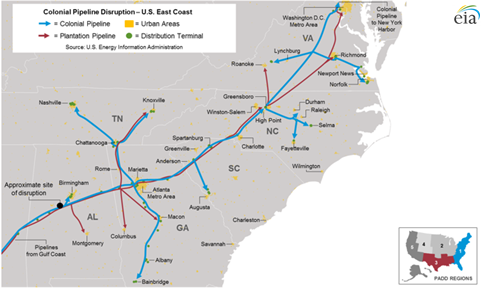
Colonial Pipeline runs a system its chief executive described to the Senate as more than 5,500 miles long, carrying more than 100 million gallons of gasoline, diesel, jet fuel and other products a day. On May 7, 2021 it discovered a ransomware attack by the DarkSide group and shut the pipeline down. Its chief executive, Joseph Blount, testified on June 8, 2021 that the company believed the attacker used "the legacy VPN profile," which had only single-factor authentication, and that he made the decision to pay a ransom of $4.4 million.3 The Justice Department recovered 63.7 of the roughly 75 bitcoins paid.37 The Transportation Security Administration then issued its first mandatory cybersecurity directives for pipelines; those are covered in module 111, lesson 6. The lesson: an old, forgotten remote access account protected only by a password can stop a national supply line.

MOVEit Transfer, 2023
CISA and the FBI reported that the CL0P group began exploiting a previously unknown SQL injection flaw (CVE-2023-34362) in Progress Software's MOVEit Transfer product on May 27, 2023, installing a web shell CISA called LEMURLOOT on internet-facing servers and stealing data from the underlying databases. CISA added the flaw to the KEV catalog on June 2, 2023. The group had done the same thing before to other file transfer products: Accellion's appliance in 2020 and 2021 and Fortra's GoAnywhere in early 2023.30 Many victims never ran MOVEit themselves; their data was stolen from a payroll processor, benefits administrator, pension fund or other vendor that did. That is the "fourth party" problem in lesson 8.
MGM Resorts, 2023
In September 2023 a cyberattack disrupted MGM Resorts' hotels and casinos. In a Form 8-K filed October 5, 2023 (before the SEC's Item 1.05 took effect), MGM said it expected a negative impact of about $100 million on its Adjusted Property EBITDAR (an earnings measure) for the quarter, less than $10 million in one-time expenses, and that attackers obtained personal information of some customers, including driver's license numbers and, for a limited number, Social Security or passport numbers. It said it believed its cyber insurance would be sufficient to cover the financial impact.40 The filing does not name an attacker or explain how the attackers got in; news reports attributed the attack to Scattered Spider affiliates who used social engineering against the help desk, which matches the methods in the FBI and CISA advisory on that group.36
Change Healthcare, 2024
UnitedHealth Group's chief executive, Andrew Witty, told the Senate Finance Committee on May 1, 2024 that attackers entered "a Change Healthcare portal" that "was not protected by multifactor authentication," and that ransomware was deployed nine days later; asked how much was paid, he answered, "Twenty-two million dollars."4 His written statement in the hearing record, also reported at the time, identified it as a Citrix remote access portal, entered with compromised credentials on February 12, 2024.441 OCR's count of about 192.7 million affected people makes it the largest health data breach ever reported.19 The case moved multifactor sign-in from an IT preference to a board question, and it showed concentration risk: one clearinghouse outage stopped cash flow to providers across the country. Sector detail is in module 109, lesson 8.
Snowflake customer accounts, 2024
On June 10, 2024, Mandiant reported that a financially motivated group it tracks as UNC5537 had stolen large volumes of data from customers of the cloud data platform Snowflake, and that Mandiant and Snowflake had notified about 165 potentially exposed organizations. Mandiant found no breach of Snowflake's own systems. It named three factors: the affected accounts "were not configured with multi-factor authentication enabled"; stolen credentials "were still valid, in some cases years after they were stolen, and had not been rotated or updated"; and the affected instances had no network allow lists limiting where logins could come from.5 The lesson is the cloud "shared responsibility" model in action: the provider runs the platform, but the customer controls who can log in. Cloud responsibility is in lesson 6.
Coinbase and Bybit, 2025
Two 2025 cases show money-motivated attacks on financial firms from opposite directions. Coinbase's was an insider case: bribed overseas support staff, an extortion email, a refusal to pay and an estimated $180 million to $400 million in costs, disclosed under Item 1.05.22 Bybit's was a state theft: the FBI attributed the roughly $1.5 billion taken on February 21, 2025 to North Korea.9 For banks, insurers and payment companies, both are reminders that the people and processes around a system matter as much as its code.
2026: industrial controllers, wipers and data theft at scale
The defining U.S. events of 2026 so far have been disruptive rather than purely financial. A joint advisory first published April 7, 2026 and updated July 22, 2026 described Iranian-affiliated actors manipulating programmable logic controllers and operator displays across several U.S. critical infrastructure sectors, "resulting in operational disruption and financial loss," and told owners to "remove PLCs from direct internet exposure."10 More than 100 water providers were targeted in July 2026, according to news reports summarizing federal statements.35 Stryker's March 2026 incident, which the company said had "a material impact on its operations" in its first quarter, showed that a global medical device maker can be knocked offline for days; its amended 8-K of April 9, 2026 said it was again fully operational across its manufacturing network.23 Data theft also continued at scale, with news accounts in 2026 describing extortion groups that used voice phishing and stolen cloud credentials against education technology providers, telecommunications companies and health data processors.35


How attackers pick targets
Executives often ask, "Why us?" The honest answer is usually some mix of two things: the organization was exposed, and it was worth the effort. Attackers sort potential victims the way any business sorts prospects, by cost to reach and likely return.
Opportunity first: who is exposed
Most criminal campaigns start with a list, not a target. Crews scan the internet for devices running a vulnerable version of a VPN gateway, firewall or file transfer server, or test stolen passwords against thousands of login pages, and then decide which of the organizations they got into are worth pursuing. The MOVEit campaign hit whoever had the product on the internet.30 The Snowflake attackers worked through credentials that infostealers had already harvested, some of them years old.5 The 2026 Iranian-affiliated attacks went after controllers reachable from the internet.10 Verizon's 2026 finding that exploitation of vulnerabilities is now the most common way in, while only 26 percent of critical KEV vulnerabilities were fully fixed during 2025, describes this pattern from the defender's side.2 A large organization has more internet-facing systems, more accounts, more vendors and more forgotten assets than a small one, so it shows up on more of these lists.
Bargaining power second: who will pay, and how much
Once inside, attackers estimate their bargaining power. Ransomware crews that go after large organizations on purpose (sometimes called "big game hunting") look for:
- Intolerance of downtime. Hospitals, manufacturers, pipelines, logistics firms, casinos and local governments lose money, safety margin or public trust every hour systems are down. The FBI's 2025 list of sectors most hit by top ransomware variants (critical manufacturing, health care and public health, government facilities) reflects exactly that.1
- Sensitive data. Health records, client files at law and accounting firms, Social Security numbers, student records and trade secrets raise the threat of a leak. Legal services were the most reported industry among non-critical-sector ransomware complaints to IC3 in 2025.1
- Ability to pay. Attackers read annual reports, insurance disclosures and press coverage to set a demand. Some have been reported to look for cyber insurance policies on victim networks.
- Position of trust. Managed service providers, software makers, clearinghouses and cloud tenants give access to many downstream victims at once.
- Regulatory pressure. Groups know that regulated victims face notice deadlines and penalties, and some threaten to report victims to regulators themselves as an added pressure point.
Timing, events and politics
Attackers also choose when. Holiday weekends, the night before a real estate closing, the week of a merger announcement and the days around an election or a military conflict all appear in government warnings and case records. State-sponsored actors pick targets for strategic reasons: telecommunications for surveillance, utilities and water for pressure in a future crisis, defense contractors and research universities for designs, and companies tied to a political dispute for signaling.833
Size is not protection, and smallness is not either
Verizon's 2025 report found ransomware in 39 percent of breaches at larger organizations and 88 percent at small and medium businesses.12 Large organizations are hit less often in proportion to their numbers because they tend to have better defenses, but when they are hit the effects spread further: to patients, customers, suppliers, public services and markets. That is the reason regulators impose duties on them that a small shop does not face. Idaho examples run from Kootenai Health's 2024 ransomware attack, which affected 464,088 people, to the thousands of Idaho residents in national breaches reported to other states.26
What the record means for a large or regulated organization
The same handful of failures appears in case after case. The good news for a board is that the first defenses are known, and most are not exotic. The table below links each major threat to the controls that would have stopped or limited the cases above and to the lesson in this module that covers them. Any change to production systems (turning on multifactor sign-in for every remote login, removing a legacy VPN, segmenting a network, changing backup systems) should be planned, tested first and paired with a way back if it breaks something important.
| Threat | Cases in the public record | First controls | Where in this module |
|---|---|---|---|
| Stolen or guessed logins | Colonial 2021, Change Healthcare 2024, Snowflake customers 2024 | Phishing-resistant multifactor sign-in on every remote and privileged login; retire legacy accounts; rotate leaked credentials | Lesson 5 |
| Unpatched internet-facing systems | Equifax 2017, MOVEit 2023, 2026 PLC attacks | Asset inventory; patch the KEV catalog first; verify patches; remove devices from direct internet exposure | Lesson 6 |
| Ransomware and extortion | Colonial, Change Healthcare, Stryker | Immutable and offline backups with tested restores; segmentation; endpoint detection; practiced response plan | Lesson 7, lesson 10 |
| Vendors and supply chain | SolarWinds 2020, MOVEit 2023, Change Healthcare 2024 | Vendor tiers; contract security terms and notice timing; limit and monitor vendor access; plan for a key vendor outage | Lesson 8 |
| Social engineering and insiders | MGM 2023, Coinbase 2025, business email compromise | Help desk identity verification; least privilege for support staff; payment call-backs; monitoring; training | Lesson 9 |
| Weak governance | Equifax's unverified patch order; SolarWinds disclosure litigation | Named executive owner; board reporting; risk register; tested disclosure process | Lesson 2, lesson 4 |
The FBI's own list of ransomware defenses in its 2025 report is nearly the same: offline, encrypted and immutable backups; no default passwords; least privilege; multifactor sign-in "for all services to the extent possible, particularly for webmail, virtual private networks, and accounts that access critical systems"; logging and endpoint detection; segmentation; and patching, with the instruction to "prioritize patching known exploited vulnerabilities in internet-facing systems."1 CISA's #StopRansomware Guide gives a fuller checklist and a response checklist, and is free.42
Two federal reporting regimes will shape how organizations handle these events. Public companies already face the SEC's four-business-day Item 1.05 clock.20 Critical infrastructure organizations are waiting for CISA's final rule under the Cyber Incident Reporting for Critical Infrastructure Act of 2022, which as proposed would require reporting covered cyber incidents within 72 hours and ransom payments within 24 hours; CISA estimated the proposal would reach 316,244 entities.43 The final rule went to the White House Office of Information and Regulatory Affairs for review on October 1, 2026 and was still pending as of November 9, 2026.44 Until it takes effect, reporting to CISA is voluntary for most organizations. Reporting duties are compared in lesson 10.
Pictures, Numbers and Infographics
The table gathers the lesson's main figures with their sources. Each figure belongs to the report year named; do not combine figures from different reports into one total.
| Measure | Figure | Source and year |
|---|---|---|
| Complaints to the FBI IC3 | 1,008,597 | IC3 2025 report1 |
| Reported losses to IC3 | $20.877 billion (up 26 percent) | IC3 2025 report1 |
| Reported losses to IC3, prior year | $16.6 billion; 859,532 complaints | IC3 2024 report11 |
| Business email compromise losses | $3,046,598,558; 24,768 complaints | IC3 2025 report1 |
| Ransomware complaints and reported losses | 3,611; $32,320,105 (excludes most downtime and recovery) | IC3 2025 report1 |
| New ransomware variants identified | 63 (5.25 a month) | IC3 2025 report1 |
| Idaho complaints and losses | 4,479 (37th); $88,725,284 (38th) | IC3 2025 report1 |
| Breaches with ransomware present | 44 percent (2025 report); 48 percent (2026 report) | Verizon DBIR122 |
| Breaches with third-party involvement | 30 percent (2025 report); 48 percent (2026 report) | Verizon DBIR122 |
| Exploitation of vulnerabilities as way in | 20 percent (2025 report); 31 percent (2026 report) | Verizon DBIR122 |
| Median ransom paid | $115,000 (2025 report); $139,875 (2026 report) | Verizon DBIR122 |
| Ransomware victims that did not pay | 64 percent (2025 report); 69 percent (2026 report) | Verizon DBIR122 |
| Traced ransomware payments | About $820 million in 2025; 28 percent of victims paid | Chainalysis, Feb. 202628 |
| Global average cost of a breach | $4.99 million (up 12 percent) | IBM 202614 |
| U.S. average cost; days to identify and contain | About $11.5 million; 247 days | IBM 2026, as summarized15 |
| Large health breaches and people affected | 663 reports; about 242,908,056 people | HHS OCR, calendar year 202417 |
| People affected by Change Healthcare | About 192.7 million (as of July 31, 2025) | HHS OCR19 |
| Vulnerabilities in CISA's KEV catalog | 1,779 (361 tied to ransomware) | CISA, version 2026.11.1029 |
| LockBit victims and ransom | More than 2,500; at least $500 million | Justice Department, 20246 |
| Equifax people affected; settlement | About 147 million; up to $700 million | FTC, 201938 |
| Colonial Pipeline ransom; amount seized back | $4.4 million; 63.7 bitcoins (over $2.3 million) | Senate testimony and Justice Department, 2021337 |
| Bybit theft attributed to North Korea | About $1.5 billion | FBI, Feb. 26, 20259 |
| SEC incident disclosure deadline | 4 business days after materiality determination | SEC rule, 202320 |
| Proposed CIRCIA deadlines | 72 hours (incident); 24 hours (ransom payment) | CISA proposed rule, 202443 |
| Idaho public agency notice to Attorney General | Within 24 hours of discovery | Idaho Code 28-51-10527 |
Common mistakes
Each mistake below is drawn from a government record, a regulator's order or a company's own filing.
- Ordering a patch and never confirming it. Equifax's security team ordered a critical patch within 48 hours in March 2017, but, according to the FTC, nobody followed up to make sure it was installed, and the flaw was exploited.38 Large organizations need a check that closes the loop: a scan or report that proves the fix is in place on every affected system.
- Leaving an old remote access door open. Colonial Pipeline's chief executive told the Senate that the attacker likely used a legacy VPN profile with single-factor authentication.3 Old accounts, test systems and forgotten portals are where attackers look first. Inventory them and close or protect them.
- Exempting one portal from multifactor sign-in. Change Healthcare's attackers entered through a remote access portal that was not protected by multifactor authentication, nine days before deploying ransomware.4 A policy that says "MFA everywhere" means nothing if the exceptions are not listed and tracked.
- Treating the cloud provider's security as the customer's security. In the Snowflake breaches, Mandiant found accounts without multifactor sign-in, passwords stolen years earlier that had never been changed, and no network allow lists.5 All three were customer settings.
- Giving support staff more access than the job needs. Coinbase said bribed support contractors and employees outside the United States pulled customer data from internal systems they could reach, and it estimated $180 million to $400 million in costs.22 Least privilege, data masking and close monitoring of outsourced support are basic controls for any large customer operation.
- Letting the help desk reset credentials on a phone call. The FBI and CISA describe Scattered Spider persuading IT help desks to reset passwords and multifactor devices for impostors.36 A help desk needs an identity check that a caller cannot talk around.
- Putting industrial controllers on the internet with default settings. Federal advisories in 2023 and 2026 describe attackers reaching programmable logic controllers that were directly exposed to the internet, in 2023 using default passwords.3410
- Treating a vendor's file transfer server as the vendor's problem. MOVEit victims included organizations whose data sat on a vendor's server they had never heard of.30 Vendor contracts and inventories need to cover where data goes after it leaves.
- Quoting a statistic for something it does not measure. Citing IC3's $32 million ransomware loss line as "the cost of ransomware" understates the problem by orders of magnitude; the FBI itself says it leaves out lost business, time and remediation.1
Questions people ask
Are large organizations more or less likely to be hit than small ones?
Large organizations are attacked constantly, because they have more people, systems and vendors to try. In Verizon's data, ransomware made up a smaller share of breaches at larger organizations (39 percent) than at small and medium ones (88 percent) in the 2025 report, which suggests larger organizations stop more of the routine attempts.12 When a large organization is hit, the consequences reach more people, which is why regulators focus on it.
Is ransomware getting better or worse?
Both, depending on the measure. Attacks and leak site postings rose in 2025, and Verizon found ransomware in a larger share of breaches in its 2026 report than in 2025. But fewer victims are paying: 28 percent in 2025 by Chainalysis's count, and 69 percent of victims in Verizon's 2026 data did not pay.282 Better backups, law enforcement takedowns and sanctions risk all play a part.
Which number should we give the board?
Give the board numbers that match its decisions. For "how likely," use the DBIR's patterns for your industry and size. For "how bad," use your own downtime cost per day and your notification costs, with IBM's study as a cross-check. For "what are we doing about it," use your own measures: share of remote and privileged logins with phishing-resistant multifactor sign-in, time to patch KEV-listed flaws, percentage of critical systems with tested restores, and number of high-risk vendors reviewed. Board metrics are in lesson 4.
Do nation-states care about an ordinary company?
Sometimes directly, more often indirectly. A regional telecommunications carrier, water utility, defense subcontractor or university lab may be a direct target. An ordinary company may be hit as collateral damage (NotPetya), as a route to a customer (SolarWinds), or by a state-linked group stealing money. Verizon's 2025 report found about 28 percent of incidents involving state-sponsored actors had a financial motive.12
What should we do first if we are hit?
Follow the incident response plan: contain the damage without destroying evidence, notify the insurer as the policy requires, call the FBI field office and file at ic3.gov, report to CISA, and start tracking legal and contractual notice clocks. The FBI's 2025 report asks every ransomware victim to file with IC3.1 The full sequence is in lesson 10.
Is artificial intelligence changing the threat?
It is making old attacks cheaper and more convincing: better-written phishing, cloned voices of executives, fake video calls, and faster research by attackers. IC3 counted $893,346,472 in reported losses with an AI-related descriptor in 2025.1 The same plain controls (call-back verification, phishing-resistant sign-in, patching) still stop most of it. A newer risk is staff pasting confidential data into unapproved AI tools, which Verizon's 2026 summary now counts among common non-malicious insider actions.2
Does cyber insurance cover all of this?
Usually not all of it. Policies vary widely in limits, waiting periods for business interruption, war and state-actor exclusions, and conditions such as requiring multifactor sign-in or approved response firms. MGM said in its 2023 filing that it believed its insurance would cover the financial impact of its incident; that is a statement about one policy, not a rule.40 Insurance is discussed for smaller firms in module 73, lesson 12.
Hard questions
Should ransom payments be banned?
The case for a ban: Ransoms fund the criminal economy; as Deputy Attorney General Monaco put it, payments are "the fuel that propels the digital extortion engine."37 If no one could pay, the business model would shrink, and organizations would invest in backups instead. The U.S. government already "strongly discourages" payment.31
The case against: A hospital or water utility with no working backups may face harm to people that only a decryption key can prevent quickly. A ban could push payments underground, stop victims from reporting and fall hardest on small public bodies with the least ability to recover. Colonial Pipeline's chief executive told the Senate he decided to pay because of the stakes of a fuel outage.3
What the evidence shows: Payment rates are already falling without a ban: Chainalysis estimated 28 percent of victims paid in 2025, and Verizon found 69 percent of ransomware victims in its 2026 data did not pay.282 No U.S. federal ban exists as of November 2026; sanctions law already bars payments to listed persons. The debate is mostly about mandatory reporting of payments, which CIRCIA's proposed rule would require within 24 hours for covered entities.43
How fast should companies have to disclose an attack?
The case for fast public disclosure: Investors, customers and patients make decisions on stale information if a company sits on a material incident. The SEC adopted a four-business-day clock after materiality is determined, and argued that investors need timely, consistent information.20
The case for more time or confidential reporting: Early disclosure can tip off attackers, invite copycats and force companies to describe events they do not yet understand. Financial trade groups petitioned the SEC in 2025 to rescind Item 1.05, and favor confidential reporting to agencies such as CISA instead.24
What the evidence shows: Filings like Stryker's show companies can meet the clock with short, general statements and add detail in amendments.23 The SEC staff's 2024 guidance channels uncertain or minor events to Item 8.01.21 Whether Item 1.05 survives the SEC's 2026 review was not settled as of the date of this lesson.
Are the big breach cost numbers trustworthy?
The case for them: Industry studies such as IBM's use consistent methods year to year, and the trends they show (higher costs for longer breaches, lower costs with practiced response) match what responders see.14
The case for skepticism: The cost studies are modeled estimates from interviews and are sponsored by companies that sell security products, while government counts such as IC3's rely on voluntary reporting and leave out most business losses.1 Neither is a census.
What the evidence shows: Company filings give the most reliable cost figures for specific events (MGM's about $100 million earnings hit, Coinbase's $180 million to $400 million estimate, Merck's NotPetya figures), and they are usually larger than the averages.402232 Use averages for direction and filings for scale.
Is sharing threat information with the government worth the risk?
The case for sharing: Federal advisories on Volt Typhoon, Scattered Spider and the 2026 controller attacks were built in part from victim reports, and they let other organizations act before they are hit.810 The Cybersecurity Information Sharing Act of 2015 gives companies legal protections when they share threat indicators.
The case for caution: Companies worry that shared information could reach regulators or plaintiffs, and privacy advocates worry about personal data in shared feeds. The 2015 law's protections lapsed on September 30, 2025 and have since run on short extensions; the Congressional Research Service reported in September 2026 that they were extended to December 11, 2026.45
What the evidence shows: Most large organizations share through sector groups called information sharing and analysis centers (ISACs) and directly with the FBI and CISA, and the joint advisories cited in this lesson show the result. The legal protections' long-term future was undecided as of November 13, 2026; check the current status before relying on them.
For reporters and advocates
What public records exist.
- FBI IC3 annual reports and state tables. National and state complaint and loss figures, including Idaho's, at ic3.gov. Read the definitions appendix before comparing years.1
- SEC filings. Form 8-K Item 1.05 (material incidents) and Item 8.01 (other incidents), amendments that add detail, and Form 10-K Item 1C (cyber risk management and governance). Use EDGAR full-text search for "Item 1.05" and the company's name.46
- HHS OCR breach portal. Every health breach of 500 or more people, searchable by state; filter for Idaho.16
- State attorney general breach lists. Maine, California, Washington, Vermont and others post notices with total counts. Idaho's law does not require private businesses to notify the Idaho Attorney General, but public agencies must do so within 24 hours of discovery, and those agency notices may be reachable through a public records request under Idaho Code Title 74.27
- Government advisories and catalogs. CISA's cybersecurity advisories and the KEV catalog record what attackers are doing and which flaws are in use.29
- Enforcement and court records. FTC and SEC orders, Justice Department indictments and press releases, OCR resolution agreements, and civil suits on PACER and CourtListener often describe how an attack happened in more detail than the company's notice.386
- Congressional hearings. Testimony on Colonial Pipeline and Change Healthcare is public on govinfo.gov and gives executives' own accounts under oath.34
Questions to ask a hospital, utility, school district, county or company. Do all remote and administrator logins require multifactor sign-in, and are there any exceptions? How long does it take to patch a flaw on CISA's KEV list on an internet-facing system? When was the last full test restore from backup, and how long did it take? Which vendors could stop your operations if they went down, and what is the plan if one does? Who decides whether to pay a ransom, and has that decision been rehearsed? Have you reported incidents to the FBI or CISA, and under what rules do you notify the public?
The Idaho angle. Idaho hospitals, school districts, counties and manufacturers have all reported incidents in recent years; Kootenai Health's 2024 ransomware attack is one documented example.26 Ask Idaho public agencies how many breach notices they sent to the Attorney General under Idaho Code 28-51-105 in the last three years, and request those notices from the Attorney General's office. Ask county commissioners and school boards whether their insurance carriers have required new controls, and what those cost. National coverage gives the numbers; local records show whether the controls in this module are in place where people live.
Where to go next
- CISA #StopRansomware Guide: Free federal guide with ransomware prevention practices and a step-by-step response checklist. For IT and security staff and incident response teams; compare it to your own plan line by line.
- CISA Known Exploited Vulnerabilities Catalog: Free list of software flaws confirmed to be exploited, with a downloadable feed. For vulnerability management teams; use it to set patch priority for internet-facing systems first.
- FBI Internet Crime Complaint Center (IC3): Free. Where victims file cybercrime complaints and where the FBI publishes annual reports, public service announcements and industry alerts. Every organization's response plan should name it.
- HHS OCR Breach Portal: Free public list of health data breaches affecting 500 or more people, searchable by state and type. For health organizations, reporters and researchers.
- SEC EDGAR Full Text Search: Free search of public company filings. Search for Item 1.05 or Item 1C with a company or industry name to read incident disclosures and cyber governance descriptions.
- Verizon Data Breach Investigations Report: Free annual industry study of how breaches happen, with industry and size breakdowns. For risk managers and boards; read the section for your industry rather than only the headline numbers.
- IBM Cost of a Data Breach Report: Free with registration. Modeled breach cost estimates by industry and factor, sponsored by IBM and researched by the Ponemon Institute. Useful for direction, not as a quote for your organization.
Still being checked (8 items)
These points could not be fully confirmed against a primary source when this lesson was written and fact checked in November 2026. The text above states each one as uncertain.
- The attribution of the 2023 MGM Resorts attack to Scattered Spider affiliates and help desk social engineering rests on news reports; MGM's Oct. 5, 2023 Form 8-K names no attacker and does not say how the attackers got in.
- Verizon 2026 DBIR figures come from Verizon's executive summary and a press summary; the full 2026 report was not opened. The release month (May 2026) is taken from press coverage. The executive summary's comparison of the median ransom to a prior-year figure of $150,000 differs from the $115,000 median in the 2025 DBIR, so the lesson gives both report figures without stating a direction of change.
- IBM 2026 figures other than the $4.99 million global average (the U.S. average of about $11.5 million, health care $6.64 million, 247 days, 602 breaches) come from a law firm's summary, not the report itself.
- The status of the SEC's review of Form 8-K Item 1.05 and Regulation S-K Item 106 was confirmed only through late October 2026; a news search on Nov. 14, 2026 found no proposal to amend or rescind Item 1.05, but no SEC primary document dated after October was checked.
- Claims that the Handala group attacked Stryker and wiped tens of thousands of devices, and that more than 100 U.S. water providers were targeted in July 2026, come from TechCrunch's reporting; Stryker's SEC filings name no attacker.
- Chainalysis's 2025 ransomware payment figures are taken from The Register's report of the Chainalysis 2026 Crypto Crime Report, not from the Chainalysis report itself.
- Health care figures for Change Healthcare (192.7 million), OCR's calendar year 2024 report, HIPAA Journal's 2025 count and Kootenai Health (464,088) were verified for module 109 on Oct. 28, 2026; the OCR 2024 report figures and the 192.7 million count were re-read on HHS pages on Nov. 14, 2026 and HIPAA Journal's 2025 count was re-read the same day; only the Kootenai Health figure still rests on a secondary report of the Maine attorney general filing.
- Whether the Cybersecurity Information Sharing Act of 2015's protections will be extended beyond Dec. 11, 2026 was not known as of Nov. 14, 2026; news reports of Nov. 9, 2026 said the law was set to expire again on Dec. 11 and that a 10-year extension was stalled with the defense authorization bill.
Last verified November 14, 2026. General education, not legal, compliance, audit or other professional advice; rule versions and dates are stated in the text, and the sources used are listed in the Notes and Sources below. Check the regulator's current text before relying on any point.
Notes
- Federal Bureau of Investigation, Internet Crime Complaint Center, 2025 IC3 Annual Report (released April 2026): 1,008,597 complaints, $20.877 billion in losses, 26 percent increase, average loss $20,699 (p. 6); crime type tables (pp. 7 to 8: business email compromise 24,768 complaints and $3,046,598,558; ransomware 3,611 and $32,320,105; personal data breach 67,456 and $1,314,923,988; data breach 3,963 and $435,240,992; AI related 22,364 and $893,346,472); ransomware section (pp. 14 to 16: 63 new variants, top ten variants, most affected critical sectors, non-critical sector industries, loss caveats); recommendations (p. 15); state tables (Idaho 4,479 complaints, 37th; $88,725,284, 38th) (read Nov. 13, 2026). Read it online. ↩
- Verizon, 2026 Data Breach Investigations Report: Executive Summary (data from Oct. 2024 through Nov. 2025; more than 31,000 incidents and 22,000 breaches in 145 countries; exploitation 31 percent, credential abuse 13 percent, phishing 16 percent; 26 percent of critical KEV vulnerabilities fully remediated, median 43 days; ransomware in 48 percent of breaches, median payment $139,875, 69 percent did not pay; third party 48 percent; human element 62 percent; AI use findings). Copyrighted industry report, described and briefly quoted (read Nov. 13, 2026). Read it online. ↩
- U.S. Senate Committee on Homeland Security and Governmental Affairs, Threats to Critical Infrastructure: Examining the Colonial Pipeline Cyber Attack, hearing of June 8, 2021, S. Hrg. 117-429 (testimony of Joseph Blount, Colonial Pipeline chief executive: system of more than 5,500 miles carrying more than 100 million gallons a day; attack discovered May 7, 2021; legacy VPN profile with single-factor authentication; decision to pay $4.4 million) (read Nov. 13, 2026). Read it online. ↩
- U.S. Senate Committee on Finance, hearing record, Hacking America's Health Care: Assessing the Change Healthcare Cyber Attack and What's Next, May 1, 2024, S. Hrg. 118-785 (testimony of UnitedHealth Group chief executive Andrew Witty: written statement that on Feb. 12, 2024 criminals used compromised credentials to remotely access a Change Healthcare Citrix portal; portal without multifactor authentication; ransomware deployed nine days after entry; "Twenty-two million dollars") (re-read Nov. 14, 2026). Read it online. ↩
- Mandiant (Google Cloud), "UNC5537 Targets Snowflake Customer Instances for Data Theft and Extortion," June 10, 2024, updated June 17, 2024 (about 165 potentially exposed organizations notified; at least 79.7 percent of accounts with prior credential exposure; six infostealer families; earliest infection November 2020; three factors: no MFA, unrotated credentials, no network allow lists). Vendor research, briefly quoted (read Nov. 13, 2026). Read it online. ↩
- U.S. Department of Justice, Office of Public Affairs, "U.S. Charges Russian National with Developing and Operating LockBit Ransomware," May 7, 2024 (26-count indictment of Dmitry Khoroshev in New Jersey; more than 2,500 victims in at least 120 countries including about 1,800 in the United States; at least $500 million in ransom; developer typically 20 percent, affiliate 80 percent; February 2024 disruption led by the U.K. National Crime Agency) (read Nov. 13, 2026). Read it online. ↩
- U.S. Government Accountability Office, WatchBlog, "SolarWinds Cyberattack Demands Significant Federal and Private-Sector Response (infographic)," April 22, 2021 (nearly 18,000 customers downloaded a tainted Orion update; dry run September 2019; code inserted February 2020; FireEye detection November 2020; CISA emergency directive Dec. 13, 2020; attribution to the Russian Foreign Intelligence Service) (read Nov. 13, 2026). Read it online. ↩
- CISA, NSA, FBI and partners, Joint Cybersecurity Advisory AA24-038A, PRC State-Sponsored Actors Compromise and Maintain Persistent Access to U.S. Critical Infrastructure, Feb. 7, 2024 (Volt Typhoon pre-positioning; sectors named) (read Nov. 13, 2026). Read it online. ↩
- FBI, Public Service Announcement I-022625-PSA, "North Korea Responsible for $1.5 Billion Bybit Hack," Feb. 26, 2025 (theft of "approximately $1.5 billion USD" in virtual assets on or about Feb. 21, 2025; activity called TraderTraitor) (read Nov. 13, 2026). Read it online. ↩
- FBI, CISA, NSA, EPA, DOE, U.S. Cyber Command's Cyber National Mission Force and partners, Joint Cybersecurity Advisory AA26-097A, Iranian-Affiliated Cyber Actors Exploit PLCs Across US Critical Infrastructure, April 7, 2026, updated July 22, 2026 (disruption of PLCs and HMI and SCADA displays; scope expanded to potentially all internet-exposed PLCs; mitigation to remove PLCs from direct internet exposure) (as read Oct. 28, 2026 for this module's sister modules; cited Nov. 13, 2026). Read it online. ↩
- FBI, Internet Crime Complaint Center, 2024 IC3 Annual Report (859,532 complaints; $16.6 billion in losses, a 33 percent increase; ransomware 3,156 complaints; 4,878 cyber threat complaints from critical infrastructure; BEC $2,770,151,146) (read Nov. 13, 2026). Read it online. ↩
- Verizon, 2025 Data Breach Investigations Report (22,052 incidents and 12,195 breaches; exploitation 20 percent of initial access; edge devices and VPNs 22 percent of exploitation targets, about 54 percent fully remediated, median 32 days; ransomware in 44 percent of breaches, median payment $115,000, 64 percent did not pay; ransomware 39 percent of breaches at larger organizations and 88 percent at SMBs; third party 30 percent; human element about 60 percent; espionage 17 percent; about 28 percent of state-sponsored actor incidents with financial motive; infostealer findings), pp. 10 to 12 and 20. Copyrighted industry report, described and briefly quoted (read Nov. 13, 2026). Read it online. ↩
- eSecurity Planet, "2026 Verizon DBIR: The New Era of Cyber Threats," May 21, 2026 (secondary summary of the 2026 DBIR used for the release timing and to cross-check figures) (read Nov. 13, 2026). Read it online. ↩
- IBM, Cost of a Data Breach Report 2026, report page (global average cost $4.99 million, a 12 percent increase and a record high). Research conducted by the Ponemon Institute; sponsored industry study (read Nov. 13, 2026). Read it online. ↩
- Baker Donelson, "Ten Takeaways From IBM's 2026 Cost of a Data Breach Report," July 30, 2026 (602 breaches, March 2025 to February 2026; U.S. average $11.5 million; health care $6.64 million, costliest for the 13th year; 247 days to identify and contain; $5.65 million versus $4.32 million split at 200 days). Secondary summary (read Nov. 13, 2026). Read it online. ↩
- HHS Office for Civil Rights, Breach Portal: Notice to the Secretary of HHS Breach of Unsecured Protected Health Information (public list of breaches affecting 500 or more individuals) (read Nov. 13, 2026). Read it online. ↩
- HHS Office for Civil Rights, Annual Report to Congress on Breaches of Unsecured Protected Health Information for Calendar Year 2024 (663 reports of 500 or more affecting about 242,908,056 individuals; hacking 534 reports and 241,582,022 individuals; business associates 106 reports and 206,921,071 individuals) (as read Oct. 28, 2026 for this module's sister modules; cited Nov. 13, 2026). Read it online. ↩
- HIPAA Journal, "2025 Healthcare Data Breach Report," Feb. 13, 2026 (710 breaches of 500 or more records; at least 61,556,256 individuals; secondary count of the HHS portal that changes as filings are amended) (as read Oct. 28, 2026 for this module's sister modules; cited Nov. 13, 2026). Read it online. ↩
- HHS Office for Civil Rights, "Change Healthcare Cybersecurity Incident Frequently Asked Questions" (approximately 192.7 million individuals affected, as of July 31, 2025) (as read Oct. 28, 2026 for this module's sister modules; cited Nov. 13, 2026). Read it online. ↩
- Securities and Exchange Commission, final rule, "Cybersecurity Risk Management, Strategy, Governance, and Incident Disclosure," 88 FR 51896 (Aug. 4, 2023), effective Sept. 5, 2023 (Form 8-K Item 1.05 due within four business days of a materiality determination; compliance Dec. 18, 2023, and June 15, 2024 for smaller reporting companies; Attorney General national security or public safety delay; Regulation S-K Item 106 and Form 10-K Item 1C) (read Nov. 13, 2026). Read it online. ↩
- Erik Gerding, Director, SEC Division of Corporation Finance, "Disclosure of Cybersecurity Incidents Determined To Be Material and Other Cybersecurity Incidents," statement, May 21, 2024 (quoting the adopting release: "Item 1.05 is not a voluntary disclosure"; use Item 8.01 for other incidents) (read Nov. 13, 2026). Read it online. ↩
- Coinbase Global, Inc., Current Report on Form 8-K, Items 1.05 and 9.01, filed May 15, 2025 (extortion email received May 11, 2025; actor believed to have paid contractors or employees in support roles outside the United States; no payment; preliminary estimate of $180 million to $400 million in costs) (read Nov. 13, 2026). Read it online. ↩
- Stryker Corporation, Current Report on Form 8-K/A (Amendment No. 1), Item 1.05, dated April 9, 2026 (incident identified March 11, 2026; original 8-K filed March 11, 2026; "a material impact on its operations" affecting first quarter 2026 results; fully operational across its global manufacturing network; no attacker named) (read Nov. 13, 2026). Read it online. ↩
- SEC, Joint Petition for Rulemaking to Amend the SEC's Cybersecurity Risk Management, Strategy, Governance, and Incident Disclosure rules, May 2025 (petition by financial industry groups to rescind Item 1.05); SEC Chairman Paul Atkins's Jan. 13, 2026 request for comment on Regulation S-K, and April 2026 industry comment letters urging repeal, as summarized in this module's sister fact sheet; no proposal to amend Item 1.05 found as of late October 2026 (as read Oct. 28, 2026 for this module's sister modules; cited Nov. 13, 2026). Read it online. ↩
- National Conference of State Legislatures, "Security Breach Notification Laws" (all 50 states, the District of Columbia, Guam, Puerto Rico and the U.S. Virgin Islands) (as read Oct. 28, 2026 for this module's sister modules; cited Nov. 13, 2026). Read it online. ↩
- SecurityWeek, "460k Impacted by Kootenai Health Ransomware Attack," August 2024 (464,088 people per the Maine attorney general filing; intrusion identified March 2, 2024; 3AM group claim). Secondary source (as read Oct. 28, 2026 for this module's sister modules; cited Nov. 13, 2026). Read it online. ↩
- Idaho Code 28-51-105, Disclosure of breach of security of computerized personal information by an agency, individual or a commercial entity (added 2006, ch. 258; amended 2014, ch. 97): notice "in the most expedient time possible and without unreasonable delay"; agencies notify the Idaho attorney general "within twenty-four (24) hours" of discovery (read Nov. 13, 2026). Read it online. ↩
- The Register, "Ransomware payments cratered in 2025, but attacks surged to record highs," Feb. 27, 2026, reporting Chainalysis's 2026 Crypto Crime Report (about $820 million in 2025, about 8 percent below 2024; 28 percent of victims paid; at least $14 million to initial access brokers, with spikes about 30 days ahead of ransomware payments; claimed victims up about 50 percent). Secondary source (read Nov. 13, 2026). Read it online. ↩
- CISA, Known Exploited Vulnerabilities Catalog, catalog version 2026.11.10 released Nov. 10, 2026 (1,779 entries; 361 marked as known to be used in ransomware campaigns), counted from CISA's JSON feed (read Nov. 13, 2026). Read it online. ↩
- CISA and FBI, Joint Cybersecurity Advisory AA23-158A, #StopRansomware: CL0P Ransomware Gang Exploits CVE-2023-34362 MOVEit Vulnerability, June 7, 2023, updated June 16, 2023 (exploitation from May 27, 2023; LEMURLOOT web shell; KEV addition June 2, 2023; CL0P reliance on data exfiltration since 2021; RaaS and affiliate roles; Accellion and GoAnywhere campaigns) (read Nov. 13, 2026). Read it online. ↩
- U.S. Department of the Treasury, Office of Foreign Assets Control, "Updated Advisory on Potential Sanctions Risks for Facilitating Ransomware Payments," Sept. 21, 2021 (the government "strongly discourages all private companies and citizens from paying ransom or extortion demands") (read Nov. 13, 2026). Read it online. ↩
- Merck and Co., Inc., Annual Report on Form 10-K for the fiscal year ended Dec. 31, 2017 (June 27, 2017 cyber-attack: sales effect of approximately $260 million in 2017; expenses of $285 million net of insurance recoveries) (re-read Nov. 14, 2026: "net of insurance recoveries of approximately $45 million"). NotPetya attribution: White House press secretary statement of Feb. 15, 2018 naming the Russian military, as reported the same day by Axios, https://www.axios.com/2018/02/15/white-house-confirms-notpetya-1518728781 (first read Oct. 28, 2026 for this module's sister modules; cited Nov. 13, 2026). Read it online. ↩
- CISA, "CISA and Partners Release Joint Advisory on Countering Chinese State-Sponsored Actors Compromise of Networks Worldwide to Feed Global Espionage System," alert, Aug. 27, 2025 (telecommunications, government, transportation, lodging and military networks; Salt Typhoon and other names) (read Nov. 13, 2026). Read it online. ↩
- FBI, CISA, NSA, EPA and the Israel National Cyber Directorate, Joint Cybersecurity Advisory AA23-335A, IRGC-Affiliated Cyber Actors Exploit PLCs in Multiple Sectors, Including U.S. Water and Wastewater Systems Facilities, Dec. 1, 2023 (CyberAv3ngers; Unitronics controllers; default credentials; victims in multiple U.S. states) (as read Oct. 28, 2026 for this module's sister modules; cited Nov. 13, 2026). Read it online. ↩
- TechCrunch, "The worst hacks and breaches of 2026 (so far)," first published June 7, 2026 and updated through September 2026 (Stryker device wiping claimed by Handala; more than 100 U.S. water providers targeted in July 2026; extortion campaigns against education, telecommunications and health data companies). Secondary source (read Nov. 13, 2026). Read it online. ↩
- FBI and CISA, Joint Cybersecurity Advisory AA23-320A, Scattered Spider, Nov. 16, 2023, updated Nov. 21, 2023 and last revised July 29, 2025 (targets "large companies and their contracted information technology (IT) help desks"; help desk social engineering, SIM swaps, MFA fatigue; data theft for extortion; most recently DragonForce ransomware, including against VMware ESXi servers) (read Nov. 13, 2026). Read it online. ↩
- U.S. Department of Justice, U.S. Attorney's Office for the Northern District of California, "Department of Justice Seizes $2.3 Million in Cryptocurrency Paid to the Ransomware Extortionists Darkside," June 2021 (63.7 of approximately 75 bitcoins paid; statement of Deputy Attorney General Lisa O. Monaco) (read Nov. 13, 2026). Read it online. ↩
- Federal Trade Commission, "Equifax to Pay $575 Million as Part of Settlement with FTC, CFPB, and States Related to 2017 Data Breach," press release, July 22, 2019 (about 147 million people; up to $700 million; unpatched vulnerability alert in March 2017 with no follow-up; plain-text credentials; FTC Act and Safeguards Rule allegations) (read Nov. 13, 2026). Read it online. ↩
- Covington and Burling, Inside Privacy, "SEC Voluntarily Dismisses SolarWinds Litigation," November 2025 (case 1:23-cv-09518, S.D.N.Y.; July 18, 2024 ruling narrowing the case; dismissal with prejudice announced Nov. 20, 2025). Secondary source (read Nov. 13, 2026). Read it online. ↩
- MGM Resorts International, Current Report on Form 8-K, Items 2.02 and 7.01, filed Oct. 5, 2023 (negative impact of approximately $100 million on Adjusted Property EBITDAR; less than $10 million in one-time expenses; customer data affected; insurance expected to be sufficient) (read Nov. 13, 2026). Read it online. ↩
- Arielle Waldman, "Change Healthcare breached via Citrix portal with no MFA," TechTarget, April 30, 2024, reporting Andrew Witty's written testimony (Citrix remote access portal; compromised credentials; entry Feb. 12, 2024). Secondary source (as read Oct. 28, 2026 for this module's sister modules; cited Nov. 13, 2026). Read it online. ↩
- CISA, MS-ISAC, NSA and FBI, #StopRansomware Guide (prevention best practices and response checklist; free) (read Nov. 13, 2026). Read it online. ↩
- CISA, "Cyber Incident Reporting for Critical Infrastructure Act (CIRCIA) Reporting Requirements," proposed rule, 89 FR 23644 (April 4, 2024) (72 hours for covered cyber incidents; 24 hours for ransom payments; estimated 316,244 entities potentially affected) (read Nov. 13, 2026). Read it online. ↩
- David DiMolfetta, "CISA updates cyber reporting form as broader incident mandate awaits approval," Nextgov/FCW, Nov. 9, 2026 (final CIRCIA rule at White House review since Oct. 1, 2026, still pending). Secondary source (read Nov. 13, 2026). Read it online. ↩
- Congressional Research Service, "The Cybersecurity Information Sharing Act of 2015: Expiring Provisions," IF12959, updated Sept. 3, 2026 (provisions extended to Dec. 11, 2026 by the Continuing Appropriations and Extensions Act, 2027) (read Nov. 13, 2026). Read it online. ↩
- SEC, EDGAR Full Text Search (free search of company filings, including Form 8-K Items 1.05 and 8.01) (read Nov. 13, 2026). Read it online. ↩
Check yourself
1. According to the FBI's 2025 IC3 annual report, how much in total losses did victims report to IC3 for 2025?
The 2025 IC3 Annual Report counted 1,008,597 complaints and $20.877 billion in reported losses, a 26 percent rise from the $16.6 billion in the 2024 report. $32.3 million is the ransomware line alone.
2. Why does the IC3 report's ransomware loss figure ($32,320,105 for 2025) understate the real cost of ransomware?
The FBI's 2025 IC3 report says ransomware adjusted losses do not normally include estimates of lost business, time, wages, files, or equipment, or third-party remediation services, and that some victims report no loss amount.
3. In Verizon's 2026 DBIR executive summary, what became the most common initial access vector in breaches?
Verizon's 2026 executive summary reports exploitation of vulnerabilities at 31 percent of breaches, ahead of credential abuse (13 percent) and phishing (16 percent).
4. What did Colonial Pipeline's chief executive tell the Senate on June 8, 2021 about how the attacker likely got in?
In S. Hrg. 117-429, Joseph Blount testified that the company believed the attacker exploited the legacy VPN profile, which had only single-factor authentication, and that he decided to pay $4.4 million.
5. In the LockBit ransomware-as-a-service model described by the Justice Department in May 2024, how was a ransom typically divided?
The Justice Department said the LockBit developer typically received 20 percent of each ransom payment and the affiliate the remaining 80 percent; LockBit hit more than 2,500 victims and took at least $500 million.
6. Which three factors did Mandiant identify in the 2024 Snowflake customer data thefts?
Mandiant's June 10, 2024 report on UNC5537 named those three factors and found no breach of Snowflake's own systems; about 165 organizations were notified.
7. Under the SEC's 2023 rule, when must a public company file a Form 8-K under Item 1.05?
The SEC final rule (88 FR 51896, Aug. 4, 2023) requires an Item 1.05 Form 8-K within four business days of a materiality determination, with a delay only if the U.S. Attorney General finds a substantial risk to national security or public safety.
8. What did federal agencies warn in February 2024 that the Chinese state-sponsored group Volt Typhoon was doing?
Joint advisory AA24-038A (Feb. 7, 2024) said the actors were seeking to pre-position themselves on IT networks for disruptive or destructive cyberattacks against U.S. critical infrastructure in the event of a major crisis or conflict.
9. Under Idaho Code 28-51-105, who must notify the Idaho Attorney General of a breach, and how fast?
Idaho Code 28-51-105 requires an agency that becomes aware of a breach to notify the Idaho attorney general within twenty-four hours of discovery; businesses must notify affected residents in the most expedient time possible and without unreasonable delay.
10. According to the FTC, what was a central failure behind the 2017 Equifax breach?
The FTC's July 22, 2019 announcement says Equifax's security team ordered the patch within 48 hours but did not follow up to make sure it was done; the settlement was at least $575 million and up to $700 million.
Terms in this lesson
- Ransomware
- Malicious software that encrypts an organization's files and systems so they cannot be used until a ransom is paid for the key.
- Double extortion
- A ransomware tactic of copying data before encrypting it, then threatening to publish the stolen data on a leak site if the victim does not pay.
- Ransomware as a service (RaaS)
- A criminal business model in which developers rent ransomware, payment sites and leak sites to affiliates who carry out attacks and share the ransom.
- Affiliate
- An independent criminal crew that breaks into victims and deploys a RaaS group's ransomware in exchange for most of the ransom.
- Initial access broker
- A criminal who breaks into organizations or buys stolen logins and sells that foothold to other criminals, often ransomware affiliates.
- Infostealer
- Malware that collects saved passwords, browser session cookies and other credentials from an infected computer and sends them to criminal markets.
- Business email compromise (BEC)
- Fraud that uses a compromised or imitated email account to redirect payments or obtain sensitive data.
- Insider threat
- Harm caused by someone with legitimate access, such as an employee, contractor or vendor staff member, whether malicious, bribed or careless.
- Supply chain attack
- An attack that reaches many victims through one trusted supplier, such as a software update, managed service provider or cloud platform.
- Nation-state actor
- A hacking group working for or with the approval of a national government, usually for espionage, pre-positioning, sabotage or state-funded theft.
- Hacktivist
- An attacker motivated by a political or social cause, typically using defacement, denial-of-service attacks or leaks.
- Known Exploited Vulnerabilities (KEV) catalog
- CISA's public list of software vulnerabilities confirmed to be exploited in real attacks, used to decide what to patch first.
- Edge device
- Equipment that sits at the boundary between an organization's network and the internet, such as a firewall, VPN gateway or file transfer server.
- Data leak site
- A website run by an extortion group that names victims and posts stolen data to pressure them to pay.
- Materiality determination
- A public company's decision that a cybersecurity incident is important enough to a reasonable investor to require disclosure; it starts the SEC's four-business-day Item 1.05 clock.
Sources
- FBI Internet Crime Complaint Center, 2025 IC3 Annual Report (2026-04-01) checked 2026-11
- FBI Internet Crime Complaint Center, 2024 IC3 Annual Report (2025-04-23) checked 2026-11
- SEC final rule, Cybersecurity Risk Management, Strategy, Governance, and Incident Disclosure, 88 FR 51896 (2023-08-04) checked 2026-11
- Senate hearing, Threats to Critical Infrastructure: Examining the Colonial Pipeline Cyber Attack, S. Hrg. 117-429 (2021-06-08) checked 2026-11
- Senate Finance Committee hearing, Hacking America's Health Care: Assessing the Change Healthcare Cyber Attack, S. Hrg. 118-785 (2024-05-01) checked 2026-11
- HHS OCR, Annual Report to Congress on Breaches of Unsecured PHI for Calendar Year 2024 (2025-01-01) checked 2026-11
- FTC, Equifax to Pay $575 Million as Part of Settlement with FTC, CFPB, and States (2019-07-22) checked 2026-11
- DOJ, U.S. Charges Russian National with Developing and Operating LockBit Ransomware (2024-05-07) checked 2026-11
- CISA and FBI advisory AA23-158A, CL0P Ransomware Gang Exploits MOVEit Vulnerability (2023-06-07) checked 2026-11
- CISA, NSA, FBI advisory AA24-038A, PRC State-Sponsored Actors (Volt Typhoon) (2024-02-07) checked 2026-11
- Joint advisory AA26-097A, Iranian-Affiliated Cyber Actors Exploit PLCs Across US Critical Infrastructure (2026-07-22) checked 2026-11
- FBI PSA I-022625-PSA, North Korea Responsible for $1.5 Billion Bybit Hack (2025-02-26) checked 2026-11
- CISA, CIRCIA Reporting Requirements proposed rule, 89 FR 23644 (2024-04-04) checked 2026-11
- Idaho Code 28-51-105 (2014-07-01) checked 2026-11
- CISA Known Exploited Vulnerabilities Catalog (2026-11-10) checked 2026-11