Lesson 1 of 10 · about 45 minutes
Why Art and Politics Meet: Persuasion, Propaganda and Witness
You'll be able to
- Name the three jobs political art does (persuade, mobilize, bear witness) and sort a work by its main job
- State what Orwell wrote in 1940 about art and propaganda and what Benjamin argued about the aura and politics
- Give the verified facts of the 1917 Committee on Public Information poster effort: the Division of Pictorial Publicity, Charles Dana Gibson, the roster and the print figures
- Explain the holdings of Hustler v. Falwell, Texas v. Johnson, United States v. Eichman and NEA v. Finley, and the limits set by true threats, incitement and copyright
- Check whether a poster or print on a Library of Congress page is safe to reuse
Start here: the short version
- Political art does three jobs, and most works lean on one. It persuades (a cartoon, a poster), it mobilizes or manages a population (wartime propaganda), or it bears witness (a photograph, a song of testimony). The labels are this course's working tools, not a scholarly consensus, and a single work can do all three.
- George Orwell wrote in 1940 that "All art is propaganda," in an essay on Dickens.1 Walter Benjamin argued that mechanical reproduction destroyed the "aura" of the original and ended with a warning about politics that fascism was "rendering aesthetic."2 Both were looking at the same fact: a picture that can be copied a million times is a political instrument.
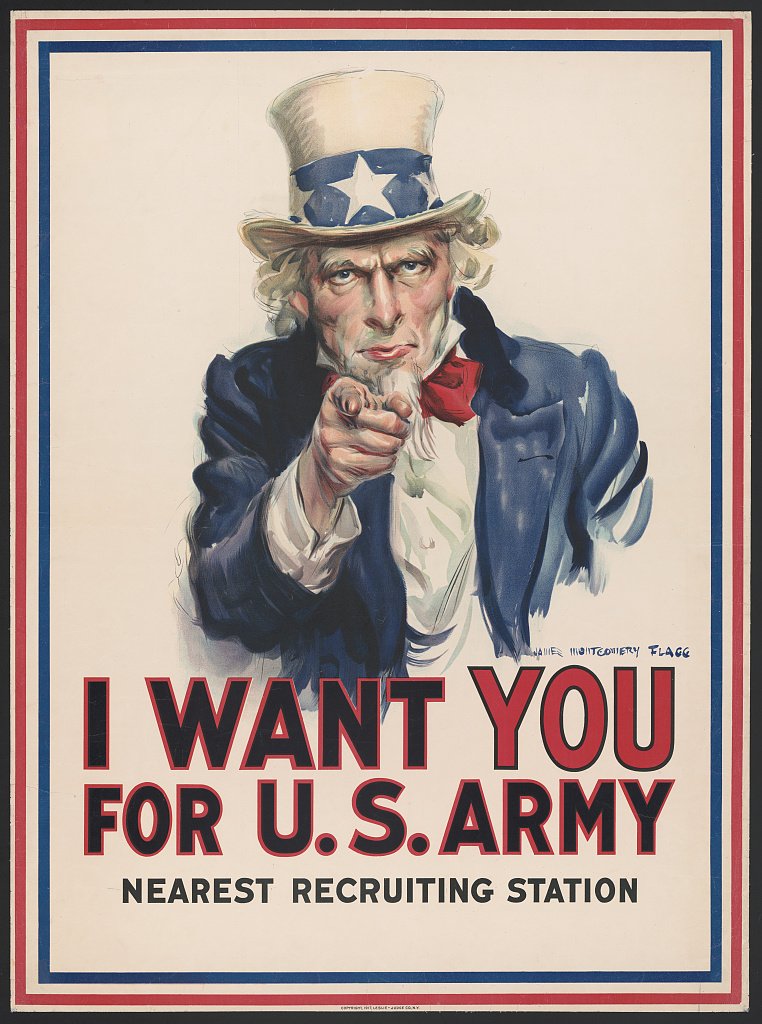
- The United States built the instrument on purpose in 1917. The Division of Pictorial Publicity, launched April 22, 1917 under Charles Dana Gibson, listed 279 artists and 33 cartoonists and produced about 700 poster designs.3 Flagg's Uncle Sam was printed more than four million times between 1917 and 1918.4
- Courts then spent seventy years deciding how much of this the government may punish. Parody of a public figure is protected (Hustler v. Falwell, 1988).5 Burning a flag is protected expression (Texas v. Johnson, 1989; United States v. Eichman, 1990).6 A funding agency may weigh "decency and respect" (NEA v. Finley, 1998).7 True threats, incitement and copyright are the limits.
- Check before you reuse. A Library of Congress catalog record is a lead, not a license: the Flagg record says "No known restrictions on publication,"8 and the Library tells researchers to assess copyright themselves.
This course picks up where Art, Music and Writing from the Revolution to the Civil War stops, with the war photographs, the songs and the printed cartoons of the 1860s. It runs to 2026. The sister course Culture and the Republic covers the wider question of how a republic's habits shape its art. This first lesson builds the frame: what political art is for, how governments learned to use it, how the courts came to protect it, and where the protection ends. Lessons 02 and 03 follow the newspaper cartoon through the century. The rest of the course takes up posters, photography, museum art, and music.
Three jobs political art does
Start with a plain observation. A drawing of a politician as a pig does something different from a photograph of a refugee on a beach, and both do something different from a recruiting poster. If we lump them together as "political art," we lose the ability to ask the useful question, which is what the work was built to do and whether it did it.
This course uses three working categories. They overlap, and that is fine.
| Job | What it does to the viewer | Typical forms | Typical risk |
|---|---|---|---|
| Persuasion | Argues a position and asks the viewer to agree, usually by compression: one image, one joke, one label | Editorial cartoon, campaign poster, protest song, op-ed illustration | Caricature can mislead, and a cartoon can be wrong about its target |
| Mobilization (propaganda in the neutral sense) | Gets a population to do something: enlist, buy a bond, plant a garden, stay quiet | War posters, state murals, anthems, official film | Slides into fear, hatred of an enemy, or suppression of dissent |
| Witness | Records what happened and makes the viewer unable to say they did not know | Documentary photograph, testimony song, graphic journalism, memorial art | Staging, cropping, caption error, and the viewer's tendency to read a single frame as the whole event |
The word propaganda carries a stain, and the stain is recent. Orwell, writing in March 1940, used it flatly. The essay is "Charles Dickens," first published March 11, 1940 and collected in Inside the Whale and Other Essays. He wrote "All art is propaganda," and went on to say that neither Dickens nor the Victorian novelists generally would have denied it.9 Orwell was making a point about the Victorians, who wrote openly to reform schools, prisons and workhouses, and he was making it in the same year Britain stood alone against Germany. He did not say all propaganda is art. He did not say a work is good because it persuades. He said that no artist works from nowhere, and that a critic who pretends otherwise has chosen a politics by default. The essay is online; read the surrounding pages, because a four-word line travels better than the argument that holds it up.
Take the line seriously and test it. A still life of a bowl of fruit is propaganda for what? For looking at fruit. The claim is strongest where the artist wants something from the audience and weakest where the artist wants only to be looked at. That gives a usable rule for this course: ask what the maker wanted the viewer to do next. If the answer is "nothing," the work may still be political, but it is not doing the job a poster does.
Benjamin: the copy changes the politics
Walter Benjamin's essay on mechanical reproduction is one of the most cited and least read texts in art history. The version at the Marxists Internet Archive is titled "The Work of Art in the Age of Mechanical Reproduction" and is dated 1936 on that page.10 The essay went through drafts and translations, and the date you see depends on the edition, so when you cite it, name the edition.
The argument runs like this. An original painting has a presence in one place and time, with a history of owners and a physical decay that can be traced. Benjamin called what a copy lacks the "aura," and wrote that the aura withers in the age of mechanical reproduction.11 Photography, lithography and film let a work be reproduced without limit, so its authority no longer comes from being the one real object. That is the part of his argument this course borrows: a work that can be printed in the millions is read by masses, and mass reading is a political fact.
The epilogue is the part that matters here. Benjamin described the state of politics in his own day, with Fascism turning mass politics into spectacle. In his words: "This is the situation of politics which Fascism is rendering aesthetic."12 Readers still argue about what he proposed as the alternative, but the essay itself gives his reply in one sentence: "Communism responds by politicizing art."13 What the line gives a reporter is a question to put to any rally, parade, monument or logo: is this designed to make me feel part of a mass, and does it ask me to think?
Benjamin wrote about film and photography, but the point applies to everything the next lessons cover. A newspaper cartoon is a drawing that arrives on a hundred thousand doorsteps in the same morning. A poster is printed in the millions. A recording on the radio replaces a singer in one room with a singer in every room. Each is a copy that has no original worth the trip to the museum. Their power is circulation.
The state discovers the poster: 1917
When the United States entered the First World War on April 6, 1917, it had no propaganda agency. President Wilson set up the Committee on Public Information seven days later (Hunter Hollins, "The War Bond Poster," Federal History, 2015).14 George Creel chaired it. Its members included the Secretaries of State, War and the Navy, as Creel's own book lists them in its front matter (How We Advertised America, 1920).15 The Committee ran several arms. The Four Minute Men were volunteer speakers: Creel's first chapter gives 75,000 speakers in 5,200 communities making 755,190 speeches16, though a congressional remark quoted in the same chapter says "forty thousand," so the two figures conflict inside one book. The Committee printed booklets, and Creel's text says seventy-five millions of them reached Americans.17 And it had a Division of Pictorial Publicity.
The Division was an act of recruitment in its own right. Charles Dana Gibson, the illustrator who created the Gibson Girl and was then president of the Society of Illustrators, volunteered on April 17, 1917 to lead it in New York, according to Hollins.18 The Army's history article, "The Poster Goes to War," says it was formally launched April 22, 1917, and that over about twenty months, April 1917 to November 1918, its roster listed 279 artists and 33 cartoonists and it produced about 700 poster designs for 58 government departments and patriotic committees.19 Hollins attributes the same figure of about 700 posters, with individual print runs above 100,000, to the historian O. W. Riegel rather than to Creel.20 The artists worked free. That is the part to keep in mind when you read the posters as art: the government did not buy these images, it borrowed the profession.
The best-known product was not made by the Division at all. James Montgomery Flagg's Uncle Sam, pointing at the viewer, had first appeared as the cover of Leslie's Weekly on July 6, 1916, under the title "What Are You Doing for Preparedness?" The Library of Congress's Today in History entry for Flagg's birthday says more than four million copies were printed between 1917 and 1918, and that Flagg dressed as Uncle Sam and used himself as the model.21 The poster, I want you for U.S. Army : nearest recruiting station, is catalogued as c1917 with copyright by the Leslie-Judge Co. of New York, and the record's rights advisory reads "No known restrictions on publication. No renewal in Copyright Office."22
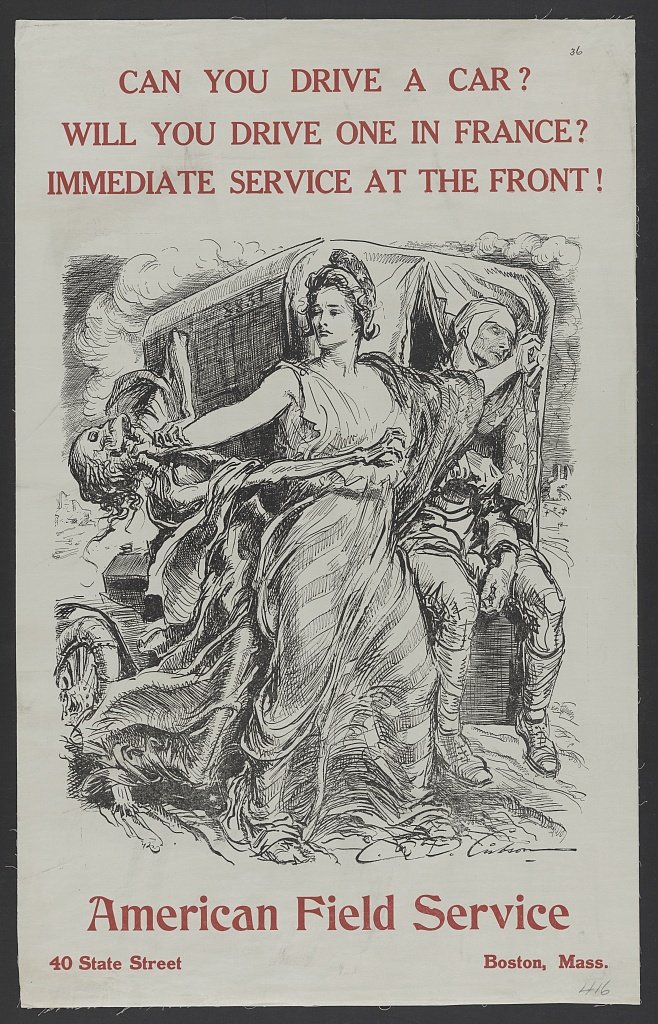
Gibson's own poster for the American Field Service is a useful companion because it is a different kind of work. Can you drive a car? Will you drive one in France? Immediate service at the front! (1917) shows Miss Columbia, robed in the American flag, holding off skeletal Death with one arm while shielding a wounded soldier with the other. The Library's summary says roughly 2,500 volunteer drivers supported the French armies and carried over 500,000 wounded.23 Flagg's poster is a finger and a demand. Gibson's is an allegory and an appeal to chivalry. Both want a body in a uniform.
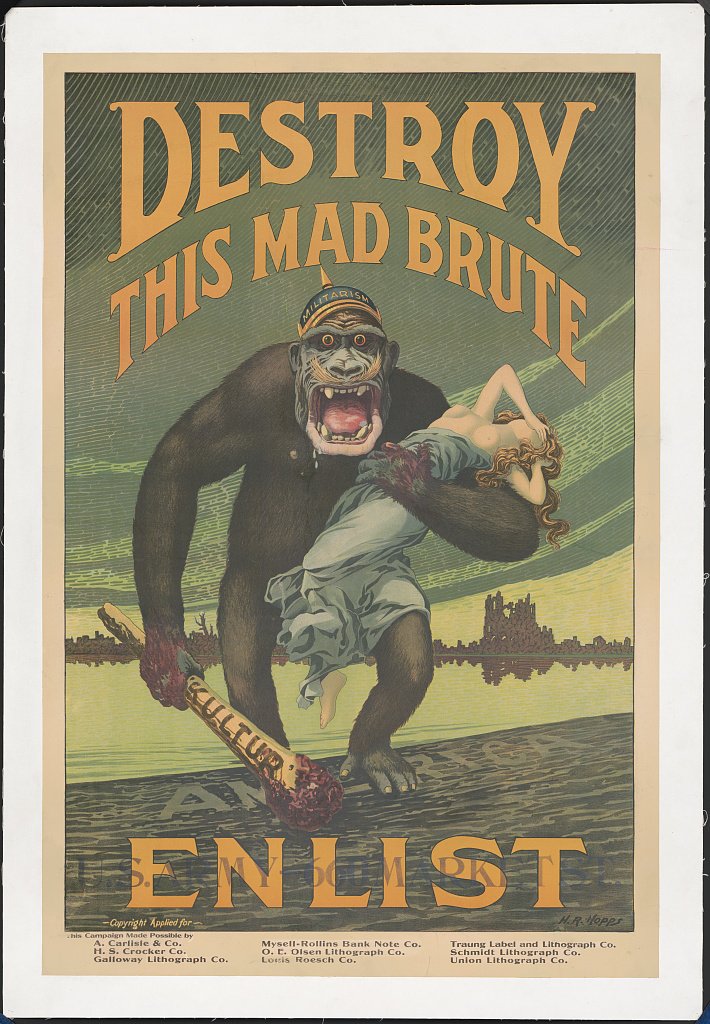
Then there is the enemy poster. Harry R. Hopps's Destroy this mad brute Enlist - U.S. Army (copyright registered April 4, 1918 by the San Francisco Army Recruiting District)24 shows a gorilla in a helmet labeled "militarism," carrying a club labeled "kultur," stepping onto an American shore beside a half-naked woman. It is a fair specimen of what propaganda looks like when fear does the work. It is also a fair specimen of why the word is stained. The image tells the viewer that a nation of people is an animal.
How to: tell which job a poster is doing
- Read the verb. Flagg's poster says "I want you." The Gibson poster asks a question about driving. Hopps's says "Destroy" and "Enlist." The verb tells you what the maker wants the viewer to do.
- Find the target. Is the viewer being asked to join something, to fear something, or to feel something about someone else's suffering? The Gibson poster targets compassion, the Hopps poster fear.
- Look for who is absent. The Hopps poster has an "enemy" with no human face. Ask what a person of that nation would see if they looked at it.
- Check the sponsor and date on the catalog record. The Hopps record gives a copyright claimant (San Francisco Army Recruiting District) and a registration date, which tells you this was an official recruiting piece and not a private cartoonist's opinion.
- Decide the dominant job: persuasion, mobilization, witness. Write one sentence naming it and one naming the second job if there is one. The Gibson poster mobilizes through an allegory that bears a little witness to the field-service figures the Library cites.
How courts came to protect political art
The state that made posters also prosecuted. During the same war, the Espionage Act of 1917 led to the suppression of a magazine of cartoons, which lesson 02 covers. The Supreme Court's first answer was Schenck v. United States, decided March 3, 1919.25 Justice Holmes wrote for a unanimous Court that Charles Schenck, general secretary of the Socialist Party in Philadelphia, and Elizabeth Baer had been properly convicted for printing and mailing about 15,000 leaflets to men called up for service, urging them to resist the draft.26 Speech lost protection, Holmes wrote, when it created a "clear and present danger" of harms Congress could prevent.27 That phrase governed for fifty years. In Brandenburg v. Ohio (June 9, 1969, per curiam) the Court replaced it with a narrower test: advocacy of illegal action is protected unless it is "directed to inciting or producing imminent lawless action" and likely to do so.28 The shift is the legal story behind every protest song and picket sign from 1969 on.
Parody and caricature came to the Court in 1988. Hustler Magazine, Inc. v. Falwell, 485 U.S. 46, was decided February 24, 1988.29 The facts are lurid and the law is plain. Hustler's November 1983 issue ran a parody of Campari liqueur ads in which a fake "first time" interview had the Reverend Jerry Falwell describing a drunken incestuous encounter with his mother in an outhouse.30 Small print said "ad parody -- not to be taken seriously," and the table of contents called it fiction.31 Falwell sued for libel, invasion of privacy and intentional infliction of emotional distress. The jury rejected the libel claim, finding the ad could not reasonably be understood as describing actual facts, and awarded $100,000 in compensatory damages and $50,000 in punitive damages against each of Hustler and its publisher Larry Flynt (a total of $200,000 by the opinion's figures; one Justia annotation says $150,000, which does not match the opinion text).32
Chief Justice Rehnquist wrote for the Court, joined by six others (White concurred in the judgment and Kennedy took no part).33 The holding: public figures and public officials cannot recover for emotional distress from a caricature like this unless they also prove a false statement of fact made with actual malice. Rehnquist's opinion drew on the history of political cartooning, quoting a cartoonist's description of the art as a weapon of attack, scorn, ridicule and satire, and rejected "outrageousness" as a standard because it "has an inherent subjectiveness about it" that lets jurors act on their tastes.34 The Court did not say the parody was good, kind or true. It said a jury's dislike is not a legal test. The full opinion is short enough to read in one sitting.
The flag cases came next. In Texas v. Johnson, 491 U.S. 397 (June 21, 1989), the Court split 5 to 4.35 Gregory Lee Johnson had taken part in a demonstration during the 1984 Republican National Convention in Dallas, protesting Reagan administration policies and some Dallas corporations, and at the end of the march in front of City Hall had doused a flag with kerosene and set it on fire.36 Texas convicted him under a statute against desecrating a venerated object and gave him a year in prison and a $2,000 fine.37 Justice Brennan, joined by Marshall, Blackmun, Scalia and Kennedy, held that burning the flag was expressive conduct, that Texas's interests in preventing breaches of the peace and preserving the flag's symbolic status did not justify punishing it, and that "the government may not prohibit the expression of an idea" because society finds it offensive.38 Rehnquist wrote the main dissent, joined by White and O'Connor, and Stevens dissented separately.39
Congress answered with the Flag Protection Act of 1989 (18 U.S.C. 700), which was written without reference to messages: it banned knowingly mutilating, defacing, burning or trampling a flag. In United States v. Eichman, 496 U.S. 310 (decided June 11, 1990, argued May 14), the same five justices struck it down as applied to political protesters, finding its asserted interest in the flag's symbolic status tied to suppressing expression.40 Stevens wrote the dissent for the same four, arguing that the government has a legitimate interest in the flag's symbolic value unrelated to any particular idea and that other means of expression remained open.41 Both opinions are worth reading with their dissents. The dissenters were not hostile to dissent; they made a serious argument about a shared symbol.
The fourth case is about money. National Endowment for the Arts v. Finley, 524 U.S. 569, was decided June 25, 1998.42 The statute, 20 U.S.C. 954(d)(1), directs the NEA to treat artistic excellence and merit as its criteria while taking into consideration "general standards of decency and respect for the diverse beliefs and values of the American public."43 Congress added the clause in the 1990 reauthorization (the Williams/Coleman Amendment) after public anger over NEA-funded works by Robert Mapplethorpe and Andres Serrano.44 Four performance artists whose applications were denied, Karen Finley, John Fleck, Holly Hughes and Tim Miller, challenged it with the National Association of Artists' Organizations.45 Justice O'Connor's opinion, joined by Rehnquist, Stevens, Kennedy and Breyer, and by Ginsburg except for one part, held the clause facially valid: it adds considerations to the review of grants, it does not bar funding of indecent or disrespectful work, and the government may set priorities as a patron. Scalia, joined by Thomas, concurred in the judgment only, writing that the statute plainly does disfavor indecent and disrespectful work but that a funding choice does not abridge speech. Souter dissented alone, arguing the clause was viewpoint based. That makes eight votes for the judgment and one against.46
| Case | Decided | Vote | Rule | What it means for political art |
|---|---|---|---|---|
| Schenck v. United States, 249 U.S. 47 | March 3, 1919 | Unanimous (Holmes) | "Clear and present danger" | Antiwar leaflets could be punished under the Espionage Act |
| Brandenburg v. Ohio, 395 U.S. 444 | June 9, 1969 | Per curiam | Advocacy is protected unless directed to and likely to produce imminent lawless action | Protest speech and song get far wider room |
| Hustler v. Falwell, 485 U.S. 46 | Feb. 24, 1988 | 8 to 0 (Kennedy not participating; White concurring) | No recovery for emotional distress from parody of a public figure without a false statement of fact made with actual malice | Cartoonists and satirists are protected from "outrageousness" verdicts |
| Texas v. Johnson, 491 U.S. 397 | June 21, 1989 | 5 to 4 (Brennan) | Flag burning is expressive conduct; state interests do not justify the ban | Protest conduct with a message gets speech protection |
| United States v. Eichman, 496 U.S. 310 | June 11, 1990 | 5 to 4 (Brennan) | Flag Protection Act of 1989 invalid as applied to protesters | Congress cannot reach the same result with a neutral-sounding statute |
| NEA v. Finley, 524 U.S. 569 | June 25, 1998 | 8 to 1 (O'Connor; Souter dissenting) | "Decency and respect" clause facially valid as a consideration in grant review | Government as patron may weigh content, though it may not ban it |
Where the protection stops
None of this means every drawing or song is safe. Three limits matter to anyone who makes or reports on political art.
The first is threat. Virginia v. Black, 538 U.S. 343, decided April 7, 2003,47 upheld a state's power to ban cross burning done with intent to intimidate, and struck the statute's provision treating any cross burning as prima facie evidence of intent, as applied in Black's case. Justice O'Connor described true threats as statements in which the speaker intends to communicate a "serious expression of an intent to commit an act of unlawful violence" against a person or group.48 A poster that names a public official with a target on his face sits near that line. In Counterman v. Colorado (decided June 27, 2023; Kagan, joined by Roberts, Alito, Kavanaugh and Jackson, with Barrett and Thomas dissenting) the Court held the state must prove the defendant had some subjective understanding of the threatening nature of his statements, and that recklessness is enough.49 The Legal Information Institute text did not give a U.S. Reports page, so this lesson cites the docket number, No. 22-138.
The second is incitement, covered above. The third is copyright, which is where most working artists and journalists actually meet the law. Parody can be a fair use: in Campbell v. Acuff-Rose Music, Inc., 510 U.S. 569 (March 7, 1994), a unanimous Court (Souter writing, Kennedy concurring) held that 2 Live Crew's commercial rap parody of Roy Orbison and William Dees's "Oh, Pretty Woman" could be a fair use under 17 U.S.C. 107, and that commercial character is "only one element to be weighed."50 But transformation has a ceiling. In Andy Warhol Foundation v. Goldsmith, decided May 18, 2023 by 7 to 2 (Sotomayor writing, Kagan dissenting with Roberts), the Court held the first fair use factor favored the photographer Lynn Goldsmith when the Foundation licensed its "Orange Prince" image to Condé Nast in 2016 for $10,000, because the use shared substantially the same purpose as her photograph and was commercial.51 Lesson 10 returns to both cases with a worked method.
Myth: the First Amendment means the government can never punish political art
It can and it has. The Court upheld the Espionage Act convictions in Schenck. Threats, incitement and copyright infringement are not protected, and the government as a funder may weigh content, as Finley held. What the cases above establish is narrower and still valuable: the government may not punish a public-figure parody because a jury finds it outrageous, may not punish a flag burning because it offends, and may not ban an artist's project merely because it is indecent. Everything else turns on the facts and the standard. If a source says a work "is protected speech," ask which case, which test, and which court.
A map of the century's movements and media
The next table gives the dates and political connections for the main movements this course touches. Dates and definitions come from Tate's art-term entries and the U.S. Holocaust Memorial Museum, and it records only what those sources say. Each movement overlapped others, and each had a different relationship to power.
| Movement or medium | Dates and place (per source) | Political relationship | Where it appears in this course |
|---|---|---|---|
| Newspaper and magazine cartoon | Puck began in German in 1876 and in English in March 1877; its sales reached nearly 90,000 subscribers in the 1890s | Mass-circulation satire of corruption and parties | Lessons 02, 03, 04 |
| Wartime poster | Division of Pictorial Publicity launched April 22, 1917 | State mobilization | Lesson 05 |
| Dada | Zurich in the First World War; Hugo Ball's Cabaret Voltaire in 1916 (Tate)52 | Anti-war and anti-bourgeois, satirical | Lesson 07 |
| Constructivism | Russia around 1915; Tatlin and Rodchenko (Tate)53 | Art for a factory-age society, later tied to the Soviet state | Lesson 05 |
| Surrealism | 1920s; Breton's manifesto published 1924 (Tate)54 | Revolutionary in its own description | Lesson 07 |
| Socialist Realism | Formally proclaimed in 1934 at the Soviet Writers Congress (Tate)55 | Mandatory optimism under the Soviet state | Lesson 07 |
| "Degenerate Art" exhibition | Munich, 1937: over 600 works, over two million visitors, against fewer than 500,000 for the official art show; over 20,000 works seized from German museums that year (USHMM)56 | Nazi state condemnation of modern art | Lesson 07 |
| Abstract Expressionism | New York, 1940s and 1950s (Tate)57 | Disputed Cold War role | Lesson 07 |
| Pop art | Mid-1950s in Britain, late 1950s in the United States, peak in the 1960s (Tate)58 | Commercial imagery turned into commentary | Lessons 05, 07 |
| Documentary photography | See lesson 06 for dates | Witness used to move policy | Lesson 06 |
| Protest and campaign song | Radio and record era | Mobilization and dissent | Lessons 08, 09 |
Two entries deserve a note. The Munich exhibition shows that a state can use an art show as an instrument of insult: the Nazi organizers hung the works crowded and often unframed with slogans mocking them as "crazy at any price," and by the USHMM account more than two million people came, against fewer than 500,000 who went to the Great German Art Exhibition that opened a day earlier.59 Visitors went to see what they were told to hate. Socialist Realism did the opposite. It ordered artists to produce "rigorously optimistic pictures," in Tate's phrase60, and banned pessimistic or critical content. In both cases the state decided what art was for. The American story in this course is mostly about a state that sometimes tried and was repeatedly stopped by courts, publishers and artists.
Witness, the third job
Orwell and Benjamin both wrote about persuasion. The job this lesson has said least about is witness, and it may be the one that does the most to change minds. A photograph or song of testimony has no argument. It has a fact the viewer cannot easily deny. Lesson 06 follows photographs from the National Child Labor Committee to phone video, and lesson 08 follows the songs of Joe Hill and Billie Holiday. The pattern in both is the same: the work is often used as witness first and persuasion second, and later users convert it into persuasion by adding a caption or a slogan.
That is a reporting problem as well as an art problem. If you describe a photograph as "proof," you owe the reader its date, photographer, caption and archive. If you describe a song as "a protest song," you owe the reader who wrote it, who recorded it, who played it on the radio and who banned it. The works are evidence and the viewer's reaction is evidence too, but the two are not the same evidence.
How to: check whether a Library of Congress image is safe to reuse
- Open the catalog record (the loc.gov/item page, not a search result thumbnail) and find the "Rights Advice" or "Rights Advisory" line. For Flagg's poster it reads "No known restrictions on publication. No renewal in Copyright Office."
- Read the Library's disclaimer on the same page. The Library does not own rights in its collections and tells researchers they are responsible for assessing copyright.61 A catalog record is a lead, not a license.
- Check the publication date against the public domain rule. Cornell Library's chart says a work published in the United States before 1931 is in the public domain as of 2026, because the 95-year term for works published in 1931 ends in 2026 and those works enter the public domain on January 1, 2027.62
- If the work is a creation of a federal employee within the scope of employment, 17 U.S.C. 105 says "Copyright protection under this title is not available" for United States Government works.63 That covers Farm Security Administration photographs, not a private artist's work the government later bought.
- Note what is not covered. Read the record's notes for any other claimant or restriction. Record the catalog URL, reproduction number and rights line in your file so a fact-checker can retrace the call.
- When in doubt, link to the archive page instead of embedding the file. This course follows that rule for every copyrighted work: the poster, photograph or cartoon is described in words and linked to its museum or archive page.
If you report on this
- When someone quotes "All art is propaganda," give the essay (Orwell's "Charles Dickens," March 11, 1940) and say it was a claim about Victorian novelists.
- For wartime poster figures, say who made the count. The Army history article gives 279 artists, 33 cartoonists and about 700 designs. Hollins credits the 700 figure to Riegel. Flagg's "more than four million" comes from the Library of Congress's Today in History entry. None of the three is a total from Creel's reports, and Creel's own book gives "a total of 1,438 drawings" in a context this lesson could not tie to the Division, so do not mix those numbers.
- For any court claim, give the case, the date, the vote and the opinion's author. Falwell is 8 to 0 with one concurrence in the judgment and one justice not participating. Johnson and Eichman are 5 to 4. Finley is 8 to 1 in the judgment.
- Do not write "the Supreme Court said flag burning is legal." It said the Texas statute and the 1989 federal statute could not be applied to political protesters. Burning a flag on someone else's property or in a way that creates a fire hazard is a different case.
- When you embed an image, put the catalog URL, the rights line and the date of your check in your notes. A "No known restrictions" line is a statement of the Library's knowledge on a date.
Go further
- Orwell, "Charles Dickens" (1940) and the Benjamin essay, read in full.
- The Library of Congress World War I poster holdings, starting from the records for Flagg, Gibson and Hopps, and the Army article "The Poster Goes to War."
- George Creel, How We Advertised America (1920), the agency head's own account.
- The opinions: Hustler v. Falwell, Texas v. Johnson, Eichman, Finley, Virginia v. Black, and Counterman.
- The site's First Amendment lesson, for the doctrines behind these cases, and the Tate art-term pages for Dada, Constructivism, Socialist Realism and Pop Art.
- The U.S. Holocaust Memorial Museum's article on Degenerate Art.
Questions and answers
Did Orwell really say all art is propaganda?
Yes, in "Charles Dickens," first published March 11, 1940, and collected that year in Inside the Whale and Other Essays. The sentence is "All art is propaganda." The next sentence says that neither Dickens nor the majority of Victorian novelists would have thought of denying it. Orwell is describing novelists who wrote to change laws. Read the essay on orwell.ru before you quote the line.
What is the "aura" in Benjamin's essay?
It is the presence of an original in its own time and place. Benjamin wrote that it withers in the age of mechanical reproduction. A lithograph or a photograph has no single original whose presence you must visit, so its force comes from circulation. The Marxists Internet Archive text dates the essay 1936; other editions differ, so name the one you cite.
How many posters did the United States make in the First World War?
No single count is verified. The Army's history article says the Division of Pictorial Publicity produced about 700 poster designs for 58 departments and committees, with a roster of 279 artists and 33 cartoonists. Hollins gives the same 700 and attributes it to O. W. Riegel, with print runs above 100,000 for single posters. The Library's entry for Flagg says more than four million copies of his Uncle Sam image were printed between 1917 and 1918. Those are different measures: designs, runs and copies of one design.
Who drew the Uncle Sam poster, and who was the model?
James Montgomery Flagg drew it. The Library of Congress's Today in History entry says he dressed in his own Uncle Sam suit and used himself as the model. The image first ran on the cover of Leslie's Weekly on July 6, 1916, under the title "What Are You Doing for Preparedness?"
Why was the Hustler parody protected when it was so offensive?
Because the Court refused to let offensiveness decide. A jury had found the ad could not reasonably be taken as a statement of fact and rejected Falwell's libel claim. Rehnquist wrote that a public figure can recover for emotional distress over a parody only if he also proves a false statement of fact made with actual malice. "Outrageousness," the Court said, "has an inherent subjectiveness about it." See 485 U.S. 46.
So can anyone burn a flag?
The Court held in Johnson (1989) and Eichman (1990) that burning a flag in political protest is expressive conduct and that Texas's statute and the federal Flag Protection Act of 1989 could not constitutionally be applied to protesters. Both votes were 5 to 4. The cases did not say a person may burn a flag anywhere, or that general laws on fires, trespass or theft are void. They said government may not punish the message.
Did NEA v. Finley mean the government can censor art?
No. The Court held the "decency and respect" clause in 20 U.S.C. 954(d)(1) facially valid because it adds a consideration to grant review and does not ban funding of indecent work. Justice Souter dissented, calling the clause viewpoint based.
Does the First Amendment protect a poster that threatens a public official?
Not if it is a true threat. Virginia v. Black described true threats as serious expressions of intent to commit unlawful violence, and Counterman (2023) requires the state to prove the speaker was at least reckless about the threatening nature of the words. Satire of an official, even harsh satire, is a different category under Falwell.
Hard questions
If "all art is propaganda," isn't the word meaningless?
It would be if Orwell meant it as a definition. He meant it as a claim about motive: artists have views and the work carries them. A definition that covers everything tells you nothing, so this course sorts works by job (persuade, mobilize, witness) and asks what the maker wanted the viewer to do. A still life and a recruiting poster both express a view of the world. Only one has a verb.
Wasn't the 1917 poster effort just the government lying to its own people?
Some of it was fear and some was ordinary advertising. Hopps's gorilla is a dehumanizing image of an enemy. The Gibson ambulance poster asks for volunteer drivers for an actual service whose figures the Library cites (roughly 2,500 drivers, over 500,000 wounded carried). Creel's own title, How We Advertised America, shows he thought of the work as selling. Whether it was honest depends on the poster, and reading each one for its verb, target and absent figure is how to judge.
Doesn't Hustler v. Falwell let anyone say anything about a public figure?
No. It protects parody that cannot reasonably be read as stating actual facts, and it keeps the remedy of libel and the actual malice standard for false statements of fact. The jury here rejected the libel claim because the ad could not reasonably be understood as describing actual facts. A cartoon that falsely claimed a named official took a bribe and was presented as news would be treated differently.
Isn't banning flag burning a reasonable way to protect a unifying symbol?
The dissenters thought so, and their argument was serious. Rehnquist in Johnson, and Stevens in Eichman, argued that the flag has a unique symbolic value the government may protect without regard to any message, and that other means of expression remain open. The majority replied that the interest in protecting the flag's symbolic status was tied to what the burning communicates. Congress's attempt to write a neutral statute in 1989 failed because the Court found the interest was not neutral. If you cover this fight, quote both Brennan and Stevens.
Why should a funder like the NEA be allowed to consider "decency"?
Because a patron picks. Justice O'Connor's opinion in Finley said the government may set spending priorities. The statute requires "artistic excellence and merit" as the criteria and adds decency and respect as considerations. Souter answered that choosing by viewpoint is different from choosing by merit. Both positions have been argued in good faith, and the 1998 vote was 8 to 1 in the judgment.
Isn't "witness" just persuasion in disguise?
Sometimes. Photographers choose a frame, editors choose a caption, and later users add slogans. The course treats witness as a distinct job because the claim it makes is different. A cartoon says "you should think this." A photograph says "this happened." The second claim can be checked against a date, a place and other evidence, which is why lesson 06 includes a method for verifying a photograph's provenance.
Learn more
- George Orwell, "Charles Dickens" (1940): the essay behind "All art is propaganda," where the line sits in a longer argument about Victorian novelists.
- Walter Benjamin, The Work of Art in the Age of Mechanical Reproduction: the source of "aura" and of the warning about politics rendered aesthetic.
- The Poster Goes to War: the Army history article with the Division of Pictorial Publicity figures.
- George Creel, How We Advertised America: the head of the Committee on Public Information describing his own agency.
- Library of Congress: Flagg, I want you for U.S. Army: the catalog record, with its rights advisory, for the best-known poster of the war.
- Hustler Magazine v. Falwell: the opinion that protects parody of public figures, short enough to read at one sitting.
- Texas v. Johnson: the 5 to 4 flag-burning decision, with Rehnquist's dissent.
- National Endowment for the Arts v. Finley: the decision on "decency and respect" in public arts funding.
- Counterman v. Colorado: the 2023 decision on how a true threat must be proved.
- U.S. Holocaust Memorial Museum: Degenerate Art: how a state turned an art exhibition into an instrument of insult.
Notes
- George Orwell, "Charles Dickens" (March 11, 1940), in Inside the Whale and Other Essays. Read it online. ↩
- Walter Benjamin, "The Work of Art in the Age of Mechanical Reproduction," Marxists Internet Archive edition (dated 1936 on that page). Read it online. ↩
- U.S. Army, "The Poster Goes to War," army.mil. Read it online. ↩
- Library of Congress, "Today in History: June 18." Read it online. ↩
- Hustler Magazine, Inc. v. Falwell, 485 U.S. 46 (1988). Read it online. ↩
- Texas v. Johnson, 491 U.S. 397 (1989), and United States v. Eichman, 496 U.S. 310 (1990). Johnson online. Eichman online. ↩
- National Endowment for the Arts v. Finley, 524 U.S. 569 (1998). Read it online. ↩
- Library of Congress, I want you for U.S. Army : nearest recruiting station (James Montgomery Flagg, c1917), catalog record. Read it online. ↩
- George Orwell, "Charles Dickens" (March 11, 1940), in Inside the Whale and Other Essays. Read it online. ↩
- Walter Benjamin, "The Work of Art in the Age of Mechanical Reproduction," Marxists Internet Archive edition (dated 1936 on that page). Read it online. ↩
- Walter Benjamin, "The Work of Art in the Age of Mechanical Reproduction," Marxists Internet Archive edition (dated 1936 on that page). Read it online. ↩
- Walter Benjamin, "The Work of Art in the Age of Mechanical Reproduction," Marxists Internet Archive edition (dated 1936 on that page). Epilogue. Read it online. ↩
- Walter Benjamin, "The Work of Art in the Age of Mechanical Reproduction," Marxists Internet Archive edition (dated 1936 on that page). Epilogue. Read it online. ↩
- Hunter Hollins, "The War Bond Poster," Federal History (2015). The Committee on Public Information was created by President Wilson seven days after the April 6, 1917 declaration of war. Read it online. ↩
- George Creel, How We Advertised America (1920). Front matter listing the Committee's members. Read it online. ↩
- George Creel, How We Advertised America (1920). Chapter 1. Read it online. ↩
- George Creel, How We Advertised America (1920). Read it online. ↩
- Hunter Hollins, "The War Bond Poster," Federal History (2015). Read it online. ↩
- U.S. Army, "The Poster Goes to War," army.mil. Read it online. ↩
- Hunter Hollins, "The War Bond Poster," Federal History (2015). Read it online. ↩
- Library of Congress, "Today in History: June 18." Read it online. ↩
- Library of Congress, I want you for U.S. Army : nearest recruiting station (James Montgomery Flagg, c1917), catalog record. Rights advisory. Read it online. ↩
- Library of Congress, Can you drive a car? Will you drive one in France? (Charles Dana Gibson, 1917), catalog record. Summary. Read it online. ↩
- Library of Congress, Destroy this mad brute Enlist - U.S. Army (Harry R. Hopps, 1918), catalog record. Read it online. ↩
- Schenck v. United States, 249 U.S. 47 (1919). Read it online. ↩
- Schenck v. United States, 249 U.S. 47 (1919), statement of facts. Read it online. ↩
- Schenck v. United States, 249 U.S. 47, 52 (1919), Holmes, J. Read it online. ↩
- Brandenburg v. Ohio, 395 U.S. 444 (1969) (per curiam), decided June 9, 1969. Read it online. ↩
- Hustler Magazine, Inc. v. Falwell, 485 U.S. 46 (1988). Read it online. ↩
- Hustler Magazine, Inc. v. Falwell, 485 U.S. 46 (1988), statement of facts. Read it online. ↩
- Falwell, 485 U.S. 46, statement of facts. Read it online. ↩
- Falwell, 485 U.S. 46, statement of the jury verdict. Read it online. ↩
- Falwell, 485 U.S. 46, opinion of Rehnquist, C.J., with White, J., concurring in the judgment. Read it online. ↩
- Falwell, 485 U.S. 46, Part III of the opinion. Read it online. ↩
- Texas v. Johnson, 491 U.S. 397 (1989). Read it online. ↩
- Texas v. Johnson, 491 U.S. 397 (1989), statement of facts. Read it online. ↩
- Johnson, 491 U.S. 397, statement of facts. Read it online. ↩
- Johnson, 491 U.S. 397, opinion of Brennan, J. Read it online. ↩
- Johnson, 491 U.S. 397, dissents of Rehnquist, C.J., and Stevens, J. Read it online. ↩
- United States v. Eichman, 496 U.S. 310 (1990), decided June 11, 1990. Read it online. ↩
- Eichman, 496 U.S. 310, dissent of Stevens, J. Read it online. ↩
- National Endowment for the Arts v. Finley, 524 U.S. 569 (1998). Read it online. ↩
- 20 U.S.C. 954(d)(1), as quoted in Finley, 524 U.S. 569. Read it online. ↩
- Finley, 524 U.S. 569, opinion of the Court on the 1990 amendment. Read it online. ↩
- Finley, 524 U.S. 569, statement of facts. Read it online. ↩
- Finley, 524 U.S. 569, opinions of O'Connor, Scalia and Souter, JJ. Read it online. ↩
- Virginia v. Black, 538 U.S. 343 (2003). Read it online. ↩
- Black, 538 U.S. 343, opinion of O'Connor, J. Read it online. ↩
- Counterman v. Colorado, No. 22-138 (June 27, 2023). Read it online. ↩
- Campbell v. Acuff-Rose Music, Inc., 510 U.S. 569 (1994). Read it online. ↩
- Andy Warhol Foundation for the Visual Arts, Inc. v. Goldsmith, No. 21-869 (May 18, 2023). Read it online. ↩
- Tate, "Dada," Art Terms. Read it online. ↩
- Tate, "Constructivism," Art Terms. Read it online. ↩
- Tate, "Surrealism," Art Terms. Read it online. ↩
- Tate, "Socialist Realism," Art Terms. Read it online. ↩
- U.S. Holocaust Memorial Museum, "Degenerate Art," Holocaust Encyclopedia. Read it online. ↩
- Tate, "Abstract Expressionism," Art Terms. Read it online. ↩
- Tate, "Pop Art," Art Terms. Read it online. ↩
- U.S. Holocaust Memorial Museum, "Degenerate Art," Holocaust Encyclopedia. Read it online. ↩
- Tate, "Socialist Realism," Art Terms. Read it online. ↩
- Library of Congress, I want you for U.S. Army : nearest recruiting station (James Montgomery Flagg, c1917), catalog record. Rights and access statement. Read it online. ↩
- Cornell University Library, "Copyright term and the public domain in the United States." Read it online. ↩
- 17 U.S.C. 105, Legal Information Institute. Read it online. ↩
Check yourself
1. What did the Supreme Court decide in Hustler Magazine v. Falwell (1988)?
Chief Justice Rehnquist wrote for seven justices (White concurred in the judgment, Kennedy took no part). The Court held that a public figure cannot recover for intentional infliction of emotional distress over a caricature like this one unless he also proves a false statement of fact made with actual malice, and it reversed the judgment.
2. How did the Court split in Texas v. Johnson (June 21, 1989) and United States v. Eichman (June 11, 1990)?
Both were 5 to 4 with the same majority. Rehnquist, White and O'Connor dissented in Johnson (Stevens wrote separately); Stevens wrote the Eichman dissent for the same four. Congress passed the Flag Protection Act of 1989 between the two decisions, and the Court struck it down too.
3. What did NEA v. Finley (1998) hold about the 'decency and respect' provision of 20 U.S.C. 954(d)(1)?
Justice O'Connor's opinion held the provision facially valid. Scalia and Thomas concurred only in the judgment, saying the statute does disfavor indecent work but that a funding choice does not abridge speech. Souter dissented alone, calling the provision viewpoint based.
4. Which fact about the 1917 Division of Pictorial Publicity matches the sources checked for this lesson?
The Army's history article gives April 22, 1917, Gibson as leader, 279 artists and 33 cartoonists and about 700 designs for 58 departments and committees. Hunter Hollins in Federal History (2015) adds that Gibson volunteered on April 17 and credits the 700 figure to O. W. Riegel.
5. The Library of Congress record for Flagg's I Want You poster carries which rights advisory?
The record says 'No known restrictions on publication. No renewal in Copyright Office.' and notes copyright by the Leslie-Judge Co. The Library does not own rights and tells researchers to assess copyright themselves, which is why this course checks the record before embedding anything.
6. Why is a threat treated differently from a cartoon under the First Amendment?
Virginia v. Black (2003) described true threats as serious expressions of intent to commit unlawful violence against a person or group. Counterman (June 27, 2023, Kagan) held the state must show the speaker had some subjective understanding of the threatening nature of the words, and that recklessness is enough.
Terms in this lesson
- Aura
- Walter Benjamin's word for the presence of an original artwork in a particular time and place, which he said 'withers' in the age of mechanical reproduction.
- Committee on Public Information
- The federal propaganda agency created in April 1917, headed by George Creel, whose Division of Pictorial Publicity commissioned posters from volunteer artists.
- Actual malice
- The standard from New York Times v. Sullivan, applied to parody in Hustler v. Falwell: knowledge that a statement of fact was false or reckless disregard of whether it was.
- Expressive conduct
- Action that carries a message, such as burning a flag in protest, which the Court treated as speech in Texas v. Johnson.
- True threat
- A serious expression of intent to commit unlawful violence against a person or group. It is outside First Amendment protection, and Counterman v. Colorado requires proof of at least recklessness.
- Incitement
- Speech directed to inciting or producing imminent lawless action and likely to do so. The Brandenburg v. Ohio (1969) test replaced the 'clear and present danger' language of Schenck (1919).
- The Soviet doctrine proclaimed in 1934 that required optimistic, realist pictures of Soviet life and barred critical content.
- Public domain
- Works whose copyright has expired or never existed, such as U.S. government works under 17 U.S.C. 105, and which anyone may reproduce.
Sources
- George Orwell, Charles Dickens (March 11, 1940; Inside the Whale and Other Essays), text at orwell.ru checked 2026-10
- Walter Benjamin, The Work of Art in the Age of Mechanical Reproduction, Marxists Internet Archive checked 2026-10
- Library of Congress, I want you for U.S. Army : nearest recruiting station (James Montgomery Flagg, c1917) checked 2026-10
- Library of Congress, Today in History: June 18 (Flagg and the Uncle Sam poster) checked 2026-10
- Library of Congress, Can you drive a car? Will you drive one in France? (Charles Dana Gibson, 1917) checked 2026-10
- Library of Congress, Destroy this mad brute Enlist - U.S. Army (Harry R. Hopps, 1918) checked 2026-10
- U.S. Army, The Poster Goes to War (Division of Pictorial Publicity: April 22, 1917; 279 artists, 33 cartoonists, about 700 designs) checked 2026-10
- Hunter Hollins, The War Bond Poster, Federal History (2015), Smithsonian repository checked 2026-10
- George Creel, How We Advertised America (1920), Internet Archive checked 2026-10
- Hustler Magazine, Inc. v. Falwell, 485 U.S. 46 (1988) checked 2026-10
- Texas v. Johnson, 491 U.S. 397 (1989) checked 2026-10
- United States v. Eichman, 496 U.S. 310 (1990) checked 2026-10
- National Endowment for the Arts v. Finley, 524 U.S. 569 (1998) checked 2026-10
- Virginia v. Black, 538 U.S. 343 (2003) checked 2026-10
- Counterman v. Colorado, No. 22-138 (June 27, 2023), Legal Information Institute checked 2026-10
- Schenck v. United States, 249 U.S. 47 (1919) checked 2026-10
- Brandenburg v. Ohio, 395 U.S. 444 (1969) checked 2026-10
- Campbell v. Acuff-Rose Music, Inc., 510 U.S. 569 (1994) checked 2026-10
- Andy Warhol Foundation v. Goldsmith, No. 21-869 (May 18, 2023), Legal Information Institute checked 2026-10
- 17 U.S.C. 105, United States Government works, Legal Information Institute checked 2026-10
- Cornell University Library, Copyright term and the public domain in the United States checked 2026-10
- Tate, Dada checked 2026-10
- Tate, Constructivism checked 2026-10
- Tate, Surrealism checked 2026-10
- Tate, Socialist Realism checked 2026-10
- Tate, Abstract Expressionism checked 2026-10
- Tate, Pop Art checked 2026-10
- U.S. Holocaust Memorial Museum, Degenerate Art checked 2026-10