Lesson 9 of 12 · about 26 minutes
The Civil War in Art, Music and Words
You'll be able to
- Tell how Julia Ward Howe wrote the Battle Hymn of the Republic and what its words claim about God and the war
- Compare the war's popular songs, Dixie, The Battle Cry of Freedom and When Johnny Comes Marching Home, and where each came from
- Explain what the Antietam and Gettysburg photographs showed Americans for the first time, and how some of them were staged
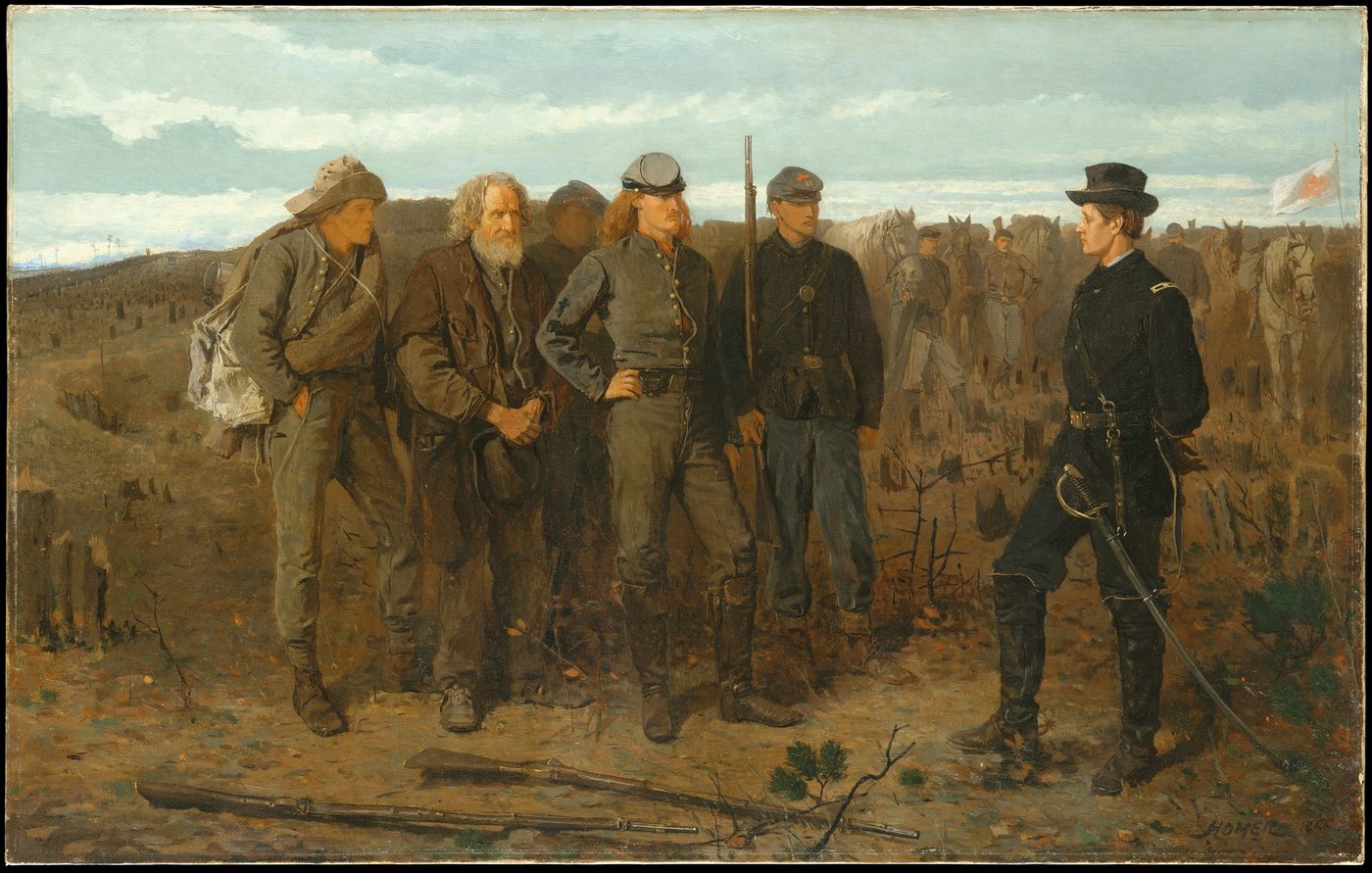
- Describe Winslow Homer's Civil War work, from Harper's Weekly to Prisoners from the Front
- Read the Gettysburg Address and the Second Inaugural as literature, and see how Whitman's Drum-Taps answered the same war
In November 1861 a Boston poet named Julia Ward Howe rode back toward Washington from a review of Union troops some distance outside the city. The review had been broken off when Confederates threatened a small detachment, and the road was so full of marching regiments that the carriage crawled. To pass the time Howe and her friends sang army songs, ending with "John Brown's body lies a-mouldering in the ground." The soldiers called back, "Good for you!" Her minister, James Freeman Clarke, asked why she did not write "some good words for that stirring tune."1
That night she slept soundly. "I awoke in the gray of the morning twilight," she remembered, "and as I lay waiting for the dawn, the long lines of the desired poem began to twine themselves in my mind." She got up, found "an old stump of a pen" in the dark, and "scrawled the verses almost without looking at the paper," afraid of waking the baby. Then she went back to bed, "saying to myself, 'I like this better than most things that I have written.'"1
The Battle Hymn of the Republic
The poem ran on the front page of the Atlantic Monthly in February 1862. The editor, James T. Fields, paid her five dollars, by the American Battlefield Trust's account, and is credited with giving it its title.2 The tune was the camp song "John Brown's Body," which had borrowed its melody from the Methodist camp meeting hymn "Say, Brothers, Will You Meet Us?"2 So the most famous anthem of the Union army came out of the same revival singing described in the lesson on music of the people.
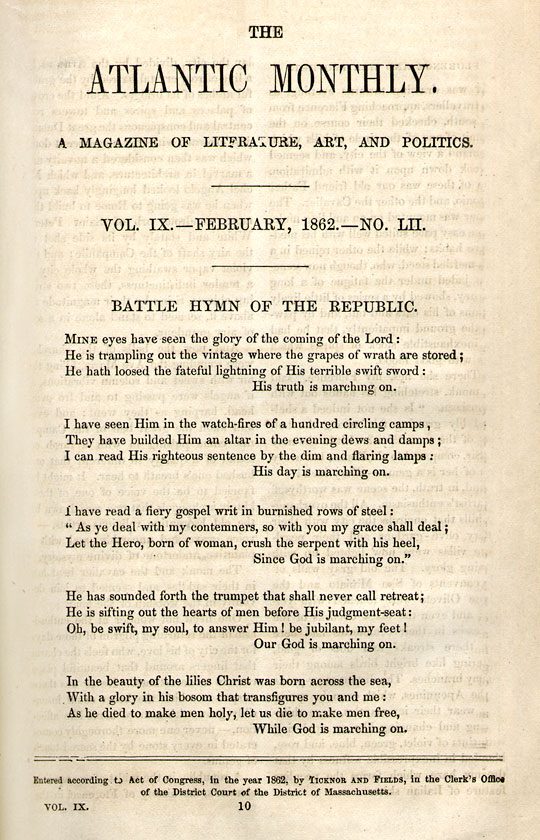
"Mine eyes have seen the glory of the coming of the Lord:
He is trampling out the vintage where the grapes of wrath are stored;
He hath loosed the fateful lightning of His terrible swift sword:
His truth is marching on.""In the beauty of the lilies Christ was born across the sea,
Julia Ward Howe, "Battle Hymn of the Republic," 1861-62, first and last stanzas. 3
With a glory in His bosom that transfigures you and me:
As He died to make men holy, let us die to make men free,
While God is marching on."
The hymn is soaked in Scripture. The "grapes of wrath" come from the winepress of God's judgment in Isaiah 63 and Revelation 14. The fourth stanza, "He is sifting out the hearts of men before His judgment-seat," turns the war into a day of reckoning for the whole nation.3 And the last stanza makes a claim no other war song dared: that a Union soldier's death for the freedom of slaves could be an imitation of Christ's death for the salvation of sinners.
That is a large claim to make about any war, and a careful Christian reader should notice how confidently Howe puts God on one side. Lincoln, as we will see, was more careful. But the hymn did its work. Howe heard that it "soon found its way to the camps." She told the story of Chaplain McCabe, a prisoner in Libby Prison, who led his fellow captives in singing it after the Black man who waited on them whispered news of a Union victory. When McCabe told that story in a lecture in Washington, people began asking, "Who wrote this Battle Hymn?" After that, she wrote, "It now became one of the leading lyrics of the war."1
Songs of the Two Armies
Dixie (1859)
The South's anthem was first sung in New York, in a blackface minstrel show. Bryant's Minstrels introduced "I Wish I Was in Dixie's Land" on Broadway on April 4, 1859, with Daniel Decatur Emmett on the fiddle. It was an instant hit. When the war came, Albert Pike wrote new words for it and the song became the Confederate anthem.4
Its authorship is disputed. In Way Up North in Dixie (1993), Howard and Judith Sacks argued that Emmett may have learned the song from the Snowdens, a Black musical family in Mount Vernon, Ohio, and that its words may first have come from Ellen Snowden, who had been enslaved in Maryland.4 The evidence is suggestive and not conclusive. Either way, the anthem of the slaveholding republic came out of the minstrel stage, and quite possibly out of a Black family's music.
Lincoln liked the tune. On April 10, 1865, just after the surrender at Appomattox, he answered a crowd that had come to serenade him at the White House. "I have always thought 'Dixie' one of the best tunes I have ever heard," he told them. He joked that he had put the question to the Attorney General, who "gave it as his legal opinion that it is our lawful prize."5
The Battle Cry of Freedom (1862)
In July 1862 Lincoln called for 300,000 more volunteers. George F. Root, a partner in the Chicago music firm of Root and Cady, wrote "The Battle Cry of Freedom" in a hurry in answer. It was first sung on July 24, 1862, and again two days later at a great war rally. Between 500,000 and 700,000 copies were printed, and fourteen presses running day and night could not keep up. The South borrowed the tune for its own words.6
When Johnny Comes Marching Home (1863)
The first sheet music of "When Johnny Comes Marching Home," in 1863, credited one "Louis Lambert." That was a pen name for Patrick S. Gilmore, an Irish-born bandmaster with the Union army. Gilmore said he learned the melody from an unnamed African American singer. No evidence confirms it, and many hear an Irish air in it. Soldiers and civilians on both sides took it up as a song of hope that the war would end.7
| Song | Year | Writer | Where it came from |
|---|---|---|---|
| "Dixie" | 1859 | Credited to Daniel Decatur Emmett; Snowden family claim | Bryant's Minstrels, New York, April 4, 1859 |
| "Battle Hymn of the Republic" | 1861-62 | Julia Ward Howe | Written in Washington, November 1861; Atlantic Monthly, February 1862 |
| "The Battle Cry of Freedom" | 1862 | George F. Root | Chicago, July 1862; 500,000 to 700,000 copies |
| "When Johnny Comes Marching Home" | 1863 | "Louis Lambert" (Patrick S. Gilmore) | Union army bandmaster; tune's origin disputed |
The Dead of Antietam
The Battle of Antietam was fought near Sharpsburg, Maryland, on September 17, 1862. In its aftermath Alexander Gardner, then working for the famous New York photographer Mathew Brady, and his assistant James Gibson reached the field. They arrived before the burial details had finished, the first time American photographers had been on a battlefield before the dead were buried, and they made about seventy views.8
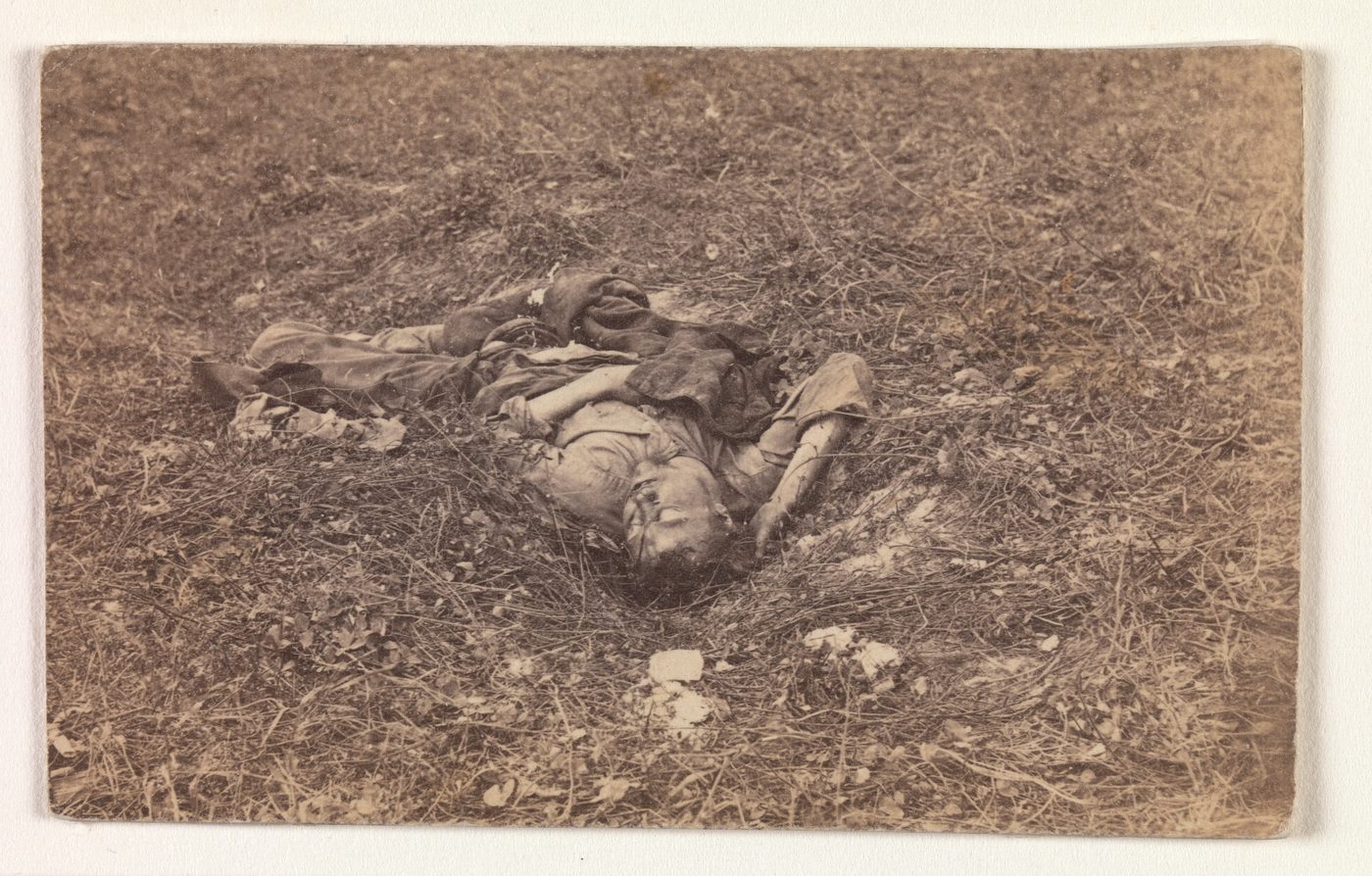
In October 1862 Brady hung the pictures in his New York gallery under a sign that read "The Dead of Antietam." Crowds climbed the stairs to see them.8 On October 20 the New York Times reported:
"Mr. Brady had done something to bring home to us the terrible reality and earnestness of war. If he has not brought bodies and laid them in our door-yards and along the streets, he has done something very like it."
New York Times, October 20, 1862, page 5. 10
The prints carried Brady's name, though Gardner and Gibson had made them.8 Credit in photography, then as now, went to the name on the studio door.
Gettysburg Through the Lens
A Harvest of Death
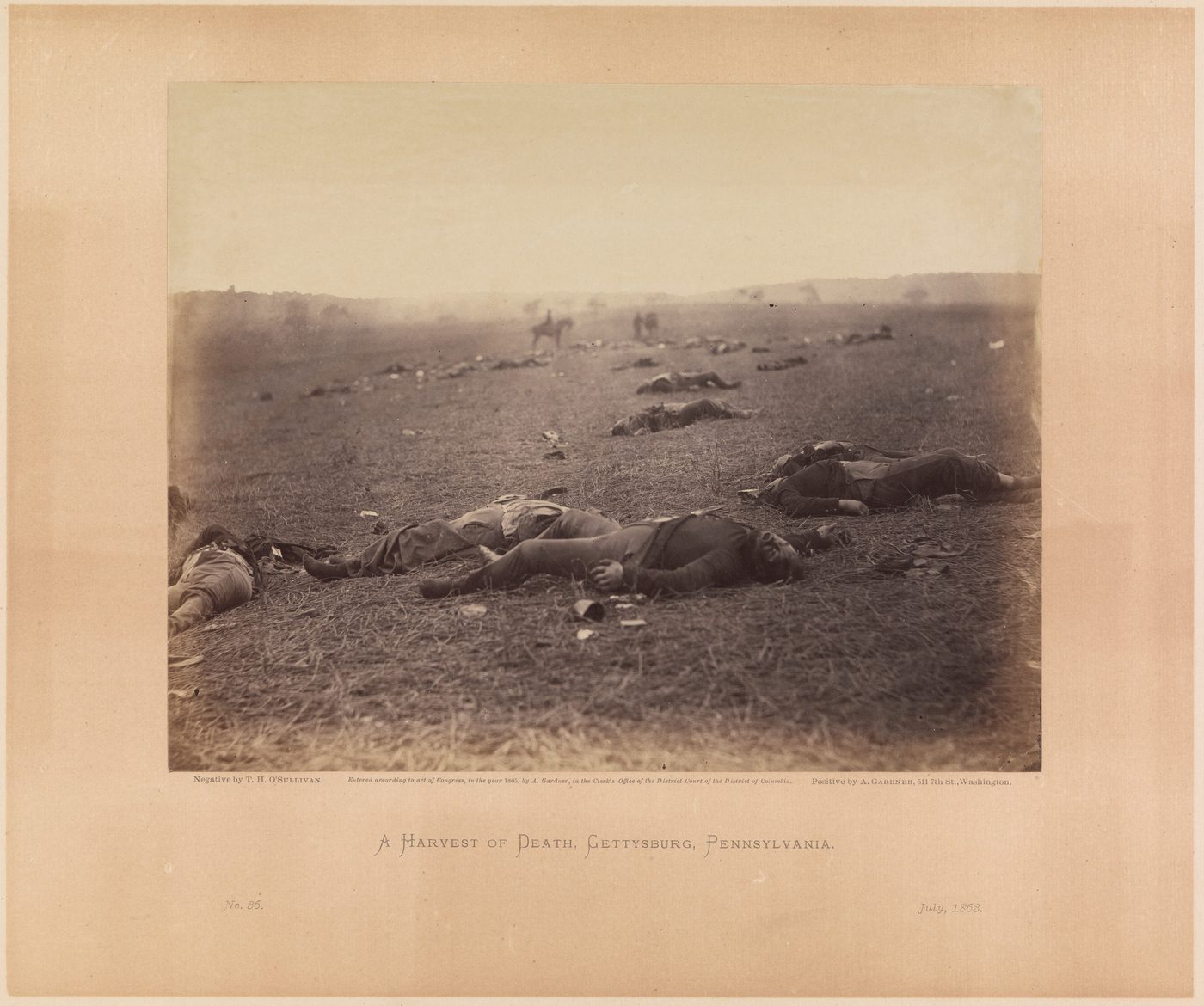
Gardner and his assistant Timothy O'Sullivan reached Gettysburg on July 5, 1863, two days after the battle ended.11 O'Sullivan's picture of the dead lying in a misty field became one of the best-known images of the battle. When Gardner published it in his Photographic Sketch Book of the War in 1866, which the Metropolitan Museum calls "the nation's first anthology of photographs," his caption said: "It was, indeed, a 'harvest of death.'"12
The Home of a Rebel Sharpshooter
Not everything in the war photographs was what it seemed. On July 6, 1863, Gardner and O'Sullivan photographed a dead Confederate soldier. Then they moved the body more than forty yards and photographed it again in a new setting, with a rifle beside it. Gardner titled the second picture "The Home of a Rebel Sharpshooter" and wrote a moving caption about a marksman who died slowly, thinking of home. In 1975 the historian William A. Frassanito compared the photographs with the ground and showed that the same body appears in both. He concluded that the rifle was most likely a prop.11
That matters for anyone who reads photographs today. A camera records what is in front of it. It does not record who arranged it, or why. Gardner's dead man was real. His story was not.
Winslow Homer at the Front
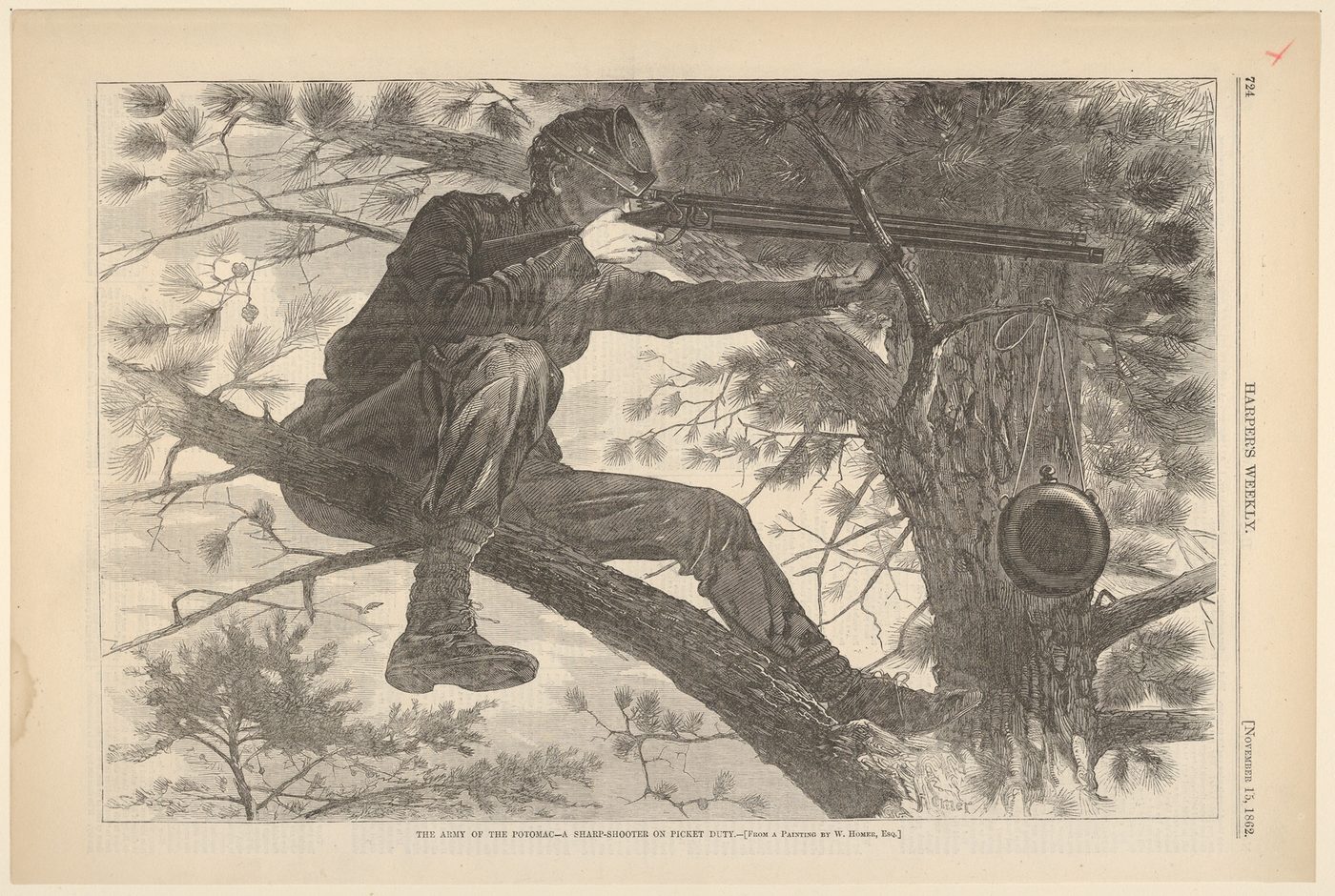
In October 1861 Harper's Weekly sent a young illustrator named Winslow Homer to the war as an artist-correspondent. In 1862 he spent two months with the Army of the Potomac in Virginia.13 His drawings were engraved on wood and printed in the weekly for readers who would never see a camp.
Prisoners from the Front (1866)
A year after the war, Homer painted the picture that made his name. Prisoners from the Front (1866) shows a young Union officer facing three Confederate prisoners across a ruined field. The Metropolitan Museum, which owns it, says it was inspired by Homer's friend Francis Channing Barlow, a Union general who captured a Confederate division at Spotsylvania, Virginia, in 1864.15
Lincoln's Words as Literature
The Gettysburg Address (1863)
On November 19, 1863, at the dedication of the Soldiers' National Cemetery at Gettysburg, Edward Everett gave the main oration. Lincoln followed with a short address. Five copies in his hand survive, known by the names of the people who held them: Nicolay, Hay, Everett, Bancroft and Bliss. The Bliss copy became the most widely distributed version.16
"Fourscore and seven years ago our fathers brought forth on this continent a new nation, conceived in liberty and dedicated to the proposition that all men are created equal. Now we are engaged in a great civil war, testing whether that nation or any nation so conceived and so dedicated can long endure."
Abraham Lincoln, Gettysburg Address, November 19, 1863. 17
Read it as a writer would. The speech is built on birth, death and rebirth. The nation is "brought forth" and "conceived." The soldiers "gave their lives that that nation might live." The ending asks for "a new birth of freedom." Lincoln never names a state, a general or the enemy. He dates the nation from 1776, not 1787, from the Declaration's "proposition that all men are created equal," and so he quietly makes the equality of the Declaration the measure of the Constitution.17
The prose moves in pairs and triplets, but the famous triplet at the end earns its place: "that government of the people, by the people, for the people shall not perish from the earth." And the speech contains the most mistaken prediction any great writer ever made: "The world will little note nor long remember what we say here, but it can never forget what they did here."17
The Second Inaugural (1865)
Lincoln's second inaugural address, on March 4, 1865, is shorter than most sermons and deeper than most. He refuses to boast. He names slavery plainly as the cause: "All knew that this interest was somehow the cause of the war." And then he does what Howe's hymn did not. He declines to claim God for his side:
"Both read the same Bible and pray to the same God, and each invokes His aid against the other. It may seem strange that any men should dare to ask a just God's assistance in wringing their bread from the sweat of other men's faces, but let us judge not, that we be not judged. The prayers of both could not be answered. That of neither has been answered fully. The Almighty has His own purposes."
Abraham Lincoln, Second Inaugural Address, March 4, 1865. 18
He goes further, into a passage that is hard to read even now. If God wills that the war continue "until all the wealth piled by the bondsman's two hundred and fifty years of unrequited toil shall be sunk, and until every drop of blood drawn with the lash shall be paid by another drawn with the sword," then it must still be said, quoting Psalm 19, that "the judgments of the Lord are true and righteous altogether."18 Here is the theology of the age at its most serious. The whole nation, North and South, stands under judgment for slavery, and the war is the price.
Only then does he turn to mercy: "With malice toward none, with charity for all, with firmness in the right as God gives us to see the right, let us strive on to finish the work we are in, to bind up the nation's wounds, to care for him who shall have borne the battle and for his widow and his orphan."18 Firmness in the right, as God gives us to see it: that phrase holds conviction and humility in the same hand. It may be the best short statement of how a free people should act in a hard time. Six weeks later Lincoln was dead.
Whitman's Drum-Taps
Walt Whitman worked through the war years as a volunteer in the army hospitals, and he wrote war poems while he did it. Out of that came Drum-Taps. On April 1, 1865, he signed a contract with Peter Eckler for 500 copies, 53 poems in 72 pages. After Lincoln's assassination he added a Sequel to Drum-Taps of 18 more poems.19 The Sequel included his elegy for Lincoln, "When Lilacs Last in the Dooryard Bloom'd."20
The early poems beat like a recruiting drum. "Beat! Beat! Drums!" calls the war into every corner of civilian life:
"Into the solemn church, and scatter the congregation,
Walt Whitman, "Beat! Beat! Drums!" in Drum-Taps. 21
Into the school where the scholar is studying;
Leave not the bridegroom quiet, no happiness must he have now with his bride."
The later poems are quieter, because by then Whitman had seen the wards. "Vigil Strange I Kept on the Field One Night" is a soldier's all-night watch beside a dead comrade. "The Wound-Dresser" is an old man remembering the hospitals: the amputations, the smell, the boys he could not save.21 The self that sang itself in 1855 had learned to sit still and listen. If you want to see how far Whitman traveled, read "Song of Myself" from the lesson on literature of the young nation and then read "The Wound-Dresser."
- 1859 "Dixie" introduced by Bryant's Minstrels in New York (April 4).
- 1861 Harper's Weekly sends Winslow Homer to the front (October). Howe writes the Battle Hymn in Washington (November).
- 1862 Battle Hymn in the Atlantic Monthly (February). Root's "Battle Cry of Freedom" first sung (July 24). Antietam (September 17). "The Dead of Antietam" at Brady's gallery (October). Homer's sharpshooter in Harper's (November 15).
- 1863 "When Johnny Comes Marching Home." Gardner and O'Sullivan at Gettysburg (July 5 and 6). Gettysburg Address (November 19).
- 1865 Whitman's Drum-Taps contract (April 1). Second Inaugural (March 4). Lincoln asks for "Dixie" (April 10).
- 1866 Gardner's Photographic Sketch Book of the War. Homer's Prisoners from the Front.
Reconciliation
Near the end of Drum-Taps is a poem of six lines. Whitman calls the end of the war "Word over all, beautiful as the sky," and hopes that "war and all its deeds of carnage must in time be utterly lost." Then he stands over a coffin.
"For my enemy is dead, a man divine as myself is dead,
Walt Whitman, "Reconciliation," in Sequel to Drum-Taps, 1865. 21
I look where he lies white-faced and still in the coffin, I draw near,
Bend down and touch lightly with my lips the white face in the coffin."
"A man divine as myself." Four years earlier the drums had been told to scatter the congregation. Now the poet bends as low as the man on Wedgwood's medallion knelt in 1787, and the face he kisses belongs to the enemy.
Learn more
- Julia Ward Howe, Reminiscences, 1819-1899: her own account of the night she wrote the Battle Hymn, and of Chaplain McCabe.
- American Battlefield Trust: Civil War Music: short histories and lyrics of the war's major songs, including the Battle Cry of Freedom.
- "Pictures of the Dead at Antietam": the full New York Times report of October 20, 1862.
- National Archives: The True Story Behind the Gettysburg Sharpshooter: how one famous photograph was staged and how it was found out.
- The Met: Prisoners from the Front: zoom in on the faces.
- Versions of the Gettysburg Address: the five copies and how they differ.
- Lincoln's Second Inaugural Address (Avalon Project): read it aloud; it takes about seven minutes.
- Walt Whitman, Drum-Taps: start with "The Wound-Dresser" and "Reconciliation."
Notes
- Julia Ward Howe, Reminiscences, 1819-1899 (Boston: Houghton, Mifflin, 1899), chapter on the Civil War years, Project Gutenberg eBook 32603. Read it online. ↩
- "Civil War Music: The Battle Hymn of the Republic," American Battlefield Trust. Read it online. ↩
- Julia Ward Howe, "Battle Hymn of the Republic," in Brander Matthews, ed., Poems of American Patriotism (New York: Charles Scribner's Sons, 1882), Project Gutenberg eBook 6316. Read it online. ↩
- "Dixie," Encyclopedia.com, discussing Howard L. Sacks and Judith Rose Sacks, Way Up North in Dixie: A Black Family's Claim to the Confederate Anthem (1993). Read it online. ↩
- Abraham Lincoln, Response to Serenade, April 10, 1865, Teaching American History. Read it online. ↩
- "Civil War Music: The Battle Cry of Freedom," American Battlefield Trust. Read it online. ↩
- "When Johnny Comes Marching Home: Song History," Ballad of America. Read it online. ↩
- "The Stained and Sordid Scene: The Dead of Antietam," The Order of the Good Death. Read it online. ↩
- Alexander Gardner, Confederate Soldier [on the Battlefield at Antietam], September 1862, albumen silver print from glass negative, Metropolitan Museum of Art, object 259606. Read it online. ↩
- "Brady's Photographs: Pictures of the Dead at Antietam," New York Times, October 20, 1862, page 5, transcribed by the American Battlefield Trust. Read it online. ↩
- Bruce Bustard, "The True Story Behind the Gettysburg Sharpshooter," Pieces of History, National Archives, June 20, 2013, discussing William A. Frassanito, Gettysburg: A Journey in Time (1975). Read it online. ↩
- Timothy H. O'Sullivan, A Harvest of Death, Gettysburg, Pennsylvania, July 1863, printed by Alexander Gardner, Metropolitan Museum of Art, object 285644. Read it online. ↩
- Winslow Homer, The Army of the Potomac: A Sharp-Shooter on Picket Duty, catalog entry, Delaware Art Museum. Read it online. ↩
- Winslow Homer, The Army of the Potomac: A Sharp-Shooter on Picket Duty, Harper's Weekly, November 15, 1862, wood engraving, Metropolitan Museum of Art, object 349139. Read it online. ↩
- Winslow Homer, Prisoners from the Front, 1866, oil on canvas, Metropolitan Museum of Art, object 22.207, gift of Mrs. Frank B. Porter, 1922. Read it online. ↩
- "Versions of the Gettysburg Address," American Battlefield Trust. Read it online. ↩
- Abraham Lincoln, Gettysburg Address, November 19, 1863, Avalon Project, Yale Law School. Read it online. ↩
- Abraham Lincoln, Second Inaugural Address, March 4, 1865, Avalon Project, Yale Law School. Read it online. ↩
- "Drum-Taps," Walt Whitman Archive. Read it online. ↩
- "When Lilacs Last in the Door-Yard Bloom'd in the Sequel to Drum-Taps," Remembering Lincoln, Ford's Theatre. Read it online. ↩
- Walt Whitman, Drum-Taps, including "Beat! Beat! Drums!", "Vigil Strange I Kept on the Field One Night," "The Wound-Dresser" and "Reconciliation," Project Gutenberg eBook 8801 (text as later arranged in Leaves of Grass). Read it online. ↩
Terms in this lesson
- Broadside
- A single sheet printed on one side, sold or posted for a song, a poem, a notice or a proclamation. Thousands of Civil War songs first circulated this way.
- Albumen print
- The most common photographic print of the 1850s to 1880s, made by coating paper with egg white and silver salts and printing from a glass negative.
- Special artist
- A newspaper or magazine artist sent to the front to draw events for publication as wood engravings, the job Winslow Homer did for Harper's Weekly.
- Wood engraving
- A print made from a design cut into the end grain of a hard wood block. Illustrated weeklies used it to print drawings alongside text.
- Elegy
- A poem of mourning for the dead. Whitman's When Lilacs Last in the Dooryard Bloom'd is an elegy for Lincoln.
- Providence
- God's purposeful governance of the world and of history, the idea at the center of Lincoln's Second Inaugural Address.
Sources
- Julia Ward Howe, Reminiscences, 1819-1899 (Project Gutenberg) checked 2026-10
- Brander Matthews, ed., Poems of American Patriotism (Project Gutenberg) checked 2026-10
- Civil War Music: The Battle Hymn of the Republic (American Battlefield Trust) checked 2026-10
- Civil War Music: The Battle Cry of Freedom (American Battlefield Trust) checked 2026-10
- Pictures of the Dead at Antietam, New York Times, October 20, 1862 (American Battlefield Trust) checked 2026-10
- The True Story Behind the Gettysburg Sharpshooter (National Archives, Pieces of History) checked 2026-10
- Winslow Homer, Prisoners from the Front, 1866 (Metropolitan Museum of Art) checked 2026-10
- Gettysburg Address (Avalon Project) checked 2026-10
- Versions of the Gettysburg Address (American Battlefield Trust) checked 2026-10
- Second Inaugural Address of Abraham Lincoln (Avalon Project) checked 2026-10
- Walt Whitman, Drum-Taps (Project Gutenberg) checked 2026-10
- Drum-Taps (Walt Whitman Archive) checked 2026-10