Lesson 10 of 12 · about 15 minutes
The Star-Spangled Banner
You'll be able to
- Tell how Francis Scott Key came to be aboard a truce ship during the bombardment of Fort McHenry, September 13 and 14, 1814
- Say who made the Star-Spangled Banner flag, how big it was, and how it reached the Smithsonian
- Read all four stanzas and say where the tune came from
- Explain the two readings of the third stanza's line about the hireling and slave, and set them beside Key's own record on slavery
- Say when and how the song became the national anthem, and how the fourth stanza connects to the national motto
On the night of September 13, 1814, a thirty-five-year-old Georgetown lawyer stood on the deck of a Baltimore mail packet in the Patapsco River and watched a fort take a beating he could only partly see. Francis Scott Key had not come to watch a battle. He had come to get a doctor out of British hands.1
The doctor was William Beanes of Upper Marlboro, Maryland, an elderly physician the British had arrested in late August, after their troops burned Washington. Key knew him. The packet, the Stephen Decatur, belonged to the Ferguson brothers of Baltimore.1
A Lawyer on the Wrong Side of the Lines
Beanes had hosted General Robert Ross and Admiral George Cockburn at his house in Upper Marlboro on the way to Washington. On the way back, after the capital burned, he helped round up British stragglers. Ross was furious and had him taken to the fleet, meaning to send him to Halifax for trial.1
Key went to President Madison for permission to negotiate. Madison sent him to John Skinner, the American agent for prisoner exchange. The two sailed from Baltimore on September 5 aboard the packet Stephen Decatur and found the British flagship Tonnant on September 7.1 Key carried a sack of letters he had collected from wounded British soldiers in American hands, who wrote warmly of the care they were getting from American doctors. Ross read them. That, and nothing else, Ross said, was why he would release Beanes.1
The release came with a catch. The British officers had talked freely at lunch about their plan to hit Baltimore, and Admiral Alexander Cochrane would not let three men who had heard it go ashore. The Americans were held until the attack was over. Skinner asked to go back to their own boat rather than watch from a British deck. Cochrane agreed and posted Royal Marines on it.1
Twenty-Five Hours
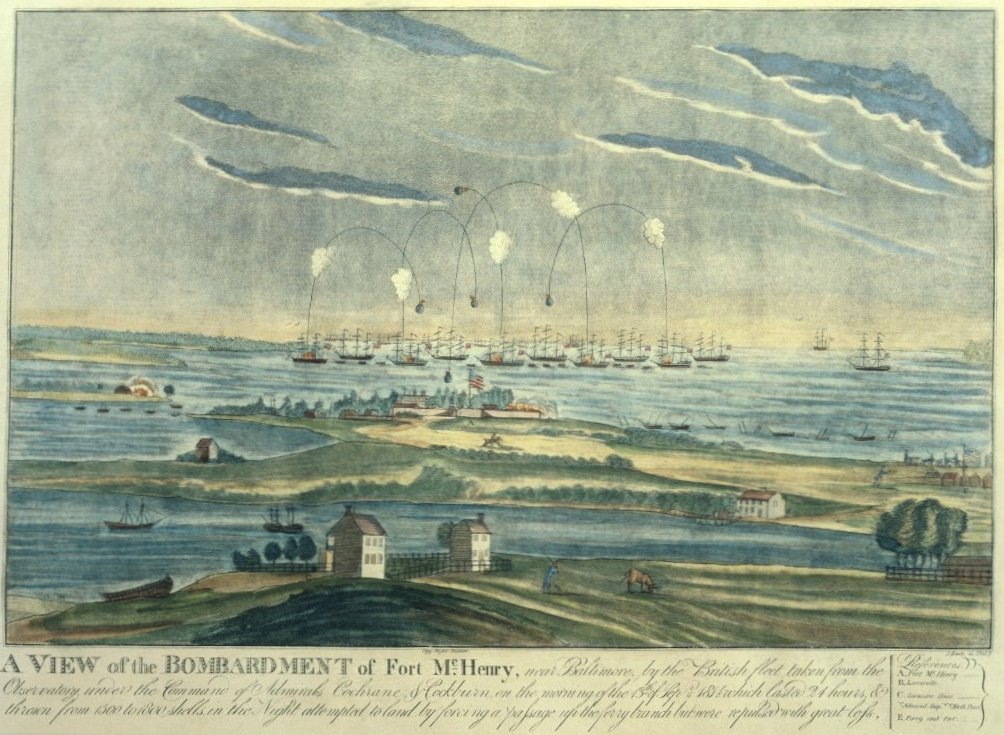
Baltimore was the third largest city in the country. The British had burned the capital and now wanted the port. The land attack had stalled after the fight at North Point on September 12. The Royal Navy's job was to batter Fort McHenry into silence so its ships could sail into the inner harbor.3 About 1,000 defenders held the fort under Major George Armistead, with some 15,000 American troops dug in around the city.4
The bombardment began on September 13 and ran twenty-five hours, with bombs thrown from mortar vessels and Congreve rockets fired besides.2 It rained through much of it.5 The poem says what the men on the packet saw: "the rocket's red glare, the bombs bursting in air." They could not tell who held the fort until the shooting stopped and the light came up.
"Then in that hour of deliverance and joyful triumph, my heart spoke."
Francis Scott Key, recalling the morning of September 14, 1814, as quoted by the Smithsonian. 6
NPS says Key and Skinner kept watching the fort through a spyglass. Just before 9:00 a.m. Armistead had the storm flag taken down, and at 9:00 the huge garrison flag went up, with fifes and drums playing "Yankee Doodle."7 As the truce ship was towed away from the fort, Key took a letter from his coat and began writing. The Smithsonian says he scribbled the first lines on the back of it.78
The sources disagree on where the ship lay. NPS puts the Stephen Decatur about two miles from the fort, tied to the British frigate Surprize. The Smithsonian places Key aboard a British troopship about four miles away.9
He finished the poem at a Baltimore tavern, the Indian Queen, on the night of September 16. Skinner and Judge Joseph Nicholson, who was related to Key by marriage, took it to the printers. NPS says over 1,000 copies were run, with a fourteen-year-old apprentice named Samuel Sands helping.7 The Smithsonian dates the first broadside, headed "Defence of Fort M'Henry," to about September 17. NPS says the Baltimore American printed the poem on September 20, and the Smithsonian reports that by mid-October at least seventeen more papers in cities up and down the coast had run it.78
- Aug 19, 1813 Mary Pickersgill's flags for Fort McHenry are finished.5
- Apr 2, 1814 Vice Admiral Cochrane offers freedom in British territory to people who come aboard British ships.10
- Late Aug 1814 The British take Dr. William Beanes prisoner after burning Washington.1
- Sep 7 Key and Skinner reach the Tonnant and win Beanes's release, then are held until the attack ends.1
- Sep 13 to 14 Twenty-five hours of bombardment; the garrison flag rises on the morning of the 14th.2
- Sep 16 to 17 Key finishes the poem in Baltimore; the first broadside is printed about the 17th.8
- Sep 20 The Baltimore American prints the song.7
- 1889, 1916, 1917 Navy, President Wilson and the armed services adopt it for ceremony.1112
- Mar 3, 1931 Congress makes it the national anthem; President Hoover signs.12
The Flag and the Woman Who Sewed It
Armistead wanted, in his own words, "a flag so large that the British will have no difficulty in seeing it from a distance."5 In the summer of 1813 he ordered two: a 30 by 42 foot garrison flag and a 17 by 25 foot storm flag. The job went to Mary Pickersgill, a thirty-seven-year-old widow who made ships' colors and signal flags in Baltimore.13
She worked about seven weeks with her thirteen-year-old daughter Caroline, her nieces Eliza and Margaret Young, and a thirteen-year-old African American indentured servant named Grace Wisher. Her mother, Rebecca Young, who had taught her the trade, may have helped too. The job outgrew the house and moved across the street to a brewery floor, where strips of English wool bunting were pieced together and fifteen cotton stars went onto the blue field.13 The flags were done by August 19, 1813. Pickersgill was paid $405.90, more than most Baltimoreans earned in a year.13
The Armistead family kept the flag. Eben Appleton inherited it in 1878, lent it to the Smithsonian in 1907 and gave it in 1912.14 The flag you can see today measures 30 by 34 feet. Over 200 square feet went out as souvenir snippings in the late 1800s, one of the stars among them. Amelia Fowler and ten needlewomen backed it with linen in 1914, and a conservation project from 1999 to 2008 took off Fowler's backing and stitching and replaced it with a polyester support. The new gallery opened in November 2008.15
The Tune and the Four Stanzas
Key set the words to a song every educated American knew. "To Anacreon in Heaven" was written about 1775 by John Stafford Smith as the club song of the Anacreontic Society, a London gentlemen's music society, and its original verses praise the Greek poet Anacreon for love and wine.16 The tune had already carried American verses, including "Adams and Liberty," and Key himself had fitted it to a song in 1805.16 It has always been a hard song to sing.12 Before he left Baltimore Key wrote the tune's name, "Anacreon in Heaven," on Skinner's copy of the manuscript.7
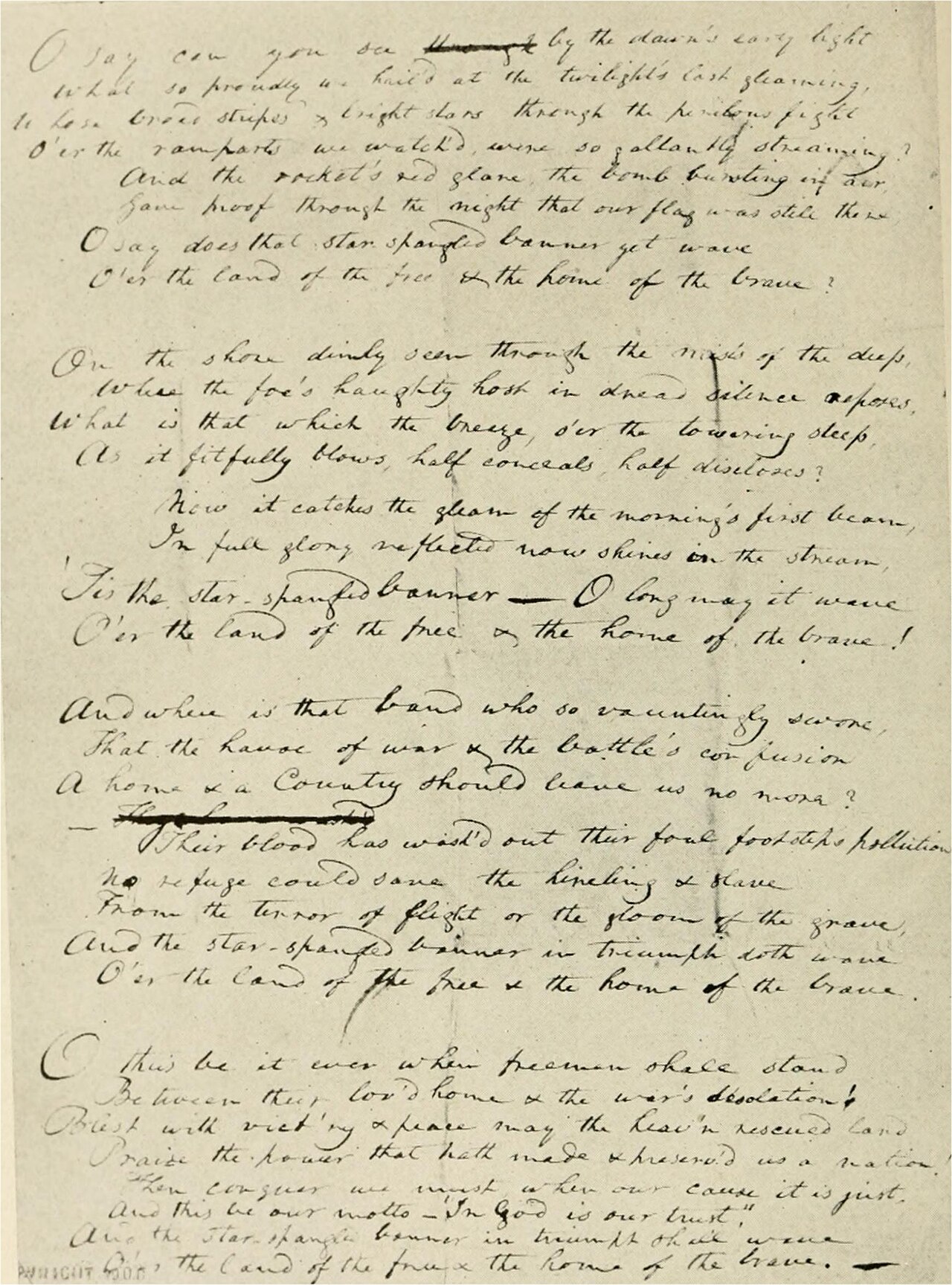
The first stanza is the one most people know. It ends on a question.
O say can you see, by the dawn's early light,
Francis Scott Key, "Defence of Fort M'Henry," September 1814, text as given by the Smithsonian National Museum of American History. 8
What so proudly we hail'd at the twilight's last gleaming,
Whose broad stripes and bright stars through the perilous fight
O'er the ramparts we watch'd were so gallantly streaming?
And the rocket's red glare, the bombs bursting in air,
Gave proof through the night that our flag was still there,
O say does that star-spangled banner yet wave
O'er the land of the free and the home of the brave?
The second answers it. The morning light finds the flag.
On the shore dimly seen through the mists of the deep
Stanza two, same source. 8
Where the foe's haughty host in dread silence reposes,
What is that which the breeze, o'er the towering steep,
As it fitfully blows, half conceals, half discloses?
Now it catches the gleam of the morning's first beam,
In full glory reflected now shines in the stream,
'Tis the star-spangled banner - O long may it wave
O'er the land of the free and the home of the brave!
The third turns on the British, and it is the one that draws argument. A later section takes it up.
And where is that band who so vauntingly swore,
Stanza three, same source. 8
That the havoc of war and the battle's confusion
A home and a Country should leave us no more?
Their blood has wash'd out their foul footstep's pollution.
No refuge could save the hireling and slave
From the terror of flight or the gloom of the grave,
And the star-spangled banner in triumph doth wave
O'er the land of the free and the home of the brave.
The fourth is a prayer and a motto.
O thus be it ever when freemen shall stand
Stanza four, same source. 8
Between their lov'd home and the war's desolation!
Blest with vict'ry and peace may the heav'n rescued land
Praise the power that hath made and preserv'd us a nation!
Then conquer we must, when our cause it is just,
And this be our motto - "In God is our trust,"
And the star-spangled banner in triumph shall wave
O'er the land of the free and the home of the brave.
The Third Stanza and Key's Own Record
The line in question is "No refuge could save the hireling and slave." Nobody wrote down what Key meant by it, and he never explained it.17 Two readings are on the table.
One reading puts the Colonial Marines in the line. On April 2, 1814, Cochrane had issued a proclamation inviting people in the United States to come aboard British ships and settle as free people in British territory. NPS says about 4,000 men, women and children took the offer in the Chesapeake, and about 200 of the men were armed and trained on Tangier Island as the Colonial Corps of Marines. They took part in the British march on Washington and in the fight at North Point.10 Jason Johnson, an associate professor at Morgan State University in Baltimore, says Key "was happy to see former slaves, who had joined the British as part of their Colonial Marines, getting slaughtered and killed as they attempted to take Baltimore." Johnson adds that Key himself had faced the Colonial Marines in battle, so the line was personal.17 NPS records Key as a volunteer aide to General Walter Smith at Bladensburg in August 1814 and the Corps as part of the British march on Washington, but none of the sources used here documents Key meeting those troops in a fight.1810 GBH reports that many historians agree with Johnson and some disagree, and it puts the number of African Americans who fled to the British at about 6,000, against NPS's 4,000.17
The other reading takes "hireling and slave" as a description of the invading force in general. Historians on the other side point out that Key never said what he meant and that the words echo Revolutionary War rhetoric, which set paid foreign troops, the hirelings, against the free American citizen in arms.17 Mark Clague, a musicologist at the University of Michigan, grants that the enemy Key attacked in the middle stanzas included both professional soldiers and the Colonial Marines, whom he calls escaped slaves who joined Britain for the promise of freedom. He argues the stanza vilifies an enemy and does not celebrate slavery, that the song honors the Black and white defenders of Fort McHenry, and that "freemen" in the fourth stanza is a legal word covering Black and white alike. He adds that the third stanza was dropped from sheet music in World War I when Britain became an ally.19
Key never explained the line. Historians read it two ways, and the words alone cannot settle it.
What Key did with slavery
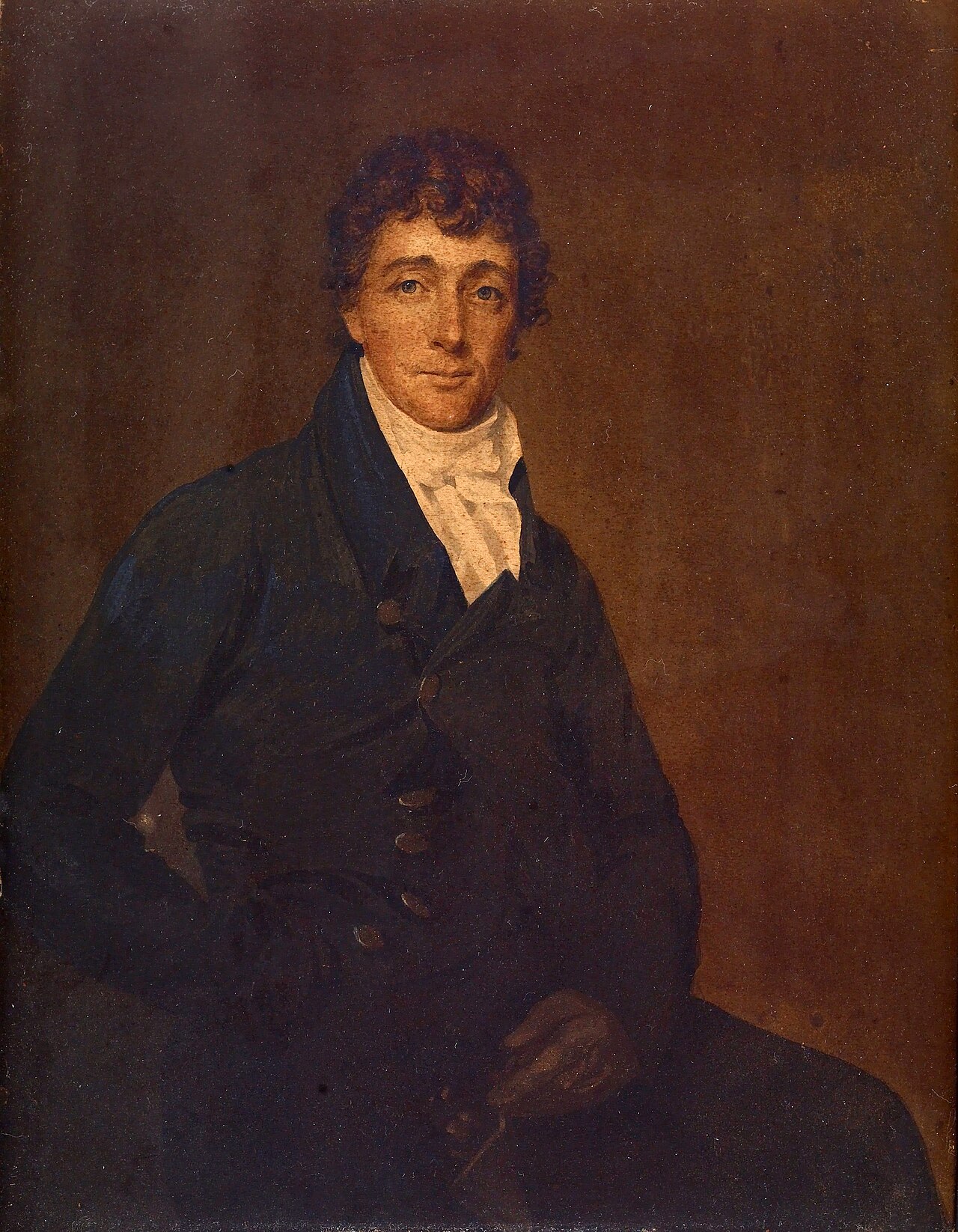
Key was born August 1, 1779, in Frederick County, Maryland, and raised at Terra Rubra, a plantation worked by enslaved people. He married into another slaveholding family in 1802. NPS says he most likely bought his first enslaved person in 1800 or 1801 and owned six by 1820.18 Clague says he inherited seven, and Morley says Key freed seven from his own household during his life, so the counts differ by source.1920
He also took cases for people suing for freedom. NPS quotes him as arguing that "by the law of nature all men are free."18 Clague adds that in 1825 he argued before the Supreme Court for Africans taken from a slave ship, in the Antelope case, and lost.19 He signed manumissions. One of them freed two boys, two years and six months old, but only when each reached twenty-five.18
He also defended slaveholders who sued to recover runaways. He helped found the American Colonization Society in 1816, which wanted free Black Americans sent to Africa, and he opposed abolition.18 As United States District Attorney for the District of Columbia from 1833 to 1841, he indicted the abolitionist editor Benjamin Lundy for libel in 1833, after Lundy reported that a woman had drowned fleeing one of Key's constables. Lundy left town.1820 In 1835 Arthur Bowen, an enslaved young man whom the sources give as eighteen or nineteen, stood in his owner's bedroom doorway with an axe, and white mobs rioted in Washington afterward.21 Key then prosecuted Dr. Reuben Crandall, a white physician, for seditious libel because Crandall had antislavery publications in a trunk. The trial ran in April 1836, and the jury acquitted him.22 His attorney told the jury he had been jailed for eight months before trial. Crandall took tuberculosis in prison and died in early February 1838.21
Key wrote "the land of the free" while he owned people, and later used his office against men who said slavery was wrong. Abolitionists pointed at the gap in his own lifetime, mocking the phrase with "Land of the Free and Home of the Oppressed."23
Myth: "The Star-Spangled Banner" has been the national anthem since 1814
It was a popular patriotic song for more than a century. Congress made it official in 1931.11
The Fourth Stanza and the Motto
The last stanza asks the nation to praise "the Power that hath made and preserv'd us a nation." It then offers a motto: "In God is our trust." Key was a devout Episcopalian who had thought of the ministry as a young lawyer.18
The motto on American money has its own paper trail, and it starts in the Civil War. On November 13, 1861, the Rev. M. R. Watkinson of Ridleyville, Pennsylvania, wrote Treasury Secretary Salmon P. Chase asking that coins recognize God. A week later Chase told the Mint director: "No nation can be strong except in the strength of God, or safe except in His defense." He went on: "The trust of our people in God should be declared on our national coins." On December 9, 1863, Chase approved the wording IN GOD WE TRUST for a coin design.24 President Eisenhower signed the law making it the national motto on July 30, 1956 (Public Law 84-851).24
Key's line and Chase's motto are separate texts, and the Treasury history quoted by the House never mentions Key. Each puts trust in God into the words of the nation, Chase on coins and Key in a stanza that opens with "freemen" standing between "their lov'd home and the war's desolation."
From Popular Song to Anthem
The song's standing grew with the wars. In the Civil War, Northerners embraced it because the flag it praised stood for loyalty to the Union.11 The Navy ordered it played at morning colors in 1889. By 1917 the Army and Navy both treated it as the national anthem for ceremony.11 NPS calls the song a "national air" like "Yankee Doodle" and "Hail, Columbia," and "My Country 'Tis of Thee" and "America the Beautiful" were among its rivals for the title.1812
The push for law came from several directions. The Smithsonian credits Mrs. Reuben Ross Holloway of the United States Daughters of 1812 and Congressman J. Charles Linthicum of Baltimore.11 Linthicum introduced the bill in 1929 with a petition of more than five million signatures, and the Veterans of Foreign Wars ran a petition drive of its own.1225 At a House Judiciary Committee hearing in January 1930, a VFW Auxiliary member, Elsie Jorss Reilly, sang the anthem with the Navy Band to answer the complaint that the high notes were beyond ordinary singers.25 The House passed the bill on April 21, 1930, the Senate on March 3, 1931, and President Hoover signed it that day.12
Lesson 2 covers the songs that came before it, Lesson 7 covers how ordinary Americans passed such tunes along, and Lesson 9 covers what the song meant when the country split.
The flag itself lies tilted at a shallow angle in a climate-controlled chamber in Washington, in light kept low to protect the old wool.15
Learn more
- The Star-Spangled Banner exhibition site: the Smithsonian's pages on the lyrics, the flag, the melody and the anthem
- Fort McHenry: Baltimore Saved: the morning of September 14 and the writing of the poem
- Fort McHenry: Francis Scott Key: a short biography that includes his slaveholding
- Freedom Seekers and the Colonial Marines: who the third stanza may be about
- Trial of Reuben Crandall: the 1836 trial Key lost
- Land of the Free? Francis Scott Key, Defender of Slavery: Jefferson Morley on Key's years as District Attorney
- Herbert Hoover and The Star Spangled Banner: why the 1931 law took a decade of lobbying
- Historians disagree on the Star-Spangled Banner: the third stanza argument in about five minutes of reading
- Star-Spangled Banner facts: the flag's size, repairs and display history
Notes
- National Park Service, Fort McHenry National Monument and Historic Shrine, "The Negotiation for Dr. Beanes," last updated May 7, 2024. Read it online. ↩
- Smithsonian National Museum of American History, "Baltimore in the Balance," The Star-Spangled Banner exhibition site. Read it online. ↩
- National Park Service, Fort McHenry, "Battle of Baltimore." Read it online. ↩
- National Park Service, Fort McHenry, "The Bombardment of Fort McHenry," last updated September 11, 2020. Read it online. ↩
- National Park Service, Fort McHenry, "The Great Garrison Flag," on Armistead's order, the size of the flags, Pickersgill and the August 19, 1813 completion. Read it online. ↩
- Smithsonian National Museum of American History, "A Moment of Triumph," The Star-Spangled Banner exhibition site, quoting Key. Read it online. ↩
- National Park Service, Fort McHenry, "Baltimore Saved," on the Stephen Decatur truce ship, the spyglass, the raising of the garrison flag, Key's first writing, the Indian Queen Tavern, the handbill and the September 20 printing in the Baltimore American. The page gives September 15 for the end of the firing, which conflicts with the Smithsonian's September 14 and with the NPS biography of Key; this lesson follows the Smithsonian. Read it online. ↩
- Smithsonian National Museum of American History, "The Lyrics," The Star-Spangled Banner exhibition site, giving the four stanzas, Key's first scribbling on the back of a letter, the broadside printed probably on September 17, the later copies, and the spread of the text to at least seventeen more papers by mid-October. Read it online. ↩
- Smithsonian National Museum of American History, "Francis Scott Key," The Star-Spangled Banner exhibition site, which places Key aboard a British troopship about four miles from the fort; the National Park Service puts the American truce ship about two miles away (see the "Baltimore Saved" note). Read it online. ↩
- National Park Service, Star-Spangled Banner National Historic Trail, "Freedom Seekers and the Colonial Marines," on Cochrane's proclamation of April 2, 1814, the 4,000 freedom seekers and the Colonial Corps of Marines. Read it online. ↩
- Smithsonian National Museum of American History, "National Anthem," The Star-Spangled Banner exhibition site, on Civil War popularity, the Navy order of 1889, the military use by 1917, the 1931 date and the work of Mrs. Reuben Ross Holloway and Congressman J. Charles Linthicum. Read it online. ↩
- Herbert Hoover Presidential Library, "Herbert Hoover and 'The Star Spangled Banner'" (March 2, 2023), on Wilson and the armed forces in 1916, the difficulty of the tune, Representative Linthicum's 1929 bill and petition of more than five million signatures, the House vote of April 21, 1930, the Senate vote of March 3, 1931, and Hoover signing the bill on March 3, 1931. The Veterans of Foreign Wars history says he signed the next morning; the Hoover Library cites the Congressional Record for March 3. Read it online. ↩
- Smithsonian National Museum of American History, "Making the Flag," The Star-Spangled Banner exhibition site, on Pickersgill, her helpers, the brewery and the $405.90 payment. Read it online. ↩
- Smithsonian National Museum of American History, "National Treasure," The Star-Spangled Banner exhibition site, on Eben Appleton and the 1907 loan and 1912 gift. Read it online. ↩
- Smithsonian Institution, "Star-Spangled Banner facts," on the flag's present size, souvenir cuttings, the 1914 Fowler treatment and the 1999 to 2008 conservation. Read it online. ↩
- Smithsonian National Museum of American History, "The Melody," The Star-Spangled Banner exhibition site, on John Stafford Smith, the Anacreontic Society and Key's 1805 use of the tune. Read it online. ↩
- GBH and PRI's The World, "Historians Disagree On Whether 'The Star-Spangled Banner' Is Racist," August 30, 2016, quoting Jason Johnson of Morgan State University. The report says many historians agree with Johnson and some disagree. Read it online. ↩
- National Park Service, Fort McHenry, "Francis Scott Key," last updated July 16, 2025, on his birth, his career, his slaveholding, the manumission of two boys, the American Colonization Society, his service at Bladensburg, the third stanza, and the song as a "national air" like "Yankee Doodle" and "Hail, Columbia." Read it online. ↩
- Mark Clague, "'Star-Spangled Banner' critics miss the point," CNN, August 31, 2016. Clague is a professor of musicology at the University of Michigan. He says Key inherited seven enslaved people; the National Park Service counts six in 1820. Read it online. ↩
- Jefferson Morley, "'Land of the Free?' Francis Scott Key, Composer of National Anthem, Was Defender of Slavery," HuffPost, September 2, 2012, on Key's indictment of Benjamin Lundy, his freeing of seven people from his household, the 1835 riot and the spring 1836 Crandall prosecution; and Morley, Snow-Storm in August (New York: Nan A. Talese, 2012). Read it online. ↩
- John R. Vile, "Trial of Reuben Crandall (1835-1836)," The First Amendment Encyclopedia, Middle Tennessee State University, August 12, 2023, on Arthur Bowen, the riot, the trunk of publications, the eight-month imprisonment argued by Crandall's counsel, the acquittal and Crandall's death in early February 1838; and The Trial of Reuben Crandall, M.D. (New York: H. R. Piercy, 1836), the trial record, which dates the proceedings to April 1836. Read it online. ↩
- The Trial of Reuben Crandall, M.D., Charged with Publishing Seditious Libels (New York: H. R. Piercy, 1836), Project Gutenberg eBook 28197, the report of the trial before the Circuit Court of the District of Columbia in April 1836. Read it online. ↩
- Christopher Wilson, "Where's the Debate on Francis Scott Key's Slave-Holding Legacy?" Smithsonian Magazine, July 1, 2016, which reports that abolitionists mocked Key's words by calling America the "Land of the Free and Home of the Oppressed." Read it online. ↩
- U.S. House of Representatives, Report 112-47 (2011), quoting the Treasury Department's history of "In God We Trust," including Chase's letters of November 20 and December 9, 1863, and Public Law 84-851 (36 U.S.C. 302). Read it online. ↩
- Herbert M. Mason, "National Anthem Celebrates 78 Years, Thanks to VFW," Veterans of Foreign Wars, on the 1930 petition drive and the January 1930 hearing of the House Judiciary Committee, where VFW Auxiliary member Elsie Jorss Reilly sang the anthem to a Navy Band accompaniment. Read it online. ↩
Terms in this lesson
- Garrison flag
- The large flag a fort flew in fair weather. Fort McHenry's measured 30 by 42 feet. A smaller storm flag, 17 by 25 feet, flew in bad weather.
- Broadside
- A single sheet printed on one side for posting or handing out. Key's poem first appeared as a broadside titled "Defence of Fort M'Henry" in Baltimore.
- Flag of truce vessel
- A boat allowed to pass between enemy lines under a white flag to talk about prisoners or terms. Key and John Skinner sailed in one.
- Anacreontic Society
- A gentlemen's music club in London. Its club song, "To Anacreon in Heaven," supplied the tune Key used.
- Colonial Marines
- A British unit of about 200 formerly enslaved men from the Chesapeake region, raised in 1814 and trained on Tangier Island.
- American Colonization Society
- An organization founded in 1816 to send free Black Americans to Africa. Key helped found it.
- Seditious libel
- The crime of publishing words said to stir up hatred of the government or unrest. Key prosecuted the abolitionist Reuben Crandall on such a charge in a trial that opened in April 1836.
Sources
- Smithsonian National Museum of American History, The Star-Spangled Banner exhibition site checked 2026-10
- National Park Service, Fort McHenry: The Negotiation for Dr. Beanes checked 2026-10
- National Park Service, Fort McHenry: Baltimore Saved checked 2026-10
- National Park Service, Fort McHenry: Francis Scott Key checked 2026-10
- National Park Service, Freedom Seekers and the Colonial Marines checked 2026-10
- Smithsonian, Star-Spangled Banner facts checked 2026-10
- John R. Vile, Trial of Reuben Crandall, The First Amendment Encyclopedia checked 2026-10
- Mark Clague, Star-Spangled Banner critics miss the point, CNN, 2016 checked 2026-10
- GBH and PRI, Historians disagree on whether the Star-Spangled Banner is racist, 2016 checked 2026-10
- Jefferson Morley, Land of the Free? Francis Scott Key, Composer of National Anthem, Was Defender of Slavery, HuffPost, 2012 checked 2026-10
- The Trial of Reuben Crandall, M.D. (New York, 1836), Project Gutenberg checked 2026-10
- Herbert Hoover Presidential Library, Herbert Hoover and The Star Spangled Banner checked 2026-10
- House Report 112-47, quoting the Treasury history of the motto In God We Trust checked 2026-10