Lesson 4 of 12 · about 26 minutes
Arts of the Early Republic
You'll be able to
- Describe Gilbert Stuart's Athenaeum and Lansdowne portraits of Washington and how they became the nation's picture of him
- Explain what Charles Willson Peale's museum and Jefferson's buildings were meant to teach citizens
- Tell how Hail Columbia (1798) and Key's Defence of Fort M'Henry (1814) were written, and how the second became the national anthem by law in 1931
- Describe what Noah Webster and Washington Irving did to make an American language and literature
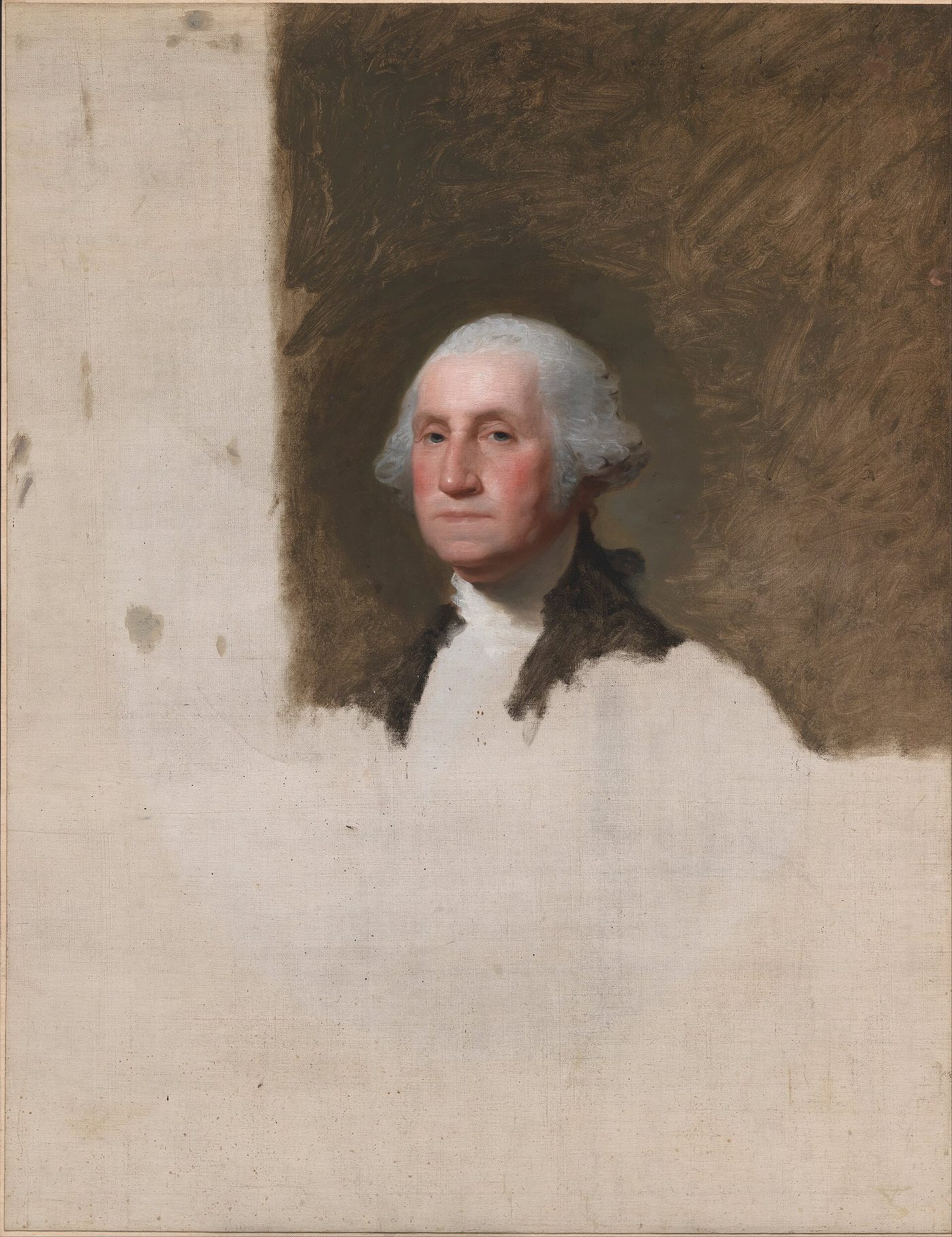
On April 12, 1796, the President of the United States climbed the stairs to Gilbert Stuart's painting room in Philadelphia and sat down. George Washington was 64. He sat only long enough for Stuart to get his face. A stand-in posed for the body, and the room behind him was invented.1 The paintings that came out of those sittings became the face of the country. One of them is in your wallet.
The new republic had a problem the old colonies never faced. It had to look like something. A king has a crown, a court and a coronation. The United States had a written Constitution, an elected president who would leave office, and no tradition at all for what a republic should look like in paint, stone or song. The artists and writers in this lesson spent forty years working that out.
Stuart's Washingtons
Gilbert Stuart was born in Rhode Island on December 3, 1755. He trained in London as Benjamin West's assistant for about five years and made his name there with The Skater in 1782.2 Back in America in the 1790s, he set out to paint Washington and sell copies.2
The Athenaeum portrait
Martha Washington asked Stuart to paint her and her husband for Mount Vernon. The result is the head now called the Athenaeum portrait. Stuart never finished it and never delivered it. He used it to paint many replicas, including one from 1805 that hangs in the White House. After his death his daughter sold the original to the Boston Athenaeum in 1831, and in 1980 the National Portrait Gallery and the Museum of Fine Arts in Boston bought it together. Washington's likeness from it is on the one-dollar bill.2
The Lansdowne portrait
In 1795 William and Anne Bingham of Philadelphia, among the richest couples in the country, commissioned a full-length portrait as a gift for William Petty, the Marquis of Lansdowne, a British admirer of Washington. They shipped it to England in 1796.1 It stayed in English hands for almost two hundred years. In 2000 the owner offered it to the National Portrait Gallery for $20 million, and in March 2001 the Donald W. Reynolds Foundation gave $30 million to buy it for the nation and send it on tour.1
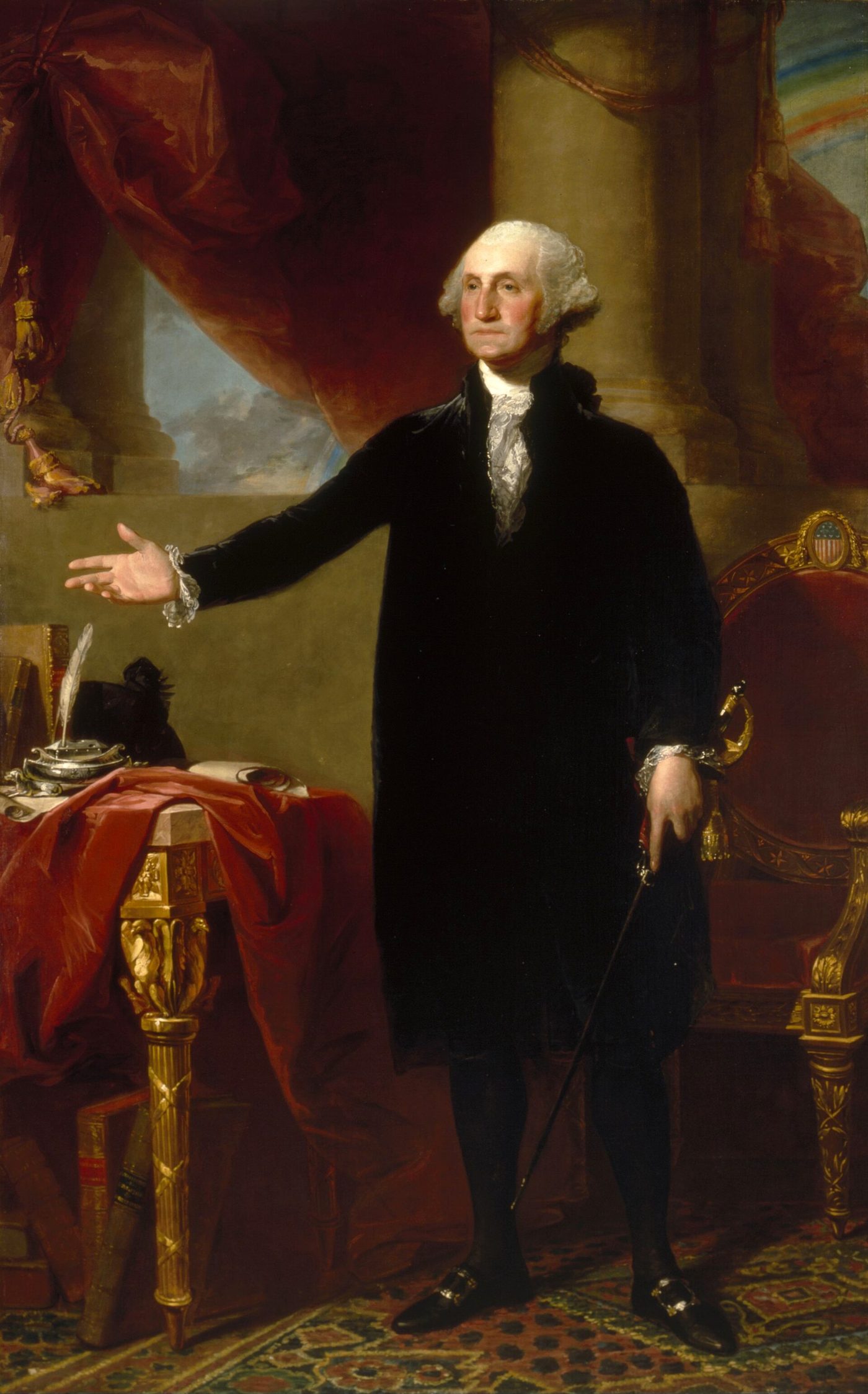
The Lansdowne is about eight by five feet. Washington stands in an orator's pose, likely drawn from his annual address of December 8, 1795. He holds a sheathed sword, and a copy of the Constitution and a history of the Revolution lean against a table leg.2 The props tell the story the republic wanted told. The general has put away the sword. The law is on the table.
Stuart made money the way Revere did, by copying. He sold a copy of the Lansdowne to the United States government in 1797 and apparently sold the same canvas again to a New York museum keeper. When it reached the President's House anyway, he denied painting it to cover himself.2
Myth: Dolley Madison cut Washington's portrait from its frame and carried it out herself
When British troops marched on Washington on August 24, 1814, the White House copy of the Lansdowne was saved, and Dolley Madison insisted it be saved before she left. But the White House Historical Association says it is more likely she directed others to take it down, among them the steward Jean-Pierre Sioussat and the gardener Thomas McGrath. Paul Jennings, James Madison's enslaved valet, wrote in the first White House memoir that the story of her rescuing it alone was "totally false." The portrait came back to the rebuilt White House in 1817.2 Give her credit for the order, and give the men who carried it credit for the work.
Peale's museum: a school for citizens
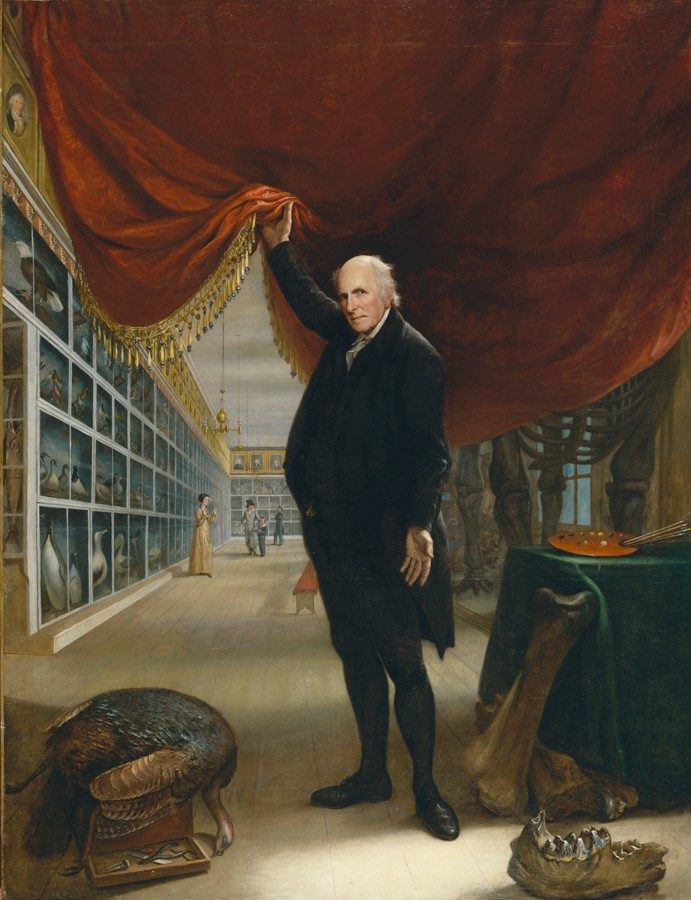
Charles Willson Peale, the painter-soldier of lesson one, wanted more than portraits. In the 1780s he turned his family home in Philadelphia into a museum, which he called "A Repository for Natural Curiosities." His portraits of Revolutionary leaders hung in the gallery beside stuffed birds, minerals and fossils.3 As it grew, he moved it into Philosophical Hall, the home of the American Philosophical Society, and later into the Pennsylvania State House, now Independence Hall, where it was fully installed by 1810.3
The mastodon, 1801
In early 1801 word reached Philadelphia that huge bones had been found on John Masten's farm in the Hudson Valley. The American Philosophical Society, whose president was Thomas Jefferson, lent Peale $500. He hired workers, built pumps to drain the marl pit, and came home with two partial skeletons in what is considered the first scientific expedition of its kind in the country.3 Jefferson cared because the French naturalist the Comte de Buffon had claimed New World animals were smaller and weaker than European ones. A beast eleven feet tall answered him.3
Moses Williams, an enslaved man in Peale's household and a gifted silhouette cutter, did much of the hard work of fitting the bones together. Peale wrote that Williams tried "the most improbable position" for pieces, and "did more good in that way than any one among those employed." The skeleton was unveiled on Christmas Eve, 1801.3 The National Park Service calls Williams the first Black museum professional in American history.3
Peale believed a republic needed citizens who knew things. A king's subjects can be kept ignorant. Free men who vote need to understand the world. His museum put that conviction on display, literally, in the building where the Declaration was signed.
Building a republic in brick and marble
Architecture had the hardest job of all, because buildings last. Jefferson understood this better than anyone in public life.
Jefferson's Virginia Capitol
In 1785, while he was minister to France, the directors of Virginia's public buildings asked Jefferson for a plan for a new capitol at Richmond. He hired a French architect, worked out the inside with him for the three branches of government, and chose as the model an ancient Roman temple at Nîmes, the Maison Carrée. He wrote to James Madison that it was "very simple, but it is noble beyond expression." Then he made his argument:
"But how is a taste in this beautiful art to be formed in our countrymen, unless we avail ourselves of every occasion when public buildings are to be erected, of presenting to them models for their study and imitation?"
Thomas Jefferson to James Madison, Paris, September 20, 1785.4
He had heard bricks were already being laid on another plan, and he begged Madison to stop the work. Better to waste a few bricks than to erect "a monument of our barbarism, which will be loaded with execrations as long as it shall endure."4 He got his temple. The building told Virginians that their government belonged in the line of the ancient republics.
Monticello
At home Jefferson never stopped building. The mountaintop at Monticello was cleared and leveled in 1768, and construction began in 1769. In 1770 he moved into the finished South Pavilion. Starting in 1796 he tore down the upper story and rebuilt the house to a new design, finishing about 1809 with the dome he called the "sky-room." The finished house has 43 rooms.5
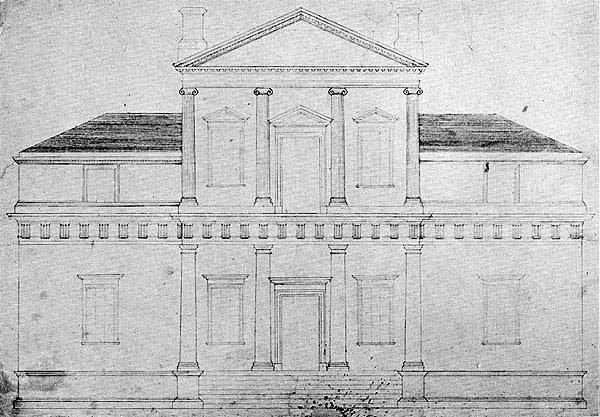
Jefferson did not build Monticello with his own hands. Enslaved workers made the bricks and nails. Local white masons and their enslaved apprentices laid the stone and brick. Free and enslaved carpenters and joiners did the woodwork, and in 1809 John Hemmings, an enslaved joiner, became the head joiner.5 The house of the author of the Declaration was built in large part by men he held in bondage. That fact belongs in the caption of every picture of it.
The Capitol
The national Capitol came out of a contest. In March 1792 the commissioners of the new federal city, at Secretary of State Jefferson's suggestion, offered $500 and a city lot for "the most approved plan." None of the seventeen entries satisfied them. A late entry from Dr. William Thornton, an amateur from the British West Indies, showed a domed center between two wings, one for each house of Congress. Washington praised its "grandeur, simplicity and convenience," and the plan was accepted in April 1793.6 Washington laid the cornerstone on September 18, 1793.6
Benjamin Henry Latrobe, the first trained architect and engineer to work in America, took over in 1803. On August 24, 1814, British troops set the building on fire. Latrobe called it "a most magnificent ruin." A rainstorm kept it from burning to the ground.6 Latrobe came back to restore it, and Charles Bulfinch of Boston finished the central section and the first dome. By 1826 John Trumbull's four Revolutionary paintings hung in its Rotunda.
Hail Columbia, 1798
The young country also needed songs, and its first great one came out of a political crisis. In the spring of 1798 the United States was close to war with France. Americans were bitterly split between those who favored France and those who favored Britain. In Philadelphia, a young singer named Gilbert Fox had a benefit night coming and expected an empty house. He came to Joseph Hopkinson, a lawyer he had known at school, and asked for a patriotic song to fit "the President's March," a popular tune of the day. Hopkinson wrote it overnight.7
Hopkinson explained his aim in 1840. He wanted "to get up an American spirit which should be independent of, and above the interests, passion and policy of both belligerents." The song made "No allusion" to France or England, so "the song found favour with both parties, for both were American."7 Fox sang it on April 25, 1798, and the audience called for it again and again, nearly a dozen times. The newspapers printed it within days, and it spread as the "New Federal Song."8 The advertisement for Fox's night printed its chorus to draw a crowd:
"Firm united let us be
Advertisement for "Mr. Fox's Night," Porcupine's Gazette, April 24, 1798, quoted in Sonneck, Report, 1909.8
Rallying around our Liberty
As a band of brothers join'd
Peace and Safety we shall find!"
In a year of partisan fury, Hopkinson wrote a song about loyalty to the country above party. "Hail Columbia" served as an unofficial anthem for more than a century and was one of the songs proposed when Congress finally chose one.9
The Defence of Fort M'Henry, 1814
Three weeks after the British burned Washington, they came for Baltimore. Francis Scott Key, a Georgetown lawyer and a devout Episcopalian who had once thought of becoming a priest, had gone out under a flag of truce with the prisoner agent John Stuart Skinner to win the release of Dr. William Beanes, an elderly physician the British had seized. The British agreed to free Beanes but held all three men so they could not warn Baltimore of the coming attack.10
From the water they watched the bombardment of Fort McHenry through September 13 and into the morning of September 14, 1814. When the garrison flag went up at nine that morning, it was the great flag Mary Pickersgill had sewn the year before, thirty by forty-two feet.10 Key was released that day, went to the Indian Queen Hotel in Baltimore, and wrote out four stanzas meant to be sung to "To Anacreon in Heaven," the tune of a London gentlemen's music club.10
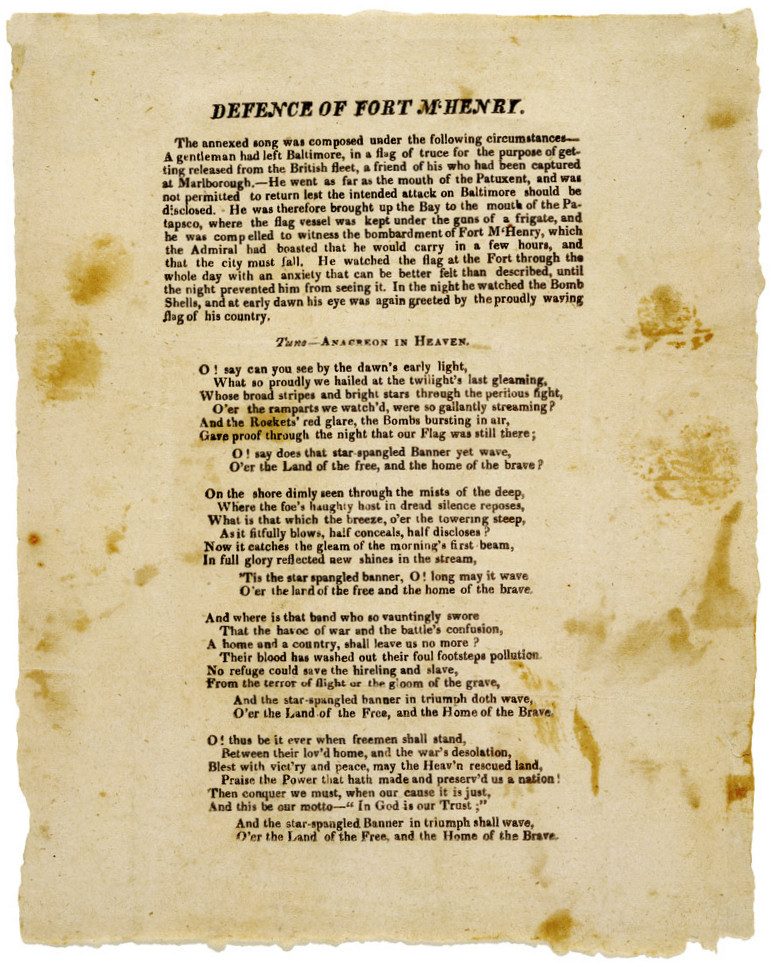
By September 17 printed copies were being handed to the men in the fort and the people of the city.10 The Baltimore Patriot published it on September 20.11 The newspaper version introduced it with the story of "A gentleman" who "watched the flag at the fort through the whole day ... until the night prevented him from seeing it. In the night he watched the Bomb Shells, and at early dawn his eye was again greeted by the proudly waving flag of his country."12
"O say, can you see by the dawn's early light,
Francis Scott Key, first stanza, as printed in Sonneck, Report, 1909.13
What so proudly we hailed at the twilight's last gleaming?
Whose broad stripes and bright stars through the perilous fight,
O'er the ramparts we watched, were so gallantly streaming!
And the rocket's red glare, the bombs bursting in air
Gave proof through the night that our flag was still there;
O say, does that star spangled banner yet wave
O'er the land of the free and the home of the brave?"
Notice that the first verse ends with a question. Key did not yet know, as he wrote the opening lines, whether the flag would still be there at dawn. The song asks every generation the same thing.
How fast did it spread?
The National Park Service says that within weeks the song, under its new name "The Star Spangled Banner," ran in seventeen newspapers across the East, and that it was first sung on stage in Baltimore on October 19, 1814.10 Sonneck, writing for the Library of Congress in 1909, warned against what he called "silly anecdotes of its wildfire progress." In his reading of the song collections, its rise as a national song before the Civil War was "steady, but comparatively slow," and it was the war of 1861 that pushed it to the front.14 Both can be true. It was widely printed at once and slowly became the nation's song.
From song to law
The Navy made it part of its flag ceremonies in 1889. President Woodrow Wilson ordered it played at military ceremonies in 1916. A resolution to make it the national anthem was introduced in 1929 and met objections: the tune came from an English drinking club, it was hard to sing, and it was too military.11 Congress passed the law on March 3, 1931, and President Herbert Hoover signed it.10 Today the federal code says it in one sentence: "The composition consisting of the words and music known as the Star-Spangled Banner is the national anthem."15
The third verse
Almost no one sings the third stanza, which mocks the defeated British and says "No refuge could save the hireling and slave." Historians disagree about what Key meant. About 6,000 enslaved people escaped to the British during the War of 1812 on the promise of freedom, and many men joined the Colonial Marines, a mostly Black British unit that fought well. Some historians, and the writer Jason Johnson, read the line as Key gloating over the deaths of those men. Others point out that Key never explained it, and that "hirelings and slaves" was an old Revolutionary phrase for all of the King's soldiers, set against free citizen armies.16 The fair course is to know both readings, and to know that Key himself had faced the Colonial Marines in battle. The song is bigger than its author, and its author was a man of his time.
An American language: Noah Webster
Noah Webster was a Connecticut schoolteacher after the war, and he hated the textbooks. American children learned from English books such as Thomas Dilworth's New Guide to the English Tongue, full of English places and English history.17 In 1783 he published the first part of A Grammatical Institute of the English Language, soon known as The American Spelling Book and, for its blue paper cover, the "Blue-Backed Speller."17 It taught syllables, pronunciation and spelling, and over more than a century it sold an estimated nearly 100 million copies.17
Webster's reason was political, and he said so in 1789:
"As an independent nation, our honor requires us to have a system of our own, in language as well as government. Great Britain, whose children we are, and whose language we speak, should no longer be our standard."
Noah Webster, Dissertations on the English Language, Dissertation I, Boston, 1789.18
Many of his spelling reforms failed. Others stuck: color for colour, theater for theatre, music for musick.17 He published a small dictionary in 1806 and then spent twenty-two more years on the big one. An American Dictionary of the English Language came out in 1828, when he was seventy, defining more than 65,000 words, including American words like skunk and squash that English dictionaries did not have.19 Webster also believed, as he once wrote, that in a republic where "government is in the hands of the people, knowledge should be universally diffused by means of public schools."17 Self-government needs a people who can read.
Washington Irving and the American story
Washington Irving was born in New York on April 3, 1783, the year the war ended. His comic A History of New York, published in 1809 under the made-up name Diedrich Knickerbocker, poked fun at the old Dutch families.20 His fame came with The Sketch Book of Geoffrey Crayon, Gent., published in parts in 1819 and 1820. It held the two American stories everyone knows, "Rip Van Winkle" and "The Legend of Sleepy Hollow."20
Rip Van Winkle sleeps for twenty years in the Catskills and wakes into a different country. The sign of his old inn still shows King George, except the red coat is now blue and buff and the name underneath is "GENERAL WASHINGTON." The tavern loafers have been replaced by a man with "his pockets full of handbills" haranguing about "rights of citizens," "elections," "members of Congress." Someone asks Rip "whether he was Federal or Democrat." Rip has no idea, and blurts out the worst possible answer:
"Alas! gentlemen," cried Rip, somewhat dismayed, "I am a poor, quiet man, a native of the place, and a loyal subject of the King, God bless him!"
Washington Irving, "Rip Van Winkle," The Sketch Book, 1819.21
The crowd shouts "a tory! a tory! a spy!" Irving is laughing at everyone: at Rip, who missed the Revolution, and at the new citizens, who turned liberty into noisy party combat. Later Rip learns that "instead of being a subject to his Majesty George the Third, he was now a free citizen of the United States."21 Irving's joke has a point any citizen can feel. A free country asks more of people than a monarchy does. You have to wake up and pay attention.
Irving spent his last years at Sunnyside, his house on the Hudson near Tarrytown, writing a five-volume Life of George Washington. The last volume came out just before he died on November 28, 1859.20
A timeline of the early republic in the arts
- 1783 Webster publishes the first part of his Grammatical Institute, the Blue-Backed Speller.
- 1785 Jefferson chooses the Maison Carrée as the model for Virginia's Capitol.
- 1789 Webster: "our honor requires us to have a system of our own, in language as well as government."
- 1793 Thornton's plan for the U.S. Capitol is accepted. September 18: Washington lays the cornerstone.
- 1796 Washington sits for Stuart. The Athenaeum head and the Lansdowne full-length are painted. Jefferson begins rebuilding Monticello.
- 1798 April 25: Gilbert Fox first sings Hopkinson's "Hail Columbia" in Philadelphia.
- 1801 Peale excavates the mastodon and unveils it on Christmas Eve.
- 1809 Irving's History of New York by "Diedrich Knickerbocker." Monticello is finished.
- 1814 August 24: the British burn the Capitol and the White House. September 14: Key writes the "Defence of Fort M'Henry."
- 1819 Irving's Sketch Book begins to appear, with "Rip Van Winkle."
- 1822 Peale paints The Artist in His Museum.
- 1828 Webster's American Dictionary of the English Language.
- 1931 March 3: "The Star-Spangled Banner" becomes the national anthem by law.
Every work in this lesson was trying to teach. Stuart's Washington taught what a republican leader looks like: plain coat, sword sheathed, law at hand. Peale's museum and Jefferson's buildings taught taste and knowledge to citizens who would need both. Hopkinson and Key gave people songs about loyalty to the country rather than to a king or a party. Webster and Irving gave them their own words and their own stories. The next lesson turns to the painters who taught Americans to see the land itself as part of the nation.
Learn more
- The Lansdowne Portrait, history (National Portrait Gallery): the life of one painting from Stuart's studio to the nation.
- Gilbert Stuart (White House Historical Association): Stuart's career, the Athenaeum and Lansdowne portraits, and what really happened in 1814.
- The Peale Museum (National Park Service): the mastodon dig and Moses Williams.
- Jefferson to Madison, September 20, 1785: Jefferson's case for the Virginia Capitol, in his own words.
- Monticello House FAQ: how the house was built, rebuilt and by whom.
- History of the U.S. Capitol Building (Architect of the Capitol): the competition, the fire and the rebuilding.
- The Star-Spangled Banner: A Flag and a Song (National Park Service): Key, Beanes, Pickersgill and the night of the bombardment.
- Sonneck's 1909 Report: the Library of Congress study of "Hail Columbia" and "The Star-Spangled Banner."
- Webster, Dissertations on the English Language: his case for an American standard.
- Irving, The Sketch Book: "Rip Van Winkle" and "The Legend of Sleepy Hollow."
Notes
- National Portrait Gallery, Smithsonian Institution, "George Washington: A National Treasure," exhibition history of the Lansdowne portrait. Read it online. ↩
- White House Historical Association, "Gilbert Stuart." Read it online. ↩
- National Park Service, "The Peale Museum: America's First Natural History Museum Features a Mastodon," Independence National Historical Park. Read it online. ↩
- Thomas Jefferson to James Madison, Paris, September 20, 1785, Avalon Project, Yale Law School. Read it online. ↩
- Thomas Jefferson Foundation, "Monticello House FAQ." Read it online. ↩
- Architect of the Capitol, "History of the U.S. Capitol Building." Read it online. ↩
- Joseph Hopkinson to Rufus W. Griswold, August 24, 1840, printed in The Wyoming Bard, quoted in O. G. Sonneck, Report on "The Star-Spangled Banner," "Hail Columbia," "America," "Yankee Doodle" (Washington: Government Printing Office, 1909), 43. Read it online. ↩
- Sonneck, Report, 44, quoting the Porcupine's Gazette advertisement of April 24, 1798, and describing the first performance and its reprinting. Read it online. ↩
- American Battlefield Trust, "Short History of The Star-Spangled Banner," on the other songs considered for national anthem. Read it online. ↩
- National Park Service, Star-Spangled Banner National Historic Trail, "The Star-Spangled Banner: A Flag and a Song." Read it online. ↩
- American Battlefield Trust, "Short History of The Star-Spangled Banner." Read it online. ↩
- Newspaper introduction to Key's poem, 1814, quoted in Sonneck, Report, 7. Read it online. ↩
- Sonneck, Report, 27, text of the first stanza of "The Star Spangled Banner." Read it online. ↩
- Sonneck, Report, 28. Read it online. ↩
- 36 U.S.C. 301(a), from Act of March 3, 1931, ch. 436, 46 Stat. 1508, U.S. Government Publishing Office. Read it online. ↩
- Christopher Woolf, "Historians Disagree On Whether 'The Star-Spangled Banner' Is Racist," GBH News, August 30, 2016. Read it online. ↩
- "Better Living through Spelling," Humanities (National Endowment for the Humanities), March/April 2010. Read it online. ↩
- Noah Webster, Dissertations on the English Language: with Notes, Historical and Critical (Boston, 1789), Dissertation I. Read it online. ↩
- Noah Webster House and West Hartford Historical Society, "Noah Webster History." Read it online. ↩
- National Archives, DocsTeach, "'Sunnyside,' Home of Washington Irving," from the National Register of Historic Places nomination. Read it online. ↩
- Washington Irving, "Rip Van Winkle," The Sketch-Book of Geoffrey Crayon, Gent. (1819-1820). Read it online. ↩
Terms in this lesson
- Federal style
- The architecture and decoration of the United States from about 1780 to 1830, lighter and more delicate than the Georgian style before it, using classical forms such as columns, domes and fanlights.
- Neoclassical
- Art and building modeled on ancient Greece and Rome. Americans used it to link their republic to the ancient republics.
- Replica
- A copy of a painting made by the artist himself. Stuart painted dozens of replicas of his Washington portraits.
- Benefit night
- A theater performance whose profits went to one actor or singer. Hail Columbia was first sung at one.
- Speller
- A schoolbook for teaching spelling, reading and pronunciation, arranged in graded lists of words and short lessons.
- Orthography
- The accepted way of spelling a language. Webster wanted an American orthography, such as color for colour.
Sources
- The Lansdowne Portrait, history (National Portrait Gallery) checked 2026-10
- Gilbert Stuart (White House Historical Association) checked 2026-10
- The Peale Museum: America's First Natural History Museum (National Park Service) checked 2026-10
- History of the U.S. Capitol Building (Architect of the Capitol) checked 2026-10
- Jefferson to Madison, September 20, 1785 (Avalon Project) checked 2026-10
- Monticello House FAQ (Thomas Jefferson Foundation) checked 2026-10
- The Star-Spangled Banner: A Flag and a Song (National Park Service) checked 2026-10
- Short History of The Star-Spangled Banner (American Battlefield Trust) checked 2026-10
- 36 U.S.C. 301, National anthem (U.S. Government Publishing Office) checked 2026-10
- Sonneck, Report on The Star-Spangled Banner, Hail Columbia, America, Yankee Doodle (1909) checked 2026-10
- Noah Webster, Dissertations on the English Language (1789), Project Gutenberg checked 2026-10
- Washington Irving, The Sketch-Book of Geoffrey Crayon (Project Gutenberg) checked 2026-10