Lesson 6 of 12 · about 24 minutes
Literature of the Young Nation
You'll be able to
- Name the major American writers from Irving to Dickinson and place their best-known works in time
- Explain what Emerson meant by self-reliance and why Oliver Wendell Holmes called The American Scholar an intellectual Declaration of Independence
- Describe why Thoreau went to jail in 1846 and what he argued in Resistance to Civil Government
- Compare how Hawthorne, Melville, Poe, Longfellow, Whitman and Dickinson each treated the individual conscience, and where they disagreed
- Judge the limits of the doctrine of the sovereign self against the founders' idea of liberty under law
A man with a grizzled beard and a rusty gun walks down from the Catskill Mountains into his old village. He has slept for twenty years. The tavern sign that once showed King George now shows a man in a cocked hat labeled General Washington. A crowd gathers. A "short but busy little fellow" pulls him by the arm, rises on his toes and asks in his ear "whether he was Federal or Democrat." Rip Van Winkle has no idea what the words mean. When he declares himself "a loyal subject of the King, God bless him!" the bystanders shout "a tory! a tory! a spy!"1
Washington Irving published that scene in 1819, in The Sketch Book of Geoffrey Crayon, Gent. It was funny, and it was pointed. A revolution had happened, a republic had been built, and ordinary people had been handed a new vocabulary of "rights of citizens," elections and "heroes of seventy-six" that some of them barely understood.1 Over the next forty years American writers would try to fill that vocabulary with meaning. They asked what a free person owes to himself, to his neighbors, to God and to the government. They did not agree. Their arguments are still the best record we have of what liberty felt like from the inside in the young republic.
Irving and Cooper Make an American Fiction
Before Irving, Americans read British books. The new country had produced pamphleteers, preachers and statesmen of the first rank, but no storyteller that London took seriously. The Sketch Book changed that. It came out in seven installments in 1819 and 1820, under the pen name Geoffrey Crayon. Most of its thirty-odd pieces describe England, but six deal with American subjects, including "Rip Van Winkle" and "The Legend of Sleepy Hollow." Britannica calls it the first American work to win international success, and the money let Irving live as a full-time writer.2
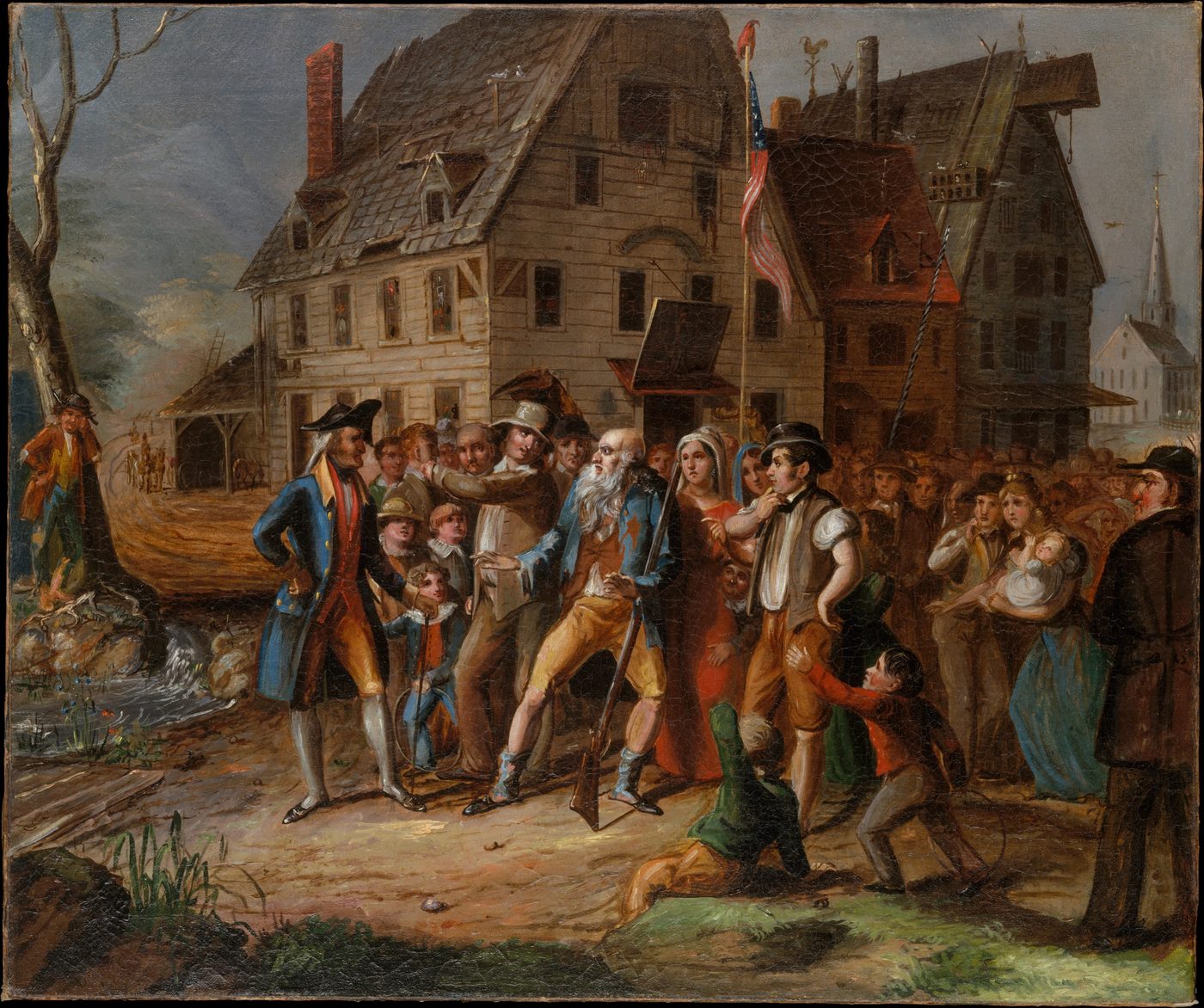
Irving's politics were mild and his touch was light. He laughed at the noisy partisan, the "self-important old gentleman, in a sharp cocked hat," who demands to know why Rip came to the election "with a gun on his shoulder, and a mob at his heels."1 He also laughed at Rip, who slept through the most important event in his country's history. Liberty, in Irving's comedy, belongs to people who stay awake.
James Fenimore Cooper gave the country its first frontier hero. His second novel, The Spy (1821), a tale of the Revolution, became a bestseller and made him the first major American novelist. The Last of the Mohicans followed on February 4, 1826, the second of five Leatherstocking Tales built around a backwoods scout named Natty Bumppo.4 Natty is free in a way no townsman can be. He lives by his own code in the forest, distrusts the law of the settlements and keeps faith with his friends. Cooper loved him and knew he could not last. Every book in the series is shadowed by the clearing of the woods and the passing of the Native nations, and Cooper's own sympathies split between the settler's order and the hunter's freedom.
Emerson Declares Independence of Mind
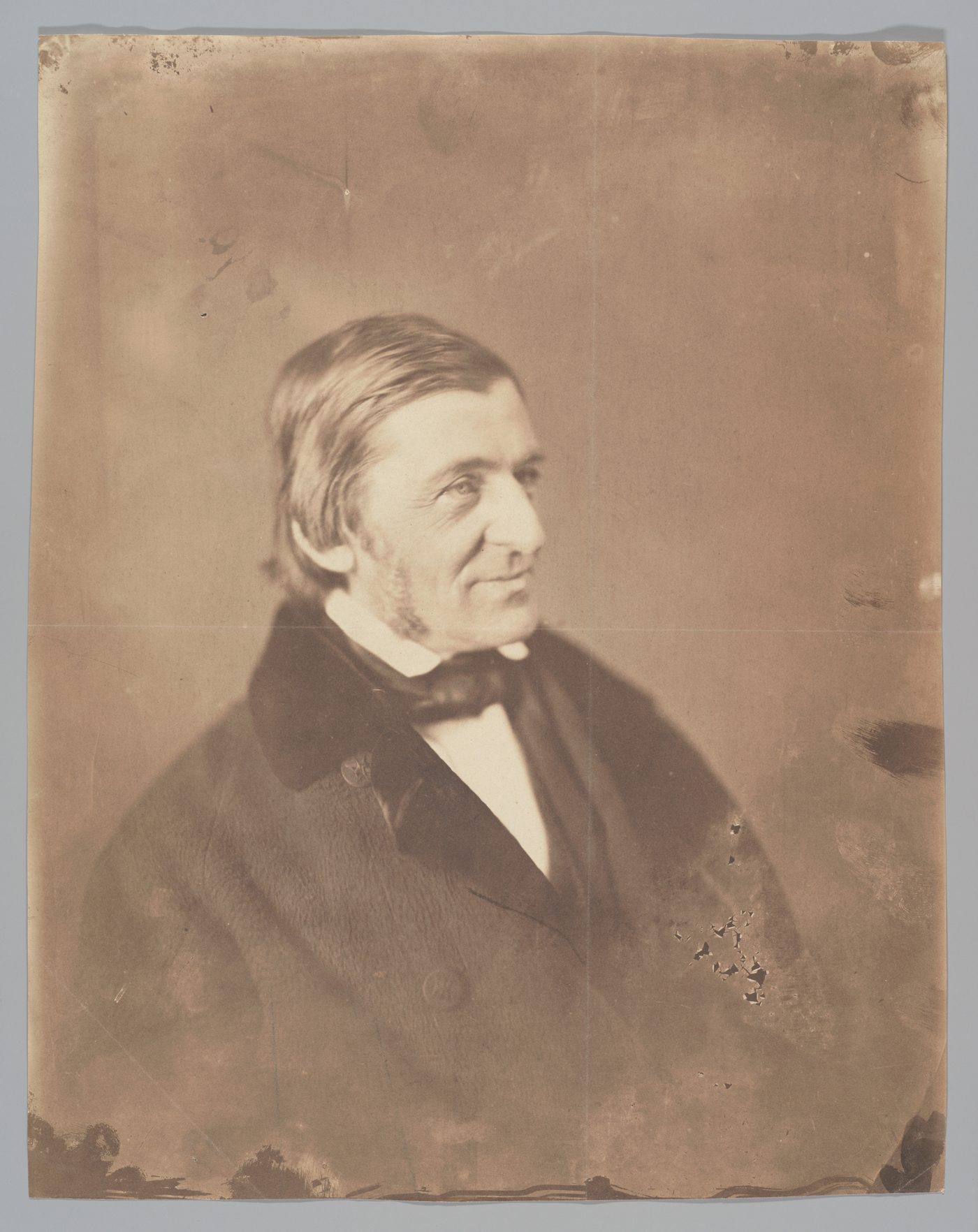
On August 31, 1837, Ralph Waldo Emerson rose before the Phi Beta Kappa Society at Cambridge, Massachusetts, to give the annual oration.5 He called it The American Scholar. Near the end he told the Harvard men in front of him something they did not expect to hear:
"We have listened too long to the courtly muses of Europe. The spirit of the American freeman is already suspected to be timid, imitative, tame."
Ralph Waldo Emerson, The American Scholar, August 31, 1837. 5
Oliver Wendell Holmes, writing his life of Emerson in 1885, put it this way: "This grand Oration was our intellectual Declaration of Independence."6 The phrase stuck because it fit. The political break with Britain had come in 1776. Emerson wanted the break in thought, taste and confidence to follow.
Self-Reliance (1841)
Emerson pressed the idea further in "Self-Reliance," published in his Essays of 1841. The essay is a string of hard sentences that readers have been underlining ever since. "Trust thyself: every heart vibrates to that iron string." "Whoso would be a man, must be a nonconformist." And the boldest one: "Nothing is at last sacred but the integrity of your own mind."7
Read carelessly, that last line sounds like permission to do whatever one likes. Emerson did not mean it that way. In the same paragraph that begins "Trust thyself," he tells the reader to "accept the place the divine providence has found for you, the society of your contemporaries, the connection of events."7 His target was conformity, the habit of borrowing opinions from the party, the pulpit or the newspaper because they are safe. He thought each soul had direct access to moral truth, and that a man who silenced his own conscience to please the crowd had given up the only thing that made him free.
This is where a reader who holds to ordered liberty has to be careful. The founders believed in conscience too. But they also believed conscience needs instruction from Scripture, from law and from the accumulated wisdom of a people, because the heart can deceive itself. Emerson's sovereign self has no such check. The essay's strength is its courage. Its weakness is that it gives the reader no way to tell the voice of conscience from the voice of appetite. A free people needs both the courage and the check.
Thoreau Goes to Jail
Emerson's friend and neighbor Henry David Thoreau tested the doctrine on his own body. On July 23, 1846, he was arrested and jailed in Concord for refusing to pay the Massachusetts poll tax. He had refused for six years, in protest against slavery. Someone paid the tax for him that night, and he walked out the next morning. He said he never knew who had paid.8 Out of that night came a lecture on the relation of the individual to the State, and in 1849 an essay called "Resistance to Civil Government." It is known today as "Civil Disobedience."8
The essay opens with a slogan Thoreau says he "heartily" accepts: "That government is best which governs least." He then pushes it to "That government is best which governs not at all," and adds that men will have such a government "when men are prepared for it."9 Readers who stop there miss his turn a page later:
"But, to speak practically and as a citizen, unlike those who call themselves no-government men, I ask for, not at once no government, but at once a better government. Let every man make known what kind of government would command his respect, and that will be one step toward obtaining it."
Henry David Thoreau, "Resistance to Civil Government," 1849. 9
Thoreau was no anarchist in practice. He wanted a government worth obeying, and he wanted each citizen to say plainly what that would look like. His complaint was against a government that upheld slavery and fought what he called "the present Mexican war," while comfortable men in Massachusetts voted, grumbled and paid. So he refused to pay and took the penalty. "Under a government which imprisons any unjustly," he wrote, "the true place for a just man is also a prison."9 He also said that "any man more right than his neighbors constitutes a majority of one already."9
Thoreau's method matters as much as his argument. He broke a law openly, in protest against a grave wrong, without violence, and he accepted the jail. That pattern, conscience plus accepted penalty, is the one Martin Luther King Jr. would cite more than a century later. It is a world away from mob action or private force.
Walden (1854)
Thoreau moved into a one-room cabin he had built at Walden Pond on July 4, 1845. He stayed two years, two months and two days, and Walden was published on August 9, 1854.8 The book is about economy in the old sense, the management of a life. "The mass of men lead lives of quiet desperation," he wrote near the start.10 His answer was to strip life down until he could see what it was for:
"I went to the woods because I wished to live deliberately, to front only the essential facts of life, and see if I could not learn what it had to teach, and not, when I came to die, discover that I had not lived."
Henry David Thoreau, Walden, 1854, "Where I Lived, and What I Lived For." 10
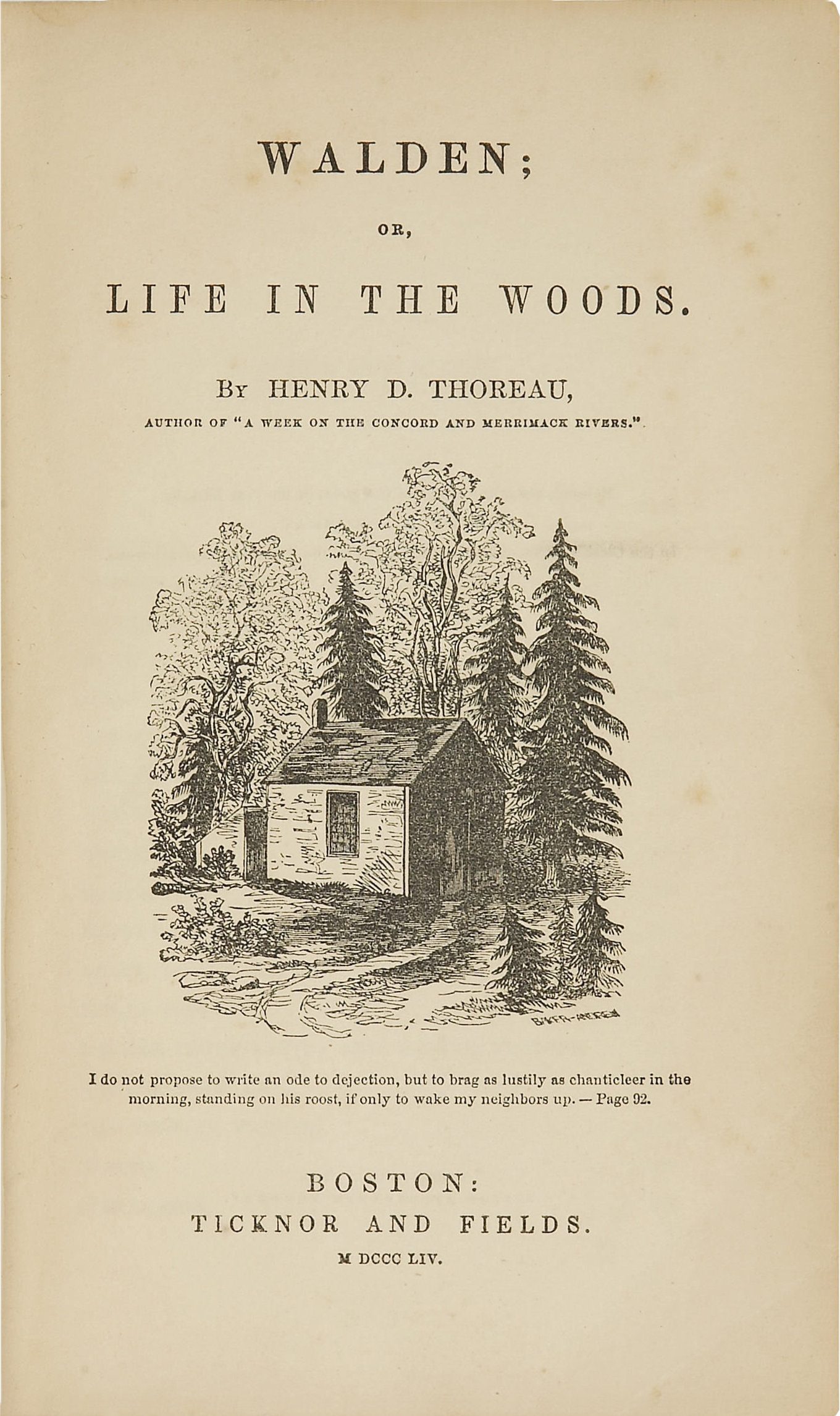
Near the end comes the line about the drummer: "If a man does not keep pace with his companions, perhaps it is because he hears a different drummer. Let him step to the music which he hears, however measured or far away."10 It is a gentler version of "Self-Reliance." Thoreau does not tell the drummer's listener to tear down the parade. He tells him to walk.
Hawthorne and the Hidden Sin
Nathaniel Hawthorne distrusted the optimism of his neighbors. Where Emerson saw a divine spark in every soul, Hawthorne saw secret guilt. The Scarlet Letter came out in Boston from Ticknor, Reed and Fields in 1850. The first printing was 2,500 copies, and it sold out in ten days.11
The novel is set in Puritan Boston in the 1640s. Hester Prynne, who has borne a child out of wedlock, is made to wear a scarlet A on her breast. She refuses to name the father. He is the young minister, Arthur Dimmesdale, who preaches holiness every Sunday and hides his sin for seven years while it eats him alive. Hester's punishment is public and cruel, yet she grows strong under it. Dimmesdale's concealment destroys him. Hawthorne's moral, which he states outright near the end, is about honesty before others: "Be true! Be true! Be true! Show freely to the world, if not your worst, yet some trait whereby the worst may be inferred!"12
Hawthorne wrote about his Puritan forebears with both respect and dread. A community that tries to enforce virtue by shame can become merciless. A man who hides his wrong behind a respectable office does more damage than the sinner who confesses. Both lessons apply to any free people that has to govern itself.
Melville and the Inexorable Self
Herman Melville's great book had a rough start. Richard Bentley published it in London as The Whale, in three volumes, on October 18, 1851. Harper and Brothers published the American edition, Moby-Dick; or, The Whale, on November 14, 1851, at $1.50 a copy. It flopped. Bentley ordered only 500 copies. Harper printed 2,915, and three years later the first American printing still had not sold out.13
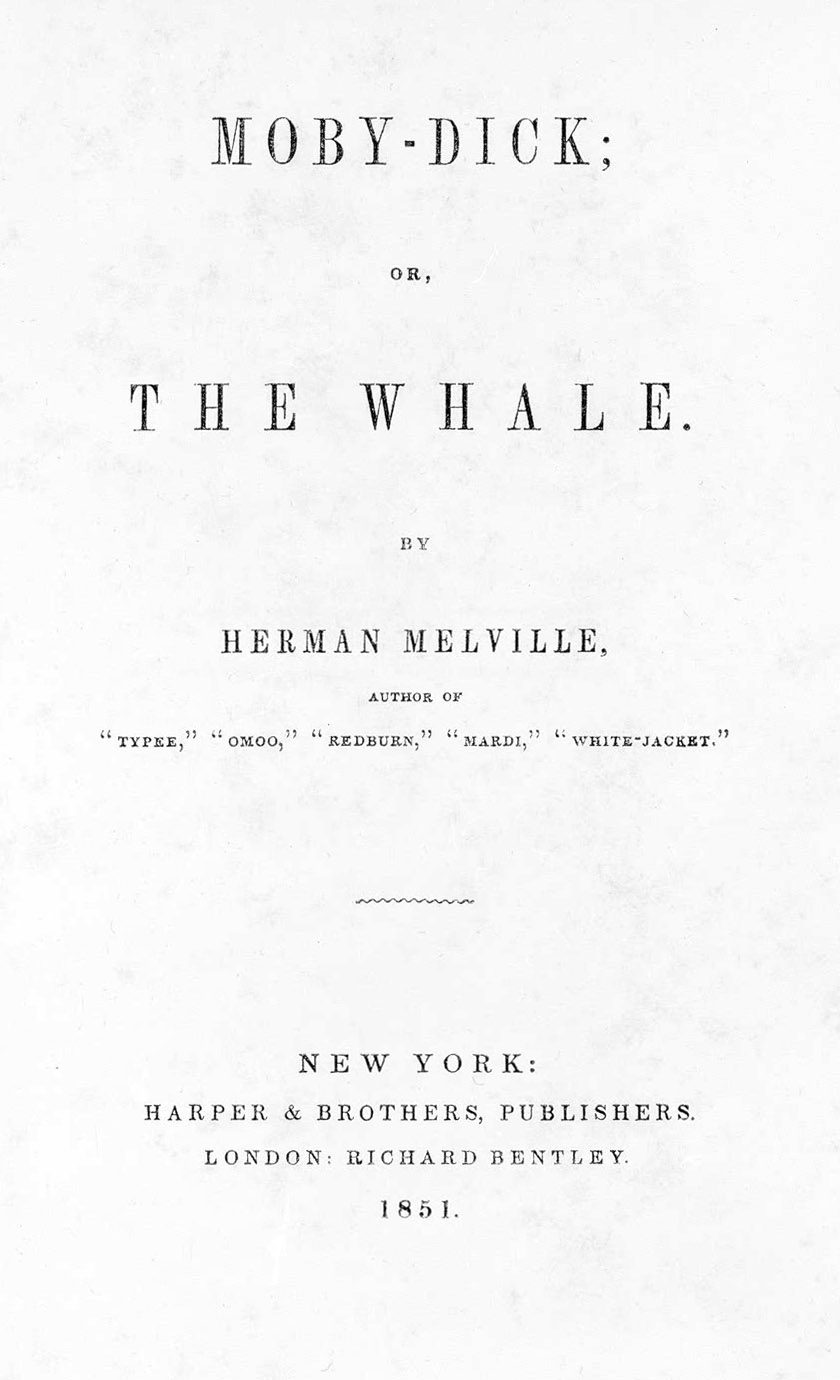
"Call me Ishmael," the book begins.14 Ishmael goes to sea and falls under the command of Captain Ahab, who has lost a leg to the white whale and means to kill it whatever the cost. Ahab is self-reliance gone mad. He trusts himself completely, and he drags his whole crew, save Ishmael, to their deaths for his private war. Melville admired the defiant spirit and feared it. Early in the book, the preacher Father Mapple gives a sermon in a New Bedford chapel that states the good form of that spirit:
"Delight is to him, a far, far upward, and inward delight, who against the proud gods and commodores of this earth, ever stands forth his own inexorable self... Delight is to him, who gives no quarter in the truth, and kills, burns, and destroys all sin though he pluck it out from under the robes of Senators and Judges."
Herman Melville, Moby-Dick, 1851, chapter 9, "The Sermon." 14
The next sentence in the sermon gives the condition: delight is to him "who acknowledges no law or lord, but the Lord his God, and is only a patriot to heaven."14 Mapple's defiance is anchored. He stands against senators and judges because he stands under God. Ahab stands under nothing. The whole novel turns on the difference between those two kinds of independence, and it is the same difference a citizen faces whenever he decides to resist those in power.
Poe Writes for the Poem's Sake
Edgar Allan Poe would have found this whole discussion tiresome. "The Raven" was accepted for the February 1845 issue of The American Review and may have been printed first in the New York Evening Mirror on January 29, 1845. Newspapers reprinted it within days.15 Its refrain, "Quoth the Raven, 'Nevermore,'" made Poe famous almost overnight.16
Poe mocked the Boston writers for loading poems with moral lessons. In "The Poetic Principle," a lecture printed after his death, he called the idea that a poem must teach "the heresy of The Didactic," and he added a jab: "We Americans especially have patronized this happy idea, and we Bostonians very especially have developed it in full." Against it he set "this poem written solely for the poem's sake."17
Poe belongs in a lesson on liberty for a reason he would not have liked. He shows that a free country does not owe its artists a political program. His stories of murder, guilt and dread, "The Tell-Tale Heart" and "The Fall of the House of Usher," take the inside of the human mind as their country. A free culture makes room for that kind of art too.
Longfellow and the Midnight Ride
Henry Wadsworth Longfellow, a pacifist and an abolitionist, was the poet American schoolrooms knew best. In April 1860, the day after a walking tour of Boston's North End, he began a poem about Paul Revere. It appeared in the Boston Evening Transcript and the Atlantic Monthly in December 1860, as the Union was coming apart.18 The opening is the most recited passage in American verse:
"Listen, my children, and you shall hear
Henry Wadsworth Longfellow, "Paul Revere's Ride," 1860. 19
Of the midnight ride of Paul Revere,
On the eighteenth of April, in Seventy-five;
Hardly a man is now alive
Who remembers that famous day and year."
Myth: Paul Revere rode alone, watched for the lanterns and carried the alarm to Concord
Longfellow's version is good poetry and poor history. Revere already knew the British route before he left Boston. The lanterns in the Old North Church were a backup signal for patriots in Charlestown, not a message Revere waited to see. He was one of two riders sent out of Boston and one of many who spread the alarm, and a British patrol captured him in Lincoln before he reached Concord.18 Longfellow, an abolitionist, was writing for 1860. He wanted a single hero and a single "cry of defiance and not of fear" that "the people" would hear again "in the hour of darkness and peril and need."19
The poem's last lines tell you why he bent the facts. The hoofbeats are borne "on the night-wind of the Past, / Through all our history, to the last."19 Longfellow used 1775 to call his own generation to stand together as the Union split apart.18
Whitman Sings Himself
In the summer of 1855 a Brooklyn printer named Andrew Rome, helped by his brother Tom, ran off 795 copies of a book called Leaves of Grass. Walt Whitman designed and published it himself. The title page carried no author's name. Twelve untitled poems ran across 85 pages, after a ten-page prose preface. Opposite the title was an engraving of a bearded young man in work clothes, shirt open at the neck, one hand on his hip.20
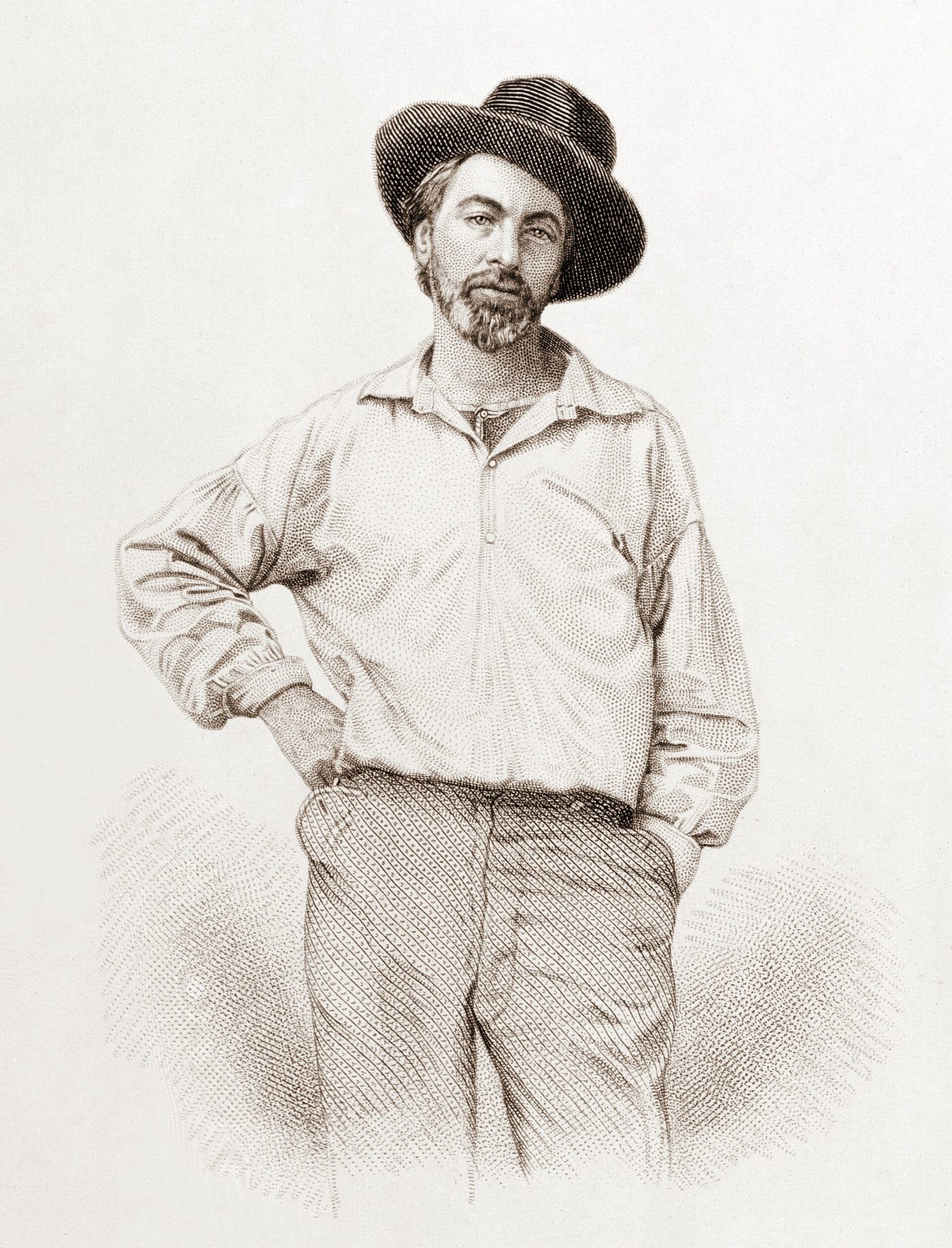
Whitman mailed a copy to Emerson. On July 21, 1855, Emerson wrote back that he found it "the most extraordinary piece of wit and wisdom that America has yet contributed," and he greeted the poet "at the beginning of a great career."21 Whitman printed the letter in the second edition of 1856.21
The long opening poem, later titled "Song of Myself," turns Emerson's self-reliance into a democratic creed. In its familiar later form it begins:
"I celebrate myself, and sing myself,
Walt Whitman, "Song of Myself," Leaves of Grass (final text, 1891-92). 22
And what I assume you shall assume,
For every atom belonging to me as good belongs to you."
The third line is the key. Whitman's self is large because it includes everybody: the slave and the slaveholder, the prostitute and the president, the farmer and the immigrant. Emerson's free man stood apart from the crowd. Whitman's free man contains the crowd. That idea of a single people made of equal persons would carry him into the army hospitals of Washington during the war, as the last lesson in this module shows.
Dickinson in the Locked Drawer
Emily Dickinson of Amherst, Massachusetts, wrote almost 1,800 poems. Only a handful were published in her lifetime.23 She was born in Amherst on December 10, 1830, and died there on May 15, 1886. Thomas Wentworth Higginson, one of the editors who brought her poems into print after her death, wrote that she had been persuaded "with great difficulty" to print "three or four poems" while she lived, and that her verse gained something "through the habit of freedom and the unconventional utterance of daring thoughts."24 Her freedom was that of a mind that answered to no audience at all.
"I'm nobody! Who are you?
Are you nobody, too?
Then there 's a pair of us, don't tell!
They 'd banish us, you know.How dreary to be somebody!
Emily Dickinson, as printed in Poems by Emily Dickinson, Three Series. 24
How public, like a frog
To tell your name the livelong day
To an admiring bog!"
Set that beside Whitman's "I celebrate myself" and you have the two poles of the age. Whitman shouted his name to the nation. Dickinson thought the shouting a little ridiculous. "The soul selects her own society, / Then shuts the door," she wrote in another poem.24 In a country that prized public speech, she guarded the private room where conscience does its work. That room is part of liberty too.
What the Writers Said About Liberty
- 1819-20 Washington Irving, The Sketch Book, with "Rip Van Winkle" and "The Legend of Sleepy Hollow."
- 1826 James Fenimore Cooper, The Last of the Mohicans (February 4).
- 1837 Emerson delivers The American Scholar at Cambridge (August 31).
- 1841 Emerson, Essays, with "Self-Reliance."
- 1845 Poe, "The Raven" (January). Thoreau moves to Walden Pond (July 4).
- 1846 Thoreau jailed for refusing the poll tax (July 23).
- 1849 Thoreau, "Resistance to Civil Government."
- 1850 Hawthorne, The Scarlet Letter.
- 1851 Melville, The Whale (London, October 18) and Moby-Dick (New York, November 14).
- 1854 Thoreau, Walden (August 9).
- 1855 Whitman, Leaves of Grass; Emerson's letter of July 21.
- 1860 Longfellow, "Paul Revere's Ride," in print in December.
- 1886 Emily Dickinson dies in Amherst (May 15). Nearly all her poems reach print only afterward.
Lay the books side by side and a pattern appears. Every one of these writers put the single person at the center: Rip waking up, Natty in the woods, Emerson's nonconformist, Thoreau in his cell, Hester under her letter, Ahab on his quarterdeck, Whitman's "myself," Dickinson's "nobody." That focus on the individual was new in literature, and it came straight out of the Revolution's claim that rights belong to persons, not to classes or crowns.
They split on what keeps the individual from becoming a tyrant over others. Emerson trusted the inner voice almost without limit. Thoreau trusted it but bound himself to nonviolence and the open acceptance of punishment. Hawthorne and Melville, the darker pair, thought the self needed a law above it. Father Mapple's preacher stands against senators only because he is "a patriot to heaven," and Ahab, who has no such anchor, wrecks his ship. That is close to what the founders believed. Liberty is the right to follow conscience, and conscience is answerable to God and to just law.
And there was the matter none of them could escape. Slavery made the talk of self-reliance sound hollow to millions of people who could not own their own bodies. Thoreau went to jail over it. Whitman wrote into "Song of Myself" the lines "The runaway slave came to my house and stopt outside."22 The writers who answered slavery most directly, though, were the formerly enslaved themselves, and their books are the subject of the lesson on slavery, abolition and the arts. The songs Americans sang in these same years are in the lesson on music of the people, and the painters who were teaching Americans to see their country are in the Hudson River School.
Learn more
- Washington Irving, The Sketch-Book: "Rip Van Winkle" takes half an hour and is funnier than its reputation.
- Emerson, The American Scholar (in Miscellanies): the full 1837 oration that Holmes called our intellectual declaration of independence.
- Emerson, Essays: First Series: read "Self-Reliance" whole, including the passages about providence that quote collections leave out.
- Thoreau, Walden and On the Duty of Civil Disobedience: the essay is short; read it before reading anyone's summary of it.
- Mass Moments: Henry David Thoreau Spends Night in Jail: the facts of July 23, 1846, from Mass Humanities.
- Smithsonian: The Origins and Early Criticism of Moby-Dick: how the 1851 reviewers and buyers received the book.
- National Park Service: Paul Revere's Ride: what Longfellow wrote, why, and what he got wrong.
- Walt Whitman Archive: Leaves of Grass, 1855 edition: the printing, the engraving and the surviving copies, from the scholars who know the book best.
- Poems by Emily Dickinson, Three Series: the early printed texts, with their editors' titles and changes.
Notes
- Washington Irving, "Rip Van Winkle," in The Sketch-Book of Geoffrey Crayon, Gent. (1819-1820), Project Gutenberg eBook 2048. Read it online. ↩
- "The Sketch Book," Encyclopaedia Britannica. Read it online. ↩
- Albertis del Orient Browere, Rip Van Winkle, 1833, oil on canvas, Metropolitan Museum of Art, object 17465, gift of Mr. and Mrs. S. Richard Krown and family, 2002. Read it online. ↩
- "The Last of the Mohicans Is Published," This Day in History, February 4, History.com. Read it online. ↩
- Ralph Waldo Emerson, The American Scholar: An Oration Delivered before the Phi Beta Kappa Society, at Cambridge, August 31, 1837, in Miscellanies, Project Gutenberg eBook 71683. Read it online. ↩
- Oliver Wendell Holmes, Ralph Waldo Emerson (Boston: Houghton, Mifflin, 1885), chapter 4, Project Gutenberg eBook 12700. Read it online. ↩
- Ralph Waldo Emerson, "Self-Reliance," in Essays: First Series (1841), Project Gutenberg eBook 2944. Read it online. ↩
- "July 23, 1846: Henry David Thoreau Spends Night in Jail," Mass Moments, Mass Humanities. Read it online. ↩
- Henry David Thoreau, "Resistance to Civil Government" (1849), printed as "On the Duty of Civil Disobedience" in Walden, and On the Duty of Civil Disobedience, Project Gutenberg eBook 205. Read it online. ↩
- Henry David Thoreau, Walden; or, Life in the Woods (Boston: Ticknor and Fields, 1854), chapters "Economy," "Where I Lived, and What I Lived For" and "Conclusion," Project Gutenberg eBook 205. Read it online. ↩
- "Special Collections: The Scarlet Letter," Maryland State Law Library. Read it online. ↩
- Nathaniel Hawthorne, The Scarlet Letter (Boston: Ticknor, Reed and Fields, 1850), chapters 2 and 24, Project Gutenberg eBook 25344. Read it online. ↩
- Eli Wizevich, "Discover the Origins and Early Criticism of Herman Melville's Great American Novel, Moby-Dick," Smithsonian, November 14, 2024. Read it online. ↩
- Herman Melville, Moby-Dick; or, The Whale (New York: Harper and Brothers, 1851), chapter 1, "Loomings," and chapter 9, "The Sermon," Project Gutenberg eBook 2701. Read it online. ↩
- Amber Paranick, "Edgar Allan Poe and 'The Raven,'" From the Catbird Seat (Library of Congress blog), January 19, 2015. Read it online. ↩
- Edgar Allan Poe, "The Raven" (1845), Project Gutenberg eBook 1065. Read it online. ↩
- Edgar Allan Poe, "The Poetic Principle" (1850), in The Works of Edgar Allan Poe, Raven Edition, vol. 5, Project Gutenberg eBook 2151. Read it online. ↩
- "Paul Revere's Ride," Longfellow House-Washington's Headquarters National Historic Site, National Park Service. Read it online. ↩
- Henry Wadsworth Longfellow, "Paul Revere's Ride," in Tales of a Wayside Inn (1863), as "The Landlord's Tale," in The Complete Poetical Works of Henry Wadsworth Longfellow, Project Gutenberg eBook 1365. Read it online. ↩
- Ivan Marki, supplemented by Ed Folsom, "Leaves of Grass, 1855 edition," Walt Whitman Archive. Read it online. ↩
- Ralph Waldo Emerson to Walt Whitman, Concord, July 21, 1855, transcription at George Mason University. Read it online. See also Marki and Folsom, note 20. ↩
- Walt Whitman, "Song of Myself," section 1, in Leaves of Grass, Project Gutenberg eBook 1322 (text of the 1891-92 edition). The 1855 text was untitled and differs in its first line. Read it online. ↩
- "Emily Dickinson exhibition," press release, The Morgan Library and Museum, 2016. Read it online. ↩
- Emily Dickinson, "I'm nobody! Who are you?" and "The soul selects her own society," in Poems by Emily Dickinson, Three Series, Complete, ed. Mabel Loomis Todd and T. W. Higginson, with Higginson's preface to the first series, Project Gutenberg eBook 12242. Read it online. ↩
Terms in this lesson
- Transcendentalism
- A New England movement of the 1830s to 1850s, led by Emerson, that held that every person can know truth directly through intuition and conscience, without depending on church, party or tradition.
- Self-reliance
- Emerson's idea that a person should trust his own judgment and conscience rather than conform to custom or public opinion.
- Civil disobedience
- Open, peaceful refusal to obey a law one believes unjust, while accepting the penalty. The phrase became attached to Thoreau's 1849 essay after his death.
- Poll tax
- A flat tax charged per person rather than on property or income. Thoreau's refusal to pay the Massachusetts poll tax led to his night in jail in 1846.
- Romance
- In Hawthorne's use, a work of fiction that claims freedom to mix the real and the imagined in order to reach moral truth, as opposed to a strictly realistic novel.
- Free verse
- Poetry without a regular pattern of meter or rhyme. Whitman's 1855 Leaves of Grass made it famous in America.
- The didactic heresy
- Poe's name for the belief that the purpose of a poem is to teach a moral lesson. He held that a poem should be written for its own sake.
Sources
- Washington Irving, The Sketch-Book of Geoffrey Crayon (Project Gutenberg) checked 2026-10
- Ralph Waldo Emerson, Miscellanies, including The American Scholar (Project Gutenberg) checked 2026-10
- Ralph Waldo Emerson, Essays: First Series, including Self-Reliance (Project Gutenberg) checked 2026-10
- Henry David Thoreau, Walden, and On the Duty of Civil Disobedience (Project Gutenberg) checked 2026-10
- Nathaniel Hawthorne, The Scarlet Letter (Project Gutenberg) checked 2026-10
- Herman Melville, Moby Dick; Or, The Whale (Project Gutenberg) checked 2026-10
- Edgar Allan Poe, The Works of Edgar Allan Poe, vol. 5, including The Poetic Principle (Project Gutenberg) checked 2026-10
- Paul Revere's Ride (Longfellow House-Washington's Headquarters, National Park Service) checked 2026-10
- Leaves of Grass, 1855 edition (Walt Whitman Archive) checked 2026-10
- Walt Whitman, Leaves of Grass (Project Gutenberg) checked 2026-10
- Poems by Emily Dickinson, Three Series, Complete (Project Gutenberg) checked 2026-10
- Oliver Wendell Holmes, Ralph Waldo Emerson (Project Gutenberg) checked 2026-10