Lesson 11 of 12 · about 15 minutes
Battle Hymn of the Republic
You'll be able to
- Trace the tune from the camp-meeting hymn to "John Brown's Body" to the Battle Hymn
- Tell how and when Howe wrote the poem and where it first appeared in print
- Compare lines of the hymn with Isaiah 63, Revelation 14 and 19, and Genesis 3:15
- Describe Lincoln's reaction when Chaplain McCabe sang it in 1864
- Compare the hymn's view of the war as judgment with Lincoln's Second Inaugural
Julia Ward Howe woke in the gray before dawn in a Washington hotel in November 1861 and found the words already lined up in her head. She was forty-two. She remembered an old stump of a pen from the day before, groped for it in the dark, and scrawled the verses almost without looking at the paper.1 Then she went back to sleep. "I like this better than most things that I have written," she told herself.1
Within three years the poem was sung in the House chamber with the President of the United States shouting for more. Martin Luther King Jr. ended his last speech in Memphis with its first line. Its first readers got it in a magazine, and the author was paid five dollars.
A Camp-Meeting Tune and a Dead Abolitionist
The melody is older than the war and older than the song it is usually attached to. It began as a Southern camp-meeting hymn, "Say, Brothers, Will You Meet Us," first published in an 1807 Virginia hymnbook.2 A Philadelphian named William Steffe later claimed he wrote the tune in the mid-1850s, but he offered no evidence, and the tune was in print half a century before that.23
John Brown was hanged at Charles Town, Virginia, on December 2, 1859, after the raid on Harpers Ferry.4 In 1861 soldiers of a Massachusetts militia battalion at Fort Warren, in Boston Harbor, sang the old hymn tune while they worked, and one of the singers was a Scottish immigrant also named John Brown.52 The others teased him about sharing a name with the dead abolitionist. The Park Service tells it as a barracks joke: one soldier announced, "John Brown's dead," and another answered to the hymn tune, "But his soul goes marching on."5 The song was reportedly first sung at Fort Warren on May 12, 1861. Its first known printing, copyrighted on July 16, 1861 by C. S. Hall of Charlestown, Massachusetts, is labelled "Origin, Fort Warren."3 Some of the battalion's men joined the 12th Massachusetts, which sang the song in public at a parade in Boston days before it left for the front in July 1861.5
Not all the soldiers' verses were about Brown. Some called for hanging Jefferson Davis.6 Howe, for her part, had often wished to write words for the tune, and Gamble says she heard soldiers singing "John Brown's Body" at camps near Washington on that trip.17
Washington, November 1861
Howe came to Washington in November 1861 with a party of Bostonians that included the Rev. James Freeman Clarke and Massachusetts Governor John Andrew. They wanted to see the progress of the war and the work of the Sanitary Commission. They stayed at the Willard Hotel, visited Congress and the White House, and met President Lincoln.7
On Monday, November 18, the group got military passes to see a review of General Irvin McDowell's division, some 10,000 men, in Northern Virginia. The review broke off when messengers brought word of a skirmish nearby, and the carriages crawled back toward the city through crowded roads. The party passed the time singing army songs, and the soldiers who heard "John Brown's body lies a-mouldering in the ground" answered, "Good for you!"1 Clarke asked her, "Mrs. Howe, why do you not write some good words for that stirring tune?"1 She said she had often wished to, but had found nothing in her mind leading toward it.1
She went to bed. By her own account she woke in the gray of the morning twilight with the lines forming in her mind, got up, and scrawled them down.1 Gamble adds that she used a sheet of Sanitary Commission stationery, and that the surviving manuscript has six stanzas.7 Sources differ by a day on when. Gamble puts the review on Monday, November 18, and the writing on the next morning. Alexandra Socarides dates the writing to the early morning hours of November 18.76 Howe's own account gives no date. The grand review of the Army of the Potomac for Lincoln came on Wednesday, November 20, after the poem was written, and Gamble has Howe attending it afterward.7
The Atlantic Monthly, February 1862
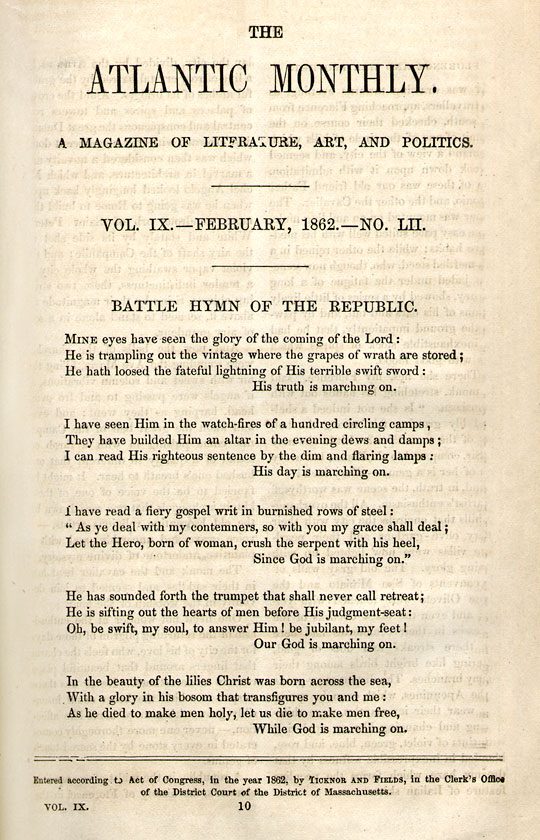
Howe took the poem to Boston. James T. Fields, the editor of The Atlantic Monthly, ran it on the front page of the February 1862 issue and is credited with the title.8 She was paid five dollars. The American Battlefield Trust, Alexandra Socarides and Historic Boston all give that figure.869
The magazine printed five stanzas, each ending in its own refrain line. Howe's first manuscript carries a sixth stanza that ends "So the world shall be his footstool, and the soul of Time his slave," and the magazine did not print it.1 Here is the version Atlantic readers saw.
Mine eyes have seen the glory of the coming of the Lord:
He is trampling out the vintage where the grapes of wrath are stored;
He hath loosed the fateful lightning of His terrible swift sword:
His truth is marching on.I have seen Him in the watch-fires of a hundred circling camps;
They have builded Him an altar in the evening dews and damps;
I can read His righteous sentence by the dim and flaring lamps:
His day is marching on.I have read a fiery gospel writ in burnished rows of steel:
"As ye deal with my contemners, so with you my grace shall deal;
Let this Hero, born of woman, crush the serpent with his heel,
Since God is marching on."He has sounded forth the trumpet that shall never call retreat;
He is sifting out the hearts of men before His judgment-seat:
Oh, be swift, my soul, to answer Him! be jubilant, my feet!
Our God is marching on.In the beauty of the lilies Christ was born across the sea,
Julia Ward Howe, "Battle Hymn of the Republic," The Atlantic Monthly, vol. 9, no. 52 (February 1862), as transcribed in the Project Gutenberg edition. 10
With a glory in his bosom that transfigures you and me:
As he died to make men holy, let us die to make men free,
While God is marching on.
- 1807 The "Say, Brothers" camp-meeting hymn appears in a Virginia hymnbook.2
- Dec 2, 1859 John Brown is hanged at Charles Town, Virginia.4
- May 12, 1861 "John Brown's Body" is reportedly first sung at Fort Warren.3
- Nov 18, 1861 Howe attends a review near Washington; by Gamble's account she writes the hymn before dawn the next morning.7
- Feb 1862 The Atlantic Monthly prints it.10
- Jul 6, 1863 Prisoners in Libby Prison sing it after news of Gettysburg.7
- Early Feb 1864 Lincoln hears McCabe sing it in the House chamber and shouts, "Sing it again!"7
- Apr 3, 1968 Martin Luther King Jr. ends his last speech with its first line.11
Where the Words Come From
The hymn's imagery echoes the King James Bible. These are the passages its best-known lines most closely resemble.
| Hymn | Scripture |
|---|---|
| "He is trampling out the vintage where the grapes of wrath are stored" | Revelation 14:19: the angel "cast it into the great winepress of the wrath of God."12 Isaiah 63:3: "I have trodden the winepress alone."13 |
| "the fateful lightning of His terrible swift sword" | Revelation 19:15: "out of his mouth goeth a sharp sword." In the same verse he "treadeth the winepress of the fierceness and wrath of Almighty God."14 |
| "Let this Hero, born of woman, crush the serpent with his heel" | Many readers hear Genesis 3:15 here, the promise that the woman's seed would bruise the serpent: "it shall bruise thy head, and thou shalt bruise his heel." That is an interpretation. Howe did not say the line refers to this verse.15 |
Isaiah's winepress belongs to a conqueror coming up from Edom with garments stained red. Revelation 14 sets a harvest of the earth and a winepress "trodden without the city," with blood to the horse bridles. Revelation 19 makes the rider on the white horse Faithful and True, who in righteousness "doth judge and make war."14 The hymn's second stanza moves from those pictures to the camps, "a hundred circling camps," where "They have builded Him an altar in the evening dews and damps."
The last stanza turns from judgment to Christ and from the battlefield to the singer: "As he died to make men holy, let us die to make men free."
Where readers disagree
Readers have taken the hymn in more than one way. Richard Gamble calls it an embodiment of the North's religious nationalism, a poem in which war, nation and faith fused.7 Alexandra Socarides describes it as presenting "a large and angry God causing mass destruction and death in the South," and writes that "it might seem strange that a Transcendentalist woman wrote it."6
Lincoln also spoke of divine judgment in the war. In the Second Inaugural, on March 4, 1865, he said that if God willed the war to continue "until all the wealth piled by the bondsman's two hundred and fifty years of unrequited toil shall be sunk, and until every drop of blood drawn with the lash shall be paid by another drawn with the sword," then "the judgments of the Lord are true and righteous altogether."16 He also said God "gives to both North and South this terrible war as the woe due to those by whom the offense came."16 Socarides reads the hymn as judgment on the South. Lincoln's speech names both North and South.
The Singing Chaplain and the President
The hymn spread by singing. Charles C. McCabe, a Methodist chaplain of the 122nd Ohio Infantry, was captured by Confederates and held in Libby Prison in Richmond. On July 6, 1863, word of the victory at Gettysburg reached the prisoners and they broke into song. McCabe led them in Howe's words, which he had clipped from The Atlantic Monthly and memorized, and the prisoners joined him in the chorus, "Glory, glory, hallelujah!"7
In early February 1864 the United States Christian Commission marked its second anniversary in the House chamber. Lincoln arrived late and, as Gamble tells it, had missed the opening prayer and Vice President Hamlin's opening remarks. McCabe told his Libby Prison story and sang the hymn as a duet with an army colonel just released from Libby, asking the crowd to join the chorus with a regimental brass band behind them. In Gamble's account Lincoln shouted, "Sing it again!" and Hamlin announced that McCabe would repeat it.7 Before repeating it, McCabe passed on a message from a fellow Libby prisoner, "Tell the President not to back down an inch," and Lincoln answered, "I won't back down."7 The press reported that "there were few dry eyes in the hall."7 McCabe, then twenty-seven, wrote to his wife that night that during the speeches of two pastors he had seen tears roll down the "rugged cheeks" of the President.7
After the War
A wood engraving in the Library of Congress shows the Fifty-fifth Massachusetts, a Black regiment, singing "John Brown's March" in the streets of Charleston on February 21, 1865.17 On May 1, 1865, freed people held a ceremony at the Charleston race course, where Union prisoners of war had died, and nearly 260 of the dead had been reburied. Historians believe it included a parade of as many as 10,000 people, among them 3,000 Black schoolchildren singing "John Brown's Body."18 Historians debate whether this ceremony was the direct source of the later Decoration Day.18
Howe spent the rest of her life on the lecture circuit, where the Battle Hymn became her tag line. After her husband died in 1876 she needed to stay busy to support herself.7 She joined Lucy Stone in founding the American Woman Suffrage Association, helped establish its paper, the Woman's Journal, which she edited for twenty years, and in 1908 became the first woman elected to the American Academy of Arts and Letters.19 She died on October 17, 1910, at ninety-one.8
The hymn outlived her. Gamble writes that during World War I it was widely sung and nearly named the American national anthem.7 On April 3, 1968, the night before he was killed, Martin Luther King Jr. finished his last speech in Memphis with the hymn's first line: "Mine eyes have seen the glory of the coming of the Lord."11
The tune had other lives on both sides of the war. Lesson 12 turns to Confederate songs and the way each side borrowed tunes. Lesson 9 sets the hymn among the war's other art, and Lesson 10 covers "The Star-Spangled Banner."
Learn more
- The Atlantic Monthly, February 1862: the issue itself, with the hymn on the first page
- Representative Poetry Online: Battle Hymn: Howe's first manuscript beside the printed text, with her own account of writing it
- Let Us Die to Make Men Free: an article on the writing and on McCabe and Lincoln
- The Poems (We Think) We Know: a literary reading of the hymn and its tune
- Lincoln, Second Inaugural Address: four paragraphs that read the same war as national judgment
- American Battlefield Trust: The Battle Hymn: a short account and a common text of the hymn
Notes
- "Battle Hymn of the Republic," Representative Poetry Online, University of Toronto Libraries, giving Howe's first manuscript and her account from Reminiscences, 1819 to 1899 (Boston: Houghton, Mifflin, 1899), pp. 273 to 275. Read it online. ↩
- "The Song That Marches On: History of the Battle Hymn of the Republic," HistoryNet, on the camp-meeting origin of "Say, Brothers, Will You Meet Us" in an 1807 Virginia hymnbook, Steffe's unsupported claim, and the Scottish immigrant John Brown at Fort Warren. Read it online. ↩
- Roger L. Hall, "The Story of the John Brown Song," Center for American Music Preservation, quoting Irwin Silber, James J. Fuld and Boyd Stutler, on the reported first singing at Fort Warren on May 12, 1861, the first printing copyrighted July 16, 1861, and Steffe's claim. A secondary account that relays older research; the May 12 date is reported, not documented here. Read it online. ↩
- National Park Service, "John Brown," on his hanging at Charles Town on December 2, 1859. Read it online. ↩
- National Park Service, Boston Harbor Islands, "The John Brown Song (John Brown's Body)," citing Jay Schmidt, Fort Warren: New England's Most Historic Civil War Site (2003), and Benjamin Cook, The History of the Twelfth Massachusetts Volunteers (Webster Regiment) (1882). Read it online. ↩
- Alexandra Socarides, "The Poems (We Think) We Know: 'Battle Hymn of the Republic,'" Los Angeles Review of Books, November 11, 2013, on the $5 fee, the date of writing (early morning of November 18, 1861), the stanzas of "John Brown's Body" calling for the hanging of Jefferson Davis, and the poem's theology. Read it online. ↩
- Richard M. Gamble, "Let Us Die to Make Men Free," American Heritage 64, no. 3 (summer 2019), on the Willard Hotel, the review of November 18, the writing on Sanitary Commission stationery, the grand review that followed, McCabe and Libby Prison, Lincoln in the House chamber, Howe's lecturing after 1876, and the hymn in World War I. Read it online. ↩
- American Battlefield Trust, "Civil War Music: The Battle Hymn of the Republic," on Fields and the title, the $5 fee, the lyrics and Howe's death on October 17, 1910. Read it online. ↩
- Historic Boston Inc., "An Anthem for Five Dollars: Julia Ward Howe's Battle Hymn and the Old Corner Bookstore," on the five-dollar payment. Read it online. ↩
- The Atlantic Monthly, vol. 9, no. 52 (February 1862), the opening page, Project Gutenberg eBook 12066. Read it online. ↩
- Martin Luther King Jr., "I've Been to the Mountaintop," delivered April 3, 1968, Mason Temple, Memphis, AFSCME transcript. Read it online. ↩
- King James Version, Revelation 14:14 to 20 (harvest of the earth, winepress "without the city"). Read it online. ↩
- King James Version, Isaiah 63:1 to 6 (the winepress "alone," garments stained red). Read it online. ↩
- King James Version, Revelation 19:11 to 16 (the rider Faithful and True, the sharp sword, the winepress). Read it online. ↩
- King James Version, Genesis 3:15. The identification of the hymn's "serpent" line with this verse is an interpretation by readers and the editor and is not a claim found in Howe's own account. Read it online. ↩
- Abraham Lincoln, Second Inaugural Address, March 4, 1865, Avalon Project, Yale Law School. Read it online. ↩
- "Marching on!" The Fifty-fifth Massachusetts Colored Regiment singing John Brown's March in the streets of Charleston, February 21, 1865, wood engraving, Library of Congress Prints and Photographs Division. Read it online. ↩
- Amanda Kerr, "Memorial Day Uncovered: Charleston's 'Martyrs of the Race Course,'" College of Charleston, May 29, 2017, on the May 1, 1865 ceremony, the reburial of nearly 260 Union dead and the historians' debate. Read it online. ↩
- National Women's History Museum, "Julia Ward Howe," on the American Woman Suffrage Association, the Woman's Journal and the American Academy of Arts and Letters in 1908. Read it online. ↩
Terms in this lesson
- Camp meeting
- An outdoor revival that drew families for days of preaching and singing, common in the early 1800s. The tune of the Battle Hymn came out of this tradition.
- Sanitary Commission
- The United States Sanitary Commission, a civilian group that raised money and supplies for the care of Union soldiers. Howe's party went to Washington in 1861 partly to see its work.
- Winepress
- The vat in which grapes were trodden for wine. Isaiah and Revelation use it as a picture of God's judgment, and the Battle Hymn borrows the picture.
- Contemners
- An old word for those who treat something with scorn. In the hymn, God speaks of those who contemn him.
- Libby Prison
- A Confederate prison for Union officers in Richmond, Virginia, where Chaplain Charles McCabe was held in 1863.
- Christian Commission
- The United States Christian Commission, founded by the YMCA in November 1861 to supply Bibles, books, chaplains and relief to Union troops.
Sources
- The Atlantic Monthly, Volume 09, No. 52, February 1862, Project Gutenberg checked 2026-10
- Representative Poetry Online, Battle Hymn of the Republic, with Howe's Reminiscences checked 2026-10
- Richard M. Gamble, Let Us Die to Make Men Free, American Heritage checked 2026-10
- Alexandra Socarides, The Poems (We Think) We Know, Los Angeles Review of Books, 2013 checked 2026-10
- American Battlefield Trust, Civil War Music: The Battle Hymn of the Republic checked 2026-10
- Abraham Lincoln, Second Inaugural Address, Avalon Project checked 2026-10
- Martin Luther King Jr., I've Been to the Mountaintop, April 3, 1968, AFSCME transcript checked 2026-10
- National Women's History Museum, Julia Ward Howe checked 2026-10
- HistoryNet, The Song That Marches On checked 2026-10
- National Park Service, The John Brown Song, Boston Harbor Islands checked 2026-10
- Historic Boston, An Anthem for Five Dollars checked 2026-10