Lesson 7 of 12 · about 24 minutes
Music of the People
You'll be able to
- Describe how singing schools, Lowell Mason's reforms and shape-note books such as The Sacred Harp (1844) taught a nation to sing in parts
- Explain what the spirituals were, what Frederick Douglass said they meant, and which claims about coded songs hold up and which do not
- State plainly what blackface minstrelsy was, why it was so popular, and how Stephen Foster's career was tied to it
- Trace how the music business worked before recordings: sheet music, publishers, pirated editions and royalties
In August 1801, somewhere between 10,000 and 30,000 people came to a log meetinghouse at Cane Ridge, in Bourbon County, Kentucky. The best guess is about 20,000. The gathering was supposed to be a Presbyterian communion. It turned into six days of preaching from eighteen or twenty ministers at once, scattered across the clearing, with people falling to the ground in distress and in joy.1 One minister, James Campbell, remembered the noise: "Some singing, some shouting, clapping their hands, hugging and even kissing, laughing."1
Singing came first in that list. In the young republic, music was something nearly everyone made with their own voices. There were no recordings and few concert halls. People sang in church, at revivals, in fields, on riverboats, around the parlor piano and in the theater. What they sang tells us who they were, what they believed and what they could not yet face about themselves.
Singing Schools and Lowell Mason
The habit started in New England. In the late 1700s, singing schools sprang up to teach ordinary church members to read music and sing in parts, after a long stretch in which Puritan congregational singing had grown slow and ragged.2 The singing masters of that era, William Billings above all, appear in the lesson on songs of the Revolution.
In the 1820s a church musician from Medfield, Massachusetts, named Lowell Mason set out to make American church music more polished and more European in style. He published The Handel and Haydn Society's Collection of Church Music in 1822, without his name on the first edition. He founded the Boston Academy of Music in 1832. And in 1838 he started what Britannica calls "the first public-school music program in the United States," in Boston.3 Between 1829 and 1869 he put out about twenty more hymn collections. Americans still sing his tunes for "Nearer, My God, to Thee" and "My Faith Looks Up to Thee."3
Mason's reforms won the cities. The countryside went another way.
Shape Notes and The Sacred Harp
In 1801 two singing masters, William Little and William Smith, published The Easy Instructor, which printed each note of the scale with a different shaped head. A singer who could not read a staff could learn four shapes for the four syllables fa, sol, la and mi, and find the pitch by the shape.4 The system spread west and south with the singing masters, through books like William Walker's Southern Harmony of 1835.5
In 1844 Benjamin Franklin White of Hamilton, Georgia, and Elisha J. King of Talbotton published The Sacred Harp.4 It was printed in Philadelphia, and King died the same year.2 The book has never gone out of use. It was revised in 1902, 1911, 1936 and 1991, and an African American edition, The Colored Sacred Harp, was compiled by Judge Jackson of Ozark, Alabama, in the 1930s.45
A Sacred Harp singing still looks the way it did. The singers sit in a "hollow square," four sections of tenor, bass, treble and alto facing one another across an open center.4 A volunteer steps into the middle to lead a song or two, and then another takes a turn.2 Nobody performs for an audience, because there is no audience. Everybody sings. It is about as democratic a form of music as exists, and it was made by country people who had no use for anyone's permission.
Camp Meeting Songs
Cane Ridge set a pattern. Through the first half of the century, camp meetings that lasted for days became part of American religious life, with families living in tents around a preaching ground. Many worshipers could not read, and hymnbooks were few, so the singing leaned on refrains a whole crowd could pick up after one hearing.
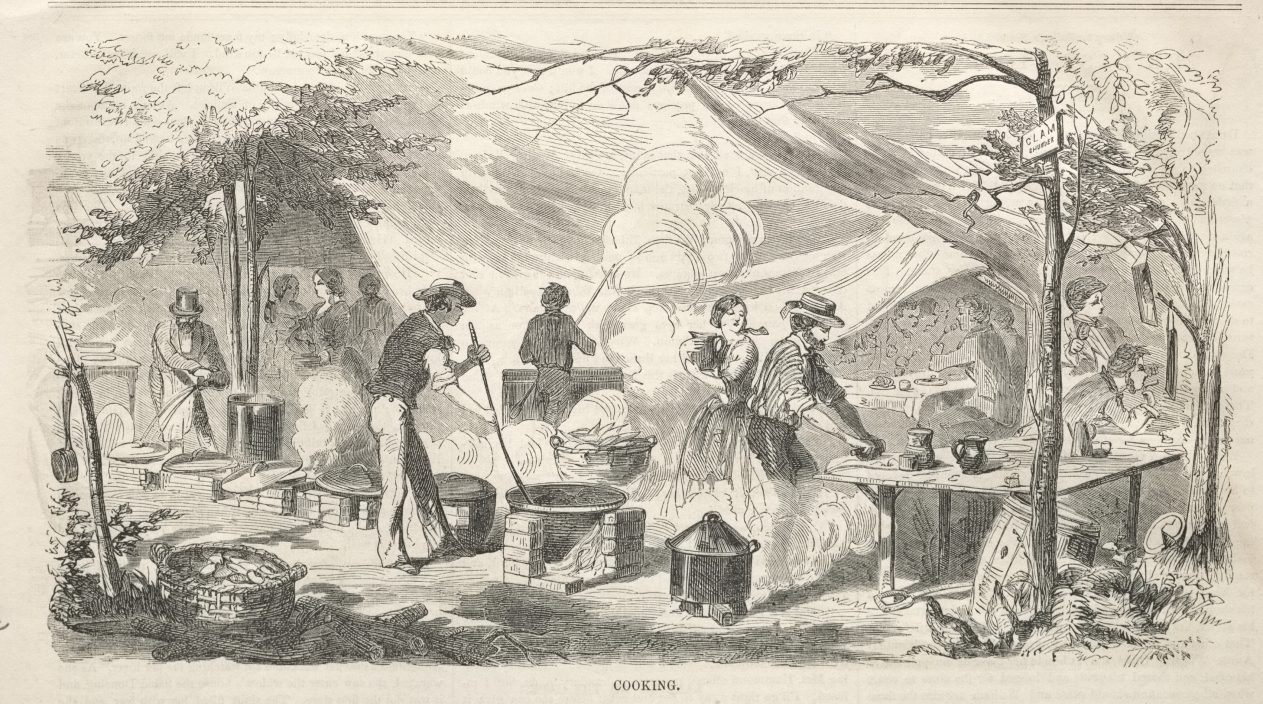
Black Christians had their own tradition alongside. In 1801, the same year as Cane Ridge, Richard Allen of Philadelphia published A Collection of Spiritual Songs and Hymns for his Bethel congregation. Hymnary.org calls it "the first hymnal published for Blacks," and the first hymnal to print refrains or choruses that could be sung with any hymn, the same habit that made camp meeting singing work.7 Allen's church broke from white Methodist control, and in 1816 it became the mother church of the African Methodist Episcopal denomination.7
The Spirituals
The enslaved made the deepest music of the age, and almost none of it was written down before the Civil War. The spirituals were built from Bible stories, especially the Exodus: Moses, Pharaoh, the crossing of the Jordan, the promised land. They were sung in the fields, at night meetings in the woods and in plantation churches, often with a leader calling a line and the group answering.
What Douglass Heard
Frederick Douglass grew up hearing these songs on a Maryland plantation, and in his Narrative of 1845 he answered the slaveholders' favorite argument about them. Visitors to the South liked to say that singing slaves were happy slaves. Douglass wrote:
"I have often been utterly astonished, since I came to the north, to find persons who could speak of the singing, among slaves, as evidence of their contentment and happiness. It is impossible to conceive of a greater mistake. Slaves sing most when they are most unhappy. The songs of the slave represent the sorrows of his heart; and he is relieved by them, only as an aching heart is relieved by its tears."
Frederick Douglass, Narrative of the Life of Frederick Douglass, an American Slave, 1845, chapter 2. 8
A few lines earlier he wrote that "every tone was a testimony against slavery, and a prayer to God for deliverance from chains," and that "to those songs I trace my first glimmering conception of the dehumanizing character of slavery."8
Songs With a Double Meaning
Ten years later, in My Bondage and My Freedom, Douglass added something. When he and a few friends were planning to escape at the beginning of 1836, they sang the hymn "O Canaan, sweet Canaan, / I am bound for the land of Canaan" so often that "a keen observer might have detected" in it "something more than a hope of reaching heaven." He explained: "We meant to reach the north," and "the north was our Canaan." Another favorite, "I don't expect to stay / Much longer here," he said "had a double meaning."9
That is solid evidence, from a man who was there, that enslaved people sometimes sang of heaven and meant freedom on earth too. It is also the limit of what the record shows.
Myth: "Follow the Drinking Gourd" was a coded map of the Underground Railroad
The story is that a one-legged sailor named Peg Leg Joe taught the song to slaves in Alabama, and that its verses gave directions north by the Big Dipper and the rivers. The tale first appeared in print in 1928, in an account by H. B. Parks published by the Texas Folklore Society. The researcher Joel Bresler, who spent years on the song, points out that "No other map songs survive to the present" and that the song "has never been found in its home territory of Alabama." The version most people know was arranged by Lee Hays in 1947 and recorded by the Weavers in 1951. Bresler concludes the song is best treated as folklore, "a curious tale, perhaps based on a historical person, but not necessarily 'history.'"10 The same caution belongs on popular claims that "Wade in the Water" or "Steal Away" carried escape instructions. Douglass shows that some songs carried double meanings. None of the sources behind this lesson documents a system of coded directions.
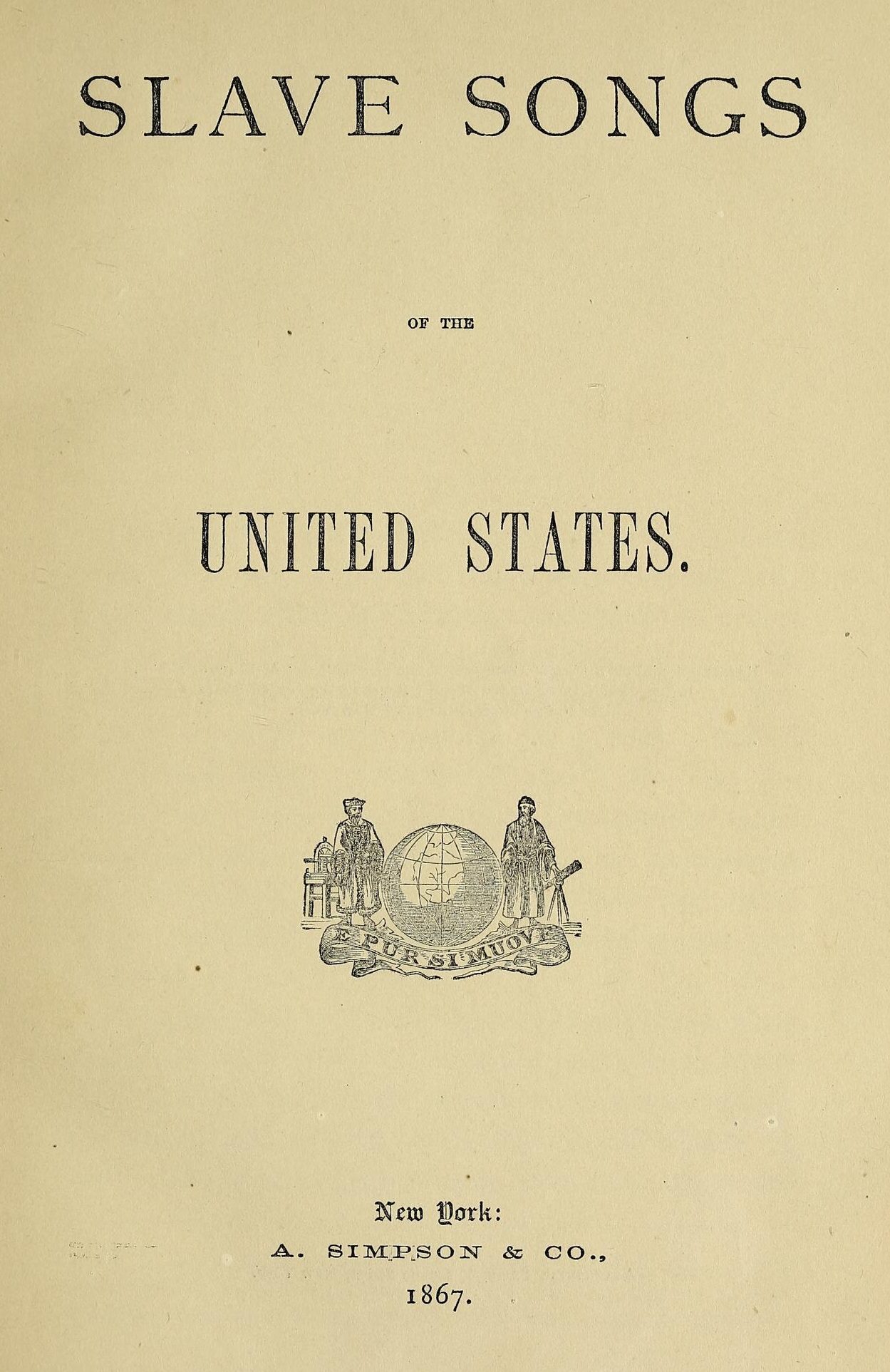
The first book of spirituals came only after emancipation. Slave Songs of the United States, compiled by William Francis Allen, Charles Pickard Ware and Lucy McKim Garrison, was published in 1867 with 136 songs, among them "Michael, Row the Boat Ashore" and "Nobody Knows the Trouble I've Had."11
Minstrelsy, Stated Plainly
Now the hard part. The most popular stage entertainment in America for most of the nineteenth century was the blackface minstrel show. White performers blackened their faces with burnt cork, dressed in rags or in absurd finery, and acted out caricatures of Black people as lazy, foolish, childlike and happy in slavery. It was racist entertainment. It was also enormously popular, the leading form of professional musical theater in the country until vaudeville displaced it around 1900.12 Both things are true, and an honest history has to hold them together.
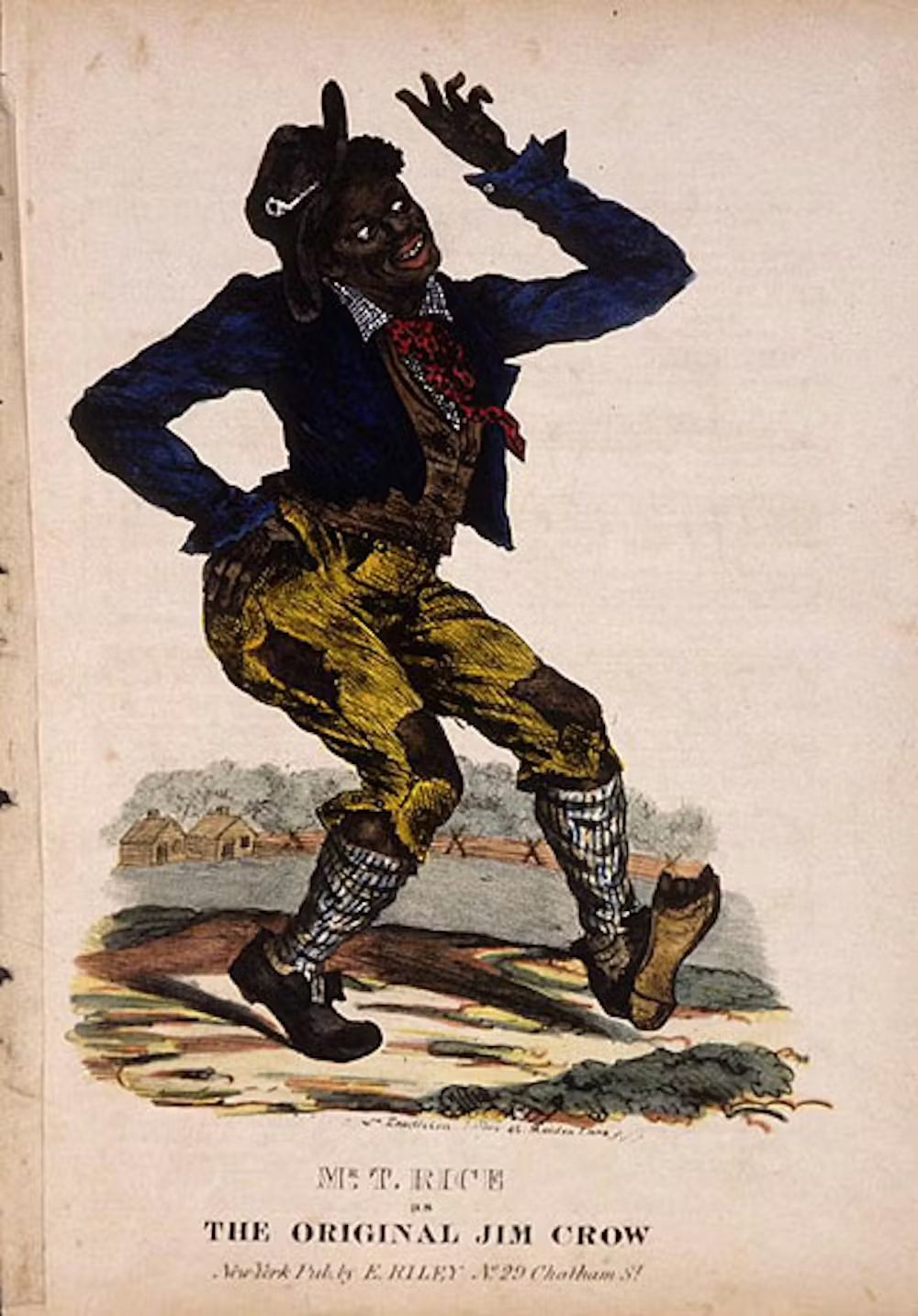
The form grew out of one act. About 1830 a white actor named Thomas Dartmouth Rice began performing a song and dance called "Jump Jim Crow" between the acts of a play, in the character of a ragged, foolish Black man. He was not the first to perform in blackface, but his fame made minstrelsy a theatrical form. By the late 1830s, Britannica notes, "Jim Crow" had already become a slur for Black Americans. After Reconstruction the name was attached to the laws of segregation.13
The full minstrel show arrived in February 1843, when the Virginia Minstrels, led by Daniel Decatur Emmett, later credited with "Dixie," performed a whole evening at the Bowery Amphitheatre in New York. The University of Virginia's exhibit on American song calls the minstrel show "America's first indigenous musical theater" and says it "raises disturbing questions about racism and entertainment." Amateur minstrel shows went on in American towns until the 1950s.12
Black Americans saw exactly what it was. In October 1848 Frederick Douglass, writing in his paper The North Star, called the blackface performers "the filthy scum of white society, who have stolen from us a complexion denied to them by nature."14 The article was headed "The Hutchinson Family," after a very different group of white singers who are taken up below.
Stephen Foster and the Song Business
Stephen Foster was born in Lawrenceville, Pennsylvania, near Pittsburgh, on July 4, 1826, fifty years to the day after the Declaration.15 He tried to do something almost no American had done: live on the sale of his songs. That put him in business with the minstrel stage, because that was where the hits were made.
Oh! Susanna (1848)
"Oh! Susanna" was published in 1848. The Christy Minstrels made it a national hit, and more than two dozen publishers printed it without paying him. Stephen Foster got "a mere $100 from a single firm in Cincinnati."16 It is still sung by people who have no idea where it came from. Its original dialect verses belong to the minstrel stage.
The lesson was not lost on him. On December 3, 1849, he signed a contract with the New York firm of Firth, Pond and Company, which paid royalties. The Center for American Music at the University of Pittsburgh dates his professional career from that contract.16
Old Folks at Home (1851)
"Old Folks at Home," the song Americans know as "Swanee River," was submitted for copyright on August 26, 1851. The sheet music said it was "Written and Composed by E. P. Christy." Christy, the leader of the Christy Minstrels, had paid Stephen Foster $15 for the right to put his own name on it.17 The song was "an instantaneous and overwhelming success." On May 25, 1852, Stephen Foster wrote to Christy asking to undo the arrangement, because he now wished "to establish my name as the best Ethiopian songwriter."17 "Ethiopian song" was the trade name for minstrel music.
He never saw the Suwannee River. His only trip to the Deep South was a riverboat cruise to New Orleans in February 1852.15
Weighing His Record
A fair account has to weigh both sides of the ledger. Stephen Foster wrote nearly two hundred songs, and fewer than twenty are in the blackface category, though those were among his most popular. The Pittsburgh scholars who care for his papers note that he "eventually eliminated dialect from his songs" and never allowed cartoons of slaves on his authorized sheet music, though pirated editions used them.15 Later songs such as "Hard Times Come Again No More" speak of sorrow without caricature. But "Old Folks at Home" still puts a longing for the plantation into the mouth of an enslaved man, which was the central lie of minstrelsy. The Center for American Music prints a warning on its page for the song that it contains "demeaning caricatures rooted in racism and white supremacy."17
And here is a turn worth knowing. A Black Ohio songwriter and Underground Railroad agent, Joshua McCarter Simpson, took Stephen Foster's tunes and wrote new antislavery words to them. His "I'm on My Way to Canada" used the melody of "Oh! Susanna." He said he meant to "kill the degrading influence of these comic Negro Songs."18 Simpson's work is part of the lesson on slavery, abolition and the arts.
Stephen Foster's royalties over his whole life came to $15,091.08.16 He spent his last years living alone in New York lodging houses and theater district hotels. After a fall that cut his neck and face, he died at Bellevue Hospital on January 13, 1864, at 37, with 38 cents in his pocket.1516 "Beautiful Dreamer" was published after his death.16
| Stephen Foster's money, as documented | Amount |
|---|---|
| Paid by a Cincinnati firm for "Oh! Susanna" (1848), while two dozen others pirated it | $100 |
| Paid by E. P. Christy to be named composer of "Old Folks at Home" (1851) | $15 |
| All royalties received in his lifetime (1849 to 1864) | $15,091.08 |
| Royalties later paid to his heirs | $4,199 |
| Cash in his pocket at death, January 13, 1864 | $0.38 |
Sources: Center for American Music, University of Pittsburgh.161715 He earned almost nothing from performances, because there was no performing-rights system to collect it.16
Singers for a Cause: The Hutchinson Family
Not every popular act sold caricature. The Hutchinson Family Singers came from Milford, New Hampshire, and began touring New England in 1842. From January 1843 they sang at antislavery meetings across the Northeast. Their abolitionist song "Get Off the Track!", written by Jesse Hutchinson Jr., brought them threats in 1844.19
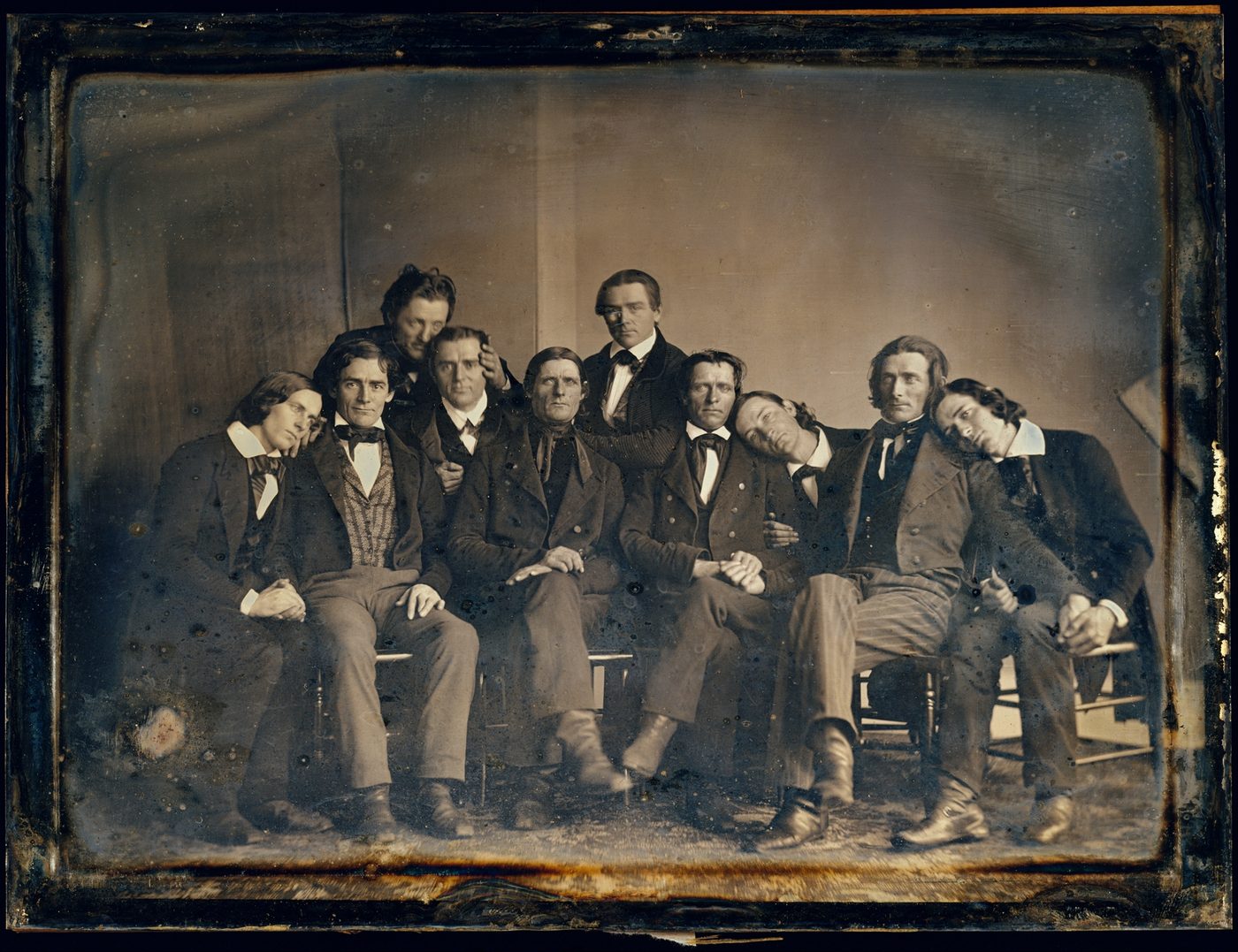
The Hutchinsons show that popular music could carry a moral argument and still fill the seats. They stand near the head of the American protest-song tradition, and their example runs straight into the songs of the Civil War.
Brass Bands and the Parlor Piano
Bands in Every Town
Towns wanted bands for Fourth of July parades, militia musters and summer concerts. One of the most celebrated bandleaders of the early republic was a Black Philadelphian, Francis Johnson, born in 1792. He became, in the words of a recent Smithsonian article, "the nation's foremost master of the keyed bugle," published more than two hundred compositions and in November 1837 took his band to England, where they gave twice-daily concerts in London. He died on April 6, 1844.21
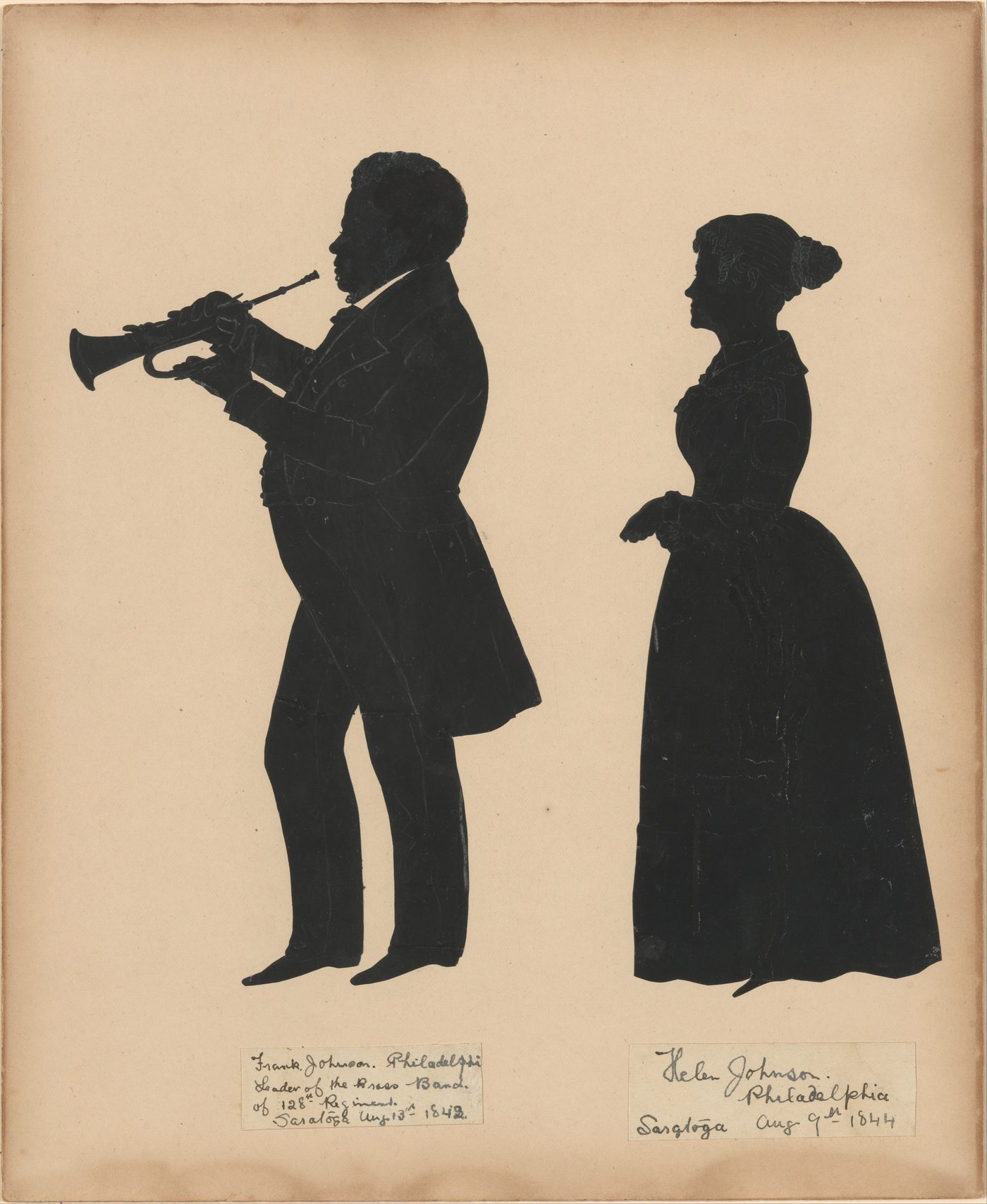
By the 1850s the brass band had a new standard sound. Allen Dodworth of New York, whose family claimed to have introduced the over-the-shoulder horn in 1838, wrote in 1849 that "most of the Bands of the present day give preference to what is called the Saxhorn." His 1853 Brass Band School told leaders, "Let nothing but Sax Horns, Ebor Cornos and Cornets, or instruments of like character be used."23
Sheet Music at Home
The other great outlet was the parlor. Publishers in New York, Baltimore, Cincinnati and other cities turned out sheet music for amateurs at the piano: hymns, waltzes, marches, minstrel tunes and sentimental songs about mother and home. To secure a copyright, a publisher registered the piece with a federal district court and deposited a copy, and the Library of Congress keeps those deposits from 1820 to 1860 in its "Music for the Nation" collection.24 A copy of "Camptown Races" printed in Baltimore by F. D. Benteen in 1852 is one of them. It is a reminder that the music business ran on paper, and that a hit song meant a hit with amateurs at the keyboard.24
A Timeline of American Popular Music, 1801 to 1867
- 1801 Little and Smith publish The Easy Instructor, the first shape-note book. Richard Allen publishes his hymnal for Bethel church. The Cane Ridge camp meeting, August 6 to 12.
- 1822 Lowell Mason's Handel and Haydn Society's Collection of Church Music.
- c. 1830 Thomas D. Rice introduces "Jump Jim Crow."
- 1835 William Walker's Southern Harmony.
- 1837 Francis Johnson's band sails for England (November).
- 1838 Mason starts music teaching in the Boston public schools.
- 1843 The Virginia Minstrels give the first full minstrel show (February). The Hutchinsons begin singing at antislavery meetings.
- 1844 White and King publish The Sacred Harp.
- 1845 Douglass's Narrative answers the claim that singing slaves are content.
- 1848 "Oh! Susanna." Douglass condemns blackface in The North Star (October 27).
- 1849 Stephen Foster signs with Firth, Pond and Company (December 3).
- 1851 "Old Folks at Home," credited to E. P. Christy.
- 1853 Dodworth's Brass Band School.
- 1855 Douglass's My Bondage and My Freedom explains the double meaning of "O Canaan."
- 1864 Stephen Foster dies in New York (January 13).
- 1867 Slave Songs of the United States, the first published collection of spirituals.
Two kinds of American music grew up side by side in these years. One was made by people singing for themselves and for God: the hollow square, the camp meeting, the cabin and the brush arbor. The other was made for sale, and the thing it sold best was a white fantasy of Black life. The songs of the war that ended slavery would draw on both, and they are the subject of the last lesson in this module.
Learn more
- New Georgia Encyclopedia: The Sacred Harp: the book, its compilers, its revisions and the living singing tradition.
- NEH Humanities: Cane Ridge: what happened at the great Kentucky revival of 1801.
- Douglass, Narrative (1845): chapter 2 contains his account of the slave songs; read it before reading anyone else on the subject.
- Douglass, My Bondage and My Freedom (1855): the "O Canaan" passage is in the chapter on his first attempt to escape.
- Joel Bresler, Follow the Drinking Gourd: A Cultural History: the careful, fair-minded investigation of the most famous "code song."
- Center for American Music: Frequently Asked Questions About Stephen Foster: the facts from the archive that holds his papers.
- Center for American Music: Old Folks at Home: the song's publication history and the Christy arrangement.
- University of Virginia Library: Minstrels: a short, honest introduction to minstrelsy with period images.
- Smithsonian: Frank Johnson: the Black bandleader who ruled Philadelphia's ballrooms and played in London.
Notes
- Amy Lifson, "Cane Ridge," Humanities (National Endowment for the Humanities) 45, no. 4 (Fall 2024). Read it online. ↩
- Sam Parker, "A Brief Overview of Sacred Harp Music," Birthplace of Country Music Museum. Read it online. ↩
- "Lowell Mason," Encyclopaedia Britannica. Read it online. ↩
- Malinda Snow, "The Sacred Harp," New Georgia Encyclopedia (2019). Read it online. ↩
- "Shape-Note Singing," Songs of America, Library of Congress. Read it online. ↩
- Winslow Homer, Camp Meeting Sketches: Cooking, 1858, wood engraving, Cleveland Museum of Art, Purchase from the J. H. Wade Fund, 1942.1357.a. Read it online. ↩
- "Richard Allen," Hymnary.org. Read it online. ↩
- Frederick Douglass, Narrative of the Life of Frederick Douglass, an American Slave, Written by Himself (Boston: Anti-Slavery Office, 1845), chapter 2, Project Gutenberg eBook 23. Read it online. ↩
- Frederick Douglass, My Bondage and My Freedom (New York: Miller, Orton and Mulligan, 1855), chapter 19, Project Gutenberg eBook 202. Read it online. ↩
- Joel Bresler, "Follow the Drinking Gourd: A Cultural History," followthedrinkinggourd.org, collection story and analysis of the H. B. Parks account (1928), the Lee Hays arrangement (1947) and the Weavers recording (1951). Read it online. ↩
- William Francis Allen, Charles Pickard Ware and Lucy McKim Garrison, comps., Slave Songs of the United States (New York, 1867), 136 songs; catalog record of the complete reprint, HathiTrust. Read it online. See also "Slave Songs of the United States," Wikipedia. Read it online. ↩
- "Hard Times Come Again No More: Minstrels," Lift Every Voice: Music in American Life, University of Virginia Library exhibit. Read it online. ↩
- "What Is the Origin of the Term Jim Crow?" Encyclopaedia Britannica. Read it online. ↩
- Frederick Douglass, "The Hutchinson Family. Hunkerism.," The North Star (Rochester, N.Y.), October 27, 1848, as quoted at Wikiquote, "Blackface." Read it online. ↩
- "Frequently Asked Questions About Stephen Foster," Center for American Music, University of Pittsburgh Library System. Read it online. ↩
- "Stephen Foster: Professional Career," Center for American Music, University of Pittsburgh Library System. Read it online. ↩
- "Old Folks at Home," American Music at Pitt, Center for American Music, University of Pittsburgh Library System. Read it online. ↩
- John Willis and Tim Foran, "I'm on My Way to Canada: Canada and Musical Protests against Slavery," Canadian Museum of History, February 20, 2015. Read it online. ↩
- "Abolition and Music in New Hampshire: The Hutchinson Family Singers," Nashua Historical Society. Read it online. ↩
- Unknown photographer, [Hutchinson Family Singers], 1845, daguerreotype, Metropolitan Museum of Art, Gilman Collection, object 283176. Read it online. ↩
- "Long Before Jazz, Frank Johnson Was Playing the Hottest Music in America," Smithsonian. Read it online. ↩
- Auguste Edouart, Frank Johnson, Leader of the Brass Band of the 128th Regiment in Saratoga, with his wife, Helen, 1842-44, Metropolitan Museum of Art, object 337070. Read it online. ↩
- "What Happened to the Brass Band Music Written during the Civil War," JV Music, quoting Allen Dodworth in the Message Bird (1849) and his Brass Band School (1853). Read it online. ↩
- "Camptown Races" (Baltimore: F. D. Benteen and Co., 1852), Music for the Nation: American Sheet Music, ca. 1820-1860, Library of Congress, from sheet music deposited for copyright in the U.S. District Courts. Read it online. ↩
Terms in this lesson
- Shape notes
- A way of printing music in which the head of each note has a different shape for each syllable of the scale (fa, sol, la, mi), so untrained singers can find the pitch. First published in The Easy Instructor of 1801.
- Hollow square
- The seating plan of a shape-note singing: four sections (tenor, bass, treble, alto) face each other around an open center where the leader stands.
- Camp meeting
- An outdoor revival lasting several days, where families camped in tents and wagons to hear preaching and sing. The Cane Ridge meeting of 1801 in Kentucky is the most famous.
- Spiritual
- A religious folk song created by enslaved African Americans, usually built on Bible stories and sung in call-and-response. The first published collection appeared in 1867.
- Blackface minstrelsy
- Stage entertainment in which performers, at first white men, blackened their faces with burnt cork and acted out racist caricatures of Black people in song, dance and comedy. It was the most popular form of American stage entertainment from the 1840s until vaudeville replaced it.
- Parlor song
- A sentimental song for voice and piano, sold as sheet music and sung at home by amateurs.
- Saxhorn
- A family of valved brass instruments patented by Adolphe Sax in the 1840s, which became the standard instruments of American brass bands in the 1850s.
Sources
- Malinda Snow, The Sacred Harp (New Georgia Encyclopedia) checked 2026-10
- Amy Lifson, Cane Ridge (Humanities, National Endowment for the Humanities) checked 2026-10
- Frederick Douglass, Narrative of the Life of Frederick Douglass (Project Gutenberg) checked 2026-10
- Frederick Douglass, My Bondage and My Freedom (Project Gutenberg) checked 2026-10
- Joel Bresler, Follow the Drinking Gourd: A Cultural History checked 2026-10
- Old Folks at Home (Center for American Music, University of Pittsburgh) checked 2026-10
- Stephen Foster: Professional Career (Center for American Music, University of Pittsburgh) checked 2026-10
- Frequently Asked Questions About Stephen Foster (Center for American Music, University of Pittsburgh) checked 2026-10
- Hard Times Come Again No More: Minstrels (Lift Every Voice exhibit, University of Virginia Library) checked 2026-10
- What Is the Origin of the Term Jim Crow? (Encyclopaedia Britannica) checked 2026-10
- Lowell Mason (Encyclopaedia Britannica) checked 2026-10
- Long Before Jazz, Frank Johnson Was Playing the Hottest Music in America (Smithsonian) checked 2026-10