Lesson 12 of 12 · about 15 minutes
Confederate Songs: Dixie and the Bonnie Blue Flag
You'll be able to
- Tell where Dixie came from, including the minstrel stage it was written for
- Explain what Lincoln said about Dixie on April 10, 1865
- Read the Bonnie Blue Flag and say what its stanzas count and claim
- Describe how Maryland, My Maryland came to be written and how Maryland retired it as the state song
- Describe the Snowden family claim and the other disputes over who wrote Dixie
On April 10, 1865, the day after Robert E. Lee surrendered at Appomattox, workmen from the Washington Navy Yard, headed by a band, visited President Lincoln to congratulate him. Lincoln told them he would end the visit with a tune. "I have always thought that 'Dixie' was one of the best tunes I had ever heard," he said. "Our adversaries over the way, I know, have attempted to appropriate it, but I insist that on yesterday we fairly captured it." He added that he had referred the question to the Attorney General, "and he gave it his legal opinion that it is now our property." The band played, and the crowd cheered.1 Other printings word the remarks differently. The version in Lincoln's Collected Works, as Michael Burlingame quotes it, has the Attorney General giving it as his legal opinion that the song is "our lawful prize."2
The song had been written six years earlier by a Northerner for a blackface comedy show in New York. Three more songs came out of 1861, and each borrowed from somewhere: "The Bonnie Blue Flag" took an Irish tune, "The Southern Marseillaise" a French anthem, and "Maryland, My Maryland" a melody known as "Lauriger Horatius." Northern writers set their own words to "Dixie" and to "Maryland, My Maryland" too.
A Walk-Around for Bryant's Minstrels
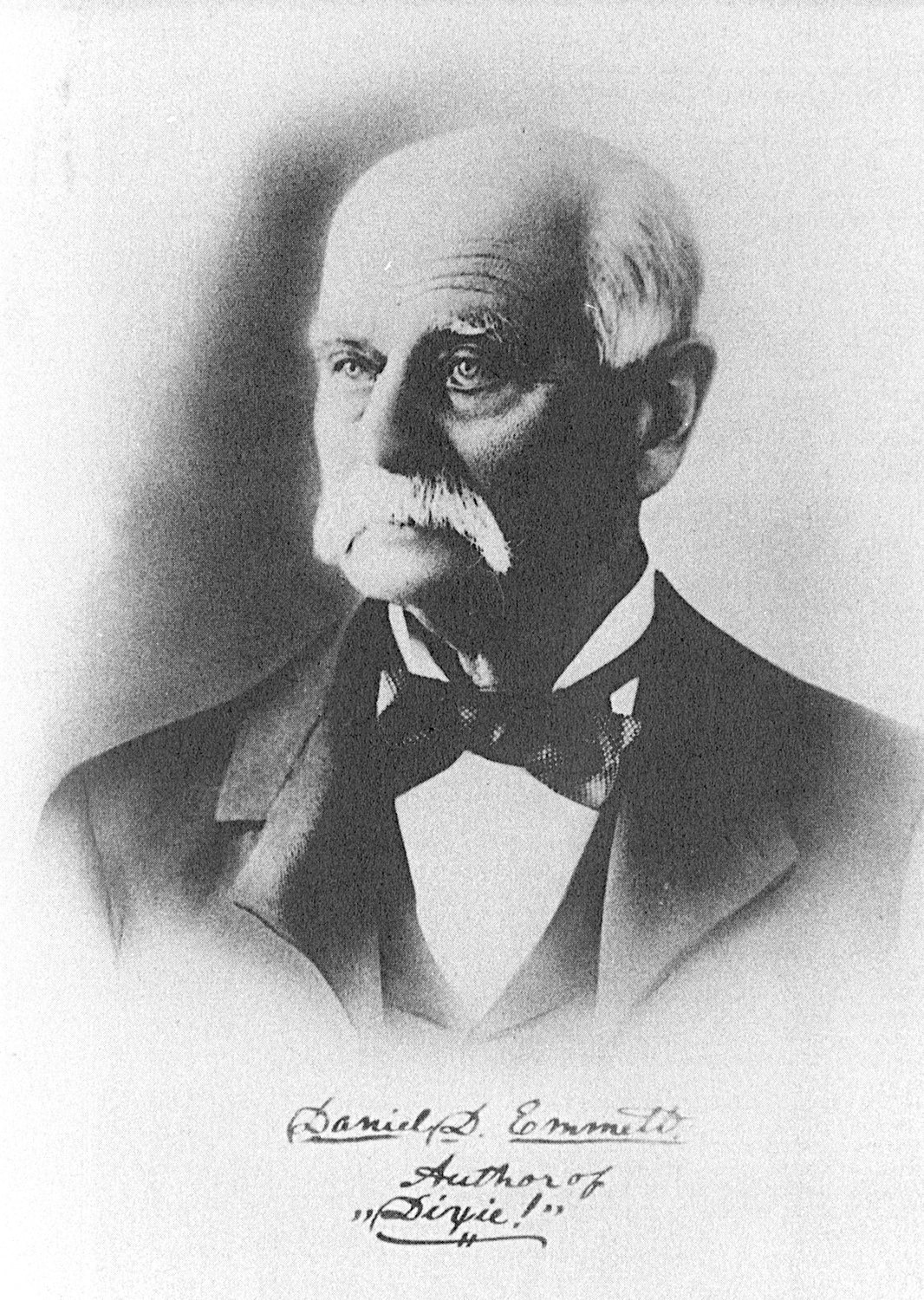
Daniel Decatur Emmett was born in Mount Vernon, Ohio, on October 29, 1815.3 By Galbreath's account, in February or March of 1843 he and three friends gathered at his boarding place on Catharine Street in New York and formed what Galbreath calls the first minstrel troupe, the Virginia Minstrels: Emmett on violin, Billy Whitlock on banjo, Frank Brower on the bones, and Dick Pelham on the tambourine.3 Minstrelsy was a commercial stage entertainment. White men blacked their faces and presented songs, dances and jokes in a stage dialect that claimed to show Black plantation life. Lesson 7 takes up the wider history of the music that people made and sang in these years.
In 1857, Galbreath says, Emmett engaged with Bryant's Minstrels in New York "to act as musician and compose negro melodies and plantation walk-arounds."3 HistoryNet places his hiring in the spring of 1859 instead.4 In 1859, by Galbreath's account, Jerry Bryant came to him late one Saturday evening and asked for a "walk-around" or "hooray song" of the plantation type for rehearsal on Monday. It needed a good tune, and the words mattered less. Emmett failed that night. On Sunday, a cold and dreary day with rain falling, he looked out the window and repeated an expression familiar to showmen in winter, "I wish I was in Dixie land," and his wife told him the name was already in the chorus: "Call it Dixie's Land."3
The date of the first performance is disputed. T. Allston Brown, in a letter to Galbreath, fixed it at Monday evening, September 19, 1859, while Emmett in three interviews said he wrote the song in the early spring of 1859.5 The Dictionary of American History gives the standard account as a premiere at Bryant's on Broadway on April 4, 1859.6 The sources do not agree, and this lesson does not choose between them. The earliest edition in the Library of Congress was published by Firth, Pond and Company of New York as "I Wish I Was in Dixie's Land," and the Register of Copyrights told Galbreath in 1904 that the earliest entry was dated June 21, 1860.3 Here is the first stanza and chorus as Galbreath printed them.
I wish I was in de land ob cotton.
Old times dar am not forgotten;
Look away! Look away! Look away! Dixie Land!
In Dixie Land whar I was born in.
Early on one frosty mornin',
Look away! Look away! Look away! Dixie Land!Den I wish I was in Dixie! Hooray! Hooray!
Daniel Decatur Emmett, "Dixie's Land," as printed in Galbreath, Daniel Decatur Emmett (1904), pp. 14 to 15. 3
In Dixie's Land we'll take our stand, to lib an' die in Dixie.
Away! away! away down South in Dixie.
Away! away! away down South in Dixie.
The stanza the Bryants first saw began differently. It retold creation in a joking way, and Mrs. Bryant objected that "in some religious homes it might be regarded as making light of the Scriptures." One of the Bryant brothers suggested dropping it, Emmett agreed, and it was left out of the printed song.3
Dis worl' was made in jiss six days,
Emmett's original first stanza, which Galbreath says "did not appear in the song as originally printed," in Galbreath, Daniel Decatur Emmett (1904), p. 13. 3
An' finish'd up in various ways;
Look away! look away! look away! Dixie Land!
Dey den made Dixie trim an' nice.
But Adam call'd it "Paradise."
Look away! look away! look away! Dixie Land!
The song grew to a score or more of stanzas, and Galbreath noted that all of them have perhaps never been printed together.3 One has the couplet "In Dixie Land de darkies grow. / If white folks only plant dar toe;" It is a minstrel joke that treats Black people as a crop. Another tells how Old Missus marries Will the weaver, who "smiled as fierce as a forty-pounder," and dies of a broken heart. The last sends the singer home: "Den hoe it down an' scratch your grabble, / To Dixie's land I'm bound to trabble."3 The song is a white entertainer's picture of an enslaved person's longing for the plantation, performed by white men in blackface for a paying audience. Galbreath, writing in 1904, described the Dixie of the first stanza as "the elysium of the colored race in the sunny Southland, where masters were kind."3 The song names no enemy and takes no side in any quarrel.
Where historians disagree
Emmett's authorship was disputed. After his death in 1904 a correspondent of the Baltimore Sun argued that Harry McCarthy, "the Arkansas comedian," wrote it, and Galbreath answered with the Library of Congress and Copyright Office records.3 This is the same Harry Macarthy who wrote "The Bonnie Blue Flag."7 In 1907 a letter to the Publishers' Weekly answered a notice of the death of Will S. Hays and of his claim to the song.3
The best-known alternative is the Snowden family claim. Emmett's hometown of Mount Vernon was home to the Snowdens, a Black family of musicians, and some scholars believe Ben and Lew Snowden composed "Dixie"; a marker at their graves reads "They taught 'Dixie' to Dan Emmett."8 Howard and Judith Sacks argued in Way Up North in Dixie (1993) that Emmett could have learned the song from the Snowdens, and that its original lyrics may be a semi-autobiographical account by Ellen Snowden, who had been enslaved in Maryland.6 The Tulane page notes that Emmett's authorship "is generally recognized" and that, given the disputed claims, "it is possible that more than one person created 'Dixie.'"8 Galbreath wrote in 1904 that the original manuscript was lost and that Emmett made many copies of it later.3 The copyright entries establish who published the words and music in 1860. They do not show what Emmett heard before he wrote.
Dixie Goes to War
Lincoln knew the song before secession. According to a fellow attorney, as Ballad of America tells it, Lincoln heard the Rumsey and Newcomb Minstrels play it in Chicago in 1860, clapped, and shouted, "Let's have it again!"9 Galbreath says only that Lincoln, "it is said," heard the tune to Republican words in the campaign of 1860 and was much pleased.3 Soon after Firth, Pond published the song, P. P. Werlein of New Orleans printed it, and Emmett's publishers notified him at once that they held the copyright.3
By the fall of 1860 the song had spread to the South, and it was soon taken up as a Confederate marching song.8 On February 18, 1861, a band playing "Dixie" headed the procession escorting President-elect Jefferson Davis to take the oath of office in Montgomery, Alabama.4 After the war began, Bryant's Minstrels could no longer perform it in New York without being jeered.4 Galbreath writes that many loyal Northerners mailed Emmett letters of disapproval: some ridiculed the song as a clownish performance on behalf of secession, and some denounced it as treason and suggested a rope for the author's neck. Emmett was a Democrat and "through the war a strong Union man," and he was surprised and confused at the song's prominence.3
Southerners who disliked the comic origin wrote new words. Albert Pike's version, which Galbreath says first appeared in the Natchez Courier on April 30, 1861, opened "Southrons, hear your country call you! / Up! lest worse than death befall you! / To arms! to arms! to arms! in Dixie!"103 Galbreath observed that none of the writers who copied Emmett's metrical formula got far from his chorus, and that they kept it wholly or in part.3 HistoryNet calls the song the Confederate Army's mainstay, and two accounts of the Battle of Franklin in November 1864 say "Dixie" and "The Bonnie Blue Flag" were played during the assault.4
The North answered in kind. Galbreath reports that Emmett's melody was used, with his approval, for a Union song by Frances J. Crosby, "Dixie for the Union," written after the evacuation of Fort Moultrie and before the fall of Fort Sumter.3 At Fredericksburg in December 1862 the bands of the two armies dueled across the Rappahannock. The Confederates opened with "Dixie," the Federals answered with "John Brown's Body," the Confederates played "The Bonnie Blue Flag," and the Federals countered with "The Star-Spangled Banner."4
- Sep 19 or Apr 4, 1859 First performance of "Dixie's Land" at Bryant's Minstrels, New York; sources give both dates.56
- Jun 21, 1860 Earliest copyright entry, by Firth, Pond and Company.3
- Feb 11, 1861 Emmett assigns his copyright to Firth, Pond and Company.3
- Feb 18, 1861 A band playing "Dixie" leads Jefferson Davis's procession in Montgomery.4
- 1861 Harry Macarthy's "The Bonnie Blue Flag" is first sung in public, in spring in Jackson or in September in New Orleans, depending on the source; Blackmar publishes "Allons Enfans," "The Southern Marseillaise."71110
- Apr 26, 1861 James Ryder Randall writes "Maryland, My Maryland" after the Baltimore riot of April 19.1012
- Apr 10, 1865 Lincoln asks the band for "Dixie" at the White House.1
- 2016 and 2021 Ole Miss stops playing "Dixie" at athletic events; Maryland repeals "Maryland, My Maryland" as its state song.1314
The Bonnie Blue Flag
The war's other great Confederate favorite had a known author. Harry Macarthy, an English-born entertainer who came to the United States in 1849 and billed himself the "Arkansas Comedian," wrote the words and set them to the Irish tune "The Irish Jaunting Car."7 Sources disagree on the premiere. The American Battlefield Trust says he sang it in Jackson, Mississippi, in the spring of 1861 and again in September at the New Orleans Academy of Music before soldiers headed for the Virginia front. HistoryNet says he got the idea in Jackson in January 1861, when he saw a delegate's wife with a blue flag during the secession convention, and describes the September concert in New Orleans, before an audience few of whom had heard it, as its breakthrough.711 A. E. Blackmar of New Orleans published six editions between 1861 and 1864.7
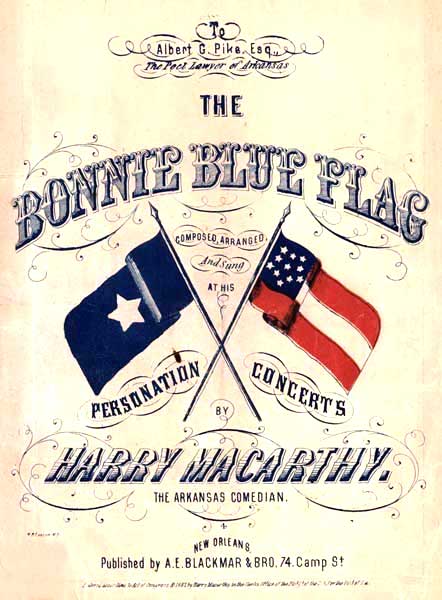
The song counts states. Each stanza adds states to the flag, a single white star on a blue field.7 This is the first stanza and chorus from W. L. Fagan's 1890 collection, followed by the stanza that completes the count:
We are a band of brothers, and native to the soil,
Fighting for our liberty, with treasure, blood and toil;
And when our rights were threatened, the cry rose near and far,
Hurrah for the Bonnie Blue Flag, that bears a Single Star!Chorus: Hurrah! Hurrah! for Southern Rights, Hurrah!
Hurrah! for the Bonnie Blue Flag that bears a Single Star!Then cheer, boys, raise the joyous shout,
Harry Macarthy (McCarthy), "The Bonnie Blue Flag," in Fagan, comp., Southern War Songs (1890). 10
For Arkansas and North Carolina now have both gone out;
And let another rousing cheer for Tennessee be given,
The Single Star of the Bonnie Blue Flag has grown to be Eleven.
The song praises "Southern Rights" and says "Northern treachery attempts our rights to mar." Printings differ in the second line of the opening stanza. Fagan's 1890 text reads "Fighting for our liberty, with treasure, blood and toil." The text the American Battlefield Trust prints reads "Fighting for the property we gained by honest toil." The two wordings name different things at stake.107
After Union forces took New Orleans in May 1862, singing the song became an offense under General Benjamin Butler's rule. New Orleans newspapers recorded arrests of men and women for singing it, with penalties from a fine to the workhouse.15 Butler is said to have had the publisher Armand Blackmar arrested and his shop ransacked, and HistoryNet says the publishing house was demolished and Blackmar fined.1511 A Philadelphia answer by M. H. Frank, "Reply to the Bonnie Blue Flag," reworked the chorus: "Hurrah! Hurrah! for Freemen's Rights, Hurrah! / Hurrah for the Glorious Old Flag, glitt'ring with many a star!"15
The Southern Marseillaise
A. E. Blackmar published a second song in 1861 titled "Allons Enfans," subtitled "The Southern Marseillaise." Its title and its refrains, "To arms, to arms, ye brave" and "March on! March on!", follow the French revolutionary anthem it is named for. Fagan, who prints it, says it "may be called the rallying song of the Confederacy," composed early in 1861 and sung throughout the South as soldiers were hurried to Virginia.10 Its first stanza:
Sons of the South awake to glory,
"Allons Enfans, The Southern Marseillaise," A. E. Blackmar, New Orleans, 1861, in Fagan, Southern War Songs (1890). 10
A thousand voices bid you rise,
Your children, wives and grandsires hoary,
Gaze on you now with trusting eyes,
Gaze on you now with trusting eyes;
Your country ev'ry strong arm calling,
To meet the hireling Northern band
That comes to desolate the land
With fire and blood and scenes appalling,
To arms, to arms, ye brave;
Th' avenging sword unsheath!
The song calls on the South to meet a "hireling Northern band." Its third stanza names slavery directly. It says "jealous, blind fanatics dare / To offer, in their zeal unbounded, / Our happy slaves their tender care," and that the South, after long yielding "to Union name," now claims "Independence."10 The same text was reprinted in Francis D. Allan's Lone Star Ballads, an excerpt of which Learning for Justice includes in its Teaching Hard History library.16
Maryland, My Maryland
On April 19, 1861, a pro-secession mob in Baltimore attacked soldiers of the 6th Massachusetts Infantry as they passed through on the way to Washington.12 James Ryder Randall, a Marylander who was a professor of English literature and classics at Poydras College in Pointe Coupee, Louisiana, read about the attack in the New Orleans Delta. He said later that he could not dismiss it from his mind, that about midnight he rose, lit a candle and went to his desk, and that "almost involuntarily" he wrote the song.17 Fagan dates the poem April 26, 1861, and says it was first published in the New Orleans Delta.10 The Maryland State Archives describes it as a nine-stanza poem that articulated Randall's Confederate sympathies, "set to the traditional tune of 'Lauriger Horatius' (more familiar as the tune of 'O, Tannenbaum')."14 Mrs. Burton Harrison, in her 1911 memoir, says Jennie Cary of Baltimore set the poem to that air and first sang it with a chorus of friends in a Baltimore drawing room.18
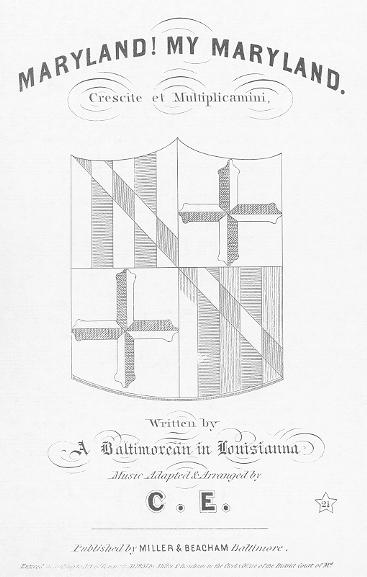
The first stanza:
The despot's heel is on thy shore,
James Ryder Randall, "Maryland, My Maryland," 1861, from Fagan, comp., Southern War Songs (1890); nine stanzas in all. 10
Maryland!
His torch is at thy temple door,
Maryland!
Avenge the patriotic gore
That flecked the streets of Baltimore,
And be the battle queen of yore,
Maryland! My Maryland!
The poem speaks of "the despot's heel" and "the tyrant's chain," and its last stanza says Maryland "spurns the Northern scum." The sixth stanza quotes Virginia's motto, "Sic semper."10 Maryland did not secede. On April 29, 1861, days after Randall wrote, the Maryland House of Delegates voted 53 to 13 against secession.19
The tune crossed the line too. In 1862 the songwriter Septimus Winner published Union words to "Maryland, My Maryland!" in Philadelphia.20
Borrowed Tunes
Americans had borrowed tunes since the Revolution: take a tune everyone knows and write new words for it. Lesson 2 covers the songs of the Revolution. In 1861 the borrowing ran in both directions at once. The Confederate "Bonnie Blue Flag" used an Irish melody, the Union "Battle Hymn" (Lesson 11) used a camp-meeting tune, "Maryland" used "Lauriger Horatius," and "Dixie" was a Northern minstrel number that both armies played. The words carried the politics, and writers on both sides swapped them freely: Pike and Crosby for "Dixie," Winner for "Maryland."
Lesson 9 sets these songs beside the rest of the war's art, music and words.
How the Songs Are Treated Today
Dixie. HistoryNet reports that in the past half-century African Americans have challenged "Dixie" as a racist relic and a tribute to slavery, while many Southerners view it as a symbol of their heritage.4 The Dictionary of American History says that a century after it was written the song became inextricable from the massive resistance of white southerners to the civil rights movement.6 In June 1999 Chief Justice William Rehnquist led a "Dixie" sing-along at the Fourth Circuit Judicial Conference. Some lawyers read it as an expression of fondness for the days of slavery, and some African American lawyers skipped the event.21 In August 2016 the University of Mississippi announced that the song would no longer be played at athletic events, ending a tradition of about seven decades. Athletic director Ross Bjork called the decision the right thing to do.13 The phrase "whistle Dixie" now means to engage in unrealistic fantasies.22
The Bonnie Blue Flag. The Encyclopedia of North Carolina says that after the war anyone singing it in the occupied South was subject to arrest.23 New Orleans Historical traces its revival as a Lost Cause symbol in the 1910s and its use as a protest song against the integration of public spaces in the civil rights era.15
Maryland, My Maryland. The General Assembly adopted it as the state song in 1939. The State Archives records that a State Song Advisory Group reported on the song on December 14, 2015, and that the General Assembly repealed it as the state song as of July 1, 2021, and did not replace it.14
Lincoln's April 1865 request is the other end of this story. Galbreath, writing in 1904, called it the President's "peace offering" at the dawn of national reunion.3 The song had begun as a Northern entertainment, and Lincoln told the crowd it was now "our property."
Learn more
- Galbreath, Daniel Decatur Emmett: the 1904 biography with Emmett's own account and the original stanzas
- Southern War Songs: a full 1890 collection of Confederate lyrics, free to read
- Ballad of America: Dixie's Land: a short account of the song with the Lincoln story
- Look Away Dixie Land: a Civil War Times article on the song in the war
- Harry Macarthy: a Civil War Times article on the author of "The Bonnie Blue Flag"
- Maryland State Song: the official record of the song's adoption and repeal
- Southern Marseillaise: the song text as classroom reading material
- Lincoln and the Navy Yard workmen: the April 10, 1865 newspaper report of the remarks
Notes
- Abraham Lincoln, remarks to Navy Yard workmen, April 10, 1865, as reprinted from a contemporary newspaper report by Ghosts of DC. Read it online. ↩
- Michael Burlingame, Abraham Lincoln: A Life, vol. 2, chap. 36, quoting the remarks of April 10, 1865 and citing Roy P. Basler, ed., The Collected Works of Abraham Lincoln (Rutgers University Press, 1953 to 1955), 8:393. Burlingame calls it a serenade; the Ghosts of DC newspaper text calls it a visit by Navy Yard workmen. Ballad of America separately places a request for "Dixie" on April 8, 1865, aboard the River Queen, on the word of a French writer. Read it online. ↩
- Charles Burleigh Galbreath, Daniel Decatur Emmett, Author of "Dixie" (Columbus: Heer, 1904), on Emmett's birth, the first minstrel troupe, the Bryant commission, the original stanzas, the Library of Congress and Copyright Office entries, the contract of February 11, 1861 (price omitted in the copy; Emmett said it was $500), the rival claims and Pike's words. The book relays Emmett's own recollections. Read it online. ↩
- "Look Away Dixie Land," Civil War Times, April 2008, HistoryNet, on Emmett's hiring in spring 1859, the Montgomery procession of February 18, 1861, the Fredericksburg band duel, the Battle of Franklin and the song's reception after 1865. Read it online. ↩
- Galbreath, Daniel Decatur Emmett, p. 12, note, quoting T. Allston Brown on September 19, 1859, and Emmett on early spring 1859. The sources conflict and this lesson does not choose. Read it online. ↩
- Martyn Bone, "Dixie," Dictionary of American History, on the premiere of April 4, 1859, the etymology of the word, and the Sacks claim for the Snowden family, citing Hans Nathan, Dan Emmett and the Rise of Early Negro Minstrelsy (1962), and Howard L. and Judith Rose Sacks, Way Up North in Dixie (1993). Read it online. ↩
- American Battlefield Trust, "Civil War Music: The Bonnie Blue Flag," on Macarthy, the tune, the premiere, Blackmar's editions and the stanzas. Read it online. ↩
- "Dixie," Tulane University, Fort Sumter teaching site (www2.tulane.edu/~sumter), on the song's spread to the South by fall 1860 and the Snowden claim. Read it online. ↩
- Ballad of America, "Dixie's Land: About the Song," on Lincoln at the Rumsey and Newcomb show in Chicago in 1860, as told by a fellow attorney. The account is secondhand. Read it online. ↩
- W. L. Fagan, comp., Southern War Songs: Camp-Fire, Patriotic and Sentimental (New York: M. T. Richardson, 1890), Project Gutenberg eBook 37538: Pike's "Dixie," Macarthy's "The Bonnie Blue Flag," "Allons Enfans" by A. E. Blackmar, 1861, and Randall's "My Maryland." Lyric texts compared line by line with the printed collection. Read it online. ↩
- E. Lawrence Abel, "Harry Macarthy: The Bob Hope of the Confederacy," Civil War Times, December 2000, HistoryNet. Read it online. ↩
- "Maryland, My Maryland," About the Song, Civil War Poetry, on the Baltimore attack of April 19, 1861 on the 6th Massachusetts. Read it online. ↩
- Adam Ganucheau, "For Ole Miss sports, 'Dixie' is dead," Mississippi Today, August 19, 2016. Read it online. ↩
- Maryland State Archives, "Maryland State Song," on the 1939 adoption (Chapter 451, Acts of 1939), Randall's poem, the tune, the Report of the State Song Advisory Group of December 14, 2015, and repeal as of July 1, 2021. Read it online. ↩
- "Bonnie Blue Flag: The Most Dangerous Song of the Civil War," New Orleans Historical, on arrests under Butler, Blackmar, the Philadelphia reply and the song's later uses. Read it online. ↩
- Learning for Justice, "Southern Marseillaise," from Francis D. Allan, Allan's Lone Star Ballads, in the Teaching Hard History text library. Read it online. ↩
- James Ryder Randall, Maryland, My Maryland, and Other Poems (Baltimore: John Murphy Company, 1908), introduction quoting Randall's account. Read it online. ↩
- Mrs. Burton Harrison, Recollections Grave and Gay (New York: Scribner's, 1911), pp. 57 to 58. Read it online. ↩
- "Maryland House of Delegates Votes Against Secession," House Divided, Dickinson College, April 29, 1861. The Maryland 400 site words the same vote as a finding that the General Assembly lacked the power to secede. Read it online. ↩
- Septimus Winner, "Maryland, My Maryland!" (Philadelphia, 1862), Union words, IMSLP catalog entry. Read it online. ↩
- Craig Timberg, "Rehnquist's Inclusion of 'Dixie' Strikes a Sour Note," Washington Post, July 22, 1999. Read it online. ↩
- "Dixie," The Oxford Pocket Dictionary of Current English, via Encyclopedia.com. Read it online. ↩
- William S. Powell, ed., Encyclopedia of North Carolina (University of North Carolina Press, 2006), "Bonnie Blue Flag," NCpedia. Read it online. ↩
Terms in this lesson
- Minstrel show
- A stage entertainment popular from the 1840s in which white performers in blackface sang, danced and joked in mock-plantation dialect. Dixie was written for one.
- Walk-around
- The closing number of a minstrel show, a lively song with a chorus the whole company could sing while parading in a circle.
- Dixie
- A nickname for the South. Its origin is disputed, and the song gave the word its widest use.
- Bonnie Blue Flag
- A plain blue flag with one white star, used as a secessionist banner. The song named for it counts the seceding states.
- Lauriger Horatius
- The traditional tune to which Maryland, My Maryland was set, better known as the tune of the carol O Tannenbaum.
- Contrafactum
- A new text set to an existing tune. Both sides used the practice constantly in the Civil War.
Sources
- Charles Burleigh Galbreath, Daniel Decatur Emmett, Author of Dixie (1904), Internet Archive checked 2026-10
- W. L. Fagan, comp., Southern War Songs (1890), Project Gutenberg eBook 37538 checked 2026-10
- Martyn Bone, Dixie, Dictionary of American History, Encyclopedia.com checked 2026-10
- HistoryNet, Look Away Dixie Land checked 2026-10
- Ballad of America, Dixie's Land: About the Song checked 2026-10
- Ghosts of DC, Celebrating Victory: The Workmen's Visit to Lincoln, April 10th, 1865 checked 2026-10
- American Battlefield Trust, Civil War Music: The Bonnie Blue Flag checked 2026-10
- HistoryNet, Harry Macarthy: The Bob Hope of the Confederacy checked 2026-10
- New Orleans Historical, Bonnie Blue Flag: The Most Dangerous Song of the Civil War checked 2026-10
- Learning for Justice, Southern Marseillaise checked 2026-10
- James Ryder Randall, Maryland, My Maryland, and Other Poems (1908), Internet Archive checked 2026-10
- Maryland State Archives, Maryland State Song checked 2026-10