Lesson 10 of 10 · about 70 minutes
Reading, Using and Reporting on Political Art: Method, Copyright and Archives
You'll be able to
- Apply a six step method to a political work and write down what you observed separately from what you infer
- State the four fair use factors from 17 U.S.C. 107 and what each of four cases decided
- Say which works are in the public domain in 2026 and how to check a specific work
- Name the archives that hold political art and the access terms each states
- Describe what Idaho Code 67-6628A covers and what it leaves out
- Describe an AI generated political image accurately in a report
Start here: the short version
- Describe before you interpret. The Library of Congress teaching tool runs on three verbs, observe, reflect and question, and its teacher's guide adds a fourth, investigate further. Write down what is in the picture or on the record before you say what it means.
- Check the date first for copyright. As of 2026, a work first published in the United States before 1931 is in the public domain by expiration, per Cornell's copyright term chart.1 A work of the U.S. Government is not eligible for copyright under 17 U.S.C. 105(a).2 Almost everything else needs checking.
- Fair use is a four factor weighing, with no fixed number of words or seconds that is safe. After Andy Warhol Foundation v. Goldsmith (May 18, 2023, seven to two)3, a new look does not save a commercial use that serves substantially the same purpose as the original.
- Archives state their own terms. The Met and the Smithsonian release open access images under CC0,4 the Library of Congress puts its Cabinet of American Illustration online (check each record's rights note before you reuse an image), and the Billy Ireland library holds the largest cartoon collection in the world by its own account.
- Idaho's 2024 FAIR Elections Act, Idaho Code 67-6628A, covers realistic but false audio and video of a person's speech or conduct in electioneering communications. It does not cover still images, and the plaintiff must prove synthetic media by clear and convincing evidence.5
The first nine lessons told what political art did. This one is a toolkit for what you do with it: how to read a work carefully, when you may copy it, where to find it and how to describe it. The lessons on photography and on music before 1970 and after supplied examples. Nothing here is advice about a particular dispute. It describes the rules and the cases so that a reporter or an advocate can see how the courts have reasoned and where the archives set their terms.
A method for reading a political work
The Library of Congress teaching page offers a free primary source analysis tool for students, a fillable form with three steps shown as observe, question and reflect, and a set of teacher's guides, among them one titled "Analyzing Political Cartoons."6 The teacher's text describes the process as observing, reflecting, questioning and investigating further. That sequence is the right backbone for any work, from a 1908 cartoon to a 2026 meme, because it puts the cheapest step first. You can observe a drawing without knowing anything about it. You cannot honestly say what it means until you have looked.
How to: analyze a cartoon, poster, photograph, artwork or song
- Observe. List what is physically there. For a cartoon: the figures, their labels, the setting, the caption, the signature, the date and the publication. For a song: title, performers, date, the structure of the lyric, and what is sung versus spoken. Write nouns and verbs. Leave adjectives and opinions for later.
- Identify the maker and the publisher. Who drew, took, wrote or sang it? Who paid for it or printed it? A newspaper cartoon speaks for its staff artist and, in some cases, the paper's editor. A poster speaks for its sponsor. A song may have one writer, one performer and one publisher.
- Place it in time. What had happened in the days or weeks before? A cartoon on April 16, 1908 reacts to what was in the news on April 15. Read a daily newspaper from the week before, and note what the work assumes the audience already knows.
- Decode the devices. Cartoons use caricature, symbols, labels, analogies, irony and exaggeration, and each can be named and located in the picture. Photographs have framing, caption and crop. Songs have a speaker, an addressee and an occasion.
- Question and check. What does the work claim, and is the claim true? Check each factual assertion against a primary source. A cartoon that says a vote was lopsided can be checked against the roll call.
- State the use and limits. Write what you can say about the work with confidence, what you infer and what you do not know. Record the catalog page, the date you looked and any rights statement.
Worked example: a public domain cartoon
The Center for Legislative Archives holds approximately 2,400 original pen and ink drawings by Clifford K. Berryman in the U.S. Senate Collection.7 The National Archives' own page says he drew for the Washington Post from 1890 until 1907 and then for the Washington Evening Star until his death in 1949.8 One cartoon from the collection, The House is in Session (According to the Minority View), ran in the Evening Star on April 16, 1908 and is cataloged at the National Archives as identifier 306107.9 The archives describe it as showing the House as a place where the majority, drawn as clones of Speaker Joseph Cannon, rules the floor with no room for minority voices.10
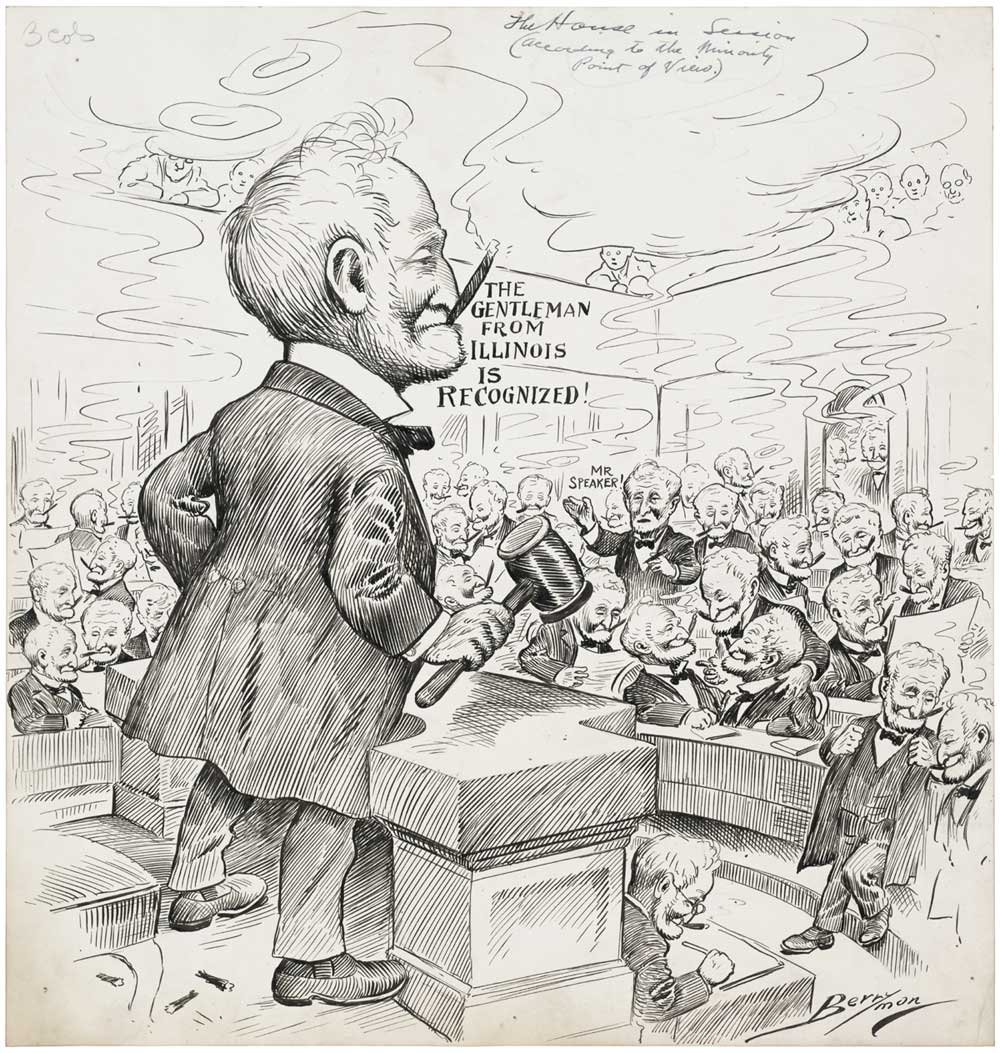
Run the six steps. Observe: a chamber full of figures with the same face. Maker and publisher: Berryman, a staff artist at a Washington evening paper read by the people who sat in the chamber he drew. Time: April 1908. The page does not say which events prompted the cartoon, and a reader has to find them in the paper's reporting from the days before. Devices: caricature and exaggeration (the repeated face), analogy (a body of men likened to copies of one man), irony (the title promises the minority's point of view and shows its absence). Question: is it true that the majority gave the minority no room? A reporter would check roll calls and rules, and would note that a cartoon argues, it does not prove. Use: the cartoon was first published in 1908, which is before 1931, so it is in the public domain by expiration, and the archives hold the original drawing in a federal collection. It is safe to embed with a credit to the National Archives.
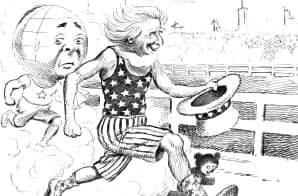
A second Berryman drawing is in the National Archives' free teaching set America and the World: Foreign Affairs in Political Cartoons, 1898 to 1940, which is a good place to practice the method on a work whose caption and context you have to find yourself. DocsTeach lists it as The Winner, July 16, 1912, National Archives Identifier 6010956.11 It is also the cover image of that book, which credits it to the Washington Evening Star of July 16, 1912. It shows12 a figure in a stars-and-stripes running costume, holding a star-spangled top hat, sprinting on a track ahead of a tearful runner with a globe for a head, with a small teddy bear running behind and a crowded stadium in the background. The archive pages checked do not say what event prompted it, so the context is for the reader to find.
Copyright and fair use for journalists and advocates
The statute is 17 U.S.C. 107. It says that the fair use of a copyrighted work, "for purposes such as criticism, comment, news reporting, teaching (including multiple copies for classroom use), scholarship, or research, is not an infringement of copyright."13 It then names four factors: the purpose and character of the use, the nature of the copyrighted work, the amount and substantiality of the portion used in relation to the work as a whole, and the effect of the use upon the potential market for or value of the work. It adds that the fact a work is unpublished does not itself bar a finding of fair use.14 The Copyright Office's own fair use page is the next stop, and this lesson did not get a copy of it, so read it directly.
Four cases shape how those factors work for political art.
Hustler Magazine v. Falwell (decided February 24, 1988).15 Hustler ran a parody in its November 1983 issue of a liquor company's celebrity "first time" advertisements, with a fabricated interview with the minister Jerry Falwell and a small print disclaimer calling it an ad parody not to be taken seriously. Chief Justice Rehnquist wrote for the Court, joined by six justices, with Justice White concurring in the judgment and Justice Kennedy not participating.16 The Court held that public figures and public officials cannot recover damages for intentional infliction of emotional distress from a publication like this unless they also show a false statement of fact made with actual malice.17 The case protects caricature of public figures that no reasonable reader takes as fact, which is the legal foundation for editorial cartooning. It is a First Amendment case, and it does not reach copyright.
Campbell v. Acuff-Rose Music (March 7, 1994, unanimous, Justice Souter).18 The Court held a commercial parody can be fair use, rejected a presumption that commercial use is unfair, and said parody "needs to mimic an original to make its point." Parody gets no presumption of fairness either, and the Court sent the case back because neither side had offered evidence on the market for rap versions. Lesson 09 covers the facts.
Fairey and the Associated Press. The Hope poster of 2008 was based on an AP photograph taken by Mannie Garcia.19 Accounts differ on his status: the Wikipedia article cites his own site for freelancer, and NPR's January 2011 report says an update established that he was an AP staffer.20 The AP said in February 2009 that the use needed permission.21 Fairey sued for a declaration of fair use. In October 2009 he admitted he had based the poster on the AP photograph and had fabricated and destroyed evidence to hide it, as the New York Times reported and the Wikipedia article cites.22 The U.S. Attorney's press release of February 24, 2012 says his 2009 complaint named a photograph of Obama with George Clooney at an April 2006 National Press Club event, when he had actually used a tightly cropped AP image from the same event.23 The parties settled in January 2011, according to an AP release, agreeing to share rights to make posters and merchandise bearing the Hope image and to work together on future images.24 Fairey pleaded guilty on February 24, 2012 to one count of criminal contempt tied to the AP litigation, admitting he destroyed documents and fabricated evidence, according to the U.S. Attorney's press release.25 In September 2012 he was sentenced to two years of probation, 300 hours of community service and a $25,000 fine, as reported by the Los Angeles Times and cited in the Wikipedia article.26 Talking Points Memo's report of September 7, 2012 confirms the probation and the fine but does not mention the community service.27 No court ruled on fair use. A judge urged settlement and said the AP would win (a New York Times report of May 29, 2010, cited in the Wikipedia article and not checked directly),28 which is a remark and not a holding. Anyone who cites the case for a fair use rule is citing something it did not decide.
Andy Warhol Foundation v. Goldsmith (May 18, 2023). Justice Sotomayor wrote for a seven to two Court that the first fair use factor favored Goldsmith for the Foundation's 2016 licensing of the Orange Prince image to Condé Nast.29 The photograph and the Warhol portrait served substantially the same purpose, since both were portraits of Prince used in magazines to illustrate stories about him, and the licensing was commercial. A new aesthetic or perceived meaning did not change the result. The Court limited its holding to that licensing. Justice Kagan dissented, joined by Chief Justice Roberts.30 A line from the opinion, "fair use is an objective inquiry into what a user does,"31 is the practical rule: ask what the new use is for.
| Case | Date and court | Question | Holding in brief |
|---|---|---|---|
| Hustler Magazine v. Falwell, 485 U.S. 46 | February 24, 1988; U.S. Supreme Court | Can a public figure recover emotional distress damages for an outrageous parody? | Not without a false statement of fact made with actual malice |
| Campbell v. Acuff-Rose Music, 510 U.S. 569 | March 7, 1994; U.S. Supreme Court, unanimous | Is a commercial parody fair use? | It can be; no presumption either way; remanded on market harm |
| Fairey and the AP (Hope poster) | Settled January 2011; Fairey plea February 2012 | Was the poster fair use of Garcia's photograph? | No ruling; settlement shared rights in the image |
| Andy Warhol Foundation v. Goldsmith, 598 U.S. 508 | May 18, 2023; U.S. Supreme Court, seven to two | Does Warhol's Orange Prince image license to a magazine count as fair use? | First factor favors Goldsmith for the 2016 licensing; same purpose, commercial use |
The public domain cutoff and government works
Peter Hirtle's chart, published by Cornell, says works first published in the United States before 1931 are in the public domain as of 2026 due to copyright expiration.32 For works published from 1931 through 1963 with notice and renewed, the term is 95 years after publication, and the same 95 years applies to works from 1964 through 1977 published with notice. For works from 1978 forward, the term is the author's life plus 70 years, or the shorter of 95 years from publication or 120 years from creation for corporate works.33 Unpublished works get life plus 70, or 120 years from creation for anonymous or corporate works. Section 305 says terms run to the end of the calendar year in which they would otherwise expire, so a work published in 1931 enters the public domain on January 1, 2027, and each January 1 after that adds the next publication year.34
Government works are a different category. Section 105(a) says that copyright protection is not available for any work of the United States Government, although the government may hold copyrights transferred to it.35 In practice that covers the photographs and posters made by federal employees in the Farm Security Administration, the Office of War Information and the Works Progress Administration. It does not automatically cover a work a contractor made or one the government merely acquired, so look at the catalog entry. Works of state and local governments follow their own rules.
How to: check whether a political image is in the public domain
- Find the first publication date, not the creation date. A drawing finished in 1925 and first published in 1932 is treated differently from one published in 1925.
- Apply the cutoff. In 2026, a work first published in the United States before 1931 has expired copyright. Check the chart for 1931 through 1977.
- Check the creator. A staff photographer for a federal agency in the course of employment produced a government work under section 105(a). A freelancer or contractor did not.
- Read the catalog's own rights field. The National Archives and the Library of Congress state restrictions on item pages. The Cabinet of American Illustration at the Library of Congress lists "unrestricted online access" in its metadata.36
- Look for open access terms. The Met releases images of public domain artworks under CC0 and marks eligible images with an OA icon.37 The Smithsonian's open access page offers more than 5.2 million items for reuse.38
- Credit and record. Even a public domain work deserves its catalog URL and the date you checked.
Myth: if a cartoon or photo is online, you may use it with credit
A credit line is a courtesy and, in some licenses, a condition. It is not a license. A cartoon from 1948 may be under copyright through 2043, because works published from 1931 through 1963 with notice and renewed run 95 years from publication under the Cornell chart.39 A photograph from last year belongs to its photographer unless a government employee took it. The test is the work's status, not whether a search engine returned it. If the status is unclear, link to the archive page and describe the work in words, which is the rule this course follows for every copyrighted image.
Licensing a cartoon, photograph or song for use
Syndicates license cartoons from cartoonists, and agencies such as the Associated Press and Getty Images license photographs. Their terms differ by use, size, audience and duration, and the sources checked for this lesson did not give verifiable benchmark prices, so none is given. For music, ASCAP's campaign guidance sets the structure: a performance license covers the performance, a synchronization license covers putting a song in a video and needs the publisher's permission, and a master recording needs the label's. Video posted online needs those licenses too, according to the same guidance.40 A platform's automatic detection system is a separate matter from the law, and the sources checked do not document how any platform's system works, so the lesson says only that you should expect it and read the platform's own rules.
Archives and how to search them
| Archive | What it holds | Access terms stated on its page |
|---|---|---|
| Library of Congress Prints and Photographs, Cabinet of American Illustration | About 4,000 original drawings, primarily 1880 to 1910, by American book, magazine and newspaper illustrators | Metadata lists "unrestricted online access"; a separate rights page exists |
| National Archives, Center for Legislative Archives | Approximately 2,400 Berryman pen and ink drawings in the U.S. Senate Collection | Viewable in the National Archives Catalog with the credit line "From the United States Senate Collection, Center for Legislative Archives"; check each entry for reuse terms |
| Billy Ireland Cartoon Library and Museum | Describes itself as the world's largest collection of materials related to cartoons and comics41 | Searchable collections online; a Reading Room and a research and reproduction page |
| Herb Block Foundation | Publishes its 2011 Report on Editorial Cartooning | Report is open to read on the foundation's site |
| Smithsonian Open Access | More than 5.2 million 2D and 3D digital items | Filter for CC0 items; the page says images can be downloaded and reused without asking |
| The Metropolitan Museum of Art | Over 492,000 images of public domain artworks42 | CC0; look for the OA icon; introduced February 2017 |
| Woody Guthrie Center archives, Tulsa | Largest collection of Dylan and Guthrie primary materials in the world, by its account, plus the papers of Phil Ochs and Tom Paxton | Reading room by appointment year round; finding aids online |
| The Pulitzer Prizes | Winners and finalists by year, including Editorial Cartooning and, by 2022, Illustrated Reporting and Commentary | Free to read; the page does not say when the category was renamed |
Two practical notes. First, read the finding aid before requesting anything. It tells you how the collection is arranged and what is restricted. Second, some archives block automated downloading, so use the item page's own download link. The National Archives Catalog blocks automated downloading, which is why this lesson takes descriptions from DocsTeach and the Center for Legislative Archives page and uses the catalog page for the identifier.
AI generated political images
The law specific to this lesson is Idaho's. Idaho Code 67-6628A, added in 2024 (session law chapter 172), is titled electioneering communications, use of synthetic media, and may be cited as the Freedom From AI-Rigged (FAIR) Elections Act.43 It defines synthetic media as an audio or video recording of an individual's speech or conduct, created with generative adversarial network techniques or other digital technology, that is realistic but false: to a reasonable individual it depicts a real event, action or speech that did not occur in reality, and it provides a fundamentally different understanding or impression than the unaltered original would. A candidate whose action or speech is deceptively represented may seek an injunction prohibiting publication, and may seek general damages, special damages or both from the information content provider. The court may award fees and costs to the prevailing party. The plaintiff must establish the use of synthetic media by clear and convincing evidence. The defense is a disclosure that reads "This (video/audio) has been manipulated." For video the text must be prominently displayed, easily readable by the average viewer and shown for the duration of the video. For audio only, it must be clearly spoken at the beginning and end, and repeated at intervals of no more than two minutes if the audio runs longer than two minutes.44 The section's history line shows it was added in 2024 and lists no 2025 or 2026 amendments.45 The statute's definition covers audio and video only, and the text does not mention still images. The course on advocacy and social media, lesson 09 of course 70, covers the electioneering communication windows and the platform rules in detail.
The Coalition for Content Provenance and Authenticity, which describes itself as a project of the Joint Development Foundation, a Washington based nonprofit,46 develops the technical standard behind Content Credentials. The sources checked for this lesson do not describe how a manifest works or give a founding year, so this lesson makes no claim about either beyond the name and the coalition's own description of itself.
How to: describe an AI generated image in a report
- Say what you know and how you know it. If the creator disclosed it, say so and name the creator. If an analysis found it, name the analyst and the method.
- Describe the content before the label. State what the image appears to show and whether the event shown happened.
- Avoid certainty you do not have. A tool that says an image is probably synthetic is giving a probability. Write "appears to be" and cite the tool.
- Check provenance. Look for credentials or metadata, search for earlier appearances of the image, and contact the poster for a statement. Metadata can be stripped or forged, so its absence proves little.
- Note the platform's label, if any, and whether it came from the poster or the platform. Platform policies change, and course 70 tracks them.
- Do not republish a convincing fake without a clear label on the image itself. A caption in the article text is easy to crop away.
An Idaho angle
A search of the Idaho State Archives catalog turns up a single cartoon item, a 1964 "Henry" cartoon credited to Carl Anderson for the one hundredth anniversary of the Idaho Statesman (MS 2/1016).47 That is a comic strip artist's anniversary drawing, not a record of an editorial cartoonist on the paper's staff, and the sources checked for this lesson do not document any Idaho staff cartoonist, so no name is offered. A reporter looking for Idaho editorial cartoons should start with the Idaho State Archives' manuscript collections and should check each cartoon's date against the 1931 cutoff before reproducing it.
If you report on this
- Credit and a link are not licenses. Check the work's date, creator and rights statement before you reproduce it, and link when you cannot confirm.
- Do not cite Fairey and the AP as a fair use ruling. It settled, and no court decided fair use.
- When you describe a statute, name the section and the amendment history. For Idaho, that is Idaho Code 67-6628A, added in 2024.
- Write what you observed before what you infer. The method in this lesson puts that rule in step one.
- Keep the treatment even across political directions. A cartoon from a newspaper that favored one candidate and a cartoon from a paper that favored another get the same six steps.
Go further
- Library of Congress primary source analysis tool and teacher's guides, including the guide to analyzing political cartoons.
- 17 U.S.C. 107, section 105 and section 305.
- Cornell's copyright term and public domain chart.
- The opinions: Hustler v. Falwell, Campbell and Warhol v. Goldsmith.
- Idaho Code 67-6628A.
- The earlier lessons in this course, from photography to music, and the course on Art, Music and Writing from the Revolution to the Civil War. The First Amendment text and cases are in the First Amendment lesson.
Questions and answers
Do I need permission to quote a few words of a song in an article?
Short quotation for news reporting and criticism is the kind of use 17 U.S.C. 107 names, and the four factors decide whether a particular quotation is fair. There is no safe word count. The course rule is to quote a title and a few words and describe the rest. See the statute.
Is a cartoon from 1925 in the public domain?
If it was first published in the United States in 1925, yes. Works first published before 1931 are in the public domain as of 2026, according to the Cornell chart. The copyright in a particular reproduction, such as a new photograph of the original with its own creative choices, may be a separate question for a museum to answer.
Are photographs by federal agency photographers free to use?
Works of the U.S. Government are not eligible for copyright under section 105(a), and photographs made by federal employees in the course of their jobs fall within that. A contractor's or freelancer's photograph acquired by the government needs separate checking.
Does Hustler v. Falwell protect all parody?
It protects against emotional distress claims by public figures over parody no reasonable reader takes as fact, unless there is a false statement of fact made with actual malice. It is a First Amendment ruling about the speech, and not about copying. The opinion is short and worth reading.
Did Warhol v. Goldsmith overturn Campbell?
No. The Court applied the earlier decision and held that the first factor favored Goldsmith for the 2016 magazine licensing because the two works served substantially the same purpose. Campbell's statement that parody needs to mimic an original to make its point remains. See Warhol.
Does Idaho's law ban AI images of candidates?
No. It covers realistic but false audio and video recordings in electioneering communications and offers a disclosure defense. It does not mention still images. A candidate must prove the use by clear and convincing evidence. The text is at Idaho Code 67-6628A.
What is the quickest way to check an image's rights?
Find the archive's item page and read its rights field. The National Archives, the Library of Congress, the Met and the Smithsonian each state their terms. If you cannot find a statement, treat the image as protected and link to it.
How many staff editorial cartoonists are there?
The Herb Block Foundation's 2011 report estimated approximately 2,000 at the start of the twentieth century and fewer than 40 at the time of the report.48 Matt Bors wrote in the Columbia Journalism Review in 2021 that the Association of American Editorial Cartoonists counted 275 staff cartoonists in 1957 and that fewer than thirty were employed full time, a figure he did not attribute.49 See the foundation's report.
Hard questions
Isn't "fair use" too vague to rely on? Why not just license everything?
Licensing is the safest path where a rights holder exists and a price is reasonable. Fair use exists because some uses, such as criticism and news reporting about the work itself, could not happen if the target of the criticism held a veto. The Court in Campbell said parody needs to mimic the original to make its point. The cost of that flexibility is uncertainty, which is why this course tells writers to use the smallest piece, and to link when unsure.
Doesn't Warhol v. Goldsmith make political commentary harder?
It narrowed one argument, that a new look alone makes a use transformative. The Court said the first factor looks at the purpose of the use, and it limited its ruling to the commercial licensing of Orange Prince. Commentary that targets the original work is in a different position from a use that serves the same purpose as the original. Justice Kagan's dissent argued the majority gave too little weight to transformation. Both opinions are in the Justia record.
If Fairey admitted fabricating evidence, why include his case at all?
Because it is the best known example of a political image fight, and because it shows how misreported cases become false rules. The plea concerned destroying and fabricating evidence. The copyright question never reached a ruling. The settlement shared rights in the image.
Idaho's statute has no satire exemption. Doesn't that chill political humor?
The statute reaches realistic but false audio and video that to a reasonable person depict an event that did not occur, and it offers a disclosure defense, which a satirist can use. The plaintiff carries a clear and convincing burden. Critics of such laws argue that even a disclosure requirement burdens speech, and supporters argue that deceptive recordings near an election are a distinct harm. No Idaho decision applying the statute was found in the sources checked.
Why trust a cartoon archive's description over my own reading?
You should not trust it over your own observation, and the method says so. The archive's description is a starting point with a named source. Your own step one list is the check on it.
Pictures, Numbers and Infographics
The figures below were checked on the sources named in the table captions and in the sources list. Where a source gives no figure, the table says so and does not estimate.
Editorial cartooning Pulitzer winners by decade
The Pulitzer Prizes' Editorial Cartooning page lists winners through 2020, with 2021 marked no award.50 The 2022 to 2025 entries come from the Pulitzer pages for those years, where the category is named Illustrated Reporting and Commentary. The Editorial Cartooning page shows no entry at all for 1923, 1936, 1960, 1965 and 1973 and does not explain the gaps. Counts below are years with a listed winner, with a team counted once.
| Decade | Years with a listed winner | Repeat winners and notes |
|---|---|---|
| 1920s (from 1922) | 7 | Rollin Kirby 1922, 1925, 1929; Nelson Harding 1927, 1928 |
| 1930s | 9 | Edmund Duffy 1931, 1934; no entry for 1936 |
| 1940s | 10 | Duffy 1940; Herbert Block 1942; Bill Mauldin 1945; Clifford Berryman 1944 |
| 1950s | 10 | Block 1954; Mauldin 1959; Daniel Fitzpatrick 1955 |
| 1960s | 8 | Paul Conrad 1964; Pat Oliphant 1967; no entries for 1960 and 1965 |
| 1970s | 9 | Conrad 1971; Jeff MacNelly 1972 and 1978; Paul Szep 1974 and 1977; Garry Trudeau 1975; Block 1979; no entry for 1973 |
| 1980s | 10 | Conrad 1984; MacNelly 1985; Jules Feiffer 1986; Berke Breathed 1987 |
| 1990s | 10 | Signe Wilkinson 1992 |
| 2000s | 10 | Ann Telnaes 2001 |
| 2010s | 10 | 2018: Jake Halpern and Michael Sloan, New York Times; 2019: Darrin Bell |
| 2020s (to 2025) | 5 | 2020 Barry Blitt; 2021 no award; 2022 Insider team;51 2023 Mona Chalabi;52 2024 Medar de la Cruz;53 2025 Ann Telnaes | 54
Staff cartoonist counts over time
| Date | Count | Source and caution |
|---|---|---|
| Start of the 20th century | Approximately 2,000 editorial cartoonists employed by American newspapers55 | Herb Block Foundation, Report on Editorial Cartooning (December 2011); an estimate |
| 1957 | 275 staff cartoonists | 56Association of American Editorial Cartoonists as reported by Matt Bors, Columbia Journalism Review, Fall 2021 |
| 2011 | Fewer than 40 | Herb Block Foundation 2011 report, "today" as of the report |
| About 2021 | Fewer than 30 full time | Bors, with no attribution for the figure; he notes Signe Wilkinson and Tom Toles retired in 2020 and their jobs were not filled |
| 1980 and 2000 | No verified figure found | The sources checked give no count for these years, so none is stated |
Public domain entry dates, derived from the Cornell chart and 17 U.S.C. 305
| First published in the U.S. in | Status in 2026 | Enters the public domain on |
|---|---|---|
| 1930 or earlier | Public domain by expiration | Already |
| 1931 | Protected if published with notice and renewed | January 1, 2027 |
| 1932 | Protected if published with notice and renewed | January 1, 2028 |
| 1945 | Protected if published with notice and renewed | January 1, 2041 |
| 1963 | Protected if published with notice and renewed | January 1, 2059 |
| 1964 to 1977 | Protected, 95 years from publication if published with notice | January 1 of the year 96 years after publication |
| 1978 and later | Author's life plus 70 years; corporate works the shorter of 95 years from publication or 120 from creation | Depends on the author |
The entry dates in the third column are arithmetic from a 95 year term that runs to the end of the calendar year. They are not quoted from the chart, and a work's renewal and notice history can change the answer.
Benchmark licensing prices
No verifiable benchmark prices for licensing a cartoon, a photograph or a song were found in the sources checked for this lesson, so the lesson gives none. Ask the syndicate, agency or publisher for a written quote that states the use, size, audience and term.
Timeline, 1900 to 2026
The timeline places dates from this course that were verified in the sources named in the lessons. Dates above the axis are cultural events and below are legal events.
Learn more
- Library of Congress, primary source analysis tool and teacher's guides: The free method this lesson is built on, with a guide to political cartoons.
- 17 U.S.C. 107, fair use: The statute with the four factors, in the original words.
- 17 U.S.C. 105, government works: The rule behind federal photographs and posters being free to use.
- Cornell, Copyright Term and the Public Domain in the United States: The chart for checking any work's date.
- Hustler v. Falwell: The opinion that protects parody of public figures.
- Campbell v. Acuff-Rose: The parody and fair use decision.
- Andy Warhol Foundation v. Goldsmith: The 2023 opinions on the first fair use factor.
- Idaho Code 67-6628A: The text of the FAIR Elections Act, so you can check each description.
- National Archives, Berryman cartoons: The collection behind the worked example.
Notes
- Cornell Libraries, Copyright Term and the Public Domain in the United States (Peter B. Hirtle chart). Pre-1931 cutoff as of 2026. Read it online. ↩
- 17 U.S.C. 105, subject matter of copyright: United States Government works, Cornell LII. Works of the United States Government. Read it online. ↩
- Andy Warhol Foundation for the Visual Arts, Inc. v. Goldsmith, 598 U.S. 508 (2023), Justia (No. 21-869). Decision date and vote. Read it online. ↩
- The Metropolitan Museum of Art, Open Access policy (CC0; over 492,000 images; OA icon). Open Access policy. Read it online. ↩
- Idaho Code 67-6628A, Freedom From AI-Rigged (FAIR) Elections Act, Idaho Legislature. Burden of proof under the statute. Read it online. ↩
- Library of Congress, Teaching with Primary Sources: analysis tool and teacher's guides (Observe, Reflect, Question; Analyzing Political Cartoons). Analysis tool and teacher's guides. Read it online. ↩
- National Archives, Center for Legislative Archives, Clifford K. Berryman cartoons (approximately 2,400 drawings; cartoon of April 16, 1908). Collection size and the credit line. Read it online. ↩
- National Archives, Center for Legislative Archives, Clifford K. Berryman cartoons (approximately 2,400 drawings; cartoon of April 16, 1908). Berryman's newspaper career. Read it online. ↩
- National Archives Catalog, identifier 306107, The House is in Session (According to the Minority View). Catalog record for the 1908 cartoon. Read it online. ↩
- National Archives Catalog, identifier 306107, The House is in Session (According to the Minority View). Archive description of the cartoon. Read it online. ↩
- DocsTeach, Berryman, The Winner (July 16, 1912), National Archives Identifier 6010956. Record for The Winner, July 16, 1912. Read it online. ↩
- National Archives, America and the World: Foreign Affairs in Political Cartoons, 1898 to 1940 (cover image The Winner, Washington Evening Star, July 16, 1912). Cover credit of the National Archives teaching book. Read it online. ↩
- 17 U.S.C. 107, limitations on exclusive rights: fair use, Cornell LII. Statutory text and the four factors. Read it online. ↩
- 17 U.S.C. 107, limitations on exclusive rights: fair use, Cornell LII. Unpublished works clause. Read it online. ↩
- Hustler Magazine, Inc. v. Falwell, 485 U.S. 46 (1988), Justia. Decision date and facts of the parody. Read it online. ↩
- Hustler Magazine, Inc. v. Falwell, 485 U.S. 46 (1988), Justia. Rehnquist opinion and lineup. Read it online. ↩
- Hustler Magazine, Inc. v. Falwell, 485 U.S. 46 (1988), Justia. Holding on emotional distress claims. Read it online. ↩
- Campbell v. Acuff-Rose Music, Inc., 510 U.S. 569 (1994), Justia. Decision date, vote and author. Read it online. ↩
- Wikipedia, Barack Obama 'Hope' poster (AP dispute, January 2011 settlement, 2012 plea), with its cited sources. Hope poster background and the AP dispute. Read it online. ↩
- NPR, Shepard Fairey and AP settle copyright dispute over Hope poster, January 12, 2011. NPR report of January 12, 2011. Read it online. ↩
- Wikipedia, Barack Obama 'Hope' poster (AP dispute, January 2011 settlement, 2012 plea), with its cited sources. AP position and Fairey's suit for a declaration. Read it online. ↩
- Wikipedia, Barack Obama 'Hope' poster (AP dispute, January 2011 settlement, 2012 plea), with its cited sources. October 2009 admission. Read it online. ↩
- U.S. Attorney, Southern District of New York, press release, Shepard Fairey pleads guilty, February 24, 2012. 2009 complaint and the April 2006 National Press Club photograph. Read it online. ↩
- NPR, Shepard Fairey and AP settle copyright dispute over Hope poster, January 12, 2011. January 2011 settlement terms. Read it online. ↩
- U.S. Attorney, Southern District of New York, press release, Shepard Fairey pleads guilty, February 24, 2012. Plea of February 24, 2012. Read it online. ↩
- Wikipedia, Barack Obama 'Hope' poster (AP dispute, January 2011 settlement, 2012 plea), with its cited sources. September 2012 sentence. Read it online. ↩
- Talking Points Memo, Shepard Fairey Gets Probation In Obama Hope Poster Case, September 7, 2012. Report of September 7, 2012 on probation and the fine. Read it online. ↩
- Wikipedia, Barack Obama 'Hope' poster (AP dispute, January 2011 settlement, 2012 plea), with its cited sources. Judge's remarks about the AP, as reported. Read it online. ↩
- Andy Warhol Foundation for the Visual Arts, Inc. v. Goldsmith, 598 U.S. 508 (2023), Justia (No. 21-869). Holding and vote in Warhol Foundation v. Goldsmith. Read it online. ↩
- Andy Warhol Foundation for the Visual Arts, Inc. v. Goldsmith, 598 U.S. 508 (2023), Justia (No. 21-869). Dissent. Read it online. ↩
- Andy Warhol Foundation for the Visual Arts, Inc. v. Goldsmith, 598 U.S. 508 (2023), Justia (No. 21-869). Quoted language of the opinion. Read it online. ↩
- Cornell Libraries, Copyright Term and the Public Domain in the United States (Peter B. Hirtle chart). Hirtle chart. Read it online. ↩
- Cornell Libraries, Copyright Term and the Public Domain in the United States (Peter B. Hirtle chart). Terms for works from 1978 forward. Read it online. ↩
- 17 U.S.C. 305, duration of copyright: terms run to the end of the calendar year, Cornell LII. Terms run to the end of the calendar year. Read it online. ↩
- 17 U.S.C. 105, subject matter of copyright: United States Government works, Cornell LII. Section 105(a). Read it online. ↩
- Library of Congress, Cabinet of American Illustration (about 4,000 drawings, primarily 1880 to 1910). Cabinet of American Illustration. Read it online. ↩
- The Metropolitan Museum of Art, Open Access policy (CC0; over 492,000 images; OA icon). CC0 release and the OA icon. Read it online. ↩
- Smithsonian Open Access (more than 5.2 million items). Open access terms. Read it online. ↩
- Cornell Libraries, Copyright Term and the Public Domain in the United States (Peter B. Hirtle chart). Term for works published from 1931 through 1963. Read it online. ↩
- ASCAP, guidance on using music in political campaigns. Performance, synchronization and master licenses. Read it online. ↩
- Billy Ireland Cartoon Library and Museum, Ohio State University Libraries. The library's self-description. Read it online. ↩
- The Metropolitan Museum of Art, Open Access policy (CC0; over 492,000 images; OA icon). Image count and introduction of Open Access. Read it online. ↩
- Idaho Code 67-6628A, Freedom From AI-Rigged (FAIR) Elections Act, Idaho Legislature. Title, definition and remedies. Read it online. ↩
- Idaho Code 67-6628A, Freedom From AI-Rigged (FAIR) Elections Act, Idaho Legislature. Disclosure requirements. Read it online. ↩
- Idaho Code 67-6628A, Freedom From AI-Rigged (FAIR) Elections Act, Idaho Legislature. History line of the section. Read it online. ↩
- C2PA, About the Coalition for Content Provenance and Authenticity. The coalition's description of itself. Read it online. ↩
- Idaho State Archives, Idaho Statesman cartoon (MS 2/1016). Catalog record for the Idaho Statesman cartoon. Read it online. ↩
- Herb Block Foundation, Report on Editorial Cartooning (December 2011). 2011 Report on Editorial Cartooning. Read it online. ↩
- Matt Bors, Back to the Drawing Board, Columbia Journalism Review (Fall 2021), republished on Substack. Back to the Drawing Board, Fall 2021. Read it online. ↩
- The Pulitzer Prizes, Editorial Cartooning winners by year, 1922 to 2020. Editorial Cartooning winners, 1922 to 2020. Read it online. ↩
- The Pulitzer Prizes, 2022 winners (Illustrated Reporting and Commentary). 2022 winners. Read it online. ↩
- The Pulitzer Prizes, 2023 winners (Illustrated Reporting and Commentary). 2023 winners. Read it online. ↩
- The Pulitzer Prizes, 2024 winners (Illustrated Reporting and Commentary). 2024 winners. Read it online. ↩
- The Pulitzer Prizes, 2025 winners (Illustrated Reporting and Commentary, Ann Telnaes). 2025 winners. Read it online. ↩
- Herb Block Foundation, Report on Editorial Cartooning (December 2011). Estimate in the 2011 report. Read it online. ↩
- Matt Bors, Back to the Drawing Board, Columbia Journalism Review (Fall 2021), republished on Substack. Count attributed to the Association of American Editorial Cartoonists. Read it online. ↩
Check yourself
1. As of 2026, works first published in the United States before what date are in the public domain by copyright expiration, according to Cornell's copyright term chart?
The chart by Peter Hirtle says works first published in the U.S. before 1931 are in the public domain as of 2026 due to copyright expiration. Works from 1931 through 1963 that were published with notice and renewed run 95 years from publication, and because terms run to the end of the calendar year, the 1931 works enter on January 1, 2027.
2. What did the Supreme Court hold in Andy Warhol Foundation v. Goldsmith, decided May 18, 2023?
Justice Sotomayor's seven to two opinion limited its ruling to the 2016 licensing to Condé Nast. Kagan dissented, joined by Chief Justice Roberts. The Court did not rule on Warhol's creation of the works themselves.
3. What does Idaho Code 67-6628A, added in 2024, cover?
The statute is the Freedom From AI-Rigged (FAIR) Elections Act. Its definition covers audio and video recordings, not still images. The plaintiff must prove the use of synthetic media by clear and convincing evidence, and the disclosure text is 'This (video/audio) has been manipulated.'
4. What does 17 U.S.C. 105(a) say about works of the United States Government?
Section 105(a) says copyright protection is not available for any work of the United States Government, but the government may hold copyrights transferred to it. The status of a work made by a contractor or acquired by the government needs checking separately.
5. In the worked example, what does the National Archives say Clifford Berryman's cartoon The House is in Session (According to the Minority View), April 16, 1908, depicts?
The Center for Legislative Archives' Berryman page gives that description and the date, with the Washington Evening Star as the newspaper. The cartoon is cataloged at the National Archives as identifier 306107.
6. How did the Fairey and Associated Press dispute over the Hope poster end, as reported in the sources cited?
Per the AP release summarized in the encyclopedia article cited, the parties settled in January 2011 and agreed to share rights in the Hope image and to collaborate on future work. Fairey pleaded guilty in February 2012 to destroying and fabricating evidence. A judge urged settlement before then, but that was a statement, not a holding.
Terms in this lesson
- Fair use
- The doctrine in 17 U.S.C. 107 that lets some unlicensed uses stand, for purposes such as criticism, comment, news reporting, teaching, scholarship or research, judged on four factors.
- Transformative use
- A use that adds something new in purpose or character. After Warhol v. Goldsmith (2023), a new look or meaning is not enough when the new use serves substantially the same purpose as the original and is commercial.
- Public domain
- Works whose copyright has expired or was never available, such as works first published in the U.S. before 1931 as of 2026, or works of the U.S. Government.
- CC0
- Creative Commons Zero, a tool by which a creator dedicates a work to the public domain. The Met and the Smithsonian release open access images under it.
- Provenance
- The documented history of a work: who made it, who published it, where it has been held. For a photograph or cartoon, provenance is what lets a reporter say where an image came from.
- C2PA
- The Coalition for Content Provenance and Authenticity, a project of the Joint Development Foundation, which develops a technical standard for attaching signed provenance information to media files.
- Synthetic media
- In Idaho Code 67-6628A, a realistic but false audio or video recording of an individual's speech or conduct made with generative adversarial networks or other digital technology.
- Finding aid
- A guide to an archive's collection that lists what it holds, how it is arranged and any restrictions on use. Reading it comes before requesting the material.
Sources
- Library of Congress, Teaching with Primary Sources: analysis tool and teacher's guides (Observe, Reflect, Question; Analyzing Political Cartoons) checked 2026-10
- National Archives, Center for Legislative Archives, Clifford K. Berryman cartoons (approximately 2,400 drawings; cartoon of April 16, 1908) checked 2026-10
- National Archives Catalog, identifier 306107, The House is in Session (According to the Minority View) checked 2026-10
- DocsTeach, Berryman, The Winner (July 16, 1912), National Archives Identifier 6010956 checked 2026-10
- 17 U.S.C. 107, limitations on exclusive rights: fair use, Cornell LII checked 2026-10
- 17 U.S.C. 105, subject matter of copyright: United States Government works, Cornell LII checked 2026-10
- 17 U.S.C. 305, duration of copyright: terms run to the end of the calendar year, Cornell LII checked 2026-10
- Cornell Libraries, Copyright Term and the Public Domain in the United States (Peter B. Hirtle chart) checked 2026-10
- Hustler Magazine, Inc. v. Falwell, 485 U.S. 46 (1988), Justia checked 2026-10
- Campbell v. Acuff-Rose Music, Inc., 510 U.S. 569 (1994), Justia checked 2026-10
- Andy Warhol Foundation for the Visual Arts, Inc. v. Goldsmith, 598 U.S. 508 (2023), Justia (No. 21-869) checked 2026-10
- Wikipedia, Barack Obama 'Hope' poster (AP dispute, January 2011 settlement, 2012 plea), with its cited sources checked 2026-10
- U.S. Attorney, Southern District of New York, press release, Shepard Fairey pleads guilty, February 24, 2012 checked 2026-10
- NPR, Shepard Fairey and AP settle copyright dispute over Hope poster, January 12, 2011 checked 2026-10
- Talking Points Memo, Shepard Fairey Gets Probation In Obama Hope Poster Case, September 7, 2012 checked 2026-10
- National Archives, America and the World: Foreign Affairs in Political Cartoons, 1898 to 1940 (cover image The Winner, Washington Evening Star, July 16, 1912) checked 2026-10
- Creative Commons, CC0 1.0 Universal public domain dedication checked 2026-10
- The Metropolitan Museum of Art, Open Access policy (CC0; over 492,000 images; OA icon) checked 2026-10
- Smithsonian Open Access (more than 5.2 million items) checked 2026-10
- Billy Ireland Cartoon Library and Museum, Ohio State University Libraries checked 2026-10
- Library of Congress, Cabinet of American Illustration (about 4,000 drawings, primarily 1880 to 1910) checked 2026-10
- Herb Block Foundation, Report on Editorial Cartooning (December 2011) checked 2026-10
- Matt Bors, Back to the Drawing Board, Columbia Journalism Review (Fall 2021), republished on Substack checked 2026-10
- The Pulitzer Prizes, Editorial Cartooning winners by year, 1922 to 2020 checked 2026-10
- The Pulitzer Prizes, 2022 winners (Illustrated Reporting and Commentary) checked 2026-10
- The Pulitzer Prizes, 2023 winners (Illustrated Reporting and Commentary) checked 2026-10
- The Pulitzer Prizes, 2024 winners (Illustrated Reporting and Commentary) checked 2026-10
- The Pulitzer Prizes, 2025 winners (Illustrated Reporting and Commentary, Ann Telnaes) checked 2026-10
- Idaho Code 67-6628A, Freedom From AI-Rigged (FAIR) Elections Act, Idaho Legislature checked 2026-10
- C2PA, About the Coalition for Content Provenance and Authenticity checked 2026-10
- Idaho State Archives, Idaho Statesman cartoon (MS 2/1016) checked 2026-10
- Woody Guthrie Center archives checked 2026-10
- ASCAP, guidance on using music in political campaigns checked 2026-10