Lesson 5 of 10 · about 60 minutes
Posters, Murals and the Drawn Line: From Uncle Sam to Hope
You'll be able to
- State the verified print figures for Flagg's Uncle Sam (more than four million copies, 1917 to 1918) and the Four Freedoms (four million sets, 16 cities, $133 million in bonds)
- Describe the WPA poster divisions using the Library of Congress counts (907 posters in its collection, over two million printed from 35,000 designs) and explain why the silkscreen process mattered
- Recount the Rivera mural dispute of 1933 and 1934 from the sources, including what the sources do not date
- Recount the Fairey and Associated Press case, including the September 7, 2012 sentence, and say which parts of it were never decided
- Trace a poster's publisher and print history and check whether a government poster is in the public domain, using Library of Congress records and 17 U.S.C. 105
Start here: the short version
- Posters ran the wars. The Library of Congress says more than four million copies of James Montgomery Flagg's Uncle Sam were printed between 1917 and 1918.1 The Office of War Information printed four million sets of Norman Rockwell's Four Freedoms, and the Rockwell Museum says the paintings' war bond tour drew more than one million visitors and $133 million in bond and stamp sales.2
- The government also paid artists to draw. The Library of Congress holds 907 posters from the WPA poster divisions, 1936 to 1943, and says over two million posters were printed from 35,000 designs.3 Silkscreen let a shop print as many as 600 in a day.4
- A mural belongs to the wall's owner. Rockefeller Center's management ordered Diego Rivera to stop in 1933, paid him in full, and had the mural hammered off the wall.5 Assistants found the fragments in oil drums in February 1934.6
- The best-known recent poster fight was about a photograph. Shepard Fairey's Hope image of Barack Obama led to a 2009 suit against the Associated Press.7 Fairey admitted fabricating evidence, and on September 7, 2012 was sentenced to two years of probation, 300 hours of community service and a $25,000 fine.8 A court never ruled on whether the poster was a fair use.
- Public domain depends on who made the work and when it was published. Works published in the United States before January 1, 1931 are in the public domain, per the Copyright Office's Circular 15A,9 and 17 U.S.C. 105 denies copyright to works of the federal government.10 Anything else, check.
Lesson 04 followed the daily cartoon into the web and the meme. This one follows the drawn line out of the newspaper: onto walls, into factories, onto fence posts and into the evidence file of a federal case. The works here are posters, murals and prints, made by illustrators, government workers and political artists, for audiences who were meant to see them without opening a paper. Each section names where the work lives, who published it, and what the record says about its circulation. Where the record is silent, the lesson says so.
The Great War: a pointing finger and a Navy girl
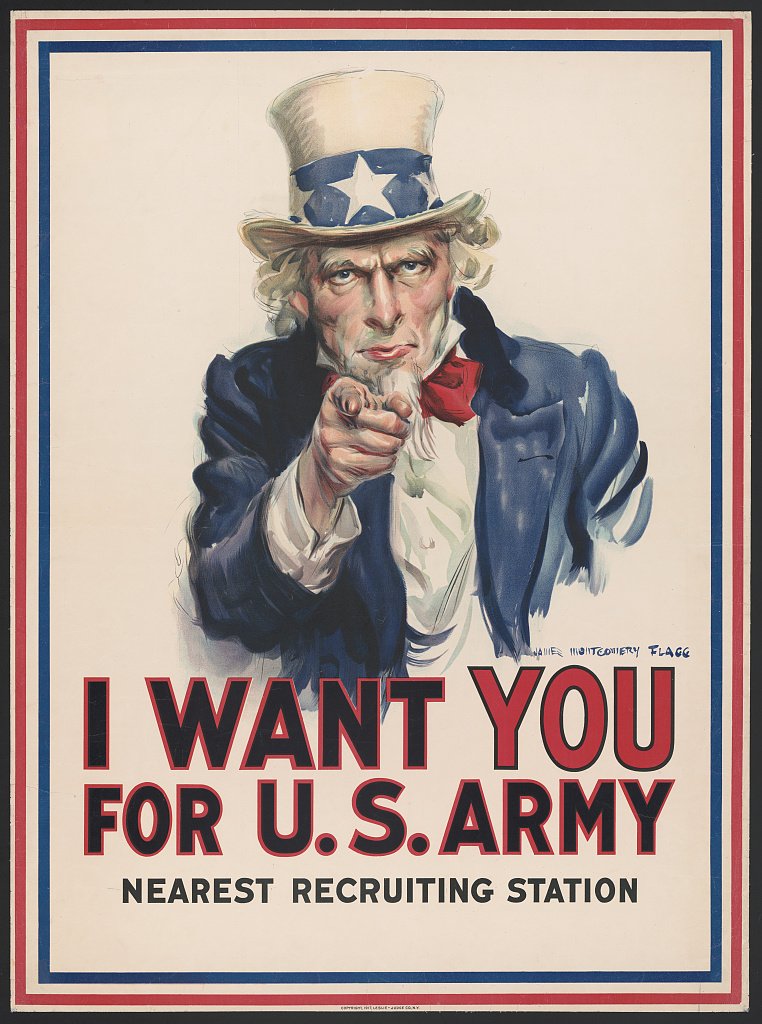
The poster most people mean by "Uncle Sam wants you" is James Montgomery Flagg's I want you for U.S. Army, catalogued by the Library of Congress as copyright 1917 by the Leslie-Judge Co. of New York.11 The Library's record describes Uncle Sam pointing his finger at the viewer to recruit soldiers, with the printed phrase "Nearest recruiting station" over a blank space where a local office could add its address. That blank is a design decision worth noticing. The poster was made to be overprinted, so one design could serve thousands of local recruiters.
The Library's Today in History entry gives the numbers and the origin. "More than four million copies were printed between 1917 and 1918."12 The picture had run first as the cover of Leslie's Weekly on July 6, 1916.13 And Flagg, dressed in his own Uncle Sam suit, used himself as the model for this poster and his other Uncle Sam illustrations.14 The Library's catalog record adds the rights position: "No known restrictions on publication. No renewal in Copyright Office." Because the work was published before 1931 it is in the public domain on that basis alone.
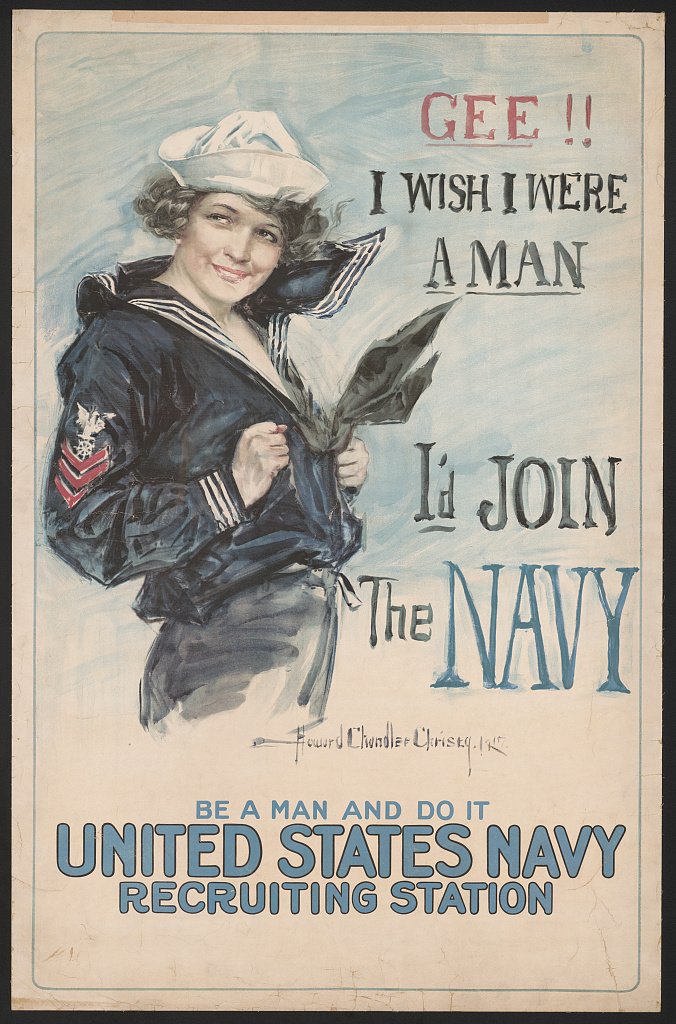
Howard Chandler Christy took a different path to the same end. His 1917 Navy recruiting poster, "Gee!! I wish I were a man, I'd join the Navy", shows a young woman in a Navy uniform and the line "Be a man and do it," with a recruiting station address line below.15 The Library catalogues it as a lithograph about 105 by 68 centimeters with no known restrictions on publication.16 The appeal is to shame and desire at once, and it puts a woman on the poster to recruit men. That poster is also a reminder that a political image can be thoroughly of its time. It is a historical record of what the Navy thought would work in 1917, and a reader in 2026 can study it as one.
Lesson 01 covers the Creel Committee's Division of Pictorial Publicity and its verified print counts, so this lesson does not repeat them.
Myth: Flagg drew Uncle Sam for the 1917 recruiting poster
The Library of Congress says Leslie's Weekly first published Flagg's picture of Uncle Sam as the cover of the July 6, 1916 issue, which was before the United States entered the war in 1917.17 The 1917 poster used the same character, and the Library says more than four million copies were printed between 1917 and 1918. The point for a reader: dating a famous image to its best-known use can miss its first life. The catalog record is where the earlier date lives.
The Second World War: four freedoms and a factory poster
Rockwell and the war bond tour
Norman Rockwell's four paintings for The Saturday Evening Post began with President Franklin D. Roosevelt's address to Congress in January 1941, which named four freedoms: of speech, of worship, from want and from fear. The Norman Rockwell Museum's Four Freedoms page says the paintings ran in the Post, with Freedom of Speech in the February 20, 1943 issue and Freedom of Worship in the February 27, 1943 issue.18 The page does not give dates for the other two, so neither does this lesson.
The paintings then became a government property of sorts. The Museum records that the Post and the U.S. Treasury Department announced a joint campaign in May 1943.19 The exhibition, which also included about 1,000 original cartoons and paintings by other illustrators and original Post manuscripts, traveled to 16 cities. More than a million people visited, and visitors bought $133 million in war bonds and stamps.20 Each bond buyer received a set of prints. The Office of War Information separately printed four million sets of poster reproductions, each marked "Buy War Bonds," for schools, institutions and overseas distribution.21
The images are not in the public domain. The Museum's page marks Freedom of Speech and Freedom of Worship "© 1943 SEPS: Licensed by Curtis Licensing, Indianapolis, IN. All rights reserved,"22 and the other two as copyrighted to SEPS and Curtis Publishing. The paintings belong to the Museum's permanent collection. This lesson links to the Museum and describes them without reproducing them. The government's use of them as bond posters did not move the copyright, and a reader who wants to republish needs a license from the rights holder.
We Can Do It!
J. Howard Miller's "We Can Do It!" is probably the most reproduced American poster of the war and the most misdescribed. The Smithsonian's National Museum of American History catalogues it as a photolithograph, 22 by 17 inches, dated about 1942.23 The record lists Westinghouse Electric Corporation as commissioner, Miller as maker and the War Production Coordinating Committee as distributor, and describes it as a work-incentive poster for Westinghouse.24 It says the poster was displayed only briefly in Westinghouse factories and later became one of the most famous icons of World War II.25 The page tags it with the subject "Rosie the Riveter" but does not explain the link, and it marks the image CC0, meaning the Museum permits copying, modification and distribution without contacting it.26
The commonly told story adds that the poster was posted for two weeks in February 1943 and forgotten until the 1980s, when it was rediscovered. The Smithsonian page does not state the display dates or the rediscovery, so this lesson does not state them as fact. What the record does support is the practical point: the poster was made for workers inside one company's plants, and its fame came afterward. It was not a national recruiting poster, and a poster made to motivate people already hired is a different job from one made to get them in the door.
The WPA posters: art as a payroll item
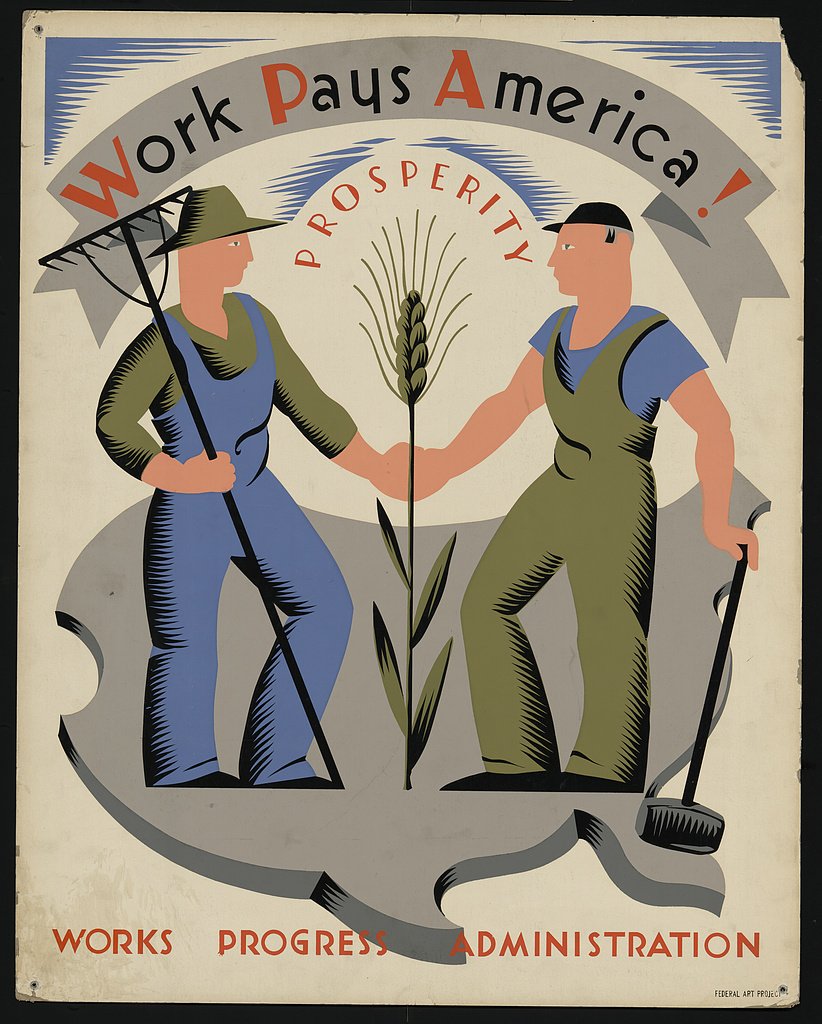
The Federal Art Project, part of the Works Progress Administration's Federal Project Number One, employed more than 5,000 artists, according to the Library of Congress's WPA poster collection page.27 Its poster divisions are the best-documented part of the story. The collection holds 907 posters produced from 1936 to 1943 by various branches of the WPA.28 Of the 2,000 WPA posters the Library says are known to exist, its collection of more than 900 is the largest.29 They were made for exhibits, community activities, theatrical productions and health and educational programs in 17 states and the District of Columbia, with the strongest representation from California, Illinois, New York, Ohio and Pennsylvania.
The Library also gives the production figures. Across the history of the WPA art projects, over two million posters were printed from 35,000 designs.30 The first poster division grew from New York City's Mayor's Poster Project of 1934, absorbed by the federal government in 1935 and headed by Richard Floethe, a German-born industrial designer educated in the Bauhaus tradition.31 By 1938 there were poster divisions in at least 18 states. At first posters were painted and lettered by hand. Silkscreen changed that. Project artist Anthony Velonis adapted the process for mass poster production in 1936, after working in a New York department store's show-card shop, and with it as many as 600 posters could be printed in a day.32 Velonis and the print curator Carl Zigrosser coined the word "serigraph" to signal the fine-art side of the process.33
The posters did more than advertise. Most promoted arts, health and education programs, so the government was using its own public art to explain itself to citizens. That is political in the broad sense, and the Library quotes Floethe's view that the government had "unwittingly launched a movement" to raise the commercial poster to a true art form.34 Congressional opposition mattered too: the Library says the New York division was put back under Mayor La Guardia's sponsorship in 1939 in part because of it, and by 1942 the remaining WPA art projects were transferred to the Defense Department as the Graphics Section of the War Service Division.
| Poster program | Dates | Verified figures | Source |
|---|---|---|---|
| Flagg, I Want You | 1917 to 1918 | More than four million copies | Library of Congress |
| Rockwell, Four Freedoms, OWI reproductions | 1943 | Four million sets | Norman Rockwell Museum |
| Four Freedoms war bond tour | Announced May 1943 | 16 cities, over one million visitors, $133 million in bonds and stamps | Norman Rockwell Museum |
| WPA posters, all poster divisions | 1936 to 1943 | Over two million printed from 35,000 designs; about 2,000 known to survive | Library of Congress |
| WPA posters in the Library of Congress | 1936 to 1943 | 907 posters, 17 states and D.C. | Library of Congress |
| Silkscreen output per shop | From 1936 | As many as 600 posters a day | Library of Congress |
Ben Shahn: the poster as an argument
Ben Shahn is the artist in this lesson who moved most easily between government and political work. The Library holds his OWI poster "This is Nazi brutality", dated June 11, 1942, catalogued as OWI #11.35 The Library's summary calls it an allegorical poster showing a faceless man handcuffed to a wall, with a telegram announcing the destruction of Lidice, Czechoslovakia, in retaliation for the assassination of SS leader Reinhard Heydrich.36 The Library's rights field on that record reads "Rights status not evaluated,"37 so this lesson links to it and does not embed it. The record names Shahn as artist and gives the OWI number, and says nothing about his employment status.
Two years later Shahn worked for a political committee. His 1944 poster "Our friend", published by the National Citizens Political Action Committee, shows the profile of Franklin Delano Roosevelt amid hands waving hats bearing labor union insignia, with a soldier carrying a child.38 The Library's record says "No known restrictions on publication. Published without copyright notice."39 His 1944 "For full employment after the war, register, vote", for the CIO Political Action Committee, shows two men in hard hats, one of them African American, and carries the same finding.40
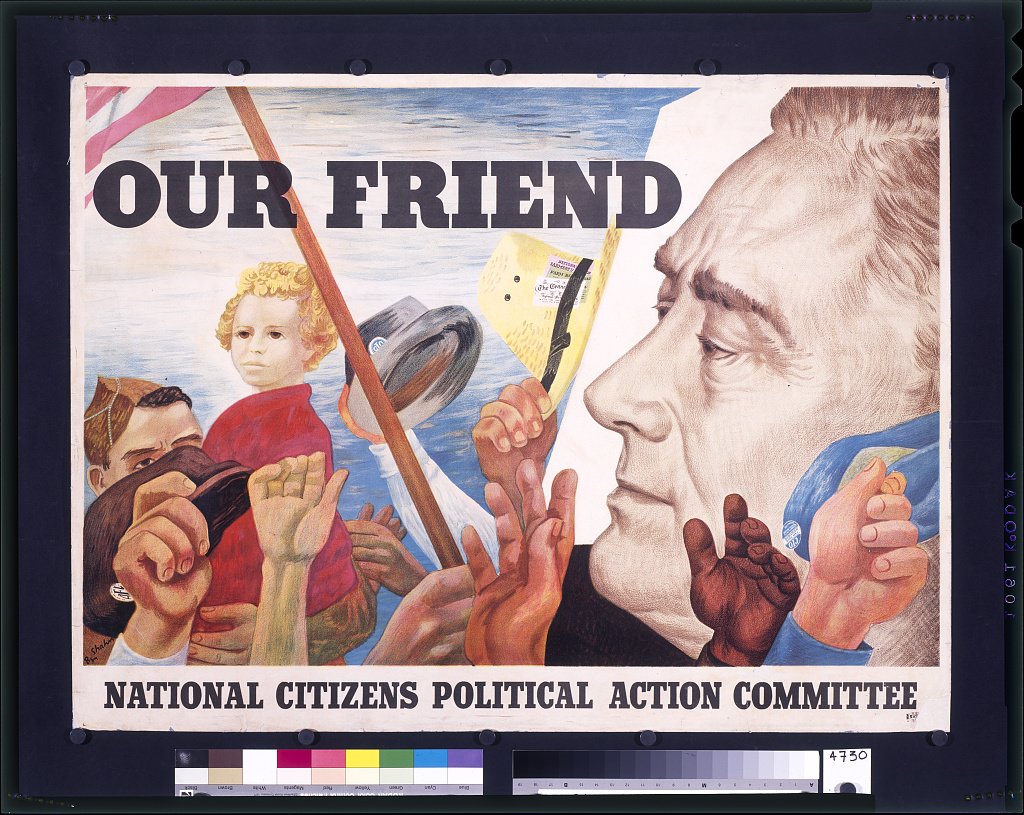
Both political posters were made for political committees in 1944, a presidential election year, and the second carries a register-and-vote message. The same artist drew for a federal agency in 1942 and for campaign committees in 1944, and the Library's records are what separate the two. Lesson 10 returns to this with a method for describing the publisher of a political image.
How to: trace a poster's publisher and print history
- Start with the Library of Congress catalog record. Read the title, the creator, the "created_published" line, and the notes. Flagg's record gives "Copyright by Leslie-Judge Co., N.Y." and a promotional goal ("U.S. J22. 1917"). That tells you who published it and what it was for.
- Read the reproduction numbers. Flagg's record lists several, including LC-DIG-ppmsc-03521 for the digital file and LC-USZC4-3859 for a color transparency, which tells you the Library holds more than one copy.
- Look for print figures in a second source. The four million Flagg copies come from the Library's Today in History entry. A figure in a record's notes and a figure in an essay are different kinds of evidence.
- Find the commissioner and the distributor. For Miller's poster the Smithsonian lists Westinghouse as commissioner and the War Production Coordinating Committee as distributor. A poster's audience follows from who sent it where.
- Check the exhibition and publication notes. The Flagg record says it was exhibited in "Echoes of the Great War" at the Library in 2017 and 2018.41 Exhibition notes confirm the object exists and was handled by curators.
- When a story about the poster is too good, look for the line in the record that supports it. Where none exists, say the story is commonly told and unverified.
Rivera and Rockefeller Center
In 1933, Diego Rivera was painting a mural on the interior wall facing the plaza entrance of the RCA Building at Rockefeller Center. PBS's American Experience account says Abby and Nelson Rockefeller persuaded Rockefeller Center management to hire him, and that John D. Rockefeller Jr. agreed reluctantly.42 The mural's title was "Man at the Crossroads Looking with Hope and High Vision to the Choosing of a New and Better Future." In May 1933 Nelson Rockefeller saw a portrait of Lenin in the newest part of the mural.43 He wrote asking Rivera to replace the face, saying it "might very seriously offend a great many people."44 Rivera refused, arguing his intent had been clear from the start.
Rockefeller Center's management ordered Rivera to stop work and paid his fee in full.45 In February 1934, two of Rivera's assistants found shattered fragments of the mural in a dozen 50-gallon oil drums near the RCA Building entrance.46 The mural had been hammered off the walls on management's orders. After returning home, PBS says, Rivera painted a replica in Mexico City.47 The PBS page does not give the date of Rockefeller's letter, the date of the dismissal, the fee amount, the date the mural was covered, or the replica's year or title. Other accounts give them, but this lesson did not verify them on a primary page and leaves them out.
There are two strong views, and each has a fair basis. Rockefeller Center's was a property position: the building and its wall were privately owned, the commission had a subject, and the client had the right to refuse a work that departed from what it had approved. Rivera's was an artist's position: the work was a public statement on a public-facing wall, he had been clear from the start about its content, and the destruction of a finished painting is a different act from declining to accept one. Neither side's argument depends on agreeing with the Lenin portrait. The wall's owner decided, and Rivera was paid. That is the law of murals in one case: a mural is a painting that a landlord owns.
The drawn line as party line: Rodchenko and Emory Douglas
The Museum of Modern Art describes Aleksandr Rodchenko as "one of the innovators and most dedicated practitioners of Russian Constructivism,"48 whose main focus was graphic design, photography and photomontage. MoMA holds, among his works, the 1929 book Rechevik. Stikhi (Orator. Verse) with a letterpress cover, by the author Sergei Tretyakov. The page checked for this lesson is a collection record and does not discuss Soviet politics, so this lesson makes no claim about Rodchenko's relationship to the state or his poster output beyond MoMA's description. That is a limit of the verified record, not a judgment that the topic is unimportant.
Emory Douglas shows how the drawn line served a movement in the United States. According to the University of California Riverside's account of its 2019 exhibition, he was born in Grand Rapids, Michigan, in 1943, was incarcerated as a teenager at the Youth Training School in Ontario, California, where he worked in the print shop, and later studied graphic design at San Francisco City College, where he developed an interest in the Black Arts Movement and political activism.49 He joined the Black Panther Party in 1967 and served as its minister of culture and graphic artist for its newspaper, tasked with establishing its visual identity.50 The newspaper was published for 12 years and at its peak had a circulation of "over 300,000," according to the same article.51 His style used bold lines, vibrant colors and frequent photographic collage, and his imagery addressed police brutality and economic and racial discrimination. The exhibition, "Emory Douglas: Bold Visual Language," ran at the Culver Center of the Arts from April 27 to July 14, 2019, organized by LACE.52
The two cases have something in common: a printed image meant to be copied, folded, posted and passed on, produced by a movement for its own audience. Whether the audience agreed is the movement's business. For a student of political art, the question is the one in the how-to boxes of this lesson: who made it, who published it, how many copies, and for whom.
The Guerrilla Girls
The National Gallery of Art describes the Guerrilla Girls as an anonymous group of female artists and art-world professionals who first put up posters on Soho and East Village walls in 1985, provoked by an international survey of painting and sculpture at the Museum of Modern Art.53 The Gallery's collection holds one of their best-known posters, "Do women have to be naked to get into the Met. Museum?". According to the group's own site, Naked Through the Ages, the group counted the women artists on display at the Metropolitan Museum against the number of naked female bodies in the artworks, with "very revealing" results.54 The Public Art Fund in New York had asked them to design a billboard, rejected the design, claiming it was not "clear enough," and the poster ran instead as an advertisement on New York City buses.55 The statistics appear only in the poster image, and this lesson does not quote them from memory.
The group's own site describes its method as disruptive headlines, striking visuals and statistics, and the Met poster puts the institution's own galleries to work as evidence. The museum side of the argument is that a collection reflects what was available and what donors gave. This lesson did not find a museum statement to quote on the 1989 poster, so it describes that position without attributing words to anyone.
Hope, the Associated Press and the evidence file
Shepard Fairey's red, cream and light-blue portrait of Barack Obama, a determined-looking figure gazing upward over the word "HOPE," became the image of the 2008 presidential campaign. The Associated Press's report of the 2012 sentencing describes it so and notes that Fairey was chosen to design the official poster of Obama's 2009 inauguration and made the cover image for Time magazine's 2008 Person of the Year.56
The dispute began with a photograph. The U.S. Attorney's Office for the Southern District of New York's press release says Fairey sued the Associated Press in 2009 for a declaration that his Obama works did not infringe AP copyrights.57 His complaint said he had used a photo of Obama and George Clooney as a reference. The Office says that was untrue: he had used a tightly cropped AP image of Obama alone, taken at an April 2006 National Press Club event.58 It says he created false documents to make it appear he used the Clooney photo, produced them to the AP in discovery, tried to delete electronic documents showing the real reference image, disobeyed discovery orders, suggested a back-dated document retention policy, and coached a witness to give an account he knew was untrue.59
The Associated Press's reporter wrote that Fairey admitted in the fall of 2009 that he had altered evidence.60 On September 7, 2012, U.S. Magistrate Judge Frank Maas sentenced Fairey for criminal contempt to two years of probation, 300 hours of community service and a $25,000 fine payable to the United States, sparing him jail on a misdemeanor charge with a maximum sentence of six months.61 The judge said the sentence needed to send a message that covering up is worse than telling the truth, and that Fairey's charity work over a long period mitigated the need for prison. Fairey called his decision to fabricate evidence the "worst thing I've done in my life"62 and apologized. The AP's chief executive said the company was glad the matter was "finally behind us"63 and called for fair compensation for those who produce original news content.
The prosecutor told the court, the AP reported, that Fairey personally paid only $1.15 million of $1.6 million owed to the AP in the settlement of the civil case, with insurance covering the rest.64 That settles one question this lesson is careful about: the civil case was resolved by settlement, so no court decided whether the Hope poster was a fair use of the AP photograph. Fairey's side, as the AP put it, was that he used most of the money he earned from the poster to create more posters and stickers and to make donations to the Obama campaign. The AP's side, in its chief executive's words, was the importance of fair compensation for those who produce original news content. The strongest points on each side were never tested on the merits.
The criminal case, by contrast, was decided on conduct that had nothing to do with the merits. It is possible to think the Hope poster was a legitimate transformation of a news photograph and still think fabricating evidence was serious, which is what the judge's sentence reflected.
How to: check whether a government poster is in the public domain
- Find the Library of Congress record and read its "rights advisory." Flagg's reads "No known restrictions on publication. No renewal in Copyright Office." Shahn's "This is Nazi brutality" reads "Rights status not evaluated." The two results call for different handling.
- Check the publication date. The Copyright Office's Circular 15A states that all works published in the United States before January 1, 1931 are in the public domain.65 Flagg's c1917 poster passes this test regardless of anything else.
- For a poster made by the federal government, read 17 U.S.C. 105, which says copyright protection under that title "is not available for any work of the United States Government."66 Note the word "work of" the government. It means works by federal employees as part of official duties. A poster by an outside contractor or a freelancer is not automatically covered, and the 105 rule has its own exceptions for certain covered works.
- For a work published from 1931 to 1977, the circular says the maximum total term of works already protected before 1978 is 95 years: a 28-year first term and a 67-year renewal.67 Do not guess. Check whether copyright was renewed.
- Remember the Library's own caveat. It says it does not own rights to material in its collections, does not license or grant permission, and that "it is the researcher's obligation to assess copyright or other restrictions."68
- If you cannot resolve the status, link to the Library or museum page and describe the work in words. Lesson 10 covers licensing a work you cannot use freely.
Banksy and the street
The Associated Press's account of October 5, 2018 shows how a political image can be sold and destroyed in the same minute. "Girl with Balloon" sold at Sotheby's in London for 1.04 million pounds ($1.4 million).69 After the hammer fell, an alarm sounded and the canvas fed into a shredder hidden in its frame, leaving half hanging in strips. Banksy's Instagram caption read "Going, going, gone..."70
That episode is a commentary on the market for art and not a political poster in the narrow sense, and the AP piece, as fetched, does not discuss Banksy's political stencils. This lesson makes no claim about specific street works beyond the shredding. The street's legal position is different from a gallery's. A wall belongs to someone, so the wall's owner is the first person to ask about any street work. What a reader can use is the contrast: Rivera's mural was commissioned and destroyed by its owner, Banksy's canvas shredded itself after a sale and Banksy posted the caption, and Fairey's poster ended in a federal prosecution over a photograph.
Graphic journalism: the line carries the report
The 2022 Pulitzer for Illustrated Reporting and Commentary, listed in lesson 04, went to Fahmida Azim, Anthony Del Col, Josh Adams and Walt Hickey of Insider for graphic reportage and comics on Chinese oppression of the Uyghurs, which the Pulitzer citation says made the issue accessible to a wider public.71 That is the poster's reach, applied to reporting. A drawn report can reach readers who do not read long text, and can show events no camera was present for. Its risk is the one all reconstruction carries: the drawing shows what the artist chose to show. This lesson did not verify the work of the comics journalist Joe Sacco, often named in this field, and leaves out claims about his books.
What the century's posters share
| Work | Maker and commissioner | Verified fact | Rights position |
|---|---|---|---|
| I Want You (c1917) | Flagg; Leslie-Judge Co. | More than four million copies, 1917 to 1918 | Public domain; no renewal; LOC: no known restrictions |
| Gee!! I wish I were a man (1917) | Christy; U.S. Navy | Lithograph, about 105 by 68 cm | LOC: no known restrictions |
| Four Freedoms (1943) | Rockwell; Saturday Evening Post, Treasury, OWI | 16 cities, $133 million, four million sets | Copyrighted; link only |
| We Can Do It! (ca. 1942) | Miller; Westinghouse | Displayed briefly in factories | CC0 per Smithsonian |
| WPA posters (1936 to 1943) | FAP poster divisions | 907 in LOC; over two million printed | LOC: no known restrictions (checked per item) |
| Our friend (1944) | Shahn; NCPAC | Published without copyright notice | LOC: no known restrictions |
| Man at the Crossroads (1933) | Rivera; Rockefeller Center | Hammered off the wall; fragments in oil drums, Feb. 1934 | Destroyed |
| Hope (2008) | Fairey; Obama campaign | Fairey sentenced Sept. 7, 2012 for contempt | Copyrighted; link only |
| Girl with Balloon (2018) | Banksy; sold at Sotheby's | 1.04 million pounds; half shredded | Copyrighted; link only |
If you report on this
- Use the Library of Congress record as your first source for a poster's date, publisher and rights. Quote the rights advisory exactly and say that the Library does not guarantee it.
- When you cite a print figure, name the source with it: "more than four million copies between 1917 and 1918, per the Library of Congress" and "four million sets, per the Norman Rockwell Museum." Do not average or round up across sources.
- Do not tell the We Can Do It! rediscovery story as settled fact. The Smithsonian record supports Westinghouse, Miller, the committee and the brief factory display. Say the rest is commonly told.
- For the Fairey case, state the sentence and the reason (criminal contempt for fabricating evidence), and say the fair use question was not decided because the civil case settled.
- For any mural, find out who owns the wall. The answer controls who can remove the work.
- Records to request from a local arts commission or school district: the commission contract for any public mural or poster, which shows who owns the work, who may alter or remove it, and who holds the copyright.
Go further
- Library of Congress, WPA poster collection and its rights and restrictions page, plus the Library's World War I posters guide at loc.gov/rr/print/res/243_wwipos.html.
- Norman Rockwell Museum, Four Freedoms for the licensing line on each painting.
- Smithsonian National Museum of American History, We Can Do It! object record.
- PBS American Experience on Rivera and the Rockefellers.
- Books named in the Library's WPA bibliography: Christopher DeNoon, Posters of the WPA (Wheatley Press, 1987), and Francis V. O'Connor, Art for the Millions (New York Graphic Society, 1973).
- U.S. Attorney's Office press release on the Fairey sentencing and the AP report.
- 17 U.S.C. 105 and Circular 15A, Duration of Copyright.
- The First Amendment lesson, and previous: the political cartoon in the 21st century. Next: photography and politics.
Questions and answers
How many copies of the Uncle Sam poster were printed?
The Library of Congress says more than four million copies between 1917 and 1918. The same entry says the image first ran as the Leslie's Weekly cover of July 6, 1916. Cite the Library when you give the number, because other figures circulate.
Was the Four Freedoms series a government project?
It began as Rockwell's Post commission, and then the government used it. The Norman Rockwell Museum says the Post and the Treasury Department announced a joint war bond campaign in May 1943, the exhibition traveled to 16 cities, and the Office of War Information printed four million sets of reproductions. The paintings remained copyrighted by the Post's rights holders, so government use did not make them public domain.
Was We Can Do It! a recruiting poster for women war workers?
The Smithsonian describes it as a work-incentive poster for Westinghouse, made by J. Howard Miller, distributed by the War Production Coordinating Committee, and displayed only briefly in factories. It was aimed at people already working there. The popular claim that it was a national recruiting poster is not supported by the record checked.
How many WPA posters survive?
The Library of Congress says about 2,000 are known to exist, of which its 907 are the largest holding. Over two million were printed from 35,000 designs. The Library does not say how many of the printed copies were lost.
Did Rockefeller Center pay Diego Rivera for the mural it destroyed?
PBS says management ordered him to stop work and paid his fee in full. It does not state the fee, and this lesson does not either. The mural was hammered off the wall, and in February 1934 two assistants found fragments in a dozen 50-gallon oil drums.
What happened to Shepard Fairey?
On September 7, 2012, Magistrate Judge Frank Maas sentenced him for criminal contempt to two years of probation, 300 hours of community service and a $25,000 fine. The charge was about fabricating and deleting evidence in his 2009 civil suit against the Associated Press. The civil case settled, so no court ruled on whether the Hope poster was fair use.
Can I reproduce a WPA poster from the Library of Congress?
Check the individual record. The Vera Bock poster in this lesson carries "No known restrictions on publication." The Library says it does not own rights to material in its collections and that the researcher has to assess restrictions. Federal government works have no copyright under 17 U.S.C. 105, but a poster by a local government or an outside artist may differ.
Is Banksy's shredded painting political?
The AP account describes the October 5, 2018 shredding after a 1.04 million pound sale at Sotheby's and Banksy's caption, and not a political message. Whether it is political art or a comment on the art market is an interpretation. The facts are the sale, the shredder and the caption.
Hard questions
Isn't a government paying artists to make posters just propaganda?
Some of it was, and the Library's own collection page says the posters promoted federal programs. The WPA's stated purpose was employing out-of-work artists, and the Library records that more than 5,000 were employed. Both facts hold. A poster for a theater performance or a health clinic is publicity for a public service, and a poster that sells a war is persuasion. Citizens are entitled to ask which is which, and the catalog record usually tells you who paid.
If the Rockefellers owned the wall, wasn't destroying the mural within their rights?
On the facts PBS gives, management controlled the wall and paid Rivera in full. The counter-argument is an artistic and civic one: a finished mural is the work of the artist's hand, and destroying it is permanent. The PBS page does not mention a lawsuit, and no source checked here addresses the law on destroying artworks.
Fairey lied under oath. Doesn't that prove the Hope poster was theft?
No. It proves he fabricated evidence about which photograph he used, and he was punished for it. Whether a heavily altered portrait based on a news photograph is a fair use is a separate question that a court never answered, because the civil case settled. The AP says it was glad the matter was behind it. Fairey says he used most of his earnings to make more art and to donate. A fair reader can think the use was legitimate and the cover-up inexcusable.
Why not just embed the famous posters, if everyone has seen them?
Because fame does not change the copyright. Rockwell's Four Freedoms are marked as copyrighted by the Post's rights holders on the Museum's own page. Hope, Girl with Balloon and We Can Do It! each have a different rights position, and CC0 applies to the Smithsonian's image of Miller's poster only by the Museum's own statement. The posters in this lesson are the ones the record supports reproducing: a 1917 poster, a 1917 Navy poster, a WPA poster and a 1944 poster published without notice. For the rest, a link serves the reader as well.
Doesn't the focus on posters ignore the artists' own politics?
It would if the lesson ignored them, and the aim here is the opposite: Flagg and Christy sold wars, Shahn drew for federal agencies and for union committees, Douglas drew for a movement, the Guerrilla Girls for a cause, and Fairey for a campaign. Each is treated by what the record shows them doing. A reader can disagree with any of them and still check the print figures.
Learn more
- Library of Congress, WPA poster collection: The production figures, the silkscreen story and the program's history in one place.
- Library of Congress, Flagg's Uncle Sam record: The catalog entry that shows how to read a poster's publisher and rights line.
- Library of Congress, Today in History, June 18: The print run and the 1916 magazine cover behind the famous poster.
- Norman Rockwell Museum, Four Freedoms: The war bond tour figures and the licensing line on each painting.
- Smithsonian, We Can Do It! object record: What the museum does and does not say about the factory poster.
- PBS American Experience on Rivera and the Rockefellers: The account of the Rockefeller Center mural and its destruction.
- U.S. Attorney's Office press release on the Fairey sentencing: The prosecutors' account of the fabricated evidence behind the Hope case.
- 17 U.S.C. 105: The statute that denies copyright to works of the federal government.
- Circular 15A, Duration of Copyright: The Copyright Office table for when old works enter the public domain.
Notes
- Library of Congress, Today in History, June 18, on the "I Want You" poster. Read it online. ↩
- Norman Rockwell Museum, "Norman Rockwell's Four Freedoms." Read it online. ↩
- Library of Congress, Work Projects Administration Posters: About this Collection. Read it online. ↩
- Library of Congress, Work Projects Administration Posters: About this Collection. Read it online. ↩
- PBS American Experience, The Rockefellers: Rivera's mural. Read it online. ↩
- PBS American Experience, The Rockefellers: Rivera's mural. Read it online. ↩
- U.S. Attorney's Office, Southern District of New York, press release on the sentencing of Shepard Fairey, September 7, 2012. Read it online. ↩
- Associated Press via Christian Science Monitor, "Shepard Fairey spared jail time in criminal contempt case," September 7, 2012. Read it online. ↩
- U.S. Copyright Office, Circular 15A, Duration of Copyright (revised April 2026). Read it online. ↩
- 17 U.S.C. 105, United States Government works. Read it online. ↩
- Library of Congress, "I want you for U.S. Army," James Montgomery Flagg, c1917, catalog record. Read it online. ↩
- Library of Congress, Today in History, June 18, on the "I Want You" poster. Read it online. ↩
- Library of Congress, Today in History, June 18, on the "I Want You" poster. Read it online. ↩
- Library of Congress, Today in History, June 18, on the "I Want You" poster. Read it online. ↩
- Library of Congress, "Gee!! I wish I were a man, I'd join the Navy," Howard Chandler Christy, 1917, catalog record. Read it online. ↩
- Library of Congress, "Gee!! I wish I were a man, I'd join the Navy," Howard Chandler Christy, 1917, catalog record. Read it online. ↩
- Library of Congress, Today in History, June 18, on the "I Want You" poster. Read it online. ↩
- Norman Rockwell Museum, "Norman Rockwell's Four Freedoms." Read it online. ↩
- Norman Rockwell Museum, "Norman Rockwell's Four Freedoms." Read it online. ↩
- Norman Rockwell Museum, "Norman Rockwell's Four Freedoms." Read it online. ↩
- Norman Rockwell Museum, "Norman Rockwell's Four Freedoms." Read it online. ↩
- Norman Rockwell Museum, "Norman Rockwell's Four Freedoms." Read it online. ↩
- Smithsonian National Museum of American History, "We Can Do It!" by J. Howard Miller, Westinghouse, ca. 1942, object record. Read it online. ↩
- Smithsonian National Museum of American History, "We Can Do It!" by J. Howard Miller, Westinghouse, ca. 1942, object record. Read it online. ↩
- Smithsonian National Museum of American History, "We Can Do It!" by J. Howard Miller, Westinghouse, ca. 1942, object record. Read it online. ↩
- Smithsonian National Museum of American History, "We Can Do It!" by J. Howard Miller, Westinghouse, ca. 1942, object record. Read it online. ↩
- Library of Congress, Work Projects Administration Posters: About this Collection. Read it online. ↩
- Library of Congress, Work Projects Administration Posters: About this Collection. Read it online. ↩
- Library of Congress, Work Projects Administration Posters: About this Collection. Read it online. ↩
- Library of Congress, Work Projects Administration Posters: About this Collection. Read it online. ↩
- Library of Congress, Work Projects Administration Posters: About this Collection. Read it online. ↩
- Library of Congress, Work Projects Administration Posters: About this Collection. Read it online. ↩
- Library of Congress, Work Projects Administration Posters: About this Collection. Read it online. ↩
- Library of Congress, Work Projects Administration Posters: About this Collection. Read it online. ↩
- Library of Congress, "This is Nazi brutality," Ben Shahn, OWI poster, June 11, 1942, catalog record. Read it online. ↩
- Library of Congress, "This is Nazi brutality," Ben Shahn, OWI poster, June 11, 1942, catalog record. Read it online. ↩
- Library of Congress, "This is Nazi brutality," Ben Shahn, OWI poster, June 11, 1942, catalog record. Read it online. ↩
- Library of Congress, "Our friend," Ben Shahn, National Citizens Political Action Committee, 1944, catalog record. Read it online. ↩
- Library of Congress, "Our friend," Ben Shahn, National Citizens Political Action Committee, 1944, catalog record. Read it online. ↩
- Library of Congress, "For full employment after the war, register, vote," Ben Shahn, 1944, catalog record. Read it online. ↩
- Library of Congress, "I want you for U.S. Army," James Montgomery Flagg, c1917, catalog record. Read it online. ↩
- PBS American Experience, The Rockefellers: Rivera's mural. Read it online. ↩
- PBS American Experience, The Rockefellers: Rivera's mural. Read it online. ↩
- PBS American Experience, The Rockefellers: Rivera's mural. Read it online. ↩
- PBS American Experience, The Rockefellers: Rivera's mural. Read it online. ↩
- PBS American Experience, The Rockefellers: Rivera's mural. Read it online. ↩
- PBS American Experience, The Rockefellers: Rivera's mural. Read it online. ↩
- Museum of Modern Art, Aleksandr Rodchenko, Rechevik. Stikhi (Orator. Verse), 1929, collection record. Read it online. ↩
- University of California Riverside, "The Enduring Power of Art Activism: Emory Douglas, Bold Visual Language," 2019. Read it online. ↩
- University of California Riverside, "The Enduring Power of Art Activism: Emory Douglas, Bold Visual Language," 2019. Read it online. ↩
- University of California Riverside, "The Enduring Power of Art Activism: Emory Douglas, Bold Visual Language," 2019. Read it online. ↩
- University of California Riverside, "The Enduring Power of Art Activism: Emory Douglas, Bold Visual Language," 2019. Read it online. ↩
- National Gallery of Art, Guerrilla Girls, "Do women have to be naked to get into the Met. Museum?" collection record. Read it online. ↩
- Guerrilla Girls, "Naked Through the Ages." Read it online. ↩
- Guerrilla Girls, "Naked Through the Ages." Read it online. ↩
- Associated Press via Christian Science Monitor, "Shepard Fairey spared jail time in criminal contempt case," September 7, 2012. Read it online. ↩
- U.S. Attorney's Office, Southern District of New York, press release on the sentencing of Shepard Fairey, September 7, 2012. Read it online. ↩
- U.S. Attorney's Office, Southern District of New York, press release on the sentencing of Shepard Fairey, September 7, 2012. Read it online. ↩
- U.S. Attorney's Office, Southern District of New York, press release on the sentencing of Shepard Fairey, September 7, 2012. Read it online. ↩
- Associated Press via Christian Science Monitor, "Shepard Fairey spared jail time in criminal contempt case," September 7, 2012. Read it online. ↩
- Associated Press via Christian Science Monitor, "Shepard Fairey spared jail time in criminal contempt case," September 7, 2012. Read it online. ↩
- Associated Press via Christian Science Monitor, "Shepard Fairey spared jail time in criminal contempt case," September 7, 2012. Read it online. ↩
- Associated Press via Christian Science Monitor, "Shepard Fairey spared jail time in criminal contempt case," September 7, 2012. Read it online. ↩
- Associated Press via Christian Science Monitor, "Shepard Fairey spared jail time in criminal contempt case," September 7, 2012. Read it online. ↩
- U.S. Copyright Office, Circular 15A, Duration of Copyright (revised April 2026). Read it online. ↩
- 17 U.S.C. 105, United States Government works. Read it online. ↩
- U.S. Copyright Office, Circular 15A, Duration of Copyright (revised April 2026). Read it online. ↩
- Library of Congress, "I want you for U.S. Army," James Montgomery Flagg, c1917, catalog record. Read it online. ↩
- Associated Press via MPR News, "Banksy artwork self-destructs just after $1.4 million sale," October 6, 2018. Read it online. ↩
- Associated Press via MPR News, "Banksy artwork self-destructs just after $1.4 million sale," October 6, 2018. Read it online. ↩
- Pulitzer Prizes, Illustrated Reporting and Commentary winners, 2022 entry for Insider. Read it online. ↩
Check yourself
1. According to the Library of Congress, how many copies of James Montgomery Flagg's I Want You Uncle Sam poster were printed, and when?
The Library of Congress says more than four million copies were printed between 1917 and 1918, and that Leslie's Weekly first published the image as the cover of its July 6, 1916 issue, with Flagg using himself as the model.
2. What does the Smithsonian's National Museum of American History say about J. Howard Miller's We Can Do It! poster?
The object record names Miller as maker, Westinghouse as commissioner and the War Production Coordinating Committee as distributor, dated about 1942, and says it was displayed only briefly in factories. The page does not give the 1980s rediscovery story, so this lesson does not either.
3. How many people visited the Four Freedoms war bond exhibition and how much did they buy, per the Norman Rockwell Museum?
The Museum says the exhibition traveled to 16 cities, drew more than one million visitors, and visitors bought $133 million in war bonds and stamps. The Office of War Information separately printed four million sets of poster reproductions marked Buy War Bonds.
4. What was done to Diego Rivera's mural in the RCA Building at Rockefeller Center?
PBS's American Experience says management ordered Rivera to stop work after Nelson Rockefeller objected to a portrait of Lenin, paid his fee in full, and that in February 1934 two assistants found shattered fragments in a dozen 50-gallon oil drums. The page gives no date for the dismissal.
5. On September 7, 2012, what was Shepard Fairey sentenced to for the AP case, according to the U.S. Attorney's Office?
Magistrate Judge Frank Maas imposed that sentence for criminal contempt tied to Fairey's fabrication and destruction of evidence in the civil case. Whether the Hope poster was a fair use of the AP photograph was never decided by a court, because the civil case settled.
6. Why can a reproduction of a Library of Congress poster still carry restrictions even when the Library lists it as having no known restrictions?
The Library's WPA collection page says it does not own rights to material in its collections, does not license or charge fees, and that it is the researcher's obligation to assess copyright or other restrictions. A rights advisory is a finding of record, not a guarantee.
Terms in this lesson
- Poster division
- A unit of the Federal Art Project that designed and printed posters for federal and local programs. The first was New York City's in 1935; by 1938 there were divisions in at least 18 states.
- Silkscreen (serigraph)
- A stencil printing method adapted for mass poster production in 1936 by Federal Art Project artist Anthony Velonis. As many as 600 posters could be printed in a day.
- Work-incentive poster
- A poster made to motivate workers inside a factory or agency, as opposed to a poster for the public. Miller's We Can Do It! was one, for Westinghouse.
- Mural
- A painting made directly on a wall or ceiling, often commissioned for a public or commercial building. Its owner controls the wall, which is how Rivera's mural was destroyed.
- Rights advisory
- The Library of Congress catalog field stating what is known about copyright or restrictions on an item. It is a cataloguer's finding and not a guarantee.
- Work of the United States Government
- A work prepared by a federal employee as part of official duties. Under 17 U.S.C. 105 it receives no copyright protection.
- Criminal contempt
- A charge for disobeying a court order. Fairey pleaded to it for fabricating and destroying evidence in his civil suit against the Associated Press.
- Street art
- Artwork made in public space, often without a commission. The wall's owner is the first person to ask about it.
Sources
- Library of Congress, I want you for U.S. Army, James Montgomery Flagg, c1917 (catalog record) checked 2026-10
- Library of Congress, Today in History, June 18 (I Want You: four million copies, Leslie's Weekly July 6, 1916) checked 2026-10
- Library of Congress, Gee!! I wish I were a man, I'd join the Navy, Howard Chandler Christy, 1917 checked 2026-10
- Smithsonian National Museum of American History, We Can Do It! (J. Howard Miller, Westinghouse, ca. 1942) checked 2026-10
- Norman Rockwell Museum, Norman Rockwell's Four Freedoms checked 2026-10
- Library of Congress, Work Projects Administration Posters: About this Collection checked 2026-10
- Library of Congress, Work pays America! Prosperity, Vera Bock, Federal Art Project (WPA poster) checked 2026-10
- Library of Congress, This is Nazi brutality, Ben Shahn, OWI poster, June 11, 1942 checked 2026-10
- Library of Congress, Our friend, Ben Shahn, National Citizens Political Action Committee, 1944 checked 2026-10
- Library of Congress, For full employment after the war, register, vote, Ben Shahn, 1944 checked 2026-10
- PBS American Experience, The Rockefellers: Rivera's mural checked 2026-10
- Museum of Modern Art, Aleksandr Rodchenko, Rechevik. Stikhi (Orator. Verse), 1929 checked 2026-10
- University of California Riverside, The Enduring Power of Art Activism: Emory Douglas, Bold Visual Language (2019) checked 2026-10
- National Gallery of Art, Guerrilla Girls, Do women have to be naked to get into the Met. Museum? checked 2026-10
- Guerrilla Girls, Naked Through the Ages checked 2026-10
- U.S. Attorney's Office, Southern District of New York, press release on the sentencing of Shepard Fairey (September 7, 2012) checked 2026-10
- Associated Press via Christian Science Monitor, Shepard Fairey spared jail time in criminal contempt case (September 7, 2012) checked 2026-10
- Associated Press via MPR News, Banksy artwork self-destructs just after $1.4 million sale (October 6, 2018) checked 2026-10
- 17 U.S.C. 105, United States Government works (Cornell Legal Information Institute) checked 2026-10
- U.S. Copyright Office, Circular 15A, Duration of Copyright (revised April 2026) checked 2026-10
- Pulitzer Prizes, Illustrated Reporting and Commentary winners (2022 Insider on the Uyghurs) checked 2026-10