Lesson 2 of 10 · about 55 minutes
The Political Cartoon, 1900 to 1945: Puck, Berryman, The Masses and Willie and Joe
You'll be able to
- Read a cartoon with the Library of Congress and National Archives techniques: symbols, words, caricature, exaggeration, irony and context
- Give the verified early Pulitzer winners and years for editorial cartooning from 1922 to 1945, including the years the category page lists no winner
- Recount the Berryman cartoon of November 16, 1902 and correct the claim that he invented the teddy bear
- State what happened to The Masses in 1917 and 1918: the postmaster's ban, Masses v. Patten, the indictment, and two juries that could not agree
- Describe the Mauldin and Patton episode of March 1945 with the points on which the sources differ
Start here: the short version
- Between 1900 and 1945 the newspaper cartoon became a daily habit for millions of readers. The Herb Block Foundation's 2011 report says American papers employed approximately 2,000 editorial cartoonists in the early 1900s.1 It names no source for the figure, so treat it as the Foundation's estimate.
- The first Pulitzer for editorial cartooning went to Rollin Kirby of the New York World in 1922, for "On the Road to Moscow."2 Through 1945 the Pulitzer site's category page lists twenty-two winners across twenty-two years and shows no entry for 1923 or 1936.3
- Cartoons could be dangerous to their makers. In August 1917 the New York postmaster refused to mail The Masses under the Espionage Act.4 In 1918 its editors and artists, Art Young among them, were tried for conspiring to obstruct enlistment. Both trials ended with juries that could not agree.5
- Famous cartoons often have shakier legends than their fame suggests. Clifford Berryman's "Drawing the line in Mississippi" (The Washington Post, November 16, 1902) linked Theodore Roosevelt with a bear, but the Library of Congress says Berryman did not invent the teddy bear toy.6
- A cartoon is a document. The Library of Congress and National Archives both teach readers to look at symbols, words, caricature, exaggeration and irony, and then ask who drew it, when and for whom.
Lesson 01 sorted political art into persuasion, mobilization and witness. The newspaper cartoon is the purest case of persuasion: one picture, a few words, delivered to a hundred thousand doorsteps with the morning paper. This lesson follows it from the humor magazines of the 1880s to the soldiers' newspapers of 1945. Every date, name and prize below was checked against a catalog record, a prize list, a court summary or a museum page this session, and where two sources disagree the lesson says so.
Puck, Judge and the magazine cartoon
The newspaper cartoonists of 1900 inherited a craft that the humor weeklies had built. Puck began in 1876 as a German-language satirical magazine in New York, founded by the Austrian-born Joseph Keppler and his partners. Its first English issue appeared in March 1877, sixteen pages for ten cents (Theodore Roosevelt Center, "Puck Magazine").7 The Senate's own art pages explain why it mattered: Puck used lithography instead of wood engraving and ran three cartoons an issue where other magazines ran one, first in black and white, then with tints, then in full color (U.S. Senate).8 Its chief target, the Roosevelt Center says, was political corruption of whatever party. It reached nearly 90,000 subscribers in the 1890s.9
The Library of Congress holds Keppler's The Bosses of the Senate, a lithograph by J. Ottmann after Keppler's drawing, from Puck of January 23, 1889.10 The catalog record gives no description, and this lesson will not supply one from memory. It is a good first exercise anyway: the title alone tells you the target (the Senate), the charge (that it is run by bosses) and the era's habit of naming the villain in the caption. The Seventeenth Amendment course covers the scandals the Senate cartoons were drawing on.
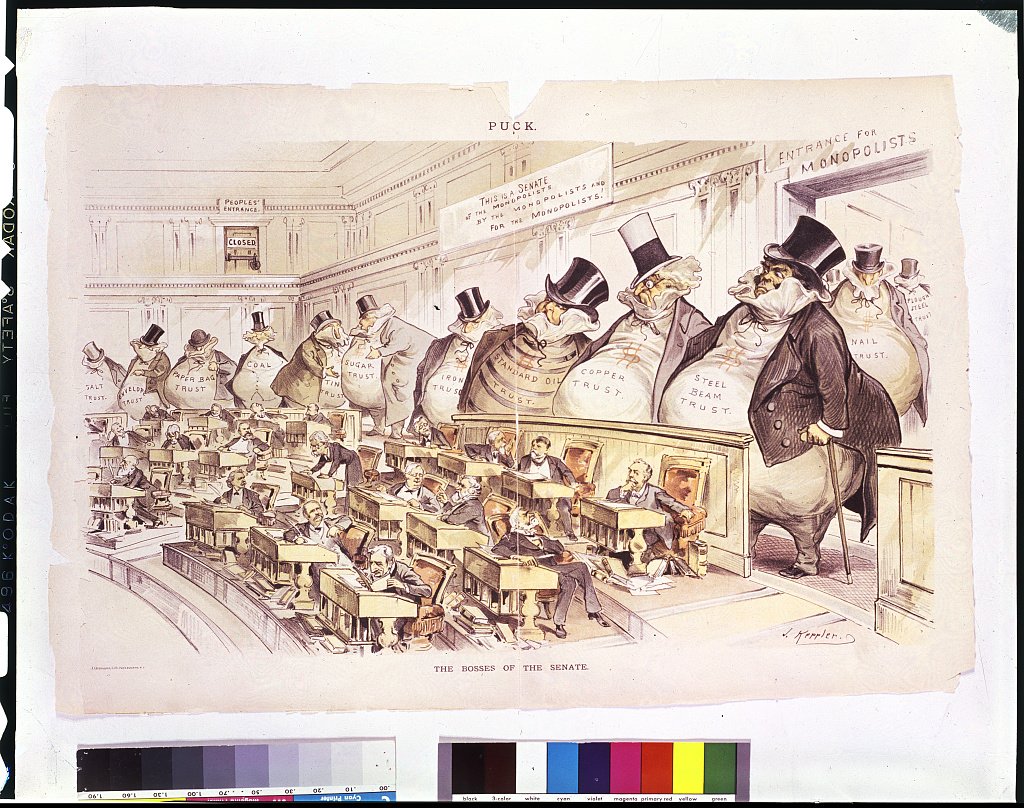
Puck had a rival. The Senate's page calls Judge its weak rival, says Republicans bought it, and says it eventually replaced Puck as the leading humor magazine.11 This lesson does not give Judge's founding date because none of the pages fetched for it did. Then came the end. According to the Roosevelt Center, the Hearst organization bought Puck in 1917, steered it away from hard political commentary toward fine arts and social fads, and discontinued it in September 1918 after subscriptions fell.12 A magazine that began by lampooning corruption died as a property of a newspaper empire. The daily paper had taken the job.
Homer Davenport and the dollar mark
Homer Davenport (1867 to 1912) turned a businessman into a symbol. The Library of Congress holds a small ink drawing from a note he sent on January 4, 1900,13 inscribed "To Mr Chas H Daniels from Homer Davenport": [Dollar Mark Hanna], a bust-length caricature of Marcus Alonzo Hanna in a suit studded with dollar signs, smoking a cigar. The cataloger devised the title. The record describes Hanna as a coal and iron businessman nicknamed the "money manipulator," who helped elect William McKinley in 1896 and 1900 by raising large campaign funds.14 The rights line says "No known restrictions on publication. No renewal in Copyright Office."15
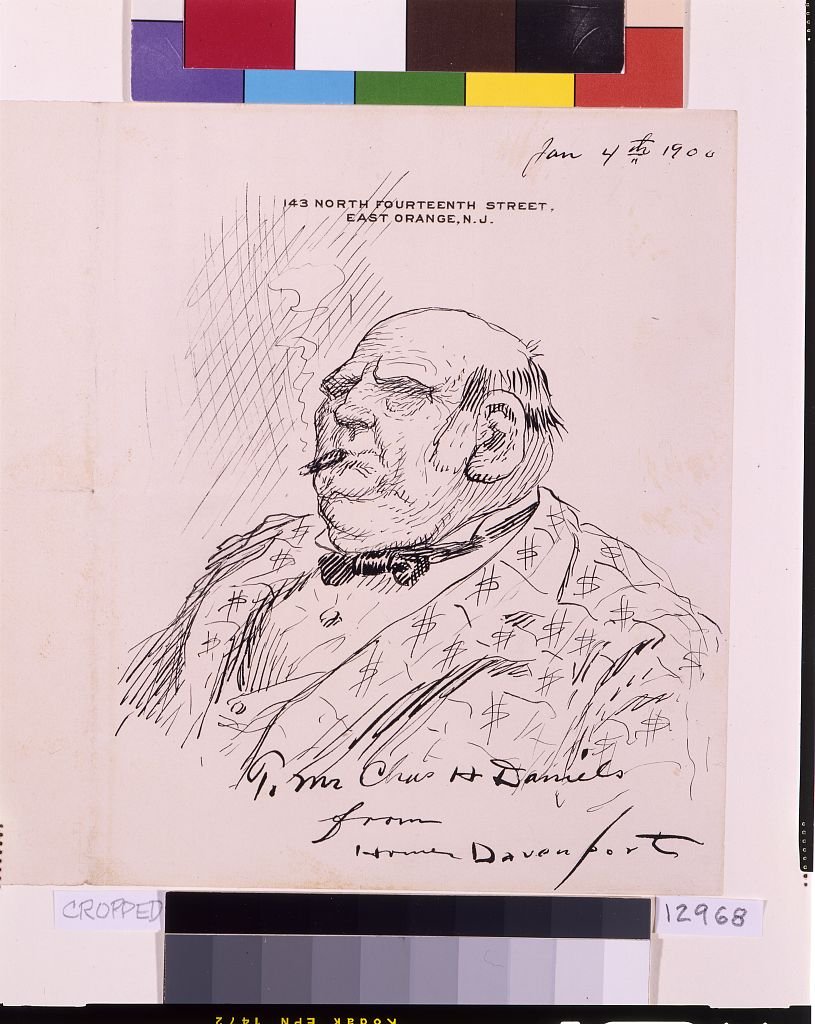
Read it with the tools the Library teaches. The symbol is the dollar sign, repeated until it becomes cloth. The exaggeration is the suit: no one's coat is made of money, so the picture can only be a claim. The caricature is the face, the cigar and the build. The irony is the cheerful pose. Hanna looks pleased, and the picture lets the viewer decide what he is pleased about. The date and the catalog note supply the context: the drawing belongs to the campaign money fights of 1900, campaign money, an issue the Seventeenth Amendment course follows into the Senate. This lesson does not assert any connection between Davenport and any particular publisher. The sources fetched do not establish one.
How to: read a political cartoon
- Meet it first. The National Archives worksheet starts with what you notice first and whether there is a title or caption.16 Write down the first thing your eye lands on before you analyze.
- List the parts. Under "words," note labels, speech, captions and signs. Under "visuals," list people, objects, places and actions. In the Davenport drawing the words are none and the visual list is a man, a cigar and a suit of dollar signs.
- Name the techniques. The Library of Congress primary-source set on political cartoons names symbols, words, caricature, exaggeration and irony, and notes that John Bull personifies Great Britain the way Uncle Sam personifies the United States.17 Mark each one you can find.
- Find the context. Who drew it, when, and what was happening? The catalog record usually gives the publication and date. Davenport's note is dated January 4, 1900, in an election year.
- State the message in one sentence and name the evidence in the picture for it. The Archives worksheet asks for exactly this. If you cannot name the evidence, you have a reaction, not a reading.
- Use it as evidence. The worksheet's last step asks what the cartoon reveals that you could not learn elsewhere and what other sources you need.18 A cartoon tells you what a paper's artist wanted readers to think, not what happened.
Clifford Berryman and the bear
The most repeated cartoon story of the century is partly true. In November 1902, President Theodore Roosevelt went on a bear-hunting trip near Onward, Mississippi, invited by Governor Andrew H. Longino. On November 14 his hosts, having failed to find a bear for him, tied a black bear to a willow tree and suggested he shoot it. Roosevelt refused, seeing it as unsportsmanlike, and the story spread through the press (National Park Service, "The Story of the Teddy Bear").19 Clifford Berryman's cartoon, Drawing the line in Mississippi, ran in The Washington Post on November 16, 1902, as a detail from his series "The Passing Show."20
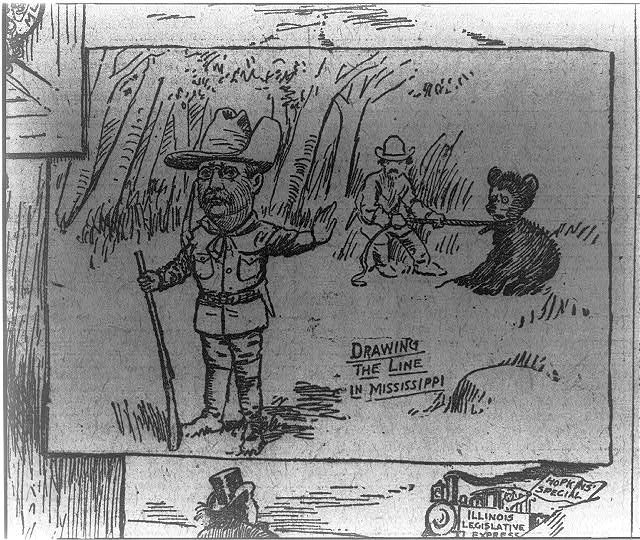
The Library's record, citing Linda Mullins's book Teddy Bear Men: Theodore Roosevelt and Clifford Berryman (1987), pp. 32 to 33, says the bear, "Bruin," became so popular that Berryman used him in many cartoons on other topics.21 It says Berryman helped link Roosevelt with bears in the public mind but did not invent the teddy bear toy. The Park Service tells the toy's story: Morris Michtom, a Brooklyn candy-shop owner who also made stuffed animals, saw the cartoon, made a stuffed bear he called "Teddy's Bear," got Roosevelt's permission to use the name, and went on to found the Ideal Toy Company.22 The Library's note adds that the Library does not own the original drawing, which the Archives of American Art has reproduced.23
Berryman's career is better documented than his legend. The National Archives' Running for Office exhibit says his cartoons appeared on the front pages of Washington newspapers from 1898 through 1948, and that the Center for Legislative Archives holds nearly 2,400 of his pen-and-ink drawings, which the Charles Engelhard Foundation bought in 1992 and donated to the U.S. Senate.24 The Pulitzer site lists Clifford K. Berryman of the Washington Evening Star as the 1944 winner, for "Where Is the Boat Going?"25 and lists James T. Berryman of the Evening Star as the 1950 winner.26 The sources checked here do not say how the two were related, so this lesson does not.
Myth: Clifford Berryman invented the teddy bear
The cartoon is real, the date is real, and the toy is real. The invention is the link between them. The Library of Congress record for the cartoon says in so many words that Berryman did not invent the toy. The National Park Service credits Morris Michtom of Brooklyn with the stuffed bear and says he saw the cartoon before making it. What Berryman did was give Roosevelt a lasting animal. The record says Berryman reused Bruin in many later cartoons and helped link the president with bears in the public mind. When a source writes "Berryman's teddy bear," ask whether it means the cartoon bear or the toy.
The first Pulitzers
The Pulitzer Prize for Editorial Cartooning was first awarded in 1922. The category page lists Rollin Kirby of the New York World that year for "On the Road to Moscow."27 It then lists winners for most years through 1945, and the page gives no entry for 1923 or 1936. (It does not say why. This lesson does not guess.) Several names repeat: Kirby in 1922, 1925 and 1929; Edmund Duffy of the Baltimore Sun in 1931, 1934 and 1940; Jay Norwood "Ding" Darling of the Des Moines Register and Tribune in 1924 and 1943; Daniel R. Fitzpatrick of the St. Louis Post-Dispatch in 1926 (listed as D. R. Fitzpatrick) and, outside this table, in 1955.28
| Year | Winner | Paper | Cited work (as the Pulitzer page gives it) | 29
|---|---|---|---|
| 1922 | Rollin Kirby | New York World | "On the Road to Moscow" |
| 1924 | Jay Norwood Darling | Des Moines Register & Tribune | "In Good Old USA" |
| 1925 | Rollin Kirby | New York World | "News from the Outside World" |
| 1926 | D. R. Fitzpatrick | St. Louis Post-Dispatch | "The Laws of Moses and the Laws of Today" |
| 1927 | Nelson Harding | Brooklyn Daily Eagle | "Toppling the Idol" |
| 1928 | Nelson Harding | Brooklyn Daily Eagle | "May His Shadow Never Grow Less" |
| 1929 | Rollin Kirby | New York World | "Tammany" |
| 1930 | Charles R. Macauley | Brooklyn Daily Eagle | "Paying for a Dead Horse" |
| 1931 | Edmund Duffy | Baltimore Sun | "An Old Struggle Still Going On" |
| 1932 | John T. McCutcheon | Chicago Tribune | "A Wise Economist Asks a Question" |
| 1933 | H. M. Talburt | Washington Daily News | "The Light of Asia" |
| 1934 | Edmund Duffy | Baltimore Sun | "California Points with Pride!" |
| 1935 | Ross A. Lewis | Milwaukee Journal | "Sure, I'll Work for Both Sides" |
| 1937 | C. D. Batchelor | Daily News (New York) | "Come on in, I'll treat you right. I used to know your Daddy." |
| 1938 | Vaughn Shoemaker | Chicago Daily News | "The Road Back" |
| 1939 | Charles G. Werner | The Daily Oklahoman | "Nomination for 1938" |
| 1940 | Edmund Duffy | Baltimore Sun | "The Outstretched Hand" |
| 1941 | Jacob Burck | Chicago Daily Times | "If I Should Die Before I Wake" |
| 1942 | Herbert Lawrence Block (Herblock) | Newspaper Enterprise Association | "British Plane" |
| 1943 | Jay Norwood Darling | Des Moines Register & Tribune | "What a Place For a Waste Paper Salvage Campaign" |
| 1944 | Clifford K. Berryman | Washington Evening Star | "Where Is the Boat Going?" |
| 1945 | Bill Mauldin (rank listed as Technician Third Grade on the category page, Sergeant on another Pulitzer page) | United Feature Syndicate | Series "Up Front With Mauldin" |
Two things stand out in the list. First, the titles. Kirby's "On the Road to Moscow" and Fitzpatrick's "The Laws of Moses and the Laws of Today" are arguments in a sentence, and the titles are the prize jury's record of what the cartoon said. Second, the 1945 entry is not a cartoon in a newspaper at all. The Pulitzer prize page credits a soldier, Bill Mauldin, and a syndicate, and cites a series; the category page lists him as "Technician Third Grade Bill Mauldin" while another Pulitzer page says "Sergeant," so the rank is given differently on the same site. The prize had begun by honoring a staff cartoonist at a metropolitan paper and by 1945 honored a syndicated panel drawn for a military newspaper. Both Darling's and Herblock's entries were in the war years. Herblock's first, 1942, is credited to the Newspaper Enterprise Association, a syndicate; the rest of his career is the subject of lesson 03.
The prize list also has a bias worth stating. It records what juries chose from entries submitted by papers, which means a cartoonist at a paper that did not enter, or a paper that did not run the cartoon, is absent. The list is the record of recognition, not of everything that was drawn.
The Masses and the Espionage Act
The Masses was founded in January 1911 as an illustrated socialist monthly.30 The Modernist Journals Project says it combined radical politics with modernist aesthetics, that Max Eastman edited it from 1912 with Floyd Dell as managing editor, and that its artists included Art Young, John Sloan and Boardman Robinson.31 LaborArts, the Tamiment Library's exhibit, adds that Eastman pioneered the one- or two-line cartoon caption and that nearly all contributors were unpaid. Floyd Dell, it says, earned $25 a week as Eastman's literary assistant.32
Art Young (1866 to 1943) is the magazine's cartoonist this lesson follows. The Library of Congress holds his [Freedom of the press], published in The Masses in December 1912: a male newspaper owner and editor dressed as a woman prostitute called "The Madam" takes money from a man labeled "Big Advertisers" while staff sit beneath a sign reading "Obey the Madam." The record's exhibit caption says Young used the drawing to attack William Randolph Hearst by portraying the capitalist press as a brothel, and that it marks a shift in his work from humor toward politics.33
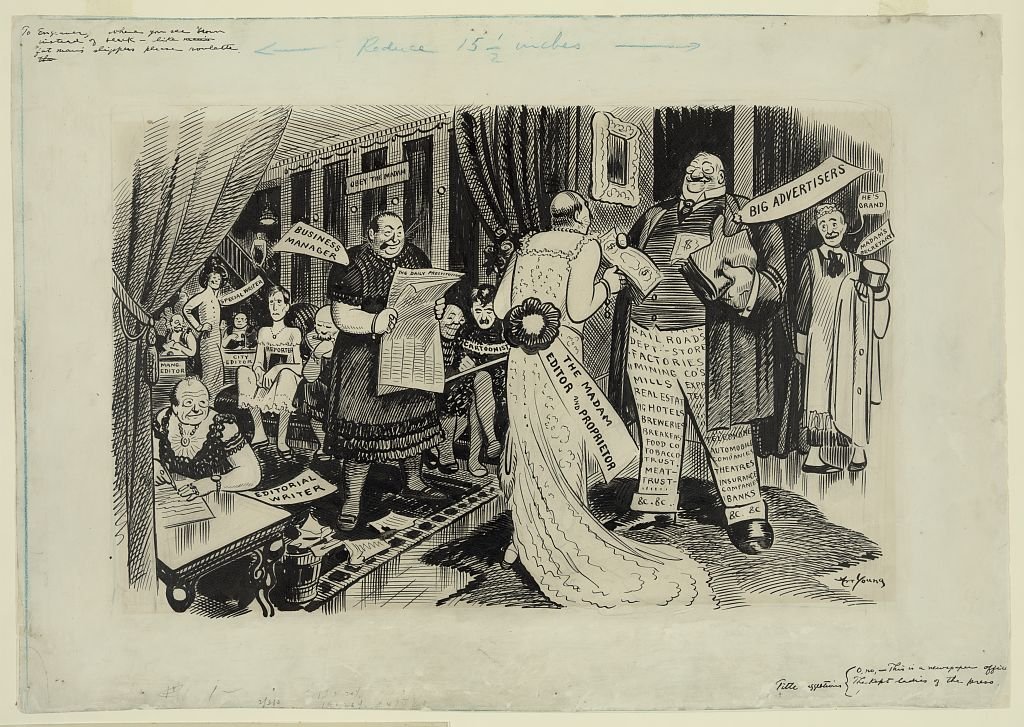
The United States entered the war in April 1917, and the Espionage Act passed in June. LaborArts reports that the New York postmaster refused to mail the August 1917 issue as "unmailable" under the Act, and that losing its second-class mailing permit forced the magazine to stop.34 The Modernist Journals Project dates the ban August 1917 and gives the stated reason as the magazine's criticism of U.S. involvement in the war.35 The postmaster was Thomas G. Patten, and the magazine sued.36
The case was Masses Publishing Co. v. Patten, 244 F. 535 (S.D.N.Y. 1917), decided by Judge Learned Hand.37 John R. Vile's entry in the First Amendment Encyclopedia says Hand separated persuasion from action, held that agitation is not the same as direct incitement to violent resistance, and found no direct advocacy of resistance to recruiting.38 The Second Circuit overturned him. Vile's entry gives no citation or date for that reversal, and this lesson did not confirm one. The standard Hand articulated is the ancestor of the incitement test the Supreme Court adopted in Brandenburg v. Ohio (1969), covered in lesson 01. The Court's actual 1919 answer in Schenck went the other way.39
The criminal case followed. LaborArts reports that the government charged Max Eastman, Floyd Dell, John Reed, Art Young, Merrill Rogers, Josephine Bell and H. J. Glintenkamp with conspiring to obstruct enlistment, a charge carrying a possible 20 years and a $10,000 fine.40 The first trial opened April 15, 1918.41 The jury could not reach a verdict. According to the marxists.org introduction (a page credited to Tim Davenport and Wikipedia contributors, so a secondary source), only five of the seven defendants appeared, because Reed was in Russia and Glintenkamp's whereabouts were unknown.42 LaborArts says a second trial ended with another jury unable to agree, four voting to convict and eight to acquit, and that no further trials followed.43 The sources disagree on when. LaborArts says "about a year later," but John Reed's own account in The Liberator of December 1918 describes a second trial in the fall of 1918, before Judge Martin Manton, with the jury standing eight to acquit and four to convict, so "a year later" does not fit. The marxists.org page says September 1918 with Reed present;44 that is a secondary source, and this lesson does not confirm the exact month. The Masses folded, and Eastman and his sister Crystal started The Liberator.
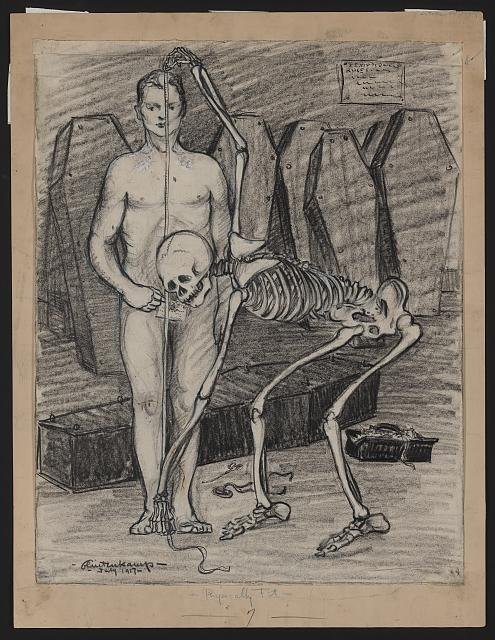
Which cartoon was charged? The marxists.org introduction says the indictment cited Glintenkamp's 1917 drawing "Physically Fit."45 The Library of Congress holds it: Physically fit, The Masses, July 1917, in which a skeleton measures a naked young man holding his draft notice, with coffins in the background. The Library's own record46 says nothing about the Espionage Act or any indictment, so the link between this picture and the charge rests on the secondary page alone. Treat it as a lead for an archive search, not as settled.
| Date | Event | Source |
|---|---|---|
| January 1911 | The Masses founded as an illustrated socialist monthly | Modernist Journals Project |
| December 1912 | Art Young's "Freedom of the press" published | Library of Congress |
| June 1917 | Espionage Act passes | Marxists Internet Archive intro |
| July 1917 | Glintenkamp's "Physically Fit" published | Library of Congress |
| August 1917 | Postmaster refuses to mail the August issue; the magazine sues | LaborArts; Modernist Journals Project |
| 1917 | Masses Publishing Co. v. Patten, 244 F. 535, Judge Learned Hand; reversed by the Second Circuit (citation and date not confirmed here) | MTSU First Amendment Encyclopedia |
| April 15, 1918 | First criminal trial opens; jury cannot agree | LaborArts |
| Fall 1918 (exact month not confirmed; LaborArts's "a year later" is contradicted by Reed in The Liberator, December 1918) | Second trial; jury splits, reportedly 8 to 4 for acquittal; no further trials | LaborArts; marxists.org intro |
How to: find out whether a cartoon was ever the subject of a legal case
- Start with the catalog record. The Library's entry for "Physically fit" gives the issue and date but says nothing about charges. A silent record is not proof there was no case.
- Search the magazine's name with "Espionage Act" and the artist's name in a university library or the First Amendment Encyclopedia. Note whether the source is a scholar (Vile at MTSU), an institutional exhibit (LaborArts, Tamiment Library) or a crowd-edited reference.
- Find the opinion. For Masses v. Patten the district court citation is 244 F. 535 (S.D.N.Y. 1917). Case-law databases such as CourtListener carry federal reports; if a page refuses automated access, read it in a browser.
- Check what the court decided against what the encyclopedia says it decided. The district court ruled for the magazine under a direct-incitement standard. The appeals court reversed.
- Check the criminal side separately from the postal side. The mail ban was a civil dispute with the postmaster. The indictment was a criminal conspiracy charge. Mixing them up is the commonest error in summaries.
- Write down what you could not confirm, and leave it out of the published text.
War cartoons: Seuss, Low and Mauldin
The Second World War gave the cartoon a new set of jobs. The collection at UC San Diego, described on Calisphere, describes more than 400 editorial cartoons (390 of them digitized) that Theodor Seuss Geisel, "Dr. Seuss," drew for the New York paper PM from 1941 to 1943, where he was chief editorial cartoonist.47 The Calisphere page states no rights position, so this course links to the collection and does not embed any of the cartoons. PM appears as a newspaper in one place on the page and a magazine in another, which is a small lesson in how catalog descriptions carry their own errors. Readers who want the images should go to the Dr. Seuss Political Cartoons collection and read the cartoons with the method above. This lesson does not paraphrase individual cartoons because none was verified here.
Britain's counterpart was David Low. The British Cartoon Archive says he was born in Dunedin, New Zealand, on 7 April 1891, worked for the Sydney Bulletin from 1911 to 1919, moved to London in August 1919, and joined the Evening Standard in 1927 as its first political cartoonist, resigning at the end of 1949.48 He then worked briefly at the Daily Herald from February 1950 and moved to the Manchester Guardian in February 1953 as its first staff cartoonist, staying nearly to his death. Colonel Blimp first appeared in the Evening Standard in April 1934.49 The Archive describes Low in the 1930s as a fierce opponent of Hitler, Mussolini and the policy of appeasement. It also says he declined a knighthood at the height of his powers and accepted one in 1962.50 He died on 19 September 1963.51 The Archive page does not cover how the German government reacted to his cartoons, so this lesson leaves that out.
Why include Low in a course on American politics? Because it shows the cartoon doing two of its jobs in one country at the same time: persuasion against a policy (appeasement) and an offered national character (Blimp as a "decent old boy," the phrase The Times used in 1939 as the Archive reports)52. American cartoonists of the same years drew in a different political climate and for different editors, which the Pulitzer table above shows in the winners' titles.
Bill Mauldin: Willie and Joe and the general
Bill Mauldin (born October 29, 1921, in Mountain Park, New Mexico; died January 22, 2003) is the soldier's cartoonist. The 45th Infantry Division museum says he enlisted in the Arizona National Guard in 1940, served as a sergeant in K Company, 180th Infantry Regiment, and drew for the Oklahoma City newspaper and the 45th Division News.53 His characters Willie and Joe, two exhausted front-line infantrymen, were created in 1940 for the 45th Division News, the Eisenhower Foundation says, and began appearing in the Mediterranean edition of Stars and Stripes in November 1943.54 Early in 1944 he transferred officially to that edition, and his editor arranged syndication of his work as Up Front through United Feature.55 The cartoons showed boredom, poor food, miserable conditions and incompetent officers, in the 45th Division museum's summary, and were popular with enlisted men and their families.56
Then came the general. According to the 45th Division page, which reprints Stars and Stripes text, General George Patton wrote a 1945 letter threatening to ban the paper from Third Army over "Mauldin's scurrilous attempts to undermine military discipline,"57 and then lectured Mauldin on the dangers of cartoons that mocked officers. The Eisenhower Foundation profile places the meeting in March 1945 at Patton's quarters in Luxembourg, where Patton scolded him for drawing soldiers who looked like bums and accused him of undermining discipline.58 Mauldin was allowed to speak his mind and left feeling he had changed neither his own view nor Patton's. The sources differ on one point. The 45th Division page says Eisenhower disagreed with banning the paper, worried about morale, and arranged the meeting.59 The Eisenhower Foundation profile does not mention Eisenhower's role. This lesson reports the March 1945 meeting and leaves Eisenhower's part unclaimed.
The Pulitzer site lists his 1945 prize for the series "Up Front With Mauldin" and a second, in 1959, for a St. Louis Post-Dispatch cartoon published October 30, 1958.60 The 45th Division museum says he won the first at age 23.61 His later career is in lesson 03.
| Cartoonist | Outlet | What this lesson verified | Where it comes from |
|---|---|---|---|
| Joseph Keppler | Puck | The Bosses of the Senate, January 23, 1889; Puck founded in German in 1876, English in March 1877 | Library of Congress; Theodore Roosevelt Center |
| Homer Davenport | Not stated in the record | Dollar Mark Hanna drawing dated January 4, 1900 | Library of Congress |
| Clifford Berryman | The Washington Post; later the Evening Star | Drawing the line in Mississippi, November 16, 1902; 1944 Pulitzer | Library of Congress; Pulitzer site |
| Art Young | The Masses | Freedom of the press, December 1912; indicted 1918; jury could not agree | Library of Congress; LaborArts |
| Henry Glintenkamp | The Masses | Physically fit, July 1917; named in the 1918 indictment | Library of Congress; LaborArts |
| Rollin Kirby | New York World | First Pulitzer for editorial cartooning, 1922; also 1925 and 1929 | Pulitzer site |
| Ding Darling | Des Moines Register & Tribune | Pulitzers 1924 and 1943 | Pulitzer site |
| Dr. Seuss | PM | More than 400 cartoons, 1941 to 1943 | Calisphere (UC San Diego) |
| David Low | Evening Standard; Manchester Guardian | Evening Standard 1927 to 1949; Colonel Blimp from April 1934 | British Cartoon Archive |
| Bill Mauldin | 45th Division News; Stars and Stripes | Willie and Joe; Patton meeting, March 1945; Pulitzer 1945 | Eisenhower Foundation; 45th Division museum; Pulitzer site |
What this lesson could not verify
A reader should know what is missing. No cartoon from the German or Japanese side was verified this session. The sources fetched give American and British examples, plus Puck's German-language beginnings, so this lesson does not claim a balanced set from every belligerent. Lesson 05 returns to posters, where more of the enemy's work is catalogued. Ding Darling's conservation career (federal wildlife work and the duck stamp) is a well-known part of his biography but the page that would confirm it could not be read, so it is left out. The founding date of Judge and the relationship between the two Berrymans are also left out for the same reason.
If you report on this
- When you cite a prize, cite pulitzer.org by category, year and the cited work. The category page lists no winner for 1923 and 1936. Do not write that the prize "was not awarded" those years unless you have the Board's statement.
- When you describe a famous cartoon, give the outlet, date and catalog number. "Berryman's teddy bear cartoon" is the Washington Post, November 16, 1902; the Library's record is LC-USZ62-34274.
- For The Masses, separate the mail ban (August 1917), the Hand opinion (1917), and the criminal trials (1918). Note that two juries could not agree and no one was convicted in those trials, per LaborArts.
- For Patton and Mauldin, say March 1945 and Luxembourg, and note that one profile credits Eisenhower with arranging the meeting and another does not mention him.
- For staff-cartoonist numbers, say whose number it is. The Herb Block Foundation's "approximately 2,000" for the early 1900s is the Foundation's, with no source named in the report.
Go further
- The Pulitzer category page for Editorial Cartooning, with cited works for early years.
- Library of Congress records: The Bosses of the Senate, Dollar Mark Hanna, Drawing the line in Mississippi, Freedom of the press and Physically fit.
- The National Archives Analyze a Cartoon worksheet and the Library of Congress political cartoons primary source set.
- LaborArts, A Short History of The Masses, and the Modernist Journals Project for the magazine itself.
- The Dr. Seuss Political Cartoons collection at UC San Diego and the British Cartoon Archive page on David Low.
- Linda Mullins, Teddy Bear Men: Theodore Roosevelt and Clifford Berryman (1987), cited by the Library of Congress for the bear story; and the Herb Block Foundation's report on editorial cartooning.
Questions and answers
Who won the first Pulitzer for editorial cartooning?
Rollin Kirby of the New York World, in 1922, for "On the Road to Moscow," according to the Pulitzer site's category page. Kirby also won in 1925 ("News from the Outside World") and 1929 ("Tammany"). The page lists no winner for 1923.
Did Berryman invent the teddy bear?
No. The Library of Congress record for "Drawing the line in Mississippi" says he helped link Roosevelt with bears in the public mind but did not invent the toy. The National Park Service says Brooklyn shop owner Morris Michtom made the stuffed bear after seeing the cartoon, and called it "Teddy's Bear."
What exactly did Berryman's cartoon show?
The Library describes it as a detail from his series "The Passing Show" satirizing Roosevelt's reported refusal to shoot a chained bear on his November 1902 Mississippi hunting trip. It ran in The Washington Post on November 16, 1902, two days after the hunt on November 14.
Why was The Masses prosecuted?
The government treated its antiwar articles and cartoons as obstructing the draft. The postmaster refused to mail the August 1917 issue under the Espionage Act, and in 1918 prosecutors charged Eastman, Dell, Reed, Young, Rogers, Bell and Glintenkamp with conspiring to obstruct enlistment (LaborArts). Judge Hand's 1917 opinion in the postal case held that persuasion was not direct incitement, but the Second Circuit reversed.
Was Art Young convicted?
No. LaborArts reports that both trials of the Masses defendants ended with juries unable to agree, and no further trials followed. The second jury reportedly split 4 to 8 for conviction against acquittal.
Who was Dr. Seuss's employer during the war?
The New York paper PM. Calisphere's description of the UC San Diego collection says Theodor Seuss Geisel served as PM's chief editorial cartoonist and produced more than 400 cartoons from 1941 to 1943.
What happened between Mauldin and Patton?
Patton objected to Willie and Joe as anti-officer and, per a Stars and Stripes text reprinted by the 45th Division museum, wrote a 1945 letter threatening to ban the paper from Third Army. In March 1945 Mauldin met him at his Luxembourg quarters, as the Eisenhower Foundation tells it. Patton scolded him. Neither man changed his view. Whether Eisenhower arranged the meeting depends on which source you read.
How many editorial cartoonists were there in 1900?
The Herb Block Foundation's 2011 report says approximately 2,000 at the start of the 20th century, without naming a source. Treat it as an estimate and attribute it. Lesson 03 and lesson 04 deal with the decline that followed.
Hard questions
Cartoons are opinion. Why teach them like documents?
Because opinion is evidence of what someone wanted readers to think and when. The National Archives worksheet's last step is "use it as historical evidence," asking what the cartoon reveals that you could not learn elsewhere. A Davenport caricature does not prove Hanna's conduct. It proves that a cartoonist in 1900 thought a dollar-sign suit would persuade readers, and that someone thought the drawing worth keeping.
Wasn't the Masses prosecution justified in wartime?
The Supreme Court upheld convictions under the same Act in Schenck (March 3, 1919), where about 15,000 leaflets urged draftees to resist.62 A defender of the prosecution would say the Masses issue was part of an effort to hinder recruitment while the country was at war. The answer on the other side is Hand's: persuasion is not direct incitement, and two juries that heard the evidence did not convict. Report both positions and the actual outcomes.
Is it fair to say the Pulitzer list shows who the best cartoonists were?
No. It shows whom a jury chose among papers' submissions in a year. Some years are missing from the page (1923, 1936), some winners are cited by a single cartoon and others by a year or a body of work, and a cartoonist who worked for a paper that did not enter has no entry. Use it as a record of recognition.
Doesn't a cartoon of a businessman in a dollar-sign suit just stereotype him?
It is caricature, which works by exaggeration, and caricature can be unfair. Hanna was a real public figure with real power over campaign money, and the Library's record describes him as raising large funds for McKinley in 1896 and 1900. A reader can decide whether the drawing's claim was fair. That is the exercise, and the same test applies to a cartoon of any official from any party.
If the sources disagree about Patton, why print either version?
Because the disagreement is itself a fact about the record. Two sources agree on March 1945 and on Patton's objection. They differ on whether Eisenhower had a part. A reporter who found a third source could settle it. Until then, say what each says and who said it.
Learn more
- Pulitzer Prizes: Editorial Cartooning: the category page with every early winner and cited work.
- Library of Congress: Drawing the line in Mississippi: the catalog record that separates Berryman's cartoon from the toy bear.
- National Park Service: The Story of the Teddy Bear: the toy-maker side of the bear story.
- LaborArts: A Short History of The Masses: the magazine, the postal ban and the two trials in one exhibit.
- Modernist Journals Project: The Masses: the magazine itself, issue by issue.
- The First Amendment Encyclopedia: Masses Publishing Co. v. Patten: a scholar's summary of Learned Hand's opinion.
- National Archives: Analyze a Cartoon worksheet: the step-by-step method used in this lesson.
- British Cartoon Archive: David Low: a full biography of the Evening Standard cartoonist.
- Eisenhower Foundation: William Mauldin: the profile that places the Patton meeting in March 1945.
- Herb Block Foundation: Report on Editorial Cartooning: the 2011 report on the state of the profession.
Notes
- Herb Block Foundation, Report on Editorial Cartooning (December 2011). Read it online. ↩
- Pulitzer Prizes, Editorial Cartooning winners by category. Read it online. ↩
- Pulitzer Prizes, Editorial Cartooning winners by category. Read it online. ↩
- LaborArts (Tamiment Library, NYU), "A Short History of The Masses." Read it online. ↩
- LaborArts (Tamiment Library, NYU), "A Short History of The Masses." Read it online. ↩
- Library of Congress, Drawing the line in Mississippi (Clifford Berryman, The Washington Post, November 16, 1902), catalog record. Note citing Linda Mullins, Teddy Bear Men (1987). Read it online. ↩
- Theodore Roosevelt Center, "Puck Magazine." Read it online. ↩
- U.S. Senate, "Puck" introduction, Political Cartoons and Caricatures. Read it online. ↩
- Theodore Roosevelt Center, "Puck Magazine." Read it online. ↩
- Library of Congress, The Bosses of the Senate (J. Keppler, lithograph by J. Ottmann, Puck, January 23, 1889), catalog record. Read it online. ↩
- U.S. Senate, "Puck" introduction, Political Cartoons and Caricatures. Read it online. ↩
- Theodore Roosevelt Center, "Puck Magazine." Read it online. ↩
- Library of Congress, [Dollar Mark Hanna] (Homer Davenport, 1900), catalog record. Read it online. ↩
- Library of Congress, [Dollar Mark Hanna] (Homer Davenport, 1900), catalog record. Read it online. ↩
- Library of Congress, [Dollar Mark Hanna] (Homer Davenport, 1900), catalog record. Rights advisory. Read it online. ↩
- National Archives, "Analyze a Cartoon" worksheet. Read it online. ↩
- Library of Congress, "Political Cartoons and Public Debates" (primary source set). Read it online. ↩
- National Archives, "Analyze a Cartoon" worksheet. Read it online. ↩
- National Park Service, "The Story of the Teddy Bear." Read it online. ↩
- Library of Congress, Drawing the line in Mississippi (Clifford Berryman, The Washington Post, November 16, 1902), catalog record. Read it online. ↩
- Library of Congress, Drawing the line in Mississippi (Clifford Berryman, The Washington Post, November 16, 1902), catalog record. Note citing Linda Mullins, Teddy Bear Men: Theodore Roosevelt and Clifford Berryman (1987), pp. 32 to 33. Read it online. ↩
- National Park Service, "The Story of the Teddy Bear." Read it online. ↩
- Library of Congress, Drawing the line in Mississippi (Clifford Berryman, The Washington Post, November 16, 1902), catalog record. Note on the original drawing. Read it online. ↩
- National Archives, "Running for Office," Clifford Berryman collection. Read it online. ↩
- Pulitzer Prizes, Editorial Cartooning winners by category. Read it online. ↩
- Pulitzer Prizes, Editorial Cartooning winners by category. Read it online. ↩
- Pulitzer Prizes, Editorial Cartooning winners by category. Read it online. ↩
- Pulitzer Prizes, Editorial Cartooning winners by category. Read it online. ↩
- Pulitzer Prizes, Editorial Cartooning winners by category. Read it online. ↩
- Modernist Journals Project, "The Masses." Read it online. ↩
- Modernist Journals Project, "The Masses." Read it online. ↩
- LaborArts (Tamiment Library, NYU), "A Short History of The Masses." Read it online. ↩
- Library of Congress, [Freedom of the press] (Art Young, The Masses, December 1912), catalog record and exhibit caption. Read it online. ↩
- LaborArts (Tamiment Library, NYU), "A Short History of The Masses." Read it online. ↩
- Modernist Journals Project, "The Masses." Read it online. ↩
- John R. Vile, "Masses Publishing Co. v. Patten," The First Amendment Encyclopedia (MTSU). Read it online. ↩
- John R. Vile, "Masses Publishing Co. v. Patten," The First Amendment Encyclopedia (MTSU). Read it online. ↩
- John R. Vile, "Masses Publishing Co. v. Patten," The First Amendment Encyclopedia (MTSU). Read it online. ↩
- Schenck v. United States, 249 U.S. 47 (1919). Read it online. ↩
- LaborArts (Tamiment Library, NYU), "A Short History of The Masses." Read it online. ↩
- LaborArts (Tamiment Library, NYU), "A Short History of The Masses." Read it online. ↩
- Marxists Internet Archive, "An Introduction to The Masses" (a secondary source credited to Tim Davenport and Wikipedia contributors). Read it online. ↩
- LaborArts (Tamiment Library, NYU), "A Short History of The Masses." Read it online. ↩
- Marxists Internet Archive, "An Introduction to The Masses" (a secondary source credited to Tim Davenport and Wikipedia contributors). Read it online. ↩
- Marxists Internet Archive, "An Introduction to The Masses" (a secondary source credited to Tim Davenport and Wikipedia contributors). Read it online. ↩
- Library of Congress, Physically fit (Henry Glintenkamp, The Masses, July 1917), catalog record. Read it online. ↩
- UC San Diego Library, "Dr. Seuss Political Cartoons," Calisphere collection description. Read it online. ↩
- British Cartoon Archive, University of Kent, "David Low" biography. Read it online. ↩
- British Cartoon Archive, University of Kent, "David Low" biography. Read it online. ↩
- British Cartoon Archive, University of Kent, "David Low" biography. Read it online. ↩
- British Cartoon Archive, University of Kent, "David Low" biography. Read it online. ↩
- British Cartoon Archive, University of Kent, "David Low" biography. Read it online. ↩
- 45th Infantry Division Museum, "Bill Mauldin." Read it online. ↩
- Eisenhower Foundation, "Soldier profile: William Mauldin." Read it online. ↩
- Eisenhower Foundation, "Soldier profile: William Mauldin." Read it online. ↩
- 45th Infantry Division Museum, "Bill Mauldin." Read it online. ↩
- 45th Infantry Division Museum, "Bill Mauldin." Reprinting Stars and Stripes text on the Patton letter. Read it online. ↩
- Eisenhower Foundation, "Soldier profile: William Mauldin." Read it online. ↩
- 45th Infantry Division Museum, "Bill Mauldin." Read it online. ↩
- Pulitzer Prizes, Editorial Cartooning winners by category. Read it online. ↩
- 45th Infantry Division Museum, "Bill Mauldin." Read it online. ↩
- Schenck v. United States, 249 U.S. 47 (1919). Read it online. ↩
Check yourself
1. Who won the first Pulitzer Prize for editorial cartooning, and in what year, according to the Pulitzer site's category page?
The category page lists Kirby, New York World, 1922, 'On the Road to Moscow,' as the earliest entry. Kirby won again in 1925 and 1929. The page lists no winner for 1923.
2. What does the Library of Congress record for Berryman's 'Drawing the line in Mississippi' say about the teddy bear toy?
The record, citing Linda Mullins's Teddy Bear Men (1987), dates the cartoon November 16, 1902 in The Washington Post, says it satirized Roosevelt's reported refusal to shoot a chained bear, and says Berryman did not invent the toy. The National Park Service credits Brooklyn shopkeeper Morris Michtom with the stuffed bear.
3. What was the outcome of the criminal trials of Max Eastman, Floyd Dell, Art Young and others from The Masses in 1918?
LaborArts (Tamiment Library, NYU) reports the first trial opened April 15, 1918 and the jury could not reach a verdict; the second also ended without a verdict, reportedly 8 to 4 for acquittal; no further trials followed. Sources differ on the date of the second trial.
4. How many editorial cartoons does the UC San Diego collection of Dr. Seuss's work for PM hold, and what years does it cover?
Calisphere's description of the UC San Diego Library collection says Theodor Seuss Geisel was PM's chief editorial cartoonist and the collection description says it holds more than 400 editorial cartoons from 1941 to 1943.
5. In what month and where did Bill Mauldin meet General Patton about Willie and Joe, according to the Eisenhower Foundation's profile?
The Eisenhower Foundation profile says Mauldin drove to Patton's quarters in Luxembourg in March 1945, was scolded for drawing soldiers who looked like bums, spoke his mind, and left feeling he had changed neither his own view nor Patton's. A different profile says Eisenhower arranged the meeting; the Foundation page does not mention him.
6. According to the Herb Block Foundation's 2011 report, how many editorial cartoonists did American newspapers employ in the early 1900s?
The report says there were approximately 2,000 editorial cartoonists at the start of the 20th century and fewer than 40 staff cartoonists at the time of the report. It names no source for either figure, and one essayist in it puts the 2011 staff count at just over 60.
Terms in this lesson
- Caricature
- A portrait that exaggerates a person's features to make a point. One of the techniques the Library of Congress names for reading cartoons.
- Symbol
- An object that stands for an idea, such as the dollar mark for money or Uncle Sam for the United States.
- Espionage Act of 1917
- The federal law used in 1917 to bar The Masses from the mails and in 1918 to charge its editors and artists with conspiring to obstruct enlistment.
- Direct incitement
- The standard Judge Learned Hand applied in Masses v. Patten (1917): persuasion is not the same as direct incitement to violent resistance.
- Staff cartoonist
- A cartoonist on a newspaper's payroll, as opposed to a freelancer or syndicated artist. The Herb Block Foundation counted about 2,000 in the early 1900s.
- Selling the same cartoon or strip to many newspapers through one distributor, as Bill Mauldin's Up Front was through United Feature.
- Willie and Joe
- Bill Mauldin's two exhausted infantrymen, created in 1940 for the 45th Division News and later carried in Stars and Stripes.
- Provenance
- The recorded history of where a work came from, such as the publication, date and holding archive on a catalog record.
Sources
- Pulitzer Prizes, Editorial Cartooning winners by category checked 2026-10
- Library of Congress, [Dollar Mark Hanna], Homer Davenport, 1900 checked 2026-10
- Library of Congress, Drawing the line in Mississippi, Clifford Berryman, The Washington Post, November 16, 1902 checked 2026-10
- National Park Service, The Story of the Teddy Bear checked 2026-10
- National Archives, Running for Office exhibit (Clifford Berryman collection) checked 2026-10
- Library of Congress, The Bosses of the Senate, Puck, January 23, 1889 checked 2026-10
- U.S. Senate, Puck introduction (political cartoons and caricatures) checked 2026-10
- Theodore Roosevelt Center, Puck Magazine checked 2026-10
- Library of Congress, [Freedom of the press], Art Young, The Masses, December 1912 checked 2026-10
- Library of Congress, Physically fit, Henry Glintenkamp, The Masses, July 1917 checked 2026-10
- LaborArts (Tamiment Library, NYU), A Short History of The Masses checked 2026-10
- Marxists Internet Archive, An Introduction to The Masses checked 2026-10
- Modernist Journals Project, The Masses checked 2026-10
- John R. Vile, Masses Publishing Co. v. Patten, The First Amendment Encyclopedia (MTSU) checked 2026-10
- UC San Diego Library, Dr. Seuss Political Cartoons (Calisphere) checked 2026-10
- British Cartoon Archive, David Low biography checked 2026-10
- 45th Infantry Division Museum, Bill Mauldin (with Stars and Stripes text on the Patton letter) checked 2026-10
- Eisenhower Foundation, Soldier profile: William Mauldin checked 2026-10
- Library of Congress, Political Cartoons and Public Debates (primary source set) checked 2026-10
- National Archives, Analyze a Cartoon worksheet checked 2026-10
- Herb Block Foundation, Report on Editorial Cartooning (December 2011) checked 2026-10
- Herb Block Foundation, 2011 white paper (PDF) checked 2026-10
- Schenck v. United States, 249 U.S. 47 (1919) checked 2026-10