Lesson 6 of 10 · about 70 minutes
Photography and Politics: The Camera as Witness and as Weapon
You'll be able to
- Explain how the National Child Labor Committee used Hine's photographs and state what Keating-Owen required, why Hammer v. Dagenhart struck it down, and how the FLSA and Darby reversed that result
- Describe the FSA/OWI file (agencies, dates, size, Stryker's role) and give the verified facts behind Migrant Mother, the Rothstein skull and Parks's 1942 portrait of Ella Watson
- Recount what is known and disputed about Capa's Falling Soldier and Rosenthal's Iwo Jima photograph, including how the staging rumor began and the Marine Corps corrections of 2016 and 2019
- State the facts of the Adams, Ut and Filo photographs and the 2025 World Press Photo decision on The Terror of War, with AP's finding
- Separate the kinds of photographic manipulation (retouching, staging, selective framing, synthetic generation) and give a verified example of each
- Run a provenance check on a political photograph: reverse image search, archive catalog, EXIF limits and Content Credentials
Start here: the short version
- A photograph can be true and still be an argument. Lewis Hine's 5,100 prints for the National Child Labor Committee (1908 to 1924) were made to pass a law, and the law passed: Keating-Owen, signed September 1, 1916.1 The Supreme Court struck it down 5 to 4 in Hammer v. Dagenhart (June 3, 1918).2 The Fair Labor Standards Act of 1938 tried again and United States v. Darby (February 3, 1941) upheld it unanimously and overruled Hammer.3 Pictures opened the door; it took 25 years and a different Court to walk through it.
- The federal government's own file of about 175,000 negatives (Resettlement Administration 1935 to 1937, Farm Security Administration 1937 to 1942, Office of War Information 1942 to 1944) is public domain4 and includes Migrant Mother, whose negative was retouched in the 1930s to remove a thumb, and Rothstein's steer skull, which he moved between exposures and which Republican papers used against Roosevelt in August 1936.5
- The two most famous "staged" claims point opposite ways. The evidence against Capa's Falling Soldier (1936) has grown since 2009, when Jose Manuel Susperregui placed it at Espejo rather than Cerro Muriano.6 The evidence against Rosenthal's Iwo Jima photograph (February 23, 1945) was never more than a misheard answer; Time's radio program made the charge and retracted it within days.7
- Attribution is evidence too. On May 16, 2025, World Press Photo suspended its attribution of The Terror of War (1972) to Nick Ut after the film The Stringer claimed another photographer took it;8 the AP's 96-page investigation found no definitive evidence to change the credit.9 Both positions are on the record and this lesson gives both.
- Manipulation has four kinds: retouching a real picture (Yezhov removed from Stalin's side; Time's darkened cover of June 27, 1994), staging a real scene (the skull), framing a real scene selectively (every photograph), and generating a picture of something that never happened (the Pentagon explosion of May 22, 2023).10 Each needs a different check, and the how-to below walks through them.
Lesson 05 ended with posters and the drawn line, which persuade by design and admit it. Photographs persuade by seeming not to. A poster says "this is what we want you to feel." A photograph says "this happened," and most viewers take the claim at face value. That is why governments, reformers, armies and campaigns have all wanted cameras on their side since the cameras became portable, and why the fights over political photographs are fights over a single question: did this happen the way the picture says?
This lesson follows that question from a Vermont cotton mill in 1910 to an image generator in 2023, and it keeps to what the archives, the courts and the photographers themselves have said. Where a famous story has been checked and found wanting, the lesson says so. Where it has been checked and holds up, the lesson says that too.
Hine, the child labor committee and a law that took 25 years
The National Child Labor Committee was founded in 1904.11 In 1908 it hired Lewis Wickes Hine (1874 to 1940), a New York schoolteacher who had been photographing immigrants at Ellis Island, as what the Library of Congress calls an "investigative photographer."12 He worked for the committee from 1908 to 1924. The collection the committee gave the Library in 1954, through its chief executive Gertrude Folks Zimand, holds more than 5,100 prints numbered 1 to 5126 and 355 glass negatives, remounted in 1968, microfilmed, and digitized in 2003 (LOC collection overview).
Hine's method was deception in the service of record. He posed as a Bible salesman, a postcard salesman or an industrial photographer come to picture the machinery. When a manager kept him out, he waited at the gate of the cannery, mine, mill or farm and photographed the children going in and coming out, carrying about fifty pounds of equipment. He called himself a detective. The historian Daile Kaplan, quoted by the Library, called him a gentleman actor and mimic. Many of the caption cards quote the children, and the Library, following Daile Kaplan, attributes the captions to Hine, which is why the catalog titles read like field notes.
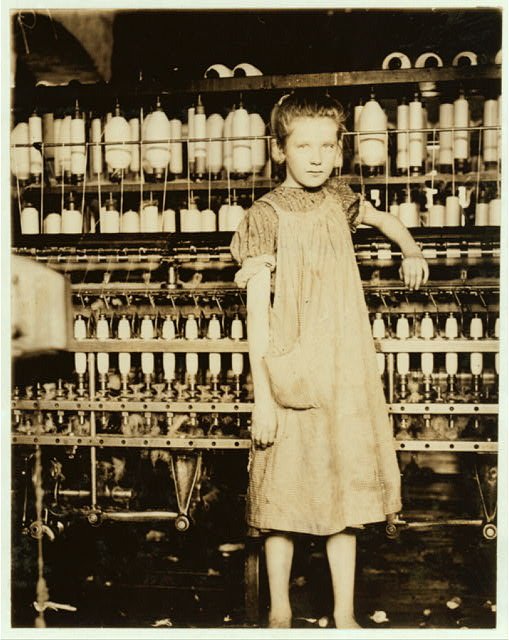
Take that card as an example of how Hine worked. His full caption for Addie Card reads, in part: "Girls in mill say she is ten years. She admitted to me she was twelve."13 He recorded both claims and let the reader weigh them. The committee did the same at scale. The National Archives' teaching unit on Hine says the NCLC "organized exhibitions with photographs and statistics to dramatize the plight of these children,"14 and that Hine believed people who saw the abuses for themselves would demand laws to end them (NARA, Photographs of Lewis Hine).
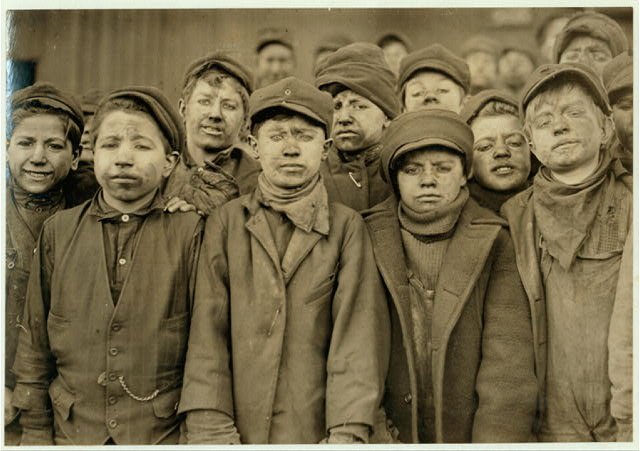
The law came in 1916. The Keating-Owen Child Labor Act, signed by Woodrow Wilson on September 1, 1916,15 used the commerce power rather than a direct ban: it barred from interstate shipment the products of mines that employed children under 16 and of mills, canneries and factories that employed children under 14, and it limited 14- and 15-year-olds to eight hours a day and six days a week, with no night work16 (NARA, Milestone Documents). The Archives' teaching page adds the proof-of-age requirement. Did Hine's pictures pass it? The honest answer is that no one can draw a line from a photograph to a roll call. What the record supports is narrower and still large: the committee that lobbied for the bill built its public case on his pictures, and the National Archives says his images "stirred America's conscience and helped change the nation's labor laws."17 By 1920, the Archives says, the number of child laborers had been cut to nearly half its 1910 level18, and by then the federal Act had been struck down.
The Court undid the federal law in less than two years. Hammer v. Dagenhart, 247 U.S. 251, decided June 3, 1918, held 5 to 4 that Keating-Owen exceeded the commerce power and invaded the authority over manufacturing that the Tenth Amendment reserved to the states.19 Justice Day wrote for the majority. Justice Holmes, joined by McKenna, Brandeis and Clarke, dissented: "The act does not meddle with anything belonging to the States"20 (opinion at Justia). Twenty years passed. The Fair Labor Standards Act of 1938 put the ban back in nearly the same form. Its child labor section, now 29 U.S.C. 212, forbids any producer, manufacturer or dealer to ship in commerce goods made in an establishment where "oppressive child labor" was employed within thirty days before the goods were removed21, and separately forbids employing oppressive child labor in or for commerce. In United States v. Darby, 312 U.S. 100, decided February 3, 1941, a unanimous Court under Justice Stone upheld the Act and overruled Hammer by name, calling it a departure from earlier commerce clause principles22 (opinion at Justia).
| Date | Event | What the record says |
|---|---|---|
| 1904 | National Child Labor Committee founded | LOC collection overview |
| 1908 | NCLC hires Hine | LOC; he works for the committee to 1924 |
| Feb. 1910, Jan. 1911 | Addie Card (North Pownal, Vt.); breaker boys (Pittston, Pa.) | LOC catalog records, Hine nos. 1056 and 1950 |
| Sept. 1, 1916 | Keating-Owen Act signed | NARA: under 16 in mines, under 14 in mills, canneries, factories; 8 hours, 6 days for ages 14 and 15 |
| June 3, 1918 | Hammer v. Dagenhart, 247 U.S. 251 | 5 to 4, Day; Holmes dissent |
| 1920 | Child laborers near half the 1910 level | NARA teaching page; the federal Act had been struck down in 1918 |
| 1924 | Hine's NCLC work ends | LOC |
| 1938 | Fair Labor Standards Act, child labor section (29 U.S.C. 212) | Cornell LII text |
| Feb. 3, 1941 | United States v. Darby, 312 U.S. 100 | Unanimous, Stone; Hammer overruled |
| 1954 | NCLC gives Hine collection to the Library of Congress | LOC; 5,100+ prints, 355 glass negatives |
The government's own camera: the FSA and OWI file
In 1935 the Resettlement Administration, a New Deal agency, hired a former Columbia economics instructor named Roy Stryker to run a photographic section.23 The section moved to the Farm Security Administration in 1937 and to the Office of War Information in 1942, and Stryker ran it for most of its life. The Library of Congress holds the result: about 175,000 black and white negatives, 1,610 color transparencies and about 107,000 prints, covering roughly 1935 to 1944.24 Most of it was made by Walker Evans, Dorothea Lange, Russell Lee, Arthur Rothstein, Ben Shahn, Jack Delano, Marion Post Wolcott, Gordon Parks, John Vachon, Carl Mydans and others in Stryker's unit, and the print file also includes about 30,000 photographs acquired from other sources (LOC, FSA/OWI About this collection). The photographers were federal employees making the pictures as part of their work, and the Library states that the black-and-white negatives collection is in the public domain and free to use and reuse, with a credit line.25 For a writer or advocate in 2026 this is the single richest body of public domain American political photography that exists, and the three pictures below come from it.
Migrant Mother, March 1936
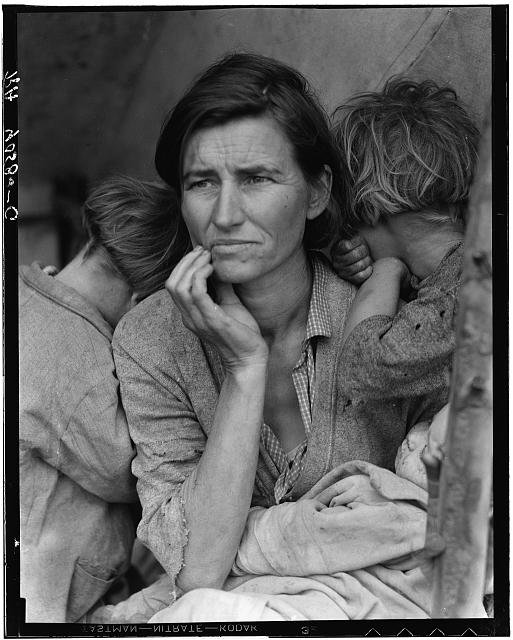
Everything the catalog says about this negative is worth knowing, because almost every popular version gets something wrong. The official title is the caption card's: "Destitute pea pickers in California. Mother of seven children. Age thirty-two. Nipomo, California."26 The date is March 1936. The negative is 4 by 5 inch nitrate, call number LC-USF34-009058-C.27 The record states that the negative "was retouched in the 1930s to erase the thumb holding a tent pole in lower right hand corner,"28 and that a file print made before the thumb was retouched survives as LC-DIG-ppmsca-12883 (LOC record). So the most reproduced documentary photograph in American history was altered, by the government agency that made it, before most people saw it.
Lange's own account, quoted by the Museum of Modern Art, was that she "made five exposures, working closer and closer from the same direction,"29 and that the family was living on frozen vegetables and birds the children caught after the pea crop froze. The woman was Florence Owens Thompson. MoMA's label records that Thompson disputed Lange's account in a 1970s interview: she said the two never spoke, that she had not sold her car's tires as Lange's account claimed, and that Lange may have confused her with another farmer or embellished (MoMA, Migrant Mother). The Library's record names her plainly in its summary: "Florence Thompson with three of her children."30 Two things are true at once. The picture shows real people in real poverty in a real pea pickers' camp. And the words around it, Lange's and the agency's, were partly wrong and the frame was partly cleaned up. MoMA's gallery label adds that Lange modeled the photograph on familiar Christian depictions of Mary and the infant Jesus to move viewers31; that is an interpretation, not a fact, and the lesson gives it as one.
The skull, May and August 1936
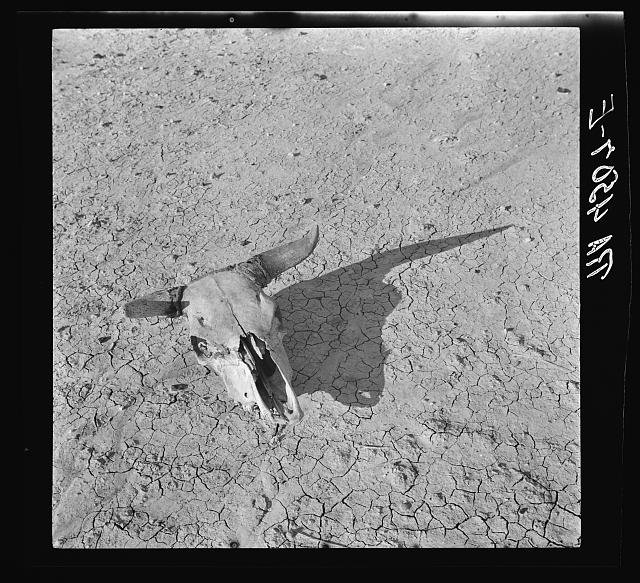
Arthur Rothstein, born in 1915, photographed a steer skull on cracked earth in Pennington County, South Dakota, in May 193632 (LOC record, LC-USF34-004507-E). He made more than one exposure and moved the skull between them; the Museum of Hoaxes database reproduces three of the frames, which show the skull had been moved. When the agency released the image in August 1936, during Roosevelt's trip through the drought states, Republican newspapers led by the Fargo Forum attacked it as government propaganda, called the skull "a movable prop,"33 and argued the drought itself was being exaggerated for the election. Rothstein's answer was that he had moved the skull no more than ten feet34 (Museum of Hoaxes, The Perambulating Skull). The nickname followed him for the rest of his career. The episode matters because a government photograph's staging became a campaign issue, and because the facts on both sides are undisputed: he moved it, the ground was dry, and the paper that caught him had its own politics.
Ella Watson, August 1942
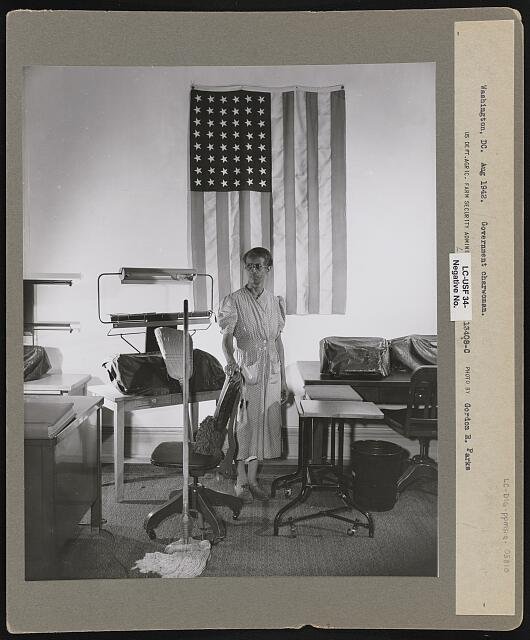
Gordon Parks (1912 to 2006) joined Stryker's section in 1942 and photographed Ella Watson, a government charwoman, at work and at home that August.35 The catalog title is "Washington, D.C. Government charwoman," with "Ella Watson" as an alternate title; the Library's record notes the title came from the caption card and the alternate from the 1988 book Documenting America, 1935-1943 (LOC record, LC-USF34-013408-C). The picture is a federal employee's portrait of another federal employee, made in a federal building, under a flag, by a government agency whose job was to show America to itself during a war against racial dictatorships. It is political without a caption, and it is in the public domain for exactly the reason it was possible: the government paid for it.
How to: read a Library of Congress photograph record before you use the picture
- Open the item page (loc.gov/item/NNNNNNNNNN/). Read the title. If it came from a caption card, the record says so; that title is the photographer's or agency's claim about the scene, and you should quote it as such. Popular titles (Migrant Mother, American Gothic) are later labels.
- Read every note. The Migrant Mother record contains the retouching note and the existence of an unretouched print. The Hine records say attribution to Hine is "based on provenance," meaning the committee's album, not a signature.
- Read the rights statement. "No known restrictions" is the Library's conclusion about publication, with a link to the collection's rights page. For FSA/OWI negatives the Library goes further and states the collection is public domain. For the Hine prints the basis is publication before 1931 and the committee's donation; the Library still asks you to make your own assessment.
- Record the reproduction number (LC-DIG-fsa-8b29516, LC-DIG-nclc-01830) and the call number. Those identify the exact negative or print, so a reader can find the same object you did.
- Look for related items. The Parks record links to other Ella Watson frames, including her home; the Rothstein record sits beside other Pennington County frames from the same month. Series tell you what the photographer was doing; a single frame tells you what an editor chose.
- Download from the Library's tile server, not from a republisher, and keep the catalog URL with the file. That is the provenance you will need if anyone asks.
War: Capa and Rosenthal
Robert Capa was born Andre Friedmann in Budapest in 1913, co-founded the Magnum agency after the Second World War with Henri Cartier-Bresson, David Seymour and George Rodger, and was killed by a landmine in Indochina in 1954 while covering the French war for Life36 (International Center of Photography). His most famous image, which the Met catalogs as The Falling Soldier (1936, printed later) and ICP calls Death of a Loyalist Soldier, shows a Republican militiaman thrown backward at what the caption said was the moment of death in the Spanish Civil War. Picture Post called Capa "the greatest war photographer in the world" in 1938,37 and the Met notes that the image became famous through magazines rather than prints38 (Met record). It ran in the French magazine Vu in late September 1936 and in Life in July 1937.
The argument about it has run for decades and the lesson gives the current state fairly. Capa's biographer Richard Whelan defended the picture's authenticity in a 2002 article (Aperture no. 166, also on the PBS American Masters site) and identified the man as Federico Borrell, a 24-year-old millworker from Alcoy and militiaman killed at Cerro Muriano on September 5, 1936;39 the identification rested on a former militiaman's memory of the battle, the confirmation of Borrell's younger brother, distinctive cartridge cases and Spanish records showing only one man of Borrell's column died there that day. In 2009 the Basque scholar Jose Manuel Susperregui, in Sombras de la fotografia, matched the hills behind the soldier to the countryside near Espejo40, some distance from Cerro Muriano, and argued the frame was made before September 5, when there was no fighting there, and was posed, probably with Gerda Taro's Rolleiflex on a tripod. Sebastiaan Faber of Oberlin College, writing for the Abraham Lincoln Brigade Archives in March 2010, judged that Susperregui's book strengthened the doubters' case, called Whelan's decision to stake Capa's reputation on the Borrell identification a tactical mistake, and argued that a staged picture could still tell the truth about a war that killed many men exactly that way (Faber, The Volunteer). That is where it stands: the location evidence points to Espejo, the death-moment claim is unproven, and the picture is still in the Met.
Joe Rosenthal's photograph of the second flag raising on Mount Suribachi, Iwo Jima, on February 23, 1945, has the opposite history. The facts, from the AP's own 1995 account and from American Heritage's 2023 review of the record: a patrol under Lt. Harold G. Schrier raised a small flag around 10:30 that morning, photographed by Marine Staff Sgt. Louis R. Lowery.41 Commanders ordered a larger flag put up. Rosenthal, of the Associated Press, climbed with Marine photographers Bob Campbell and Sgt. Bill Genaust, who was shooting motion picture film; in Rosenthal's own account, quoted in the AP story, Genaust came across in front of him with a movie camera and took a position about three feet to his right before the flag went up.42 The picture ran on the front page of the New York Times on February 25, 1945 and won the 1945 Pulitzer Prize for Photography, with the citation "For his photograph of the Marines planting the American flag on Mount Suribachi on Iwo Jima"43 (Pulitzer Prizes). The Marine Corps War Memorial in Arlington, Virginia, modeled on the photograph, was dedicated November 10, 1954.
The staging rumor began in Guam a few days later. Asked whether his picture was posed, Rosenthal said "Sure,"44 thinking the question meant his second picture that day, a posed "gung-ho" group of more than a dozen men cheering under the flag. Robert Sherrod of Time-Life relayed a version of the exchange to New York, Time's radio program "Time Views the News" said Rosenthal had reached the summit after the flag was already up, and Time retracted and apologized within days.45 The damage lasted the rest of his life. Rosenthal told the AP in 1995, "I think that is a twist that has been put on by Sherrod"46 (Landsberg, AP, February 17, 1995; Lancaster, American Heritage, 2023). What has changed since is the identification of the men. In 2016 the Marine Corps found that Pfc. Harold Schultz, not Navy corpsman John Bradley, was in the photograph.47 On October 17, 2019, after a two-year investigation with FBI help, it found that Cpl. Harold P. Keller, not Pfc. Rene Gagnon, was the man on the far side of the pole, of whom only part of a helmet shows (Military Times). The photograph was not staged. The caption was wrong for 71 years.
Myth: Rosenthal staged the Iwo Jima flag raising
The claim rests on one word, "Sure," spoken in answer to a question Rosenthal understood to be about a different, posed photograph. Time's radio program broadcast the accusation and retracted it within days in 1945. A Marine motion picture cameraman, Sgt. Bill Genaust, took a position about three feet to Rosenthal's right with his movie camera before the second flag went up, by Rosenthal's account in the AP story. The first flag, raised about 10:30 a.m. and photographed by Staff Sgt. Louis Lowery, is a separate event, and confusing the two is where most "staged" arguments start. What is true is that the famous picture shows the second, larger flag, and that the Marine Corps misidentified two of the six men until 2016 and 2019. A wrong caption is a real error. It is a different error from a staged picture, and the Capa case shows what the real thing looks like.
Dallas, Saigon, Trang Bang, Kent
Abraham Zapruder's 8 mm home movie of November 22, 1963 is the twentieth century's most studied piece of amateur footage and a lesson in how a private picture becomes public property. Under the 1992 JFK Records Act the camera-original film was transferred to the National Archives' JFK Records Collection and became government property on August 1, 1998.48 The Constitution requires just compensation for a taking, so an arbitration panel chaired by Arlin M. Adams set the price. On August 3, 1999 the Justice Department announced the award: $16 million, by a 2 to 1 vote.49 The Zapruder family's LMH Company had asked $30 million; government experts had valued the film at $784,000 to $1 million;50 the dissenting arbitrator, Walter Dellinger, called $16 million "simply too large an amount in light of the evidence."51 Under the agreement LMH kept the copyright and control over commercial uses (DOJ release 99-339). The object belongs to the public. The right to license it did not, at least as of that release.
Eddie Adams of the Associated Press photographed Brig. Gen. Nguyen Ngoc Loan, chief of South Vietnam's national police, shooting a bound prisoner in the head on a Saigon street during the Tet Offensive. The picture, titled "Saigon Execution," won the 1969 Pulitzer Prize for Spot News Photography52 (Pulitzer Prizes). Thirty years later Adams wrote Loan's eulogy for Time (July 27, 1998). He said the photograph had in effect taken two lives, the prisoner's and the general's; that photographs omit the context that produced the moment and can mislead without being altered; that Loan's men respected him and that he had built hospitals for war casualties;53 and that the picture "really messed up his life,"54 though Loan never blamed him. The two stayed in touch until Loan's final illness, and Adams sent flowers (Adams, Time). No photographer has written a more direct account of what a true picture can do to the man in it.
On June 8, 1972, at a highway checkpoint outside the village of Trang Bang, South Vietnamese aircraft dropped napalm on their own side's position and nine-year-old Phan Thi Kim Phuc ran toward the press, burned, naked, screaming. The photograph credited to AP's Huynh Cong "Nick" Ut, titled "The Terror of War," won the 1973 Pulitzer for Spot News Photography "depicting children in flight from a napalm bombing"55 (Pulitzer Prizes). Kim Phuc survived and received asylum in Canada in 1992. In January 2025 a documentary from The VII Foundation, The Stringer, directed by Bao Nguyen, premiered at Sundance and claimed that a Vietnamese stringer named Nguyen Thanh Nghe took the picture and sold it to the AP. The AP investigated for most of a year and published a 96-page report in May 2025 based on eyewitness interviews, examination of the cameras, surviving negatives and a 3D model of the scene;56 it found "no definitive evidence" to change the credit and said crediting Nghe would require "several leaps of faith."57 On May 16, 2025, World Press Photo nonetheless suspended its attribution to Ut. Its executive director, Joumana El Zein Khoury, wrote that "the level of doubt is too significant to maintain the existing attribution,"58 while saying there was not enough evidence to name another author; the organization said Nghe or a military photographer, Huynh Cong Phuc, may have been better positioned than Ut. The award itself was not withdrawn. Ut's lawyer, James Hornstein, called the suspension "deplorable and unprofessional"59 and said the organization had seemed set on punishing Ut from the start (CNN via KRDO, May 19, 2025; CBC). As of October 2026 the lesson has found no later reversal by either body. If you cite the picture, say "credited by the AP to Nick Ut; attribution suspended by World Press Photo in May 2025." Both facts are true.
John Filo was a Kent State photography major on May 4, 1970, when Ohio National Guardsmen fired between 61 and 67 shots in 13 seconds into a crowd of students, killing Jeffrey Miller, Allison Krause, William Schroeder and Sandra Scheuer and wounding nine, one of whom, Dean Kahler, was paralyzed.60 Twenty-eight of more than seventy Guardsmen on Blanket Hill fired; many fired into the air or ground (Kent State, The Search for Historical Accuracy). Filo, in the parking lot where many students had gathered, thought the Guardsmen were firing blanks and kept taking pictures. His photograph of a fourteen-year-old runaway, on one knee screaming over Miller's body won the 1971 Pulitzer for Spot News Photography for the Valley Daily News and Daily Dispatch61 (Pulitzer Prizes). The young woman's own account of why she screamed was not verified for this lesson. The picture is the one most Americans mean when they say "Kent State," and it is a reminder that the photographer who made the century's record of a campus shooting was a student with a camera, not a staff man flown in.
Abu Ghraib, Bodrum, Minneapolis
The pictures that moved politics after 2000 were increasingly made by people who were not photographers. The Abu Ghraib photographs were taken by American soldiers of other American soldiers. CBS's 60 Minutes II broadcast them at the end of April 2004 (the network's web report is dated April 27, 2004).62 They showed a hooded prisoner standing on a box with wires attached to his hands, told he would be electrocuted if he fell; naked prisoners stacked in a pyramid; prisoners posed to simulate sex; a dog attacking a detainee; a badly beaten man who appeared dead; and American soldiers laughing, pointing and giving thumbs-up. Six soldiers faced court-martial and the Army had removed seventeen people from duty, including a brigadier general.63 Brig. Gen. Mark Kimmitt told CBS the acts were wrong and reprehensible, that they did not represent the roughly 150,000 soldiers in Iraq, and that the investigation should reach anyone who encouraged the abuse (CBS News). The photographs did what the earlier written reports had not: they made the abuse undeniable to people who had not read the reports.
On September 2, 2015, in the early hours, Nilufer Demir of Turkey's Dogan News Agency (DHA) was on the beach at Bodrum to photograph refugees launching dinghies toward the Greek island of Kos when the bodies of Syrians from a capsized boat were found. One was a three-year-old boy, Alan Kurdi, whose family had been trying to reach Canada. Demir said she "almost felt paralyzed,"64 that a press photographer's job "does not allow time for second-guessing, for freezing," and that she hoped the picture would change how Europe saw migration65 (Vice, September 4, 2015). Peter Bouckaert of Human Rights Watch shared the picture on social media and it went around the world within hours. Time's account records that British Prime Minister David Cameron then pledged to take in many more Syrians66 (Time). A caution belongs here. Many articles credit the picture with changing policy in several countries. The verified link in the sources this lesson checked is to Cameron's pledge; other links are claims, and the table below marks them that way.
On May 25, 2020, a Minneapolis police officer, Derek Chauvin, knelt on George Floyd's neck until he died. A seventeen-year-old bystander, Darnella Frazier, recorded it on her phone. The recording became the central evidence in Chauvin's state trial; he was sentenced on June 25, 2021 to 22.5 years67 (Minnesota Attorney General). The Pulitzer Prize board gave Frazier a special citation in 2021 for "courageously recording the murder of George Floyd,"68 noting that the video spurred protests against police brutality around the world and showed the part ordinary citizens play in journalists' search for truth (Pulitzer Prizes). The same year the board's Breaking News Photography prize went to the AP's staff for pictures of the national reaction. A phone, held steady by a teenager who did not look away, did what Hine's fifty pounds of equipment did in 1910. The technology changed. The job did not.
| Photograph or recording | Date | Change that followed | How strong is the link? |
|---|---|---|---|
| Hine's NCLC photographs | 1908 to 1924 | Keating-Owen Act, Sept. 1, 1916; state laws; FLSA 1938 | Strong for the campaign (NCLC exhibitions used the pictures with statistics); no roll call can be tied to a picture; the 1916 Act was struck down in 1918 and effective federal law waited until 1938 and 1941 |
| Migrant Mother | March 1936 | Relief shipments to Nipomo camps, in most accounts | The lesson could not verify the relief-shipment claim on a primary source this session and leaves it as a widely repeated account |
| Rothstein's skull | May 1936; released Aug. 1936 | Campaign attack on the Resettlement Administration | Strong and documented in the opposing press; the staging was real and so was the drought |
| Rosenthal, Iwo Jima | Feb. 23, 1945 | Marine Corps War Memorial (dedicated Nov. 10, 1954); war bond imagery | Strong for the memorial, modeled on the picture |
| Zapruder film | Nov. 22, 1963 | Warren Commission evidence; 1992 JFK Records Act transfer; $16 million award, Aug. 3, 1999 | Strong and on the record (DOJ) |
| Adams, Saigon Execution | Tet Offensive, 1968 | Shift in American opinion on the war, in most histories | Plausible, not measurable; Adams himself said the picture misled about Loan |
| Ut, The Terror of War | June 8, 1972 | Same claim; attribution suspended by World Press Photo May 16, 2025 | Opinion effect plausible, not measurable; the 2025 dispute is documented on both sides |
| Filo, Kent State | May 4, 1970 | Student strike; Scranton Commission | The shootings, not the photograph, caused the response; the photograph fixed the memory |
| Abu Ghraib photographs | Broadcast late April 2004 | Courts-martial of six soldiers; 17 removed from duty incl. a brigadier general (as reported at the time) | Strong: the investigation preceded the broadcast, but the photographs forced the public reckoning |
| Demir, Alan Kurdi | Sept. 2, 2015 | Cameron's pledge to take more Syrians | Verified for the UK pledge in the sources checked; other national effects are claims |
| Frazier, George Floyd recording | May 25, 2020 | Chauvin conviction and 22.5-year sentence (June 25, 2021); protests; Pulitzer special citation | Strong for the trial evidence and the citation |
Manipulation: four kinds and a verified example of each
Lumping every altered picture under "fake" loses the distinctions that matter for checking. Four kinds recur.
Retouching a real picture. Stalin's censors made the practice a state function. The best known case is a photograph of Stalin walking the Moscow-Volga Canal with Kliment Voroshilov, Vyacheslav Molotov and the secret police chief Nikolai Yezhov; after Yezhov was arrested in 1939 and executed in February 1940, a reissued version showed only three men and the water where he had stood. The British designer David King collected such pairs in The Commissar Vanishes, exhibited at The Photographers' Gallery in London from January 21 to March 27, 2005,69 which also showed how Alexander Rodchenko was compelled to deface his own copy of Ten Years of Uzbekistan with thick black India ink after the 1937 purge70 (The Photographers' Gallery; Museum of Hoaxes). The American case that taught newsrooms the same lesson was mild by comparison. For its June 27, 1994 cover, Time had a freelance artist, Matt Mahurin, alter O.J. Simpson's police booking photograph on a computer: the skin and stubble darkened, the facial contours softened, the background lightened, the ID number shrunk. Newsweek ran the same mug shot unaltered the same week, and the two sat side by side on newsstands. Time labeled its version a "photo illustration" and its spokeswoman, Nancy Kearney, called it "irresponsible and insulting" to describe the cover as misleading or racist; Sheila Stainback of the National Association of Black Journalists asked "Why did he have to be darker?"71 Managing editor James Gaines defended the result as an "icon of tragedy,"72 and the magazine later apologized to readers73 (Kurtz, Washington Post, June 22, 1994; Museum of Hoaxes). The label did not save it.
Staging a real scene. Rothstein's skull is the clean example: real skull, real drought, moved ten feet. The Falling Soldier is the contested example: if Susperregui is right, a real militiaman performed a fall for the camera near Espejo and the caption invented his death. Hine's children were posed in the ordinary sense, standing still for a slow lens, and no one has ever called that staging; the line is whether the arrangement changes what the picture claims.
Framing a real scene selectively. Every photograph does this, and the honest version is a caption that says what is outside the frame. Adams's eulogy is the classic admission: the picture did not show what the prisoner had done or what Loan's men had seen that week, and so, in Adams's judgment, it misled without a single altered grain.
Generating a picture of something that never happened. On May 22, 2023, an image of black smoke beside a building captioned as an explosion at the Pentagon spread on Twitter through verified accounts, including one impersonating Bloomberg News and the real account of RT, the Russian state outlet. The Arlington County Fire Department and the Pentagon Force Protection Agency issued a joint statement that there was "NO explosion or incident"74 at or near the Pentagon. Stock indexes dipped briefly and recovered. Nick Waters of Bellingcat pointed to the tells: he told readers to look at the frontage of the building and the way the fence melded into the crowd barriers, the kind of error image generators make. When NPR reported, no second image, video or first-hand witness had appeared (NPR). In the 2024 campaign the same tools produced generated images of Taylor Swift appearing to endorse Donald Trump, which Trump reposted on Truth Social with the caption "I accept!"75 After the September 10, 2024 presidential debate, Swift posted on Instagram that the images "really conjured up my fears around AI"76 and endorsed Kamala Harris (CyberScoop). A fake endorsement produced a real one, which is as neat a demonstration as the subject offers that synthetic images have political consequences whether or not anyone believes them.
| Kind | Verified example | What was real | What was false | How it was caught |
|---|---|---|---|---|
| Retouching | Yezhov removed from the Moscow-Volga Canal photograph (after 1939) | The walk, the other three men | Yezhov's presence | Comparison with the earlier published print (King's archive) |
| Retouching | Migrant Mother negative, 1930s | Everything but a thumb | A clean lower corner | The unretouched file print, now LC-DIG-ppmsca-12883 |
| Retouching | Time cover, June 27, 1994 | The booking photograph | Skin tone, contours, ID number size | Newsweek's unaltered cover beside it |
| Staging | Rothstein's skull, May 1936 | Skull, drought, Badlands | That the skull lay where found | Other exposures showing the skull had been moved (Museum of Hoaxes) |
| Staging (contested) | Capa's Falling Soldier, 1936 | A militiaman, a hillside | Possibly the death and the place | Matching the background hills to Espejo (Susperregui, 2009) |
| Framing | Adams, Saigon Execution, 1968 | Everything in the frame | Nothing; the context was outside it | The photographer's own account (Time, 1998) |
| Generation | Pentagon explosion, May 22, 2023 | Nothing | The event | Official denial; architectural mismatch; no second source |
| Generation | Swift endorsement images, 2024 | Nothing | The endorsement | The subject's own denial and contrary endorsement |
How to: check a political photograph's provenance
- Find the earliest instance. Run the image through at least two reverse image searches (Google Images, TinEye, Bing, Yandex) and sort by date. You are looking for the first upload, the first caption and the first credit, not the most popular. A picture captioned as this week's protest that first appeared in 2014 is answered at this step.
- Go to the archive if there is one. For any American government photograph before 1945, search the Library of Congress Prints and Photographs catalog and the National Archives catalog by subject and date; for wire photographs search AP Images and Getty by caption. The catalog record gives the title, date, maker and rights, and tells you whether a famous frame has siblings.
- Read the EXIF, then distrust it. Tools such as the free exiftool show the camera, date and sometimes GPS data if the file still carries them. Social platforms strip this data on upload, editors can rewrite it, and a generated file can carry any values its maker chose. Present EXIF supports a claim; absent EXIF proves nothing.
- Look for Content Credentials. The Coalition for Content Provenance and Authenticity (C2PA), a project of the Joint Development Foundation that joined the efforts of the Content Authenticity Initiative and Project Origin,77 publishes an open standard for signed provenance data attached to a file (C2PA). Where a camera, editor or generator attached credentials, a verifier shows the chain of edits. Where none are present, the picture is simply unverified by that route, which as of October 2026 is still the case for most pictures.
- Check the scene against the world. Does the building match street-level imagery of the stated place? Does the weather match the stated date? Does the shadow angle match the stated hour? Do fences, text and hands behave like physical objects? The Pentagon fake failed the first and fourth of these.
- Find a second source or say there is none. A real event of any size produces more than one picture, from more than one angle, by more than one person. One image, one angle, one account, and official denial: that pattern is the generated image's signature.
- Write what you found, including the gaps. "Credited to X by agency Y; first published Z; archive record N; no credentials attached; matches street view of the location" is a provenance statement. "Looks real" is not.
How to: decide whether you can republish a photograph
- Was it made by a federal employee as part of the job? FSA, OWI, Army Signal Corps, NASA and most other federal agency photographs are public domain under 17 U.S.C. 105. Check that the maker was an employee, not a contractor, and that the picture was made for the agency; the Library's FSA/OWI rights page states the collection is public domain.
- Was it published before January 1, 1931? As of 2026 everything published in the United States before that date is public domain, which covers Hine's NCLC prints of 1908 to 1924 and Puck and Judge cartoons. The Library marks such material "no known restrictions."
- Is it a wire or magazine photograph after 1930? Capa, Rosenthal, Adams, Ut, Filo and Demir are all under copyright held by agencies, estates or publishers. Link to the museum or agency page and describe the picture in words. This lesson does exactly that for every one of them.
- Is it a phone recording by a private person? The recorder owns the copyright from the moment of recording. The Floyd video belongs to Darnella Frazier, not to the public, whatever its public importance.
- Is it a government document that happens to be a photograph, such as the Abu Ghraib pictures taken by soldiers? Works of federal employees in the course of duty are public domain, but the question of whether off-duty soldiers' snapshots qualify is unsettled, and many outlets treat them as licensable. When in doubt, link.
- Record the basis for your decision next to the file: "LOC, FSA/OWI, public domain, catalog URL" or "pre-1931 publication, LOC no known restrictions." If you cannot write a basis, you do not have one.
If you report on this
- Quote catalog titles as the maker's claim and famous titles as later labels. "Migrant Mother" is a nickname; the Library of Congress title is the caption card's text, and the catalog record says the negative was retouched. Readers deserve both facts.
- When you write that a photograph "changed policy," name the policy, the date and the evidence connecting them. Hine's pictures were used in the NCLC's exhibitions; the Keating-Owen Act passed in 1916; Hammer struck it down in 1918; effective federal law came in 1938. That sequence is defensible. "Hine's photographs ended child labor" is not.
- Separate staging from misidentification. Rosenthal's picture was not staged; two of its six men were misidentified until 2016 and 2019. Capa's picture may have been staged; its location has been challenged since 2009. Use the right word for each.
- On The Terror of War, give both institutions' positions and dates: AP's 96-page report (May 2025) found no definitive evidence to change the credit; World Press Photo suspended the attribution on May 16, 2025. Do not write "proven" for either side.
- For any picture circulating in a campaign, run the provenance steps before you describe it, and describe what you found, including "no earlier instance located" or "no credentials attached." A reporter who writes "an AI-generated image" should be able to say how they know.
- Credit lines are evidence. "Library of Congress, Prints & Photographs Division, FSA/OWI Collection, LC-USF34-009058-C" lets a reader find the negative. "Photo: internet" lets them find nothing.
Go further
- Library of Congress, National Child Labor Committee Collection, all 5,100 Hine prints searchable by state, industry and Hine number, and the National Archives' Hine teaching unit.
- Library of Congress, FSA/OWI Black-and-White Negatives, about 175,000 negatives, with the lot-level browsing that shows every frame a photographer made on an assignment. Carl Fleischhauer and Beverly W. Brannan, eds., Documenting America, 1935-1943 (University of California Press, 1988), is the Library's own study of the file and the source of the Parks title.
- Sara Hermanson Meister, Dorothea Lange: Migrant Mother (MoMA One on One series, 2018), the source the Library cites for the date, and MoMA's object page with Lange's and Thompson's accounts.
- Sebastiaan Faber's survey of the Falling Soldier debate and Jose Manuel Susperregui, Sombras de la fotografia (Universidad del Pais Vasco, 2009).
- Marc Lancaster in American Heritage (2023) and the AP's 1995 interview with Rosenthal; the Marine Corps' 2016 and 2019 identification announcements.
- The Pulitzer Prizes site, which lists every photography winner by year with citations, and is the only source you should cite for a prize claim.
- David King, The Commissar Vanishes: The Falsification of Photographs and Art in Stalin's Russia (Metropolitan Books, 1997; Tate edition 2014), with the 2005 Photographers' Gallery exhibition page.
- C2PA and its specifications site for how Content Credentials work; Bellingcat's published guides for the manual checks in the how-to above.
- Lesson 10 of this course for licensing photographs from AP Images and Getty and for Idaho's synthetic media election law; the Constitution course's First Amendment lesson for the law on publishing what the camera caught.
Questions and answers
Did Hine's photographs pass the Keating-Owen Act?
No single piece of evidence connects a photograph to a vote, and the lesson does not claim one. What the record shows is that the committee lobbying for the bill built its exhibitions on Hine's pictures paired with statistics, that the Act passed in 1916, and that the National Archives credits his images with helping change labor laws. The Act was struck down in 1918, and durable federal law came with the FLSA in 1938 and Darby in 1941. The pictures were part of a twenty-five-year campaign, not a switch.
Is Migrant Mother a faked photograph?
It is a real photograph of Florence Owens Thompson and three of her children in a Nipomo pea pickers' camp in March 1936, one of five exposures Lange said she made. Its negative was retouched in the 1930s to remove a thumb in the corner; the Library of Congress record says so and holds an unretouched print. Thompson later disputed parts of Lange's caption. "Retouched at the edge and captioned with errors" is the accurate description. "Faked" is not.
Who owns the FSA pictures?
No one, in the copyright sense. The photographers were federal employees working for a federal agency, and the Library of Congress states that the FSA/OWI Black-and-White Negatives collection is in the public domain and free to use and reuse. The Library asks for a credit line naming the Prints and Photographs Division and the collection. Lange's work for other employers before and after is a different matter and is under copyright.
What exactly did World Press Photo decide about Nick Ut?
On May 16, 2025, it suspended its attribution of The Terror of War to Ut, saying the level of doubt was too significant to maintain it, while declining to attribute the picture to anyone else and leaving the 1973 award in place. It said the evidence leaned toward Nguyen Thanh Nghe, with Huynh Cong Phuc another possibility. The AP's 96-page report of the same month reached the opposite conclusion: no definitive evidence to change the credit. Both are primary positions and a careful writer gives both.
Was the Iwo Jima flag raising posed?
No. The famous picture shows the second, larger flag going up on February 23, 1945; a Marine motion picture cameraman, Sgt. Bill Genaust, was beside Rosenthal with a movie camera. The rumor came from Rosenthal answering "Sure" to a question he took to be about his posed group photograph made afterward, relayed by a Time-Life correspondent and broadcast by Time's radio program, which retracted it within days. What was wrong for decades was the identification of two of the six men, corrected by the Marine Corps in 2016 and 2019.
Who owns the Zapruder film?
The public owns the object: the camera-original film became government property on August 1, 1998 under the 1992 JFK Records Act and is held in the National Archives. An arbitration panel awarded the Zapruder heirs' company $16 million for it on a 2 to 1 vote, announced August 3, 1999. Under the agreement described in the Justice Department's release, the company kept the copyright and control over commercial uses, so the right to license the images did not pass with the film.
Why does Eddie Adams's eulogy matter for how we read photographs?
Because the man who made one of the century's most consequential pictures wrote that it misled without being altered. Adams said the photograph omitted the context that produced the moment, that it took the general's life as surely as the prisoner's, and that Loan never blamed him. It is the clearest statement by a photographer that framing is a kind of editing, and that a true picture can still be an unfair one.
How can I tell a generated image from a real one?
Often you cannot from the pixels alone, and the tells (odd hands, blending fences, impossible text) get fewer every year. The reliable checks are external: find the earliest instance, look for a second picture or witness from another angle, check the scene against known imagery of the place, see whether Content Credentials are attached, and look for an official denial. The Pentagon fake of May 22, 2023 failed every one of those checks.
What is the difference between "no known restrictions" and "public domain"?
"Public domain" is a legal status: no one holds a copyright. "No known restrictions" is the Library of Congress's conclusion after examining a collection that it has found nothing preventing publication, and it still asks you to make your own assessment. For federal work like the FSA file the Library states public domain outright. For the Hine prints the basis is publication before 1931 and the committee's donation, and the Library uses the more cautious phrase.
Hard questions
If Lange's agency retouched the negative and her caption was wrong, why should anyone trust documentary photography at all?
Because the record that exposes the retouching is the same record that preserves the picture. The Library of Congress kept the unretouched print, catalogued the alteration, and published both. Thompson's dispute is on MoMA's label. That is what a trustworthy archive looks like: it shows its corrections. The lesson for a reader is to trust catalogs more than captions and to trust a series more than a frame. The lesson for a maker is that a thumb at the edge was not worth eighty years of asterisks.
Rothstein moved a skull ten feet and was pilloried. Hine lied his way into factories and is a hero. Isn't that a double standard?
The two deceptions aimed at different people. Hine deceived mill owners to get access and then recorded what he found, including the children's conflicting claims about their own ages, on the caption cards. Rothstein's picture, as released, asked the public to take the skull's position as found. The standard is the same in both cases: did the picture, with its caption, claim something the photographer knew to be arranged? Hine's did not. Rothstein's did, though the drought it depicted was real and his critics had their own motives. The honest conclusion is that Rothstein's sin was small and his critics' use of it was large, and that both facts belong in the account.
World Press Photo suspended Ut's credit on evidence the AP found insufficient. Doesn't that show the award bodies are just following a documentary's publicity?
That is Ut's lawyer's position, and it deserves a hearing: the organization acted after a film premiered, before new physical evidence, and did not name another author. The other side also deserves one: World Press Photo's job is to stand behind its own attributions, and it concluded it could no longer do so to its own standard, which is different from the AP's standard for changing a credit. Two institutions applied two burdens of proof to the same evidence and reached different results. That happens in courts too. What a writer owes readers is both dates, both findings and the name of the man who has been credited for fifty years.
A photograph of a dead child on a beach is used to argue for a policy. Isn't that exploitation, whatever the policy?
The photographer answered the question herself: her job did not allow time to freeze, and she hoped the picture would change how Europe saw migration. The family's own wishes, the agency's decision to distribute, the editors' decisions to publish and the activists' decisions to share were separate choices, and each can be judged. What the lesson insists on is narrower: the picture was real, the date and place are verified, and the one policy change this lesson could verify from a primary account was Cameron's pledge. Arguments about whether the picture should have been shown are legitimate. Arguments that it was faked are not.
Everyone now carries a camera and anyone can generate a picture. Hasn't the political photograph lost its power as evidence?
It has lost its presumption, which is different. A single picture no longer proves an event by itself; it did not in 1936 either, as the skull showed, but most people acted as if it did. What has replaced the presumption is a method: earliest instance, second angle, archive record, credentials, denial. The Frazier recording of May 25, 2020 shows the other half of the change. The most consequential political image of the decade was made by a bystander with a phone, admitted as evidence in a criminal trial, and honored by the Pulitzer board. The camera as witness is more common than ever. It just has to show its work.
Learn more
- Library of Congress, National Child Labor Committee Collection: All of Hine's prints, searchable, with the history of how the collection came to the Library.
- National Archives, Photographs of Lewis Hine: A teaching unit on how the committee used his pictures with statistics.
- Library of Congress, FSA/OWI Black-and-White Negatives: The public domain file of about 175,000 federal negatives.
- MoMA, Migrant Mother: Lange's account beside Florence Thompson's dispute of it.
- Sebastiaan Faber on the Falling Soldier debate: A readable survey of the evidence on Capa's most famous frame.
- Marc Lancaster, Was the Flag-Raising on Iwo Jima Posed?: The record on the staging rumor and who started it.
- CNN via KRDO on the Napalm Girl attribution: Both sides of the 2025 dispute over who took The Terror of War.
- Eddie Adams, Eulogy: General Nguyen Ngoc Loan: A photographer's own account of what his picture left out.
- C2PA, About: The open standard behind Content Credentials for checking where a file came from.
Notes
- National Archives, Milestone Documents: Keating-Owen Child Labor Act of 1916. Read it online. ↩
- Hammer v. Dagenhart, 247 U.S. 251 (1918). Read it online. ↩
- United States v. Darby, 312 U.S. 100 (1941). Read it online. ↩
- Library of Congress, FSA/OWI Black-and-White Negatives: About this collection. Read it online. ↩
- Museum of Hoaxes photo database, "The Perambulating Skull." Read it online. ↩
- Sebastiaan Faber, "Truth in the Making: The Never-Ending Saga of Capa's Falling Soldier," The Volunteer, March 17, 2010. Read it online. ↩
- Marc Lancaster, "Was the Flag-Raising on Iwo Jima Posed?" American Heritage, vol. 68 no. 6 (2023). Read it online. ↩
- CNN via KRDO, "Who took 'Napalm Girl'? World Press Photo suspends attribution of historic Vietnam War image," May 19, 2025. Read it online. ↩
- CNN via KRDO, "Who took 'Napalm Girl'? World Press Photo suspends attribution of historic Vietnam War image," May 19, 2025. Read it online. ↩
- NPR, "Fake viral images of an explosion at the Pentagon were probably created by AI," May 22, 2023. Read it online. ↩
- Library of Congress, National Child Labor Committee Collection: About this collection. Read it online. ↩
- Library of Congress, National Child Labor Committee Collection: About this collection. Read it online. ↩
- Library of Congress, "Addie Card, 12 years. Spinner in North Pormal [i.e., Pownal] Cotton Mill," Lewis Hine, February 1910, catalog record. Read it online. ↩
- National Archives, Teaching With Documents: Photographs of Lewis Hine, Documentation of Child Labor. Read it online. ↩
- National Archives, Milestone Documents: Keating-Owen Child Labor Act of 1916. Read it online. ↩
- National Archives, Milestone Documents: Keating-Owen Child Labor Act of 1916. Read it online. ↩
- National Archives, Teaching With Documents: Photographs of Lewis Hine, Documentation of Child Labor. Read it online. ↩
- National Archives, Teaching With Documents: Photographs of Lewis Hine, Documentation of Child Labor. Read it online. ↩
- Hammer v. Dagenhart, 247 U.S. 251 (1918). Read it online. ↩
- Hammer v. Dagenhart, 247 U.S. 251 (1918). Read it online. ↩
- 29 U.S.C. 212, Fair Labor Standards Act child labor provisions. Read it online. ↩
- United States v. Darby, 312 U.S. 100 (1941). Read it online. ↩
- Library of Congress, FSA/OWI Black-and-White Negatives: About this collection. Read it online. ↩
- Library of Congress, FSA/OWI Black-and-White Negatives: About this collection. Read it online. ↩
- Library of Congress, FSA/OWI Black-and-White Negatives: Rights and access. Read it online. ↩
- Library of Congress, "Destitute pea pickers in California. Mother of seven children. Age thirty-two. Nipomo, California," Dorothea Lange, March 1936, catalog record. Read it online. ↩
- Library of Congress, "Destitute pea pickers in California. Mother of seven children. Age thirty-two. Nipomo, California," Dorothea Lange, March 1936, catalog record. Read it online. ↩
- Library of Congress, "Destitute pea pickers in California. Mother of seven children. Age thirty-two. Nipomo, California," Dorothea Lange, March 1936, catalog record. Read it online. ↩
- Museum of Modern Art, Dorothea Lange, Migrant Mother, Nipomo, California (1936), collection record with Lange's account and Thompson's dispute. Read it online. ↩
- Library of Congress, "The bleached skull of a steer on the dry sun-baked earth of the South Dakota Badlands," Arthur Rothstein, May 1936, catalog record. Read it online. ↩
- Museum of Hoaxes photo database, "The Perambulating Skull." Read it online. ↩
- Museum of Hoaxes photo database, "The Perambulating Skull." Read it online. ↩
- Library of Congress, "Washington, D.C. Government charwoman," Gordon Parks, August 1942, catalog record. Read it online. ↩
- International Center of Photography, Robert Capa, biography. Read it online. ↩
- Metropolitan Museum of Art, Robert Capa, The Falling Soldier (1936, printed later), collection record. Read it online. ↩
- Metropolitan Museum of Art, Robert Capa, The Falling Soldier (1936, printed later), collection record. Read it online. ↩
- Richard Whelan, "Proving that Robert Capa's Falling Soldier is genuine: A detective story," Aperture no. 166 (Spring 2002), on PBS American Masters. Read it online. ↩
- Sebastiaan Faber, "Truth in the Making: The Never-Ending Saga of Capa's Falling Soldier," The Volunteer, March 17, 2010. Read it online. ↩
- Marc Lancaster, "Was the Flag-Raising on Iwo Jima Posed?" American Heritage, vol. 68 no. 6 (2023). Read it online. ↩
- Mitchell Landsberg (AP), "Photographer fights life-long battle over famous flag-raising photo," Seattle Times, February 17, 1995. Read it online. ↩
- The Pulitzer Prizes, Joe Rosenthal, 1945 Photography. Read it online. ↩
- Mitchell Landsberg (AP), "Photographer fights life-long battle over famous flag-raising photo," Seattle Times, February 17, 1995. Read it online. ↩
- Marc Lancaster, "Was the Flag-Raising on Iwo Jima Posed?" American Heritage, vol. 68 no. 6 (2023). Read it online. ↩
- Mitchell Landsberg (AP), "Photographer fights life-long battle over famous flag-raising photo," Seattle Times, February 17, 1995. Read it online. ↩
- Military Times, "Another Marine was misidentified in iconic Iwo Jima flag-raising photo, Corps says," October 17, 2019. Read it online. ↩
- U.S. Department of Justice, press release 99-339, "Arbitration panel awards $16 million for Zapruder film," August 3, 1999. Read it online. ↩
- U.S. Department of Justice, press release 99-339, "Arbitration panel awards $16 million for Zapruder film," August 3, 1999. Read it online. ↩
- U.S. Department of Justice, press release 99-339, "Arbitration panel awards $16 million for Zapruder film," August 3, 1999. Read it online. ↩
- U.S. Department of Justice, press release 99-339, "Arbitration panel awards $16 million for Zapruder film," August 3, 1999. Read it online. ↩
- The Pulitzer Prizes, Edward T. Adams, 1969 Spot News Photography. Read it online. ↩
- Eddie Adams, "Eulogy: General Nguyen Ngoc Loan," Time, July 27, 1998. Read it online. ↩
- Eddie Adams, "Eulogy: General Nguyen Ngoc Loan," Time, July 27, 1998. Read it online. ↩
- The Pulitzer Prizes, Huynh Cong Ut, 1973 Spot News Photography. Read it online. ↩
- CNN via KRDO, "Who took 'Napalm Girl'? World Press Photo suspends attribution of historic Vietnam War image," May 19, 2025. Read it online. ↩
- CNN via KRDO, "Who took 'Napalm Girl'? World Press Photo suspends attribution of historic Vietnam War image," May 19, 2025. Read it online. ↩
- World Press Photo, "Authorship disputed: The Terror of War." Read it online. ↩
- CBC News, "World Press Photo suspends credit for historic 'Napalm Girl' photo," May 2025. Read it online. ↩
- Kent State University, "The May 4 Shootings at Kent State University: The Search for Historical Accuracy." Read it online. ↩
- The Pulitzer Prizes, John Paul Filo, 1971 Spot News Photography. Read it online. ↩
- CBS News, "Abuse Of Iraqi POWs By GIs Probed," 60 Minutes II, April 2004. Read it online. ↩
- CBS News, "Abuse Of Iraqi POWs By GIs Probed," 60 Minutes II, April 2004. Read it online. ↩
- Vice, "We Spoke to the Photographer Behind the Picture of the Drowned Syrian Boy," September 4, 2015. Read it online. ↩
- Vice, "We Spoke to the Photographer Behind the Picture of the Drowned Syrian Boy," September 4, 2015. Read it online. ↩
- Time, "Alan Kurdi: the drowned boy who became a symbol of the refugee crisis." Read it online. ↩
- Minnesota Attorney General, statement on the sentencing of Derek Chauvin, June 25, 2021. Read it online. ↩
- The Pulitzer Prizes, Darnella Frazier, 2021 Special Citation. Read it online. ↩
- The Photographers' Gallery, "David King: The Commissar Vanishes," exhibition, 2005. Read it online. ↩
- The Photographers' Gallery, "David King: The Commissar Vanishes," exhibition, 2005. Read it online. ↩
- Howard Kurtz, "Time Magazine Draws Fire For 'Manipulated' O.J. Cover," Washington Post, via Seattle Times, June 22, 1994. Read it online. ↩
- Howard Kurtz, "Time Magazine Draws Fire For 'Manipulated' O.J. Cover," Washington Post, via Seattle Times, June 22, 1994. Read it online. ↩
- Museum of Hoaxes photo database, "O.J.'s Darkened Mug Shot," Time, June 27, 1994. Read it online. ↩
- NPR, "Fake viral images of an explosion at the Pentagon were probably created by AI," May 22, 2023. Read it online. ↩
- CyberScoop, "Taylor Swift endorses Harris, cites AI deepfake Trump posted," September 2024. Read it online. ↩
- CyberScoop, "Taylor Swift endorses Harris, cites AI deepfake Trump posted," September 2024. Read it online. ↩
- Coalition for Content Provenance and Authenticity (C2PA), About. Read it online. ↩
Check yourself
1. What did the Supreme Court hold in Hammer v. Dagenhart (1918)?
Justice Day's 5 to 4 majority held that barring interstate shipment of goods made with child labor reached production, which the Tenth Amendment reserved to the states. Holmes dissented. United States v. Darby overruled Hammer in 1941.
2. What did the Library of Congress record say happened to the Migrant Mother negative?
The LOC catalog record for LC-USF34-009058-C states that the negative was retouched in the 1930s to remove a thumb in the lower right corner, and that a file print made before retouching survives (ppmsca-12883).
3. How, by Rosenthal's own account, did the rumor that the Iwo Jima flag raising was staged begin?
Rosenthal said he assumed the question referred to the 'gung-ho' group shot. A Time-Life correspondent relayed the exchange, Time's radio program said the photo was staged, and Time retracted and apologized within days. Marine Sgt. Bill Genaust was beside him with a movie camera, and Rosenthal's own account in the AP story says Genaust crossed in front of him and took a position about three feet to his right.
4. What did World Press Photo do on May 16, 2025 regarding The Terror of War?
World Press Photo suspended the attribution, with its executive director saying the level of doubt was too significant to maintain it, while declining to name another author. The AP's 96-page investigation, released earlier that month, found no definitive evidence to change the credit.
5. Which of these is an example of synthetic generation rather than retouching or staging?
The Pentagon image depicted an event that never happened and was most likely produced by an image generator. The Yezhov and Time examples altered real photographs; Rothstein staged a real object.
6. How much did the arbitration panel award the Zapruder heirs for the camera-original film, and what did the owners keep?
The Justice Department's August 3, 1999 release reports a 2 to 1 award of $16 million (LMH had asked $30 million; government experts valued the film at $784,000 to $1 million) and states that LMH kept the copyright under its agreement with the government.
Terms in this lesson
- Photography made to record living and working conditions in order to change them. Hine's work for the National Child Labor Committee (1908 to 1924) and the FSA file are the American models.
- Caption card
- The typed card that accompanied each FSA/OWI negative and NCLC print, giving the photographer's title, place and date. The Library of Congress takes catalog titles from these cards, so the official title of Migrant Mother is 'Destitute pea pickers in California. Mother of seven children. Age thirty-two. Nipomo, California.'
- Staging
- Arranging a real scene before photographing it, from posing people to moving an object. Rothstein's 1936 skull is the standard American example; the question with Capa's Falling Soldier is whether the fall was staged at all.
- Retouching
- Altering a negative or print after exposure. The Migrant Mother negative lost a thumb in the 1930s; Soviet retouchers removed purged officials with airbrush and scalpel.
- Photo-illustration
- A publisher's label for an image altered for effect rather than presented as a record. Time used it for the darkened O.J. Simpson cover of June 27, 1994; the label did not stop the criticism.
- Synthetic image
- A picture generated by software from a text prompt or other inputs rather than captured by a camera. The May 22, 2023 Pentagon explosion fake is an example.
- Provenance
- The documented chain of a picture's origin: who made it, when, where, for whom, and how it reached you. For an archive photograph the catalog record is the primary provenance document.
- EXIF
- Metadata a camera writes into an image file (date, camera model, sometimes location). Useful when present, but platforms strip it, editors can rewrite it, and a generated image can carry invented values. Its absence proves nothing.
- Content Credentials
- Cryptographically signed provenance data attached to a file under the C2PA open standard, recording how an image was made and edited. Present only when a maker or tool chooses to attach them.
- No known restrictions
- The Library of Congress phrasing for material it has examined and believes free of copyright or other restrictions on publication. It is a research conclusion, not a license, and the Library asks users to make their own assessment.
Sources
- Library of Congress, National Child Labor Committee Collection: About this collection checked 2026-10
- Library of Congress, Addie Card, 12 years. Spinner in North Pormal [i.e., Pownal] Cotton Mill (Hine, February 1910), catalog record checked 2026-10
- Library of Congress, Breaker boys in #9 Breaker, Hughestown Borough, Pa. Coal Co. (Hine, January 1911), catalog record checked 2026-10
- National Archives, Teaching With Documents: Photographs of Lewis Hine, Documentation of Child Labor checked 2026-10
- National Archives, Milestone Documents: Keating-Owen Child Labor Act of 1916 checked 2026-10
- Hammer v. Dagenhart, 247 U.S. 251 (1918) checked 2026-10
- 29 U.S.C. 212, Fair Labor Standards Act child labor provisions checked 2026-10
- United States v. Darby, 312 U.S. 100 (1941) checked 2026-10
- Library of Congress, FSA/OWI Black-and-White Negatives: About this collection checked 2026-10
- Library of Congress, Destitute pea pickers in California. Mother of seven children. Age thirty-two. Nipomo, California (Lange, March 1936), catalog record with retouching note checked 2026-10
- Museum of Modern Art, Dorothea Lange, Migrant Mother, Nipomo, California (1936), with Lange's account and Thompson's dispute checked 2026-10
- Library of Congress, The bleached skull of a steer on the dry sun-baked earth of the South Dakota Badlands (Rothstein, May 1936), catalog record checked 2026-10
- Museum of Hoaxes photo database, The Perambulating Skull (Rothstein, 1936; Fargo Forum) checked 2026-10
- Library of Congress, Washington, D.C. Government charwoman (Gordon Parks, August 1942), catalog record checked 2026-10
- International Center of Photography, Robert Capa (biography) checked 2026-10
- Metropolitan Museum of Art, Robert Capa, The Falling Soldier (1936, printed later) checked 2026-10
- Sebastiaan Faber, Truth in the Making: The Never-Ending Saga of Capa's Falling Soldier, The Volunteer (ALBA), March 17, 2010 checked 2026-10
- The Pulitzer Prizes, Joe Rosenthal, 1945 Photography checked 2026-10
- Marc Lancaster, Was the Flag-Raising on Iwo Jima Posed?, American Heritage, vol. 68 no. 6 (2023) checked 2026-10
- Mitchell Landsberg (AP), Photographer fights life-long battle over famous flag-raising photo, Seattle Times, February 17, 1995 checked 2026-10
- Military Times, Another Marine was misidentified in iconic Iwo Jima flag-raising photo, Corps says, October 17, 2019 checked 2026-10
- U.S. Department of Justice, press release 99-339: arbitration panel awards $16 million for Zapruder film, August 3, 1999 checked 2026-10
- The Pulitzer Prizes, Edward T. Adams, 1969 Spot News Photography checked 2026-10
- Eddie Adams, Eulogy: General Nguyen Ngoc Loan, Time, July 27, 1998 checked 2026-10
- The Pulitzer Prizes, Huynh Cong Ut, 1973 Spot News Photography checked 2026-10
- CBC News, World Press Photo suspends credit for historic 'Napalm Girl' photo, May 2025 checked 2026-10
- CNN via KRDO, Who took 'Napalm Girl'? World Press Photo suspends attribution of historic Vietnam War image, May 19, 2025 checked 2026-10
- The Pulitzer Prizes, John Paul Filo, 1971 Spot News Photography checked 2026-10
- Kent State University, The May 4 Shootings at Kent State University: The Search for Historical Accuracy (Lewis and Hensley) checked 2026-10
- CBS News, Abuse Of Iraqi POWs By GIs Probed (60 Minutes II), April 2004 checked 2026-10
- Time, Alan Kurdi: the drowned boy who became a symbol of the refugee crisis (Nilufer Demir interview material) checked 2026-10
- Vice, We Spoke to the Photographer Behind the Picture of the Drowned Syrian Boy, September 4, 2015 checked 2026-10
- The Pulitzer Prizes, Darnella Frazier, 2021 Special Citation checked 2026-10
- Minnesota Attorney General, statement on the sentencing of Derek Chauvin, June 25, 2021 checked 2026-10
- The Photographers' Gallery, David King: The Commissar Vanishes (exhibition, 2005) checked 2026-10
- Museum of Hoaxes photo database, The Commissar Vanishes (Stalin and Yezhov) checked 2026-10
- Howard Kurtz (Washington Post), Time Magazine Draws Fire For 'Manipulated' O.J. Cover, Seattle Times, June 22, 1994 checked 2026-10
- Museum of Hoaxes photo database, O.J.'s Darkened Mug Shot (Time, June 27, 1994) checked 2026-10
- NPR, Fake viral images of an explosion at the Pentagon were probably created by AI, May 22, 2023 checked 2026-10
- CyberScoop, Taylor Swift endorses Harris, cites AI deepfake Trump posted, September 2024 checked 2026-10
- Coalition for Content Provenance and Authenticity (C2PA), About checked 2026-10
- Library of Congress, FSA/OWI Black-and-White Negatives: Rights and access (public domain statement and credit line) checked 2026-10
- Richard Whelan, Proving that Robert Capa's Falling Soldier is genuine: A detective story (PBS American Masters; Aperture no. 166, Spring 2002) checked 2026-10
- World Press Photo, Authorship disputed: The Terror of War (suspension of attribution to Nick Ut) checked 2026-10