Lesson 11 of 12 · about 55 minutes · Updated November 22, 2026
Medicare Fraud and Scams Aimed at Seniors
You'll be able to
- Distinguish fraud, kickbacks, abuse and improper payments, and read CMS's fiscal 2025 improper payment rates correctly.
- Describe the main Medicare fraud schemes named in HHS-OIG alerts and Justice Department takedowns, and the red flags a beneficiary might see.
- Report the status of Idaho-connected Medicare cases exactly as the court record states it: charged, pleaded guilty, convicted, or settled with or without admission.
- Explain the CMS marketing rules for Medicare Advantage agents and Idaho's producer licensing law.
- Describe how the Senior Medicare Patrol works in Idaho and compare Idaho's 2024 results with neighbor states using a per-beneficiary rate.
- Follow the steps for checking a Medicare Summary Notice or plan explanation of benefits and identify the reporting path for each kind of problem.
Start here: the short version
- Most improper payments are not fraud, and CMS says so. CMS estimated that Original Medicare (fee-for-service) paid $28.83 billion improperly in fiscal year 2025, an improper payment rate of 6.55 percent, down from 7.66 percent ($31.70 billion) in fiscal 2024; Medicare Advantage (Part C) was 6.09 percent ($23.67 billion) and Part D 4.00 percent ($4.23 billion). CMS's fact sheet of Jan. 15, 2026 states that "improper payment measurement is not a measure of fraud."1
- The federal takedowns are huge and national. The Justice Department's June 30, 2025 National Health Care Fraud Takedown charged 324 defendants in cases with "over $14.6 billion in intended loss"; the June 23, 2026 takedown charged 455 defendants in cases with "over $6.5 billion" in alleged fraud. Both releases list the U.S. Attorney's Office for the District of Idaho among the participating offices.23
- Idaho has its own Medicare cases. A Coeur d'Alene physician, David Antonio Becerril, was convicted by a federal jury in Washington state on Sept. 29, 2025 of 16 counts for signing genetic test and brace orders for Medicare patients he never treated, and was sentenced to 40 months in prison with $1.25 million in restitution in July 2026. A nurse practitioner licensed in Idaho, Kristen Bolling, pleaded guilty in Idaho in October 2023 in a $6.1 million brace and cancer genetic testing conspiracy.456
- The scams that reach Idaho kitchens are mostly phone, text and ad scams. Federal alerts describe offers of "free" genetic tests, braces, catheters and remote monitoring that end with Medicare billed for things no doctor ordered. Medicare.gov says "Medicare will never call you uninvited and ask you to give us personal or private information."789
- Idahoans 60 and older reported $37.4 million in internet crime losses in 2025. FBI Internet Crime Complaint Center figures cited by the Idaho Department of Finance show 1,136 complaints and $37,394,229 in losses for 2025, against 775 complaints and $18,663,392 in 2024 (all scam types, not only Medicare).10
- Idaho's Senior Medicare Patrol is run by the Idaho Commission on Aging through the Area Agencies on Aging. The commission's 2026 to 2029 strategic plan says each Area Agency on Aging has at least one SMP volunteer coordinator. HHS-OIG's data show the Idaho project had 25 active team members and 966 individual contacts with or for beneficiaries in 2024.1112
- The paper trail is the defense. Original Medicare mails a Medicare Summary Notice at least twice a year; Medicare Advantage plans must send an explanation of benefits under 42 CFR 422.111(k) that includes instructions for reporting fraud; Part D plans must send one by the end of the month after any month with drug claims under 42 CFR 423.128(e).131415
Law: Social Security Act titles XI and XVIII, 31 U.S.C. 3729 to 3733 (False Claims Act), 18 U.S.C. 1347, and 42 CFR parts 420, 422 and 423 as amended through Nov. 22, 2026; Idaho Code Title 41 through the 2026 session; improper payment estimates for fiscal year 2025 as published by CMS on Jan. 15, 2026; takedown figures as announced by the Justice Department on June 30, 2025 and June 23, 2026; court records as described in the press releases named in each note; data as named in each table; checked Nov. 22, 2026. Case status changes: a charge is only an accusation, and a defendant is presumed innocent unless proven guilty.
Medicare Advantage alone accounted for $388.72 billion in Part C spending in calendar 2023, by CMS's count, and money on that scale draws theft.16 Some of it is done by people who never see a patient: telemarketers, shell suppliers and labs that buy Medicare numbers and bill for things no one needed. Some is done by licensed doctors, nurse practitioners and clinics that sign orders they should not sign. Some sits in a gray zone where billing rules are bent and the courts or CMS later decide whether money was owed back. And some of the harm lands directly on beneficiaries, through calls and texts from people pretending to be Medicare, or agents who switch someone's plan without a real conversation.
This lesson separates those pieces. It explains the difference between fraud, abuse and improper payments, lays out the main schemes federal investigators describe, reports the 2025 and 2026 national takedowns and the Idaho cases that appear in the public record, and explains what the Senior Medicare Patrol does in Idaho. It then walks through reading a Medicare Summary Notice and a Medicare Advantage explanation of benefits, and shows the reporting paths. Every named person or company is described exactly as the court record or press release describes them: charged, pleaded guilty, convicted, or settled without admitting liability.
Other lessons carry the background. How Medicare Advantage plans are paid, including risk scores and coding intensity, is in lesson 04, Original Medicare vs. Medicare Advantage. Part D coverage and drug costs are in lesson 06, Part D and Drug Costs. How the public can take part in Medicare rulemaking, including the yearly Medicare Advantage and Part D rules that set CMS marketing standards, is in lesson 12, Having a Say. Phone, email and computer scams in general, including the tricks used on older adults, are covered in the Home Computer Security course, and the laws on personal data and breaches are in Privacy and Data Security Laws. Medicaid fraud, which runs on a separate state and federal track, is touched on in the Idaho Medicaid course, lesson 05.

Fraud, abuse and improper payments: three different things
Public arguments about Medicare money often mix three terms. They mean different things in law and in the data, and mixing them leads to wrong conclusions in both directions: either that Medicare is mostly fraud, or that fraud is too small to matter.
What the words mean
- Fraud
- Knowingly lying to get paid, or knowingly causing a false claim. The federal health care fraud statute, 18 U.S.C. 1347, makes it a crime to knowingly and willfully execute a scheme to defraud a health care benefit program, with up to 10 years in prison, up to 20 years if the violation results in serious bodily injury, and up to life if it results in death.17 Civil fraud is handled under the False Claims Act, 31 U.S.C. 3729, which makes a person liable for knowingly presenting a false claim for payment to the United States.18
- Kickbacks
- Paying or receiving anything of value to induce or reward referrals of items or services paid by Medicare or another federal health care program. The Anti-Kickback Statute, Social Security Act section 1128B(b) (42 U.S.C. 1320a-7b(b)), makes this a felony.19 Most of the telemarketing schemes described below run on kickbacks: a lab or supplier pays for signed orders.
- Self-referral
- The physician self-referral law (often called the Stark law), Social Security Act section 1877 (42 U.S.C. 1395nn), bars a physician from referring Medicare patients for certain services to an entity the physician or a family member has a financial relationship with, unless an exception applies. It is a civil, strict-liability rule: intent does not matter.20
- Abuse and waste
- Billing or practices that are inconsistent with sound medical or business practice and lead to unnecessary costs, without proof that anyone intended to deceive. Abuse can become fraud if it is done knowingly. The line is drawn case by case by investigators, prosecutors and courts.
- Improper payment
- Any payment that should not have been made or was made in the wrong amount, including payments the reviewer cannot confirm because the paperwork is missing. This is an accounting and audit term. CMS estimates it every year by sampling claims, and it includes honest mistakes, missing signatures, wrong codes and underpayments as well as fraud.121
- Exclusion
- HHS-OIG can bar a person or company from billing Medicare, Medicaid and other federal health programs. Social Security Act section 1128 (42 U.S.C. 1320a-7) requires exclusion after certain convictions, including program-related crimes and patient abuse, and allows it for other conduct.22
The improper payment numbers for fiscal 2025
CMS measures Original Medicare's error rate through its CERT program, which pulls a random sample of claims, requests the medical records from the provider, and has reviewers decide whether each claim was paid correctly under Medicare rules.21 Medicare Advantage and Part D have their own measurements. For Medicare Advantage, CMS checks whether the diagnoses a plan reported (which drive its risk-adjusted payment) are supported by the patient's medical record. For fiscal 2025, the Part C measure was based on calendar 2023 payments.16
| Program | FY 2024 rate | FY 2024 amount | FY 2025 rate | FY 2025 amount | Source |
|---|---|---|---|---|---|
| Original Medicare (fee-for-service) | 7.66% | $31.70 billion | 6.55% | $28.83 billion | CMS fact sheet, Jan. 15, 20261 |
| Medicare Advantage (Part C) | 5.61% | $19.07 billion | 6.09% | $23.67 billion | CMS fact sheet; Part C findings16 |
| Medicare Part D | 3.70% | $3.58 billion | 4.00% | $4.23 billion | CMS fact sheet |
| Medicare, three parts added (our sum) | n/a | $54.35 billion | n/a | $56.73 billion | Our calculation from the rows above |
| Medicaid (for comparison; federal and state) | 5.09% | $31.10 billion | 6.12% | $37.39 billion | CMS fact sheet |
Three points in the CMS documents matter for reading these numbers. First, the fee-for-service rate has been below 10 percent for nine straight years, according to CMS. Second, CMS says most improper payments across programs happened when a reviewer could not tell whether a payment was proper because the documentation was missing or not enough, and for Medicaid it says 77.17 percent of fiscal 2025 improper payments came from insufficient documentation, which it describes as "generally not indicative of fraud or abuse."1 Third, the Medicare Advantage number is mostly about diagnoses. CMS's Part C findings put calendar 2023 overpayments at $21.43 billion and underpayments at $2.23 billion, out of $388.72 billion in Part C spending; the net improper amount was $19.20 billion (4.94 percent). Unsupported diagnoses made up 5.51 percent of Part C spending, and missing or insufficient documentation only 0.22 percent ($869 million).16
How we figured it: the three-part Medicare total
CMS publishes separate estimates for Original Medicare, Part C and Part D and does not publish one combined Medicare figure in the fact sheet. We added the three published dollar amounts: $28.83 billion + $23.67 billion + $4.23 billion = $56.73 billion for fiscal 2025, and $31.70 billion + $19.07 billion + $3.58 billion = $54.35 billion for fiscal 2024. The three measures use different methods and different payment years (the fiscal 2025 Part C figure reflects calendar 2023 payments), so the sum is a rough scale, not a single error rate, and we do not compute one.116
Who fights Medicare fraud
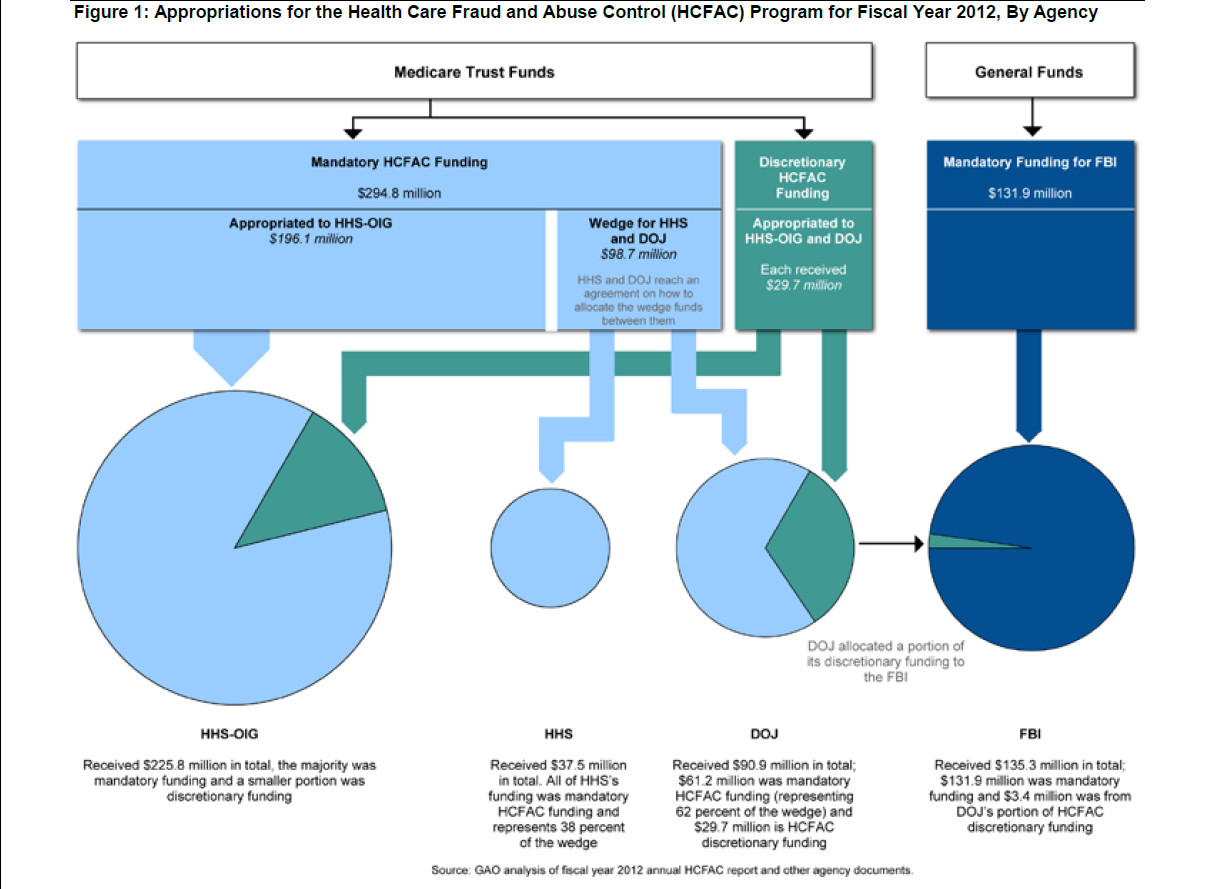
Several federal offices share the work, paid for in large part by a dedicated account. The Health Insurance Portability and Accountability Act of 1996 (P.L. 104-191, Aug. 21, 1996) created the Health Care Fraud and Abuse Control Program, now Social Security Act section 1128C, which told the HHS Secretary, acting through the Inspector General, and the Attorney General to set up a joint program "not later than January 1, 1997."23 Its money comes from an account in the Hospital Insurance trust fund set up by Social Security Act section 1817(k).24
- HHS Office of Inspector General (HHS-OIG) investigates, audits and evaluates Medicare, runs the hotline, issues consumer and fraud alerts, imposes civil money penalties and excludes providers.
- The Justice Department prosecutes through the 93 U.S. Attorneys' Offices (including the District of Idaho in Boise) and the Criminal Division's Fraud Section, whose Health Care Fraud Unit runs Medicare Fraud Strike Forces; since March 2007 the strike forces have charged more than 5,400 defendants who billed Medicare more than $27 billion, according to the 2025 takedown release.2 DOJ's Civil Division and U.S. Attorneys handle False Claims Act cases. In 2026 the department announced a National Fraud Enforcement Division on April 7.3
- The FBI investigates health care fraud alongside OIG.
- CMS's Center for Program Integrity runs claim edits, audits and contractors, and can suspend payments or revoke a provider's billing privileges. The 2026 takedown release lists CMS actions to suspend 1,079 providers and revoke billing privileges for 1,403.3
- State Medicaid Fraud Control Units, in Idaho a unit in the Attorney General's office, focus on Medicaid but often work joint cases; Idaho's unit assisted in the Boise lab-billing case described below.25
The HCFAC program's fiscal 2025 report, as summarized in OIG's fact sheet, counts more than $6.9 billion in civil health care fraud settlements and judgments under the False Claims Act in fiscal 2025, 622 criminal actions and 861 civil actions from HHS-OIG investigations, more than 448 defendants convicted of health care fraud-related crimes, and 2,837 individuals and entities excluded from federal health programs. It reports a three-year return of $3.20 for every dollar spent for fiscal 2023 to 2025.26

The main schemes, as investigators describe them
The table below lists the schemes that show up most often in HHS-OIG alerts, CMS actions and Justice Department takedowns from 2023 to 2026. Each row says what the record says the scheme looks like, what a beneficiary might notice, and where the description comes from. It is a description of reported patterns. It does not say that any particular supplier, lab, hospice or plan in Idaho does these things.
| Scheme | How it works, per the record | What a beneficiary might notice | Source |
|---|---|---|---|
| Genetic testing ("free" cancer or heart gene tests) | Telemarketers, health fairs or door-to-door visits collect a cheek swab and a Medicare number; a doctor who never saw the patient signs the order; the lab bills Medicare. If Medicare denies the claim, the beneficiary may be billed. | A test kit in the mail no doctor ordered; a lab on the summary notice you never heard of | HHS-OIG fraud alert7 |
| Braces and other durable medical equipment (DME) | Calls or ads offer a free back, knee or shoulder brace "billed to Medicare"; a telemedicine doctor signs a pre-filled order; a supplier bills Medicare and pays kickbacks. | Braces shipped to the door; supplies on statements you did not order | HHS-OIG alerts; Idaho and Washington cases846 |
| Urinary catheters | Suppliers bill Medicare every month for catheters that are not needed and may never be delivered, often using stolen identities. | Monthly catheter charges on a summary notice | HHS-OIG alert (March 6, 2024); 2025 takedown82 |
| Remote patient monitoring | Companies enroll people in monitoring that is not medically needed and bill for setup, teaching and monthly monitoring that often never happens. | Devices you did not ask for; monitoring charges with no follow-up from your own doctor | HHS-OIG alert (Nov. 21, 2023)27 |
| Wound care skin substitutes (amniotic grafts) | Billing of very high-priced skin substitute products, sometimes in very large quantities or for patients who did not need them; Part B spending rose from $256 million in 2019 to more than $10 billion in 2024. | Wound care charges of thousands of dollars per visit, including at home | CMS (Oct. 31, 2025); HHS-OIG (Sept. 3, 2025); 2026 takedown28293 |
| Hospice | Enrolling people who are not terminally ill, offering gifts, providing little care; "churn and burn" hospices that close after an audit and reopen under a new number. | Someone signed up for hospice who was not told they were dying; loss of coverage for curative care | CMS (Aug. 22, 2023); SMP outreach data3012 |
| Lab tests (urine drug tests, panels) | Billing for tests no clinician ordered, sometimes using clinicians' names without permission. | Lab charges for tests you did not take | Boise case, 202125 |
| Medicare Advantage diagnosis inflation (risk score fraud) | Reporting diagnoses that the medical record does not support, or adding them after the visit, to raise the risk-adjusted payment a plan receives from CMS. | Usually nothing; the beneficiary's own care may be unaffected, though a wrong diagnosis can sit in the record | CMS Part C findings; HHS-OIG (Oct. 21, 2024); Kaiser settlement (Jan. 14, 2026)163132 |
| Identity theft and "new card" calls | Callers posing as Medicare or government staff ask for a Medicare number to "verify" or to send a "new plastic card," then use or sell the number. | Calls or texts asking for your Medicare number; charges from providers you never saw | FTC (June 5, 2024); Idaho SHIBA and SMP handout3334 |
Genetic tests, braces and the telemarketing model
The scheme that reached Idaho most directly is the telemarketing and telemedicine model that peaked from about 2017 to 2019. The best-documented local example is the case of Dr. David Antonio Becerril. According to the U.S. Attorney's Office for the Eastern District of Washington, telemarketers working for a company called Real Time Physicians, LLC contacted elderly Medicare beneficiaries and got their personal information and Medicare numbers. Becerril, then of Selah, Washington and later of Coeur d'Alene, certified prescriptions for genetic tests and for back, knee, shoulder and ankle braces through a Real Time internet portal, though he never treated the beneficiaries. Real Time sold the prescriptions to genetic testing labs and DME companies, which billed Medicare and shared the proceeds; Real Time paid Becerril $20 per prescription. The release says he reviewed prescriptions for an average of 26 seconds before signing, that more than $3.2 million was billed to Medicare and more than $1.3 million paid before the fraud was uncovered, and that he received more than $37,000.4
A federal jury in the Eastern District of Washington (Case No. 1:23-CR-02029-SAB) convicted him on Sept. 29, 2025 of 16 counts of conspiracy, fraud and false statements, according to the office's Nov. 17, 2025 release.4 The office's sentencing release of July 22, 2026 says Chief U.S. District Judge Stanley A. Bastian sentenced him on July 8, 2026 to 40 months in prison and three years of court supervision; it lists the 16 felony counts as conspiracy to commit health care fraud, conspiracy to commit wire fraud, and multiple counts of health care fraud, wire fraud and false statements relating to health care matters, and gives restitution of $1,250,667.19 to Medicare and a $37,340 forfeiture money judgment.5
The same model appears in an Idaho case. On Oct. 23, 2023, the U.S. Attorney's Office for the District of Idaho announced that Kristen Bolling, 40, of Sheridan, Wyoming, a nurse practitioner licensed in Idaho, Wyoming, Colorado and Washington, pleaded guilty to conspiracy to commit health care fraud. The release says that from April 2017 through October 2019 she accepted pre-filled orders from companies and signed them "without seeing the patients or making a medical necessity determination," was paid about $15 to $30 per "consult" and at least $204,007 in total, and that Medicare paid more than $6.1 million for braces and cancer genetic tests that were not medically necessary and were obtained through kickbacks and bribes. Sentencing was set for Jan. 9, 2024, with a maximum of 10 years.6 We did not find a published sentencing release for her case; its outcome is listed as unverified.
Catheters and Operation Gold Rush
HHS-OIG's consumer alert on urinary catheter scams, published March 6, 2024, describes scammers who reach Medicare enrollees by phone, internet ads and text with offers of free services, equipment or gift cards, then bill Medicare monthly for catheters that may never be delivered, often starting with a supplier that claims to call on behalf of Medicare. The alert says "No one other than your provider's office should ever request your Medicare information."8
The 2025 national takedown included the largest case of this type. The Justice Department said 19 defendants were charged in five districts in "Operation Gold Rush," accused of submitting $10.6 billion in fraudulent Medicare claims for urinary catheters and other equipment using the stolen identities of "over one million Americans" in all 50 states. Medicare was scheduled to pay about $4.45 billion; the department said authorities prevented all but about $41 million of that, while Medicare supplemental insurers still paid about $900 million.2 That last figure matters to Idaho families with Medigap: a supplement policy pays some or all of what Medicare leaves, so claims made with stolen identities can draw money from supplement insurers too. Medigap is covered in lesson 05, Medigap in Idaho. These defendants were charged; the charges are allegations.
Wound care and skin substitutes
Skin substitutes are sheets of processed tissue (some made from donated placental or amniotic tissue) applied to wounds such as diabetic foot ulcers. CMS said on Oct. 31, 2025 that Medicare Part B spending on them rose "from $256 million in 2019 to over $10 billion in 2024," that prices could reach "more than $2,000 per square centimeter," and that it would pay for skin substitutes under the 2026 Physician Fee Schedule as incident-to supplies, a change it expected to "reduce Medicare spending on these products by nearly 90%."28 HHS-OIG's Sept. 3, 2025 report (OEI-BL-24-00420) said spending was "surpassing $10 billion annually by the end of 2024" and that costs for enrollees reportedly treated at home were four times as high as for those treated in an office.29
The 2026 takedown charged 11 defendants across six districts in wound care cases. The release says one company's allografts were billed to Medicare at more than $4 billion with more than $2 billion paid, and it describes a $906 million case against a nurse practitioner in the Southern District of Texas.3 CMS's change keeps paying for the products, at a much lower rate, rather than ending coverage. Whether patients with chronic wounds keep the same access in 2026 and 2027 is something the claims data will show over time; the competing arguments are laid out under Hard questions below.
Hospice
Hospice is a Medicare Part A benefit for people with a terminal illness and a life expectancy of six months or less who choose comfort care over treatment meant to cure. On Aug. 22, 2023 CMS announced a "provisional period of enhanced oversight" for newly enrolling hospices in Arizona, California, Nevada and Texas, with medical review before claims are paid. CMS cited reports of hospices certifying patients who were not terminally ill and providing little or no care, and "churn and burn" schemes in which a hospice closes after an audit and reopens under a new billing number; it said it had visited more than 7,000 hospices and that nearly 400 were being considered for administrative action.30 Nevada is one of Idaho's neighbors; Idaho was not one of the four states named. In 2024 the SMP projects held 161 group events on hospice fraud reaching 10,658 people, according to HHS-OIG.12
Remote patient monitoring and telehealth
HHS-OIG warned on Nov. 21, 2023 that some companies enroll Medicare patients in remote patient monitoring even when it is not medically needed, and bill for setup, teaching and monthly monitoring that usually never happens; contacts come through cold calls, online ads or TV ads, often from an equipment company or a pharmacy.27 Telehealth itself is a legitimate and heavily used benefit, especially in rural Idaho; the fraud cases involve using "telemedicine" as cover for signing orders without any real visit. In the 2025 takedown, the Justice Department said 49 defendants were charged in telemedicine and genetic testing cases involving more than $1.17 billion in allegedly fraudulent Medicare claims.2 The rules on Medicare telehealth coverage, and the extensions Congress has passed since 2020, are covered in lesson 09, Medicare and Rural Idaho.
Medicare Advantage and risk scores
Medicare pays a Medicare Advantage plan a monthly amount per member that is adjusted up or down by a risk score. The score is built from the diagnoses the plan reports for each member through CMS's hierarchical condition category (CMS-HCC) model: more and more serious reported conditions mean a higher payment. How this works, and MedPAC's estimates of "coding intensity" (higher scores in MA than for similar people in Original Medicare), are explained in lesson 04, Original Medicare vs. Medicare Advantage. The fraud question is narrower: whether a plan knowingly reported diagnoses it knew were not supported.
The record from 2023 to 2026 includes three kinds of evidence:
- CMS's own error measurement. For calendar 2023 payments, CMS found that diagnoses not supported by the medical record amounted to 5.51 percent of Part C spending.16 That is an improper payment finding, not a fraud finding.
- HHS-OIG evaluations. OIG's report OEI-03-23-00380, issued Oct. 21, 2024, estimated that diagnoses reported only on health risk assessments (HRAs) and HRA-linked chart reviews, with no other record of care for that condition, generated an estimated $7.5 billion in MA risk-adjusted payments for 2023; in-home HRAs and linked chart reviews generated almost two-thirds of that, and 20 MA companies drove 80 percent. OIG recommended limiting payment for such diagnoses and auditing them; CMS agreed only with a third recommendation, to study which condition categories are more open to misuse.31 OIG said the lack of any follow-up visits, tests or supplies for these diagnoses among 1.7 million MA enrollees means either the diagnoses were inaccurate (and the payments improper) or the enrollees did not get needed care for serious conditions. The same report notes that higher payments for sicker enrollees help ensure plans can cover more costly care, which is the purpose of risk adjustment.
- False Claims Act cases. On Jan. 14, 2026 the Justice Department announced that five Kaiser Permanente affiliates in California and Colorado agreed to pay $556 million to resolve allegations that from 2009 to 2018 they pressured physicians to add diagnoses through addenda to medical records after visits, often months later. The release says "The claims resolved by the settlement are allegations only and there has been no determination of liability." Two former employees who filed the whistleblower suits will receive $95 million.32 The settling affiliates are in California and Colorado; the case is included because it is the largest Medicare Advantage diagnosis settlement in the records read for this lesson.
CMS has also changed how it audits. On May 21, 2025, CMS said it would audit all eligible MA contracts every payment year through risk adjustment data validation (RADV) audits, finish the remaining audits for payment years 2018 to 2024 by early 2026, and grow its team of medical coders from 40 to about 2,000 by Sept. 1, 2025.35
The national takedowns of 2025 and 2026
In recent years the Justice Department, HHS-OIG, the FBI and partner agencies have bundled many separate cases into one announced "takedown." The cases are filed in different courts over weeks or months; the takedown is the announcement. Two things to keep in mind when reading the totals: most defendants are charged, not convicted, on the day of the announcement, and the dollar headline is often "intended loss" or alleged false claims, meaning what was billed or attempted, which is much larger than what Medicare actually paid.
| Measure | 2025 takedown (announced June 30, 2025) | 2026 takedown (announced June 23, 2026) |
|---|---|---|
| Defendants charged | 324, including 96 doctors, nurse practitioners, pharmacists and other licensed professionals | 455, including 90 doctors and other licensed medical professionals |
| Where | 50 federal districts and 12 state attorneys general's offices | 56 federal districts; 45 states and territories; 50 state Medicaid Fraud Control Units |
| Dollar headline | "over $14.6 billion in intended loss" | "over $6.5 billion" in alleged fraud |
| Assets seized | Over $245 million | Over $182 million |
| CMS actions | Prevented over $4 billion in payments; suspended or revoked billing privileges of 205 providers | Suspended 1,079 providers; revoked billing privileges for 1,403 |
| Largest themes | Operation Gold Rush catheters and DME ($10.6 billion alleged); telemedicine and genetic testing ($1.17 billion); wound care ($1.1 billion); opioids (74 defendants) | Wound care and amniotic grafts (11 defendants); DME ($3.7 billion alleged in one Florida case); hospice ($27.7 million case in California); opioids (36 defendants); Medicaid (295 defendants, over $518 million) |
| District of Idaho | Listed among participating offices; its case summary was a $3 million civil False Claims Act settlement with Bloom Care, LLC (no admission of liability) | Listed among participating offices; its case summary was a wire fraud and identity theft indictment of a Caldwell woman accused of posing as a nurse; no Medicare claim was described |
| Sources | DOJ release 25-677; case summaries236 | DOJ release 26-683; case summaries337 |
The 2026 total is smaller in dollars and larger in defendants. The 2025 figure was driven by one case, Operation Gold Rush, which alone accounted for $10.6 billion of alleged claims.2 The 2026 release counts 295 Medicaid defendants, so most of the 2026 defendants were charged in Medicaid cases brought with state fraud units.3 Comparing the two headlines as if they measured the same thing would mislead: the 2025 release counts "intended loss" and the 2026 release counts "false claims," and both are allegations.
The Idaho entries show how small the local share of a national takedown can be. The 2025 District of Idaho summary was a civil settlement: Bloom Care, LLC and its owners, Spencer Smith and Michael Weir, agreed to pay $3 million to resolve allegations that urgent care centers in Idaho and New Mexico billed for medically unnecessary strep and flu tests on patients without symptoms during the COVID-19 pandemic and billed higher-level visit codes for COVID-19 patients than the care supported. The U.S. Attorney's release says "the claims resolved by the settlement are allegations only and there has been no admission or determination of liability," and it refers to "Federal healthcare programs" without naming Medicare.3836 The 2026 District of Idaho summary was a criminal indictment of Niki Rashel Cook, 47, of Caldwell, on wire fraud and aggravated identity theft charges, accused of getting nursing jobs at a behavioral health hospital, a rehabilitation hospital, a skilled nursing facility and hospice businesses by posing as a registered nurse and licensed practical nurse using other people's names and licenses; no health program was named, and she is presumed innocent.37 In neighboring Oregon, the 2026 summaries list a charge against the owner of a lab accused of billing Medicare Advantage plans for genetic tests that were never provided, with a loss of more than $15 million; that, too, is a charge.37
Idaho cases in the public record
The table lists Idaho-connected cases involving Medicare that we found in U.S. Attorney and HHS-OIG releases from 2020 to 2026. It is not a full list of every Idaho case: many settlements are announced only by DOJ's Civil Division or not at all, and sealed qui tam cases are not public. Medicaid-only cases (for example, the 2017 Payette dental hygienist case and the 2020 Boise nursing facility office manager case) are left out because Medicaid is covered in module 74. Each status is exactly what the release says.
| Case and court | Who | What the record says | Programs | Status in the record |
|---|---|---|---|---|
| U.S. v. Becerril, E.D. Wash. No. 1:23-CR-02029-SAB | David Antonio Becerril, physician, of Coeur d'Alene (formerly Selah, Wash.) | Signed genetic test and brace orders for telemarketing company Real Time Physicians, LLC for patients he never treated; $20 per order; more than $3.2 million billed | Medicare | Convicted by jury of 16 counts, Sept. 29, 2025; sentenced to 40 months, July 8, 2026; $1,250,667.19 restitution45 |
| U.S. v. Bolling, D. Idaho | Kristen Bolling, nurse practitioner, of Sheridan, Wyo., licensed in Idaho | Signed pre-filled orders for braces and cancer genetic tests without seeing patients, 2017 to 2019; Medicare paid over $6.1 million | Medicare | Pleaded guilty to conspiracy to commit health care fraud, announced Oct. 23, 2023; sentencing was set for Jan. 9, 2024 (outcome not found)6 |
| U.S. v. Laney, D. Idaho | Scott Alexander Laney, 38, of Boise, sales representative for two urine drug testing labs | Set up fraudulent lab accounts using nurse practitioners' names and identifying information without authority; claims not authorized or medically necessary | Medicare and Idaho Medicaid | Convicted after a five-day bench trial, Oct. 5, 2020; sentence of 42 months announced Feb. 1, 2021, restitution $29,795.49, fine $2,50025 |
| U.S. v. Hatch, et al., D. Idaho No. 23-CV-00566-DKG | AmeriHealth (Eastern Idaho Health Clinics) and owners Ryan and Alban Hatch | Complaint alleged pressure on staff to give unnecessary care, a lab kickback scheme, controlled substance violations and false PPP loan certifications | Medicare, Medicaid, TRICARE | $2 million consent judgment announced Jan. 17, 2024 after defendants admitted False Claims Act violations; other allegations resolved without admission39 |
| U.S. v. Peay-Goodman, D. Idaho No. 23-CV-00241 (CWD) | Rachel Peay-Goodman, nurse practitioner who worked for AmeriHealth in Pocatello | Complaint alleged prescriptions for "dangerous combinations of drugs"; she admitted prescriptions that "lacked a legitimate medical purpose" and submitting at least one false claim to Medicare | Medicare | Consented to judgment, announced June 13, 2023; civilly liable under the Controlled Substances Act and False Claims Act; $75,000 and surrender of her DEA license40 |
| Bloom Care, LLC, D. Idaho (civil) | Urgent care operator in Idaho and New Mexico and its owners | Alleged unnecessary strep and flu tests and upcoded visits during COVID-19 | "Federal healthcare programs" (Medicare not named) | $3 million settlement, July 15, 2025; allegations only, no admission or determination of liability38 |
Two patterns stand out. First, the Idaho-connected cases with the largest Medicare dollars came from telemarketing operations that paid clinicians licensed in or living in Idaho to sign orders; the sentencing release calls Becerril's case a "nationwide telemarketing conspiracy."5 Second, the cases rooted in Idaho clinics and labs (AmeriHealth and Peay-Goodman in Pocatello, Laney in Boise) involved Medicare, in two of them alongside Medicaid and other payers, and were brought in federal court in Idaho as civil consent judgments or a criminal prosecution. We did not find a Medicare fraud prosecution announced by the District of Idaho against a provider in the Magic Valley (Twin Falls, Gooding, Lincoln, Minidoka, Cassia, Camas or Blaine counties) in the releases we read; that is a statement about the public record we searched, not a finding that no such case exists.

Scams aimed at beneficiaries
The schemes above steal from Medicare. The scams in this section aim at the person: their Medicare number, their bank account, or their plan choice. They often overlap, because a stolen Medicare number is what lets a supplier bill for a brace.
Fake Medicare calls and "new card" scams
The Federal Trade Commission warned on June 5, 2024 that scammers pose as government agents or medical staff and ask for a Medicare number to "verify your identity" or to send "new plastic cards," or promise a "Medicare-approved" back or knee brace. The FTC states that "Medicare won't call you to verify your card" and that Medicare cards are paper, not plastic, and free.33 Medicare.gov's card page adds that "Medicare will never call you uninvited and ask you to give us personal or private information," and tells beneficiaries not to share the number "with anyone who contacts you by phone."9 A legitimate replacement card can be printed from a secure Medicare.gov account or requested through 1-800-MEDICARE.9
Idaho's SHIBA program (Senior Health Insurance Benefits Advisors, in the Idaho Department of Insurance) and the Senior Medicare Patrol put out a joint handout on medical identity theft in November 2025. It lists the schemes used to steal personal information, including offers of "free" COVID-19 tests, back or knee braces, genetic testing, cancer screening kits, "new" Medicare cards and telehealth, and names the signs: unknown charges and providers on Medicare statements, shipments no one asked for, a debt collector calling about a provider bill not owed, and a plan denying coverage because of a condition the person does not have.34
Identity theft and the Medicare number (MBI)
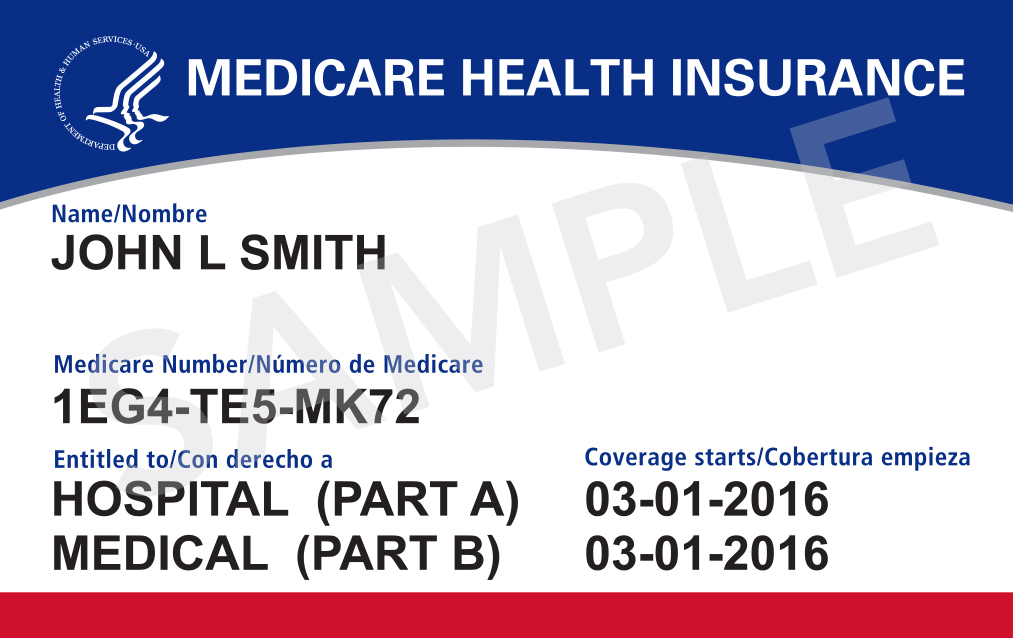
Until 2018 the Medicare card number was built on the person's Social Security number, so a lost card or a stolen record exposed both. Section 501 of the Medicare Access and CHIP Reauthorization Act of 2015 (P.L. 114-10, signed April 16, 2015) required Social Security numbers to be removed from Medicare cards.41 CMS mailed new cards with a randomly assigned Medicare Beneficiary Identifier (MBI) to more than 61 million people over about nine months and announced on Jan. 16, 2019 that it had finished three months before Congress's April 2019 deadline.42 CMS's provider page says the transition period, during which either number could be used, ended Dec. 31, 2019; for services on or after Jan. 1, 2020 claims must use the MBI. The MBI is 11 characters, uses only numbers and capital letters, and leaves out the letters S, L, O, I, B and Z.43
The MBI is still personal information. CMS says it should be protected like a Social Security number.43 The Idaho handout tells people who think their number has been misused to report the compromised number to 1-800-MEDICARE or to their Medicare Advantage plan, and, if they also gave out a Social Security number, to report it to Social Security and use the FTC's identity theft recovery steps.34 Medicare.gov's card page tells people who think someone is using their number to call 1-800-MEDICARE.9 Data breach notice duties and state identity theft law are covered in Privacy and Data Security Laws, and breaches at hospitals and clinics in Healthcare Cybersecurity and HIPAA.


Plan-switch scams and the marketing rules
Every fall, during the annual election period from Oct. 15 to Dec. 7, Medicare beneficiaries see a wave of TV ads, mailers and calls about Medicare Advantage and Part D plans.44 Most of it is legal marketing by licensed agents and brokers. The fraud and abuse problems the rules target are enrollments made without a person's informed consent, misleading claims, and people posing as Medicare. CMS's marketing rules for Medicare Advantage are in 42 CFR part 422, subpart V (parallel Part D rules are in part 423, subpart V).
- No cold calls, texts or door knocking. 42 CFR 422.2264(a) bars unsolicited door-to-door contact, approaching people in common areas, social media direct messages, and "telephone solicitation (that is, cold calling), robocalls, text messages, or voicemail messages." Contact is not unsolicited if the beneficiary consents or starts the contact.45
- Scope of appointment. Before a personal sales appointment, the plan or agent must agree on and record the products to be discussed, in writing for in-person meetings, and may not go beyond that scope or market non-health products such as annuities; a scope of appointment is valid for 12 months. The 48-hour wait between a scope of appointment and the meeting, added in 2023, was eliminated by CMS's Contract Year 2027 final rule (April 6, 2026, effective June 1, 2026).45
- Educational events cannot be sales events. At an event advertised as educational, plans may not market specific plans or take applications; at marketing events they may not require sign-in sheets or contact information, run health screenings, or use raffle entries for other purposes.45
- The third-party marketing disclaimer. Call centers and websites that sell for more than one MA organization must say, before discussing benefits on a sales call, how many organizations and plans they represent, and that Medicare.gov or 1-800-MEDICARE has information on all options; if they do not sell every plan in the area they must say "We do not offer every plan available in your area." The required text is at 42 CFR 422.2267(e)(41).46
- No generic ads. CMS's April 5, 2023 final rule (CMS-4201-F) prohibited ads that do not mention a specific plan name and the use of words, imagery or Medicare logos in ways that are misleading or confusing.47
Idaho law adds a licensing layer. Idaho Code section 41-1004 says no person may sell, solicit or negotiate insurance in Idaho without a producer license for that line of insurance.48 Complaints about an agent go to the Idaho Department of Insurance, which runs SHIBA and lists an insurance fraud hotline (1-866-939-7226) and a "Protect Yourself From Improper Marketing" page.49 How Medicare Advantage plans are paid and compete is in lesson 04, and the 2027 plan changes in Idaho are in lesson 08, The 2027 Plan Year in Idaho.
How much Idaho seniors lose to scams
No public dataset counts Medicare scam losses by state. The closest Idaho figure is the FBI's Internet Crime Complaint Center (IC3) count of complaints from people 60 and older, which covers every kind of online and phone-linked fraud (investment, tech support, romance, government impersonation and others), not only Medicare. The Idaho Department of Finance, in a June 15, 2026 release for World Elder Abuse Awareness Day, cited IC3 figures of 1,136 complaints and $37,394,229 in reported losses for Idaho residents 60 and older in 2025, against 775 complaints and $18,663,392 in 2024.10
| Idaho residents 60 and older (IC3) | 2024 | 2025 | Change (our calculation) |
|---|---|---|---|
| Complaints filed | 775 | 1,136 | Up 46.6% |
| Reported losses | $18,663,392 | $37,394,229 | Up 100.4% |
| Average reported loss per complaint (our calculation) | $24,082 | $32,917 | Up $8,835 |
These are complaints people chose to file; most scam victims never report, so the real figure is higher, and a single large loss can move the average. The Idaho numbers include no breakdown for Medicare or health insurance scams.
How we figured it: Idaho scam loss changes
Inputs: 775 complaints and $18,663,392 in losses (2024) and 1,136 complaints and $37,394,229 in losses (2025), Idaho residents 60 and older, as cited by the Idaho Department of Finance from IC3.10 Percent change = (2025 figure / 2024 figure - 1) x 100: complaints (1,136 / 775 - 1) = 46.6 percent; losses ($37,394,229 / $18,663,392 - 1) = 100.4 percent. Average loss per complaint = losses / complaints: $18,663,392 / 775 = $24,082; $37,394,229 / 1,136 = $32,917 (rounded to the dollar). In the chart, bar heights are proportional within each pair (complaints scaled to 0.2 px per complaint; losses to 5.35 px per million dollars).
The Senior Medicare Patrol in Idaho
The Senior Medicare Patrol (SMP) is a federal grant program run by the Administration for Community Living (ACL), part of HHS. ACL funds one SMP project in each state, the District of Columbia, Puerto Rico, Guam and the U.S. Virgin Islands (54 in all) to recruit and train retirees and other volunteers to teach beneficiaries how to prevent, detect and report Medicare fraud, errors and abuse. HHS-OIG has reported the projects' performance every year since 1997. In 2024 the program's funding was $35.5 million from the Health Care Fraud and Abuse Control program, of which $31.6 million went to the projects.12
Who runs it in Idaho
Idaho's SMP is hosted by the Idaho Commission on Aging (ICOA), the state agency on aging in Boise. The commission's web page says "The Idaho Senior Medicare Patrol (SMP) program helps us prevent, detect and report health care fraud," lists double-billing, unnecessary services and identity protection as focus areas, offers "Scam Jam" events, and says the program "relies on volunteers in our local communities to provide education and one-to-one counseling." It lists the commission's numbers, (208) 334-3833 and (877) 471-2777, and its office at 6305 W. Overland Road, Suite 110, Boise.50
The commission's 2026 to 2029 strategic plan describes how the work is delivered: the SMP is "Administered through the AAA network," and each Area Agency on Aging has "at least one (1) SMP volunteer coordinator" who recruits volunteers. Its listed partners are SHIBA and the Idaho Scam Jam Alliance, and it says ICOA and the Scam Jam network lead a statewide campaign each June to prevent Medicare and related fraud. The plan sets goals to build a formal SMP volunteer program, tracking team member counts in the federal SMP Information and Reporting System (SIRS), and to raise the share of high-risk clients by 3 percent a year.11 For the Magic Valley, that means the Area Agency on Aging serving south-central Idaho is the local SMP contact point; the Treasure Valley, eastern Idaho and northern Idaho are served by their own area agencies.
Idaho SMP by the numbers, compared with neighbors
HHS-OIG's data brief on 2024 SMP performance (OEI-02-25-00160, issued June 12, 2025) gives each state's numbers. We set Idaho beside its six neighbors and, to adjust for size, divided by the number of Medicare eligibles in each state from CMS's Medicare Advantage State/County Penetration file for March 2024.1251
| State (2024) | Active team members | Team member hours | Group events | People reached at events | Individual interactions | Medicare eligibles, March 2024 | Interactions per 10,000 eligibles (our calc.) | Team members per 100,000 eligibles (our calc.) |
|---|---|---|---|---|---|---|---|---|
| Idaho | 25 | 7,342 | 178 | 7,394 | 966 | 387,006 | 25.0 | 6.5 |
| Montana | 67 | 5,418 | 342 | 11,978 | 2,604 | 258,816 | 100.6 | 25.9 |
| Nevada | 92 | 32,848 | 872 | 30,082 | 8,456 | 593,657 | 142.4 | 15.5 |
| Oregon | 113 | 4,858 | 295 | 15,212 | 2,944 | 934,826 | 31.5 | 12.1 |
| Utah | 110 | 9,338 | 541 | 36,271 | 6,967 | 457,088 | 152.4 | 24.1 |
| Washington | 70 | 2,739 | 166 | 6,530 | 2,012 | 1,503,039 | 13.4 | 4.7 |
| Wyoming | 82 | 7,749 | 87 | 2,319 | 4,137 | 125,649 | 329.3 | 65.3 |
| All 54 projects | 5,643 | 579,904 | 22,752 | 1,172,875 | 283,724 | 66,624,189 | 42.6 | 8.5 |
Idaho's project logged a lot of volunteer time for its size (7,342 hours from 25 team members) but recorded fewer one-on-one contacts per beneficiary than every neighbor except Washington, and about 60 percent of the national rate. Idaho, like Montana, Oregon, Utah, Washington and Wyoming, reported $0 in expected Medicare recoveries for 2024, and Idaho also reported $0 in cost avoidance and $0 in Medicaid recoveries.12 That is less damning than it looks: nationally, OIG said nearly all of the $35,115,211 in expected Medicare recoveries for 2024 came from one project's case against a doctor who signed cancer genetic testing and equipment orders without treating patients and was ordered to pay nearly $34.8 million in restitution, and OIG notes that projects "may not be receiving full credit" because referrals by trained beneficiaries are hard to trace.12
How we figured it: SMP rates per beneficiary
Numerators come from Appendix D of HHS-OIG's report OEI-02-25-00160, which lists each state's 2024 totals for active team members and individual interactions.12 Denominators are the "Eligibles" column of CMS's Medicare Advantage State/County Penetration file for March 2024, summed across all counties in each state (44 counties for Idaho, total 387,006); the national denominator is the sum of all rows in the file (66,624,189), which includes the territories, as the 54 SMP projects do.51 Interactions per 10,000 = interactions / eligibles x 10,000 (Idaho: 966 / 387,006 x 10,000 = 25.0). Team members per 100,000 = team members / eligibles x 100,000 (Idaho: 25 / 387,006 x 100,000 = 6.5). The comparison to the national rate is 25.0 / 42.6 = 0.59. Chart bars are drawn at 1.7 px per interaction per 10,000. Projects define and count "interactions" through ACL's reporting system, and counting practices can differ by state, so small differences should not be over-read.
Reading your Medicare Summary Notice and plan statements
The single most useful fraud check is the one a beneficiary or caregiver can do at the kitchen table: comparing the statements Medicare or the plan sends against what actually happened. Which statement arrives depends on how the person gets Medicare.
| Coverage | Statement | How often | Rule or source |
|---|---|---|---|
| Original Medicare (Parts A and B) | Medicare Summary Notice (MSN) | Medicare.gov says people get it "at least twice a year," every 6 months if they had services in that period; people who choose electronic MSNs get an email for any month with a processed claim. (A summary line on the same page still says every 4 months.) | Medicare.gov MSN page13 |
| Medicare Advantage (Part C) | Explanation of benefits (EOB) from the plan | Monthly, or quarterly with per-claim notices; must include each billed service and code, the plan's and member's shares, year-to-date totals toward the out-of-pocket maximum, instructions for reporting fraud, and denied claims with appeal rights (people with both Medicare and Medicaid may not get one) | 42 CFR 422.111(k)14 |
| Part D drug plan (stand-alone or in an MA plan) | Part D explanation of benefits | By the end of the month after any month with drug claims; lists each drug paid, year-to-date costs against the deductible and out-of-pocket threshold, and price changes | 42 CFR 423.128(e)15 |
The MSN "is not a bill," Medicare.gov says. It lists every service or supply that providers and suppliers billed to Medicare in the period, what Medicare paid, and the maximum the person may owe the provider, and its last page explains how to appeal.13 Medicare publishes sample Part A, Part B and equipment notices that show where each item sits on the page.52
- Gather the paper. Put the MSN or plan statement next to a calendar, appointment cards, receipts and any delivery slips for the same months.
- Check the name and number. Make sure the statement is for the right person and that the Medicare number matches the card.
- Read every provider name. Look for doctors, labs, equipment suppliers or hospices you have never heard of, and for providers in other states you have not visited.
- Match each service and date. For each line, ask whether you got that service on that date. Watch for the patterns in the federal alerts: genetic tests, braces, catheters, monitoring devices, wound care products, and services billed while you were out of town or in the hospital.
- Look for repeats. The same item billed twice, or a monthly supply that keeps coming after you stopped using it, can be an error or a scheme.
- Compare "you may be billed" with what the provider asks. For a provider that accepts assignment, the MSN shows the most you owe; a bill for more is worth questioning.
- Call the provider first for small errors. Medicare.gov and the FTC both suggest contacting the doctor's office or plan when something looks wrong; many problems are coding mistakes that the office can correct.1333
- Report what is not an error. If the service never happened, the item was never ordered, or the provider will not explain it, use the reporting paths in the next section, and keep copies and notes of each call (date, name, what was said).
How suspected fraud is reported
There is no single front door. Which office takes a report depends on what happened. The paths below are the ones named in the federal and Idaho documents cited in this lesson; all of them are free.
| What happened | Where the record says it goes | Contact as published | Source |
|---|---|---|---|
| A service, test or item on a Medicare Summary Notice that never happened; someone else using a Medicare number | Medicare (1-800-MEDICARE) | 1-800-633-4227; TTY 1-877-486-2048 | Medicare.gov9 |
| Suspected fraud, waste or abuse by a provider, supplier, lab or plan | HHS-OIG hotline | 1-800-HHS-TIPS (1-800-447-8477); tips.hhs.gov | HHS-OIG alerts and hotline page853 |
| Help deciding whether something is fraud; help reporting; medical identity theft | Senior Medicare Patrol (in Idaho, through the Idaho Commission on Aging and the Area Agencies on Aging) | National locator 877-808-2468, smpresource.org; ICOA (208) 334-3833 or (877) 471-2777 | HHS-OIG; Idaho handout; ICOA83450 |
| A claim on a Medicare Advantage or Part D statement that looks wrong | The plan (its statement must include fraud reporting instructions), plus the paths above | Number on the plan card and statement | 42 CFR 422.111(k)(3)14 |
| An agent or marketer who misled someone, enrolled them without consent, or is not licensed | Idaho Department of Insurance (which runs SHIBA); 1-800-MEDICARE for plan complaints | SHIBA 1-800-247-4422; insurance fraud hotline 1-866-939-7226 | Idaho DOI49 |
| Identity theft beyond Medicare; scam calls and texts | Federal Trade Commission | ReportFraud.ftc.gov; IdentityTheft.gov | FTC33 |
| A Social Security number given to a scammer | Social Security, plus the FTC recovery steps | As listed by Social Security | Idaho SHIBA and SMP handout34 |
What happens after a report
Most tips do not produce a visible result for the person who reported. A report to 1-800-MEDICARE about a single wrong claim may simply lead to the claim being corrected. A pattern of reports about one supplier can lead CMS to review claims, suspend payment or revoke billing privileges, or lead HHS-OIG to open an investigation, which may take years and may end in a charge, a civil settlement, an exclusion or nothing public at all. The SMP data show how hard the link is to trace: OIG says the projects cannot always track referrals from beneficiaries they trained.12
Medicare also has a small reward program for tips. Under 42 CFR 420.405, as it stands in the eCFR, a person whose information leads to the recovery of at least $100 of Medicare money may receive a reward of up to 10 percent of the overpayments recovered or $1,000, whichever is less, if the case was not already under review and the person was not involved in the offense.54
The False Claims Act and whistleblower (qui tam) suits
Much of the money recovered for Medicare comes through civil cases under the False Claims Act, 31 U.S.C. 3729 to 3733. A person who knowingly submits or causes a false claim is liable for three times the government's damages plus a civil penalty per claim.18 For penalties assessed after July 3, 2025, the Justice Department's inflation adjustment sets the per-claim range at $14,308 to $28,619 (28 CFR 85.5).55
The act lets a private person, called a relator, file a sealed "qui tam" suit on the government's behalf. The government investigates and decides whether to intervene. Under 31 U.S.C. 3730(d), a relator generally receives 15 to 25 percent of the recovery if the government intervenes and 25 to 30 percent if it does not.56 Many of the largest health care cases begin this way, often with a former employee: the Kaiser settlement above began with suits by two former Kaiser employees, who will receive $95 million.32
The Justice Department said on Jan. 16, 2026 that False Claims Act settlements and judgments in fiscal 2025 (ended Sept. 30, 2025) exceeded $6.8 billion, the most in the law's history; more than $5.7 billion related to the health care industry; whistleblowers filed a record 1,297 qui tam suits (up from 980 in 2024); and recoveries since 1986 total more than $85 billion. It named managed care, prescription drugs and medically unnecessary care as major health care enforcement areas.57 A settlement is not a finding: in most releases the department states that the claims resolved are allegations only. Where a defendant does admit facts, as in the AmeriHealth consent judgment, the release says so.39
A timeline of Medicare fraud control
| Date | Law, action or event | What changed | Source |
|---|---|---|---|
| Aug. 21, 1996 | Health Insurance Portability and Accountability Act (P.L. 104-191) | Created the Health Care Fraud and Abuse Control Program (Social Security Act section 1128C), to be set up by Jan. 1, 1997, funded from an account in the HI trust fund | Social Security Act2324 |
| 1997 | Senior Medicare Patrol performance reporting begins | HHS-OIG has reported SMP results every year since; expected recoveries 1997 to 2024 total $287.9 million | HHS-OIG12 |
| March 2007 | Medicare Fraud Strike Force | Joint DOJ and HHS-OIG teams; more than 5,400 defendants charged since, billing more than $27 billion | DOJ 2025 release2 |
| April 16, 2015 | MACRA (P.L. 114-10), section 501 | Required Social Security numbers to be removed from Medicare cards | Congress.gov41 |
| April 2018 to January 2019 | New Medicare cards mailed | More than 61 million cards with random MBIs, finished Jan. 2019 | CMS42 |
| Dec. 31, 2019 | MBI transition ends | Claims for services from Jan. 1, 2020 must use the MBI | CMS43 |
| April 5, 2023 | CMS-4201-F final rule | Banned MA ads with no plan name and misleading use of Medicare logos; tightened agent oversight | CMS47 |
| Aug. 22, 2023 | Hospice enhanced oversight | Medical review before payment for new hospices in Arizona, California, Nevada and Texas | CMS30 |
| Oct. 21, 2024 | HHS-OIG report OEI-03-23-00380 | Estimated $7.5 billion in 2023 MA payments from diagnoses reported only on health risk assessments | HHS-OIG31 |
| May 21, 2025 | CMS RADV audit expansion | All eligible MA contracts audited each year; coders from 40 to about 2,000 | CMS35 |
| June 30, 2025 | 2025 National Health Care Fraud Takedown | 324 defendants; over $14.6 billion intended loss | DOJ2 |
| Oct. 31, 2025 | 2026 Physician Fee Schedule final rule | Skin substitutes paid as incident-to supplies; nearly 90 percent spending cut expected | CMS28 |
| Jan. 14, 2026 | Kaiser affiliates settlement | $556 million to resolve MA diagnosis allegations; no determination of liability | DOJ32 |
| April 7, 2026 | DOJ National Fraud Enforcement Division | New division announced | DOJ 2026 release3 |
| June 23, 2026 | 2026 National Health Care Fraud Takedown | 455 defendants; over $6.5 billion alleged | DOJ3 |
| July 2026 | Becerril sentenced | 40 months; $1.25 million restitution (Coeur d'Alene physician) | HHS-OIG5 |
Pictures, Numbers and Infographics
The key numbers, rules and dates from this lesson in one table, with Idaho beside the national or neighbor figure where one exists.
| Measure | Idaho | United States or other states | Year | Source |
|---|---|---|---|---|
| Original Medicare improper payment rate | Not published by state | 6.55% ($28.83 billion) | FY 2025 | CMS1 |
| Medicare Advantage improper payment rate | Not published by state | 6.09% ($23.67 billion); unsupported diagnoses 5.51% of Part C spending | FY 2025 (CY 2023 payments) | CMS16 |
| Part D improper payment rate | Not published by state | 4.00% ($4.23 billion) | FY 2025 | CMS1 |
| National takedown, defendants | District of Idaho participated (1 civil settlement listed) | 324 defendants; over $14.6 billion intended loss | June 2025 | DOJ236 |
| National takedown, defendants | District of Idaho participated (1 indictment listed, no Medicare claim) | 455 defendants; over $6.5 billion alleged | June 2026 | DOJ337 |
| Largest Idaho-connected Medicare case in this lesson | Becerril: over $3.2 million billed; 40 months; $1.25 million restitution | Operation Gold Rush: $10.6 billion alleged (charged) | 2025 to 2026 | DOJ; HHS-OIG452 |
| Losses reported by people 60 and older (all internet crime) | $37,394,229; 1,136 complaints | Idaho 2024: $18,663,392; 775 complaints | 2025 | Idaho Dept. of Finance (IC3)10 |
| SMP active team members | 25 | Montana 67; Utah 110; Oregon 113; national 5,643 | 2024 | HHS-OIG12 |
| SMP individual interactions per 10,000 eligibles (our calc.) | 25.0 | National 42.6; Utah 152.4; Washington 13.4 | 2024 | HHS-OIG; CMS1251 |
| SMP program funding (HCFAC) | Not published by state | $35.5 million | 2024 | HHS-OIG12 |
| HCFAC three-year return | n/a | $3.20 per $1.00 spent | FY 2023 to 2025 | HHS-OIG fact sheet26 |
| False Claims Act penalty per claim | Same federal law | $14,308 to $28,619, plus treble damages | Assessed after July 3, 2025 | 28 CFR 85.555 |
| Qui tam suits filed | Not published by state | 1,297 (record) | FY 2025 | DOJ57 |
| Medicare number format | Same nationwide | 11 characters, random; SSNs removed under MACRA section 501 | Cards mailed 2018 to 2019 | CMS4342 |
| Skin substitute Part B spending | Not published by state in the sources read | $256 million (2019) to over $10 billion (2024) | 2019, 2024 | CMS28 |
Common mistakes
- Treating the improper payment rate as a fraud rate. CMS states that "improper payment measurement is not a measure of fraud." Most errors are documentation problems, coding mistakes and underpayments; some fraud is never caught by sampling at all.1
- Reading a takedown's dollar headline as money stolen. The 2025 figure was "intended loss," and in Operation Gold Rush the department said Medicare was scheduled to pay about $4.45 billion and authorities stopped all but about $41 million of it.2 Billed, paid and stolen are three different numbers.
- Calling a defendant guilty at indictment, or calling a settlement a conviction. A charge is an allegation. A civil settlement often states "allegations only" with "no determination of liability," as in the Kaiser and Bloom Care releases; a consent judgment with admissions, as in AmeriHealth, is different, and the release says so.323839
- Giving a Medicare number to a caller who says they are from Medicare. Medicare.gov says Medicare will never call uninvited to ask for personal information, and the FTC says Medicare will not call to verify a card.933
- Accepting a "free" kit or brace in the mail. HHS-OIG's alerts say to refuse or return equipment and test kits your own doctor did not order and to note the sender and date; if Medicare denies the claim, the beneficiary may be billed for the full cost.78
- Throwing away the Medicare Summary Notice unopened. It is not a bill, but it is the only record that shows what was billed in a person's name; HHS-OIG and the FTC both point beneficiaries to their statements as the first check.133327
- Assuming a plan switch was legitimate because the caller knew personal details. Licensed sellers must follow the no-cold-call rule and give the third-party marketing disclaimer before discussing benefits; a caller who skips these steps is not following CMS's rules.4546
- Comparing state SMP numbers without adjusting for size. Raw counts make big states look busy; dividing by Medicare eligibles, as in this lesson's methods box, gives a fairer picture, and even then counting practices differ.12
What we know, what we don't, and what the data can show
What we know
- CMS's national improper payment estimates for fiscal 2025 by program, and that CMS does not treat them as a fraud measure.1
- The size and themes of the 2025 and 2026 national takedowns, and that the District of Idaho took part both years.23
- The court status of the Idaho-connected Medicare cases named here, as stated in the releases.
- Who runs the Senior Medicare Patrol in Idaho and how it is delivered through the Area Agencies on Aging, and the Idaho project's 2024 performance numbers.1112
- The federal marketing rules for Medicare Advantage agents and the Idaho licensing requirement.4548
What we don't know
- How much Medicare fraud happens in Idaho. CMS does not publish improper payment rates by state, and no agency publishes an Idaho fraud estimate.
- How many Idahoans lost money specifically to Medicare scams. The IC3 Idaho figures cover all scam types.10
- The outcome of some cases, including the Bolling sentencing, and the content of sealed qui tam suits.
- Whether CMS's 2026 skin substitute payment change and its expanded MA audits will reduce improper payments; the first full-year data will not appear until later improper payment reports.
- Whether Idaho's lower SMP contact rate reflects fewer volunteers, different counting, or less demand.
What the data can show
- HHS-OIG's annual SMP data brief (Appendix D) shows Idaho's team members, hours, events, people reached, interactions and recoveries each year, so trends can be tracked from 2016 onward.12
- CMS's annual improper payment fact sheet and the Part C and Part D findings show national error rates and causes by program and year.116
- The HHS-OIG exclusion list (LEIE) can be searched for Idaho providers barred from federal programs, with the legal basis for each exclusion.58
- DOJ and U.S. Attorney press releases and PACER court dockets show charges, pleas, verdicts and settlements for named defendants in the District of Idaho and neighboring districts.37
- CMS's Medicare Part B and DME supplier utilization files on data.cms.gov can show spikes in billing for braces, catheters, genetic tests or skin substitutes by provider and state, the kind of pattern investigators look for.
- FBI IC3 state data, as cited by the Idaho Department of Finance, show complaints and losses by age group each year.10
Questions people ask
Does Medicare ever call people?
Medicare.gov says "Medicare will never call you uninvited and ask you to give us personal or private information."9 A plan you already belong to may call members about plan business under 42 CFR 422.2264(b), and a person can ask an agent or plan to call. A call out of the blue asking for a Medicare number, offering a new card or offering free equipment fits the scam patterns described by the FTC and HHS-OIG.4533
Can someone get a new Medicare number if theirs is stolen?
Medicare.gov's card page tells people who think someone is using their number to call 1-800-MEDICARE, and Idaho's SHIBA and SMP handout says to report the compromised number to 1-800-MEDICARE or the Medicare Advantage plan.934 We did not find a CMS consumer page in the sources read that states the exact rules for issuing a new MBI, so this is listed as unverified; the SMP can help with the process.
Will reporting fraud affect my coverage?
Nothing in the Medicare.gov, HHS-OIG or FTC material cited here says reporting affects a person's benefits. Reporting a claim that should not have been paid can correct a person's record and, in some cases, the amount they were told they owed.138
What if I already accepted a brace or test kit?
HHS-OIG's alerts say to refuse or return items not ordered by your own doctor, keep a record of the sender and the return date, check your statements for the charge, and report it to the OIG hotline.78 The Idaho handout adds getting copies of medical records from any provider the scammer may have used and checking credit reports.34
Is a Medicare Advantage plan more or less exposed to fraud than Original Medicare?
Different, according to the federal measures. Original Medicare's improper payments are mostly about individual claims (6.55 percent in fiscal 2025); Medicare Advantage's are mostly about diagnoses the plans report to CMS (6.09 percent, mostly unsupported diagnoses).116 Plans must give members fraud reporting instructions on each statement.14 Scams that steal a Medicare number can hit either kind of coverage.
How can someone check whether an agent is licensed in Idaho?
Idaho Code section 41-1004 requires a producer license to sell, solicit or negotiate insurance in Idaho.48 The Idaho Department of Insurance licenses agents and runs SHIBA, which counsels Medicare beneficiaries; its SHIBA line is 1-800-247-4422.49
Who pays for the Senior Medicare Patrol?
Federal fraud-control money. In 2024 the program's $35.5 million came from the Health Care Fraud and Abuse Control program, which is financed through an account in the Medicare Hospital Insurance trust fund.1224 The Idaho Commission on Aging delivers the Idaho project through the Area Agencies on Aging.11
Hard questions
Is Medicare Advantage diagnosis coding a fraud problem or a payment design problem?
The case that it is mainly a fraud and enforcement problem: CMS's own measure found unsupported diagnoses equal to 5.51 percent of Part C spending; HHS-OIG found $7.5 billion in 2023 payments tied to diagnoses with no other record of care; and DOJ has secured large settlements over diagnoses added after visits.163132 The case that it is mainly a design question: risk adjustment is meant to pay more for sicker members so plans can cover them, as HHS-OIG's own report says, and complete coding is not the same as false coding; most of the difference between MA and Original Medicare scores is a payment-policy issue for CMS and Congress to set.31 What the evidence shows: the improper payment and OIG findings are not findings of fraud, and the settlements resolve allegations without findings of liability; the fraud cases are about knowingly adding unsupported diagnoses. Both enforcement (RADV audits) and payment policy (the coding model, covered in lesson 04) are in play.35
Do the annual takedowns deter fraud?
For: the HCFAC program reports a return of $3.20 for each dollar spent over fiscal 2023 to 2025, and the 2025 release says CMS prevented more than $4 billion in payments.262 Against: the same schemes (genetic tests, braces, catheters, telemedicine) recur year after year in the releases, and the 2025 release says 29 defendants tied to transnational criminal organizations accounted for over $12 billion in alleged claims, which suggests that charging individuals does not by itself stop the business model.2 Evidence: the return-on-investment figure measures money recovered, not fraud prevented; no federal measure of how much fraud is deterred was found in the sources read.
Will the skin substitute payment cut stop fraud or hurt patients with wounds?
CMS's case: spending grew from $256 million to more than $10 billion in five years with prices above $2,000 per square centimeter, and paying the products as supplies is expected to cut spending by nearly 90 percent.28 The concern: people with diabetic foot ulcers and other chronic wounds need these treatments, and a steep payment cut could lead some clinicians to stop offering them, especially in rural areas. Evidence: HHS-OIG found home-treatment costs four times office costs, a sign of billing outside normal care patterns.29 Whether access falls will show up in 2026 and 2027 claims data, which were not available as of Nov. 22, 2026.
How much data should Medicare and plans use to catch fraud?
For more data use: CMS's RADV expansion and payment suspensions rely on analyzing claims and records at scale, and the 2025 takedown release credits CMS with stopping billions before payment.352 For limits: medical records are sensitive, more record requests burden small practices, and pre-payment review delays payment to honest providers as well as dishonest ones. Evidence: the tradeoffs are set in federal rules and contracts; how privacy law applies to health data is covered in Privacy and Data Security Laws and Healthcare Cybersecurity and HIPAA.
For reporters and advocates
Records that exist. U.S. Attorney for the District of Idaho press releases and the court dockets behind them (PACER; case numbers are in the releases); DOJ's annual takedown case summaries by district; HHS-OIG enforcement actions, audits and evaluations; the OIG exclusion list; HHS-OIG's annual SMP data brief with Idaho's numbers; CMS's annual improper payment fact sheet and Part C and Part D findings; CMS provider enrollment revocations; data.cms.gov utilization files by provider; Idaho Department of Insurance producer license records, complaint data and enforcement orders; Idaho Commission on Aging SMP reports and contracts with the Area Agencies on Aging; Idaho Department of Finance and IC3 elder fraud data.3712110
Questions to ask. For the U.S. Attorney: how many Medicare cases the office opened, charged and settled each year, and how many involved Idaho beneficiaries or providers. For the Idaho Commission on Aging: how many SMP volunteers each Area Agency on Aging has, how SMP money is split among them, how many complaints were referred to OIG or CMS, and why Idaho's contact rate trails its neighbors. For the Department of Insurance: how many Medicare marketing complaints it received each year, how many agents were disciplined, and whether any unlicensed call centers were found selling to Idahoans. For local hospitals and clinics: whether they have seen patients targeted by brace or genetic test schemes.
How to get them. State agency records (the Commission on Aging, the Department of Insurance, the Department of Finance) can be requested under the Idaho Public Records Act, Idaho Code Title 74, chapter 1; see Idaho Public Records Requests. Federal records from CMS, HHS-OIG, ACL and DOJ are requested under the federal Freedom of Information Act; investigative files are often withheld while a case is open. Court records in closed cases are public through PACER and the clerk's office in Boise.
The Idaho angle. The largest Idaho-connected Medicare cases in the record involved clinicians licensed in or living in Idaho signing orders for telemarketing operations. The Becerril sentencing in July 2026 closed the largest of these in the record. The open questions are local: whether Idaho's Senior Medicare Patrol reaches enough beneficiaries in rural counties, and whether Idahoans' reported scam losses, which doubled from 2024 to 2025, include a growing Medicare share. Interpreting rates and per-person figures is covered in Data and Statistics.
Where to go next
- Idaho Senior Medicare Patrol (Idaho Commission on Aging): Idaho's SMP, delivered through the Area Agencies on Aging. Free education, Scam Jam events and one-on-one help for beneficiaries and caregivers who see something suspicious on a Medicare statement; also recruits volunteers.
- SMP Resource Center (national SMP locator): The national resource center for Senior Medicare Patrols, funded through ACL. Free. Its locator finds the SMP in any state, and it posts fraud alerts and sample statements with explanations.
- SHIBA (Idaho Department of Insurance): Idaho's free Medicare counseling program (Senior Health Insurance Benefits Advisors). Counselors explain plan options, statements and marketing rules; the Department also takes complaints about agents and insurance fraud.
- HHS-OIG: Report Fraud: The HHS Inspector General's hotline and online form for reporting suspected fraud, waste and abuse in Medicare and other HHS programs. Free; reports can be made anonymously.
- HHS-OIG Consumer Alerts: Plain-language alerts on current scams (genetic tests, catheters, braces, remote monitoring, impersonation). Free; useful for SMP and SHIBA volunteers, caregivers and reporters.
- Medicare.gov: Your Medicare card: Official guidance on protecting the Medicare number and getting a free replacement card through a secure Medicare.gov account or 1-800-MEDICARE.
- FTC: ReportFraud.ftc.gov and IdentityTheft.gov: The Federal Trade Commission's free sites for reporting scams and building an identity theft recovery plan; reports feed the Consumer Sentinel database used by law enforcement.
- HHS-OIG Exclusions database (LEIE): Free online search of people and companies barred from federal health programs; used by employers, hospitals, reporters and researchers.
Still being checked (7 items)
These points could not be fully confirmed against a primary source when this lesson was written and fact checked in November 2026. The text above states each one as uncertain.
- The sentencing outcome for Kristen Bolling (plea announced Oct. 23, 2023; sentencing was set for Jan. 9, 2024): no sentencing release was found.
- Whether HHS-OIG has published 2025 performance data for the Senior Medicare Patrol projects; the newest brief found covers 2024.
- The current rules and process for CMS to issue a new Medicare Beneficiary Identifier after a number is compromised; Medicare.gov's card page says only to call 1-800-MEDICARE.
- The status of court challenges by insurers to CMS's RADV audit methodology.
- The Kootenai Health False Claims Act qui tam case dismissed after a settlement in September 2021 (reported by Bloomberg Law) is not included because we did not read a primary court record or government release.
- Whether the Bloom Care, LLC settlement involved Medicare claims; the release names only federal health care programs.
- Medicare.gov's MSN page gives two frequencies (every 6 months in the body text; every 4 months in its summary description); the lesson reports both.
Last verified November 22, 2026. General education, not legal, medical, insurance or financial advice; every figure names its source and year in the Notes and Sources below. Data is revised: check the newest release before relying on any number.
Notes
- CMS, Fiscal Year 2025 Improper Payments Fact Sheet, Jan. 15, 2026: Medicare fee-for-service 6.55% ($28.83 billion) vs. 7.66% ($31.70 billion) in FY 2024; Part C 6.09% ($23.67 billion); Part D 4.00% ($4.23 billion); Medicaid 6.12% ($37.39 billion); statement that improper payment measurement is not a measure of fraud (read Nov. 22, 2026). Read it online. ↩
- U.S. Department of Justice, Office of Public Affairs, "National Health Care Fraud Takedown Results in 324 Defendants Charged in Connection with Over $14.6 Billion in Alleged Fraud," release 25-677, June 30, 2025 (District of Idaho listed among participating offices; Operation Gold Rush; strike force totals since March 2007) (read Nov. 22, 2026). Read it online. ↩
- U.S. Department of Justice, Office of Public Affairs, "National Health Care Fraud Takedown Results in 455 Defendants Charged in Connection with Over $6.5 Billion in Alleged Fraud," release 26-683, June 23, 2026 (District of Idaho listed; CMS suspensions and revocations; National Fraud Enforcement Division announced April 7) (read Nov. 22, 2026). Read it online. ↩
- U.S. Attorney's Office, Eastern District of Washington, "Coeur d'Alene Physician Found Guilty in Telemarketing Medicare Fraud Conspiracy," Nov. 17, 2025 (jury verdict Sept. 29, 2025; Case No. 1:23-CR-02029-SAB; 16 counts of conspiracy, fraud and false statements; Real Time Physicians, LLC; $20 per prescription; over $3.2 million billed, over $1.3 million paid; average review 26 seconds) (read Nov. 22, 2026). Read it online. ↩
- U.S. Attorney's Office, Eastern District of Washington, "Coeur d'Alene Physician Sentenced to 40 Months Imprisonment and $1.25 Million in Restitution for Involvement in Fraudulent Telemedicine Fraud Scheme," July 22, 2026 (sentenced July 8, 2026; 40 months and 3 years of court supervision; restitution $1,250,667.19 to Medicare; $37,340 forfeiture money judgment; counts of conviction; "nationwide telemarketing conspiracy to defraud Medicare"); also posted by HHS-OIG as an enforcement action (read Nov. 22, 2026). Read it online. ↩
- U.S. Attorney's Office, District of Idaho, "Nurse Practitioner Pleads Guilty to $6.1 Million Health Care Fraud Conspiracy in Idaho," Oct. 23, 2023 (Kristen Bolling; April 2017 to October 2019; at least $204,007 received; sentencing set Jan. 9, 2024; maximum 10 years) (read Nov. 22, 2026). Read it online. ↩
- HHS-OIG, "Fraud Alert: Genetic Testing Scam," last updated Sept. 27, 2019 (read Nov. 22, 2026). Read it online. ↩
- HHS-OIG, "Consumer Alert: Urinary Catheter Scams," published March 6, 2024, updated April 30, 2024 (hotline 1-800-HHS-TIPS; SMP locator 877-808-2468) (read Nov. 22, 2026). Read it online. ↩
- Medicare.gov, "Your Medicare card" ("Medicare will never call you uninvited"; 1-800-MEDICARE (1-800-633-4227), TTY 1-877-486-2048; replacement cards) (read Nov. 22, 2026). Read it online. ↩
- Idaho Department of Finance, news release for World Elder Abuse Awareness Day, June 15, 2026, citing FBI Internet Crime Complaint Center figures for Idaho residents 60 and older (2025: 1,136 complaints, $37,394,229; 2024: 775 complaints, $18,663,392) (read Nov. 22, 2026). Read it online. ↩
- Idaho Commission on Aging, ICOA Strategic Plan 2026 to 2029 (posted July 2026), pages 22, 23 and 35: Senior Medicare Patrol "Administered through the AAA network"; each AAA has at least one SMP volunteer coordinator; partners SHIBA and the Idaho Scam Jam Alliance; June fraud prevention campaign (read Nov. 22, 2026). Read it online. ↩
- HHS-OIG, 2024 Performance Data for the Senior Medicare Patrol Projects, data brief OEI-02-25-00160, issued June 12, 2025 (54 projects; 5,643 team members; $35,115,211 expected Medicare recoveries; $35.5 million HCFAC funding; Appendix D state tables including Idaho; results since 1997) (read Nov. 22, 2026). Read it online. ↩
- Medicare.gov, "Medicare Summary Notice (MSN)" (at least twice a year; every 6 months with services; electronic MSNs monthly; "It's not a bill"; appeal directions on the last page) (read Nov. 22, 2026). Read it online. ↩
- 42 CFR 422.111(k), Claims information (Medicare Advantage explanation of benefits: contents, monthly or quarterly timing, fraud reporting instructions, dual-eligible exception), eCFR (read Nov. 22, 2026). Read it online. ↩
- 42 CFR 423.128(e), Explanation of benefits (Part D), Legal Information Institute (read Nov. 22, 2026). Read it online. ↩
- CMS, Part C Improper Payment Measure, Fiscal Year 2025 Payment Error Rate Results (based on calendar 2023 payments): overpayments $21.43 billion, underpayments $2.23 billion, Part C expenditures $388.72 billion, net improper $19.20 billion (4.94%), unsupported diagnoses 5.51% of Part C expenditures, missing documentation $869 million (0.22%) (read Nov. 22, 2026). Read it online. ↩
- 18 U.S.C. 1347, Health care fraud (penalties up to 10 years; 20 years if serious bodily injury results; up to life if death results), Legal Information Institute (read Nov. 22, 2026). Read it online. ↩
- 31 U.S.C. 3729, False claims (liability for knowingly presenting false claims; treble damages and civil penalties), Legal Information Institute (read Nov. 22, 2026). Read it online. ↩
- Social Security Act section 1128B (42 U.S.C. 1320a-7b), Criminal penalties for acts involving federal health care programs, including subsection (b) on illegal remunerations (kickbacks), Social Security Administration compilation (read Nov. 22, 2026). Read it online. ↩
- Social Security Act section 1877 (42 U.S.C. 1395nn), Limitation on certain physician referrals, Social Security Administration compilation (read Nov. 22, 2026). Read it online. ↩
- CMS, CERT program page (Medicare fee-for-service error rate testing: sampling, medical record requests and review) (read Nov. 22, 2026). Read it online. ↩
- Social Security Act section 1128 (42 U.S.C. 1320a-7), Exclusion of certain individuals and entities from participation in Medicare and state health care programs, Social Security Administration compilation (read Nov. 22, 2026). Read it online. ↩
- Social Security Act section 1128C (42 U.S.C. 1320a-7c), Fraud and Abuse Control Program, added by the Health Insurance Portability and Accountability Act of 1996 (P.L. 104-191, Aug. 21, 1996); program to be established "Not later than January 1, 1997" (read Nov. 22, 2026). Read it online. ↩
- Social Security Act section 1817 (42 U.S.C. 1395i), Federal Hospital Insurance Trust Fund, subsection (k), Health Care Fraud and Abuse Control Account, Social Security Administration compilation (read Nov. 22, 2026). Read it online. ↩
- U.S. Attorney's Office, District of Idaho, "Boise Man Sentenced to 3.5 Years in Federal Prison for Health Care Fraud and Aggravated Identity Theft," Feb. 1, 2021 (Scott Alexander Laney; Medicare and Idaho Medicaid; 42 months; restitution $29,795.49; fine $2,500; bench trial verdict Oct. 5, 2020; Idaho Medicaid Fraud Control Unit assisted) (read Nov. 22, 2026). Read it online. ↩
- HHS-OIG, FY 2025 HCFAC Annual Report Fact Sheet: $6.9 billion+ in civil health care fraud settlements and judgments, 622 criminal actions, 861 civil actions, 448+ defendants convicted, 2,837 exclusions, $3.20 returned per $1.00 spent for FY 2023 to 2025 (read Nov. 22, 2026). Read it online. ↩
- HHS-OIG, "Consumer Alert: Remote Patient Monitoring," Nov. 21, 2023 (read Nov. 22, 2026). Read it online. ↩
- CMS press release on the calendar year 2026 Physician Fee Schedule final rule ("CMS Modernizes Payment Accuracy and Significantly Cuts Spending Waste"), Oct. 31, 2025: skin substitute spending $256 million (2019) to over $10 billion (2024); payment as incident-to supplies; nearly 90 percent reduction expected (read Nov. 22, 2026). Read it online. ↩
- HHS-OIG, Medicare Part B Payment Trends for Skin Substitutes Raise Major Concerns About Fraud, Waste, and Abuse, OEI-BL-24-00420, issued Sept. 3, 2025 (read Nov. 22, 2026). Read it online. ↩
- CMS blog, "CMS Taking Action to Address Benefit Integrity Issues Related to Hospice Care," Aug. 22, 2023 (provisional period of enhanced oversight for new hospices in Arizona, California, Nevada and Texas) (read Nov. 22, 2026). Read it online. ↩
- HHS-OIG, Medicare Advantage: Questionable Use of Health Risk Assessments Continues To Drive Up Payments to Plans by Billions, OEI-03-23-00380, issued Oct. 21, 2024 ($7.5 billion in 2023 payments; 1.7 million enrollees; 20 companies drove 80 percent; CMS concurred with one of three recommendations) (read Nov. 22, 2026). Read it online. ↩
- U.S. Department of Justice, Office of Public Affairs, "Kaiser Permanente Affiliates Pay $556M to Resolve False Claims Act Allegations," release 26-24, Jan. 14, 2026 (2009 to 2018; relators' share $95 million; "allegations only and there has been no determination of liability") (read Nov. 22, 2026). Read it online. ↩
- Federal Trade Commission, Consumer Advice, Bridget Small, "Your Medicare number is valuable. Protect it.", June 5, 2024 (read Nov. 22, 2026). Read it online. ↩
- Idaho Department of Insurance, SHIBA and Senior Medicare Patrol, "Medicare Minute" handout, November 2025, "Medical Identity Theft" (Word document) (read Nov. 22, 2026). Read it online. ↩
- CMS press release, "CMS Rolls Out Aggressive Strategy to Enhance and Accelerate Medicare Advantage Audits," May 21, 2025 (read Nov. 22, 2026). Read it online. ↩
- U.S. Department of Justice, Criminal Division, Health Care Fraud Unit, 2025 National Health Care Fraud Takedown case summaries, District of Idaho entry (Bloom Care, LLC, Spencer Smith and Michael Weir; $3,000,000 False Claims Act settlement) (read Nov. 22, 2026). Read it online. ↩
- U.S. Department of Justice, Criminal Division, Health Care Fraud Unit, 2026 National Health Care Fraud Takedown case summaries, District of Idaho entry (Niki Rashel Cook, Caldwell, wire fraud and aggravated identity theft indictment) and District of Oregon entries (read Nov. 22, 2026). Read it online. ↩
- U.S. Attorney's Office, District of Idaho, "Urgent Care Operator Pays 3 Million Dollars to Resolve Alleged Violations of the False Claims Act," July 15, 2025 (Bloom Care LLC; allegations only, no admission or determination of liability; "Federal healthcare programs") (read Nov. 22, 2026). Read it online. ↩
- U.S. Attorney's Office, District of Idaho, "AmeriHealth Clinics Consent to a $2 Million Judgment to Resolve Healthcare Fraud Allegations," Jan. 17, 2024 (United States v. Hatch, et al., No. 23-CV-00566-DKG; admitted False Claims Act violations; other allegations resolved without admission; Medicare, Medicaid and TRICARE) (read Nov. 22, 2026). Read it online. ↩
- U.S. Attorney's Office, District of Idaho, "Pocatello Nurse Practitioner Is Fined and Surrenders License for Unlawful Prescriptions and Fraud," June 13, 2023 (United States v. Rachel Peay-Goodman, No. 23-CV-00241 (CWD); $75,000; complaint alleged dangerous drug combinations; she admitted prescriptions lacked a legitimate medical purpose and at least one false claim to Medicare; DEA license surrendered) (read Nov. 22, 2026). Read it online. ↩
- Congress.gov, H.R. 2, Medicare Access and CHIP Reauthorization Act of 2015, P.L. 114-10, signed April 16, 2015; section 501 (prohibition of inclusion of Social Security account numbers on Medicare cards) (read Nov. 22, 2026). Read it online. ↩
- CMS press release, "CMS Finalizes New Medicare Card Distribution Ahead of Deadline, Accelerating Fight Against Medicare Fraud," Jan. 16, 2019 (more than 61 million cards; April 2019 deadline under MACRA) (read Nov. 22, 2026). Read it online. ↩
- CMS, "New Medicare Card" provider page (MBI format of 11 characters; letters S, L, O, I, B and Z not used; transition period ended 12/31/2019; MBI to be protected as personally identifiable information) (read Nov. 22, 2026). Read it online. ↩
- 42 CFR 422.62, Election of coverage under an MA plan (annual coordinated election period Oct. 15 to Dec. 7), eCFR (read Nov. 22, 2026). Read it online. ↩
- 42 CFR 422.2264, Beneficiary contact (unsolicited contact, plan business contact, educational and marketing events, personal marketing appointments and scope of appointment), eCFR, up to date as of Oct. 22, 2026; 48-hour scope of appointment wait eliminated by CMS, Contract Year 2027 final rule, CMS-4208-F3 and CMS-4212-F, 91 FR 17384 (April 6, 2026), effective June 1, 2026 (read Nov. 22, 2026). Read it online. ↩
- 42 CFR 422.2267(e)(41), Third-party marketing organization disclaimer, eCFR (read Nov. 22, 2026). Read it online. ↩
- CMS fact sheet, "2024 Medicare Advantage and Part D Final Rule (CMS-4201-F)," April 5, 2023 (marketing provisions) (read Nov. 22, 2026). Read it online. ↩
- Idaho Code section 41-1004, License required, Idaho Legislature (read Nov. 22, 2026). Read it online. ↩
- Idaho Department of Insurance, SHIBA (Senior Health Insurance Benefits Advisors) page: Medicare help line 1-800-247-4422; Department fraud hotline 1-866-939-7226; "Protect Yourself From Improper Marketing" link (read Nov. 22, 2026). Read it online. ↩
- Idaho Commission on Aging, "Medicare Fraud Prevention" (Idaho Senior Medicare Patrol) web page: program description, volunteers, Scam Jams, contact numbers (208) 334-3833 and (877) 471-2777 (read Nov. 22, 2026). Read it online. ↩
- CMS, Medicare Advantage State/County Penetration file, March 2024 (State_County_Penetration_MA_2024_03.csv), "Eligibles" column; summed by state by us (read Nov. 22, 2026). Read it online. ↩
- Medicare.gov, sample Part B Medicare Summary Notice (PDF) (read Nov. 22, 2026). Read it online. ↩
- HHS-OIG, "Report Fraud" (hotline 1-800-HHS-TIPS, 1-800-447-8477, and online form) (read Nov. 22, 2026). Read it online. ↩
- 42 CFR 420.405, Rewards for information relating to Medicare fraud and abuse (reward not to exceed 10 percent of overpayments recovered or $1,000, whichever is less; at least $100 recovered), eCFR text as of Nov. 1, 2026 (read Nov. 22, 2026). Read it online. ↩
- 28 CFR 85.5, Adjustments to penalties for inflation: False Claims Act, 31 U.S.C. 3729(a), minimum $14,308 and maximum $28,619 for civil penalties assessed after July 3, 2025, eCFR, up to date as of Oct. 23, 2026 (read Nov. 22, 2026). Read it online. ↩
- 31 U.S.C. 3730, Civil actions for false claims, subsection (d) (relator share of 15 to 25 percent when the government proceeds and 25 to 30 percent when it does not), Legal Information Institute (read Nov. 22, 2026). Read it online. ↩
- U.S. Department of Justice, Office of Public Affairs, "False Claims Act Settlements and Judgments Exceed $6.8B in Fiscal Year 2025," Jan. 16, 2026 (read Nov. 22, 2026). Read it online. ↩
- HHS-OIG, Exclusions Program and List of Excluded Individuals/Entities (LEIE) search (read Nov. 22, 2026). Read it online. ↩
Check yourself
1. According to CMS's fact sheet of Jan. 15, 2026, what was Original Medicare's fee-for-service improper payment rate for fiscal 2025?
CMS's Fiscal Year 2025 Improper Payments Fact Sheet reports 6.55 percent ($28.83 billion) for Medicare fee-for-service, down from 7.66 percent in fiscal 2024; 6.09 percent is Part C and 4.00 percent is Part D.
2. What does CMS say about the relationship between improper payments and fraud?
The Jan. 15, 2026 CMS fact sheet states that improper payment measurement is not a measure of fraud and that not all improper payments are attributable to fraud or abuse.
3. What made up most of Medicare Advantage's improper payments in CMS's fiscal 2025 Part C measure?
CMS's Part C findings (calendar 2023 payments) show unsupported diagnoses equal to 5.51 percent of Part C expenditures, against 0.22 percent for missing or insufficient documentation.
4. How many defendants did the Justice Department charge in the June 23, 2026 National Health Care Fraud Takedown?
DOJ release 26-683 of June 23, 2026 reports 455 defendants and over $6.5 billion in alleged fraud; 324 was the 2025 total, and 1,079 is the number of providers CMS suspended.
5. What is the status of Dr. David Antonio Becerril of Coeur d'Alene in the public record?
The U.S. Attorney's Office for the Eastern District of Washington reported the Sept. 29, 2025 jury verdict on 16 counts, and its July 22, 2026 release reports the July 8, 2026 sentence of 40 months in prison and $1,250,667.19 in restitution.
6. Which federal rule bars Medicare Advantage plans and agents from cold calling, robocalls and unsolicited text messages to beneficiaries?
42 CFR 422.2264(a) lists telephone solicitation (cold calling), robocalls, text messages and voicemail messages among prohibited unsolicited contacts.
7. Who hosts the Senior Medicare Patrol in Idaho, according to the state's own documents?
The Idaho Commission on Aging's Medicare Fraud Prevention page describes the Idaho SMP, and its 2026 to 2029 strategic plan says SMP is administered through the AAA network with at least one SMP volunteer coordinator per AAA.
8. In 2024, how many individual interactions with or on behalf of beneficiaries did Idaho's SMP project report, per HHS-OIG?
Appendix D of HHS-OIG data brief OEI-02-25-00160 lists 966 individual interactions for Idaho in 2024; 283,724 is the national total, 7,394 is people reached at Idaho events, and 25 is Idaho's active team members.
9. Under the MACRA law of 2015, what changed about Medicare cards?
Section 501 of P.L. 114-10 required removing Social Security numbers from Medicare cards; CMS mailed cards with random 11-character MBIs to more than 61 million people by January 2019. The FTC notes Medicare cards are paper, not plastic.
10. Under 31 U.S.C. 3730(d), what share of a False Claims Act recovery does a whistleblower (relator) generally receive when the government intervenes?
31 U.S.C. 3730(d) sets 15 to 25 percent when the government proceeds with the action and 25 to 30 percent when it does not.
Terms in this lesson
- Improper payment
- A payment that should not have been made or was made in the wrong amount, including payments a reviewer cannot confirm because documentation is missing. CMS estimates it each year by sampling; it is not a measure of fraud.
- Health care fraud
- Knowingly and willfully carrying out a scheme to defraud a health care benefit program, a crime under 18 U.S.C. 1347; civil fraud is pursued under the False Claims Act.
- Anti-Kickback Statute
- Social Security Act section 1128B(b), which makes it a felony to pay or receive anything of value to induce or reward referrals of items or services paid by federal health programs.
- False Claims Act
- The federal law (31 U.S.C. 3729 to 3733) that makes anyone who knowingly submits or causes a false claim to the government liable for three times the damages plus a per-claim penalty.
- Qui tam suit and relator
- A False Claims Act case filed under seal by a private person (the relator, often a former employee) on the government's behalf; the relator can receive 15 to 30 percent of the recovery.
- Intended loss
- In a criminal fraud case, the amount the defendants allegedly tried to obtain, usually the amount billed; it is often far larger than what Medicare actually paid.
- Exclusion
- An HHS-OIG action under Social Security Act section 1128 that bars a person or company from billing Medicare, Medicaid and other federal health programs.
- Senior Medicare Patrol (SMP)
- A federal grant program of the Administration for Community Living, with one project in each state and territory, that trains volunteers to help beneficiaries prevent, detect and report Medicare fraud, errors and abuse.
- Medicare Beneficiary Identifier (MBI)
- The random 11-character Medicare number that replaced the Social Security-based number on Medicare cards mailed in 2018 and 2019.
- Explanation of benefits (EOB)
- The statement a Medicare Advantage or Part D plan sends members listing services or drugs paid, the member's share and year-to-date totals; MA EOBs must include fraud reporting instructions under 42 CFR 422.111(k).
- Third-party marketing organization (TPMO)
- A call center, website or agency that sells Medicare plans for one or more insurers; one that sells for more than one MA organization must give the disclaimer in 42 CFR 422.2267(e)(41).
- Scope of appointment
- The written or recorded agreement, made before a personal sales appointment, on which Medicare products an agent will discuss; it limits what may be marketed at the meeting (42 CFR 422.2264(c)(3)).
- Risk adjustment data validation (RADV)
- CMS audits that check whether diagnoses a Medicare Advantage plan reported are supported by medical records, used to recover overpayments.
- Health risk assessment (HRA)
- A questionnaire or visit, often in the home, that an MA plan or its vendor uses to gather a member's health information; diagnoses reported only through HRAs drew HHS-OIG scrutiny in 2024.
- Payment suspension and revocation
- CMS program integrity actions that stop payments to a provider while a credible fraud allegation is investigated, or end the provider's Medicare billing privileges.
- Skin substitute
- A sheet of processed tissue or synthetic material applied to wounds; Medicare Part B spending on these products rose from $256 million in 2019 to over $10 billion in 2024, according to CMS.
Sources
- CMS, Fiscal Year 2025 Improper Payments Fact Sheet (Jan. 15, 2026) (2026-11-22) checked 2026-11
- CMS, Part C Improper Payment Measure, FY 2025 results (2026-11-22) checked 2026-11
- U.S. Department of Justice, 2025 National Health Care Fraud Takedown (June 30, 2025) (2026-11-22) checked 2026-11
- U.S. Department of Justice, 2026 National Health Care Fraud Takedown (June 23, 2026) (2026-11-22) checked 2026-11
- U.S. Attorney's Office, E.D. Wash., Becerril verdict release (Nov. 17, 2025; verdict Sept. 29, 2025) (2026-11-22) checked 2026-11
- U.S. Attorney's Office, District of Idaho, Bolling plea (Oct. 23, 2023) (2026-11-22) checked 2026-11
- HHS-OIG, 2024 Performance Data for the Senior Medicare Patrol Projects (OEI-02-25-00160) (2026-11-22) checked 2026-11
- HHS-OIG, Medicare Advantage: Questionable Use of Health Risk Assessments (OEI-03-23-00380) (2026-11-22) checked 2026-11
- Idaho Commission on Aging, Strategic Plan 2026 to 2029 (2026-11-22) checked 2026-11
- 42 CFR 422.2264, Beneficiary contact (eCFR) (2026-11-22) checked 2026-11
- 31 U.S.C. 3729, False Claims Act (2026-11-22) checked 2026-11
- Medicare.gov, Medicare Summary Notice (2026-11-22) checked 2026-11
- Idaho Department of Finance, World Elder Abuse Awareness Day release with IC3 data (June 15, 2026) (2026-11-22) checked 2026-11
- HHS-OIG, FY 2025 HCFAC Annual Report Fact Sheet (2026-11-22) checked 2026-11