Lesson 1 of 12 · about 55 minutes · Updated November 22, 2026
What Medicare Is: Parts A, B, C and D
You'll be able to
- Explain the four roads into Medicare (age 65, disability after 24 months, kidney failure and ALS) and the statutes that set them.
- Describe what Part A, Part B, Part C and Part D each cover and state the 2026 and 2027 premiums, deductibles and coinsurance set by CMS.
- Explain how a Part A benefit period works and why Original Medicare has no yearly out-of-pocket limit.
- Identify Medicare's money sources in 2025 (payroll taxes, premiums, general revenue and taxes on Social Security benefits) and which trust fund each pays into.
- List what Medicare excludes under Social Security Act section 1862(a) and explain who pays first when a beneficiary also has job-based coverage.
- Compare Idaho's Medicare enrollment, Medicare Advantage share and disability share with the United States and neighbor states using CMS's monthly enrollment file.
Start here: the short version
- Medicare is a federal health insurance program, run by the Centers for Medicare & Medicaid Services (CMS), for people 65 and older and for some younger people with disabilities, end-stage renal disease (ESRD) or ALS. It is written into title XVIII of the Social Security Act; section 226 (42 U.S.C. 426) sets the age 65 and 24-month disability rules, and section 226(h), added by P.L. 106-554 (Dec. 21, 2000), lets people with ALS skip the 24-month wait.1
- Part A (hospital insurance) costs most people no premium but has a deductible of $1,736 per benefit period in 2026, rising to $1,776 in 2027. Days 61 to 90 of a hospital stay cost $434 a day in 2026 ($444 in 2027), and skilled nursing facility days 21 to 100 cost $217 a day ($222 in 2027), CMS announced on Nov. 14, 2025 and Nov. 17, 2026.23
- The standard Part B premium is $202.90 a month in 2026 and $209.40 in 2027; the Part B deductible is $283 in 2026 and $292 in 2027. After the deductible, the beneficiary generally pays 20 percent of the Medicare-approved amount, and Original Medicare has no yearly out-of-pocket limit.2345
- Part C is Medicare Advantage (private plans paid by Medicare) and Part D is drug coverage. The Part D out-of-pocket cap is $2,100 in 2026 and $2,400 in 2027, and the standard deductible is $615 in 2026 and $700 in 2027, under CMS's 2027 Rate Announcement of April 6, 2026.6
- Medicare is paid for by a 2.9 percent payroll tax (1.45 percent each from worker and employer), an extra 0.9 percent tax on wages over $200,000 ($250,000 for joint filers), premiums, federal general revenue and part of the income tax on Social Security benefits. In 2025, payroll taxes were about 87 percent of hospital insurance (HI) trust fund income and general revenue was about 75 percent of supplementary medical insurance (SMI) income, the 2026 Trustees Report says.78
- Idaho had 417,781 Medicare beneficiaries in July 2026, and 45.9 percent were in Medicare Advantage or other private health plans (our calculation), compared with 51.1 percent nationally. The Idaho share fell from 49.8 percent in December 2025 to 45.3 percent in January 2026, CMS's Medicare Monthly Enrollment file shows.910
- Medicare does not pay for long-term custodial care, most dental care, routine eyeglasses, hearing aids or most care outside the United States. Those exclusions are in Social Security Act section 1862(a) (42 U.S.C. 1395y(a)). Medicaid, a different program, pays for nursing home care for people who qualify.11
Law: Social Security Act title XVIII and 42 CFR as amended through Nov. 22, 2026; Internal Revenue Code payroll tax sections as amended through Nov. 22, 2026; Idaho Code and IDAPA rules through the 2026 session. 2026 amounts as announced by CMS on Nov. 14, 2025; 2027 Part A and Part B amounts as announced by CMS on Nov. 17, 2026; 2027 Part D amounts from the CMS Rate Announcement of April 6, 2026 and the CMS Part D bid fact sheet of July 28, 2026. Trust fund figures from the 2026 Medicare Trustees Report (transmittal letter dated June 9, 2026). Idaho enrollment from the CMS Medicare Monthly Enrollment file, July 2026 data. Checked Nov. 22, 2026. Amounts change every year; check Medicare.gov.
Medicare is the health insurance program most Idahoans will use for the last third of their lives, and it is also one of the most misunderstood. People confuse it with Medicaid. They assume it pays for nursing homes. They expect it to cap what they owe in a bad year. They do not know that the doctor who "takes Medicare" may still be allowed to bill them more than Medicare's rate, or that the payroll tax taken from every Idaho paycheck pays for only one of Medicare's two trust funds. This lesson starts at the bottom: what the program is, who can get it, what each of its four parts covers and costs in 2026 and 2027, where the money comes from, and what Medicare does not cover at all.
The lesson describes the rules and the choices the law creates. It does not tell any reader which part to sign up for, which plan to choose or whether to keep job-based coverage, and it gives no medical, insurance, tax or financial advice. Every rule is tied to the statute or regulation behind it, and every dollar amount is tied to the CMS or Social Security Administration announcement that set it. Where we calculated something ourselves, such as a share of enrollment or a sample payroll tax bill, we say so and show the arithmetic in a box marked "How we figured it." Any person, income or bill made up to illustrate a rule is labeled as a hypothetical example.
Later lessons go deeper. How the program was built, law by law, from 1965 to 2026 is lesson 02, How Medicare Grew, 1965 to 2026. The trade-offs between Original Medicare and private plans are in lesson 04, Original Medicare vs. Medicare Advantage. Medicare supplement insurance and Idaho's rules for it are in lesson 05, Medigap in Idaho. Drug coverage, the out-of-pocket cap and negotiated drug prices are in lesson 06, Part D and Drug Costs. Premium history and the income-related surcharges are in lesson 07, Premiums, IRMAA and What Seniors Pay. Medicaid, the separate state and federal program for people with low incomes, has its own course; start with What Medicaid Is and Is Not.

What Medicare is and is not
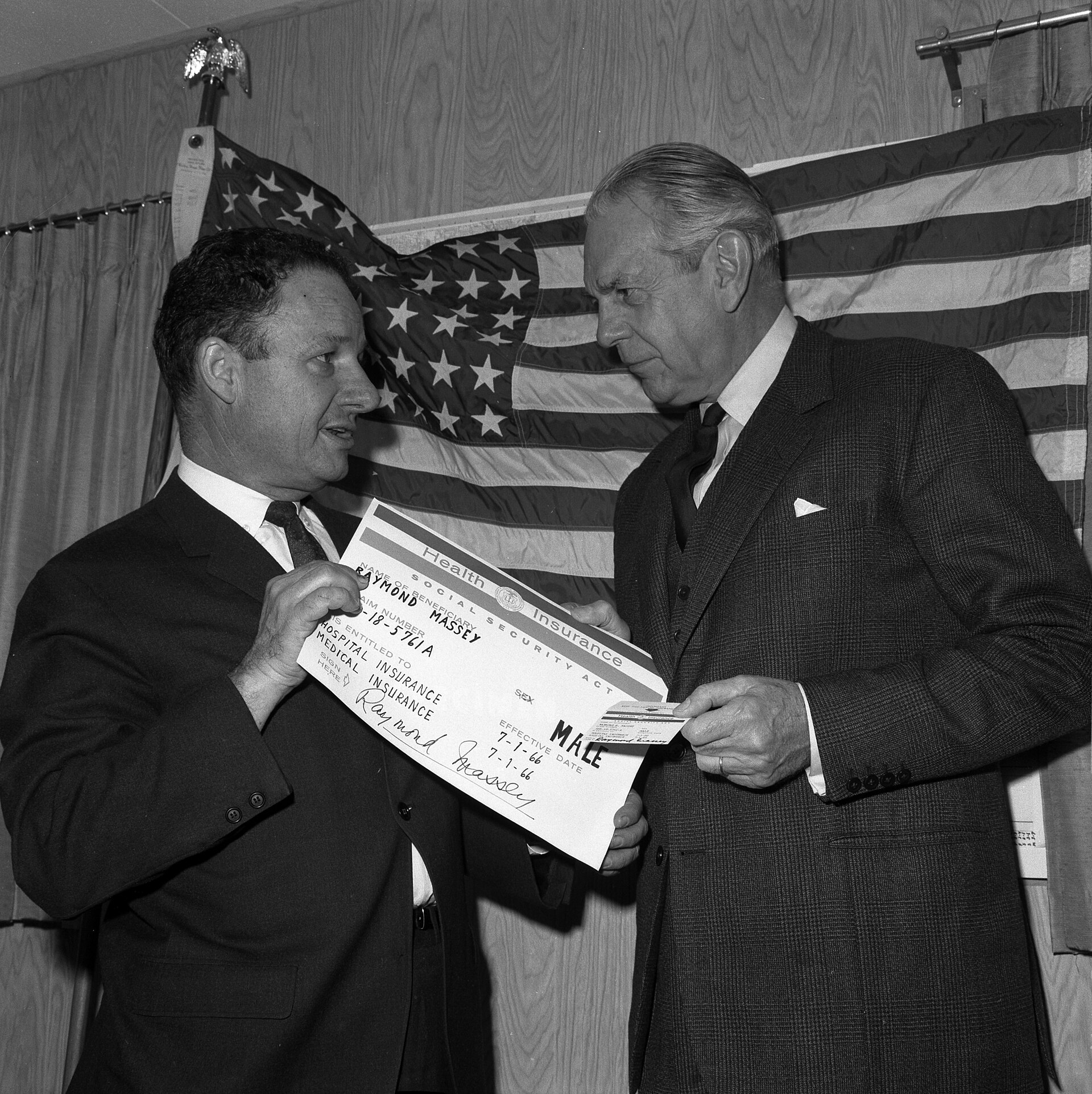
Medicare is federal health insurance. Congress created it in the Social Security Amendments of 1965, P.L. 89-97, which President Lyndon Johnson signed on July 30, 1965, and benefits began on July 1, 1966.12 The law added a new title XVIII to the Social Security Act, called "Health Insurance for the Aged" (it is now titled "Health Insurance for the Aged and Disabled"), and title XVIII is still where Medicare's rules live. Its sections run from 1801 (42 U.S.C. 1395) through the 1890s, and CMS turns them into detailed regulations in title 42 of the Code of Federal Regulations, mainly parts 405 through 426.
Medicare is an insurance program for people who qualify by age, disability or illness. Nobody has to show low income or few assets to get it. Eligibility is based on age, disability or a few specific diseases, and for free hospital coverage, on a work record of paying Medicare taxes. Income matters in only two places: higher-income people pay a surcharge on their Part B and Part D premiums (lesson 07), and lower-income people can get help paying Medicare's costs through the Medicare Savings Programs and Extra Help.313
The four parts in one sentence each
Medicare.gov describes four parts.14
- Part A, hospital insurance, "helps cover inpatient care in hospitals, skilled nursing facility care, hospice care, and home health care." It is paid from the Hospital Insurance (HI) trust fund.
- Part B, medical insurance, covers "services from doctors and other health care providers," outpatient care, durable medical equipment such as walkers and oxygen, some home health care and many preventive services. It is paid from the Supplementary Medical Insurance (SMI) trust fund.
- Part C, Medicare Advantage, is not a separate set of benefits. It is a way to get Part A and Part B benefits, and usually Part D, through a private insurance company that Medicare pays to cover its members. Its rules are in Social Security Act sections 1851 to 1859 (42 U.S.C. 1395w-21 onward) and 42 CFR part 422.15
- Part D, prescription drug coverage, helps pay for drugs bought at a pharmacy. It is sold only by private plans, either as a stand-alone plan alongside Original Medicare or built into a Medicare Advantage plan. Its rules start at Social Security Act section 1860D-1 (42 U.S.C. 1395w-101) and are in 42 CFR part 423.16
"Original Medicare" is the name for Parts A and B run directly by the federal government. A person on Original Medicare can see any doctor or hospital in the country that accepts Medicare, usually needs no referral, and pays the deductibles and coinsurance described below. Many people on Original Medicare add a stand-alone Part D plan, and many add a Medicare supplement policy (Medigap), sold by private insurers under federal and Idaho rules, to cover some of the deductibles and coinsurance. Medicare Advantage replaces that combination with one private plan that has a network and its own cost sharing.5
Who runs Medicare
Several federal offices and many private contractors share the work, and knowing which one does what explains why a beneficiary may deal with three or four of them in a year.
- CMS, part of the U.S. Department of Health and Human Services, writes the regulations, sets payment rates for hospitals and doctors, approves and pays Medicare Advantage and Part D plans, and announces each year's premiums and deductibles. The CMS administrator approved the 2027 Part B premium notice on Nov. 16, 2026.4
- The Social Security Administration (SSA) handles most enrollment, decides who is entitled to Part A, takes Part B premiums out of Social Security checks, and decides who owes the income-related surcharges. SSA, not CMS, is carrying out the 2025 law that ends Medicare for some noncitizens (described below).17
- Medicare Administrative Contractors (MACs), private companies under contract with CMS, process claims from hospitals, doctors and suppliers in Original Medicare. CMS lists 12 regional A/B MAC jurisdictions and four for durable medical equipment.18
- Private insurers run every Medicare Advantage and Part D plan under contracts with CMS, and private insurers sell Medigap policies under state law. In Idaho, the Department of Insurance licenses those companies and runs SHIBA, the Senior Health Insurance Benefits Advisors program, which counsels people on Medicare for free.1920
- The Medicare Board of Trustees, which includes the secretaries of the Treasury, Labor and Health and Human Services and the Social Security commissioner, reports each year on the trust funds' finances. The two public trustee seats have been vacant since July 2015.8
Medicare is not Medicaid
The two programs were created by the same 1965 law and their names differ by two letters, which is the main reason people mix them up. Medicare (title XVIII) is federal, based on age or disability, and the same in every state except for the private plans available locally. Medicaid (title XIX) is run by each state under federal rules, is paid for jointly by the state and federal governments, and is based on income and, for some groups, assets. In Idaho, Medicaid is run by the Idaho Department of Health and Welfare.12 The Idaho Medicaid course explains that program in full, starting with What Medicaid Is and Is Not and Who Qualifies and Who Is Covered.
The two overlap for people who qualify for both, called dual eligibles. In July 2026, CMS counted 53,100 Idaho Medicare beneficiaries who also had some Medicaid help, 12.7 percent of Idaho's Medicare population (our calculation), of whom 28,728 had full Medicaid benefits.9 For them, Medicare pays first and Medicaid fills in some or all of Medicare's premiums and cost sharing, and full Medicaid can pay for long-term nursing home care that Medicare does not cover. A later part of this health series will cover dual eligibles and long-term care in detail.
Who is eligible
There are four main roads into Medicare: age, disability, kidney failure and ALS. Each is set by statute, and each has its own timing.
Age 65 and work credits
Social Security Act section 226(a) (42 U.S.C. 426(a)) makes a person entitled to Part A at 65 if he or she is entitled to Social Security or Railroad Retirement benefits, or would be if he or she applied.1 In practice that means the person, or a spouse, worked and paid Medicare taxes for at least 40 quarters (about 10 years). People who have that record get Part A without a premium; CMS says about 99 percent of beneficiaries pay no Part A premium.3
People 65 or older without enough work credits can still buy Part A. In 2026 the monthly Part A premium is $311 for people with 30 to 39 quarters of coverage and $565 for people with fewer than 30; in 2027 those premiums are $328 and $597.23 Part B is open to anyone 65 or older who is a U.S. citizen or a lawfully admitted permanent resident who has lived in the country continuously for five years, whether or not they have work credits (Social Security Act section 1836, 42 U.S.C. 1395o).21
Disability after 24 months
People under 65 who receive Social Security Disability Insurance (SSDI) become entitled to Medicare after they have been entitled to disability benefits for 24 calendar months, under section 226(b).1 Since the Social Security disability program itself has a five-month waiting period before cash benefits start, a person typically waits about two and a half years from the onset of disability to Medicare. The 24-month rule was added by the Social Security Amendments of 1972, P.L. 92-603, signed Oct. 30, 1972, which also created the kidney failure coverage described next.22
In July 2026, 37,098 Idahoans got Medicare on the basis of disability, 8.9 percent of the state's beneficiaries, compared with 9.5 percent nationally (our calculations from CMS's Medicare Monthly Enrollment file). Neighbor states ranged from 7.7 percent in Montana to 8.6 percent in Oregon.9
Kidney failure (ESRD)
People of any age with end-stage renal disease, meaning permanent kidney failure that requires dialysis or a transplant, can get Medicare under section 226A (42 U.S.C. 426-1) if they or a spouse or parent have enough work credits.23 Medicare.gov says coverage "usually starts on the first day of the fourth month of your dialysis treatments," can start in the first month for people in a Medicare-certified home dialysis training program, and can begin the month a person is admitted to a Medicare-certified hospital for a kidney transplant if the transplant happens that month or within the next two months.24
ALS: no waiting period
Section 226(h) says that for a person "medically determined to have amyotrophic lateral sclerosis (ALS)," Medicare entitlement begins with the first month of disability benefits "rather than twenty-fifth month." Congress added that subsection in P.L. 106-554, signed Dec. 21, 2000, effective for months beginning July 1, 2001.1
Citizenship and lawful presence: the 2025 change
The 2025 budget reconciliation law, P.L. 119-21, signed July 4, 2025, narrowed which noncitizens can be entitled to or enrolled in Medicare. Section 71201 limits Medicare to U.S. citizens and nationals, lawful permanent residents (green card holders), people lawfully residing in the United States under the Compacts of Free Association (citizens of the Federated States of Micronesia, the Marshall Islands and Palau) and Cuban and Haitian entrants.2517 SSA says people already on Medicare who do not fit one of those categories generally keep coverage through Jan. 31, 2027, with termination taking effect Feb. 1, 2027. On Nov. 10, 2026, SSA told advocates it would begin notifying current beneficiaries whose eligibility it could not confirm that week, and that coverage for them "may end February 1, 2027."26 SSA has not published how many people nationally or in Idaho are affected; we found no count. People who believe they were wrongly identified can send documents through a my Social Security account or a Social Security office, and appeals must be filed in writing within 60 days of the decision letter, according to SSA.17


Signing up: the enrollment windows
Medicare has fixed sign-up windows, and missing them can cost money for life. The rules are in 42 CFR part 407 for Part B and in Medicare.gov's plain-language pages.
- Automatic enrollment. People already getting Social Security or Railroad Retirement benefits before 65 are enrolled in Parts A and B automatically, and people on disability benefits are enrolled automatically in their 25th month of entitlement (the Part B rule is 42 CFR 407.17). They get a card in the mail and may turn down Part B.27
- The initial enrollment period (IEP). Everyone else signs up through SSA. The IEP "lasts for 7 months, starting 3 months before you turn 65, and ending 3 months after the month you turn 65," Medicare.gov says, and it is defined in 42 CFR 407.14.2829
- When coverage starts. Signing up in the three months before the birthday month starts coverage in the birthday month. Signing up in the birthday month or the three months after starts coverage the next month. Premium-free Part A starts the month a person turns 65.28
- The general enrollment period. A person who missed the IEP and has no special enrollment right can sign up from Jan. 1 to March 31 each year, with coverage starting the month after sign-up.28
- The special enrollment period for workers. A person covered by a group health plan based on current employment (his or her own or a spouse's) can sign up for Part B while still covered or during the eight months after the coverage or the employment ends, whichever comes first (42 CFR 407.20).2830
- Late enrollment penalties. For Part B, a person pays "an extra 10% for each year you could have signed up for Part B, but didn't," and the penalty generally lasts as long as the person has Part B. For Part D, the penalty is 1 percent of the national base beneficiary premium for each month without creditable drug coverage, "for as long as you have Medicare drug coverage." For people who must buy Part A, the premium can go up 10 percent for twice the number of years they were late.31
SHIBA counselors and 1-800-MEDICARE answer enrollment timing questions for free; the Idaho Department of Insurance lists SHIBA's toll-free line as 1-800-247-4422.20 Retiree coverage and COBRA do not count as coverage from current employment for the eight-month special enrollment period, which is one of the most expensive mistakes people make (see "Common mistakes" below).3230
The Medicare card and number
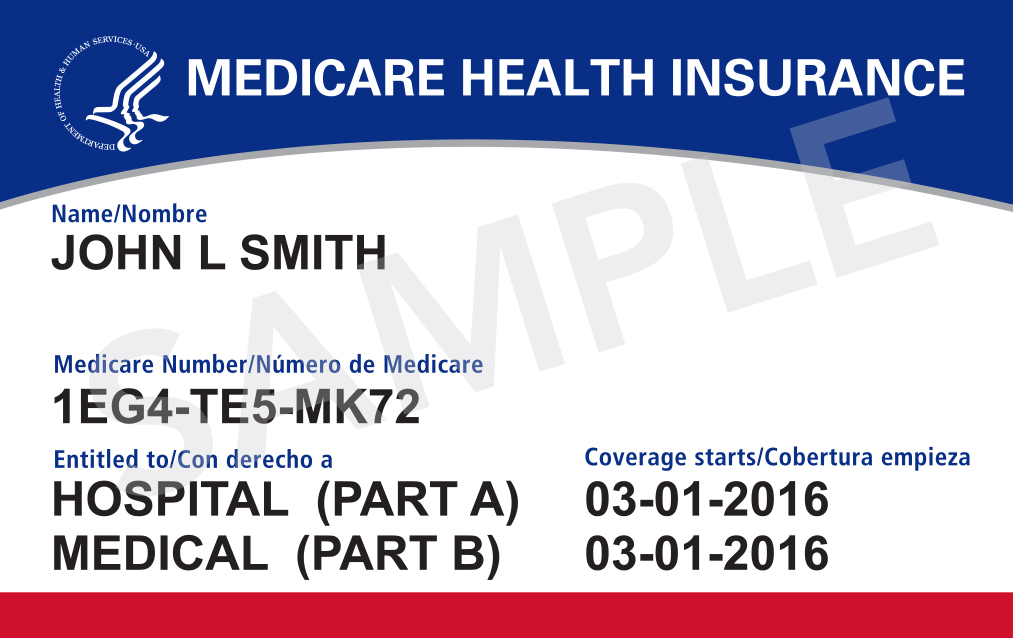
Each person on Medicare has a red, white and blue card with a Medicare Beneficiary Identifier (MBI), an 11-character number that is not the person's Social Security number. CMS removed Social Security number-based claim numbers from Medicare cards under the Medicare Access and CHIP Reauthorization Act of 2015 (MACRA), P.L. 114-10, signed April 16, 2015, and ended the transition period for providers to use the old numbers on Dec. 31, 2019.3334 A January 2026 SHIBA handout posted by the Idaho Department of Insurance (prepared by the Medicare Rights Center, a nonprofit beneficiary advocacy group) warned that "Medicare beneficiaries are not receiving new cards this year" and that anyone who calls offering a new card and asking for personal information should be treated with suspicion.20 Scams aimed at beneficiaries are covered in lesson 11, Medicare Fraud and Scams Aimed at Seniors.

Part A: hospital insurance
Part A pays for care in four settings: an inpatient hospital stay (including a critical access hospital, the small rural hospitals covered in lesson 09), a skilled nursing facility after a qualifying hospital stay, hospice, and home health care. Medicare.gov's one-line summary is that Part A "helps cover inpatient care in hospitals, skilled nursing facility care, hospice care, and home health care."14 Part A does not pay the doctor who treats a person in the hospital; the doctor's bill is a Part B claim.
Benefit periods: the unit Part A counts in
Part A does not count by calendar year. It counts by benefit period, a term defined in 42 CFR 409.60. A benefit period starts the day a person is admitted as an inpatient to a hospital, critical access hospital or skilled nursing facility. It ends when the person has gone at least 60 consecutive days without being an inpatient in any of them.35 A new benefit period means a new deductible. A person admitted to the hospital in February and again in October, with more than 60 days at home between the stays, pays the Part A deductible twice in one year. A person readmitted 30 days after discharge is still in the first benefit period and does not pay a second deductible, but keeps counting days toward the 60-day and 90-day thresholds.
Within each benefit period, 42 CFR 409.61 gives 90 days of inpatient hospital coverage: 60 days after the deductible with no daily charge, then 30 "coinsurance days." On top of that, each person has a "non-renewable lifetime reserve of 60 days" to draw on when a stay runs past 90 days in a benefit period; once used, reserve days do not come back.36 Inpatient care in a freestanding psychiatric hospital has a separate lifetime limit of 190 days (42 CFR 409.62).37
Part A amounts for 2026 and 2027
The daily coinsurance amounts are tied to the deductible by regulation: one-fourth of the deductible for hospital days 61 to 90, one-half for lifetime reserve days, and one-eighth for skilled nursing facility days 21 to 100 (42 CFR 409.83 and 409.85).38 That is why they all move together each year.
| Part A amount | 2025 | 2026 | 2027 | Rule |
|---|---|---|---|---|
| Inpatient hospital deductible, per benefit period | $1,676 | $1,736 | $1,776 | Set each year by CMS under Social Security Act section 1813 |
| Hospital days 1 to 60 | $0 after deductible | $0 after deductible | $0 after deductible | 42 CFR 409.61 |
| Hospital days 61 to 90, per day | $419 | $434 | $444 | 1/4 of the deductible (42 CFR 409.83) |
| Lifetime reserve days (60 per lifetime), per day | $838 | $868 | $888 | 1/2 of the deductible |
| Skilled nursing facility days 1 to 20 | $0 | $0 | $0 | 42 CFR 409.85 |
| Skilled nursing facility days 21 to 100, per day | $209.50 | $217 | $222 | 1/8 of the deductible (42 CFR 409.85) |
| Part A premium, 30 to 39 quarters of coverage, per month | $285 | $311 | $328 | Social Security Act section 1818 |
| Part A premium, fewer than 30 quarters, per month | $518 | $565 | $597 | Social Security Act section 1818 |
Sources: CMS fact sheet "2026 Medicare Parts A & B Premiums and Deductibles," Nov. 14, 2025 (2025 and 2026 columns; the 2025 Part A premiums are the 2026 amounts minus the increases the fact sheet states), and CMS fact sheet "2027 Medicare Parts A & B Premiums and Deductibles," Nov. 17, 2026 (2027 column).23 Medicare Advantage plans set their own inpatient cost sharing, often a daily copayment, within CMS limits.
Skilled nursing care and the three-day rule
Part A pays for a skilled nursing facility stay only after a qualifying hospital stay. Under 42 CFR 409.30, the person must have been hospitalized "for medically necessary inpatient hospital or inpatient CAH care, for at least 3 consecutive calendar days, not counting the date of discharge," and generally must enter the nursing facility within 30 days after discharge for care related to the hospital stay.39 Time spent in the hospital as an outpatient, including time "under observation," does not count toward the three days, because the rule says inpatient. A person can spend three nights in a hospital bed and still not qualify.
Skilled nursing facility coverage is for daily skilled care, such as rehabilitation therapy or nursing that only licensed staff can safely provide, after an illness or injury. It is short-term by design: at most 100 days per benefit period, with daily coinsurance from day 21. It is not long-term nursing home care. A resident who needs help only with bathing, dressing and eating is receiving custodial care, which Social Security Act section 1862(a)(9) excludes from Medicare.11
Hospice and home health
Hospice is end-of-life care for a person certified as terminally ill "with a life expectancy of 6 months or less" who chooses comfort care instead of treatment to cure the illness. Part A pays for it, including for people in Medicare Advantage plans. Medicare.gov says the person pays nothing for hospice care itself, may pay a copayment of up to $5 per prescription for drugs to control pain and symptoms, and may pay 5 percent of the Medicare-approved amount for inpatient respite care.40
Home health care covers part-time or intermittent skilled nursing and therapy at home for a person who is homebound, under a plan of care ordered by a doctor or other provider after an in-person visit, delivered by a Medicare-certified home health agency. Both Part A and Part B pay for home health, depending on whether it follows a hospital or nursing facility stay. "You pay nothing for covered home health services," Medicare.gov says, but durable medical equipment used at home carries the usual 20 percent Part B coinsurance.41


Part B: medical insurance
Part B covers medically necessary services from doctors, nurse practitioners and other clinicians; outpatient hospital care, including emergency room visits and outpatient surgery; lab tests and imaging; ambulance trips; durable medical equipment; outpatient mental health care; many preventive services such as screenings and the yearly wellness visit; and some drugs that are given in a doctor's office or clinic rather than picked up at a pharmacy, such as many cancer drugs and infusions.14 Part B is voluntary. A person who has job-based coverage from current work may delay it without a penalty, as described above; most other people who delay it pay the late penalty for life.31
The Part B premium and deductible
The standard Part B premium is $202.90 a month in 2026, up $17.90 from $185 in 2025, and $209.40 a month in 2027, up $6.50. The Part B deductible is $283 for 2026 and $292 for 2027.23 CMS attributes the 2027 increase "mainly" to "projected increases in healthcare spending."3
The premium is set by formula. Social Security Act section 1839 (42 U.S.C. 1395r) sets the standard premium at half of the "monthly actuarial rate" for enrollees 65 and over, and the actuarial rate is itself half of projected Part B costs per aged enrollee, so the standard premium covers about 25 percent of Part B costs and federal general revenue pays the rest.42 The Federal Register notice for 2027 sets the monthly actuarial rate for aged enrollees at $418.70; half of that, rounded to the nearest 10 cents, is the $209.40 premium.4 People with higher incomes pay more. In 2027, the income-related monthly adjustment amount (IRMAA) starts for individuals with modified adjusted gross income above $112,000 and joint filers above $224,000, and the total monthly Part B premium ranges up to $711.80 at the top bracket; in 2026 the first threshold was $109,000 for individuals.32 Lesson 07 covers IRMAA brackets, the two-year income lookback and the premium's history back to $3 a month in 1966.
The 20 percent, and no yearly limit
After the deductible, Medicare generally pays 80 percent of the Medicare-approved amount for a Part B service and the beneficiary owes 20 percent, under Social Security Act section 1833(a) (42 U.S.C. 1395l(a)).43 Some services have no cost sharing, including most preventive services and the yearly wellness visit. The approved amount is the price Medicare sets in its fee schedules, which is usually far less than a hospital's or doctor's list price.
Original Medicare has no out-of-pocket maximum. Medicare.gov's comparison page puts it plainly: in Original Medicare, "There's no yearly limit on what you pay out-of-pocket," unless the person has supplemental coverage, while Medicare Advantage plans "have a yearly limit on what you pay for covered Medicare services."5 Twenty percent of a large bill, such as a year of outpatient chemotherapy or dialysis, can run into thousands of dollars. That gap is the main reason Medigap policies, employer retiree plans and Medicare Advantage exist in the form they do, and it is the starting point for lessons 04 and 05.
Assignment, excess charges and Idaho
How much a doctor can bill depends on the doctor's relationship with Medicare. There are three kinds:
- Participating providers agree to "accept assignment" on every claim: they take the Medicare-approved amount as full payment and "agree to charge you only the Medicare deductible and coinsurance amount," and they file the claim themselves.44
- Non-participating providers accept Medicare patients but can decide claim by claim whether to accept assignment. When they do not, they may ask for full payment at the visit and may charge more than the approved amount. Medicare.gov says "In many cases, the charge can't be more than 15% above the Medicare-approved amount," a cap called "the limiting charge."44 The statute behind it is Social Security Act section 1848(g) (42 U.S.C. 1395w-4(g)). Because the fee schedule amount for non-participating providers is 95 percent of the participating amount, the 15 percent limit works out to about 9.25 percent above what a participating doctor is paid (see the box below).45 The amount above the approved amount is called an excess charge.
- Opt-out providers leave Medicare entirely for at least two years and see Medicare patients only under private contracts. "Medicare won't pay for items or services you get from provider that opts out, except in emergencies," Medicare.gov says.44
Some states limit excess charges more tightly than federal law. We found no Idaho statute or Department of Insurance rule that does. The Department of Insurance's 2025 Medicare supplement shopper's guide describes the federal 15 percent cap for non-participating doctors and does not mention any lower Idaho limit; its chart shows Part B excess charges covered by only two Medigap plan letters.19 Because a search of Idaho Code title 41 and IDAPA 18 cannot prove a negative, we list Idaho's lack of a state limit as "still being checked" at the end of this lesson. Medigap Plans F and G are the two standardized plans that pay excess charges; lesson 05 explains them.
How we figured it: the limiting charge on a hypothetical $100 visit
The hypothetical visit. Suppose the Medicare-approved amount for an office visit is $100 for a participating doctor, and the patient has already met the Part B deductible. This is a hypothetical example, not any real fee.
Participating doctor. Medicare pays 80 percent ($80); the patient owes 20 percent ($20). Total paid to the doctor: $100.
Non-participating doctor who accepts assignment on this claim. The approved amount is 95 percent of the participating amount: $95. Medicare pays 80 percent ($76); the patient owes $19.
Non-participating doctor who does not accept assignment. The limiting charge is 115 percent of $95: $109.25. Medicare pays $76 (80 percent of $95), and the patient owes the rest: $109.25 minus $76 = $33.25, which is the $19 coinsurance plus a $14.25 excess charge. $109.25 is 9.25 percent above the participating amount of $100. Sources for the 95 and 115 percent rules: Social Security Act section 1848(a)(3) and (g) (42 U.S.C. 1395w-4); Medicare.gov.4544
Part C: Medicare Advantage in brief
Medicare Advantage (MA) lets a private company take over a person's Part A and Part B coverage. Social Security Act section 1851 (42 U.S.C. 1395w-21) gives every person entitled to Part A and enrolled in Part B the choice between Original Medicare and an MA plan offered where the person lives.15 The person keeps paying the Part B premium to Medicare, and Medicare pays the plan a monthly amount for each member, adjusted for the member's health status. The plan must cover everything Original Medicare covers, except hospice, which stays with Original Medicare, and may charge different cost sharing.
The main trade-offs, which lesson 04 lays out in full, are these. MA plans must cap each member's yearly out-of-pocket spending for Part A and B services at no more than a limit CMS sets each year (42 CFR 422.100(f)(4)), often charge low or no extra premium, and often add benefits Original Medicare does not cover, such as some dental, vision and hearing care.465 In return, most MA plans use provider networks, may require referrals, and may require prior authorization, meaning the plan must approve some services in advance. Medicare.gov notes that MA members "may need to get a referral to see a specialist."5
MA's growth is the biggest change in Medicare in the past 20 years. Nationally, 51.1 percent of all Medicare beneficiaries were in MA or other private health plans in July 2026 (our calculation from CMS's Medicare Monthly Enrollment file, which counts MA plans together with cost plans, PACE and some demonstration plans in its "MA and other" column).9 MedPAC, the independent agency that advises Congress on Medicare payment, uses a different base, people with both Part A and Part B, and put MA's share at 55 percent in 2025.47 Idaho has been below the national share and moving: 30.3 percent in July 2013, 37.2 percent in July 2020, 49.9 percent in July 2025, then a drop to 45.9 percent by July 2026 (our calculations from the same CMS file).910 The month-to-month numbers show where the drop happened: 49.8 percent in December 2025 and 45.3 percent in January 2026, when plan year 2026 began. In September 2025 the Idaho Department of Insurance had warned that "plan withdrawals are expected in 2026."1048 The CMS file shows the drop but not its causes; lesson 08, The 2027 Plan Year in Idaho, follows plan exits and entries county by county.
Part D: drug coverage in brief
Part D, created by the Medicare Prescription Drug, Improvement, and Modernization Act of 2003 (P.L. 108-173, signed Dec. 8, 2003) and in effect since Jan. 1, 2006, pays for drugs bought at pharmacies.49 It is voluntary and run entirely by private plans: stand-alone prescription drug plans for people in Original Medicare, and MA plans that include drug coverage. Each plan has a formulary (its list of covered drugs), tiers that set the copayment or coinsurance for each drug, and a pharmacy network. In July 2026, 326,629 Idahoans, 78.2 percent of Idaho's Medicare beneficiaries, had Part D coverage, about evenly split between stand-alone plans (155,673) and MA drug plans (170,956), according to CMS's monthly enrollment file (percent is our calculation).9
The Inflation Reduction Act of 2022 (P.L. 117-169, signed Aug. 16, 2022) rebuilt Part D's cost sharing, capping out-of-pocket drug spending starting in 2025.50 The standard benefit's numbers for 2026 and 2027 come from CMS's 2027 Rate Announcement, Table V-2:6
| Part D standard benefit | 2026 | 2027 | Source |
|---|---|---|---|
| Deductible (maximum a plan may charge) | $615 | $700 | CMS CY 2027 Rate Announcement, Table V-2 (April 6, 2026) |
| Annual out-of-pocket threshold (cap) | $2,100 | $2,400 | Same |
| Base beneficiary premium (used to figure the late penalty and premium subsidies; not any plan's actual premium) | $38.99 | $41.33 | Idaho Department of Insurance SHIBA handout, Jan. 2026 (2026); CMS Part D bid fact sheet, July 28, 2026 (2027) |
CMS said on July 28, 2026 that it is ending the voluntary premium stabilization demonstration for stand-alone drug plans at the end of 2026.5120 Extra Help (the low-income subsidy), the Medicare Prescription Payment Plan that spreads drug costs over the year, the $35 monthly limit on covered insulin and the first drugs with prices negotiated by Medicare are all covered in lesson 06, Part D and Drug Costs.
Who pays for Medicare
Medicare has two trust funds in the U.S. Treasury, and they are financed in very different ways. The Hospital Insurance (HI) trust fund pays for Part A. The Supplementary Medical Insurance (SMI) trust fund has two accounts, one for Part B and one for Part D. Medicare Advantage plans are paid from both funds in proportion to the Part A and Part B benefits they replace.52
The payroll tax
The Medicare payroll tax is 1.45 percent of wages taken from the worker's paycheck (26 U.S.C. 3101(b)(1)) and another 1.45 percent paid by the employer (26 U.S.C. 3111(b)), for 2.9 percent in all. Self-employed people pay the full 2.9 percent on net self-employment earnings (26 U.S.C. 1401(b)).75354 Unlike the Social Security part of the payroll tax, the Medicare tax has no wage cap; Congress removed the cap starting in 1994 in the Omnibus Budget Reconciliation Act of 1993, P.L. 103-66, signed Aug. 10, 1993.55
Since 2013, higher earners have paid an "additional" Medicare tax of 0.9 percent on wages and self-employment income above $200,000 for single filers, $250,000 for married couples filing jointly and $125,000 for married people filing separately (26 U.S.C. 3101(b)(2) and 1401(b)(2)). The employer does not match it. The tax was added by the Affordable Care Act, P.L. 111-148, signed March 23, 2010, which set the rate at 0.9 percent in section 10906, as amended a week later by P.L. 111-152; it applies to wages received, and taxable years beginning, after Dec. 31, 2012.756 The thresholds are written into the statute as fixed dollar amounts and are not adjusted for inflation, so each year a larger share of workers crosses them.
Premiums
Beneficiaries pay premiums for Part B, Part D and, for the few without enough work credits, Part A. In 2025, premiums were about 22 percent of SMI trust fund income ($165.6 billion) and about 1 percent of HI income ($6.0 billion), according to the 2026 Trustees Report summary.8 Most beneficiaries have their Part B premium taken out of their monthly Social Security check.
General revenue
General revenue means money from the federal government's general fund: income taxes, corporate taxes, other revenue and borrowing. It is the largest single source of Medicare money. In 2025, "government contributions" from general revenue were $571.8 billion, about 75 percent of SMI income, and less than 1 percent of HI income ($1.1 billion).8 Because Part B and Part D draw most of their money from general revenue, those parts cannot run out of money the way Part A can; their financing is reset each year by law. The cost shows up instead in the federal budget.
Income taxes on Social Security benefits
Up to 85 percent of Social Security benefits can be subject to federal income tax for people whose income is above set thresholds (26 U.S.C. 86). The income tax collected on the portion between 50 and 85 percent of benefits, a tier added by the 1993 budget law, goes to the HI trust fund.5755 In 2025, that came to $41.1 billion, about 9 percent of HI income.8
Medicare money in 2025 in one table
| Source (2025) | HI trust fund (Part A) | SMI trust fund (Parts B and D) | Both funds (our sum) | Share of both (our calculation) |
|---|---|---|---|---|
| Payroll taxes | $403.2 billion (about 87%) | none | $403.2 billion | 32.9% |
| General revenue (government contributions) | $1.1 billion (under 1%) | $571.8 billion (about 75%) | $572.9 billion | 46.7% |
| Beneficiary premiums | $6.0 billion (about 1%) | $165.6 billion (about 22%) | $171.6 billion | 14.0% |
| Income tax on Social Security benefits | $41.1 billion (about 9%) | none | $41.1 billion | 3.4% |
| All other (interest, state payments for dual eligibles' drug costs and other) | $10.9 billion (our calculation) | $26.4 billion (our calculation) | $37.3 billion | 3.0% |
| Total income | $462.4 billion | $763.8 billion | $1,226.2 billion | 100% |
| Total cost (benefits and administration) | $444.2 billion | $765.8 billion | $1,210.0 billion |
Source: Social Security and Medicare Boards of Trustees, Status of the Social Security and Medicare Programs: A Summary of the 2026 Annual Reports, and the 2026 Medicare Trustees Report.852 The Trustees' summary gives the income and cost totals and the named sources in billions of dollars; the "all other" row and the combined columns are our arithmetic.
How we figured it: combined Medicare income shares and two payroll tax examples
Combined shares. The Trustees' summary reports 2025 HI income of $462.4 billion and SMI income of $763.8 billion. We added the two: $1,226.2 billion. For each source we added the HI and SMI dollar amounts the summary gives and divided by $1,226.2 billion: payroll taxes $403.2 / $1,226.2 = 32.9 percent; general revenue ($1.1 + $571.8) = $572.9 / $1,226.2 = 46.7 percent; premiums ($6.0 + $165.6) = $171.6 / $1,226.2 = 14.0 percent; taxation of benefits $41.1 / $1,226.2 = 3.4 percent. "All other" is what is left: HI $462.4 minus ($403.2 + $1.1 + $6.0 + $41.1) = $10.9 billion; SMI $763.8 minus ($571.8 + $165.6) = $26.4 billion; together $37.3 billion, 3.0 percent. Totals may not add exactly because of rounding in the source.
Hypothetical worker earning $60,000 in wages in 2026. Worker's Medicare tax: 1.45 percent x $60,000 = $870. Employer's matching tax: $870. Total going to the HI trust fund: $1,740. No additional tax applies because wages are under $200,000.
Hypothetical single filer earning $300,000 in wages in 2026. Regular Medicare tax: 1.45 percent x $300,000 = $4,350 from the worker and $4,350 from the employer. Additional Medicare tax: 0.9 percent x ($300,000 minus $200,000) = $900, paid by the worker only. Worker's total: $5,250; total to Medicare from both: $9,600. Both workers are hypothetical examples; rates from 26 U.S.C. 3101 and 3111.753
The trust funds in brief
The HI trust fund took in $18.2 billion more than it spent in 2025, but the 2026 Trustees Report projects that its reserves will be depleted "in the second quarter of 2033," one quarter earlier than the 2025 report projected. At that point, incoming payroll taxes and other income would cover 89 percent of scheduled Part A benefits. The 75-year HI deficit grew from 0.42 percent of taxable payroll in the 2025 report to 0.56 percent in the 2026 report.8 The SMI fund cannot be depleted in the same way because general revenue and premiums are reset every year to match projected costs. The Trustees issued a "Medicare funding warning" for the ninth year in a row under the 2003 drug law, which requires one when two consecutive Trustees Reports project that general revenue will exceed 45 percent of total Medicare outlays within seven fiscal years.849 The Trustees report projected Medicare costs at 4.1 percent of the economy (gross domestic product) in 2026, rising to 6.5 percent in 2050.8 The math, the history of projected depletion dates and the policy options are in lesson 10, The Trust Funds and the Long-Term Math.
What Medicare does not cover
The list of things Medicare will not pay for is in the statute itself, Social Security Act section 1862(a) (42 U.S.C. 1395y(a)). The broadest exclusion, in paragraph (1), is anything "not reasonable and necessary for the diagnosis or treatment of illness or injury." The others name specific categories.11
- Long-term custodial care (paragraph (9)): help with daily activities such as bathing, dressing, eating and using the bathroom, whether at home, in an assisted living facility or in a nursing home, when that is the main care a person needs. This is the most expensive gap for families. In Idaho, Medicaid pays for nursing home and some home and community-based long-term care for people who meet its income, asset and care-need rules; see Who Qualifies and Who Is Covered.
- Dental care (paragraph (12)): "services in connection with the care, treatment, filling, removal, or replacement of teeth or structures directly supporting teeth," with a narrow exception for hospital stays required by a medical condition or the severity of a dental procedure.
- Routine vision and hearing (paragraph (7)): routine physical checkups, eyeglasses, eye exams for prescribing or fitting glasses, hearing aids and hearing aid exams, with listed exceptions (for example, glasses after cataract surgery and the preventive services Congress has added).
- Care outside the United States (paragraph (4)), with narrow exceptions for certain inpatient hospital care near the border or on the way to Alaska through Canada. Medicare.gov notes that some Medigap policies cover emergency care abroad, and some MA plans offer it as an extra benefit.5
- Cosmetic surgery (paragraph (10)), except prompt repair of an accidental injury or improving the function of a malformed body part.
- Routine foot care (paragraph (13)), such as trimming nails or removing corns and calluses, and treatment of flat feet.
Medicare Advantage plans often add some of these as "supplemental benefits," most commonly dental, vision and hearing allowances. Those benefits vary by plan, county and year, and are not part of the Medicare entitlement itself: a plan can change or drop them for the next year.5 Lesson 04 covers supplemental benefits.
Medicare and job-based coverage at 65
Many Idahoans keep working past 65, or are covered through a working spouse. Medicare's "secondary payer" rules, in Social Security Act section 1862(b) (42 U.S.C. 1395y(b)), decide whether Medicare or the job-based plan pays first. The test turns on the size of the employer and on whether the coverage comes from current work.5832
- Age 65 or older, coverage from current work, employer with 20 or more employees: "The group health plan pays first, and Medicare pays second." The statute counts an employer with "20 or more employees for each working day in each of 20 or more calendar weeks in the current calendar year or the preceding calendar year."3258
- Age 65 or older, employer with fewer than 20 employees: "Medicare pays first, and the group health plan pays second."32
- Under 65 with a disability, employer with 100 or more employees (a "large group health plan"): the job-based plan pays first; with fewer than 100 employees, Medicare pays first.32
- Kidney failure: the job-based plan pays first during a 30-month coordination period, then Medicare pays first.24
- Retiree coverage and COBRA: Medicare pays first. For COBRA, Medicare.gov warns that once Medicare pays first, "COBRA may only pay a small portion of your medical costs."32
Who pays first matters most when a person does not enroll in Part B. If Medicare is supposed to pay first and the person has no Part B, the retiree plan or small-employer plan may pay as if Medicare had paid, leaving the person with the bill Medicare would have covered. This guide does not say whether any reader should delay Part B; it describes how the rules work. SHIBA counselors explain these rules for specific situations at no charge.20
Idaho by the numbers
CMS publishes Medicare enrollment by state and county every month in its Medicare Monthly Enrollment file on data.cms.gov. The newest month available on Nov. 22, 2026 was July 2026, in a file posted in October 2026.9 The file counts everyone with Part A or Part B. Its "MA and other" column includes Medicare Advantage plans, cost plans, PACE and some demonstration plans, so it is a little broader than Medicare Advantage alone. Counties with fewer than 11 people in a cell are suppressed with an asterisk; none of the Idaho county totals used below was suppressed.
| Measure, July 2026 | Idaho | United States | Source |
|---|---|---|---|
| Medicare beneficiaries (Part A or B) | 417,781 | 70,736,624 | CMS Medicare Monthly Enrollment, July 2026 |
| In Original Medicare | 226,056 | 34,558,874 | Same |
| In Medicare Advantage and other health plans | 191,725 (45.9%) | 36,177,750 (51.1%) | Same; percent is our calculation |
| Eligible because of age | 380,683 | 64,042,910 | Same |
| Eligible because of disability (under 65) | 37,098 (8.9%) | 6,693,714 (9.5%) | Same; percent is our calculation |
| Enrolled in Part B | 390,545 (93.5%) | 64,845,571 (91.7%) | Same; percent is our calculation |
| With Part D drug coverage | 326,629 (78.2%) | 57,387,569 (81.1%) | Same; percent is our calculation |
| Dual eligibles (Medicare and some Medicaid) | 53,100 (12.7%) | 11,991,216 (17.0%) | Same; percent is our calculation |
Idaho's Medicare population grew from 260,443 in July 2013, the first year in the file, to 417,781 in July 2026, an increase of 60.4 percent (our calculation).910 Lesson 03, Idaho's Medicare Population, has all 44 counties, the growth compared with other states and the share of each county's residents on Medicare.
Selected counties show how different Medicare looks across Idaho. In the Treasure Valley, a majority of beneficiaries are in private plans; in Blaine County and much of northern and central Idaho, most are in Original Medicare.
| County, July 2026 | Beneficiaries | Original Medicare | MA and other | MA and other share (our calculation) | Disabled, under 65 |
|---|---|---|---|---|---|
| Ada | 107,097 | 47,781 | 59,316 | 55.4% | 7,723 |
| Canyon | 49,664 | 18,708 | 30,956 | 62.3% | 5,087 |
| Twin Falls | 19,507 | 8,613 | 10,894 | 55.8% | 1,955 |
| Gooding | 3,504 | 1,779 | 1,725 | 49.2% | 311 |
| Lincoln | 980 | 510 | 470 | 48.0% | 86 |
| Minidoka | 4,567 | 2,614 | 1,953 | 42.8% | 409 |
| Cassia | 4,628 | 2,831 | 1,797 | 38.8% | 418 |
| Camas | 325 | 209 | 116 | 35.7% | 17 |
| Blaine | 6,391 | 5,030 | 1,361 | 21.3% | 136 |
| Bonneville | 22,850 | 14,109 | 8,741 | 38.3% | 2,740 |
| Bannock | 17,929 | 9,566 | 8,363 | 46.6% | 2,373 |
| Kootenai | 48,831 | 28,545 | 20,286 | 41.5% | 4,017 |
| Nez Perce | 11,086 | 8,653 | 2,433 | 21.9% | 1,265 |
| Idaho County | 5,658 | 4,668 | 990 | 17.5% | 459 |
Source: CMS, Medicare Monthly Enrollment, July 2026, county rows for Idaho.9 Ada and Canyon counties together had 156,761 beneficiaries, 37.5 percent of Idaho's total (our calculation). Twin Falls County includes the cities of Twin Falls, Kimberly and Buhl; Gooding County includes Gooding, Wendell and Hagerman; Minidoka County includes Rupert; Cassia County includes Burley.
Pictures, Numbers and Infographics
The lesson's main numbers, rules and dates in one place, followed by two charts of Medicare Advantage enrollment drawn from CMS's monthly enrollment file.
| Measure | Idaho | U.S. or other states | Year | Source |
|---|---|---|---|---|
| Medicare beneficiaries | 417,781 | U.S. 70,736,624 | July 2026 | CMS Medicare Monthly Enrollment9 |
| Share in MA and other plans (our calculation) | 45.9% | U.S. 51.1%; UT 55.0%; OR 53.8%; NV 52.0%; WA 49.7%; MT 29.8%; WY 15.4% | July 2026 | CMS Medicare Monthly Enrollment9 |
| Share eligible by disability (our calculation) | 8.9% | U.S. 9.5%; OR 8.6%; UT 8.4%; WA 8.0%; WY 8.0%; NV 7.9%; MT 7.7% | July 2026 | CMS Medicare Monthly Enrollment9 |
| Growth in beneficiaries since July 2013 (our calculation) | 60.4% | n/a | 2013 to 2026 | CMS Medicare Monthly Enrollment10 |
| Part A deductible per benefit period | Same nationwide | $1,736 (2026); $1,776 (2027) | 2026, 2027 | CMS fact sheets23 |
| Standard Part B premium per month | Same nationwide | $202.90 (2026); $209.40 (2027) | 2026, 2027 | CMS fact sheets; CMS-8094-N234 |
| Part B deductible | Same nationwide | $283 (2026); $292 (2027) | 2026, 2027 | CMS fact sheets23 |
| Part D out-of-pocket cap | Same nationwide | $2,100 (2026); $2,400 (2027) | 2026, 2027 | CMS Rate Announcement, Table V-26 |
| Medicare payroll tax | Same nationwide | 2.9% (1.45% worker, 1.45% employer); +0.9% over $200,000 / $250,000 joint | Since 2013 | 26 U.S.C. 3101, 3111753 |
| HI trust fund projected depletion | Not state-specific | Second quarter of 2033; 89% of Part A benefits payable after | 2026 Trustees Report | Trustees summary8 |
| Medicare total cost (HI plus SMI) | Not reported by state in the Trustees Report | $1,210.0 billion (our sum of $444.2 and $765.8 billion) | 2025 | Trustees summary8 |
| Disability waiting period | Same nationwide | 24 months of disability benefits; none for ALS | Since 1972 (ALS since 2001) | 42 U.S.C. 426(b), (h)1 |
How we figured it: Idaho enrollment shares
From CMS's Medicare Monthly Enrollment file (dataset "Medicare Monthly Enrollment," July 2026 release on data.cms.gov), we took the state-level rows for Idaho, the six neighbor states and the national row. Each share is the "MA_AND_OTH_BENES" count divided by "TOT_BENES" for the same month: Idaho July 2026, 191,725 / 417,781 = 45.9 percent; United States, 36,177,750 / 70,736,624 = 51.1 percent; Utah 270,074 / 491,386 = 55.0 percent; Oregon 523,528 / 973,880 = 53.8 percent; Nevada 328,126 / 630,832 = 52.0 percent; Washington 788,606 / 1,586,306 = 49.7 percent; Montana 81,284 / 273,047 = 29.8 percent; Wyoming 20,527 / 133,449 = 15.4 percent. Idaho trend: July 2013, 78,933 / 260,443 = 30.3 percent; July 2020, 130,095 / 349,782 = 37.2 percent; July 2025, 203,381 / 407,530 = 49.9 percent; December 2025, 204,769 / 411,388 = 49.8 percent; January 2026, 187,819 / 414,605 = 45.3 percent. Growth: 417,781 / 260,443 = 1.604, a 60.4 percent increase. Disability shares use "DSBLD_TOT_BENES," Part D shares use "PRSCRPTN_DRUG_TOT_BENES," and dual shares use "DUAL_TOT_BENES," each divided by "TOT_BENES." Because the denominator includes people with Part A only, who cannot join an MA plan, these shares run a few points lower than shares figured on people with both Parts A and B, such as MedPAC's.91047
Common mistakes
- Confusing Medicare with Medicaid. Medicare is federal and based on age, disability or illness; Medicaid is state-run and based on income. Someone with modest savings who needs long-term nursing home care will not find it in Medicare, which excludes custodial care under section 1862(a)(9).11 The Idaho Medicaid course covers how Medicaid long-term care works.
- Assuming retiree coverage or COBRA lets a person delay Part B. Only coverage from current employment creates the eight-month special enrollment period, and for retiree and COBRA coverage, "Medicare pays first."3230 People who wait can face the 10-percent-per-year Part B penalty for as long as they have Part B.31
- Thinking three nights in the hospital always qualify a person for skilled nursing care. The three days must be as an admitted inpatient, not counting the day of discharge; observation time is outpatient time.39
- Expecting a yearly out-of-pocket limit in Original Medicare. There is none; Medicare.gov says "There's no yearly limit on what you pay out-of-pocket" in Original Medicare.5 Medicare Advantage plans and Part D have caps; Parts A and B alone do not.
- Thinking the Part A deductible is yearly. It is charged per benefit period, which can mean more than one deductible in a year.35
- Treating "takes Medicare" as "accepts assignment." A non-participating doctor can charge up to the limiting charge, 15 percent above the non-participating approved amount, on claims where the doctor does not accept assignment.44
- Comparing Medicare Advantage shares from different sources without checking the denominator. CMS's monthly file divides by everyone with Part A or B; MedPAC divides by people with both; the Idaho Department of Insurance said "approximately 51%" of Medicare-eligible Idahoans were enrolled in a Medicare Advantage plan in 2024.94748 The numbers are not contradictions; they measure different groups at different times.
- Believing a caller who says Medicare is issuing new cards. The Department of Insurance warned in January 2026 that Medicare is not issuing new cards in 2026.20
What we know, what we don't, and what the data can show
What we know
- The 2026 and 2027 Part A and Part B premiums, deductibles and coinsurance amounts, from CMS fact sheets of Nov. 14, 2025 and Nov. 17, 2026, and the 2027 Part B premium notice (CMS-8094-N).234
- The 2026 and 2027 Part D deductible and out-of-pocket cap, from CMS's April 6, 2026 Rate Announcement.6
- How Medicare was financed in 2025 and the HI trust fund's projected depletion in the second quarter of 2033, from the 2026 Trustees Report.8
- Idaho's Medicare enrollment by state and county through July 2026, including the drop in the private-plan share at the start of 2026, from CMS's monthly enrollment file.910
- The 2025 law ending Medicare eligibility for some noncitizens, with termination effective Feb. 1, 2027 for current beneficiaries SSA cannot confirm.1726
What we don't know
- How many Idahoans will lose Medicare under section 71201 of P.L. 119-21; SSA has not published a state count.
- Whether any Idaho statute or rule limits Part B excess charges below the federal 15 percent; we found none, but a search cannot rule one out.
- Why the private-plan share in Idaho fell between December 2025 and January 2026, county by county; the enrollment file counts people but does not record reasons.
- How much Medicare money is spent in Idaho in 2026; the Trustees Report is national, and CMS's state spending data lag by more than a year (lesson 03).
What the data can show
- CMS Medicare Monthly Enrollment (data.cms.gov): monthly totals by state and county since 2013 for Original Medicare, MA and other plans, Part D, aged and disabled, and dual eligibles.
- CMS premium and deductible fact sheets and Federal Register notices: each year's amounts back many years, which lets readers track cost changes (lesson 07).
- The Medicare Trustees Reports: income by source, costs and projected depletion dates, report by report (lesson 10).
- CMS Rate Announcements: Part D parameters and MA payment changes for each plan year (lessons 04, 06 and 08).
Questions people ask
Is Medicare free if I paid into it for 40 quarters?
Part A is premium-free with 40 quarters of Medicare-covered work by the person or a spouse, but Part A still has a deductible ($1,736 per benefit period in 2026, $1,776 in 2027) and daily coinsurance on long stays. Part B costs a monthly premium ($202.90 in 2026, $209.40 in 2027) for everyone, more for higher incomes, plus a deductible and 20 percent coinsurance. Part D plans charge their own premiums.23
Can I get Medicare before 65?
Yes, in three situations set by statute: after 24 months of Social Security disability benefits; with ALS, from the first month of disability benefits; and with end-stage renal disease, usually from the fourth month of dialysis.12324 In July 2026, 37,098 Idahoans under 65 had Medicare because of a disability, including ESRD.9
Does Medicare pay for a nursing home?
Only for short-term skilled care after a qualifying three-day inpatient hospital stay, up to 100 days per benefit period, with daily coinsurance from day 21 ($217 in 2026, $222 in 2027). It does not pay for long-term custodial care, the kind most nursing home residents receive.39311 Idaho Medicaid pays for long-term nursing home care for people who qualify.
What happens if I do nothing at 65?
People already getting Social Security are enrolled in Parts A and B automatically.27 People not yet getting Social Security are not, and must sign up through SSA during the seven-month initial enrollment period or, if covered by a group plan from current work, later under the special enrollment period. Missing both can mean waiting for the Jan. 1 to March 31 general enrollment period and paying a lifelong Part B penalty.2831 Drug coverage also has a penalty for going without it, explained in lesson 06.
Does the Medicare payroll tax pay for my doctor visits?
No. The payroll tax goes to the HI trust fund, which pays for Part A. Doctor visits are Part B, which is paid from the SMI trust fund, about three-fourths by general revenue and about one-fourth by beneficiary premiums.842
Why does my neighbor pay a different Part B premium?
The most common reasons are the income-related surcharge (IRMAA), a late enrollment penalty, or a state Medicaid program paying the premium through a Medicare Savings Program. A small number of people pay less than the standard amount because of the "hold harmless" rule in section 1839(f), which limits a Part B premium increase to the dollar size of the person's Social Security cost-of-living increase.3311342 Lesson 07 explains each.
Is Medicare Advantage part of Medicare?
Yes. MA is Part C of the same law, and people in MA are still Medicare beneficiaries who keep paying the Part B premium. The plan, not Medicare, decides which providers are in network and how much members pay at each visit, within CMS rules.155 Lesson 04 compares the two paths.
Hard questions
Should payroll taxes rise, or benefits change, before 2033?
The case for acting soon on revenue: the HI fund is projected to run short in the second quarter of 2033, when only 89 percent of Part A benefits could be paid; hospitals, nursing homes and hospices in Idaho would face automatic payment cuts, and earlier action spreads the change over more years.8 The case for cutting cost growth instead: payroll taxes already fall on every worker's wages with no cap, and people who hold this view argue that growth in Medicare spending per person drives the gap, so they favor payment changes for hospitals, private plans and drugs. What the evidence shows: the 75-year HI deficit is 0.56 percent of taxable payroll in the 2026 report, up from 0.42 percent a year earlier, so the gap grew in one year.8 Lesson 10 lists the options and the savings the Congressional Budget Office has estimated for each.
Does Medicare Advantage cost taxpayers more than Original Medicare?
MedPAC's case: in its March 12, 2026 report, MedPAC estimated that Medicare spends "approximately 14 percent more for MA enrollees" than it would if they were in Original Medicare, a projected $76 billion in 2026, a difference MedPAC said "stems largely from two factors: favorable selection of beneficiaries into MA and coding intensity" (healthier people choosing MA, and plans recording more diagnoses).47 The insurance industry's case: AHIP, the health insurers' trade association, said in a March 15, 2024 statement on MedPAC's earlier estimates that they rest on "speculative assumptions" and ignore who MA serves and the extra value members receive.59 What the evidence shows: MedPAC's estimate is the official advisory figure to Congress, and MA enrollees do get yearly out-of-pocket limits and extra benefits Original Medicare lacks; how much of the payment difference buys those benefits, and how much is coding, is the core of the dispute. Lesson 04 goes through MedPAC's method and CMS's own coding adjustments.
Should Original Medicare cover dental, vision and hearing?
The case for: section 1862(a) has excluded routine dental care, eyeglasses and hearing aids since the start, which leaves people in Original Medicare without coverage that many MA members get as extras. The case against: adding them would raise Part B costs, and since Part B premiums are tied by law to about 25 percent of Part B costs, premiums would rise for every enrollee, along with general revenue spending, while the HI fund already faces a shortfall.1142 What the evidence shows: as of Nov. 22, 2026, Congress had not changed the statutory exclusions; these benefits remain available only through MA supplemental benefits, Medicaid for those who qualify, or separate private coverage.
Is the 24-month wait for people with disabilities justified?
The case for ending or shortening it: people approved for disability benefits have already shown they cannot work, and many lose job-based coverage long before Medicare starts; Congress has already waived the wait for ALS.1 The case for keeping it: shortening it would add federal costs at a time when the HI fund faces depletion, and Medicaid and the individual market can cover some people during the wait. What the evidence shows: the wait has been in law since P.L. 92-603 in 1972, and the only disease-specific waiver is ALS, added in 2000.221
For reporters and advocates
Records and data that exist. CMS's Medicare Monthly Enrollment file gives monthly beneficiary counts by state and county, split by Original Medicare and MA, aged and disabled, Part D and dual eligibility.9 CMS's yearly premium fact sheets and Federal Register notices set each year's amounts, and the Federal Register notice includes the actuarial rates behind the Part B premium.34 The Trustees Reports give financing by source and projections.52 MedPAC's March and June reports to Congress analyze payment adequacy and MA.47 The Idaho Department of Insurance publishes news releases and SHIBA handouts each fall and keeps consumer complaint and Medigap rate filing records.4820
Questions for officials. For SSA's Idaho offices: how many Idaho beneficiaries received notices under section 71201 of P.L. 119-21, and how many have been resolved? For the Idaho Department of Insurance and SHIBA: how many Idahoans sought help during the 2025 and 2026 open enrollment periods, and how many involved plan exits? For hospitals: what share of their patients and revenue is Medicare, and what share of Medicare patients are in MA plans? For the congressional delegation: what is each member's position on the HI shortfall and on MA payment policy?
How to ask. Idaho Department of Insurance records are public records under the Idaho Public Records Act, Idaho Code title 74, chapter 1; the module Idaho Public Records Requests explains how to write a request. CMS and SSA records are covered by the federal Freedom of Information Act; each agency has an online FOIA portal. Medicare data on individual people is protected by privacy law (see Privacy and Data Security Laws), so ask for counts, not names.
The Idaho angle. Idaho's private-plan share fell more than four percentage points at the start of 2026, while the national share stayed at about 50.8 percent from December 2025 to January 2026; the county rows show where the Idaho drop happened.10 Idaho's dual eligible share (12.7 percent) is well below the nation's (17.0 percent), which affects how much Idaho Medicaid spends on Medicare premiums and cost sharing. And the state's fast population growth means more Idahoans turning 65 each year (lesson 03). Working with CMS data files is covered in Data and Statistics.9
Where to go next
- Medicare.gov: The official federal Medicare site run by CMS, for beneficiaries, families and caregivers. Free. It has the Medicare & You handbook, cost pages for each part, and Medicare Plan Finder for comparing drug and Medicare Advantage plans by ZIP code; 1-800-MEDICARE (1-800-633-4227) answers questions by phone.
- SHIBA, Senior Health Insurance Benefits Advisors (Idaho Department of Insurance): Idaho's State Health Insurance Assistance Program, run by the Department of Insurance with trained counselors and volunteers around the state. Free and unbiased; it does not sell insurance. Its toll-free line is 1-800-247-4422, and it offers one-on-one counseling, enrollment events and the Idaho Medigap shopper's guide.
- Social Security Administration: Medicare: Where most people apply for Medicare, change Part B enrollment, report income changes that affect IRMAA and read notices about the 2025 eligibility law. Free; a my Social Security account lets beneficiaries do many tasks online.
- CMS Medicare Monthly Enrollment data: CMS's free downloadable enrollment counts by state and county since 2013, for reporters, researchers, county officials and advocates. Use the data viewer to filter to Idaho, or download the CSV file.
- Medicare Trustees Reports: CMS Office of the Actuary's page for each year's Trustees Report on the HI and SMI trust funds. Free; the summary on ssa.gov is the quickest read, and the full report has the income and cost tables.
- Idaho Commission on Aging and Area Agencies on Aging: The state agency for older Idahoans and the six regional Area Agencies on Aging it works with, which provide information and referral, caregiver support and benefits help. Services are free or low cost.
- Idaho Legal Aid Services: A nonprofit that provides free civil legal help to low-income Idahoans and seniors, with self-help materials on public benefits including Medicare and Medicaid; eligibility rules apply.
Still being checked (3 items)
These points could not be fully confirmed against a primary source when this lesson was written and fact checked in November 2026. The text above states each one as uncertain.
- Whether any Idaho statute or Department of Insurance rule limits Medicare Part B excess charges below the federal 15 percent limiting charge. We found none in Idaho Code title 41 or IDAPA 18, and the Department's 2025 shopper's guide describes only the federal limit, but we could not confirm the absence from an official Idaho statement.
- How many Idaho Medicare beneficiaries will lose coverage under section 71201 of P.L. 119-21; SSA had not published a state count as of Nov. 22, 2026.
- The public release date of the 2026 Medicare Trustees Report: the transmittal letter is dated June 9, 2026, and outside analyses were published that day, but neither the CMS nor the SSA page we read states a release date.
Last verified November 22, 2026. General education, not legal, medical, insurance or financial advice; every figure names its source and year in the Notes and Sources below. Data is revised: check the newest release before relying on any number.
Notes
- Social Security Act section 226 (42 U.S.C. 426), entitlement to hospital insurance benefits: subsection (a) age 65; subsection (b) 24 calendar months of disability benefits; subsection (h) ALS, entitlement begins "with the first month (rather than twenty-fifth month)"; subsection (h) added by P.L. 106-554 (Dec. 21, 2000), effective for months beginning July 1, 2001, per the Code's amendment notes, Legal Information Institute, Cornell Law School (read Nov. 22, 2026). Read it online. ↩
- Centers for Medicare & Medicaid Services, fact sheet, "2026 Medicare Parts A & B Premiums and Deductibles," Nov. 14, 2025 (Part B premium $202.90 and deductible $283; Part A deductible $1,736; coinsurance $434, $868 and $217; Part A premiums $311 and $565; 2025 comparisons; first 2026 IRMAA threshold $109,000) (read Nov. 22, 2026). Read it online. ↩
- Centers for Medicare & Medicaid Services, fact sheet, "2027 Medicare Parts A & B Premiums and Deductibles," Nov. 17, 2026 (Part B premium $209.40, deductible $292, immunosuppressive drug premium $125.70; Part A deductible $1,776, coinsurance $444, $888 and $222, premiums $328 and $597; about 99 percent pay no Part A premium; IRMAA tables starting at $112,000 individual and $224,000 joint) (read Nov. 22, 2026). Read it online. ↩
- CMS, "Medicare Program; Medicare Part B Monthly Actuarial Rates, Premium Rates, and Annual Deductible Beginning January 1, 2027," CMS-8094-N, Federal Register public inspection document 2026-23601, filed for public inspection Nov. 17, 2026, and published in the Federal Register Nov. 19, 2026, at 91 FR 74570 (CMS announced the amounts in its fact sheet of Nov. 17, 2026); approved by the CMS administrator Nov. 16, 2026 (monthly actuarial rate $418.70 for aged enrollees; standard premium $209.40; deductible $292) (read Nov. 22, 2026). Read it online. ↩
- Medicare.gov, "Compare Original Medicare and Medicare Advantage" (out-of-pocket limits, coverage outside the U.S., referrals) (read Nov. 22, 2026). Read it online. ↩
- CMS, Announcement of Calendar Year (CY) 2027 Medicare Advantage (MA) Capitation Rates and Part C and Part D Payment Policies, April 6, 2026, Attachment V, Table V-2, "Updated Part D Benefit Parameters for Defined Standard Benefit" (deductible $615 in 2026 and $700 in 2027; out-of-pocket threshold $2,100 in 2026 and $2,400 in 2027), page 95 (read Nov. 22, 2026). Read it online. ↩
- 26 U.S.C. 3101 (Federal Insurance Contributions Act, tax on employees): subsection (b)(1) hospital insurance rate of 1.45 percent; subsection (b)(2) additional 0.9 percent on wages over $250,000 (joint return), $125,000 (married filing separately) and $200,000 (other), for taxable years beginning after Dec. 31, 2012, Legal Information Institute (read Nov. 22, 2026). Read it online. ↩
- Social Security and Medicare Boards of Trustees, Status of the Social Security and Medicare Programs: A Summary of the 2026 Annual Reports, Social Security Administration Office of the Chief Actuary (HI depletion "in the second quarter of 2033"; 89 percent payable; 2025 HI income $462.4 billion and cost $444.2 billion; SMI income $763.8 billion and cost $765.8 billion; income by source; 69.3 million enrolled; HI 75-year deficit 0.56 percent of taxable payroll vs. 0.42 percent in 2025; Medicare funding warning; costs 4.1 percent of GDP in 2026 and 6.5 percent in 2050; public trustee seats vacant since July 2015) (read Nov. 22, 2026). Read it online. ↩
- CMS, Medicare Monthly Enrollment, data.cms.gov dataset "Medicare Monthly Enrollment" (file "Medicare Monthly Enrollment Data_July 2026," posted October 2026), state, national and Idaho county rows for July 2026 (fields TOT_BENES, ORGNL_MDCR_BENES, MA_AND_OTH_BENES, AGED_TOT_BENES, DSBLD_TOT_BENES, DUAL_TOT_BENES, FULL_DUAL_TOT_BENES, B_TOT_BENES, PRSCRPTN_DRUG_TOT_BENES, PRSCRPTN_DRUG_PDP_BENES, PRSCRPTN_DRUG_MAPD_BENES). "MA and other" includes Medicare Advantage, cost plans, PACE and some demonstrations; cells under 11 are suppressed. Shares are our calculations (read Nov. 22, 2026). Read it online. ↩
- CMS, Medicare Monthly Enrollment (same dataset), Idaho state rows for July 2013 (260,443 total; 78,933 MA and other), July 2020 (349,782; 130,095), July 2025 (407,530; 203,381), December 2025 (411,388; 204,769) and January 2026 (414,605; 187,819), retrieved through the data.cms.gov data API; national rows for December 2025 (50.75 percent MA and other) and January 2026 (50.78 percent). Shares are our calculations (read Nov. 22, 2026). Read it online. ↩
- Social Security Act section 1862 (42 U.S.C. 1395y), exclusions from coverage and Medicare as secondary payer: subsection (a)(1) not reasonable and necessary; (a)(4) services outside the United States; (a)(7) routine physical checkups, eyeglasses, eye exams for glasses, hearing aids; (a)(9) custodial care; (a)(10) cosmetic surgery; (a)(12) dental services; (a)(13) routine foot care, Legal Information Institute (read Nov. 22, 2026). Read it online. ↩
- Social Security Amendments of 1965, P.L. 89-97, 79 Stat. 286 (July 30, 1965), title I, part 1, adding title XVIII, "Health Insurance for the Aged," and title XIX, Medicaid, to the Social Security Act, U.S. Government Publishing Office (read Nov. 22, 2026). Read it online. ↩
- Medicare.gov, "Medicare Savings Programs" (state programs that help pay Medicare premiums and cost sharing for people with limited income and resources) (read Nov. 22, 2026). Read it online. ↩
- Medicare.gov, "Parts of Medicare" (Part A "helps cover inpatient care in hospitals, skilled nursing facility care, hospice care, and home health care"; Part B services from doctors, outpatient care, durable medical equipment and preventive services; Part C; Part D) (read Nov. 22, 2026). Read it online. ↩
- Social Security Act section 1851 (42 U.S.C. 1395w-21), eligibility, election and enrollment in Medicare Advantage; implementing rules at 42 CFR part 422, Legal Information Institute (read Nov. 22, 2026). Read it online. ↩
- Social Security Act section 1860D-1 (42 U.S.C. 1395w-101), eligibility and enrollment in Part D prescription drug plans; implementing rules at 42 CFR part 423, Legal Information Institute (read Nov. 22, 2026). Read it online. ↩
- Social Security Administration, "Changes to Medicare Eligibility" (P.L. 119-21; eligible categories; coverage generally continues through Jan. 31, 2027, with termination effective Feb. 1, 2027; ways to send documents; written appeal within 60 days) (read Nov. 22, 2026). Read it online. ↩
- CMS, "Who are the MACs" (Medicare Administrative Contractor jurisdictions: 12 A/B MAC jurisdictions and four DME MAC jurisdictions) (read Nov. 22, 2026). Read it online. ↩
- Idaho Department of Insurance, SHIBA, 2025 Medicare Supplement Shopper's Guide (February 2025): glossary describes the 15 percent limit for non-participating doctors; plan chart shows Part B excess charges covered by two plans; cites IDAPA 18.04.10 as the Idaho Medigap rule (read Nov. 22, 2026). Read it online. ↩
- Idaho Department of Insurance, SHIBA, "January 2026 Medicare Minute Handout: What's New for 2026" (2026 Part A and B amounts; Part D base premium $38.99, maximum deductible $615 and cap $2,100; "Medicare beneficiaries are not receiving new cards this year"; handout prepared by the Medicare Rights Center, a nonprofit beneficiary advocacy group; SHIP and SMP toll-free line 800-247-4422) (read Nov. 22, 2026). Read it online. ↩
- Social Security Act section 1836 (42 U.S.C. 1395o), eligibility for Part B: age 65 and a U.S. citizen or an alien lawfully admitted for permanent residence who has resided in the United States continuously for five years, Legal Information Institute (read Nov. 22, 2026). Read it online. ↩
- Social Security Amendments of 1972, P.L. 92-603, 86 Stat. 1329 (Oct. 30, 1972), sections 201 (Medicare for disability beneficiaries after 24 months) and 2991 (end-stage renal disease), U.S. Government Publishing Office (read Nov. 22, 2026). Read it online. ↩
- Social Security Act section 226A (42 U.S.C. 426-1), special provisions for end-stage renal disease, Legal Information Institute (read Nov. 22, 2026). Read it online. ↩
- Medicare.gov, "End-Stage Renal Disease (ESRD)" (coverage "usually starts on the first day of the fourth month of your dialysis treatments"; home dialysis training and transplant exceptions; 30-month coordination period with employer or union plans) (read Nov. 22, 2026). Read it online. ↩
- An Act to provide for reconciliation pursuant to title II of H. Con. Res. 14, P.L. 119-21 (July 4, 2025), H.R. 1, 119th Congress, section 71201 (Medicare eligibility limited to citizens, lawful permanent residents and certain other categories), Congress.gov (read Nov. 22, 2026). Read it online. ↩
- Social Security Administration, message to advocates, "Changes to Medicare Eligibility Requirements," Nov. 10, 2026 (section 71201 of P.L. 119-21; notices to current beneficiaries beginning that week; coverage "may end February 1, 2027") (read Nov. 22, 2026). Read it online. ↩
- 42 CFR 407.17, automatic enrollment in Part B, Electronic Code of Federal Regulations (read Nov. 22, 2026). Read it online. ↩
- Medicare.gov, "When does Medicare coverage start?" (seven-month initial enrollment period; coverage start dates by sign-up month; general enrollment period Jan. 1 to March 31; special enrollment period ending 8 months after group health plan coverage or employment ends) (read Nov. 22, 2026). Read it online. ↩
- 42 CFR 407.14, initial enrollment period, Electronic Code of Federal Regulations (read Nov. 22, 2026). Read it online. ↩
- 42 CFR 407.20, special enrollment period related to coverage under group health plans, Electronic Code of Federal Regulations (read Nov. 22, 2026). Read it online. ↩
- Medicare.gov, "Avoid late enrollment penalties" (Part A premium increase of 10 percent for twice the number of years late; Part B "an extra 10% for each year you could have signed up for Part B, but didn't"; Part D 1 percent of the national base beneficiary premium per month without creditable coverage) (read Nov. 22, 2026). Read it online. ↩
- Medicare.gov, "Who pays first?" (employer size rules of 20 employees for people 65 and older and 100 employees for people with disabilities; retiree coverage and COBRA) (read Nov. 22, 2026). Read it online. ↩
- Medicare Access and CHIP Reauthorization Act of 2015, P.L. 114-10 (April 16, 2015), H.R. 2, 114th Congress, section 501 (prohibition on inclusion of Social Security account numbers on Medicare cards), Congress.gov (read Nov. 22, 2026). Read it online. ↩
- CMS, "New Medicare Card" (removal of Social Security number-based Health Insurance Claim Numbers from Medicare cards; transition period ended Dec. 31, 2019) (read Nov. 22, 2026). Read it online. ↩
- 42 CFR 409.60, benefit periods (a benefit period ends when the beneficiary has not been an inpatient of a hospital, CAH or SNF for at least 60 consecutive days), Electronic Code of Federal Regulations (read Nov. 22, 2026). Read it online. ↩
- 42 CFR 409.61, general limitations on amount of benefits (60 days plus 30 coinsurance days per benefit period; "non-renewable lifetime reserve of 60 days"), Electronic Code of Federal Regulations (read Nov. 22, 2026). Read it online. ↩
- 42 CFR 409.62, lifetime maximum on inpatient psychiatric care (190 days), Electronic Code of Federal Regulations (read Nov. 22, 2026). Read it online. ↩
- 42 CFR 409.83 (inpatient hospital coinsurance: one-fourth of the deductible for days 61 to 90 and one-half for lifetime reserve days) and 42 CFR 409.85 (SNF coinsurance: one-eighth of the deductible for days 21 to 100), Electronic Code of Federal Regulations (read Nov. 22, 2026). Read it online. ↩
- 42 CFR 409.30, basic requirements for posthospital SNF care (inpatient stay of "at least 3 consecutive calendar days, not counting the date of discharge"; admission generally within 30 calendar days of discharge), Electronic Code of Federal Regulations (read Nov. 22, 2026). Read it online. ↩
- Medicare.gov, "Hospice care" (life expectancy of 6 months or less; copayment up to $5 per prescription; 5 percent of the approved amount for inpatient respite care) (read Nov. 22, 2026). Read it online. ↩
- Medicare.gov, "Home health services" (homebound and skilled-need conditions; face-to-face visit; "You pay nothing for covered home health services"; 20 percent for durable medical equipment) (read Nov. 22, 2026). Read it online. ↩
- Social Security Act section 1839 (42 U.S.C. 1395r), amount of Part B premiums (monthly actuarial rate equal to one-half of projected benefits and administrative costs per aged enrollee; standard premium set from that rate; hold-harmless provision in subsection (f)), Legal Information Institute (read Nov. 22, 2026). Read it online. ↩
- Social Security Act section 1833 (42 U.S.C. 1395l), payment of Part B benefits (80 percent of the approved amount after the deductible, with exceptions), Legal Information Institute (read Nov. 22, 2026). Read it online. ↩
- Medicare.gov, "Does your provider accept Medicare as full payment?" (participating providers and assignment; non-participating providers and the limiting charge, "In many cases, the charge can't be more than 15% above the Medicare-approved amount"; opt-out providers for a minimum of 2 years) (read Nov. 22, 2026). Read it online. ↩
- Social Security Act section 1848 (42 U.S.C. 1395w-4), physician fee schedule: subsection (a)(3) fee schedule amount for non-participating physicians (95 percent); subsection (g) limitation on beneficiary liability (limiting charge of 115 percent), Legal Information Institute (read Nov. 22, 2026). Read it online. ↩
- 42 CFR 422.100, general requirements for Medicare Advantage plans, paragraph (f)(4) (maximum out-of-pocket limits set by CMS), Electronic Code of Federal Regulations (read Nov. 22, 2026). Read it online. ↩
- Medicare Payment Advisory Commission (MedPAC), press release on the March 2026 Report to the Congress: Medicare Payment Policy, March 12, 2026 (Medicare spends "approximately 14 percent more for MA enrollees" than under fee-for-service, a projected $76 billion in 2026, a difference that "stems largely from two factors: favorable selection of beneficiaries into MA and coding intensity"; MA enrolled about 34.9 million people in 2025, 55 percent of beneficiaries with Parts A and B) (read Nov. 22, 2026). Read it online. ↩
- Idaho Department of Insurance, news release, "Idaho Department of Insurance Urges Medicare Beneficiaries to Review Plans During Open Enrollment," Sept. 19, 2025 ("plan withdrawals are expected in 2026"; seven carriers offering county-specific MA plans; "approximately 51%" of Medicare-eligible Idahoans in MA in 2024; SHIBA 1-800-247-4422) (read Nov. 22, 2026). Read it online. ↩
- Medicare Prescription Drug, Improvement, and Modernization Act of 2003, P.L. 108-173 (Dec. 8, 2003), H.R. 1, 108th Congress, Congress.gov (read Nov. 22, 2026). Read it online. ↩
- Inflation Reduction Act of 2022, P.L. 117-169 (Aug. 16, 2022), H.R. 5376, 117th Congress, title I, subtitle B (prescription drug pricing reform, including the Part D redesign), Congress.gov (read Nov. 22, 2026). Read it online. ↩
- CMS, fact sheet, "Medicare Part D 2027 National Average Monthly Bid Amount Information," July 28, 2026 (2027 base beneficiary premium $41.33; national average monthly bid amount $296.05; premium stabilization demonstration ends after 2026) (read Nov. 22, 2026). Read it online. ↩
- Boards of Trustees, Federal Hospital Insurance and Federal Supplementary Medical Insurance Trust Funds, 2026 Annual Report (letter of transmittal dated June 9, 2026), CMS Office of the Actuary (read Nov. 22, 2026). Read it online. ↩
- 26 U.S.C. 3111 (tax on employers), subsection (b) hospital insurance rate of 1.45 percent of wages paid, Legal Information Institute (read Nov. 22, 2026). Read it online. ↩
- 26 U.S.C. 1401 (tax on self-employment income), subsection (b)(1) hospital insurance rate of 2.9 percent and (b)(2) additional 0.9 percent above the same thresholds, Legal Information Institute (read Nov. 22, 2026). Read it online. ↩
- Omnibus Budget Reconciliation Act of 1993, P.L. 103-66 (Aug. 10, 1993), H.R. 2264, 103rd Congress, sections 13207 (repeal of the dollar limit on wages subject to the hospital insurance tax, effective 1994) and 13215 (second tier of income taxation of Social Security benefits, with the added revenue credited to the HI trust fund), Congress.gov (read Nov. 22, 2026). Read it online. ↩
- Patient Protection and Affordable Care Act, P.L. 111-148 (March 23, 2010), H.R. 3590, 111th Congress, sections 9015 and 10906 (additional hospital insurance tax on high-income taxpayers; section 10906 set the rate at 0.9 percent), as amended by the Health Care and Education Reconciliation Act of 2010, P.L. 111-152 (March 30, 2010), section 1402(b), Congress.gov (read Nov. 22, 2026). Read it online. ↩
- 26 U.S.C. 86, Social Security and tier 1 railroad retirement benefits (inclusion of up to 85 percent of benefits in gross income above set thresholds), Legal Information Institute (read Nov. 22, 2026). Read it online. ↩
- Social Security Act section 1862(b) (42 U.S.C. 1395y(b)), Medicare as secondary payer: working aged rule applies to plans of employers with "20 or more employees for each working day in each of 20 or more calendar weeks in the current calendar year or the preceding calendar year"; disability rule tied to large group health plans; ESRD coordination period, Legal Information Institute (read Nov. 22, 2026). Read it online. ↩
- AHIP (health insurance industry trade association), "AHIP Statement on MedPAC Estimates for Medicare Advantage Spending," March 15, 2024 (industry source) (read Nov. 22, 2026). Read it online. ↩
Check yourself
1. Under Social Security Act section 226(b), when does a person under 65 on Social Security disability benefits usually become entitled to Medicare?
Section 226(b) (42 U.S.C. 426(b)) requires 24 calendar months of entitlement to disability benefits; the rule dates to P.L. 92-603 (1972). ALS is the exception under section 226(h).
2. What is the Part A inpatient hospital deductible for 2027, according to CMS's Nov. 17, 2026 fact sheet?
CMS's 2027 fact sheet sets the Part A deductible at $1,776, up $40 from $1,736 in 2026; it is charged per benefit period, not per year.
3. When does a Part A benefit period end?
42 CFR 409.60(b) says a benefit period ends when the beneficiary has, for at least 60 consecutive days, not been an inpatient in a hospital, critical access hospital or skilled nursing facility.
4. To qualify for Part A skilled nursing facility coverage, what kind of hospital stay must come first under 42 CFR 409.30?
42 CFR 409.30(a) requires a medically necessary inpatient stay of at least 3 consecutive calendar days, not counting the date of discharge; observation time is outpatient.
5. What is the standard monthly Part B premium for 2027?
CMS's Nov. 17, 2026 fact sheet and Federal Register notice CMS-8094-N set the 2027 standard Part B premium at $209.40, up $6.50 from $202.90 in 2026.
6. Which trust fund receives the 2.9 percent Medicare payroll tax?
The 2026 Trustees Report summary shows payroll taxes as about 87 percent of HI income ($403.2 billion in 2025) and none of SMI income; Part B is financed mainly by general revenue and premiums.
7. Under 26 U.S.C. 3101(b)(2), the additional 0.9 percent Medicare tax applies to wages above what amount for a married couple filing jointly?
26 U.S.C. 3101(b)(2) sets thresholds of $250,000 for joint returns, $125,000 for married filing separately and $200,000 in other cases, for taxable years beginning after Dec. 31, 2012.
8. A 66-year-old Idahoan works for an employer with 12 employees and has the employer's group health plan. Under the Medicare secondary payer rules, who pays first?
Medicare.gov's "Who pays first?" and Social Security Act section 1862(b) say the group plan pays first only if the employer has 20 or more employees; with fewer than 20, Medicare pays first.
9. Which of these does Social Security Act section 1862(a) exclude from Medicare coverage?
Section 1862(a)(9) (42 U.S.C. 1395y(a)(9)) excludes custodial care; hospice is covered under Part A, skilled nursing under Part A after a qualifying stay, and emergency room care under Part B.
10. In CMS's Medicare Monthly Enrollment file for July 2026, about what share of Idaho's Medicare beneficiaries were in Medicare Advantage and other private health plans?
Idaho had 191,725 of 417,781 beneficiaries in MA and other plans in July 2026, 45.9 percent (our calculation from the CMS file); 30.3 percent was Idaho in July 2013, 55.0 percent was Utah and 62.3 percent was Canyon County.
Terms in this lesson
- Original Medicare
- Medicare Part A and Part B run directly by the federal government, with no network; the beneficiary pays deductibles and coinsurance set by law and CMS.
- Benefit period
- The unit Part A counts in: it starts with an inpatient admission and ends after 60 consecutive days without inpatient hospital or skilled nursing care (42 CFR 409.60). Each new benefit period brings a new deductible.
- Lifetime reserve days
- 60 extra days of inpatient hospital coverage a person can use, once in a lifetime, after 90 days in a benefit period; they carry a daily coinsurance of half the Part A deductible (42 CFR 409.61).
- Coinsurance
- The share of a covered cost the beneficiary pays, such as 20 percent of the Medicare-approved amount for most Part B services, or a daily amount for long hospital and skilled nursing stays.
- Deductible
- The amount a beneficiary pays before Medicare starts paying: per benefit period for Part A and per year for Part B.
- Assignment
- A provider's agreement to accept the Medicare-approved amount as full payment and charge the beneficiary only the deductible and coinsurance.
- Limiting charge (excess charge)
- The most a non-participating provider who does not accept assignment may bill for a covered service: 115 percent of the non-participating fee schedule amount (Social Security Act section 1848(g)). The part above the approved amount is an excess charge.
- Hospital Insurance (HI) trust fund
- The Treasury trust fund that pays for Part A, financed mostly by the Medicare payroll tax; projected in the 2026 Trustees Report to be depleted in the second quarter of 2033.
- Supplementary Medical Insurance (SMI) trust fund
- The Treasury trust fund that pays for Part B and Part D, financed mostly by federal general revenue and beneficiary premiums and reset each year.
- General revenue
- Money from the federal government's general fund (income and other taxes and borrowing), about 75 percent of SMI income in 2025.
- Medicare Beneficiary Identifier (MBI)
- The 11-character number on the Medicare card that replaced Social Security number-based claim numbers under MACRA (P.L. 114-10).
- Initial enrollment period (IEP)
- The seven-month window around a person's 65th birthday month (three months before, the month, three months after) to sign up for Medicare (42 CFR 407.14).
- Dual eligible
- A person enrolled in Medicare who also gets some help from Medicaid, from payment of Medicare premiums to full Medicaid benefits.
- Medicare secondary payer
- The rules in Social Security Act section 1862(b) that decide whether Medicare or another insurer, such as a job-based plan, pays a claim first.
Sources
- Social Security Act title XVIII (Medicare), Social Security Administration compilation (2026-11-22) checked 2026-11
- CMS fact sheet: 2027 Medicare Parts A & B Premiums and Deductibles (Nov. 17, 2026) (2026-11-22) checked 2026-11
- CMS fact sheet: 2026 Medicare Parts A & B Premiums and Deductibles (Nov. 14, 2025) (2026-11-22) checked 2026-11
- CMS-8094-N, Part B premium and deductible for 2027, Federal Register public inspection 2026-23601 (2026-11-22) checked 2026-11
- CMS, CY 2027 Medicare Advantage and Part D Rate Announcement (April 6, 2026) (2026-11-22) checked 2026-11
- Social Security and Medicare Boards of Trustees, A Summary of the 2026 Annual Reports (2026-11-22) checked 2026-11
- 2026 Medicare Trustees Report, CMS Office of the Actuary (2026-11-22) checked 2026-11
- CMS Medicare Monthly Enrollment (data.cms.gov), July 2026 data (2026-11-22) checked 2026-11
- 42 CFR part 409, Hospital Insurance Benefits (eCFR) (2026-11-22) checked 2026-11
- 42 CFR part 407, Supplementary Medical Insurance Enrollment and Entitlement (eCFR) (2026-11-22) checked 2026-11
- Social Security Administration, Changes to Medicare Eligibility (P.L. 119-21) (2026-11-22) checked 2026-11
- 26 U.S.C. 3101, Medicare hospital insurance tax on employees (2026-11-22) checked 2026-11
- Idaho Department of Insurance, SHIBA Medicare Minute handout, January 2026 (2026-11-22) checked 2026-11