Lesson 2 of 12 · about 55 minutes · Updated November 22, 2026
How Medicare Grew, 1965 to 2026
You'll be able to
- Name the major Medicare laws from 1965 to 2026 with their public law numbers, signing dates and main changes.
- Explain when and how disability coverage, kidney failure coverage, private plans, Part D and the Part D cap were added.
- Describe how Medicare's payment of hospitals and doctors changed in 1983, 1989, 1997 and 2015.
- Report how Idaho's senators and representatives voted on the 1965, 2003, 2010, 2015, 2018, 2022 and 2025 laws, citing the roll calls.
- Read CMS enrollment and National Health Expenditure data to show how Medicare grew nationally and in Idaho, and explain the limits of splicing data series.
- Identify what the 2025 reconciliation law and the 2026 appropriations law changed and which of those changes expire.
Start here: the short version
- Medicare became law on July 30, 1965. President Lyndon B. Johnson signed H.R. 6675, the Social Security Amendments of 1965 (P.L. 89-97), at the Harry S. Truman Library in Independence, Missouri, and handed former President Truman the first Medicare card. Hospital and medical coverage began July 1, 1966, when CMS counts 19,082,454 people enrolled.1234
- Idaho's 1965 delegation split. Sen. Frank Church and Rep. Compton White Jr. supported the bill; Sen. Len Jordan and Rep. George Hansen voted against final passage, according to the roll calls recorded in the Congressional Record and compiled by Voteview.5678
- The 1972 amendments (P.L. 92-603, Oct. 30, 1972) added people on Social Security disability and people with end-stage kidney disease. The 1983 amendments (P.L. 98-21) replaced cost-based hospital payment with a prospective payment system based on diagnoses (DRGs).910
- Private plans and drug coverage came in steps. TEFRA (1982) allowed full-risk HMO contracts, the Balanced Budget Act of 1997 created Medicare+Choice (Part C), and the Medicare Prescription Drug, Improvement, and Modernization Act (P.L. 108-173, Dec. 8, 2003) created Part D, which began in 2006, and renamed the private plans Medicare Advantage. All four Idahoans in Congress voted for the 2003 law.1112131415
- The Inflation Reduction Act (P.L. 117-169, Aug. 16, 2022) set up drug price negotiation and capped Part D out-of-pocket costs at $2,000 in 2025, $2,100 in 2026 and $2,400 in 2027, per CMS. The first negotiated prices took effect Jan. 1, 2026. Idaho's four members of Congress voted no.1617181920
- Recent laws keep changing the program. P.L. 119-21 (July 4, 2025) limits Medicare to citizens and certain lawfully present groups, raised physician pay 2.5 percent for 2026 and widened the orphan drug exclusion from negotiation. P.L. 119-75 (Feb. 3, 2026) extended the pandemic-era telehealth rules through Dec. 31, 2027.212223
- Growth in numbers: national enrollment rose from 19.1 million (July 1966) to 70.7 million (July 2026), and Idaho's from 260,443 (July 2013) to 417,781 (July 2026), up 60.4 percent, faster than the U.S. and every neighbor state (our calculation from CMS files). Medicare spending was $1,118.0 billion in 2024, 21 percent of national health spending.4242526
Law: Social Security Act title XVIII and the public laws named here as enacted through Nov. 22, 2026 (P.L. 119-75 is the newest Medicare law cited); 2026 and 2027 amounts as announced by CMS on the dates named (Part D parameters April 6, 2026; Part A and Part B amounts announced Nov. 17, 2026); enrollment from CMS Medicare Monthly Enrollment (July 2026 release) and the CMS national trends file for 1966 to 2013; spending from the CMS National Health Expenditure accounts (2024 data); roll calls from the House Clerk, the Senate and Voteview; checked Nov. 22, 2026. Amounts change every year; check Medicare.gov.
Medicare is 61 years old. The program a 65-year-old in Twin Falls or Coeur d'Alene signs up for in 2026 is built on the 1965 law, but almost every piece of it has been rewritten since: who is eligible, how hospitals and doctors are paid, whether private plans can take over a person's coverage, whether drugs are covered, and what the premiums are. This lesson walks through that history law by law, with the signing date, the public law number and what each law changed, and it follows how Idaho's senators and representatives voted on the biggest ones.
The lesson is a history of the rules, not a guide to choosing coverage. Today's version of each part is explained in other lessons: the four parts and who pays for them in lesson 01, What Medicare Is: Parts A, B, C and D; private plans in lesson 04, Original Medicare vs. Medicare Advantage; drug coverage in lesson 06, Part D and Drug Costs; premiums over time in lesson 07, Premiums, IRMAA and What Seniors Pay; and the trust fund projections in lesson 10, The Trust Funds and the Long-Term Math. Medicaid, created by the same 1965 law, has its own course: Idaho Medicaid: What Medicaid Is and Is Not.

Before 1965: the long fight over health insurance
Medicare was the end of a 20-year argument. CMS's own history traces the idea back to 1937, when Surgeon General Thomas Parran proposed that national health insurance start with Social Security beneficiaries.27 The proposal that framed the later debate came from President Harry S. Truman. On Nov. 19, 1945, he sent Congress a special message on health that included a line Johnson would quote two decades later: "Millions of our citizens do not now have a full measure of opportunity to achieve and enjoy good health."28
Truman asked for five things, including more hospitals, more public health services and medical research. The fourth, "prepayment of medical costs," was the one that started the fight: he proposed "distributing the costs through expansion of our existing compulsory social insurance system," so that people would pay premiums into a common fund while well and draw on it when sick, for doctor, hospital, nursing, laboratory and dental care. He estimated that such a program "would need total amounts approximately equal to 4% of such earnings" (the earnings on which Social Security premiums were figured) and left the split between premiums and general revenues to Congress. He also answered the charge before it was made: "This is not socialized medicine." Socialized medicine, he wrote, "means that all doctors work as employees of government. The American people want no such system."28
Congress did not pass Truman's plan. The narrower idea of covering only Social Security retirees kept coming back, and by 1965 the case for it rested on a fact CMS still cites: at the time, older Americans were the age group most likely to be living in poverty, and only about half had health insurance.27
The 1965 law: Social Security Amendments of 1965 (P.L. 89-97)
What the 1965 law did
P.L. 89-97, signed July 30, 1965, is printed in volume 79 of the Statutes at Large beginning at page 286. Its long title describes its purpose plainly: "To provide a hospital insurance program for the aged under the Social Security Act with a supplementary medical benefits program and an expanded program of medical assistance."1 In today's terms, it did three big things:
- Title XVIII, Part A (hospital insurance): hospital care, post-hospital extended care and home health care for nearly all Americans 65 and older, financed mainly by a payroll tax. Part A is an earned benefit: people who are entitled to Social Security or Railroad Retirement benefits are entitled to it without a premium.127
- Title XVIII, Part B (supplementary medical insurance): doctor services and other outpatient care, voluntary, paid for by a monthly premium matched by the federal government. The premium in 1966 was $3 a month, taken out of the person's Social Security check.3
- Title XIX, Medicaid: an optional federal-state program of medical assistance for low-income people, which Idaho runs today. Module 74 covers it: How Idaho Got Expansion.27
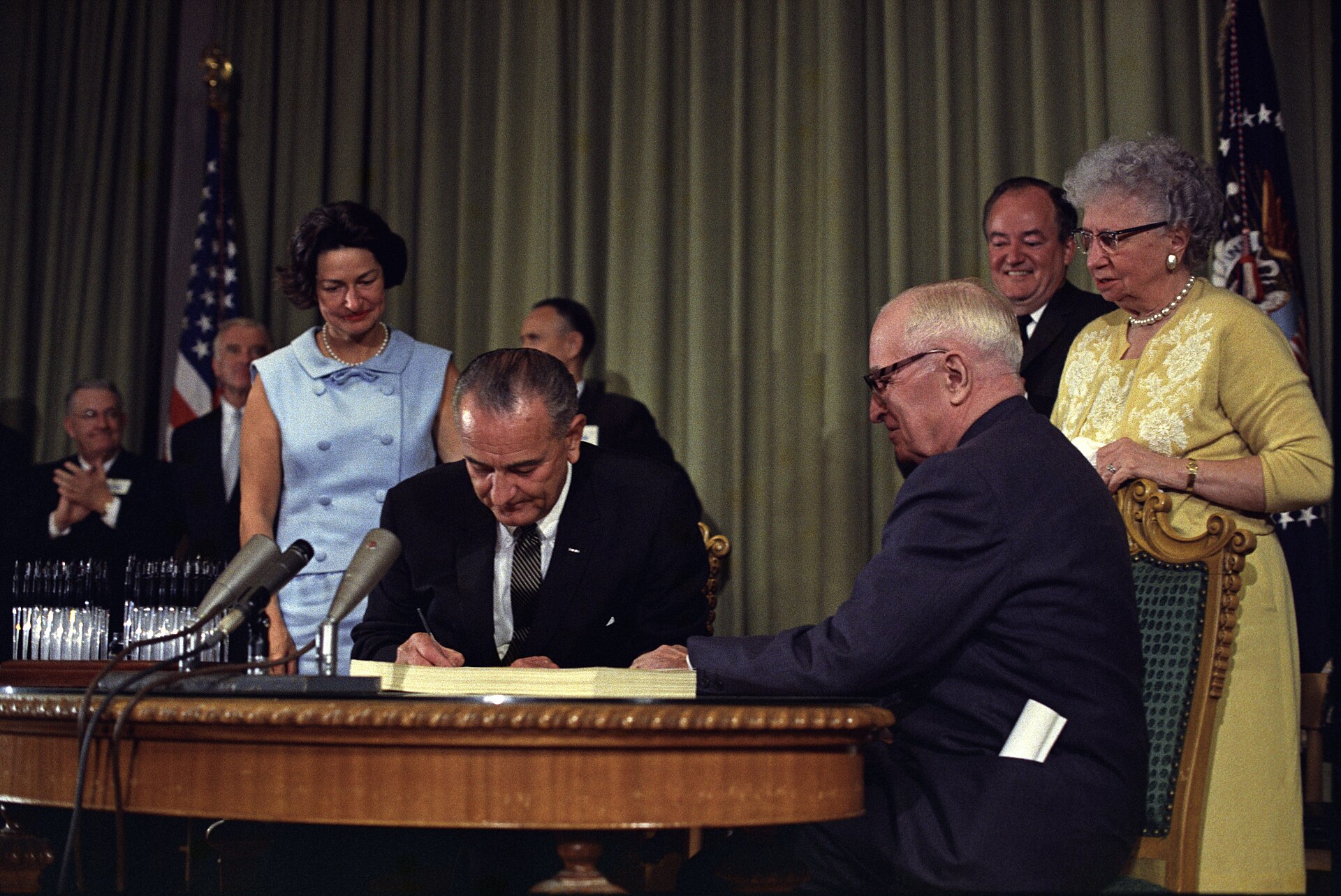
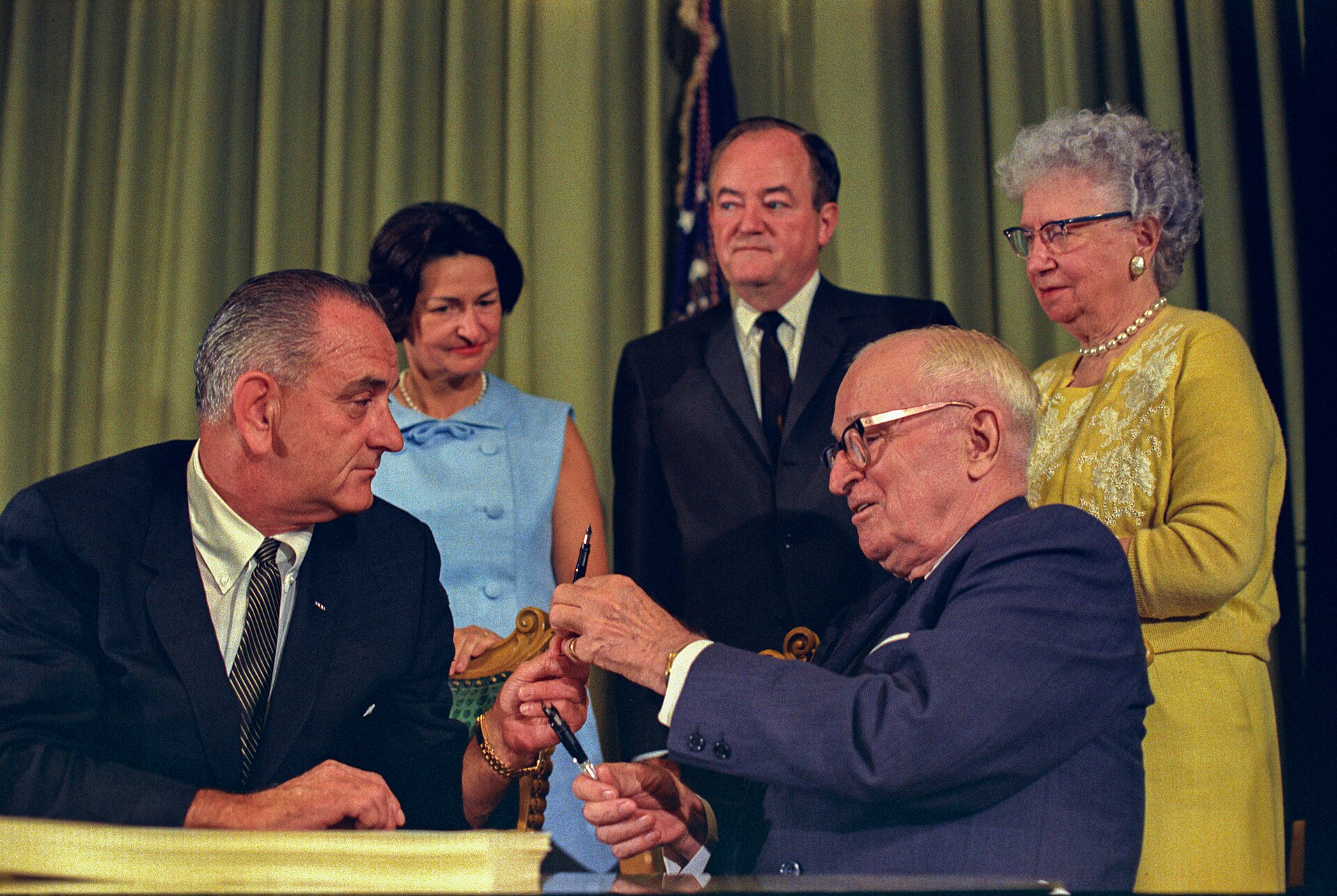
Johnson flew to Independence to sign the bill because of Truman. "But it all started really with the man from Independence," he said at the ceremony, and he quoted that line from the 1945 message. The best-known line of his remarks was a promise: "No longer will older Americans be denied the healing miracle of modern medicine." Johnson also told the crowd there were "more than 18 million Americans over the age of 65," and that skilled nursing home coverage of up to 100 days would begin in 1967.29 The Social Security Administration's history office records that Johnson presented Truman with the first Medicare card at the ceremony; the photograph caption names Lady Bird Johnson, Vice President Hubert Humphrey and Bess Truman among those present.2

How the 1965 votes went
The House passed H.R. 6675 on April 8, 1965, by 313 to 115, the Senate passed its version on July 9, 1965, by 68 to 21, and both chambers then approved the conference agreement: the House on July 27 and the Senate on July 28.30 The roll call records compiled by Voteview, a University of California, Los Angeles database of every recorded congressional vote, give the final tallies as 307 to 116 in the House and 70 to 24 in the Senate.86 The SSA history office's party breakdown of the final votes shows Democrats voting heavily in favor (237 to 48 in the House, 57 to 7 in the Senate) and Republicans split (70 to 68 in the House, 13 to 17 in the Senate).30
Before final passage in the House, Republicans offered their own approach. Rep. John W. Byrnes of Wisconsin moved to send the bill back to the Ways and Means Committee; the motion failed 191 to 236 on April 8, 1965.31 The vote on that motion is the clearest record of who preferred a different plan over the bill as written.
Idaho's delegation in 1965
Idaho had four members of Congress in 1965: Sen. Frank Church (Democrat), Sen. Len B. Jordan (Republican), Rep. Compton I. White Jr. (Democrat, 1st District) and Rep. George V. Hansen (Republican, 2nd District).57 Voteview's member-by-member files for the 89th Congress, which we downloaded and read, show:
| Vote (date) | Result | Church (D) | Jordan (R) | White (D) | Hansen (R) | Source |
|---|---|---|---|---|---|---|
| House: Byrnes motion to recommit (Apr. 8, 1965) | Failed 191 to 236 | n/a | n/a | Nay | Yea | Voteview H. roll call 3431 |
| House: passage of H.R. 6675 (Apr. 8, 1965) | Passed 313 to 115 | n/a | n/a | Yea | Nay | Voteview H. roll call 357 |
| Senate: passage (July 9, 1965) | Passed 68 to 21 | Yea | Nay | n/a | n/a | Voteview S. roll call 1515 |
| House: conference report (July 27, 1965) | Agreed 307 to 116 | n/a | n/a | Yea | Nay | Voteview H. roll call 978 |
| Senate: conference report (July 28, 1965) | Agreed 70 to 24 | Announced yea (did not cast a recorded vote) | Nay | n/a | n/a | Voteview S. roll call 1746 |
Church's position on the final Senate vote is recorded in Voteview as "announced yea," the code it uses when a senator who was absent had his support for the measure announced on the floor; it is not counted in the 70 to 24 tally.6 Church went on to chair the Senate Special Committee on Aging; a committee hearing record from April 27, 1971, lists "Frank Church, Idaho, Chairman."32 Jordan and Hansen's votes against the bill matched most Republicans in the Senate and about half of House Republicans.30 The Congressional Record for those days carries each member's floor statements, which is where a reader would look for their stated reasons; we did not find a published statement of reasons from Jordan or Hansen and do not guess at one.
July 1, 1966: the program starts
Coverage did not begin on the signing date. The Social Security Administration had less than a year to enroll people, sign up hospitals and set up claims. Its history office records that Johnson proclaimed March 1966 "National Medicare Enrollment Month," that the deadline to sign up for the voluntary medical insurance (Part B) for July coverage was March 31, 1966, and that Congress passed P.L. 89-384 on April 8, 1966, to give people who turned 65 between March 1 and June 30 until May 31 to enroll.3 Hospital insurance and the voluntary medical insurance both took effect July 1, 1966; the extended care (skilled nursing) benefit followed on Jan. 1, 1967. The hospital deductible was $40 until it rose to $44 on Jan. 1, 1969, and the Part B premium rose from $3 to $4 a month on April 1, 1968.3
CMS's national enrollment series, which counts people enrolled in hospital insurance, medical insurance or both as of July 1 each year, starts at 19,082,454 in 1966.4 CMS's milestones history rounds this to "more than 19 million individuals enrolled by July 1."27 For comparison, the 2027 amounts CMS announced on Nov. 17, 2026 are a $1,776 Part A hospital deductible and a $209.40 standard monthly Part B premium; those are not comparable dollar for dollar with 1966 amounts because of inflation, which lesson 07 adjusts for.3334
The 1970s: disability, kidney failure and a new agency
The Social Security Amendments of 1972 (P.L. 92-603)
President Richard Nixon signed the Social Security Amendments of 1972 on Oct. 30, 1972. The SSA history office describes the law as one that "made substantial changes in Medicare," along with creating the Supplemental Security Income program.35 The law's table of contents lists the Medicare changes that still shape who is covered:9
- Section 201, "Coverage for disability beneficiaries under Medicare." People under 65 who receive Social Security disability benefits became eligible for Medicare. Current law sets the wait at 24 months of entitlement to disability benefits before Medicare starts (Social Security Act section 226(b), 42 U.S.C. 426(b)).936
- Section 299I, "Chronic renal disease considered to constitute disability." People with end-stage renal disease (kidney failure needing dialysis or a transplant) became eligible regardless of age. The rules are now in Social Security Act section 226A (42 U.S.C. 426-1).936
- Section 202, hospital insurance for people not otherwise eligible. People 65 and over without enough Social Security work history could buy Part A by paying a premium; that premium still exists for people with fewer than 40 quarters of work (lesson 07).927
- Section 226, payments to health maintenance organizations. An early step toward private plans, years before Medicare Advantage.9
The effect on enrollment shows up in CMS's series the next year: the first disabled enrollees appear in 1973, when 1,730,538 of 23,301,082 enrollees (7.4 percent, our calculation) were under 65 and disabled.4 The same law has a small Idaho line item unrelated to Medicare: section 126 is titled "Policemen and firemen in Idaho" and dealt with Social Security coverage for those public employees.9
1977: a separate agency
For its first 11 years, Medicare was run by the Social Security Administration's Bureau of Health Insurance. On March 8, 1977, that bureau moved out of SSA and became part of the new Health Care Financing Administration (HCFA), which ran both Medicare and Medicaid.3527 HHS Secretary Tommy Thompson renamed HCFA the Centers for Medicare & Medicaid Services (CMS) in 2001.27 SSA still handles Medicare enrollment, the Part B premium deduction from Social Security checks and the income-related premium decision described in lesson 07.
The 1980s: paying hospitals differently, and a benefit Congress took back
TEFRA 1982: hospice and full-risk private plans
The Tax Equity and Fiscal Responsibility Act of 1982 (P.L. 97-248), signed Sept. 3, 1982, was mainly a tax and deficit law, but its Medicare sections had long reach.11 Section 114, "Payments to health maintenance organizations and competitive medical plans," let Medicare pay private plans a set amount per enrollee and let the plan keep or lose the difference, which CMS's history describes as contracting "on a full risk basis."1127 Section 122, "Hospice care," created the Medicare hospice benefit, which CMS lists as established in 1983: an option for terminally ill beneficiaries to receive care focused on relieving pain and managing symptoms, often at home.1127
1983: the prospective payment system and DRGs
Until 1983 Medicare paid hospitals what they reported it cost to treat Medicare patients. The Social Security Amendments of 1983 (P.L. 98-21), signed April 20, 1983, were passed mostly to keep Social Security's cash benefits solvent, and the law's long title adds "to reform the medicare reimbursement of hospitals." Title VI, "Prospective payments for Medicare inpatient hospital services," replaced cost-based payment with a fixed payment set in advance for each hospital stay according to the patient's diagnosis.1027 The diagnosis categories are called diagnosis-related groups, or DRGs. A hospital that treats a patient for less than the DRG payment keeps the difference; one that spends more absorbs the loss. The inpatient prospective payment system (IPPS) is still how Medicare pays most acute-care hospitals. Small rural hospitals that later became critical access hospitals are paid on cost instead (lesson 09, Medicare and Rural Idaho).
1988 and 1989: the Catastrophic Coverage Act and its repeal
The Medicare Catastrophic Coverage Act of 1988 (P.L. 100-360), signed July 1, 1988, was described in its own long title as an act "to provide protection against catastrophic medical expenses under the medicare program."37 CMS's milestones history calls it the most significant change since Medicare began: it improved hospital and skilled nursing benefits, covered mammography, added an outpatient prescription drug benefit and capped what patients paid. It also created the Qualified Medicare Beneficiary program, through which Medicaid pays Medicare premiums and cost sharing for low-income beneficiaries.27
Seventeen months later Congress undid most of it. The Medicare Catastrophic Coverage Repeal Act of 1989 (P.L. 101-234), signed Dec. 13, 1989, repealed the Medicare provisions of the 1988 law.38 CMS's history gives the reason in one sentence: the drug benefit and other enhancements were repealed "after higher-income seniors protested new premiums."27 The new benefits had been paid for largely by the beneficiaries themselves through a supplemental premium tied to income. The Medicaid pieces, including the Qualified Medicare Beneficiary program, survived.27 Medicare would not cover outpatient prescription drugs for most beneficiaries until 2006.
1989: the physician fee schedule
The Omnibus Budget Reconciliation Act of 1989 (P.L. 101-239), signed Dec. 19, 1989, replaced Medicare's charge-based payment for doctors with a national fee schedule based on the resources each service takes, the resource-based relative value scale (RBRVS).3927 Social Security Act section 1848 (42 U.S.C. 1395w-4), the section that law created, applies the fee schedule to physicians' services starting with 1992.40 The fee schedule is updated every year by a CMS rule, adjusted by a geographic index for each payment area, and is the source of nearly every Medicare payment fight between doctors and Congress since.
The 1990s: the Balanced Budget Act of 1997
The Balanced Budget Act of 1997 (P.L. 105-33), signed Aug. 5, 1997, was the largest Medicare law between 1965 and 2003. Its Medicare sections, all listed in the law's table of contents, include:12
- Section 4001, "Establishment of Medicare+Choice program." A new Part C of title XVIII let beneficiaries choose private plans (HMOs, PPOs, provider-sponsored organizations and private fee-for-service plans) in place of Original Medicare, enrolled through a coordinated open enrollment period. Part C still exists; the plans were renamed in 2003.
- Section 4201, "Medicare rural hospital flexibility program." This created the critical access hospital designation, under which small rural hospitals are paid based on their reasonable costs instead of DRG rates. Many Idaho hospitals use it (lesson 09).
- Sections 4432, 4523 and 4603: new prospective payment systems for skilled nursing facilities, hospital outpatient departments and home health agencies, extending the 1983 idea of set-in-advance payments beyond inpatient stays.
- Section 4503: the sustainable growth rate (SGR). A formula that tied doctors' fee updates to growth in the economy. Congress repealed it in 2015 (below).
CMS's milestones history adds that the act was designed to slow Medicare spending growth and extend the life of the hospital insurance trust fund by 10 years, and that it expanded preventive benefits such as screening mammography (section 4101).2712
Two public service pieces of the era still matter for Idaho beneficiaries: Medicare.gov launched in 1998, and the first annual Medicare & You handbook was mailed to every beneficiary household in 1999, the same year 1-800-MEDICARE became available nationwide.27
2003: the Medicare Prescription Drug, Improvement, and Modernization Act
What the 2003 law did
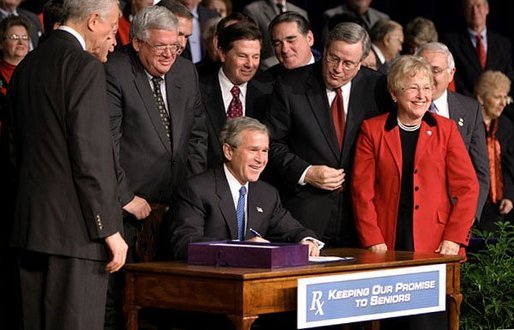
President George W. Bush signed H.R. 1, the Medicare Prescription Drug, Improvement, and Modernization Act of 2003 (the MMA, P.L. 108-173), on Dec. 8, 2003.13 CMS calls it the most significant change to Medicare since the program began.27 The main pieces:
- Section 101, "Medicare prescription drug benefit." A new, voluntary Part D, delivered only through private plans (stand-alone prescription drug plans or Medicare Advantage plans with drug coverage), effective in 2006. A temporary discount card program covered the gap before 2006, and beneficiaries with incomes below 150 percent of the federal poverty level became eligible for a low-income subsidy, now called Extra Help.1327
- Section 201 and title II: Medicare Advantage. Medicare+Choice was replaced by Medicare Advantage, with regional PPO plans (section 221) and special needs plans for people with particular conditions or who are also on Medicaid (section 231).13
- Section 811, "Income-related reduction in Part B premium subsidy." Beginning in 2007, higher-income beneficiaries pay more than the standard Part B premium. This is the income-related monthly adjustment amount (IRMAA) explained in lesson 07.1327
The original Part D design had a coverage gap, nicknamed the "donut hole": after a beneficiary and the plan together spent a set amount, the beneficiary paid the full cost of drugs until reaching a catastrophic threshold. Later laws in 2010, 2018 and 2022 closed the gap and then replaced the whole structure with a cap (below, and in lesson 06).
CMS records that Part D began in 2006 and that enrollment opened in 2005.27 By July 2026, 326,629 of Idaho's 417,781 Medicare enrollees had Part D coverage through a stand-alone plan or a Medicare Advantage plan, according to the Medicare Monthly Enrollment file.24

The 2003 votes and Idaho's delegation
The MMA passed by some of the narrowest margins of any major Medicare law. The House passed H.R. 1 on June 27, 2003, by 216 to 215, with 1 member voting present and 3 not voting (roll call 332).41 The House agreed to the conference report on Nov. 22, 2003, by 220 to 215 (roll call 669), and the Senate agreed to it on Nov. 25, 2003, by 54 to 44 (vote 459).1415 Idaho's four members, all Republicans, voted yes on every one of those votes:
| Vote | Date | Result | Idaho members | Source |
|---|---|---|---|---|
| House passage of H.R. 1 (roll call 332) | June 27, 2003 | 216 to 215 | Rep. C.L. "Butch" Otter: Aye; Rep. Mike Simpson: Aye | House Clerk41 |
| House agreeing to conference report (roll call 669) | Nov. 22, 2003 | 220 to 215 | Otter: Yea; Simpson: Yea | House Clerk14 |
| Senate agreeing to conference report (vote 459) | Nov. 25, 2003 | 54 to 44 | Sen. Larry Craig: Yea; Sen. Mike Crapo: Yea | U.S. Senate15 |
2010: the Affordable Care Act's Medicare changes
The Patient Protection and Affordable Care Act (ACA, P.L. 111-148), signed March 23, 2010, and the Health Care and Education Reconciliation Act of 2010 (P.L. 111-152), signed March 30, 2010, are known for the insurance marketplaces and the Medicaid expansion that Idaho voters later adopted (module 74). They also changed Medicare in ways that still apply:4243
- Closing the donut hole. ACA section 3301 created the Medicare coverage gap discount program, in which drug makers gave discounts on brand-name drugs in the gap, and HCERA section 1101, titled "Closing the medicare prescription drug 'donut hole'," sent a one-time $250 rebate to beneficiaries who reached the gap in 2010 and phased the gap down over the next decade.4243
- Preventive care without cost sharing. ACA section 4104, "Removal of barriers to preventive services in Medicare," eliminated the deductible and coinsurance for many preventive services. CMS reported that an estimated 37.2 million beneficiaries received at least one free preventive service in 2013.4227
- Medicare Advantage payment changes. ACA section 3201 and HCERA section 1102, "Medicare Advantage payments," changed how county payment benchmarks are set and tied bonus payments to plan quality (star) ratings, which lesson 04 explains.4243
- The Center for Medicare and Medicaid Innovation (CMMI). ACA section 3021 created the innovation center, which tests new payment models such as accountable care organizations and bundled payments.42
- The Additional Medicare Tax. ACA sections 9015 and 10906 added a 0.9 percent hospital insurance tax on wages and self-employment income above $200,000 for single filers and $250,000 for joint filers, starting with 2013.42
- An Independent Payment Advisory Board. Section 3403 (as renamed by section 10320) created a board to recommend Medicare savings if spending grew faster than set targets. Congress repealed it in 2018 (P.L. 115-123 section 52001).4244
No Idahoan in Congress voted for the ACA. The Senate passed H.R. 3590 on Dec. 24, 2009, by 60 to 39 (vote 396), with Sens. Mike Crapo and Jim Risch voting nay. The House agreed to the Senate version on March 21, 2010, by 219 to 212 (roll call 165); Idaho's representatives, Democrat Walt Minnick and Republican Mike Simpson, both voted no.4546
2015: MACRA ends the SGR
The Medicare Access and CHIP Reauthorization Act of 2015 (MACRA, P.L. 114-10), signed April 16, 2015, did three things that touch nearly every beneficiary and doctor:47
- Section 101 repealed the sustainable growth rate formula from 1997 and replaced it with fixed updates and a two-track system for doctors: the Merit-based Incentive Payment System (MIPS), which adjusts pay up or down based on quality and cost scores, and incentives for doctors in advanced alternative payment models (APMs).4727
- Section 401 limited Medigap Plans C and F (the plans that cover the Part B deductible) so they cannot be sold to people newly eligible for Medicare on or after Jan. 1, 2020 (lesson 05, Medigap in Idaho).47
- Section 501 prohibited printing Social Security numbers on Medicare cards. CMS began mailing new cards with a randomly assigned Medicare Beneficiary Identifier (MBI) in April 2018 and finished sending them to more than 61 million people about three months ahead of the April 2019 deadline, according to a CMS release of Jan. 16, 2019.4748 Lesson 11 covers card scams.
MACRA was one of the few large Medicare laws with lopsided bipartisan support. The House passed H.R. 2 on March 26, 2015, by 392 to 37; Rep. Mike Simpson voted yea and Rep. Raúl Labrador voted nay. The Senate passed it April 14, 2015, by 92 to 8, with Sens. Crapo and Risch voting yea.4950
2018: the Bipartisan Budget Act and the CHRONIC Care Act
The Bipartisan Budget Act of 2018 (P.L. 115-123), signed Feb. 9, 2018, was a spending deal that carried a long list of Medicare changes. Its title III is the CHRONIC Care Act ("Creating High-Quality Results and Outcomes Necessary to Improve Chronic Care"). Among its sections:44
- Sections 50321 and 50322 let Medicare Advantage plans offer benefits tailored to chronically ill enrollees, including supplemental benefits that are not primarily health related, such as meals or transportation. This is the legal basis for many of the extra benefits in MA plan advertising (lesson 04).
- Section 50325 expanded telehealth for people with stroke, and section 50323 increased the use of telehealth in Medicare Advantage.
- Section 50202 repealed the dollar caps on outpatient therapy.
- Section 53116, "Closing the donut hole for seniors," moved the end of the Part D coverage gap up to 2019.
- Section 53114 adjusted the income-related premium brackets for higher-income beneficiaries.
- Section 52001 repealed the Independent Payment Advisory Board.
The House agreed to the final version on Feb. 9, 2018, by 240 to 186 (roll call 69): Simpson voted aye and Labrador no. The Senate's 71 to 28 vote the same day (vote 31) had Crapo and Risch both voting nay.5152 Their votes were on the whole spending deal, not the Medicare sections alone.
2020 to 2026: COVID and the telehealth extensions
Before 2020, Original Medicare paid for telehealth only in narrow cases, mostly for patients in rural areas who went to a clinic or hospital to connect with a distant doctor; that is the rule CMS says returns in 2028 for most services.23 The first coronavirus spending law, P.L. 116-123, signed March 6, 2020, gave HHS authority to waive those limits during the public health emergency, and the CARES Act (P.L. 116-136), signed March 27, 2020, widened that authority.5354 Once the emergency ended, the flexibilities lived on only through short extensions written into spending laws, each of which amended the end date in Social Security Act section 1834(m):
| Law | Signed | Extended the telehealth flexibilities through | Source |
|---|---|---|---|
| Consolidated Appropriations Act, 2023 (P.L. 117-328) | Dec. 29, 2022 | Dec. 31, 2024 | 5556 |
| American Relief Act, 2025 (P.L. 118-158) | Dec. 21, 2024 | March 31, 2025 | 56 |
| Full-Year Continuing Appropriations and Extensions Act, 2025 (P.L. 119-4) | March 15, 2025 | Sept. 30, 2025 | 57 |
| (No extension in effect from Oct. 1, 2025, until the next law was signed) | n/a | Six-week gap during the fall 2025 funding lapse; P.L. 119-37 restored the flexibilities, and CMS says they apply retroactively | 5823 |
| Continuing Appropriations, Agriculture, Legislative Branch, Military Construction and Veterans Affairs, and Extensions Act, 2026 (P.L. 119-37) | Nov. 12, 2025 | Jan. 30, 2026 | 58 |
| Consolidated Appropriations Act, 2026 (P.L. 119-75), Division J, section 6209 | Feb. 3, 2026 | Dec. 31, 2027 | 22 |
CMS's telehealth questions and answers, updated in October 2026, state the current rule: "Through December 31, 2027, beneficiaries can receive Medicare telehealth services anywhere in the United States and territories." Starting Jan. 1, 2028, unless Congress acts again, beneficiaries will generally need to be "in a medical facility and in a rural area" for telehealth other than behavioral health, and for visits during the fall 2025 shutdown the FAQ says the flexibilities "will apply retroactively as if there hadn't been a temporary lapse in the application of the telehealth flexibilities."23 The same 2026 law extended the acute hospital care at home waiver to Sept. 30, 2030 (section 6210), the Medicare-dependent hospital program to Jan. 1, 2027 (section 6202) and the ambulance add-on payments to Jan. 1, 2028 (section 6203), and section 6224 set new rules for pharmacy benefit managers that work for Part D plans beginning with plan year 2028.22 For rural Idaho, where a clinic visit can mean an hour's drive, the telehealth end date is one of the most watched dates in Medicare (lesson 09).
2022: the Inflation Reduction Act
What the 2022 law did to Medicare
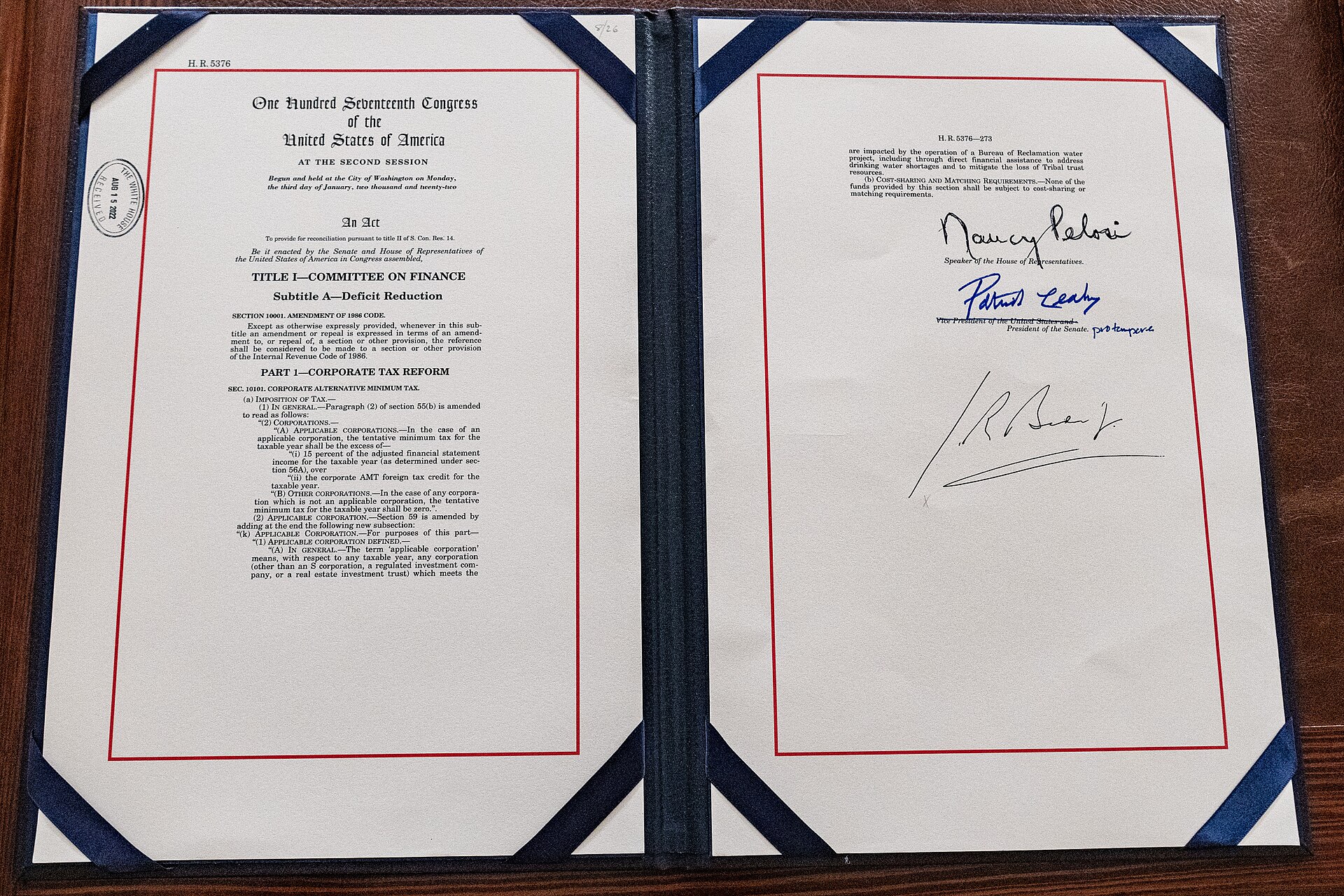
President Joe Biden signed H.R. 5376, the Inflation Reduction Act of 2022 (P.L. 117-169), on Aug. 16, 2022.16 Its Medicare drug sections, listed in its table of contents, are:16
- Section 11001: drug price negotiation. For the first time, Medicare negotiates prices with drug makers for a limited number of high-spending drugs that have been on the market for years without generic or biosimilar competition. The negotiated price is called the maximum fair price.
- Sections 11101 and 11102: inflation rebates. Drug makers that raise Part B or Part D drug prices faster than inflation pay rebates to Medicare.
- Section 11201: the Part D redesign. Beginning in 2024 beneficiaries no longer paid cost sharing in the catastrophic stage, and beginning in 2025 out-of-pocket spending on covered drugs was capped at $2,000 a year, indexed after that.
- Section 11202: the Medicare Prescription Payment Plan, which lets Part D enrollees spread their out-of-pocket drug costs in monthly payments across the year.
- Section 11401: no cost sharing for adult vaccines recommended by the Advisory Committee on Immunization Practices under Part D.
- Section 11404: full Extra Help (low-income subsidy) for people up to 150 percent of the poverty level.
- Sections 11406 and 11407: a $35 monthly limit on cost sharing for covered insulin products in Part D and Part B.
The cap has gone up with the index CMS applies each year. CMS's 2027 Rate Announcement, released April 6, 2026, lists the Part D standard deductible and out-of-pocket threshold as $615 and $2,100 for 2026 and $700 and $2,400 for 2027.17
Negotiation so far
The first cycle covered 10 Part D drugs. CMS announced the negotiated prices on Aug. 15, 2024, and estimated that if they had been in effect in 2023 they would have saved about $6 billion in net covered drug costs, about 22 percent; those prices took effect Jan. 1, 2026.18 The second cycle covered 15 more Part D drugs; on Nov. 25, 2025, CMS announced negotiated prices effective Jan. 1, 2027, and estimated net savings of 44 percent, or $12 billion, compared with the previous year's spending on those drugs.59 On Jan. 27, 2026, CMS selected 15 drugs for the third cycle, "for the first time" including drugs paid under Part B, plus one earlier drug (Tradjenta) for renegotiation, with prices to take effect Jan. 1, 2028.60 Lesson 06 lists the drugs, their uses and their prices.
The 2022 votes
The Inflation Reduction Act passed both chambers with no Republican votes. The Senate passed it on Aug. 7, 2022, on a 50 to 50 tie broken by the Vice President's yea vote (vote 325); Crapo and Risch voted nay. The House agreed on Aug. 12, 2022, by 220 to 207 (roll call 420); Reps. Russ Fulcher and Mike Simpson voted nay.1920 Lesson 06 follows what has happened to the negotiation program since.

2025: the reconciliation law (P.L. 119-21)
H.R. 1, the 2025 budget reconciliation law that its sponsors called the One Big Beautiful Bill Act, became P.L. 119-21 on July 4, 2025.21 Most of its health provisions concern Medicaid and the ACA marketplaces (module 74 covers the Medicaid work requirements in The 2027 Work Requirements). Its Medicare chapter has three sections:21
- Section 71201, "Limiting Medicare coverage of certain individuals." It adds a new Social Security Act section 1899C (42 U.S.C. 1395mmm). A person may be entitled to or enrolled in Medicare only if the person is a U.S. citizen or national, a lawful permanent resident, a Cuban or Haitian entrant as defined in a 1980 law, or a person lawfully living in the U.S. under a Compact of Free Association. For people already enrolled on July 4, 2025, the limit applies 18 months after enactment. The Commissioner of Social Security must review current enrollees within one year to identify anyone who does not meet the new rule and notify them that their Medicare will end.21 Lawful permanent residents (green card holders) who otherwise qualify remain eligible. By the section's terms, lawfully present noncitizens in other categories (for example, refugees or asylees who have not become permanent residents) are not on the list, even if they have the work history that would otherwise qualify them. How many Idahoans are affected has not been published; we found no SSA or CMS count by state.
- Section 71202: a one-year physician pay increase. It adds 2.5 percent to Medicare physician fee schedule payments for services furnished on or after Jan. 1, 2026, and before Jan. 1, 2027. Because it is temporary, the increase drops out in 2027 unless Congress extends it.21
- Section 71203: the orphan drug exclusion. The 2022 negotiation law exempted drugs approved to treat only one rare disease. The 2025 law widens the exemption to drugs approved for one or more rare diseases and changes how the clock runs for drugs that later gain other uses, applying to negotiation years beginning on or after Jan. 1, 2028.21
The law also changed Medicare's revenue indirectly. The 2026 Trustees Report states that the law "reduced income tax rates and increased income tax deductions," and that as a result the hospital insurance trust fund's projected income from taxes on Social Security benefits is lower than in the previous report.61 Lesson 10 explains that revenue source.
The vote again followed party lines. The Senate passed H.R. 1 on July 1, 2025, on a 50 to 50 tie broken by the Vice President's yea vote (vote 372), with Crapo and Risch voting yea. The House agreed to the Senate version July 3, 2025, by 218 to 214 (roll call 190), with Fulcher and Simpson voting aye.6263
2026: what changed this year
Five Medicare events of 2026 belong in the history:
- Jan. 1, 2026: the first negotiated drug prices took effect for the 10 drugs in the first cycle, along with the $2,100 Part D out-of-pocket cap and the temporary 2.5 percent physician pay increase.181721
- Jan. 27, 2026: CMS picked the third round of drugs, the first to include Part B drugs given in doctors' offices and hospital outpatient departments.60
- Feb. 3, 2026: P.L. 119-75 extended telehealth through 2027 and renewed a set of rural and hospital payment programs (above).22
- April 6, 2026: CMS finalized 2027 Medicare Advantage payment rates, projected to raise payments to MA plans by 2.48 percent, or more than $13 billion, in 2027.64
- June 9, 2026: the Medicare Trustees transmitted their 2026 report (the date on the transmittal letter), projecting that the hospital insurance trust fund's reserves will be depleted in the second quarter of 2033, one quarter earlier than in the 2025 report, and that income would then cover 89 percent of costs.6561
On Nov. 17, 2026, CMS also announced the 2027 amounts: the standard Part B premium rises from $202.90 to $209.40 a month and the Part B deductible from $283 to $292; the Part A inpatient deductible rises from $1,736 to $1,776.3433 The 2027 plan year in Idaho, with its plan exits and network changes, is lesson 08, The 2027 Plan Year in Idaho.
The laws in one table
Every law in this table is cited from its enrolled text at the Government Publishing Office (govinfo.gov) or the Statutes at Large; the "What it changed" column names the sections discussed above.
| Year | Law (public law number, signed) | What it changed for Medicare | Source |
|---|---|---|---|
| 1965 | Social Security Amendments of 1965 (P.L. 89-97, July 30, 1965) | Created Medicare (title XVIII, Parts A and B) and Medicaid (title XIX) | 1 |
| 1972 | Social Security Amendments of 1972 (P.L. 92-603, Oct. 30, 1972) | Disability beneficiaries and end-stage renal disease covered; Part A buy-in for the uninsured; HMO payments | 9 |
| 1982 | Tax Equity and Fiscal Responsibility Act (P.L. 97-248, Sept. 3, 1982) | Full-risk HMO contracts; hospice benefit | 11 |
| 1983 | Social Security Amendments of 1983 (P.L. 98-21, April 20, 1983) | Inpatient prospective payment system using DRGs | 10 |
| 1988 | Medicare Catastrophic Coverage Act (P.L. 100-360, July 1, 1988) | Catastrophic cap, outpatient drug benefit, Qualified Medicare Beneficiary program | 37 |
| 1989 | Medicare Catastrophic Coverage Repeal Act (P.L. 101-234, Dec. 13, 1989) | Repealed the 1988 law's Medicare provisions | 38 |
| 1989 | Omnibus Budget Reconciliation Act of 1989 (P.L. 101-239, Dec. 19, 1989) | Physician fee schedule (RBRVS), starting with 1992 | 3940 |
| 1997 | Balanced Budget Act of 1997 (P.L. 105-33, Aug. 5, 1997) | Medicare+Choice (Part C), critical access hospitals, new prospective payment systems, SGR | 12 |
| 2003 | Medicare Prescription Drug, Improvement, and Modernization Act (P.L. 108-173, Dec. 8, 2003) | Part D (2006), Medicare Advantage, special needs plans, Part B IRMAA (2007) | 13 |
| 2010 | Affordable Care Act (P.L. 111-148, March 23, 2010) and HCERA (P.L. 111-152, March 30, 2010) | Donut hole phase-out, free preventive services, MA payment changes, CMMI, 0.9 percent Additional Medicare Tax | 4243 |
| 2015 | MACRA (P.L. 114-10, April 16, 2015) | SGR repealed; MIPS and APMs; Medigap C and F closed to new enrollees from 2020; SSNs off cards | 47 |
| 2018 | Bipartisan Budget Act of 2018 (P.L. 115-123, Feb. 9, 2018) | CHRONIC Care Act; MA supplemental benefits; donut hole closed in 2019; therapy caps repealed; IPAB repealed | 44 |
| 2020 | P.L. 116-123 (March 6, 2020) and CARES Act (P.L. 116-136, March 27, 2020) | Emergency telehealth waivers | 5354 |
| 2022 | Inflation Reduction Act (P.L. 117-169, Aug. 16, 2022) | Drug price negotiation, inflation rebates, Part D cap, $35 insulin, free vaccines, Extra Help expansion | 16 |
| 2025 | P.L. 119-21 (July 4, 2025) | Eligibility limited by immigration status; 2.5 percent physician increase for 2026; orphan drug exclusion widened | 21 |
| 2026 | Consolidated Appropriations Act, 2026 (P.L. 119-75, Feb. 3, 2026) | Telehealth through Dec. 31, 2027; hospital at home through Sept. 30, 2030; rural and ambulance extensions; Part D PBM rules from 2028 | 22 |
How enrollment grew, 1966 to 2026
The national count
Two CMS sources cover the whole 60 years. For 1966 to 2013, CMS published a national trends table of people enrolled in hospital insurance, medical insurance or both, counted as of July 1 each year, split between aged and disabled enrollees.4 For 2013 onward, the Medicare Monthly Enrollment file on data.cms.gov gives counts for every month, state and county; the newest release when this lesson was checked runs through July 2026.24 The two series overlap in 2013 and differ by about 0.4 percent that year (52,255,162 in the trends table, 52,466,118 in the monthly file for July), so the chart below marks where one source ends and the other begins.
Three things stand out in the numbers:
- Enrollment more than tripled. From 19,082,454 in July 1966 to 70,736,624 in July 2026, an increase of about 271 percent (our calculation). Growth sped up after 2010: national enrollment rose by 23.4 million in the 16 years from July 2010 (47,386,066) to July 2026, close to the 28.3 million it added in the 44 years from 1966 to 2010 (our calculation from the two CMS files).424
- The disabled share rose, then fell. Disabled enrollees under 65 were 7.4 percent of the total in 1973, their first year, and 16.6 percent in July 2013 (8,693,392 people). By July 2026 the count had dropped to 6,693,714, or 9.5 percent of enrollees, while the number 65 and over kept growing (our calculations; the files do not give reasons for the change).424
- Private plans took over half the program. In July 2013, 28.3 percent of national enrollees were in Medicare Advantage and other private health plans; in July 2026 it was 51.1 percent (our calculation from the monthly file, which counts Medicare Advantage together with cost plans, PACE and other private arrangements in one "MA and other" column).24
Idaho and its neighbors
The monthly file starts in 2013, so it is the longest consistent series for Idaho. Idaho's Medicare enrollment grew 60.4 percent between July 2013 and July 2026, from 260,443 to 417,781, the fastest growth among Idaho and its six neighbors and well above the national 34.8 percent. Lesson 03, Idaho's Medicare Population, breaks the Idaho count down by county.
| State | Enrollees, July 2013 | Enrollees, July 2026 | Growth, 2013 to 2026 | MA and other share, July 2013 | MA and other share, July 2026 |
|---|---|---|---|---|---|
| Idaho | 260,443 | 417,781 | 60.4% | 30.3% | 45.9% |
| Utah | 320,586 | 491,386 | 53.3% | 33.1% | 55.0% |
| Nevada | 413,814 | 630,832 | 52.4% | 31.3% | 52.0% |
| Wyoming | 88,919 | 133,449 | 50.1% | 3.6% | 15.4% |
| Montana | 188,473 | 273,047 | 44.9% | 15.7% | 29.8% |
| Washington | 1,102,600 | 1,586,306 | 43.9% | 28.7% | 49.7% |
| Oregon | 700,070 | 973,880 | 39.1% | 42.0% | 53.8% |
| United States | 52,466,118 | 70,736,624 | 34.8% | 28.3% | 51.1% |
Source: CMS Medicare Monthly Enrollment, July rows for each year, July 2026 release; growth and shares are our calculations.24
Idaho's private plan share climbed from 31.3 percent in July 2017 to 49.9 percent in July 2025 (203,381 of 407,530 enrollees), then fell to 45.9 percent in July 2026 (191,725 of 417,781), while the number in Original Medicare rose from 204,149 to 226,056.24 July 2026 is the first July in the series (2013 to 2026) in which the number of Idahoans in MA and other private plans went down. Lessons 04 and 08 cover the plan changes for 2026 and 2027 that lie behind it.
How we figured it: enrollment growth and shares
National enrollment for 1966 to 2010 comes from the CMS table "Medicare Enrollment, National Trends 1966-2013" (hospital and/or supplementary medical insurance, all areas, as of July 1).4 National and state enrollment for 2015 to 2026 comes from the CMS Medicare Monthly Enrollment file (July rows, columns TOT_BENES, MA_AND_OTH_BENES, ORGNL_MDCR_BENES, AGED_TOT_BENES and DSBLD_TOT_BENES), which we pulled from the data.cms.gov application programming interface on Nov. 21 and 22, 2026, and saved in the downloads folder for this lesson.24
- Growth = (later count divided by earlier count) minus 1. Example: Idaho, 417,781 divided by 260,443 = 1.604, so 60.4 percent.
- National growth 1966 to 2026: 70,736,624 divided by 19,082,454 = 3.707, or a 270.7 percent increase. These come from two different CMS files that count slightly differently (see the 2013 overlap above), so treat the figure as approximate.
- Private plan share = MA_AND_OTH_BENES divided by TOT_BENES for the same July. The "MA and other" column includes Medicare Advantage, cost plans, PACE and demonstration plans; it is not the same as the Medicare Advantage penetration figures in the CMS State/County Penetration files (lesson 04).
- Disabled share = disabled enrollees divided by all enrollees. The 1973 figure (1,730,538 of 23,301,082) is from the trends table; the 2013 and 2026 figures (DSBLD_TOT_BENES) are from the monthly file.
The monthly file is revised as late enrollment records arrive, so a later download may differ slightly. Older state-level Idaho counts (before 2013) are not in the monthly file; lesson 03 uses other CMS sources for those years.
How spending grew
The National Health Expenditure (NHE) accounts, kept by the CMS Office of the Actuary, measure Medicare spending each year in current dollars. NHE Table 3 shows Medicare at $7.7 billion in 1970, $37.4 billion in 1980, $110.2 billion in 1990, $224.8 billion in 2000, $519.5 billion in 2010, $833.8 billion in 2020 and $1,118.0 billion in 2024.25 CMS's NHE fact sheet reports that Medicare spending grew 7.8 percent in 2024 and made up 21 percent of national health expenditures, and that the actuaries project Medicare to grow faster than any other major payer from 2025 to 2034, at an average of 7.7 percent a year.26
How we figured it: Medicare's share of national health spending
Share = Medicare spending divided by total national health expenditures for the same year, both from NHE Table 3 (amounts in billions of current dollars).25 1970: 7.7 divided by 74.1 = 10.4 percent. 1980: 37.4 / 253.2 = 14.8 percent. 1990: 110.2 / 718.7 = 15.3 percent. 2000: 224.8 / 1,365.2 = 16.5 percent. 2010: 519.5 / 2,588.7 = 20.1 percent. 2020: 833.8 / 4,204.3 = 19.8 percent. 2024: 1,118.0 / 5,278.6 = 21.2 percent. The dollar amounts are not adjusted for inflation; comparing 1970 and 2024 dollars directly overstates real growth. Table 3 notes that Medicare and Medicaid became effective in July 1966; its selected years jump from 1960 to 1970, so the chart starts at 1970.
Spending per person and as a share of the economy are lesson 10's subject. The 2026 Trustees Report projects total Medicare costs rising from 4.1 percent of gross domestic product in 2026 to 6.5 percent in 2050, and counts 69.3 million people enrolled in Medicare in 2025.61
Pictures, Numbers and Infographics
The table gathers the lesson's key numbers, dates and rules. Each row names its source; Idaho figures are given where a published Idaho number exists.
| Measure | Idaho | U.S. or other states | Year or date | Source |
|---|---|---|---|---|
| Medicare signed into law (P.L. 89-97) | Church and White for; Jordan and Hansen against on final passage | House 307 to 116; Senate 70 to 24 (final votes) | July 30, 1965 | 186 |
| Coverage begins | n/a | 19,082,454 enrolled as of July 1 | July 1, 1966 | 43 |
| Part B premium, first year | Same nationwide | $3 a month | 1966 | 3 |
| Part B standard premium | Same nationwide | $202.90 (2026); $209.40 (2027) | 2026, 2027 | 34 |
| Part A inpatient deductible | Same nationwide | $40 (1966); $1,736 (2026); $1,776 (2027) | 1966, 2026, 2027 | 333 |
| Disability and ESRD coverage added (P.L. 92-603) | n/a | 1,730,538 disabled enrollees in 1973 | Oct. 30, 1972 | 94 |
| MMA final House vote | Otter, Simpson: yea | 220 to 215 | Nov. 22, 2003 | 14 |
| MMA final Senate vote | Craig, Crapo: yea | 54 to 44 | Nov. 25, 2003 | 15 |
| Part D out-of-pocket cap | Same nationwide | $2,000 (2025); $2,100 (2026); $2,400 (2027) | 2025 to 2027 | 1617 |
| Medicare enrollment | 260,443 (2013); 417,781 (2026) | U.S. 52,466,118 (2013); 70,736,624 (2026) | July of each year | 24 |
| Enrollment growth, 2013 to 2026 | 60.4% | U.S. 34.8%; Utah 53.3%; Nevada 52.4%; Wyoming 50.1%; Montana 44.9%; Washington 43.9%; Oregon 39.1% | July 2013 to July 2026 | 24 |
| MA and other private plan share | 49.9% (2025); 45.9% (2026) | U.S. 51.1% (2026) | July 2025, July 2026 | 24 |
| Medicare spending | Not in NHE Table 3 by state | $1,118.0 billion, 21% of national health spending | 2024 | 2526 |
| Hospital insurance trust fund depletion (projected) | Same nationwide | Second quarter of 2033; 89% of costs payable then | 2026 Trustees Report | 61 |
| Telehealth flexibilities end (unless extended) | Same nationwide | Dec. 31, 2027 | P.L. 119-75, Feb. 3, 2026 | 2223 |
Common mistakes
- Dating Medicare's coverage to 1965. The law was signed July 30, 1965, but hospital and medical coverage started July 1, 1966, and the skilled nursing benefit Jan. 1, 1967, according to the SSA history office and Johnson's own remarks.329
- Treating Medicare and Medicaid as one program because they share a birthday. P.L. 89-97 created both, but as separate titles of the Social Security Act: Medicare (title XVIII) is federal and based mostly on age, disability and work history; Medicaid (title XIX) is a federal-state program based on income.127 See What Medicaid Is and Is Not.
- Saying Medicare never covered drugs before 2006. The 1988 Catastrophic Coverage Act added an outpatient drug benefit, which Congress repealed in 1989 before it took full effect; Part D, created in 2003, began in 2006.373827
- Talking about the "donut hole" as if it still exists. The ACA and the 2018 budget law closed the gap by 2019 for brand-name drugs, and the 2022 law replaced the whole structure with an annual out-of-pocket cap starting in 2025 ($2,100 in 2026; $2,400 in 2027).43441617
- Assuming the pandemic telehealth rules are permanent. Except for behavioral health, they run only through Dec. 31, 2027, under P.L. 119-75, and they lapsed for six weeks in fall 2025 until P.L. 119-37 restored them, with CMS applying them retroactively to the gap.2223
- Reading the 2025 law as ending Medicare for all immigrants. Section 71201 keeps eligibility for citizens, nationals, lawful permanent residents, Cuban and Haitian entrants and Compact of Free Association residents who otherwise qualify; it gives current enrollees outside those groups 18 months before the limit applies.21
- Splicing data series without saying so. The CMS 1966 to 2013 trends table and the monthly enrollment file count differently (52,255,162 vs. 52,466,118 for 2013). Comparing a number from one with a number from the other, or comparing nominal dollars across decades, is a common way to overstate or understate change. Our methods boxes show both series.42425
- Assuming Idaho's delegation always votes as a bloc. In 1965 the delegation split two to two; in 2015 Simpson voted for MACRA and Labrador against; in 2018 Simpson voted for the budget deal and Labrador against.754951
What we know, what we don't, and what the data can show
What we know
- The dates, public law numbers and section headings of every major Medicare law from 1965 through Feb. 3, 2026, from the enrolled texts at govinfo.gov and the Statutes at Large.122
- How Idaho's members of Congress voted on the 1965 law (Voteview roll call files), the 2003 law (House Clerk and Senate records) and the 2010, 2015, 2018, 2022 and 2025 laws (House Clerk and Senate records).5141545466263
- National enrollment every year since 1966 and Idaho enrollment every month since January 2013, from CMS.424
- Medicare spending every year since 1966 in current dollars, from the National Health Expenditure accounts.25
What we don't know
- How many Idaho Medicare enrollees will lose coverage under the 2025 law's immigration-status limit; SSA's review results by state have not been published.21
- Whether Congress will extend the telehealth rules past Dec. 31, 2027, or the 2.5 percent physician increase past 2026.2221
- Why Idaho's 1965 Republicans voted no in their own words: we did not find statements from Sen. Jordan or Rep. Hansen in the sources read for this lesson, and the Congressional Record for April 8 and July 9, 1965 would be the place to look.
- Idaho's Medicare enrollment before 2013 in a consistent series; the monthly file starts in 2013 (lesson 03 uses older CMS state tables).24
What the data can show
- CMS Medicare Monthly Enrollment (data.cms.gov): Idaho and county enrollment by month since 2013, split by Original Medicare and MA, aged and disabled, Part D and dual eligibility; it can show how each law's effective date lined up with changes in enrollment, such as the 2026 drop in Idaho's private plan share.24
- CMS National Health Expenditure tables: national Medicare spending by year since 1966 and by type of service; the separate NHE state tables give Medicare spending by state of residence for selected years.2526
- Voteview and the House and Senate roll call archives: every recorded vote by every Idaho member on any Medicare bill.514
- The Medicare Trustees Reports, 1966 to 2026: how projections of the trust funds changed after each law (lesson 10).61
Questions people ask
Who was the first Medicare beneficiary?
Former President Harry S. Truman. The SSA history office records that Johnson presented him with the first Medicare card at the signing ceremony in Independence on July 30, 1965; Bess Truman was also present.2 Coverage for everyone, including Truman, began July 1, 1966.3
Why was Medicare tied to Social Security?
Because the proposal that finally passed built on the existing Social Security system: the same payroll tax, the same records of work history and the same agency. CMS traces the idea to 1937, Truman proposed financing health insurance through "our existing compulsory social insurance system" in 1945, and the 1965 law made Medicare title XVIII of the Social Security Act.27281
When did people under 65 get Medicare?
The Social Security Amendments of 1972, signed Oct. 30, 1972, added people on Social Security disability (after a waiting period, now 24 months) and people with end-stage renal disease. The first disabled enrollees appear in CMS's counts in 1973.9364 Lesson 01 covers the current eligibility rules.
When did private plans start in Medicare?
In steps: the 1972 law allowed payments to HMOs, TEFRA in 1982 allowed full-risk contracts, the Balanced Budget Act of 1997 created Medicare+Choice as Part C, and the 2003 MMA renamed it Medicare Advantage.9111213 By July 2026, 51.1 percent of U.S. enrollees and 45.9 percent of Idaho enrollees were in MA and other private plans.24
Did Idaho's senators vote for the drug benefit?
Yes. Sens. Larry Craig and Mike Crapo voted for the 2003 conference report that created Part D, and Reps. Butch Otter and Mike Simpson voted for it in the House.1514 All four of Idaho's 2022 members voted against the Inflation Reduction Act, which redesigned Part D.1920
What did Congress change about Medicare in 2026?
The main 2026 law is the Consolidated Appropriations Act, 2026 (P.L. 119-75), signed Feb. 3, 2026. Its Division J extended telehealth through Dec. 31, 2027, hospital at home through Sept. 30, 2030, the Medicare-dependent hospital program to Jan. 1, 2027, and ambulance add-ons to Jan. 1, 2028, and set new Part D pharmacy benefit manager rules starting in 2028.22
Hard questions
Has the growth of private plans been good for Medicare?
The case for: Congress built private options into Medicare in 1982, 1997 and 2003 on the theory that plans managing care and competing for members could offer extra benefits and out-of-pocket limits that Original Medicare does not, and enrollment shows many beneficiaries choosing them: 51.1 percent nationally in July 2026.11121324 The case against: private plans bring networks, prior authorization and a payment system that Congress and CMS keep adjusting: the 2010 law rewrote MA benchmarks and tied bonuses to star ratings, and CMS sets plan payment rates again every year (a 2.48 percent increase for 2027).4364 What the evidence shows: the history shows Congress expanding private plans and then adjusting how they are paid; it does not by itself settle whether MA costs more or less than Original Medicare. Lesson 04 reports MedPAC's payment estimates, the industry's response and the OIG's findings on denials.
Is Medicare drug price negotiation worth what it may cost in new drugs?
The case for: CMS estimates the first round would have cut net spending on 10 drugs by about 22 percent, or $6 billion, and the second round by 44 percent, or $12 billion, savings that lower Medicare's spending on those drugs.1859 The case against: drug makers argue that lower prices on established drugs reduce the returns that pay for research, and Congress itself narrowed the program in 2025 by widening the exclusion for drugs that treat rare diseases.21 What the evidence shows: the savings figures are CMS's own estimates against prior spending; long-run effects on research and new drugs cannot be measured yet because the first prices only took effect in 2026.18
Should the pandemic telehealth rules be made permanent?
The case for: for rural patients, including those in Camas, Lincoln or Idaho County, a video visit can replace a long drive, and Congress extended the rules five times between December 2022 and February 2026, with a six-week gap in fall 2025 that CMS later covered retroactively.5556575822 The case against: each extension adds federal spending, and Congress has kept some guardrails, such as the in-person visit requirement for mental health telehealth that the CMS FAQ says will apply after Dec. 31, 2027.23 What the evidence shows: the record shows a pattern of short extensions instead of a permanent decision; the geographic limits are already gone for behavioral health but will return for most other services on Jan. 1, 2028, unless Congress acts.23
Did the 1965 critics' fears about cost come true?
The case for "yes": Medicare spending rose from $7.7 billion in 1970 to $1,118.0 billion in 2024, and from 10.4 to 21.2 percent of national health spending; the 2026 Trustees Report projects the hospital insurance fund's reserves running out in 2033.2561 The case for "no": enrollment more than tripled, people live longer on Medicare, and medical care itself changed; spending growth also reflects decisions Congress made later, such as adding the disabled, ESRD and Part D, not the 1965 design alone.4913 What the evidence shows: nominal dollar growth overstates real growth; the fair measures are spending per enrollee adjusted for inflation and spending as a share of the economy, which lesson 10 covers.
For reporters and advocates
- Read the law, not the summary. Every public law since 1995 is on govinfo.gov in full text with section headings; older laws are in the Statutes at Large there. The Social Security Act as amended is on ssa.gov. For each Medicare change, cite the section and the effective date, not just the year of passage.122
- Find the votes. House roll calls are at clerk.house.gov (each with an XML file listing every member), Senate votes at senate.gov, and votes before 1990 in Voteview's downloadable files. Idaho angle: compare how each member voted on Medicare laws with what the member says now.14155
- Check enrollment yourself. The CMS Medicare Monthly Enrollment file can be filtered to Idaho or any county; check the month and note that "MA and other" includes plans that are not Medicare Advantage.24
- Questions for officials: How many Idaho enrollees has SSA notified under P.L. 119-21 section 71201? How many Idaho Medicare telehealth visits would be affected if the flexibilities end Dec. 31, 2027? How did Idaho hospitals' Medicare payments change under the 2026 physician increase and the rural extensions in P.L. 119-75?2122
- Records requests. State records (for example from the Idaho Department of Insurance or SHIBA about Medicare counseling) can be requested under Idaho Code Title 74, chapter 1; see Idaho Public Records Requests. Federal records (CMS, SSA) go through the Freedom of Information Act, 5 U.S.C. 552.
- History sources: the Truman Library holds the 1945 message; the LBJ Library holds the signing remarks and photographs; the SSA history office and CMS's milestones history give dates.282927 Working with the numbers in these files is covered in Data and Statistics.
Where to go next
- Medicare.gov: The official federal Medicare site from CMS, free. It has the current Medicare & You handbook, the Plan Finder and plain-language pages on what each part covers today; use it to check any current rule or amount mentioned in this lesson.
- CMS history pages: Free CMS pages with the agency's own history of Medicare and Medicaid, the milestones timeline used in this lesson and downloadable history documents. Useful for dates and official descriptions of each law.
- Social Security Administration history: Medicare: Free pages from SSA's historian on the 1965 signing, with photos, vote tallies and year-by-year chronologies. Good for students and reporters checking early dates.
- govinfo.gov public and private laws: The U.S. Government Publishing Office's free collection of every public law since 1995 in full text, plus the Statutes at Large for older laws. Search by Congress and law number (for example 117-169) to read the sections cited here.
- Voteview: A free University of California, Los Angeles database of every recorded vote in Congress since 1789, with downloadable member-by-member files. Use it to find how Idaho members voted on older bills not on the House and Senate websites.
- LBJ Presidential Library: The National Archives library for President Johnson, free to search online. It holds the text of the Medicare signing remarks and related documents and photographs.
- Harry S. Truman Presidential Library and Museum: The National Archives library in Independence, Missouri, where Medicare was signed; free online public papers include Truman's 1945 health message.
Still being checked (5 items)
These points could not be fully confirmed against a primary source when this lesson was written and fact checked in November 2026. The text above states each one as uncertain.
- Why Sen. Len Jordan and Rep. George Hansen voted against the 1965 law: we did not find a statement of reasons from either in the sources read for this lesson; the Congressional Record for April 8 and July 9, 1965 was not read directly.
- Idaho delegation votes for 1965 come from Voteview's member files, which are compiled from the Congressional Record; we did not check the printed Congressional Record pages ourselves. Sen. Church's position on the July 28, 1965 vote is Voteview's code for an announced yea.
- The dates of the fall 2025 telehealth gap (Oct. 1 to Nov. 12, 2025) are computed from the end date in P.L. 119-4 and the signing date of P.L. 119-37; the CMS Telehealth FAQ (answer 16) confirms the flexibilities apply retroactively to that gap. P.L. 119-75 also left three days (Jan. 31 to Feb. 2, 2026) between the P.L. 119-37 end date and its signing; it extended the same continuous period to Dec. 31, 2027, but we did not find a CMS statement on claims from those days.
- How many Idaho Medicare enrollees are affected by the immigration-status limit in P.L. 119-21 section 71201: no SSA or CMS count by state had been published as of Nov. 22, 2026.
- The exact effective date of the Medicare hospice benefit created by TEFRA section 122: CMS's milestones history lists it under 1983; we did not confirm the day.
Last verified November 22, 2026. General education, not legal, medical, insurance or financial advice; every figure names its source and year in the Notes and Sources below. Data is revised: check the newest release before relying on any number.
Notes
- P.L. 89-97, Social Security Amendments of 1965, 79 Stat. 286 (July 30, 1965), H.R. 6675, as printed in the United States Statutes at Large, U.S. Government Publishing Office; title I created title XVIII (Medicare) and title XIX (Medicaid) of the Social Security Act (read Nov. 22, 2026). Read it online. ↩
- Social Security Administration, Historian's Office, "Medicare Is Signed Into Law" (photographs and notes on the July 30, 1965 ceremony, including the presentation of the first Medicare card to Harry S. Truman) (read Nov. 22, 2026). Read it online. ↩
- Social Security Administration, Historian's Office, Social Security History: Chronology, 1960s (entries for July 30, 1965; March 6, March 31, April 8 and July 1, 1966; Jan. 1, 1967; Dec. 30, 1967 (the $4 Part B premium); Jan. 1, 1969) (read Nov. 22, 2026). Read it online. ↩
- Centers for Medicare & Medicaid Services, "Medicare Enrollment, National Trends 1966-2013: Hospital and/or Supplementary Medical Insurance, Aged and Disabled Enrollees by Type of Coverage, All Areas, as of July 1" (file SMI2013.pdf) (read Nov. 22, 2026). Read it online. ↩
- Voteview (Jeffrey B. Lewis, Keith Poole, Howard Rosenthal, Adam Boche, Aaron Rudkin and Luke Sonnet, University of California, Los Angeles), U.S. Senate roll call 151, 89th Congress, July 9, 1965, passage of H.R. 6675, 68 to 21; member votes from the data file S089_votes.csv (Church, icpsr 1721: yea; Jordan, icpsr 10807: nay). Voteview compiles roll calls from the Congressional Record (read Nov. 22, 2026). Read it online. ↩
- Voteview, U.S. Senate roll call 174, 89th Congress, July 28, 1965, agreeing to the conference report on H.R. 6675, 70 to 24; data file S089_votes.csv records Church with cast code 3 (announced yea) and Jordan with cast code 6 (nay) (read Nov. 22, 2026). Read it online. ↩
- Voteview, U.S. House roll call 35, 89th Congress, April 8, 1965, passage of H.R. 6675, 313 to 115; data file H089_votes.csv records White (1st District, icpsr 10637) yea and Hansen (2nd District, icpsr 10734) nay (read Nov. 22, 2026). Read it online. ↩
- Voteview, U.S. House roll call 97, 89th Congress, July 27, 1965, agreeing to the conference report on H.R. 6675, 307 to 116; data file H089_votes.csv records White yea and Hansen nay (read Nov. 22, 2026). Read it online. ↩
- P.L. 92-603, Social Security Amendments of 1972, 86 Stat. 1329 (Oct. 30, 1972), H.R. 1; table of contents, sections 126, 201, 202, 226 and 299I (read Nov. 22, 2026). Read it online. ↩
- P.L. 98-21, Social Security Amendments of 1983, 97 Stat. 65 (April 20, 1983), H.R. 1900; title VI, Prospective Payments for Medicare Inpatient Hospital Services (read Nov. 22, 2026). Read it online. ↩
- P.L. 97-248, Tax Equity and Fiscal Responsibility Act of 1982, 96 Stat. 324 (Sept. 3, 1982), H.R. 4961; sections 114 (payments to health maintenance organizations and competitive medical plans) and 122 (hospice care) (read Nov. 22, 2026). Read it online. ↩
- P.L. 105-33, Balanced Budget Act of 1997 (Aug. 5, 1997), H.R. 2015; table of contents, sections 4001, 4101, 4201, 4432, 4503, 4523 and 4603 (read Nov. 22, 2026). Read it online. ↩
- P.L. 108-173, Medicare Prescription Drug, Improvement, and Modernization Act of 2003 (Dec. 8, 2003), H.R. 1; sections 101, 201, 221, 231 and 811 (read Nov. 22, 2026). Read it online. ↩
- Office of the Clerk, U.S. House of Representatives, roll call 669, 108th Congress, Nov. 22, 2003, on agreeing to the conference report on H.R. 1, 220 to 215 (Otter yea, Simpson yea) (read Nov. 22, 2026). Read it online. ↩
- U.S. Senate, roll call vote 459, 108th Congress, 1st session, Nov. 25, 2003, on the conference report to H.R. 1, 54 to 44 (Craig yea, Crapo yea) (read Nov. 22, 2026). Read it online. ↩
- P.L. 117-169, Inflation Reduction Act of 2022 (Aug. 16, 2022), H.R. 5376; title I, subtitle B, part 1, sections 11001, 11101, 11102, 11201, 11202, 11401, 11404, 11406 and 11407 (read Nov. 22, 2026). Read it online. ↩
- Centers for Medicare & Medicaid Services, Announcement of Calendar Year (CY) 2027 Medicare Advantage (MA) Capitation Rates and Part C and Part D Payment Policies, April 6, 2026, Part D benefit parameters table (standard deductible $615 in 2026 and $700 in 2027; out-of-pocket threshold $2,100 in 2026 and $2,400 in 2027) (read Nov. 22, 2026). Read it online. ↩
- Centers for Medicare & Medicaid Services, fact sheet, "Medicare Drug Price Negotiation Program: Negotiated Prices for Initial Price Applicability Year 2026," Aug. 15, 2024 (read Nov. 22, 2026). Read it online. ↩
- U.S. Senate, roll call vote 325, 117th Congress, 2nd session, Aug. 7, 2022, on passage of H.R. 5376 as amended, 50 to 50 with the Vice President voting yea to break the tie (Crapo nay, Risch nay) (read Nov. 22, 2026). Read it online. ↩
- Office of the Clerk, U.S. House of Representatives, roll call 420, 117th Congress, Aug. 12, 2022, on motion to concur in the Senate amendment to H.R. 5376, 220 to 207 (Fulcher nay, Simpson nay) (read Nov. 22, 2026). Read it online. ↩
- P.L. 119-21 (July 4, 2025), H.R. 1, an act to provide for reconciliation pursuant to title II of H. Con. Res. 14; title VII, sections 71201 (new Social Security Act section 1899C, 42 U.S.C. 1395mmm), 71202 (amending section 1848(t)) and 71203 (amending section 1192(e)) (read Nov. 22, 2026). Read it online. ↩
- P.L. 119-75, Consolidated Appropriations Act, 2026 (Feb. 3, 2026), H.R. 7148; division J (Health Care Extenders), sections 6201, 6202, 6203, 6209, 6210 and 6224 (read Nov. 22, 2026). Read it online. ↩
- Centers for Medicare & Medicaid Services, Telehealth FAQ, updated Oct. 8, 2026 (answers 1, 2 and 11, and answer 16 on telehealth services during the fall 2025 shutdown: the flexibilities "will apply retroactively as if there hadn't been a temporary lapse") (read Nov. 22, 2026). Read it online. ↩
- Centers for Medicare & Medicaid Services, Medicare Monthly Enrollment, data.cms.gov, release covering through July 2026; national and state rows for July of each year 2013 to 2026, columns TOT_BENES, ORGNL_MDCR_BENES, MA_AND_OTH_BENES, AGED_TOT_BENES, DSBLD_TOT_BENES and PRSCRPTN_DRUG_TOT_BENES, retrieved through the data.cms.gov API Nov. 21 and 22, 2026 (read Nov. 22, 2026). Read it online. ↩
- Centers for Medicare & Medicaid Services, Office of the Actuary, National Health Statistics Group, National Health Expenditure Accounts, Table 3, "National Health Expenditures; Levels and Annual Percent Change, by Source of Funds: Selected Calendar Years 1960-2024" (in the NHE tables zip file) (read Nov. 22, 2026). Read it online. ↩
- Centers for Medicare & Medicaid Services, "NHE Fact Sheet" (2024 historical data and 2025 to 2034 projections) (read Nov. 22, 2026). Read it online. ↩
- Centers for Medicare & Medicaid Services, Medicare & Medicaid Milestones, 1937-2015, July 2015 (read Nov. 22, 2026). Read it online. ↩
- Harry S. Truman, "Special Message to the Congress Recommending a Comprehensive Health Program," Nov. 19, 1945, Public Papers of the Presidents, Harry S. Truman Presidential Library and Museum (read Nov. 22, 2026). Read it online. ↩
- Lyndon B. Johnson, "Remarks With President Truman at the Signing in Independence of the Medicare Bill," July 30, 1965, LBJ Presidential Library (read Nov. 22, 2026). Read it online. ↩
- Social Security Administration, Historian's Office, "Vote Tallies for Passage of Medicare in 1965" (dates and totals of the House and Senate votes and the party breakdown of the final votes) (read Nov. 22, 2026). Read it online. ↩
- Voteview, U.S. House roll call 34, 89th Congress, April 8, 1965, motion by Rep. John W. Byrnes (R-Wis.) to recommit H.R. 6675 to the Committee on Ways and Means, 191 to 236; data file H089_votes.csv records White nay and Hansen yea (read Nov. 22, 2026). Read it online. ↩
- U.S. Senate, Special Committee on Aging and Subcommittee on Aging of the Committee on Labor and Public Welfare, joint hearings, Evaluation of Administration on Aging and Conduct of White House Conference on Aging, Part 5, 92nd Congress, 1st session, April 27, 1971 (committee roster: "Frank Church, Idaho, Chairman") (read Nov. 22, 2026). Read it online. ↩
- Centers for Medicare & Medicaid Services, notice CMS-8092-N, "Medicare Program; CY 2027 Inpatient Hospital Deductible and Hospital and Extended Care Services Coinsurance Amounts," filed for public inspection Nov. 17, 2026 ($1,776 deductible for 2027; $1,736 for 2026) (read Nov. 22, 2026). Read it online. ↩
- Centers for Medicare & Medicaid Services, notice CMS-8094-N, "Medicare Program; Medicare Part B Monthly Actuarial Rates, Premium Rates, and Annual Deductible Beginning January 1, 2027," filed for public inspection Nov. 17, 2026, scheduled for Federal Register publication Nov. 19, 2026 ($209.40 premium and $292 deductible for 2027; $202.90 and $283 for 2026) (read Nov. 22, 2026). Read it online. ↩
- Social Security Administration, Historian's Office, Social Security History: Chronology, 1970s (entries for Oct. 30, 1972 and March 8, 1977) (read Nov. 22, 2026). Read it online. ↩
- Social Security Act section 226 (42 U.S.C. 426), entitlement to hospital insurance benefits, subsection (b)(2)(A) ("has for 24 calendar months been entitled to" disability insurance benefits), and section 226A (42 U.S.C. 426-1), end stage renal disease, as compiled by the Social Security Administration (read Nov. 22, 2026). Read it online. ↩
- P.L. 100-360, Medicare Catastrophic Coverage Act of 1988, 102 Stat. 683 (July 1, 1988) (read Nov. 22, 2026). Read it online. ↩
- P.L. 101-234, Medicare Catastrophic Coverage Repeal Act of 1989, 103 Stat. 1979 (Dec. 13, 1989), H.R. 3607 (read Nov. 22, 2026). Read it online. ↩
- P.L. 101-239, Omnibus Budget Reconciliation Act of 1989, 103 Stat. 2106 (Dec. 19, 1989) (read Nov. 22, 2026). Read it online. ↩
- Social Security Act section 1848 (42 U.S.C. 1395w-4), payment for physicians' services, subsection (a)(1), as compiled by the Social Security Administration (read Nov. 22, 2026). Read it online. ↩
- Office of the Clerk, U.S. House of Representatives, roll call 332, 108th Congress, June 27, 2003, on passage of H.R. 1, 216 to 215, 1 present, 3 not voting (Otter aye, Simpson aye) (read Nov. 22, 2026). Read it online. ↩
- P.L. 111-148, Patient Protection and Affordable Care Act (March 23, 2010), H.R. 3590; sections 3021, 3201, 3301, 3403, 4104, 9015 and 10906 (read Nov. 22, 2026). Read it online. ↩
- P.L. 111-152, Health Care and Education Reconciliation Act of 2010 (March 30, 2010), H.R. 4872; sections 1101 (closing the Medicare prescription drug donut hole) and 1102 (Medicare Advantage payments) (read Nov. 22, 2026). Read it online. ↩
- P.L. 115-123, Bipartisan Budget Act of 2018 (Feb. 9, 2018), H.R. 1892; division E, sections 50202, 50321, 50322, 50323, 50325, 52001, 53114 and 53116 (read Nov. 22, 2026). Read it online. ↩
- U.S. Senate, roll call vote 396, 111th Congress, 1st session, Dec. 24, 2009, on passage of H.R. 3590 as amended, 60 to 39 (Crapo nay, Risch nay) (read Nov. 22, 2026). Read it online. ↩
- Office of the Clerk, U.S. House of Representatives, roll call 165, 111th Congress, March 21, 2010, on motion to concur in the Senate amendments to H.R. 3590, 219 to 212 (Minnick no, Simpson no) (read Nov. 22, 2026). Read it online. ↩
- P.L. 114-10, Medicare Access and CHIP Reauthorization Act of 2015 (April 16, 2015), H.R. 2; sections 101 (repealing the SGR), 401 (limitation on certain Medigap policies for newly eligible individuals) and 501 (prohibition of inclusion of Social Security account numbers on Medicare cards) (read Nov. 22, 2026). Read it online. ↩
- Centers for Medicare & Medicaid Services, press release, "CMS finalizes new Medicare card distribution ahead of deadline," Jan. 16, 2019 (read Nov. 22, 2026). Read it online. ↩
- Office of the Clerk, U.S. House of Representatives, roll call 144, 114th Congress, March 26, 2015, on passage of H.R. 2, 392 to 37 (Labrador nay, Simpson yea) (read Nov. 22, 2026). Read it online. ↩
- U.S. Senate, roll call vote 144, 114th Congress, 1st session, April 14, 2015, on passage of H.R. 2, 92 to 8 (Crapo yea, Risch yea) (read Nov. 22, 2026). Read it online. ↩
- Office of the Clerk, U.S. House of Representatives, roll call 69, 115th Congress, Feb. 9, 2018, on motion to concur in the Senate amendment to the House amendment to the Senate amendment to H.R. 1892, 240 to 186 (Labrador no, Simpson aye) (read Nov. 22, 2026). Read it online. ↩
- U.S. Senate, roll call vote 31, 115th Congress, 2nd session, Feb. 9, 2018, on the motion to concur in the House amendment to the Senate amendment to H.R. 1892 with an amendment, 71 to 28 (Crapo nay, Risch nay) (read Nov. 22, 2026). Read it online. ↩
- P.L. 116-123, Coronavirus Preparedness and Response Supplemental Appropriations Act, 2020 (March 6, 2020), H.R. 6074 (read Nov. 22, 2026). Read it online. ↩
- P.L. 116-136, Coronavirus Aid, Relief, and Economic Security Act (CARES Act) (March 27, 2020), H.R. 748 (read Nov. 22, 2026). Read it online. ↩
- P.L. 117-328, Consolidated Appropriations Act, 2023 (Dec. 29, 2022), H.R. 2617 (read Nov. 22, 2026). Read it online. ↩
- P.L. 118-158, American Relief Act, 2025 (Dec. 21, 2024), H.R. 10545, amending Social Security Act section 1834(m) by striking "ending December 31, 2024" and inserting "ending March 31, 2025" (read Nov. 22, 2026). Read it online. ↩
- P.L. 119-4, Full-Year Continuing Appropriations and Extensions Act, 2025 (March 15, 2025), H.R. 1968, amending section 1834(m) to replace March 31, 2025 with Sept. 30, 2025 (read Nov. 22, 2026). Read it online. ↩
- P.L. 119-37, Continuing Appropriations, Agriculture, Legislative Branch, Military Construction and Veterans Affairs, and Extensions Act, 2026 (Nov. 12, 2025), H.R. 5371, amending section 1834(m) to replace Sept. 30, 2025 with Jan. 30, 2026 (read Nov. 22, 2026). Read it online. ↩
- Centers for Medicare & Medicaid Services, press release, "CMS Delivers Savings for Seniors on 15 Major Drugs for Cancer and Chronic Disease," Nov. 25, 2025 (read Nov. 22, 2026). Read it online. ↩
- Centers for Medicare & Medicaid Services, press release announcing the selection of drugs for the third cycle of the Medicare Drug Price Negotiation Program, including the first Part B drugs, Jan. 27, 2026 (read Nov. 22, 2026). Read it online. ↩
- Social Security and Medicare Boards of Trustees, "Status of the Social Security and Medicare Programs: A Summary of the 2026 Annual Reports" (HI depletion in the second quarter of 2033; 89 percent payable; Medicare costs 4.1 percent of GDP in 2026 rising to 6.5 percent in 2050; 69.3 million enrolled in 2025; effect of the One Big Beautiful Bill Act on income from taxation of benefits) (read Nov. 22, 2026). Read it online. ↩
- U.S. Senate, roll call vote 372, 119th Congress, 1st session, July 1, 2025, on passage of H.R. 1 as amended, 50 to 50 with the Vice President voting yea to break the tie (Crapo yea, Risch yea) (read Nov. 22, 2026). Read it online. ↩
- Office of the Clerk, U.S. House of Representatives, roll call 190, 119th Congress, July 3, 2025, on motion to concur in the Senate amendment to H.R. 1, 218 to 214 (Fulcher aye, Simpson aye) (read Nov. 22, 2026). Read it online. ↩
- Centers for Medicare & Medicaid Services, fact sheet, "2027 Medicare Advantage and Part D Rate Announcement," April 6, 2026 (payments to MA plans projected to rise 2.48 percent, or more than $13 billion, in 2027) (read Nov. 22, 2026). Read it online. ↩
- Centers for Medicare & Medicaid Services, Office of the Actuary, 2026 Annual Report of the Boards of Trustees of the Federal Hospital Insurance and Federal Supplementary Medical Insurance Trust Funds, letter of transmittal dated June 9, 2026 (read Nov. 22, 2026). Read it online. ↩
Check yourself
1. Where and when did President Johnson sign the Medicare law?
P.L. 89-97 was signed July 30, 1965, at the Truman Library in Independence, Missouri (Statutes at Large, 79 Stat. 286; LBJ Library remarks; SSA history office).
2. When did Medicare hospital and medical coverage actually begin?
The SSA history office chronology records that hospital insurance and the voluntary medical insurance took effect July 1, 1966; extended care followed Jan. 1, 1967.
3. Which law first extended Medicare to people on Social Security disability and people with end-stage renal disease?
P.L. 92-603, signed Oct. 30, 1972, section 201 (coverage for disability beneficiaries) and section 299I (chronic renal disease considered a disability).
4. What did title VI of the Social Security Amendments of 1983 (P.L. 98-21) do?
Title VI of P.L. 98-21 is headed Prospective Payments for Medicare Inpatient Hospital Services; CMS's milestones history describes the diagnosis-based system replacing cost-based payments.
5. What happened to the Medicare Catastrophic Coverage Act of 1988?
The Medicare Catastrophic Coverage Repeal Act of 1989 (P.L. 101-234, 103 Stat. 1979) repealed the 1988 law's Medicare provisions; CMS says this followed protests by higher-income seniors over new premiums.
6. Which law created Part D and the name Medicare Advantage?
P.L. 108-173, signed Dec. 8, 2003, section 101 (Medicare prescription drug benefit) and title II (Medicare Advantage); CMS milestones say Part D began in 2006.
7. How did Idaho's four members of Congress vote on the final 2003 Medicare drug law?
House roll call 669 (Nov. 22, 2003) shows Otter and Simpson voting yea; Senate vote 459 (Nov. 25, 2003) shows Craig and Crapo voting yea.
8. What is the Part D out-of-pocket threshold (cap) for 2027 according to CMS?
CMS's 2027 Rate Announcement (April 6, 2026) lists the out-of-pocket threshold as $2,100 for 2026 and $2,400 for 2027, indexed from the $2,000 cap set by the Inflation Reduction Act for 2025.
9. Under current law, through what date do Medicare's pandemic-era telehealth flexibilities run?
P.L. 119-75 (Feb. 3, 2026), division J, section 6209, amended Social Security Act section 1834(m) to replace Jan. 30, 2026 with Dec. 31, 2027; the CMS Telehealth FAQ (October 2026) states the same date.
10. By how much did Idaho's Medicare enrollment grow from July 2013 to July 2026, and how did that compare?
CMS Medicare Monthly Enrollment shows Idaho at 260,443 in July 2013 and 417,781 in July 2026, up 60.4 percent (our calculation), compared with 34.8 percent nationally and 39.1 to 53.3 percent in Oregon, Washington, Montana, Wyoming, Nevada and Utah.
Terms in this lesson
- Public law number
- The number Congress gives a bill once it becomes law, in the form P.L. 89-97: the 89th Congress, the 97th public law it enacted. It is the standard way to cite a federal law.
- Statutes at Large
- The official chronological collection of every law Congress passes, cited by volume and page (79 Stat. 286 is volume 79, page 286). Older laws are found there on govinfo.gov.
- Title XVIII
- The part of the Social Security Act that contains Medicare. Title XIX contains Medicaid; both were added by the 1965 law.
- Roll call vote
- A recorded vote in which each member's yes or no is listed by name. House roll calls are posted by the House Clerk and Senate votes by the Senate.
- Conference report
- The final version of a bill worked out by House and Senate negotiators when the two chambers pass different versions. Both chambers must approve it before the bill goes to the President.
- Motion to recommit
- A House motion to send a bill back to committee, often used by the minority party to offer its alternative just before final passage.
- Announced yea
- A position recorded when an absent member's support is announced on the floor. It is not counted in the official tally.
- Prospective payment system
- Paying a provider a fixed amount set in advance for a service or stay, instead of reimbursing what it reports spending. Medicare adopted it for hospital inpatient stays in 1983.
- A category of hospital stay based on the patient's diagnosis and treatment; Medicare's inpatient payment is set for each DRG.
- Full-risk contract
- An arrangement in which Medicare pays a private plan a set amount per enrollee and the plan keeps or loses the difference from actual costs; TEFRA allowed it in 1982.
- Medicare+Choice
- The private plan program created as Part C by the Balanced Budget Act of 1997, renamed Medicare Advantage by the 2003 law.
- Sustainable growth rate (SGR)
- A 1997 formula that tied Medicare physician fee updates to growth in the economy; MACRA repealed it in 2015.
- Resource-based relative value scale (RBRVS)
- The method behind the Medicare physician fee schedule since 1992, which pays for each service according to the work, practice expense and malpractice cost it takes.
- Coverage gap (donut hole)
- The stage of the original Part D design in which a beneficiary paid the full cost of drugs between the initial coverage limit and the catastrophic threshold. It was closed by 2019 and replaced by an annual cap in 2025.
- Telehealth flexibilities
- Temporary rules, first allowed in 2020, that let Medicare pay for telehealth wherever the patient is and from more kinds of practitioners. They run through Dec. 31, 2027, under P.L. 119-75.
- National Health Expenditure (NHE) accounts
- The CMS Office of the Actuary's official yearly estimates of U.S. health spending by payer and service, in current dollars, from 1960 on.
Sources
- P.L. 89-97, Social Security Amendments of 1965 (Statutes at Large, 79 Stat. 286) (2026-11-22) checked 2026-11
- Harry S. Truman, special message to Congress on health, Nov. 19, 1945 (Truman Library) (2026-11-22) checked 2026-11
- Lyndon B. Johnson, remarks at the signing of the Medicare bill, July 30, 1965 (LBJ Library) (2026-11-22) checked 2026-11
- CMS, Medicare and Medicaid Milestones, 1937 to 2015 (2026-11-22) checked 2026-11
- CMS, Medicare Enrollment National Trends 1966 to 2013 (2026-11-22) checked 2026-11
- CMS, Medicare Monthly Enrollment (data.cms.gov), July 2026 release (2026-11-22) checked 2026-11
- CMS Office of the Actuary, National Health Expenditure tables (2024 data) (2026-11-22) checked 2026-11
- P.L. 108-173, Medicare Prescription Drug, Improvement, and Modernization Act of 2003 (2026-11-22) checked 2026-11
- P.L. 117-169, Inflation Reduction Act of 2022 (2026-11-22) checked 2026-11
- P.L. 119-21 (July 4, 2025), title VII Medicare sections 71201 to 71203 (2026-11-22) checked 2026-11
- P.L. 119-75, Consolidated Appropriations Act, 2026, division J (2026-11-22) checked 2026-11
- U.S. House Clerk, roll call 669 (Nov. 22, 2003) (2026-11-22) checked 2026-11
- U.S. Senate, roll call vote 459, 108th Congress (Nov. 25, 2003) (2026-11-22) checked 2026-11
- Voteview, 89th Congress roll call data (UCLA) (2026-11-22) checked 2026-11
- CMS, 2027 Medicare Advantage and Part D Rate Announcement (April 6, 2026) (2026-11-22) checked 2026-11