Lesson 6 of 8 · about 22 minutes
The Two Liberties in America
You'll be able to
- Show how much of the U.S. Constitution is written as restraint, and where it grants power
- Explain what Roosevelt meant by freedom from want and freedom from fear in 1941, and what he added in 1944
- Read Chapter X of the 1936 Soviet constitution and compare its promises with the conditions attached to them
- Identify which articles of the Universal Declaration follow each of Berlin's two concepts
- State Jeff A. Pierson's covenant reading and the strongest reply to it, each in its own terms
On 6 January 1941, eleven months before Pearl Harbor, Franklin D. Roosevelt stood before Congress for his annual message and named what became known as the Four Freedoms, the ones the world should be built on. Two of them were old. Two of them were new.1 Seventeen years later Isaiah Berlin would give names to two different kinds of liberty. The first two on Roosevelt's list were claims to be left alone. The second two, at least as later readers heard them, were claims to be given something. America has argued over the space between them ever since.
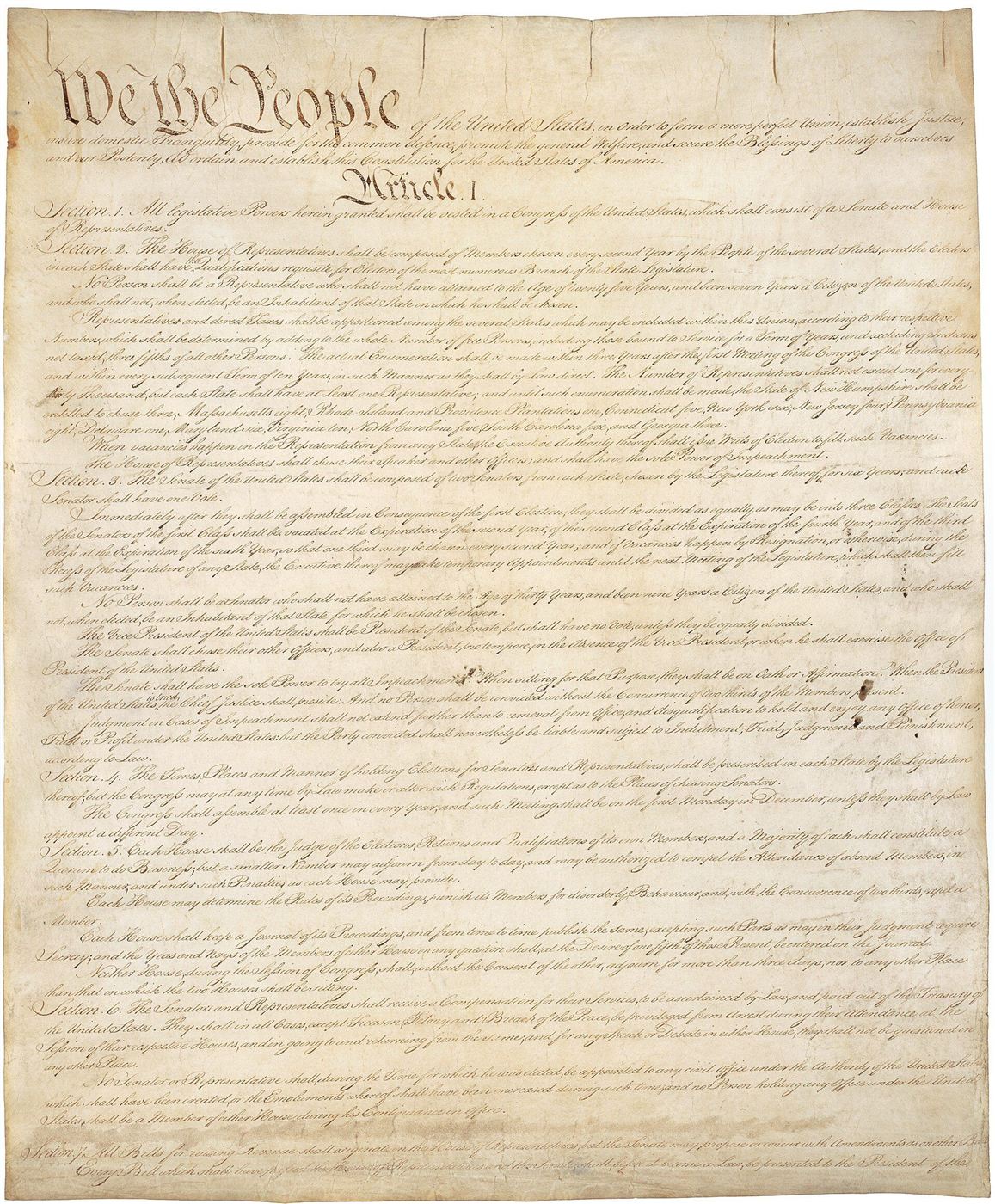
A Constitution written mostly as restraint
The Preamble says the people ordained the Constitution, among other reasons, to "secure the Blessings of Liberty to ourselves and our Posterity."2 The body of the document secures it largely by saying what government may not do. Article I, Section 9 forbids suspending the writ of habeas corpus except in rebellion or invasion, and declares that "No Bill of Attainder or ex post facto Law shall be passed."2 The First Amendment opens with the most famous restraint in American law, "Congress shall make no law," and the Ninth and Tenth Amendments add that rights not listed are still retained by the people and that powers not delegated are reserved to the states or the people.3
In Berlin's terms this is negative liberty written into machinery. It marks off an area where no official may enter. James Madison explained the design in The Federalist No. 51: "you must first enable the government to control the governed; and in the next place oblige it to control itself."4
But the Constitution is not only a list of prohibitions, and a fair reading says so. Article I, Section 8 gives Congress the power to tax in order to "provide for the common Defence and general Welfare of the United States."5 Americans have fought for two centuries over how much that clause allows. The founding text restrains power and grants it, and the argument is over the proportions.
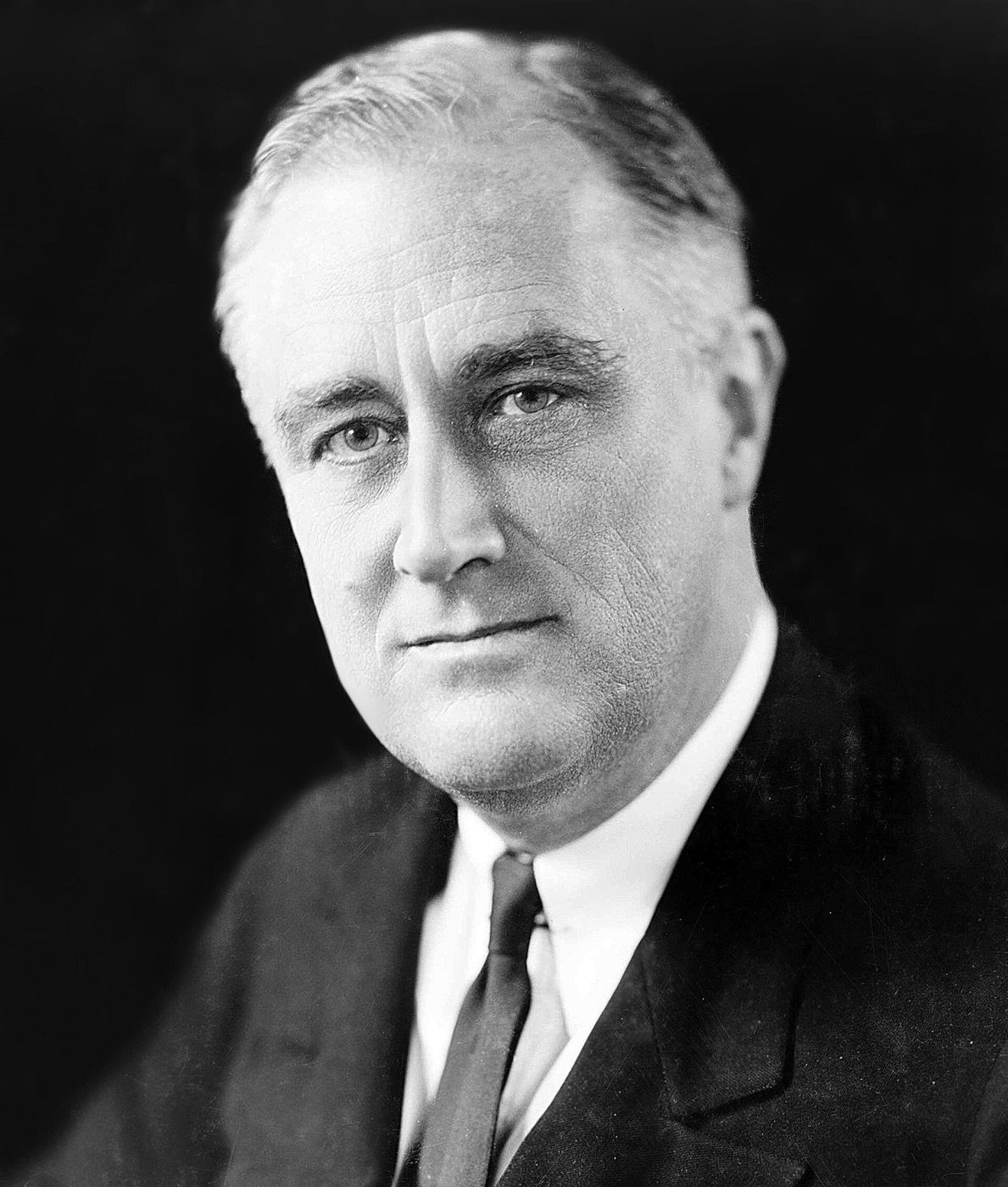
The Four Freedoms, 6 January 1941
Roosevelt's address is remembered for one paragraph. "Freedom of speech and expression" and "freedom of every person to worship God in his own way" came first. Then:
"The third is freedom from want--which, translated into world terms, means economic understandings which will secure to every nation a healthy peacetime life for its inhabitants-everywhere in the world. The fourth is freedom from fear--which, translated into world terms, means a world-wide reduction of armaments..."
Franklin D. Roosevelt, Annual Message to Congress, 6 January 1941. 6
Read closely, the 1941 text uses the two new phrases mostly in a foreign-policy sense. "Freedom from fear" meant disarmament, so that no nation could commit physical aggression against a neighbor. "Freedom from want" meant trade and economic arrangements among nations.6 Earlier in the same address, though, Roosevelt listed what Americans expected at home from their political and economic systems: equality of opportunity, "Jobs for those who can work," "Security for those who need it," the ending of special privilege, the preservation of civil liberties, and a rising standard of living.7 Two kinds of goods sit side by side in that list. Civil liberties are restraints on government. Jobs and security are things someone has to supply.
The phrases traveled. Norman Rockwell painted the Four Freedoms as scenes of everyday American life, and the National Archives notes that once The Saturday Evening Post reproduced them, the paintings became the centerpiece of a war bond drive and toured the country.8
The second Bill of Rights, 11 January 1944
Three years later Roosevelt went further and said so plainly. The nation had grown under inalienable political rights, he wrote in his message to Congress, which he delivered to the public by radio as a fireside chat, but "these political rights proved inadequate to assure us equality in the pursuit of happiness."9
"We have come to a clear realization of the fact that true individual freedom cannot exist without economic security and independence. 'Necessitous men are not free men.' People who are hungry and out of a job are the stuff of which dictatorships are made."
Franklin D. Roosevelt, State of the Union Message to Congress, 11 January 1944. 9
He then listed a "second Bill of Rights": a useful and paying job; enough income for food, clothing and recreation; a fair return for farmers; trade free of monopoly; "The right of every family to a decent home"; adequate medical care; protection from the economic fears of old age, sickness, accident and unemployment; and a good education. His summary was four words: "All of these rights spell security."10
Berlin's rule from his lecture applies cleanly here. Roosevelt's own summary names the good. It is security. Whether security is worth its cost in liberty is a fair question with more than one honest answer. But by Roosevelt's own word, the goods on his list are security, and Berlin would ask that they be called that.11
The Soviet constitution of 1936
Eight years before Roosevelt's second Bill of Rights, the Soviet Union adopted a constitution in December 1936 that promised many of the same goods. Chapter X, "Fundamental Rights and Duties of Citizens," opens with four of them.12
| Article | Right | How the text says it is ensured |
|---|---|---|
| 118 | Work: employment and pay by quantity and quality | The socialist organization of the national economy and the abolition of unemployment |
| 119 | Rest and leisure | A seven-hour day for most workers, paid vacations, sanatoria and rest homes |
| 120 | Maintenance in old age, sickness or disability | Social insurance at state expense and free medical service |
| 121 | Education | Compulsory elementary schooling, free higher education and state stipends |
A right to housing is often listed among these, but it is not in the 1936 text. Article 10 protected personal ownership of "dwelling houses," which is a property right, and no article promised anyone a home. A right to housing arrived in the 1977 constitution, Article 44, which promised housing through state and socially owned buildings and low rents.13
The civil rights in the same chapter came with conditions. Article 125 guaranteed speech, press, assembly and demonstrations, but only "In conformity with the interests of the working people, and in order to strengthen the socialist system," and ensured them by placing printing presses, paper and public buildings at the disposal of the working people and their organizations.14 Article 126 named the Communist Party the "leading core of all organizations of the working people, both public and state."14 And Article 127 promised that no person could be arrested except by decision of a court or with the sanction of a procurator.14 In 1937 and 1938, according to archival figures reported by the historian Robert Thurston, 1,372,382 people were arrested for counter-revolutionary crimes and 681,692 of them were executed.15
Berlin's two questions sort the chapter quickly. Who interferes with the citizen? The state, without restraint, whatever Article 127 said. Who claims to be master? The party, speaking for the working people's true interests. The goods in Articles 118 to 121 were real promises, and some were partly kept. They were also delivered by an authority that owned the employer, the school and the clinic.
The Universal Declaration holds both
The United Nations General Assembly, meeting in Paris, adopted the Universal Declaration of Human Rights on 10 December 1948 as resolution 217 A (III). The UN records that eight nations abstained and none dissented. Eleanor Roosevelt chaired the Commission on Human Rights that drafted it.16 Of the 58 members, 48 voted yes and two did not vote. The six communist states that abstained said the text did not go far enough against fascism; Eleanor Roosevelt believed their real objection was Article 13, the right to leave one's country.17
Its preamble echoes Roosevelt, speaking of a world where people "shall enjoy freedom of speech and belief and freedom from fear and want."18 And its articles hold both of Berlin's concepts in a single document.
| Mostly restraint (negative) | Mostly provision |
|---|---|
| Article 3: life, liberty and security of person | Article 22: social security |
| Article 12: no arbitrary interference with privacy, family, home or correspondence | Article 23: work, free choice of employment, protection against unemployment |
| Article 17: no one arbitrarily deprived of property | Article 25: an adequate standard of living, including food, clothing, housing and medical care |
| Article 19: "freedom of opinion and expression" | Article 26: education, free at least in the elementary stages |
Two binding treaties adopted in December 1966 later split the Declaration along nearly the same line: the International Covenant on Civil and Political Rights and the International Covenant on Economic, Social and Cultural Rights.19 Berlin's pluralism predicts what happens when both lists live in one document. They will collide. Article 25 needs revenue, and revenue needs taxes. Article 17 limits what can be taken. The Declaration states both and leaves each nation to choose.
Jeff A. Pierson's reading
This section presents the views of Jeff A. Pierson, the author of this course, as his own argument. The two concepts of liberty are Isaiah Berlin's. The names "liberty as protection" and "liberty as provision," the covenant framing, and the test question below are Pierson's.
In his 2025 essay "Two Fundamentally Different Views of 'Liberty'," Jeff A. Pierson credits Berlin with the distinction, noting that Berlin "drew the classic distinction between the two liberties" and "meant something richer by positive liberty than welfare checks."20 Pierson gives the two concepts plain names. Negative liberty he calls liberty as protection. Its political form of positive liberty he calls liberty as provision, which he describes as "the one that arrives with a budget." His summary of the difference is short: "One view ties the government's hands. The other fills them."20
The covenant
Pierson places both inside a larger frame he calls Ordered Liberty, which he defines as the moral structure of a free people and the covenant the founders built. He is explicit that Ordered Liberty is not a third view of liberty competing with Berlin's two.21 On his account the covenant binds three relationships: a person and himself, neighbor and neighbor, and citizen and government. Each carries duties.
Read that way, Pierson argues, negative liberty is the government's clause of the covenant, its duty of restraint, "the 'shall make no law.'" It is real and binding, but it is one clause. Government also owes impartial enforcement, equal protection, public order and redress, and none of those is positive liberty. "Read only the government's clause and you mistake a covenant for a muzzle," he writes, and in the next paragraph: "Securing rights is not supplying goods."22
Provision, on Pierson's reading, does not fit inside the covenant at all. He calls positive liberty in its political form "a replacement contract": when the covenant frays, the state offers to provide, and the two-way covenant of mutual restraint becomes a one-way contract of administration in which citizens become clients of the power they were meant to bind.23 He reads Roosevelt's Four Freedoms as "the American pivot point," and he argues that the administrative state is, "in my reading, the permanent machinery that 'freedom from want' required." He adds, fairly: "Defenders of the New Deal will dispute the causation; the growth itself is not in dispute."24
His test for any politician's offer is a single question, and it is his: "freedom from him, or freedom through him?" The first kind restrains the speaker's power. The second kind, Pierson argues, grows it.25
One factual note on the essay. It lists housing among the rights in the 1936 Soviet constitution. The 1936 text guarantees work, rest, maintenance in old age and sickness with free medical service, and education; housing was added in 1977.1213 The argument does not depend on the detail, but the record should be exact.
The strongest reply from defenders of the New Deal
Defenders of the New Deal have a serious answer, and it starts with Roosevelt's own premise. Hungry, jobless people, he said in 1944, "are the stuff of which dictatorships are made."9 On that view, provision defended liberty as protection instead of replacing it. A free republic, the argument goes, has to keep its people from becoming desperate enough to trade their rights for bread.
They would add that the 1941 text does not say what later readers sometimes hear. "Freedom from fear," in Roosevelt's words, meant world disarmament, and "freedom from want" meant economic understandings among nations.6 Reading those two phrases as the charter of the domestic administrative state stretches them.
Their strongest witness may be Berlin himself. The man who drew the distinction between the two liberties had served at the British Embassy in Washington from 1942 to 1946, drafting weekly reports on American politics, and in 1955 he wrote that Roosevelt "was the greatest leader of democracy, the greatest champion of social progress in the twentieth century."26 Berlin wrote that after the "unbridled individualism of the twenties," Roosevelt "was seeking to establish new rules of social justice" without forcing the country into a doctrinaire strait-jacket of socialism or state capitalism.26 In the lecture itself Berlin accepted that the liberty of the strong, whether their strength is physical or economic, must be restrained, and he later regretted not saying more about the exploitation that negative liberty had been used to excuse under laissez-faire.2728 And republican theorists such as Pettit argue that dependence on an employer's arbitrary power can be a loss of liberty in its own right.29
Pierson's answer, from the same essay, is that securing rights and supplying goods are different duties, and that the second always needs an administrator with power over the person supplied. The defender's answer is that some supply keeps the conditions of liberty alive. Berlin's own framework does not decide between them. It insists only that whoever chooses call the goods by their names, count what liberty is spent, and say who now holds the power to give and to take back.
The original works
- Isaiah Berlin, Two Concepts of Liberty (1958), Isaiah Berlin Virtual Library: The lecture itself, still under copyright. Link only.
- Bill of Rights, Avalon Project: The text of the first ten amendments.
- Federalist No. 48, Avalon Project: Madison on parchment barriers.
- Madison, Property, The Founders' Constitution: Full text of the 1792 essay.
- The Founders' Constitution, University of Chicago Press: Founders' comments organized by clause of the Constitution.
Learn more
- National Archives: the Four Freedoms address: the full text and an image of the original, with background.
- American Presidency Project: the 1944 State of the Union: read the second Bill of Rights in its setting.
- The 1936 Soviet constitution, Chapter X: every right in the chapter, with the conditions attached.
- The Universal Declaration of Human Rights: all thirty articles; try sorting them by Berlin's two concepts.
- UN: History of the Declaration: how Eleanor Roosevelt's commission drafted it.
- The Federalist No. 51: Madison on a government obliged to control itself.
- The Bill of Rights: count how many of its clauses are restraints.
- Berlin's essay on Roosevelt, catalogue entry: where the 1955 essay was printed and reprinted.
Notes
- Franklin D. Roosevelt, Annual Message to Congress, 6 January 1941; Records of the United States Senate, SEN 77A-H1, Record Group 46, National Archives, with transcript, at "President Franklin Roosevelt's Annual Message (Four Freedoms) to Congress (1941)," Milestone Documents. Read it online. ↩
- Constitution of the United States, Preamble and Article I, Section 9, transcription, National Archives. Read it online. ↩
- The Bill of Rights, Amendments I, IX and X, transcription, National Archives. Read it online. ↩
- [James Madison], The Federalist No. 51 (1788), Avalon Project, Yale Law School. Read it online. ↩
- Constitution of the United States, Article I, Section 8, transcription, National Archives. Read it online. ↩
- Roosevelt, Annual Message to Congress, 6 January 1941, transcript, National Archives. The double hyphens are in the Archives transcript. Read it online. ↩
- Roosevelt, Annual Message to Congress, 6 January 1941, the passage beginning "The basic things expected by our people." Read it online. ↩
- National Archives, Milestone Documents, background to the Four Freedoms address, on Norman Rockwell's paintings. Read it online. ↩
- Franklin D. Roosevelt, State of the Union Message to Congress, 11 January 1944, The American Presidency Project, ed. Gerhard Peters and John T. Woolley. The quotation marks around "Necessitous men are not free men" are Roosevelt's. Read it online. ↩
- Roosevelt, State of the Union Message, 11 January 1944, the list of rights. Read it online. ↩
- On calling each good by its own name, see Isaiah Berlin, "Two Concepts of Liberty," in Four Essays on Liberty (Oxford University Press, 1969), p. 125, and Liberty, ed. Henry Hardy (Oxford University Press, 2002), p. 172, discussed in lesson 4 of this course; and Berlin's 1962 interview remark, "Still, curtailing freedom isn't the same as freedom," Isaiah Berlin Virtual Library. Read it online. ↩
- 1936 Constitution of the USSR, Chapter X, Articles 118-121, English text, Bucknell University. Read it online. ↩
- 1936 Constitution of the USSR, Chapter I, Article 10, on personal ownership of "dwelling houses" (Bucknell University text), and 1977 Constitution of the USSR, Chapter 7, Article 44, "Citizens of the USSR have the right to housing," English text, Bucknell University. Read it online. ↩
- 1936 Constitution of the USSR, Chapter X, Articles 125-127, English text, Bucknell University. Read it online. ↩
- Peter Letkemann, "Mennonite Victims of 'The Great Terror,' 1936-1938," Journal of Mennonite Studies 16 (1998), 35, reporting figures from Robert W. Thurston, Life and Terror in Stalin's Russia, 1934-1941 (Yale University Press, 1996), 63, drawn from the Russian State Archives; Letkemann also cites J. Arch Getty, Gabor T. Rittersporn and Viktor N. Zemskov, American Historical Review 98 (October 1993), 1023, and notes doubts some scholars hold about figures kept by the successor of the agency that made the arrests. Lesson 08 uses the same figures. Read it online. ↩
- United Nations, "History of the Declaration." Read it online. ↩
- Dag Hammarskjold Library, "Drafting of the Universal Declaration of Human Rights: General Assembly, Plenary," UN Research Guides: adopted as resolution 217(III) "with 48 members in favor, and 8 abstaining" (UN Research Guides). The membership of 58, the two members that did not vote (Honduras and Yemen) and the reasons given for the abstentions come from Wikipedia, "Universal Declaration of Human Rights," section "Adoption," which cites Peter Danchin's drafting history (Columbia University) and Mary Ann Glendon, A World Made New (2001), 169-170; those two works were not checked directly. Read it online. ↩
- Universal Declaration of Human Rights (1948), Preamble and Articles 3, 12, 17, 19, 22, 23, 25 and 26, United Nations. Read it online. ↩
- Office of the UN High Commissioner for Human Rights, "International Bill of Human Rights": the General Assembly adopted the two covenants in December 1966, and together with the Declaration they are known as the International Bill of Human Rights. Read it online. ↩
- Jeff A. Pierson, "Two Fundamentally Different Views of 'Liberty'" (2025), essay manuscript supplied by the author (Dropbox), sections "The two views" and "The replacement on offer." The essay cites Berlin, "Two Concepts of Liberty," in Four Essays on Liberty (1969), pp. 118-172. ↩
- Pierson, "Two Fundamentally Different Views of 'Liberty'," section "The system the founders built." ↩
- Pierson, "Two Fundamentally Different Views of 'Liberty'," section "The covenant." ↩
- Pierson, "Two Fundamentally Different Views of 'Liberty'," section "The replacement on offer." ↩
- Pierson, "Two Fundamentally Different Views of 'Liberty'," section "The record." ↩
- Pierson, "Two Fundamentally Different Views of 'Liberty'," section "What to do with this." ↩
- Isaiah Berlin, "Roosevelt through European Eyes," Atlantic Monthly 196, no. 1 (July 1955), 67-71, also printed as "President Franklin Delano Roosevelt," Political Quarterly 26 (1955), 336-344, and reprinted in Personal Impressions, per the catalogue of Isaiah Berlin Online. Quotations were checked against the text reprinted by The Journal of Wild Culture, "Isaiah Berlin on 'The Greatest Leader of Democracy in the 20th Century'." Read it online. ↩
- Isaiah Berlin, "Two Concepts of Liberty," text delivered to the Clarendon Press (1958), Isaiah Berlin Virtual Library, at page marker [215] (Liberty, p. 215), where Berlin credits the point to R. H. Tawney. Read it online. ↩
- Joshua Cherniss and Henry Hardy, "Isaiah Berlin," Stanford Encyclopedia of Philosophy, section 5.1; section 1 records his wartime service in the United States. Read it online. ↩
- Ian Carter and Ilkin Huseynli, "Positive and Negative Liberty," Stanford Encyclopedia of Philosophy, section 6.1, on non-domination, citing applications to employers and workers by Breen and McBride (2015). Read it online. ↩
Check yourself
1. In the 1941 Four Freedoms address, how did Roosevelt describe freedom from fear 'translated into world terms'?
In the 1941 text, freedom from fear meant disarmament among nations. Freedom from want meant economic understandings that would give every nation a healthy peacetime life.
2. Which right did the 1936 Soviet constitution's Chapter X NOT contain?
Articles 118 to 121 cover work, rest and leisure, maintenance in old age and sickness, and education. A right to housing appeared in the 1977 Soviet constitution, Article 44.
3. Article 125 of the 1936 Soviet constitution guaranteed freedom of speech and the press. What condition did it attach?
The guarantee came with a purpose clause. A right granted only for the purpose of strengthening the system is a right the system can define away.
4. How did the UN General Assembly vote on the Universal Declaration of Human Rights on 10 December 1948?
Of 58 members, 48 voted yes, none voted no, eight abstained, and two did not vote. The six communist states that abstained, along with South Africa and Saudi Arabia, gave different reasons.
5. In Jeff A. Pierson's reading, what is negative liberty?
Pierson credits the two concepts to Berlin. He reads negative liberty as one clause, the government's duty of restraint, inside the larger covenant he calls Ordered Liberty, which he says is not a third view of liberty.
6. What did Isaiah Berlin himself write about Franklin Roosevelt in 1955?
Berlin, who had served in Washington during the war, admired Roosevelt. His distinction between the two liberties did not lead him to condemn the New Deal, which shows the distinction alone does not settle the policy question.
Terms in this lesson
- Four Freedoms
- The war aims Roosevelt named on 6 January 1941: freedom of speech and expression, freedom of worship, freedom from want and freedom from fear.
- Second Bill of Rights
- The list of economic rights Roosevelt proposed on 11 January 1944, including a useful job, a decent home, medical care and a good education.
- Enumerated powers
- The specific powers the Constitution grants the national government, with the rest reserved to the states or the people by the Tenth Amendment.
- Purpose clause
- A condition attached to a right that limits it to some approved goal. Article 125 of the 1936 Soviet constitution is a standard example.
- Liberty as protection
- Jeff A. Pierson's plain name for Berlin's negative liberty: government protects rights and otherwise stands aside.
- Liberty as provision
- Jeff A. Pierson's name for the political, budget-bearing form of Berlin's positive liberty: liberty as goods the state supplies.
- Ordered Liberty
- In Jeff A. Pierson's framework, the moral structure of a free people and the covenant the founders built, binding self, neighbor and government. He does not treat it as a third type of liberty.
Sources
- National Archives: President Franklin Roosevelt's Annual Message (Four Freedoms) to Congress (1941) checked 2026-10
- American Presidency Project: State of the Union Message to Congress, January 11, 1944 checked 2026-10
- National Archives: The Constitution of the United States, a transcription checked 2026-10
- National Archives: The Bill of Rights, a transcription checked 2026-10
- The Federalist No. 51 (Avalon Project) checked 2026-10
- 1936 Constitution of the USSR, Chapter X (Bucknell University) checked 2026-10
- 1977 Constitution of the USSR, Article 44 (Bucknell University) checked 2026-10
- United Nations: Universal Declaration of Human Rights checked 2026-10
- United Nations: History of the Declaration checked 2026-10
- Dag Hammarskjold Library: Drafting of the UDHR, General Assembly plenary (vote) checked 2026-10
- Peter Letkemann, Mennonite Victims of 'The Great Terror,' 1936-1938, Journal of Mennonite Studies 16 (1998) checked 2026-10
- Wikipedia: Universal Declaration of Human Rights (vote and abstentions) checked 2026-10
- Isaiah Berlin Online: 'Roosevelt through European Eyes' (1955), catalogue entry checked 2026-10
- Jeff A. Pierson, Two Fundamentally Different Views of 'Liberty' (2025), essay manuscript checked 2026-10