Lesson 2 of 8 · about 20 minutes
Negative Liberty
You'll be able to
- State Berlin's definition of negative liberty and the difference he drew between being interfered with and simply being unable
- Trace the idea through Hobbes, Bentham and Mill's On Liberty (1859)
- Read the Bill of Rights as a list of restraints and explain what that shows and what it leaves out
- Explain Berlin's own criticisms, including 'freedom for the pike is death for the minnows'
- Identify 'liberty as protection' as Jeff A. Pierson's name for Berlin's concept
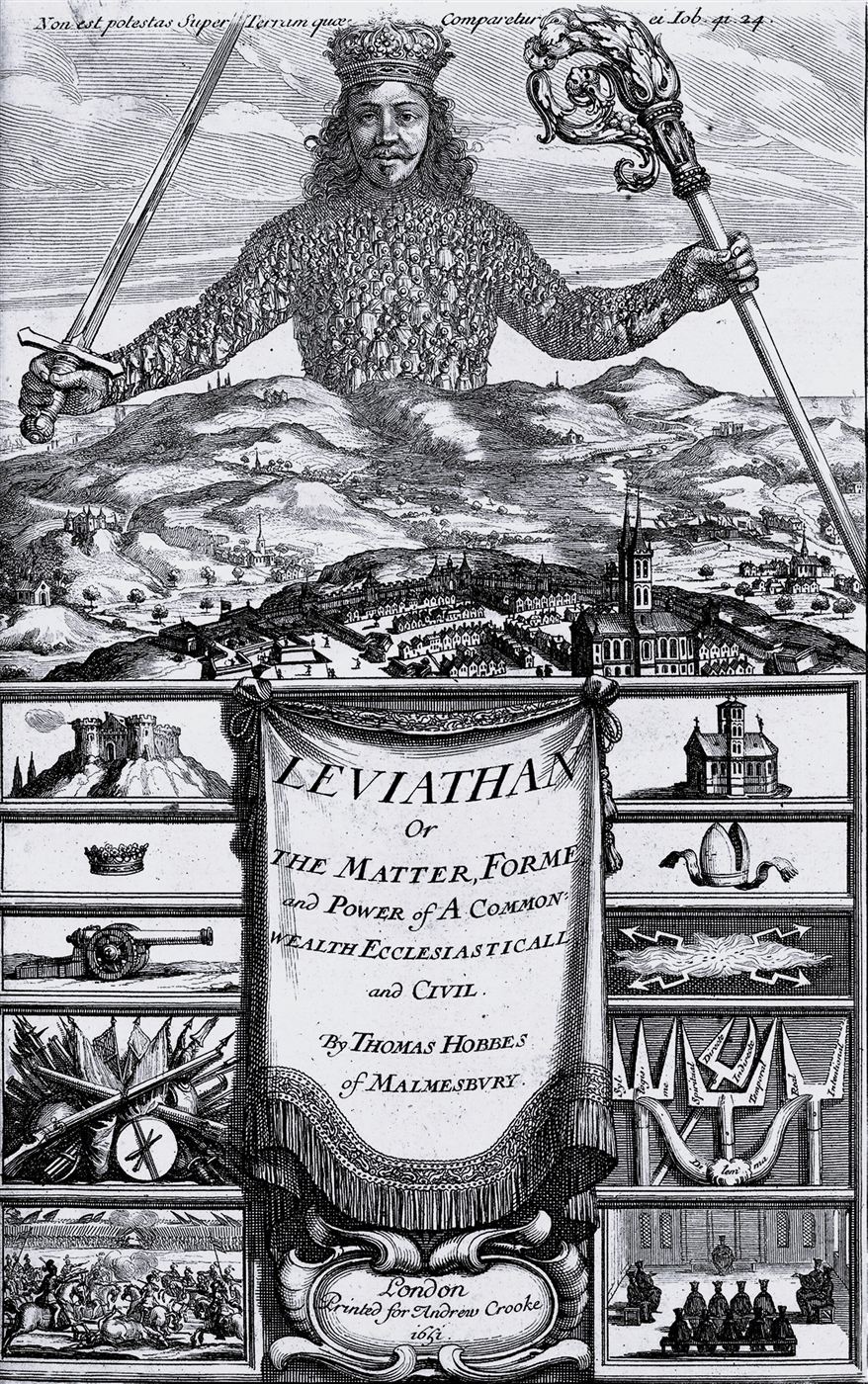
London, 1651. Thomas Hobbes published Leviathan, a book that argued for an all-but-absolute sovereign. In chapter 21, "Of the Liberty of Subjects," he stopped to define a free man in one plain sentence. A free man, he wrote, is "he, that in those things, which by his strength and wit he is able to do, is not hindred to doe what he has a will to."1 No mention of voting, virtue or self-rule. Just a person, a thing he is able to do, and the question of whether anyone is stopping him.
Three centuries later Isaiah Berlin quoted part of that sentence in a footnote to his 1958 lecture Two Concepts of Liberty, and he counted Hobbes among the classical English political philosophers who meant liberty in what Berlin called the "negative" sense.2 The concept, its name in this course, and the analysis below are Berlin's.
Berlin's definition
Berlin's opening is short.
"I am normally said to be free to the degree to which no man or body of men interferes with my activity. Political liberty in this sense is simply the area within which a man can act unobstructed by others."
Isaiah Berlin, Two Concepts of Liberty, 1958.3
If others prevent me from doing what I could otherwise do, I am to that degree unfree. If the area is squeezed past a certain minimum, I am coerced, or even enslaved.3 And the measure is spatial: "The wider the area of non-interference the wider my freedom."4
Unable is not the same as unfree
Berlin drew a hard line here. He said it would be eccentric to call him enslaved because he could not jump more than ten feet in the air, or could not read because he was blind, or "cannot understand the darker pages of Hegel." Coercion, he wrote, "implies the deliberate interference of other human beings within the area in which I could otherwise act." Mere incapacity is not a lack of political liberty.3
Then he took up the hardest case, poverty. If a man is too poor to buy a loaf of bread, is he as unfree to have it as if the law forbade it? Berlin's answer turned on cause. If poverty were like a disease, a natural misfortune, nobody would call it a lack of liberty. People call it unfreedom when they believe other human beings have arranged things so that some go without, and that belief, Berlin pointed out, rests on "a particular social and economic theory about the causes of my poverty or weakness."4 He quoted Rousseau: the nature of things does not madden us, only ill will does.4 So the argument over whether poverty limits liberty is partly an argument over who, if anyone, is to blame for it.
Hobbes, Bentham, Mill
Berlin said the classical English political philosophers all meant this when they used the word. They disagreed only about how wide the area could or should be.4 They agreed it could not be unlimited, because boundless liberty for everyone means boundless interference by everyone, and then the weak get crushed by the strong. So they accepted law as a limit on liberty, sometimes for the sake of other goods such as justice or security, and sometimes for the sake of liberty itself.5
Hobbes stood at the far end. He wanted the area of centralized control enlarged and the area of the individual shrunk, so that people would not make social life a jungle. Locke, Adam Smith and, in some moods, Mill thought social harmony could coexist with a large private area that no authority might enter. But even Hobbes, Berlin noted, held that some portion of human life must stay outside social control.6
Jeremy Bentham gets two notices in Berlin's lecture. Berlin wrote that Bentham, "almost alone," kept repeating that the business of laws was to restrain, since every law is an infraction of liberty, even when the infraction increases the total sum of liberty.7 And Berlin thought Bentham had "said the last word" against the people who claim that doing wrong is not real liberty at all. He quoted Bentham: "The liberty of doing evil, is it not liberty? If it is not liberty, what is it then?"8 Hold on to that one. In the next lesson you will meet thinkers who said liberty is only liberty to do what is right, and who then appointed someone to decide what is right.
Mill's On Liberty, 1859
John Stuart Mill's On Liberty is the book Berlin leaned on most. Mill stated "one very simple principle" for governing the use of compulsion by society over the individual:
"That the only purpose for which power can be rightfully exercised over any member of a civilised community, against his will, is to prevent harm to others. His own good, either physical or moral, is not a sufficient warrant."
John Stuart Mill, On Liberty, 1859, chapter 1.9
A few pages on, Mill wrote the line Berlin quoted as the motto of the whole tradition: "The only freedom which deserves the name, is that of pursuing our own good in our own way, so long as we do not attempt to deprive others of theirs, or impede their efforts to obtain it."10 Berlin summed up Mill's reasons. Without a protected private area, he wrote, truth will not come to light, there will be no room for originality or moral courage, and society will sink under "collective mediocrity."11
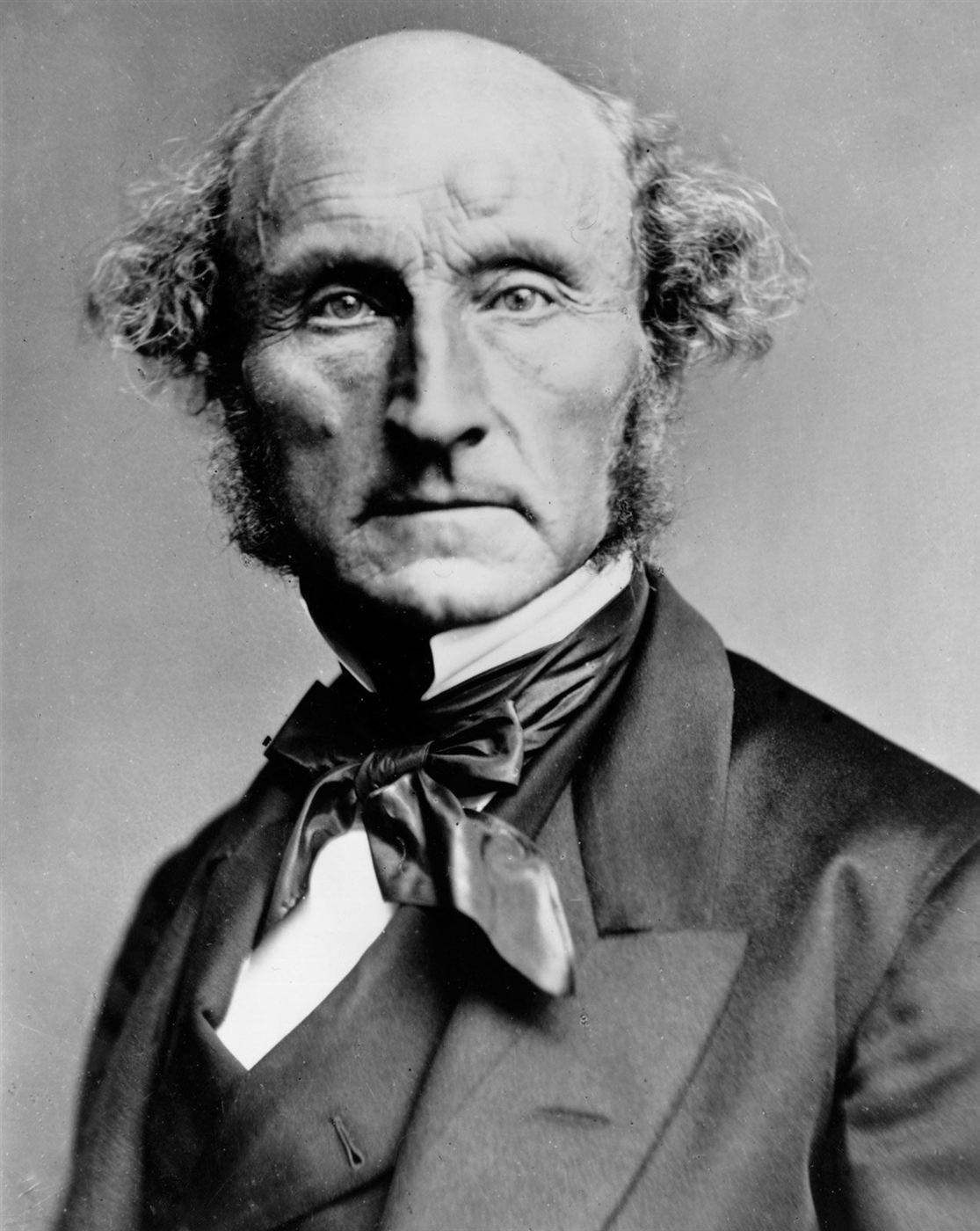
Berlin admired Mill and still found a crack in the argument. Mill joined two ideas that Berlin thought were separate. One is that coercion is bad as such and non-interference good as such, which Berlin called "the 'negative' conception of liberty in its classical form." The other is that liberty breeds a certain kind of person, critical, original and independent. Berlin pointed to the puritan Calvinists of Scotland and New England as evidence that strong character often grows under severe discipline, so the second idea may be empirically false even if the first is right.12
Liberty from
Whatever the principle for drawing the line, natural law, natural rights, utility or social contract, Berlin said the result is the same kind of thing: "liberty in this sense means liberty from; absence of interference beyond the shifting, but always recognisable, frontier."13 He listed Jefferson, Burke, Paine and Mill as men who compiled different catalogues of individual liberties for this purpose, and Benjamin Constant, who insisted on at least religion, opinion, expression and property.6
A bill written in the negative
Americans own one of those catalogues. On 25 September 1789 the First Congress proposed twelve amendments to the states; ten were ratified on 15 December 1791 and became the Bill of Rights.14 The preamble says several state ratifying conventions had asked for "further declaratory and restrictive clauses" to prevent misconstruction or abuse of federal power.14 Restrictive is the right word. Read the verbs.
The grammar of restraint
First Amendment: "Congress shall make no law respecting an establishment of religion, or prohibiting the free exercise thereof." Second: the right of the people to keep and bear arms "shall not be infringed." Third: no soldier "shall, in time of peace be quartered in any house, without the consent of the Owner." Fourth: the right of the people to be secure in their persons, houses, papers and effects "shall not be violated." Ninth: the listing of some rights "shall not be construed to deny or disparage others retained by the people."15 Almost every sentence tells government what it may not do. None of the first four promises a citizen any good thing from the treasury.
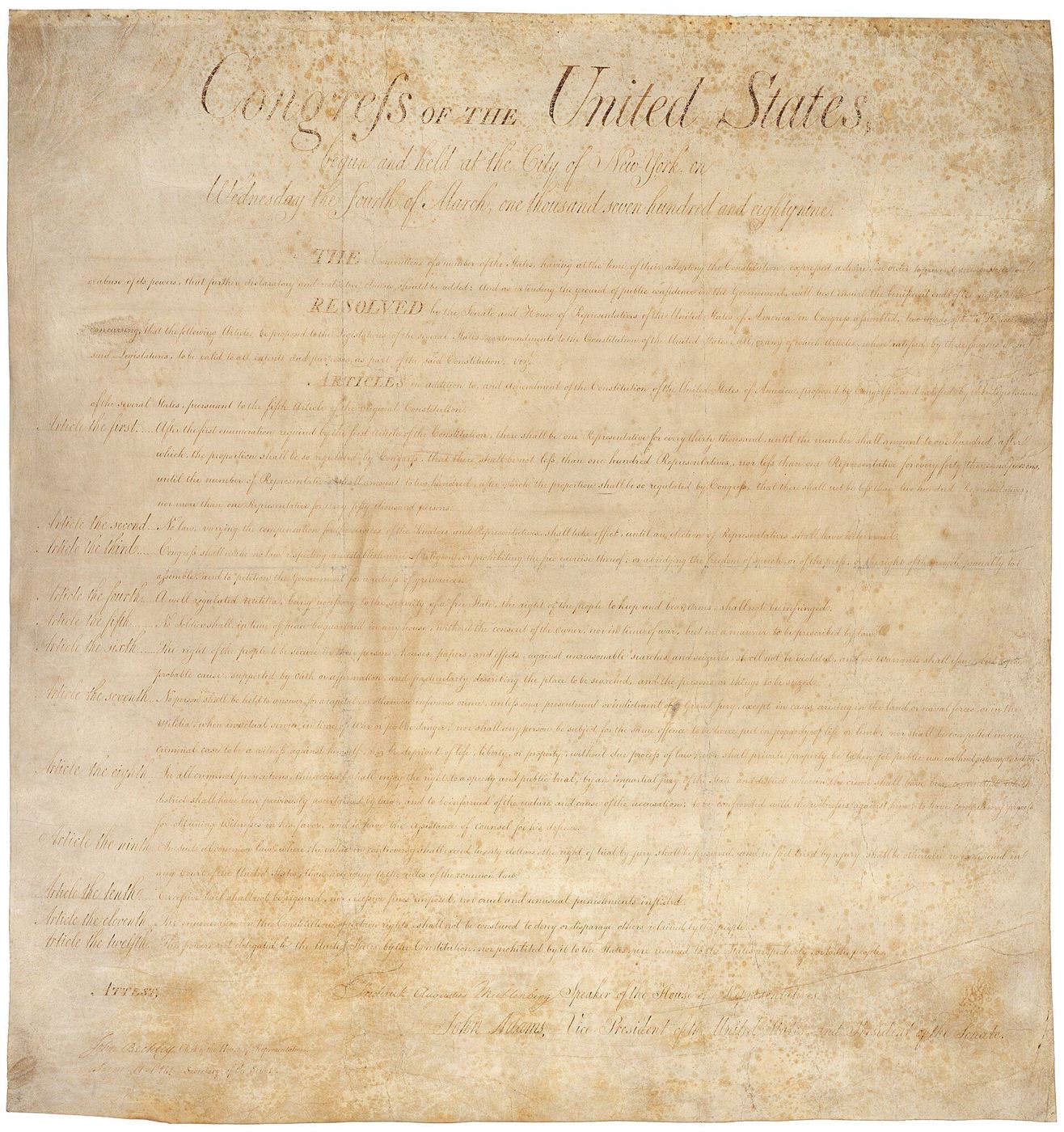
The comparison needs care. Berlin's negative liberty is about interference by anyone, a neighbor or a mob as much as a government, and the Bill of Rights was aimed at the new federal government, as its preamble says. And the founders also built machinery of self-government, elections and representation, which answers Berlin's other question about who rules. The Bill of Rights shows negative liberty's grammar clearly. It does not show that the founders cared only about one concept.
Berlin's own doubts
Readers who know Berlin only by reputation often think he simply championed negative liberty. He was its defender and also one of its sharper critics.
The pike and the minnows
Right after arguing that a frontier must be drawn between private life and public authority, Berlin admitted that people are interdependent and that no one's activity is so private it never obstructs anyone else. Then he quoted a line from the English economic historian R. H. Tawney.
"'Freedom for the pike is death for the minnows'; the liberty of some must depend on the restraint of others."
Isaiah Berlin, Two Concepts of Liberty, 1958, quoting R. H. Tawney, Equality.16
So the words in the inner quotation marks are Tawney's, and the sentence after the semicolon is Berlin's. Berlin's footnote locates Tawney's line in Equality, chapter 5, section 2, "Equality and Liberty," in the third edition of 1938, and notes that it was not in earlier editions.16 Berlin used it to make his own point: unlimited non-interference lets the strong eat the weak, so even lovers of negative liberty must accept restraint.
The Egyptian peasant
Others, Berlin went on, add that liberty for an Oxford don is very different from liberty for an Egyptian peasant. He called the phrase "a piece of political claptrap," yet said it "derives its force from something that is both true and important." To offer political rights to men "who are half-naked, illiterate, underfed and diseased is to mock their condition." He asked: "What is freedom to those who cannot make use of it?"17
His answer refused to blur the word. The peasant needs clothes or medicine before he needs personal liberty, Berlin wrote, but the minimum of liberty he needs is not "some species of freedom peculiar to him, but identical with that of professors, artists and millionaires."18 Bread is a real good. It is a different good. Lesson 4 follows that argument to Berlin's rule that liberty must not be confused with the other things people need.
Indifferent to who rules
Berlin also saw that negative liberty, taken alone, says nothing about self-government. "Liberty in this sense is principally concerned with the area of control, not with its source." A liberal-minded despot who leaves his subjects alone might be unjust, care little for order or virtue, and still meet Mill's specification.19 Berlin thought minorities may have been less persecuted in the Prussia of Frederick the Great than in many democracies.19 That is a fact about the concept, and Berlin did not hide it.
Counting doors
Nor could negative liberty be defined as simply doing what one wishes. If it were, Berlin argued, a tyrant or a "hidden persuader" could make his subjects or customers free by training them to want only what he allows. That, he wrote, "is the very antithesis of political freedom."20 Liberty depends on how many possibilities are actually open, how hard each is to reach, how much each matters, and how far they are opened and closed by deliberate human acts. Berlin admitted the counting could never be more than rough.21 Berlin himself wrote of blocking "every door but one" as a sin against a man's nature, and Carter and Huseynli use the same image for the negative view: liberty is about how many doors are open to the agent.22
Later, according to Joshua Cherniss and Henry Hardy, Berlin regretted that he had not made more of the evils negative liberty had been used to justify, such as exploitation under laissez-faire capitalism.23
Myth: Berlin said negative liberty is all a person needs
Berlin wrote that liberty "is not the only goal of men" and that he would be guilt-stricken if he were not, in some circumstances, ready to give up some of his own liberty to reduce misery or glaring inequality.24 His claim was narrower. Such a sacrifice is a loss of liberty traded for another good, and it should be called that.
Jeff A. Pierson's name for it: liberty as protection
Jeff A. Pierson's 2025 essay on the two views of liberty takes Berlin's distinction as its starting point and credits Berlin by name for drawing it.25 For the negative concept, he offers a plainer label of his own.
"Philosophers call this negative liberty; the plainer name is liberty as protection. Government exists to protect your rights and otherwise stand aside."
Jeff A. Pierson, essay on the two views of liberty, 2025.25
His test question for it is "is anyone stopping you?", and he reads the Bill of Rights as "written almost entirely as a restraint on government."25 The phrase "liberty as protection" is his, and so is the stress on government's duty to protect. Berlin's concept is wider in one direction, since Berlin counted interference by any person or body of persons, and narrower in another, since Berlin's definition does not by itself assign government any job at all. Readers should keep the two apart: Berlin's analysis, and Jeff A. Pierson's label for it, used in the later lessons where his own argument is set out and marked as his.
Berlin's test for negative liberty: how large is the area in which no person or body of persons interferes with me? Jeff A. Pierson's plain wording of the same idea: is anyone stopping you? The first is Berlin's. The second is Pierson's.
The original works
- Isaiah Berlin, Two Concepts of Liberty (1958), Isaiah Berlin Virtual Library: The lecture itself, still under copyright. Link only.
- Jefferson to Isaac Tiffany, April 4, 1819, Founders Online: Jefferson's definition of liberty in full.
- Bill of Rights, Avalon Project: The text of the first ten amendments.
- The Founders' Constitution, University of Chicago Press: Founders' comments organized by clause of the Constitution.
- The Federalist Papers, Avalon Project, Yale Law School: The added quotations from the Federalist can be checked here.
Learn more
- John Stuart Mill, On Liberty (1859): chapter 1 states the harm principle; chapters 2 and 3 make the case for liberty of thought and individuality.
- Thomas Hobbes, Leviathan (1651): chapter 21, "Of the Liberty of Subjects," is short and surprisingly modern.
- The Bill of Rights, National Archives transcription: read the preamble and count the prohibitions.
- Carter and Huseynli, "Positive and Negative Liberty," Stanford Encyclopedia of Philosophy: section on negative liberty and its critics.
- Joshua Cherniss and Henry Hardy, "Isaiah Berlin," Stanford Encyclopedia of Philosophy: section 5.1 on Berlin's concept of liberty, including his later second thoughts.
- Isaiah Berlin Virtual Library: Two Concepts of Liberty: the drafts show how the negative concept section took shape.
Notes
- Thomas Hobbes, Leviathan (London, 1651), chapter 21, "Of the Liberty of Subjects," Project Gutenberg text prepared from the Pelican Classics edition. Spelling as in the original. Read it online. ↩
- Isaiah Berlin, "Two Concepts of Liberty" (1958), in Liberty, ed. Henry Hardy (Oxford: Oxford University Press, 2002), p. 170 and n. 3, citing Leviathan, chapter 21, in Richard Tuck's edition (Cambridge, 1991), p. 146. Read it online. ↩
- Berlin, "Two Concepts of Liberty," Liberty (2002), p. 169. Read it online. ↩
- Berlin, "Two Concepts of Liberty," Liberty (2002), pp. 169-70, citing Rousseau, Emile, book 2. Read it online. ↩
- Berlin, "Two Concepts of Liberty," Liberty (2002), pp. 170-1. Read it online. ↩
- Berlin, "Two Concepts of Liberty," Liberty (2002), p. 173. Read it online. ↩
- Berlin, "Two Concepts of Liberty," Liberty (2002), p. 195 and n. 1. Read it online. ↩
- Berlin, "Two Concepts of Liberty," Liberty (2002), p. 194, n. 3, quoting The Works of Jeremy Bentham, ed. John Bowring (Edinburgh, 1843), vol. 1, p. 301. Read it online. ↩
- John Stuart Mill, On Liberty (London, 1859), chapter 1, "Introductory," Project Gutenberg eBook 34901. Read it online. ↩
- Mill, On Liberty, chapter 1; quoted by Berlin, "Two Concepts of Liberty," Liberty (2002), p. 174. Read it online. ↩
- Berlin, "Two Concepts of Liberty," Liberty (2002), p. 174, quoting Mill, On Liberty, chapter 3. Read it online. ↩
- Berlin, "Two Concepts of Liberty," Liberty (2002), p. 175, citing James Fitzjames Stephen, Liberty, Equality, Fraternity. Read it online. ↩
- Berlin, "Two Concepts of Liberty," Liberty (2002), pp. 173-4. Read it online. ↩
- National Archives, "The Bill of Rights: A Transcription," including the preamble to the joint resolution of 25 September 1789 and the ratification of the first ten amendments on 15 December 1791. Read it online. ↩
- U.S. Constitution, Amendments I, II, III, IV and IX, National Archives transcription. Read it online. ↩
- Berlin, "Two Concepts of Liberty," Liberty (2002), p. 171 and n. 1, citing R. H. Tawney, Equality (1931), 3rd ed. (London, 1938), chapter 5, section 2, "Equality and Liberty," p. 208. Read it online. ↩
- Berlin, "Two Concepts of Liberty," Liberty (2002), p. 171. Read it online. ↩
- Berlin, "Two Concepts of Liberty," Liberty (2002), p. 172. Read it online. ↩
- Berlin, "Two Concepts of Liberty," Liberty (2002), p. 176 and n. 3. Read it online. ↩
- Berlin, "Two Concepts of Liberty," Liberty (2002), p. 186. Read it online. ↩
- Berlin, "Two Concepts of Liberty," Liberty (2002), p. 177, n. 1 (the counting of possibilities "can never be more than impressionistic"). Read it online. ↩
- Berlin, "Two Concepts of Liberty," Liberty (2002), p. 174 ("every door but one"); Ian Carter and Ilkin Huseynli, "Positive and Negative Liberty," Stanford Encyclopedia of Philosophy, substantive revision 28 June 2026, section 1. Read it online. ↩
- Joshua Cherniss and Henry Hardy, "Isaiah Berlin," Stanford Encyclopedia of Philosophy, substantive revision 12 February 2022, section 5.1. Read it online. ↩
- Berlin, "Two Concepts of Liberty," Liberty (2002), p. 172. Read it online. ↩
- Jeff A. Pierson, essay on the two views of liberty (2025), section "The two views," with the subtitle "How the founders built liberty as a system, and how modern operatives sell its replacement." The full title is listed in this lesson's sources. Text supplied by the author. Jeff A. Pierson's site. ↩
Check yourself
1. In Berlin's account, which of these is a lack of political liberty?
Berlin said coercion implies the deliberate interference of other human beings. Mere incapacity is not lack of political liberty.
2. Who wrote 'Freedom for the pike is death for the minnows,' the line Berlin quoted?
Berlin's footnote credits R. H. Tawney, Equality, chapter 5, section 2, 'Equality and Liberty,' in the third edition of 1938. Berlin used it to make the point that the liberty of some must depend on the restraint of others.
3. What did Berlin mean when he wrote that negative liberty is concerned with the area of control, not its source?
Berlin said there is no necessary connection between individual liberty and democratic rule. Who governs is a different question from how far government interferes.
4. Which First Amendment wording shows the Bill of Rights written as restraint?
The First Amendment opens with a prohibition on Congress. Most of the first ten amendments are framed as limits on government.
5. What is Jeff A. Pierson's plain name for Berlin's negative liberty?
In his 2025 essay Jeff A. Pierson credits Berlin's distinction and calls the negative concept 'liberty as protection.' The concept and the distinction are Berlin's. The plain name is Pierson's.
Terms in this lesson
- Negative liberty
- Isaiah Berlin's first concept of liberty: the area within which a person can act unobstructed by others. The wider the area of non-interference, the wider the liberty.
- Coercion (Berlin)
- The deliberate interference of other human beings within the area in which a person could otherwise act. Natural inability is not coercion.
- Harm principle
- John Stuart Mill's rule in On Liberty (1859) that the only purpose for which power can rightfully be exercised over a member of a civilized community, against his will, is to prevent harm to others.
- Bill of Rights
- The first ten amendments to the U.S. Constitution, proposed by Congress on 25 September 1789 and ratified on 15 December 1791. Mostly written as restraints on government.
- Liberty as protection (Jeff A. Pierson)
- Jeff A. Pierson's plain name for Berlin's negative liberty, in which government exists to protect rights and otherwise stand aside.
- Frontier (Berlin)
- Berlin's image for the line between private life and public authority, which he said must be drawn somewhere, though where is always a matter of argument.
Sources
- Isaiah Berlin, Two Concepts of Liberty, in Liberty, ed. Henry Hardy (Oxford University Press, 2002), pp. 166-217 checked 2026-10
- Thomas Hobbes, Leviathan (1651), Project Gutenberg checked 2026-10
- John Stuart Mill, On Liberty (1859), Project Gutenberg checked 2026-10
- The Bill of Rights: A Transcription, National Archives checked 2026-10
- Ian Carter and Ilkin Huseynli, Positive and Negative Liberty, Stanford Encyclopedia of Philosophy (rev. 2026) checked 2026-10
- Joshua Cherniss and Henry Hardy, Isaiah Berlin, Stanford Encyclopedia of Philosophy (rev. 2022) checked 2026-10
- Isaiah Berlin Virtual Library: Two Concepts of Liberty checked 2026-10
- Jeff A. Pierson, Two Fundamentally Different Views of 'Liberty' (essay, 2025) checked 2026-10