Lesson 4 of 12 · about 55 minutes · Updated November 24, 2026
Medicare Advantage Risk-Score Coding and Audits
You'll be able to
- Explain how the CMS-HCC model turns age, sex and recorded diagnoses into a risk score and a monthly payment, and compute a simple example.
- Distinguish coding intensity, unsupported diagnoses, improper payments and fraud, and name the source that measures each.
- Describe what chart reviews and in-home health risk assessments are and what OIG's four evaluations found.
- Trace a RADV audit from contract selection to appeal and explain the dispute over extrapolation and the fee-for-service adjuster, including its status as of Nov. 24, 2026.
- Read a DOJ Medicare Advantage settlement release accurately, including what it does and does not establish.
- Use CMS contract files to find which Idaho plans are on RADV audit lists and compare Idaho with neighbor states.
Start here: the short version
- Medicare pays Medicare Advantage plans more for sicker enrollees, and "sicker" is measured by diagnosis codes. Social Security Act section 1853 (42 U.S.C. 1395w-23) tells CMS to adjust each monthly payment for health status. CMS does it with the CMS-HCC model, which turns age, sex, Medicaid status and recorded diagnoses into a risk score.12
- The law requires a cut for coding differences, and CMS uses the minimum. For 2019 and later years the statute requires an adjustment of "not less than 5.9 percent." CMS finalized exactly 5.9 percent again for 2027.13
- MedPAC estimates coding intensity still adds billions. Its March 2026 report projects MA risk scores about 10 percent above similar fee-for-service enrollees in 2026, about 4 percent after the 5.9 percent cut, worth about $22 billion of a projected $76 billion in higher MA payments. These are MedPAC estimates; plan groups dispute them.45
- RADV audits check diagnoses against medical records. 42 CFR 422.311 sets the audit and appeal process. CMS has published results for payment years 2011 to 2015 that total about $37.6 million in sample-level overpayments (our sum), and it began audits of about 590 contracts for payment year 2024 on Aug. 28, 2026.678
- The 2023 extrapolation rule was vacated and the case is on appeal. On Sept. 25, 2025, the U.S. District Court for the Northern District of Texas vacated the RADV rule (88 FR 6643) as procedurally invalid. The government appealed to the Fifth Circuit (No. 25-11293); no appellate decision was listed as of Nov. 19, 2026. On Nov. 16, 2026, CMS proposed to adopt the same policies again in its CRUSH rule (CMS-6098-P).91011
- The Justice Department has settled big coding cases without findings of liability. Kaiser Permanente affiliates agreed to pay $556 million (Jan. 14, 2026) and The Villages Health System $541.5 million (Aug. 26, 2026); each release says the claims are "allegations only."1213
- Idaho has no MA coding case in the public record that we found, but nearly all its MA enrollees are in audited contracts. By our count, 94.0 percent of Idaho's November 2026 MA enrollment was in contracts on CMS's payment year 2024 RADV audit list, and a Blue Cross of Idaho contract appears in the 2011 and 2015 results.147
Law: Social Security Act section 1853 (42 U.S.C. 1395w-23), 31 U.S.C. 3729 to 3733 and 42 CFR 422.310, 422.311 and 422.326 as amended through Nov. 24, 2026; RADV rule 88 FR 6643 (Feb. 1, 2023) as vacated on Sept. 25, 2025 and on appeal; CMS CRUSH proposed rule CMS-6098-P (issued Nov. 16, 2026, published Nov. 19, 2026 at 91 FR 74680, not final); CMS Part C improper payment results for fiscal 2025 and 2026; CMS Rate Announcements for 2024, 2026 and 2027; MedPAC March 2025 and March 2026 reports; HHS OIG reports and DOJ releases as dated; CMS enrollment files for November 2026 and RADV files as posted through Nov. 17, 2026; checked Nov. 24, 2026. Court cases, audit schedules and payment rules change; check the record.

This lesson follows one narrow but very large stream of Medicare money: the extra payments that Medicare Advantage (MA) plans receive when their enrollees have more recorded diagnoses. The basics of how MA plans are paid, including county benchmarks, star-rating bonuses, bids and rebates, are in Original Medicare vs. Medicare Advantage, and the budget effects are in The Trust Funds and the Long-Term Math. The short description of "diagnosis inflation" as a fraud scheme is in Medicare Fraud and Scams Aimed at Seniors. Here we go deeper: the formula, the audits, the court fight over the audits, the federal reports, the settled cases and what Idaho's own enrollment files show. How "improper payment" differs from fraud is in lesson 1, the agencies are in lesson 2, the False Claims Act itself is in lesson 3, Idaho's own case files are in lesson 5 and audits beyond fraud are in lesson 7.
Three words recur. Risk adjustment means paying a plan more or less for each enrollee depending on how costly that person is expected to be. Coding intensity means recording more diagnosis codes, or more severe codes, for the same underlying health. RADV (risk adjustment data validation) is CMS's audit that checks whether the diagnoses a plan reported are supported by a medical record. None of these words means fraud. Coding can be accurate and still be more thorough than in Original Medicare; an unsupported code can be a documentation mistake; and only a court can find that someone knowingly submitted false claims.
How a diagnosis becomes a payment
What the law says
Section 1853(a)(1)(C)(i) of the Social Security Act tells the Secretary of Health and Human Services to adjust MA payments "for such risk factors as age, disability status, gender, institutional status, and such other factors as the Secretary determines to be appropriate, including adjustment for health status," so as to ensure "actuarial equivalence." In plain words, a plan that enrolls a person with heart failure should be paid more than a plan that enrolls a healthy person of the same age, and the extra should match the extra cost Original Medicare would have had for that person.1
The next clause, section 1853(a)(1)(C)(ii), is the coding adjustment. It says that for 2006 and later years the health-status adjustment must reflect "differences in coding patterns between Medicare Advantage plans and providers under part A and B." It requires an annual analysis of those differences, and it sets a floor: the adjustment must be at least the 2010 factor plus 1.5 percentage points for 2014, rise by at least 0.25 point a year from 2015 to 2018, and be "not less than 5.9 percent" for 2019 and each later year. The statute lets CMS go higher. It has never been required to.1
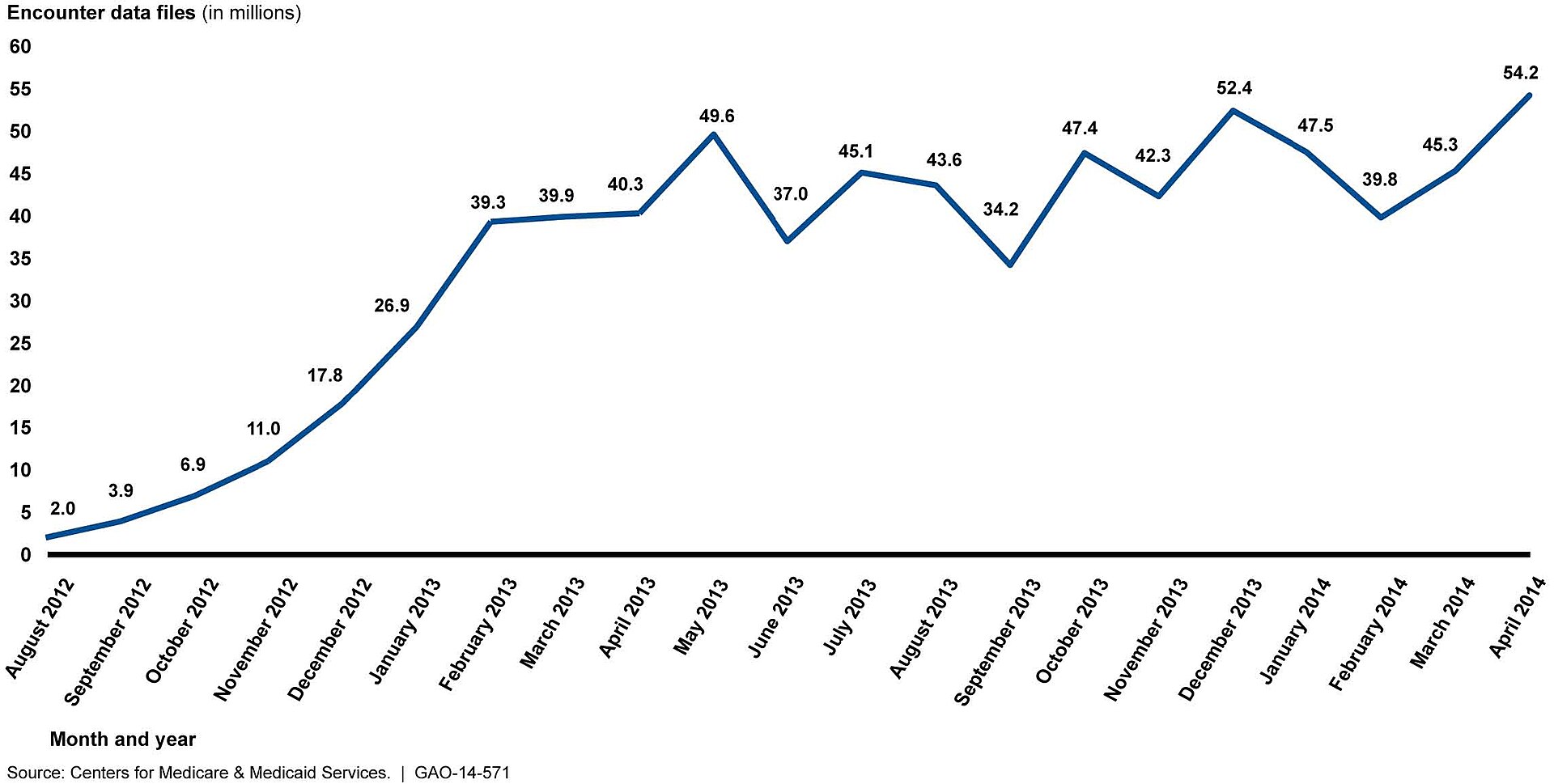
Two rules in the Code of Federal Regulations put the data side into effect. 42 CFR 422.310 requires each MA organization to submit "the data necessary to characterize the context and purposes of each item and service provided" to an enrollee, in a format equivalent to fee-for-service claims (the MA "encounter data"), and requires plans and their providers to "submit a sample of medical records for the validation of risk adjustment data." The same section sets the deadlines: the first Friday in September and the first Friday in March, with a final reconciliation deadline no earlier than Jan. 31 of the year after the payment year. After that final deadline, a plan "can submit data to correct overpayments but cannot submit diagnoses for additional payment."15
The CMS-HCC model in plain terms
CMS's model has a long name: the CMS Hierarchical Condition Category model, or CMS-HCC. A hierarchical condition category (HCC) is a group of related diagnosis codes that predict similar costs. There are about 74,000 ICD-10-CM diagnosis codes; the version of the model CMS adopted for 2024 sorts them into 266 HCCs, of which 115 count for payment. The older model, which CMS calls the 2020 model, had 204 HCCs and 86 payment HCCs.2
"Hierarchical" means that within a disease family only the most severe category counts. A person coded with both a mild and a severe form of the same condition is paid for the severe form only. Each payment HCC carries a coefficient, a number that represents its share of expected annual cost relative to the average beneficiary. The model adds up:
- a demographic factor for age and sex (different for people in the community and in institutions, for people who are also on Medicaid, and for people who first qualified through disability);
- a coefficient for each payment HCC the person has, after the hierarchy is applied;
- extra interaction terms for some combinations, such as diabetes with heart failure; and
- for people with many conditions, a count variable (in the 2024 model the count terms start at five payment HCCs for community enrollees).2
The total is the raw risk score. A score of 1.0 means the person is expected to cost about as much as the average beneficiary. CMS then divides by a normalization factor so that the average score stays near 1.0 as coding and costs drift over time (1.079 for the 2024 model in 2027), and multiplies by one minus the coding adjustment (5.9 percent). The plan's monthly payment for that person is roughly the plan's rate for an average-risk enrollee times the final score.31
Where do the diagnoses come from? For payment year 2027, CMS uses diagnoses from the 12 months before the payment year, taken from MA encounter data and fee-for-service claims, and only from services that count under CMS rules (DOJ describes the rule as requiring support in "the medical record of a face-to-face visit between a patient and a provider").12 CMS's 2027 Rate Announcement also stopped counting diagnoses that appear only on "unlinked" chart review records, as explained below.315
A worked example
The example below is a hypothetical person, built only to show the arithmetic. It uses real coefficients from the 2024 CMS-HCC model (the model in use for 2026 and kept for 2027), the 2027 normalization factor and coding adjustment, and the real 2027 Twin Falls County rate from CMS's rate book.2316
How we figured it: one hypothetical Twin Falls enrollee
The person (hypothetical). A 72-year-old woman living at home in Twin Falls County, not on Medicaid, who first qualified for Medicare by age.
Coefficients (2024 CMS-HCC model, "Community, NonDual, Aged" column, CY 2024 Rate Announcement): female age 70 to 74 = 0.395; HCC 37, diabetes with chronic complications = 0.166; HCC 226, heart failure except end-stage and acute = 0.360; the diabetes and heart failure interaction = 0.112. The count terms are zero below five payment HCCs.2
Raw scores. No recorded conditions: 0.395. Diabetes only: 0.395 + 0.166 = 0.561. Heart failure only: 0.395 + 0.360 = 0.755. Both: 0.395 + 0.166 + 0.360 + 0.112 = 1.033.
Payment scores. Raw score / 1.079 (2027 normalization factor) x (1 - 0.059) (coding adjustment). Both conditions: 1.033 / 1.079 x 0.941 = 0.901.3
Dollars. Times the 2027 Twin Falls rate with no star bonus, $1,242.09 a month: no conditions $427.88; diabetes only $607.69; heart failure only $817.84; both $1,118.98. The two recorded conditions add about $691 a month, or about $8,293 a year, for this one person.16
Limits. Real payments start from each plan's bid, not the county rate, and include rebates, star bonuses, other adjustments and Part D. The example shows direction and size, not any real person's payment. Any real plan's numbers are in its bid and CMS's payment records, which are not public.
The example shows why accuracy matters in both directions. If the woman really has both conditions and her doctor never records them, the plan is underpaid for a costly patient. If a code is added without a real diagnosis behind it, Medicare pays for a cost that does not exist. The rest of this lesson is about how anyone can tell the difference.
Normalization and the coding adjustment are different tools
The two numbers that shrink every score are easy to confuse. Normalization corrects for drift in coding and costs across all of Medicare, including Original Medicare: as doctors everywhere record more conditions over time, average raw scores rise, so CMS rescales them to keep the average near 1.0 for the payment year. CMS's 2027 notice says it calculated the factors "using a four-year simple linear regression methodology and average historical FFS risk scores from 2022 through 2025." The MA coding adjustment addresses the extra coding in MA compared with Original Medicare for similar people. The fact sheet for 2027 lists the coding adjustment as a 0 percent change from 2026, because the 5.9 percent cut was already in place, and lists the normalization update as a 1.12 percent reduction.317
CMS's fact sheet also states, in a footnote, that the projected 2.48 percent rise in 2027 payments "does not include an adjustment for underlying coding trend in MA," and that "CMS expects the MA risk scores to increase, on average, by 2.50% due to the underlying coding trend." Counting that trend, CMS put the 2027 increase at 4.98 percent.17
The 2024 model change, phased in from 2024 to 2026
What CMS changed
On March 31, 2023, CMS finalized a new version of the model for payment year 2024. CMS's announcement described three goals: moving the model's base to ICD-10 diagnosis codes "to align with the rest of the health care system, which has been using ICD-10 since 2015"; recalibrating on newer data (2018 diagnoses and 2019 spending, instead of 2014 diagnoses and 2015 spending); and making "clinically-based adjustments" so the model is "less susceptible to discretionary coding, which can lead to excess payments to MA plans."2
The numbers in the announcement show the size of the change. Payment HCCs went from 86 to 115, because ICD-10 allows finer distinctions, but 2,236 diagnosis codes that had mapped to a payment HCC no longer did. CMS also set some related categories to the same coefficient on purpose. In the 2024 model, the three diabetes categories (HCC 36 severe acute complications, HCC 37 chronic complications and HCC 38 glycemic, unspecified or no complications) all carry 0.166 in the community, non-dual, aged segment, so coding a more severe form of diabetes no longer raises the payment. The same is true of the three heart failure categories HCC 224 to 226, which all carry 0.360.2
Plan groups, MedPAC and many reporters call the old and new models "V24" and "V28," after CMS's software version numbers; MedPAC's March 2026 report uses "the V28 risk model."4
The phase-in
CMS did not switch at once. The 2024 announcement set a three-year blend, and the 2026 announcement completed it.218
| Payment year | Share of score from the 2020 model (86 payment HCCs) | Share from the 2024 model (115 payment HCCs) | Coding adjustment | Source |
|---|---|---|---|---|
| 2023 | 100% | 0% | 5.9% | CY 2024 Rate Announcement (describes the "current model")2 |
| 2024 | 67% | 33% | 5.9% | CY 2024 Rate Announcement2 |
| 2025 | 33% | 67% | 5.9% | CY 2024 Rate Announcement (expected schedule); MedPAC March 2025219 |
| 2026 | 0% | 100% | 5.9% | CY 2026 Rate Announcement18 |
| 2027 | 0% | 100% (a proposed newer model was not adopted) | 5.9% | CY 2027 Rate Announcement and fact sheet317 |
For 2027, CMS had proposed a further recalibrated model in its Advance Notice. The final fact sheet says "CMS is not implementing an updated risk adjustment model for CY 2027," and the payment effect it lists under "risk model revision and normalization" is "entirely due to the normalization factor update."17
What the change did, by MedPAC's estimate
MedPAC, the Medicare Payment Advisory Commission, is the independent congressional agency that advises Congress on Medicare payment. Its March 2026 report estimates that the new model reduced coding intensity "by 2.9 percentage points in each year of the model's phase-in (2024 through 2026)." It also notes that plans kept rebates at "a record high" in 2026, $222 per enrollee per month, "despite the complete phase-in of the V28 risk model."4
Coding intensity: what MedPAC measures and what plans say
How MedPAC defines it
MedPAC's March 2026 report defines coding intensity as "the tendency for more diagnosis codes to be recorded for MA enrollees, which causes risk scores, and payments, for the same beneficiaries to be higher when they are enrolled in MA than they would be in FFS Medicare." It lists the drivers plainly: plans documenting diagnoses more fully than providers in Original Medicare (who, MedPAC notes, "may not report all possible diagnosis codes"), "submitting fraudulent diagnostic data, and other reasons." It adds that "separately identifying all of the factors causing favorable selection and coding intensity is challenging and in many cases not possible, given available data." That sentence matters for reporters: a MedPAC coding estimate is not a fraud estimate, and MedPAC does not say what share is fraud.4
MedPAC's method compares the risk scores of MA enrollees with those of similar people in Original Medicare, controlling for age, sex, Medicaid status and other traits, and looks at how scores change when people move into MA. MedPAC changed its method in its March 2024 report, so estimates from before and after that change are not directly comparable.19
The estimates
| Measure (MedPAC estimate) | March 2025 report | March 2026 report |
|---|---|---|
| MA risk scores above similar FFS enrollees, before CMS's cut | About 17% (2023, measured); about 16% (2025, projected) | About 14% (2024, measured); about 10% (2026, projected) |
| After the 5.9% coding adjustment | About 10% (2025) | About 4% (2026) |
| Dollars from coding intensity | About $40 billion (2025) | About $22 billion (2026) |
| Dollars from favorable selection | About $44 billion (2025) | About $57 billion (2026) |
| Total MA payments above FFS for similar people | 20%, about $84 billion (2025) | 14%, about $76 billion (2026) |
| Cumulative higher payments from coding intensity | $224 billion, 2007 to 2025 | $233 billion, 2007 to 2026 ($184 billion through 2024 plus $28 billion and $22 billion projected for 2025 and 2026) |
Sources: MedPAC, March 2025 report, chapter 11; March 2026 report, chapter 12. MedPAC presents the coding and selection parts separately; they do not always sum exactly to the total.194
Coding intensity varies a lot by plan
The 5.9 percent cut is the same for every plan, but coding is not. MedPAC's March 2026 report says 16 percent of MA enrollees were in plans whose 2024 coding intensity "fell below CMS's coding adjustment," while "eight MA organizations" had average coding intensity "more than 20 percent higher than FFS levels in 2024," and "eight of the 10 largest MA organizations had coding intensity that was at least 5 percentage points higher than CMS's coding adjustment." MedPAC does not name the organizations in that passage. The practical effect is that a plan that codes the way Original Medicare doctors do is cut 5.9 percent below its real risk, while a plan that codes far above that keeps the difference.4
MedPAC's standing recommendation, first made in March 2016, is that Congress direct a model that "uses two years of FFS and MA diagnostic data and does not include diagnoses from health risk assessments from either FFS or MA," followed by "a coding adjustment that fully accounts for the remaining differences in coding." Congress has not enacted it.4
The industry response
Plans and their trade groups dispute MedPAC's numbers. In a memo dated March 12, 2026, the Better Medicare Alliance, an advocacy group supported by MA plans and others, said MedPAC's estimates "are just that: estimates," and cited an analysis by CMS researchers that it said found coding intensity of "just 1.5-2%, compared to 10% previously estimated by MedPAC." The memo also cited a Healthcare Leadership Council report saying MedPAC's new method "nearly quadrupled" its estimate of 2024 overpayments "without any change in the actual program."5 Plans also argue that the comparison leaves out the value of extra benefits and the annual out-of-pocket cap that Original Medicare lacks; MedPAC's own report says enrollees in its focus groups name supplemental benefits as "the primary reason" they choose MA.4
What the record supports: MedPAC, CMS and OIG all describe a gap between MA and Original Medicare coding; they disagree on its size; MedPAC's estimate fell sharply as the 2024 model phased in; and nobody has published a measured number for how much of the gap reflects real illness that Original Medicare doctors fail to record versus diagnoses that are wrong. MedPAC also estimates that higher MA payments raise Part B premiums for everyone with Part B, by about $11 billion in 2026, roughly $175 per beneficiary.4
Chart reviews and in-home health risk assessments
What they are
A chart review is a plan (or a vendor it hires) reading enrollees' medical records after the fact to find diagnoses the treating provider documented but did not code, or coded wrongly. CMS lets plans submit chart review records that add diagnoses or delete them. A linked chart review is tied to a specific service record; an unlinked chart review is not. A health risk assessment (HRA) is a questionnaire and visit, often in the enrollee's home, usually done by a nurse practitioner or physician working for a company the plan hires, that can record diagnoses. Both are legal. Both can catch real conditions. OIG's reports question what happens when the only evidence of a costly diagnosis, across a whole year, is the plan's own chart review or HRA.2021


OIG's four evaluations
The HHS Office of Inspector General's Office of Evaluation and Inspections has measured these payments four times. Each report used MA encounter data for one year to estimate payments in the next.
| Report and date | What OIG estimated | Payment year | CMS response and status (per OIG's page, read Nov. 24, 2026) |
|---|---|---|---|
| OEI-03-17-00470, "Billions in Estimated Medicare Advantage Payments From Chart Reviews Raise Concerns," Dec. 10, 2019 | $6.7 billion from diagnoses reported only on chart reviews, with no service record; about $2.7 billion from unlinked chart reviews; over 99 percent of chart reviews added diagnoses | 2017 | CMS concurred with all three recommendations. The recommendation to reassess unlinked chart reviews was closed as implemented on April 7, 2026; the recommendation to audit chart review diagnoses against records remains open.20 |
| OEI-03-17-00471, "Billions in Estimated Medicare Advantage Payments From Diagnoses Reported Only on Health Risk Assessments Raise Concerns," Sept. 8, 2020 | $2.6 billion from diagnoses reported only on HRAs; in-home HRAs were 80 percent of that | 2017 | CMS disagreed with three of five recommendations, including reassessing in-home HRAs as a diagnosis source (closed as superseded Aug. 19, 2025); four remain open.21 |
| OEI-03-17-00474, OIG's report on 20 companies' use of chart reviews and HRAs, Sept. 13, 2021 (full title in the note) | 20 of 162 companies drove a disproportionate share of $9.2 billion from chart-review-only and HRA-only diagnoses; one company had 40 percent of those payments with 22 percent of enrollees | 2017 (2016 data) | CMS neither concurred nor nonconcurred. Two recommendations closed as "acceptable alternative" Sept. 10, 2026; one open.22 |
| OEI-03-23-00380, "Medicare Advantage: Questionable Use of Health Risk Assessments Continues To Drive Up Payments to Plans by Billions," Oct. 21, 2024 | $7.5 billion from diagnoses reported only on HRAs and HRA-linked chart reviews, for 1.7 million enrollees; 20 companies drove 80 percent; in-home HRAs and linked chart reviews almost two-thirds | 2023 (2022 data) | CMS did not concur with two of three recommendations (restricting and auditing these diagnoses); all three open.23 |
OIG's 2021 report did not name the one company that drove the largest share, and the OIG page does not name it. Some news reports have named it; we do not, because the OIG record does not.22 OIG's 2024 report states its concern in two halves: the lack of follow-up care raises concerns that either "(1) the diagnoses are inaccurate and thus the payments are improper or (2) enrollees did not receive needed care for serious conditions." That is the honest frame for a reader. A home-visit diagnosis of a serious condition with no follow-up visit in the whole year means either a bad code or a sick person who got no care, and OIG's data alone cannot say which.23
What CMS changed for 2027
In its 2027 Rate Announcement, CMS finalized "the proposal to exclude diagnoses from unlinked chart review records (CRRs), with an exception for beneficiaries who switch from one MA organization to another." CMS estimated the payment effect at minus 1.53 percent; without the exception for people who switch plans, it would have been minus 1.78 percent. CMS did not exclude diagnoses from in-home HRAs, which OIG had asked it to restrict; commenters raised that idea and CMS said it would "consider these recommendations in the development of future risk adjustment model proposals."317
RADV: how CMS audits the diagnoses
What the rules say
The audit authority sits in two sentences of 42 CFR 422.310(e): plans and their providers "are required to submit a sample of medical records for the validation of risk adjustment data," and plans "must remit improper payments based on RADV audits, in a manner specified by CMS." The same paragraph says that "CMS may extrapolate RADV Contract-Level audit findings for payment year 2018 and subsequent payment years," and 42 CFR 422.311(a)(2) repeats that CMS "may apply extrapolation to audits for payment year 2018 and subsequent payment years." Those sentences were added by the 2023 rule discussed below. A court vacated that rule in 2025, but the electronic Code of Federal Regulations still printed those sentences on Nov. 24, 2026.1569
Extrapolation means projecting the error rate found in a random sample onto the whole contract. If an audit of 200 sampled enrollees finds unsupported codes worth a certain share of their payments, extrapolation applies that share to every enrollee in the sampling frame. Without extrapolation, CMS can recover only the dollars tied to the sampled people themselves, which is why the older audit results below are so small.
How a contract-level RADV audit works
CMS's methods document for payment year 2024, published Aug. 28, 2026, and the appeal rule at 42 CFR 422.311 describe these steps.246
- CMS picks the contracts. For newly started audits CMS now selects every eligible contract; for payment year 2024 it listed about 590.7
- CMS builds a sampling frame. For payment year 2024, enrollees had to meet several tests, including continuous enrollment, not being in certain special needs plans, and not being part of an OIG audit or settlement covering the same data; and they had to rank in the top quartile of CMS's "improper payment prediction models," meaning CMS predicted the biggest drop in their risk score from an audit.24
- CMS draws a sample sized to the contract. The ten contracts with the largest frames get 200 enrollees; the rest are split into thirds with 100, 50 and 35. Small frames are audited in full.24
- The plan submits medical records. For each audited HCC, the plan sends records to support the diagnosis. Records must come from an acceptable source and visit.6
- Certified coders review them. CMS says it "tasks certified medical record coders to perform the intake and diagnosis code abstraction reviews."25
- CMS calculates the payment error. Each sampled person's risk score is recalculated without unsupported HCCs, and CMS's methods document explains how "additional HCCs" found in the records are treated. The difference in payment is the error.24
- CMS issues an audit report. Under 42 CFR 422.311(b), it shows enrollee-level discrepancies, the contract-level error estimate and the payment adjustment.6
- The plan may appeal within 60 days, first to a reconsideration official, then a hearing officer, then CMS Administrator review. The plan bears the burden of proof by a preponderance of the evidence and cannot appeal CMS's methodology itself.6
- CMS recovers the money "in a manner specified by CMS"; the 2023 rule discussed recovery through a reduction in the plan's monthly payments.1526
The long backlog, in CMS's own files
For more than a decade, RADV produced little money. In May 2025, CMS itself said that "the last significant recovery of MA overpayments occurred following the audit of payment year (PY) 2007" and that "CMS's completed audits for PYs 2011 to 2013 found between 5% and 8% in overpayments." In March 2026, CMS posted contract-by-contract results for payment years 2011 through 2015. Because the 2023 rule barred extrapolation before payment year 2018, these are sample-level dollars only; CMS's PY 2015 methodology says it "will only collect non-extrapolated overpayments" for those audits.27728
| Payment year | Contracts audited | Contracts with $0 overpayment | Total overpayment (sample only) | Largest single contract | Results posted |
|---|---|---|---|---|---|
| 2011 | 30 | 6 | $3,952,086 | $474,029 | March 4, 2026 |
| 2012 | 30 | 6 | $5,715,759 | $1,183,402 | March 4, 2026 |
| 2013 | 30 | 7 | $3,321,977 | $336,976 | March 4, 2026 |
| 2014 | 200 | 32 | $13,459,389 | $572,535 | March 4, 2026 |
| 2015 | 204 | 48 | $11,165,787 | $931,416 | March 4, 2026 |
| Total, 2011 to 2015 | 494 | 99 | $37,614,998 |
How we figured it: RADV results by payment year
Data. CMS's five Excel files, "Payment Year 2011 (2012, 2013) List of Audited Contracts and Identified Overpayments" and "Payment Year 2014 (2015) List of Audited Contracts and Audit Results," posted March 4, 2026, downloaded Nov. 24, 2026. Each row is one contract with a "Total Overpayment" field.7
Method. We counted rows with a contract number, counted rows where the overpayment is exactly zero, summed the overpayment field and took the maximum. Sums are rounded to the dollar.
Limits. A contract can serve several states; the dollars are contract-wide. These totals are not what CMS would have recovered with extrapolation. For scale, CMS's own Part C improper payment estimate for a single year (fiscal 2026, measuring calendar 2024 payments) was about $23.86 billion.52
The audit counts then jump. CMS's posted lists for later years show 58 contracts for payment year 2018 (45 on "Version A" and 13 on "Version B"), 355 for 2019, 471 for 2020, 492 for 2021, 582 for 2023 and 590 for 2024 (our count of rows in each list). CMS's schedule, updated Nov. 17, 2026, shows audits for payment year 2020 started March 20, 2026; 2021 on May 29, 2026; 2024 on Aug. 28, 2026; and 2023 on Nov. 13, 2026. Payment year 2022 is planned for January to February 2027 and 2025 for April to May 2027, "subject to change."78
The 2023 rule: extrapolation without a fee-for-service adjuster
The final rule published at 88 FR 6643 on Feb. 1, 2023, effective April 3, 2023, did two things. It said CMS "will extrapolate RADV audit findings beginning with payment year (PY) 2018 and will not extrapolate RADV audit findings for PYs 2011 through 2017." And it said CMS "will not apply an adjustment factor (known as a Fee-For-Service (FFS) Adjuster) in RADV audits."26
The FFS adjuster is the heart of the dispute. Plans argued that the CMS-HCC model is built from Original Medicare claims, which are themselves full of diagnoses that would not survive a medical-record audit. If MA plans are paid at rates built on imperfect fee-for-service coding, they said, then holding MA plans to a strict record standard, without adjusting for the error already baked into the rates, breaks the statute's promise of "actuarial equivalence." CMS's 2012 audit method had included such an adjuster, though CMS never applied it to any audit. In the 2023 rule, CMS dropped it, citing the D.C. Circuit's 2021 decision in UnitedHealthcare Insurance Co. v. Becerra, 16 F.4th 867, which CMS read to mean that "the actuarial equivalence provision of the statute applies only to how CMS risk adjusts the payments it makes to MAOs and not to the obligation of MAOs to return improper payments." CMS also reasoned that it would not be reasonable to read the statute as requiring a minimum coding cut while barring CMS from enforcing documentation rules without an offset.26
The rule's own impact estimate was modest: about $4.7 billion in total recoveries from 2023 through 2032, net of a $51 million annual audit cost.26
Humana v. Becerra, now Humana v. Kennedy
Humana Inc. and Humana Benefit Plan of Texas, Inc. sued in the U.S. District Court for the Northern District of Texas, Fort Worth Division (No. 4:23-cv-00909-O). On Sept. 25, 2025, Chief Judge Reed O'Connor granted summary judgment to Humana on one claim: that the final rule was "procedurally invalid as it was not a 'logical outgrowth' of the Proposed Rule," because CMS changed its reasons for refusing an FFS adjuster between the proposal and the final rule. The court vacated the rule and sent it back to the agency, and did not decide Humana's other claims. Those facts are as the government describes them in its appeal brief.9
The government filed a notice of appeal on Nov. 21, 2025 (Fifth Circuit No. 25-11293). Its opening brief argues that the statute's "logical outgrowth" test applies to the rule's text, not its preamble reasons, and that the proposed and final rules were identical in declining an FFS adjuster. America's Health Insurance Plans and other groups filed an amicus brief for Humana; a group of economists and health policy scholars filed one for the government. STAT reported that a Fifth Circuit panel heard argument on Oct. 5, 2026 and "seemed poised to toss the rule out, again." The Georgetown Law litigation tracker, last updated Nov. 19, 2026, listed a Humana "notice of supplemental authority" filed Nov. 18, 2026 and no decision. As of Nov. 24, 2026, the case was pending on appeal as far as we could confirm.91030
What the vacatur means in practice is visible in CMS's own audit instructions. CMS's payment year 2024 methods document says the 2023 rule "was vacated by a federal district court in 2025, in a decision that is currently under appeal," that CMS "has designed its PY 2024 MA contract-specific RADV audits to calculate extrapolated overpayments," and that it "has not yet decided whether it will collect extrapolated overpayment amounts or only overpayments associated with the sampled enrollees." CMS's general RADV questions and answers, updated Nov. 13, 2026, showed several answers as "[Updated Q&A coming soon]."2425
The May 2025 expansion, and what happened next
On May 21, 2025, CMS announced that it would "audit all eligible MA contracts for each payment year in all newly initiated audits," about 550 plans instead of about 60 a year; would increase its "team of medical coders from 40 to approximately 2,000 by September 1, 2025"; would raise sample sizes from 35 records per plan to between 35 and 200; and would "complete all remaining RADV audits for PY 2018 to PY 2024 by early 2026." The release cited "federal estimates suggesting MA plans may overbill the government by approximately $17 billion annually" and a MedPAC figure "as high as $43 billion per year." CMS Administrator Dr. Mehmet Oz said, "We are committed to crushing fraud, waste and abuse across all federal healthcare programs."27
The files posted since then show the expansion in contract counts but not the completion date. As of the Nov. 17, 2026 schedule, audits for payment years 2020, 2021, 2023 and 2024 had been started in 2026 and payment year 2022 had not; the CMS pages we read did not post extrapolated results or recovery totals for any payment year from 2018 on.87
The November 2026 CRUSH proposal
On Nov. 16, 2026, CMS issued a broad program integrity proposed rule it calls CRUSH (CMS-6098-P). For RADV, CMS proposes "to codify that it would not apply a fee-for-service (FFS) adjuster, would determine the applicable sampling methodology, and would begin extrapolation of audit findings with payment year (PY) 2018 audits." CMS estimates this "would enable the agency to collect an average of approximately $9 billion per payment year." The proposal would also put the RADV hardship exception process into regulation and would require providers who bill MA plans to be enrolled in Original Medicare. The proposal was published in the Federal Register on Nov. 19, 2026 (91 FR 74680), and the comment period closes Jan. 19, 2027. A proposed rule is not law; reporters should expect the same procedural and statutory arguments to return in comments and in court.11
The $9 billion figure is CMS's projection for a rule that does not yet exist, set against the rule's earlier estimate of $4.7 billion over ten years. The difference reflects many more audited contracts and larger samples, but the CMS fact sheet does not show the method, so treat it as CMS's estimate.1126
OIG audits of specific diagnosis codes
Separate from CMS's RADV program, OIG's Office of Audit Services runs a long series titled "Medicare Advantage Compliance Audit of Specific Diagnosis Codes." Each audit takes one contract, picks "high-risk" diagnosis groups that OIG's data analysis flags as likely errors (for example an acute stroke code from a doctor's office with no hospital stay, or a code that looks mis-keyed), pulls the medical records and estimates the overpayment. OIG's July 2024 impact brief says it had issued "over 40 reports" on managed care payment risks since 2019 and that 70 percent of audited diagnosis codes were not supported by records.31 A few examples show the pattern, including one from a neighboring state.
| Report | Contract or subject | Years | Sample result | OIG estimate | Response |
|---|---|---|---|---|---|
| A-09-20-03009, Sept. 13, 2022 | Regence BlueCross BlueShield of Oregon, contract H3817 | 2015 and 2016 | 111 of 179 enrollee-years unsupported; $248,885 net overpaid in the sample | At least $1.8 million ($1,890,855 recommended refund) | Regence disagreed and did not concur; agreed to correct data for 108 of the 11132 |
| A-07-20-01198, Feb. 16, 2024 | MediGold, contract H3668 | 2017 and 2018 | 189 of 210 enrollee-years unsupported | At least $3.7 million; refund recommended $2.2 million because extrapolation was limited to 2018 and later | MediGold disputed findings and the method33 |
| A-02-23-01020, May 28, 2026 | Acute stroke codes on physician records with no hospital stay, all MA organizations | 2021 | All 97 sampled enrollees unsupported | $462 million potential net overpayments | CMS did not say whether it concurred34 |
| A-07-24-01215, Sept. 23, 2026 | UnitedHealthcare Benefits of Texas, contract H0609 | 2020 and 2021 | 172 of 230 enrollee-years unsupported; $622,927 in the sample | At least $24.4 million ($24,465,369 recommended refund) | United disagreed with some findings and asked that all recommendations be withdrawn35 |
Two cautions. These audits deliberately sample the riskiest codes, so their error rates describe those codes, not a plan's coding as a whole. And an OIG recommendation is not a final debt: the plan can dispute it, and CMS decides what to collect. Regence BlueCross BlueShield of Oregon's contract H3817 had 57 Idaho enrollees in November 2026, by CMS's county-contract file.14
The measured error rate: the Part C improper payment estimate
Every year CMS measures the Part C improper payment rate by reviewing a sample of enrollees' medical records, much like a national RADV audit used only for measurement. Lesson 1 explains improper payment measurement in general; here is what it shows for MA risk adjustment.29
For fiscal year 2026 (based on calendar year 2024 payments), CMS reported a Part C improper payment rate of 5.68 percent, about $23.86 billion of $419.94 billion in Part C payments. Overpayments were $21.60 billion (5.14 percent of payments) and underpayments $2.26 billion; the net error was $19.34 billion, or 4.61 percent. Missing or insufficient documentation accounted for $3.40 billion, 0.81 percent of payments. HHS reported the same 5.68 percent rate in its FY 2026 Agency Financial Report, whose Secretary's message is dated Nov. 13, 2026.52
The year before, for fiscal year 2025 (calendar year 2023 payments), the rate was 6.09 percent, about $23.67 billion of $388.72 billion, up from 5.61 percent ($19.07 billion) for fiscal 2024. Overpayments were $21.43 billion and underpayments $2.23 billion; the net error was $19.20 billion, or 4.94 percent. CMS's fiscal 2025 fact sheet says "most Part C improper payments were attributable to situations where the Medicare Advantage Organization's supporting documentation failed to substantiate the beneficiary diagnosis data submitted for payment." Missing documentation was a small part that year: $869 million, 0.22 percent of payments.2936
This is the measured number reporters most often misuse. It measures how many reported diagnoses a reviewer could not confirm in the record. It is not a fraud rate, and it is not MedPAC's coding intensity estimate either: a perfectly documented diagnosis can still be part of coding intensity, and an unsupported code can be an honest mistake. The $17 billion "overbilling" figure in CMS's May 2025 release appears to come from this measure, but the release does not cite it, so treat that link as our inference.2729
False Claims Act cases about MA coding
How a coding case is built
The False Claims Act, 31 U.S.C. 3729 to 3733, makes a person liable for knowingly presenting a false claim for payment, or knowingly making a false record material to one, and for knowingly keeping an overpayment (a "reverse false claim"). The statute, its penalties and the whistleblower (qui tam) process are in lesson 3. For MA plans, two features make it apply. First, under 42 CFR 422.504(l), a plan's chief executive or chief financial officer (or a delegate) requests each monthly payment on a document that certifies, "based on best knowledge, information, and belief," the "accuracy, completeness, and truthfulness" of the data CMS requests, including encounter data.37 Second, 42 CFR 422.326 says an MA organization that "knowingly receives or retains an overpayment" must report and return it within 60 days, with a six-year look-back, and an overpayment kept past that point "is an obligation under 31 U.S.C. 3729(b)(3)." The current version of that rule took effect after a Dec. 9, 2024 amendment (89 FR 98565).38
The cases below share a theory: the plan or provider group looked for diagnoses that would raise payment but did not look for, or did not delete, codes that its own reviews showed were unsupported. Others turn on how codes were added: addenda written months after a visit, pressure on doctors through quotas and bonuses, or home-visit forms that recorded serious conditions without the tests to support them.1239
The settled cases
Each settlement below is a compromise of disputed claims. In every DOJ release cited here except the 2012 SCAN release, the government states that the claims are "allegations only" and that "there has been no determination of liability"; the SCAN release says instead that SCAN "did not admit wrongdoing." None is a court finding of fraud.
| Date | Who settled | Amount | What the United States alleged | Case |
|---|---|---|---|---|
| Aug. 23, 2012 | SCAN Health Plan (California) | $3.82 million for the Medicare part (total $323.67 million, mostly Medi-Cal) | Did not tell CMS that some original diagnosis codes might need deleting after outside chart reviews; SCAN did not admit wrongdoing | Relator James M. Swoben (C.D. Cal., filed 2009)40 |
| May 30, 2017 | Freedom Health Inc. and related entities; former COO Siddhartha Pagidipati | $31,695,593 plus $750,000 | Unsupported diagnosis codes for two Florida plans, 2008 to 2013; also network misstatements | U.S. ex rel. Sewell v. Freedom Health, No. 8:09-cv-1625 (M.D. Fla.)41 |
| April 12, 2019 | Sutter Health LLC and medical foundations | $30 million | Unsupported diagnosis codes for patients in MA plans that shared payments with Sutter | U.S. ex rel. Ormsby v. Sutter Health, No. 15-cv-01062-JD (N.D. Cal.)42 |
| July 31, 2023 | Martin's Point Health Care Inc. (Maine) | $22,485,000 | Chart review diagnoses not supported by records, 2016 to 2019 | U.S. ex rel. Wilbur v. Martin's Point, No. 2:18-cv-00254 (D. Me.)43 |
| Sept. 30, 2023 | The Cigna Group | $172,294,350 | Chart reviews 2014 to 2019 that added codes but did not delete unsupported ones; diagnoses from vendor home-visit forms alone; morbid obesity codes without the required BMI; five-year corporate integrity agreement | U.S. ex rel. Cutler v. Cigna Corp., No. 3:21-cv-00748 (M.D. Tenn.)39 |
| Dec. 20, 2024 | Independent Health (Buffalo, N.Y.); Betsy Gaffney, chief executive of its former subsidiary DxID | Up to $98 million ($34.5 million guaranteed); Gaffney $2 million | Retrospective chart reviews and physician queries that added unsupported diagnoses, 2011 to at least 2017 | U.S. ex rel. Ross v. Independent Health, No. 12-cv-0299 (W.D.N.Y.)44 |
| Jan. 14, 2026 | Kaiser Permanente affiliates (California and Colorado) | $556 million (relator share $95 million) | Pressured physicians to add diagnoses by addenda after visits, 2009 to 2018, with goals and bonuses tied to adding diagnoses | U.S. ex rel. Osinek v. Kaiser, No. 3:13-cv-03891, and U.S. ex rel. Taylor v. Kaiser, No. 3:21-cv-03894 (N.D. Cal.)12 |
| Aug. 3, 2026 | Complete Health Partners Holdings (Florida) | $14,100,000 | Caused false codes in HCC 55 (drug and alcohol dependence) and HCC 59 (major depressive, bipolar and paranoid disorders), 2020 to 2023 | U.S. ex rel. Bowers v. Complete Health Partners, No. 3:22-cv-463 (M.D. Fla.)45 |
| Aug. 24, 2026 | Monogram Health (Tennessee) | $2.4 million | Codes in four HCCs not clinically accurate or documented, 2021 to 2023 | U.S. ex rel. Gupta v. Monogram Health, No. 2:22-cv-08758 (C.D. Cal.)46 |
| Aug. 26, 2026 | The Villages Health System LLC (Florida) | $541.5 million, approved by the bankruptcy court | Submitted false diagnosis codes to MA plans, 2020 to 2024; the company self-disclosed to OIG | In re Villages Health System, LLC, No. 6:25-bk-04156 (Bankr. M.D. Fla.)13 |
How we figured it: the settlement total
We added the amounts in the table: $3.82 million (SCAN, Medicare part only) + $32.45 million (Freedom Health and its former COO) + $30 million (Sutter) + $22.49 million (Martin's Point) + $172.29 million (Cigna) + $100 million (Independent Health at its $98 million maximum plus Gaffney's $2 million) + $556 million (Kaiser) + $14.1 million (Complete Health) + $2.4 million (Monogram) + $541.5 million (The Villages Health) = about $1,475 million. Independent Health's guaranteed amount was $34.5 million, so the floor is about $1,412 million. These are settlement amounts, not recoveries actually collected, and the list is selected, not complete.
UnitedHealth: a long civil case and a 2025 investigation
The largest MA coding case is still unresolved as far as the public record we could reach shows. In United States ex rel. Poehling v. UnitedHealth Group, Inc., No. 2:16-cv-08697 (C.D. Cal.), a whistleblower, Benjamin Poehling, sued in 2011, and the United States intervened in part in 2017. KFF Health News reported that the government alleged Medicare paid UnitedHealth more than $7.2 billion from 2009 through 2016 based on unsupported codes and would have paid $2.1 billion less without them. On March 3, 2025, the court's special master, Suzanne Segal, recommended granting UnitedHealth's motion for summary judgment, writing, "A mere possibility of an overpayment is not enough for the government to carry its burden." The plaintiffs filed a motion for review with the district judge, Fernando M. Olguin, on April 2, 2025, and a hearing was held Nov. 24, 2025. The Georgetown Law litigation tracker, last updated Sept. 13, 2026, listed no ruling after that hearing, and we could not confirm one. UnitedHealth said the special master found "no evidence to support the DOJ's claims we were overpaid."474849
Separately, on July 24, 2025, UnitedHealth Group said it had "proactively reached out to the Department of Justice after reviewing media reports about investigations into certain aspects of the Company's participation in the Medicare program" and had "now begun complying with formal criminal and civil requests from the Department." The company also said it had begun "third party reviews" of its "risk assessment coding" and other practices. DOJ had not announced charges or a civil complaint arising from those requests in the records we checked. A request for documents is not an accusation of wrongdoing.50
The Idaho angle
Who sells MA in Idaho
In November 2026, 192,566 of Idaho's 421,079 Medicare-eligible residents, 45.7 percent, were in MA, compared with 51.5 percent nationally (our calculation from CMS's penetration file). Idaho's MA share fell sharply in January 2026 when Blue Cross of Idaho and Regence BlueShield of Idaho cut back plans; that history is in 88/04.51
| Parent organization (CMS file) | Idaho contracts with the most enrollees | Idaho MA enrollees, Nov. 2026 | Share |
|---|---|---|---|
| UnitedHealth Group, Inc. | H4604, H2406, H4032, H2001 | 80,808 | 42.3% |
| Gemstone Holdings, Inc. (Blue Cross of Idaho) | H1350, H1302 | 36,158 | 18.9% |
| Trinity Health Corporation (Mount Carmel Health Plan of Idaho, sold as Saint Alphonsus Health Plan) | H6910, H3828 | 22,849 | 12.0% |
| PacificSource | H3864, H4754 | 17,030 | 8.9% |
| Humana Inc. | H7617, H5216 and others | 15,884 | 8.3% |
| Molina Healthcare, Inc. | H5628 | 12,878 | 6.7% |
| CVS Health (Aetna) | H5522 | 2,260 | 1.2% |
| All others | 3,311 | 1.7% | |
| Total in contract file | 191,178 | 100% |
Source: CMS Monthly MA Enrollment by State/County/Contract, November 2026 (full version), Idaho rows summed by contract; parent names from CMS files. Cells of 10 or fewer are suppressed, so the total runs below the penetration file. Our calculation.14
Two of the parent companies in that table are parties to MA coding matters described in this lesson. UnitedHealth is the defendant in Poehling and the subject of the 2025 DOJ requests; an OIG audit of a UnitedHealthcare Texas contract was issued Sept. 23, 2026. Humana is the plaintiff in the RADV rule case. None of those matters involves Idaho-specific allegations that we found.35914
Idaho contracts in RADV audits
Because CMS's RADV files list contract numbers, Idaho's plans can be traced. The early, sample-only results include contracts that serve Idaho today. The dollars are contract-wide, and several of these contracts serve more than one state.714
| Contract | Name in CMS RADV file | Idaho enrollees, Nov. 2026 | RADV overpayment found (sample only) | On later audit lists |
|---|---|---|---|---|
| H1350 | Blue Cross of Idaho Health Service / Care Plus | 32,375 | PY 2011: $77,065.72; PY 2015: $62,604.11 | 2019, 2020, 2021, 2023, 2024 |
| H4604 | UnitedHealthcare of Utah (now of the Rockies) | 33,224 | PY 2014: $46,174.28; PY 2015: $30,743.95 | 2019, 2020, 2021, 2023, 2024 |
| H5216 | Humana Insurance Company | 7,184 | PY 2015: $146,093.91 | 2018, 2019, 2020, 2021, 2023, 2024 |
| H5628 | Molina Healthcare of Utah | 12,878 | PY 2014: $0; PY 2015: $10,050.78 | 2019, 2020, 2021, 2023, 2024 |
| H3864 | PacificSource Community Health Plans | 15,091 | PY 2015: $9,960.36 | 2019, 2020, 2021, 2023, 2024 |
| H6910 | Mount Carmel Health Plan of Idaho | 22,127 | None posted | 2021, 2023, 2024 |
| H1304 | Regence BlueShield of Idaho | 756 | None posted | 2019, 2020, 2021, 2023, 2024 |
Sources: CMS RADV audited contract lists and results for payment years 2011 to 2024; CMS Monthly MA Enrollment by State/County/Contract, November 2026. Matching by contract number is our work.714
Idaho and its neighbors
Nearly all MA enrollees in Idaho and its neighbors are in contracts CMS has put under audit. The table compares MA shares and the share of each state's November 2026 MA enrollment in contracts on CMS's payment year 2024 RADV list.
| State | Medicare eligibles, Nov. 2026 | MA enrollees | MA share | Share of MA enrollees in PY 2024 audited contracts | Audited contracts with enrollees in the state |
|---|---|---|---|---|---|
| Idaho | 421,079 | 192,566 | 45.7% | 94.0% | 24 |
| Utah | 495,522 | 273,236 | 55.1% | 99.1% | 20 |
| Oregon | 978,713 | 525,320 | 53.7% | 99.0% | 37 |
| Washington | 1,595,647 | 790,652 | 49.6% | 94.1% | 37 |
| Montana | 274,899 | 80,946 | 29.4% | 99.9% | 16 |
| Wyoming | 134,304 | 19,845 | 14.8% | 63.9% | 8 |
| Nevada | 636,082 | 330,420 | 51.9% | 99.9% | 41 |
| United States | 69,779,581 | 35,959,234 | 51.5% | 94.3% | 590 listed |
How we figured it: share of enrollees in audited contracts
Data. CMS MA State/County Penetration file, November 2026 (eligibles, enrollees, share); CMS Monthly MA Enrollment by State/County/Contract, November 2026, full version; CMS "Payment Year 2024 List of Audited Contracts," Aug. 28, 2026.51147
Method. For each state we summed county-contract enrollment, then summed the enrollment in contracts whose ID appears on the PY 2024 list, and divided. Example for Idaho: 179,745 / 191,178 = 94.0 percent.
Limits. The PY 2024 audit covers 2024 payments; contracts and enrollment change from year to year, so this shows exposure, not who was audited for which person. Being on an audit list says nothing about whether a plan coded well or badly. The penetration file excludes Connecticut and Alaska in 2026, and the contract file suppresses small cells, so national totals differ slightly between files.
Idaho cases
We searched DOJ's national releases, the U.S. Attorney for the District of Idaho's releases, OIG's MA audit reports and the Georgetown Law litigation tracker for any risk adjustment coding case, settlement or OIG diagnosis-code audit that names an Idaho plan, an Idaho provider group or Idaho-specific conduct. As of Nov. 24, 2026, we found none. Idaho's documented health care fraud cases, which involve other schemes, are in lesson 5. The lack of a case is not proof that no problem exists; it means no public record we could find describes one.

A timeline of MA coding oversight
| Year | Law, rule or event | What changed | Source |
|---|---|---|---|
| 2006 | Social Security Act section 1853(a)(1)(C)(ii) | Coding adjustment required "for 2006 and each subsequent year" | 42 U.S.C. 1395w-231 |
| 2012 | CMS RADV method; SCAN settlement (Aug. 23) | CMS published an extrapolation method with an FFS adjuster, never applied; first large MA coding settlement | 88 FR 6643; DOJ2640 |
| 2014 to 2019 | Statutory minimum coding adjustment rises | From the 2010 factor plus 1.5 points in 2014, then at least 0.25 point a year, to "not less than 5.9 percent" from 2019 | 42 U.S.C. 1395w-231 |
| 2014 (May 23) | 79 FR 29958 | MA overpayment reporting rule, 42 CFR 422.326 | eCFR38 |
| 2017 (May 30) | Freedom Health settlement | $31.7 million plus $750,000 from a former officer | DOJ41 |
| 2019 | Sutter settlement (April 12); OIG chart review report (Dec. 10) | First big provider-group case; OIG puts chart-review-only diagnoses at $6.7 billion for 2017 | DOJ; OIG4220 |
| 2020 (Sept. 8) | OIG HRA report | $2.6 billion from HRA-only diagnoses for 2017 | OIG21 |
| 2021 | UnitedHealthcare v. Becerra (D.C. Cir., Aug. 13); OIG report on 20 companies (Sept. 13) | CMS later reads the ruling to mean actuarial equivalence does not govern the return of overpayments; OIG finds 20 companies drove a disproportionate share of $9.2 billion | 88 FR 6643; OIG2622 |
| 2023 | RADV final rule (Feb. 1, effective April 3); 2024 model finalized (March 31); Martin's Point (July 31); Cigna (Sept. 30) | Extrapolation from PY 2018, no FFS adjuster; new model phased in 2024 to 2026 | 88 FR 6643; CMS; DOJ2624339 |
| 2024 | OIG HRA report (Oct. 21); 422.326 amended (Dec. 9); Independent Health (Dec. 20) | $7.5 billion from HRA-only diagnoses for 2023 | OIG; eCFR; DOJ233844 |
| 2025 | Poehling special master report (March 3); CMS RADV expansion (May 21); UnitedHealth statement (July 24); Humana vacatur (Sept. 25); appeal (Nov. 21) | All eligible contracts to be audited; 2023 rule vacated as procedurally invalid | Court records; CMS; company4727509 |
| 2026 | Kaiser (Jan. 14); PY 2011 to 2015 results posted (March 4); 2027 Rate Announcement (April 6); OIG stroke audit (May 28); Complete Health, Monogram, Villages Health (Aug. 3, 24, 26); Fifth Circuit argument (Oct. 5, per STAT); CRUSH proposal (Nov. 16) | Unlinked chart review diagnoses dropped for 2027; RADV for all contracts under way; extrapolation proposed again | DOJ; CMS; OIG; STAT127334133011 |
Pictures, Numbers and Infographics
| Measure | Idaho | U.S. or other states | Year | Source |
|---|---|---|---|---|
| MA share of Medicare eligibles | 45.7% | U.S. 51.5%; Utah 55.1%, Oregon 53.7%, Nevada 51.9%, Washington 49.6%, Montana 29.4%, Wyoming 14.8% | Nov. 2026 | CMS penetration file, our calculation51 |
| Share of MA enrollees in PY 2024 RADV-audited contracts | 94.0% | U.S. 94.3%; neighbors 63.9% (Wyoming) to 99.9% (Montana, Nevada) | Nov. 2026 enrollment; PY 2024 list | CMS files, our calculation147 |
| Minimum MA coding adjustment | 5.9% | Same nationally; CMS used the minimum | 2019 to 2027 | 42 U.S.C. 1395w-23; CY 2027 Rate Announcement13 |
| 2027 normalization factor, 2024 CMS-HCC model | 1.079 | Same nationally | 2027 | CY 2027 Rate Announcement3 |
| 2027 Twin Falls County rate, no star bonus | $1,242.09 a month | With 5% bonus: $1,296.10 | 2027 | CMS rate book16 |
| MA coding intensity after CMS's cut (MedPAC estimate) | Not estimated by state | About 4%, about $22 billion | 2026 | MedPAC March 20264 |
| Part C improper payment rate | Not published by state | 5.68%, $23.86 billion (FY 2025: 6.09%, $23.67 billion) | FY 2026 (CY 2024 payments) | CMS5229 |
| HRA-only and HRA-linked chart review diagnoses (OIG estimate) | Not published by state | $7.5 billion, 1.7 million enrollees | 2023 | OIG OEI-03-23-0038023 |
| RADV sample-level overpayments, all audited contracts | Blue Cross of Idaho H1350: $77,066 (PY 2011), $62,604 (PY 2015) | $37.6 million total, PY 2011 to 2015 | PY 2011 to 2015 | CMS RADV results, our sum7 |
| Contracts on RADV audit list | 24 with Idaho enrollees | 590 nationally | PY 2024 | CMS, our count7 |
| CMS's projected RADV collections under the CRUSH proposal | Not estimated by state | About $9 billion per payment year (CMS estimate, proposed rule) | Proposed Nov. 16, 2026 | CMS fact sheet11 |
| Largest MA coding settlement | None found in Idaho | Kaiser affiliates, $556 million (no determination of liability) | Jan. 14, 2026 | DOJ12 |
Common mistakes
- Calling coding intensity fraud. MedPAC lists more thorough documentation, fraudulent data and "other reasons" as drivers and says separating them is often "not possible." A coding intensity estimate measures a payment gap, not a crime.4
- Calling the Part C improper payment rate a fraud rate. CMS says most Part C improper payments were diagnoses that documentation "failed to substantiate." An unsupported code can be an honest error. Lesson 1 explains the difference.36
- Treating a settlement as an admission. Every DOJ release cited here from 2017 on says the claims are "allegations only" with "no determination of liability"; the 2012 SCAN release says SCAN "did not admit wrongdoing." Write "agreed to pay to resolve allegations."1240
- Treating an OIG audit estimate as a final debt. OIG recommends refunds; the plan may dispute them, and CMS decides what to collect. Regence, MediGold and UnitedHealthcare all disputed OIG's findings.323335
- Adding MedPAC's coding and selection estimates to the improper payment rate, or to each other, as if they were one bill. They measure different things with different methods, and MedPAC warns its parts do not always sum to its total.429
- Saying the RADV rule is in force, or that it is gone for good. The rule was vacated Sept. 25, 2025, the CFR text remains, the appeal was pending, and CMS proposed the same policies again on Nov. 16, 2026. All three facts belong in the story.9611
- Reading early RADV dollars as the size of the problem. The $37.6 million in PY 2011 to 2015 results is sample-only because extrapolation was barred before PY 2018.728
- Reading an OIG high-risk-code audit as a plan's overall error rate. OIG chooses the codes most likely to be wrong.35
- Assuming a national contract's audit result is about Idaho. RADV results are contract-wide; Idaho contracts such as H4604 and H5216 serve several states.714
- Mixing fiscal and calendar years. The FY 2026 Part C rate measures calendar 2024 payments; MedPAC's "2026" figures are projections; RADV "payment year 2024" means 2024 payments based on 2023 diagnoses.5215
- Calling the CRUSH proposal a new law. It is a proposed rule open for comment, not final.11
What we know, what we don't, and what the data can show
What we know
- MA payments rise with recorded diagnoses through the CMS-HCC model, and the law requires a coding cut of at least 5.9 percent, which CMS has used every year since 2019.13
- The 2024 model, fully in use for 2026 and kept for 2027, removed 2,236 codes from payment HCCs and gave several severity levels the same coefficient.217
- OIG has estimated billions of dollars a year in payments from diagnoses that appear only on plan-initiated chart reviews and HRAs, and CMS dropped unlinked chart review diagnoses for 2027.233
- CMS has put nearly every MA contract under RADV audit for payment years 2019 to 2024, but whether it can extrapolate is in court and in a pending rulemaking.7911
- DOJ has settled at least ten MA coding matters since 2012 for amounts from $2.4 million to $556 million, all without findings of liability.1246
What we don't know
- How much of the MA coding gap is real illness that Original Medicare doctors do not record, and how much is unsupported or false. No measured number exists.4
- How the Fifth Circuit will rule, whether CMS will finalize CRUSH, and whether any extrapolated RADV recovery will be collected.1011
- Whether the district court in Poehling has ruled on the special master's recommendation after Sept. 13, 2026, and what DOJ's 2025 requests to UnitedHealth will lead to.4850
- How Idaho plans code compared with national averages. CMS and MedPAC do not publish coding intensity by state or by plan.
What the data can show
- CMS RADV audited contract lists and results show which contracts were audited each payment year and, for 2011 to 2015, the dollars found; matching contract numbers to CMS's Monthly MA Enrollment by State/County/Contract file shows which audited contracts serve Idaho counties.714
- CMS Rate Announcements show each year's model, coefficients, normalization factor and coding adjustment, enough to rebuild a risk score.23
- OIG's MA compliance audits give contract-level samples and estimated overpayments for high-risk codes.35
- MedPAC's March reports and data books give national coding intensity and selection estimates over time.4
- PACER dockets for the cases in this lesson give complaints, settlement agreements and rulings.
Questions people ask
Does a RADV audit affect my coverage or my doctor?
No rule makes a RADV audit change an enrollee's benefits. The audit is between CMS and the plan, and the money flows between them. Your doctor's office may be asked by the plan for your records, because 42 CFR 422.310(e) requires plans "and their providers and practitioners" to submit records. Plans' contracts with providers can require cooperation and, under 422.310(d)(4), may include "financial penalties for failure to submit complete data."15
Why is there a diagnosis on my plan's record that I don't recognize?
It may have come from a visit, a chart review or a home assessment. Plans send enrollees explanation of benefits statements, and enrollees can ask their plan and their doctor what was recorded and why. How beneficiaries read plan statements and how suspected fraud is reported are covered in 88/11. This course does not advise anyone whether to report anything.
Is it illegal for a plan to record every condition a patient has?
No. Accurate, documented diagnoses are what the model expects. The False Claims Act cases are about codes the government alleges were unsupported, added without a qualifying visit, or kept after the plan knew they were wrong. 42 CFR 422.326 requires a plan to return an overpayment within 60 days after it "knowingly" receives or retains it.3839
Are Idaho's plans audited?
Yes, by contract. By our match of CMS files, 24 contracts with Idaho enrollees, covering 94.0 percent of Idaho MA enrollment in November 2026, are on the payment year 2024 audit list, and Blue Cross of Idaho's contract H1350 appears in posted results for 2011 and 2015.714
Does MA coding affect people in Original Medicare?
MedPAC says higher MA payments raise Part B premiums for everyone with Part B, about $11 billion in total for 2026, and that coding intensity is part of the higher payments. Plans dispute the size of MedPAC's estimates.45
What would the CRUSH proposal change for MA plans?
For RADV, it would put into regulation extrapolation starting with payment year 2018 audits, no FFS adjuster, CMS's choice of sampling method and a hardship exception process. It would also require providers who bill MA plans to be enrolled in Original Medicare. It is a proposal.11
Hard questions
Should RADV extrapolate without a fee-for-service adjuster?
The plans' best case: MA rates are built from Original Medicare claims that contain unsupported codes too. Auditing MA to a stricter standard than the data behind the rates, then multiplying the error across a whole contract, claws back money the rates assumed plans would get, and that is not actuarially equivalent. Humana won vacatur of the 2023 rule on procedural grounds.269 The government's best case: CMS reads the D.C. Circuit's 2021 ruling to mean actuarial equivalence governs how CMS sets payments, not whether plans must return money for diagnoses with no record; CMS already cuts every score 5.9 percent for coding, and plans certify their data. Without extrapolation, audits recover pennies.2637 The evidence: sample-only results for 2011 to 2015 total $37.6 million against a measured Part C error in the tens of billions a year; the legal question is unresolved.729
Should diagnoses from home assessments and chart reviews count?
For counting them: home visits reach people who rarely see a doctor and can find real, costly conditions; chart reviews correct missed codes and can delete wrong ones. Against: OIG found billions in payments for diagnoses that appear nowhere else in a year of records, concentrated in a few companies, which means either bad codes or untreated serious illness. MedPAC recommends removing HRA diagnoses from the model. The evidence: CMS has removed unlinked chart reviews for 2027 but kept HRAs, and disagreed with OIG's HRA recommendations.232143
Is MA overpaid?
MedPAC's view: about $76 billion more in 2026 than Original Medicare would spend on the same people, $22 billion of it from coding. The industry's view: CMS researchers put coding intensity at 1.5 to 2 percent, MedPAC's method changed and inflated the estimate, and the comparison ignores extra benefits and the out-of-pocket cap. The evidence: both sides agree there is a coding gap; MedPAC's own estimate fell by nearly half in one year as the 2024 model phased in; the gap's size depends on method.4195
Should the coding cut be bigger, or different for each plan?
For a larger or targeted cut: MedPAC finds plans covering 16 percent of enrollees code below the 5.9 percent cut while eight organizations code more than 20 percent above Original Medicare; a uniform cut punishes the first group and rewards the second. Commenters asked CMS for targeted approaches in 2027. Against: plan-specific cuts would require CMS to measure each plan's coding precisely, could penalize plans that enroll sicker people, and would change payments that bids and benefits are built on. The evidence: the statute allows a larger cut; CMS chose 5.9 percent again for 2027.431
Will automated record review help or hurt?
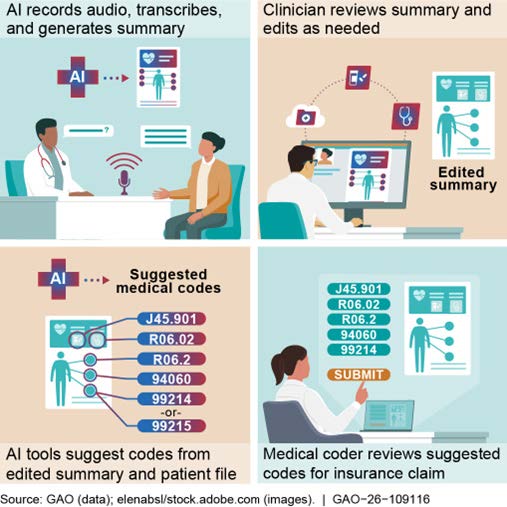
For: software lets CMS review records from every contract and lets plans find real conditions faster. Against: the same tools can add codes faster than humans can check them, and an audit that flags codes by machine still needs human coders. CMS says its coders "manually verify flagged diagnoses." The evidence: GAO's September 2026 spotlight (GAO-26-109116) describes these tools; we found no public study measuring their effect on MA risk scores.27
For reporters and advocates
Records that exist.
- CMS RADV pages: audited contract lists for each payment year, posted results for 2011 to 2015, methods documents and the audit schedule. Contract numbers can be matched to CMS's monthly MA enrollment files by county to find Idaho exposure.7814
- CMS Rate Announcements and Advance Notices (each spring), with the model coefficients, normalization factors, coding adjustment and the public comments CMS answered.3
- The Part C improper payment measure results each year, and the HHS Agency Financial Report.29
- OIG reports: evaluations on chart reviews and HRAs, and MA compliance audits of specific diagnosis codes, each with the plan's written response and recommendation status.2335
- DOJ and U.S. Attorney releases, with the court filings on PACER: complaints in intervention, settlement agreements (which state whether liability is admitted) and relator share. OIG posts corporate integrity agreements.1239
- Court dockets for Humana v. Kennedy (5th Cir. No. 25-11293), Poehling (C.D. Cal. No. 2:16-cv-08697) and the settled cases. The Georgetown Law litigation tracker posts many filings.1048
- The Federal Register docket for CMS-6098-P, where public comments on the CRUSH proposal will be posted.11
- MedPAC reports and meeting transcripts, and plan-side responses such as the Better Medicare Alliance memo, labeled as advocacy.45
What to ask. Ask CMS whether any Idaho contract's RADV audit for 2018 or later has produced a report, a disputed amount or an appeal, and whether CMS will collect extrapolated amounts while the appeal is pending. Ask each Idaho plan whether it uses in-home assessments or chart review vendors, whether its chart reviews delete codes as well as add them, and how many enrollees had a diagnosis from a home visit with no other visit that year. Ask provider groups paid on a share of MA revenue how coding affects doctors' pay. Ask the Idaho Department of Insurance what it receives about MA marketing and complaints (MA plans are federally regulated, but agents are state licensed; see 88/04).
Public records. CMS does not post plan bids, plan-level payments or contract-level RADV audit reports; 42 CFR 422.310(f) lets CMS release risk adjustment data subject to "the aggregation of dollar amounts reported for the associated encounter to protect commercially sensitive data."15 A federal FOIA request to CMS can seek audit correspondence or aggregate data; the exemptions CMS uses are covered in lesson 11. Idaho state agencies hold little MA data, but Idaho Public Records Act requests (Idaho Code Title 74, chapter 1) can reach the Department of Insurance's agent complaint records and Health and Welfare's contracts with plans that serve people on both Medicare and Medicaid (see lesson 8); see Idaho Public Records Requests.
The Idaho angle. Idaho's MA market is concentrated: UnitedHealth's contracts held 42.3 percent of Idaho MA enrollees in November 2026, and the top three parents held 73.2 percent (our calculation). A RADV result or settlement for a multi-state UnitedHealth, Humana, Molina or PacificSource contract may touch Idaho enrollees without naming Idaho. Check contract numbers against the county files, and say plainly when a result is contract-wide. How to frame numbers and allegations fairly is in lesson 12, and the public data toolbox is in lesson 9.14
Where to go next
- CMS Medicare Advantage RADV Program pages: Free. CMS's audit lists, results, methods documents and schedule. Download the Excel lists and search by contract number (for example H1350) to see which payment years a plan was audited.
- CMS Medicare Advantage rate announcements and documents: Free. Each year's Advance Notice and Rate Announcement, with model coefficients, normalization factors and CMS's answers to public comments. Useful for rebuilding a risk score.
- CMS MA contract and enrollment data: Free monthly files of MA enrollment by state, county and contract. Use them to find which contracts serve an Idaho county and how many people they enroll.
- HHS OIG reports search: Free. OIG evaluations and audits, including the Medicare Advantage Compliance Audit series; each report page shows recommendation status and the plan's or CMS's response.
- MedPAC reports to Congress: Free. The March report has the annual Medicare Advantage status chapter with coding intensity and favorable selection estimates; the July data book has supporting tables.
- Georgetown Law Health Care Litigation Tracker: Free nonprofit academic tracker that posts filings in health care cases, including Humana v. Kennedy and Poehling; check PACER for the official docket.
- PACER (federal court records): Federal court dockets and filings, including complaints and settlement-related orders in False Claims Act cases; 10 cents a page with a $3 cap per document, and fees under $30 a quarter are waived.
Still being checked (5 items)
These points could not be fully confirmed against a primary source when this lesson was written and fact checked in November 2026. The text above states each one as uncertain.
- Whether the Fifth Circuit has ruled in Humana v. Kennedy (No. 25-11293): the Georgetown tracker (updated Nov. 19, 2026) listed no decision and a web search on Nov. 24, 2026 found none; the Oct. 5, 2026 argument date and the panel's tone come from STAT (partly paywalled) and a Political.org report of the same day, not from the court's docket.
- Whether Judge Olguin ruled on the special master's March 3, 2025 recommendation in United States ex rel. Poehling v. UnitedHealth Group after the Nov. 24, 2025 hearing; the tracker (updated Sept. 13, 2026) showed none and PACER was not checked.
- Whether DOJ's 2025 criminal and civil requests to UnitedHealth Group have led to any charge or complaint; only the company's July 24, 2025 statement was read.
- The source of the '$17 billion annually' figure in CMS's May 21, 2025 release; the lesson labels its link to the Part C improper payment measure as our inference.
- The 'V24' and 'V28' labels are industry and MedPAC shorthand; CMS's rate announcements call them the 2020 and 2024 CMS-HCC models.
Last verified November 24, 2026. General education, not legal, medical, insurance or financial advice; every figure names its source and year in the Notes and Sources below. Data is revised: check the newest release before relying on any number.
Notes
- Social Security Act section 1853 (42 U.S.C. 1395w-23), paragraph (a)(1)(C)(i) (adjustment for health status "so as to ensure actuarial equivalence") and (a)(1)(C)(ii) (coding adjustment "for 2006 and each subsequent year"; "not less than 5.9 percent" for 2019 and later), Legal Information Institute text (read Nov. 24, 2026). Read it online. ↩
- CMS, Announcement of Calendar Year (CY) 2024 Medicare Advantage (MA) Capitation Rates and Part C and Part D Payment Policies, March 31, 2023: 2024 CMS-HCC model; about 74,000 ICD-10-CM codes in 266 HCCs, 115 payment HCCs (86 in the 2020 model); 2,236 codes no longer mapped to payment HCCs; phase-in of 67/33 percent for 2024 and 33/67 percent for 2025; Attachment VI coefficient tables (Community, NonDual, Aged: female 70 to 74 = 0.395, HCC 37 = 0.166, HCC 226 = 0.360, DIABETES_HF = 0.112; payment HCC count terms start at D5) (read Nov. 24, 2026). Read it online. ↩
- CMS, Announcement of CY 2027 MA Capitation Rates and Part C and Part D Payment Policies, April 6, 2026: normalization factor 1.079 for the 2024 CMS-HCC model (four-year regression on 2022 to 2025 FFS risk scores); MA coding pattern adjustment of 5.9 percent finalized; exclusion of diagnoses from unlinked chart review records with an exception for people who switch MA organizations; responses to comments on health risk assessments (read Nov. 24, 2026). Read it online. ↩
- Medicare Payment Advisory Commission (MedPAC), Report to the Congress: Medicare Payment Policy, March 2026, chapter 12, "The Medicare Advantage program: Status report": definition and drivers of coding intensity; 14 percent (2024) and about 10 percent (2026) above FFS before the 5.9 percent cut, about 4 percent after; $22 billion of $76 billion; favorable selection $57 billion; V28 reduced coding intensity 2.9 points a year; plan variation; $184 billion 2007 to 2024 and $233 billion 2007 to 2026; Part B premiums about $11 billion higher in 2026; Table 12-1 recommendations (read Nov. 24, 2026). Read it online. ↩
- Better Medicare Alliance (an advocacy group supported by MA plans and others), memorandum from Rebecca Buck to interested parties, "MedPAC - with a grain of salt," dated March 12, 2026 (read Nov. 24, 2026). Read it online. ↩
- 42 CFR 422.311, RADV audit dispute and appeal processes, paragraphs (a) to (c), current eCFR text as of Nov. 1, 2026 (read Nov. 24, 2026). Read it online. ↩
- CMS, Medicare Advantage RADV Program, "RADV Documents and Data": Lists of Audited Contracts and Identified Overpayments or Audit Results for payment years 2011 to 2015 (posted March 4, 2026) and Lists of Audited Contracts for payment years 2018 (Versions A and B), 2019 and 2021 (May 29, 2026), 2020 (March 20, 2026), 2024 (Aug. 28, 2026) and 2023 (Nov. 13, 2026), Excel files; counts, sums and Idaho matches are our calculation (read Nov. 24, 2026). Read it online. ↩
- CMS, "Medicare Advantage (MA) Risk Adjustment Data Validation (RADV) Audit Schedule," updated Nov. 17, 2026 (read Nov. 24, 2026). Read it online. ↩
- Brief for the Appellants (Department of Justice, Civil Division, Appellate Staff), Humana Inc. v. Kennedy, No. 25-11293 (5th Cir.), March 2026, on appeal from Humana Inc. v. Becerra, No. 4:23-cv-00909-O (N.D. Tex.) (judgment of Sept. 25, 2025, Chief Judge Reed O'Connor), copy posted by the Georgetown Law litigation tracker (read Nov. 24, 2026). Read it online. ↩
- Georgetown University Law Center, Health Care Litigation Tracker, "Humana Inc. et al. v. Kennedy et al.," No. 25-11293 (5th Cir.), last updated Nov. 19, 2026: docket entries from the Nov. 21, 2025 notice of appeal to a Nov. 18, 2026 notice of supplemental authority; status "Briefing is ongoing" (read Nov. 24, 2026). Read it online. ↩
- CMS, fact sheet, "Comprehensive Regulations to Uncover Suspicious Healthcare (CRUSH) Proposed Rule (CMS-6098-P)," Nov. 16, 2026: RADV reforms (no FFS adjuster, sampling methodology, extrapolation from PY 2018, about $9 billion per payment year), RADV hardship exception framework, MA provider enrollment in Original Medicare (proposed 42 CFR 422.222(a)), nearly $90 billion in total savings 2027 to 2036, 60-day comment period (read Nov. 24, 2026). Published as "Medicare, Medicaid, and Marketplace Programs; Comprehensive Regulations To Uncover Suspicious Healthcare (CRUSH)," 91 FR 74680 (Nov. 19, 2026), Federal Register document 2026-23461, comments close Jan. 19, 2027 (Federal Register API record, read Nov. 24, 2026). Read it online. ↩
- U.S. Department of Justice (DOJ), Office of Public Affairs, "Kaiser Permanente Affiliates Pay $556M to Resolve False Claims Act Allegations," Jan. 14, 2026; United States ex rel. Osinek v. Kaiser Permanente, No. 3:13-cv-03891 (N.D. Cal.), and United States ex rel. Taylor v. Kaiser Permanente, No. 3:21-cv-03894 (N.D. Cal.); relator share $95 million; "The claims resolved by the settlement are allegations only and there has been no determination of liability" (read Nov. 24, 2026). Read it online. ↩
- DOJ, "The Villages Health System LLC Agrees to $541.5M Settlement to Resolve False Claims Act Allegations," Aug. 26, 2026; In re Villages Health System, LLC, No. 6:25-bk-04156-LVV (Bankr. M.D. Fla.); self-disclosure; "allegations only" (read Nov. 24, 2026). Read it online. ↩
- CMS, Monthly MA Enrollment by State/County/Contract, November 2026, full version (SCC_Enrollment_MA_2026_11.csv): Idaho and neighbor-state rows summed by contract and parent; cells of 10 or fewer suppressed; matching to RADV lists is our calculation (read Nov. 24, 2026). Read it online. ↩
- 42 CFR 422.310, Risk adjustment data, paragraphs (b), (d), (e), (f) and (g), current eCFR text as of Nov. 1, 2026 (read Nov. 24, 2026). Read it online. ↩
- CMS, 2027 Medicare Advantage rate book, CountyRate2027.csv: Twin Falls County, Idaho (code 13410), Parts A and B rates of $1,242.09 (0 percent bonus), $1,279.89 (3.5 percent) and $1,296.10 (5 percent) a month (read Nov. 24, 2026). Read it online. ↩
- CMS, fact sheet, "2027 Medicare Advantage and Part D Rate Announcement," April 6, 2026: expected average change 2.48 percent (over $13 billion), 4.98 percent with risk score trend; coding pattern adjustment 0 percent change; risk model revision and normalization minus 1.12 percent, "entirely due to the normalization factor update"; sources of diagnoses minus 1.53 percent (minus 1.78 percent without the plan-switcher exception); underlying coding trend 2.50 percent (read Nov. 24, 2026). Read it online. ↩
- CMS, Announcement of CY 2026 MA Capitation Rates and Part C and Part D Payment Policies, April 7, 2025: completes the phase-in "by using 100 percent of the risk score calculated using the 2024 CMS-HCC risk adjustment model" for non-PACE organizations (read Nov. 24, 2026). Read it online. ↩
- MedPAC, Report to the Congress: Medicare Payment Policy, March 2025, chapter 11, "The Medicare Advantage program: Status report": 20 percent, $84 billion above FFS in 2025; selection $44 billion; coding 17 percent (2023), 16 percent (2025 projected), about 10 percent after the 5.9 percent cut, $40 billion; $224 billion 2007 to 2025; method change in the March 2024 report (read Nov. 24, 2026). Read it online. ↩
- HHS Office of Inspector General (OIG), Billions in Estimated Medicare Advantage Payments From Chart Reviews Raise Concerns, OEI-03-17-00470, Dec. 10, 2019, with recommendation status (read Nov. 24, 2026). Read it online. ↩
- HHS OIG, Billions in Estimated Medicare Advantage Payments From Diagnoses Reported Only on Health Risk Assessments Raise Concerns, OEI-03-17-00471, Sept. 8, 2020, with recommendation status (read Nov. 24, 2026). Read it online. ↩
- HHS OIG, Some Medicare Advantage Companies Leveraged Chart Reviews and Health Risk Assessments To Disproportionately Drive Payments, OEI-03-17-00474, Sept. 13, 2021, with recommendation status (read Nov. 24, 2026). Read it online. ↩
- HHS OIG, Medicare Advantage: Questionable Use of Health Risk Assessments Continues To Drive Up Payments to Plans by Billions, OEI-03-23-00380, Oct. 21, 2024, with recommendation status (read Nov. 24, 2026). Read it online. ↩
- CMS, Payment Year 2024 Medicare Advantage Contract-Specific RADV Audit Methods and Instructions, published Aug. 28, 2026: sampling frame, strata of 200, 100, 50 and 35 enrollees, "additional HCCs," extrapolation design and status of the 2023 rule (read Nov. 24, 2026). Read it online. ↩
- CMS, "RADV Questions and Answers," updated Nov. 13, 2026 (Q4 to Q6 shown as "[Updated Q&A coming soon]"; A7 on certified coders) (read Nov. 24, 2026). Read it online. ↩
- CMS, final rule, "Medicare and Medicaid Programs; Policy and Technical Changes to the Medicare Advantage ... Programs for Years 2020 and 2021" (CMS-4185-F2), 88 FR 6643 (Feb. 1, 2023), effective April 3, 2023: extrapolation from PY 2018; no FFS adjuster; reasons citing UnitedHealthcare Insurance Co. v. Becerra, 16 F.4th 867 (D.C. Cir. 2021); 2012 methodology; estimated recoveries of $4.7 billion for 2023 to 2032 net of a $51 million annual audit cost (read Nov. 24, 2026). Read it online. ↩
- CMS, press release, "CMS Rolls Out Aggressive Strategy to Enhance and Accelerate Medicare Advantage Audits," May 21, 2025 (read Nov. 24, 2026). Read it online. ↩
- CMS, Payment Year 2015 MA Contract-Specific RADV Payment Error Calculation Methodology, published March 4, 2026 (read Nov. 24, 2026). Read it online. ↩
- CMS, Part C Improper Payment Measure (Part C IPM), Fiscal Year 2025 Payment Error Rate Results (calendar year 2023 payments): 6.09 percent; gross $23.67 billion; overpayments $21.43 billion; underpayments $2.23 billion; expenditures $388.72 billion; net $19.20 billion (4.94 percent); missing documentation $0.87 billion (0.22 percent); Figure 1 overpayment shares FY 2016 to FY 2025 (read Nov. 24, 2026). Read it online. ↩
- STAT (news), "Federal appeals judges" coverage of the Fifth Circuit hearing in Humana v. Kennedy, Oct. 5, 2026 (partly paywalled; panel not named in the portion read) (read Nov. 24, 2026). Read it online. ↩
- HHS OIG, Impact Brief, "Medicare Advantage Fraud," July 2024 (read Nov. 24, 2026). Read it online. ↩
- HHS OIG, Medicare Advantage Compliance Audit of Specific Diagnosis Codes That Regence BlueCross BlueShield of Oregon (Contract H3817) Submitted to CMS, A-09-20-03009, Sept. 13, 2022 (read Nov. 24, 2026). Read it online. ↩
- HHS OIG, Medicare Advantage Compliance Audit of Specific Diagnosis Codes That MediGold (Contract H3668) Submitted to CMS, A-07-20-01198, Feb. 16, 2024 (read Nov. 24, 2026). Read it online. ↩
- HHS OIG, CMS Potentially Overpaid Medicare Advantage Organizations $462 Million Based on Certain Unsupported Acute Stroke Diagnosis Codes, A-02-23-01020, May 28, 2026 (read Nov. 24, 2026). Read it online. ↩
- HHS OIG, Medicare Advantage Compliance Audit of Specific Diagnosis Codes That UnitedHealthcare Benefits of Texas, Inc. (Contract H0609) Submitted to CMS, A-07-24-01215, Sept. 23, 2026 (read Nov. 24, 2026). Read it online. ↩
- CMS, fact sheet, "Fiscal Year 2025 Improper Payments Fact Sheet," Jan. 15, 2026 (read Nov. 24, 2026). Read it online. ↩
- 42 CFR 422.504(l), Certification of data that determine payment, current eCFR text (read Nov. 24, 2026). Read it online. ↩
- 42 CFR 422.326, Reporting and returning of overpayments (79 FR 29958, May 23, 2014, as amended at 89 FR 98565, Dec. 9, 2024): "knowingly" as defined in 31 U.S.C. 3729(b)(1)(A); 60 days; six-year look-back (read Nov. 24, 2026). Read it online. ↩
- DOJ, "The Cigna Group to Pay $172 Million to Resolve False Claims Act Allegations," Sept. 30, 2023; United States ex rel. Cutler v. Cigna Corp., et al., No. 3:21-cv-00748 (M.D. Tenn.); five-year corporate integrity agreement; "allegations only" (read Nov. 24, 2026). Read it online. ↩
- U.S. Attorney's Office, Central District of California, release No. 12-112, Aug. 23, 2012, on SCAN Health Plan's $323.67 million settlement ($3.82 million for Medicare Part C risk adjustment allegations; relator James M. Swoben; SCAN did not admit wrongdoing) (read Nov. 24, 2026). Read it online. ↩
- DOJ, "Medicare Advantage Organization and Former Chief Operating Officer to Pay $32.5 Million to Settle False Claims Act Allegations," May 30, 2017; United States ex rel. Sewell v. Freedom Health, Inc., et al., No. 8:09-cv-1625 (M.D. Fla.); "allegations only" (read Nov. 24, 2026). Read it online. ↩
- DOJ, "Medicare Advantage Provider to Pay $30 Million to Settle Alleged Overpayment of Medicare Advantage Funds," April 12, 2019; United States ex rel. Ormsby v. Sutter Health, et al., No. 15-CV-01062-JD (N.D. Cal.); "allegations only" (read Nov. 24, 2026). Read it online. ↩
- DOJ, "Martin's Point Health Care Inc. to Pay $22,485,000 to Resolve False Claims Act Allegations," July 31, 2023; U.S. ex rel. Wilbur v. Martin's Point Health Care Inc., No. 2:18-cv-00254 (D. Me.); "allegations only" (read Nov. 24, 2026). Read it online. ↩
- DOJ, "Medicare Advantage Provider Independent Health to Pay Up To $98M to Settle False Claims Act Suit," Dec. 20, 2024; United States ex rel. Ross v. Independent Health Association et al., No. 12-CV-0299(S) (W.D.N.Y.); "allegations only" (read Nov. 24, 2026). Read it online. ↩
- DOJ, "Medicare Advantage Provider Complete Health to Pay $14,100,000 to Settle False Claims Act Suit," Aug. 3, 2026; United States ex rel. Bowers v. Complete Health Partners, Inc., et al., No. 3:22-cv-463 (M.D. Fla.); "allegations only" (read Nov. 24, 2026). Read it online. ↩
- DOJ, "Medicare Advantage Provider Monogram Health Agrees to Pay $2.4M to Settle False Claims Act Suit," Aug. 24, 2026; U.S. ex rel. Gupta v. Monogram Health Professional Services, et al., No. 2:22-cv-08758 (C.D. Cal.); "allegations only" (read Nov. 24, 2026). Read it online. ↩
- Special Master's Report on Motions for Summary Judgment, United States ex rel. Poehling v. UnitedHealth Group, Inc., No. 2:16-cv-08697 (C.D. Cal.), March 3, 2025, copy posted by the Georgetown Law litigation tracker (read Nov. 24, 2026). Read it online. ↩
- Georgetown Law Health Care Litigation Tracker, "United States ex rel. Poehling v. UnitedHealth Group Inc.," No. 2:16-cv-08697 (C.D. Cal.), last updated Sept. 13, 2026: docket entries through the Nov. 24, 2025 hearing transcript; status "Briefing is ongoing" (read Nov. 24, 2026). Read it online. ↩
- KFF Health News (news), "UnitedHealth Wins Ruling Over $2B in Alleged Medicare Advantage Overpayments," March 4, 2025 (read Nov. 24, 2026). Read it online. ↩
- UnitedHealth Group, newsroom statement responding to DOJ investigation, July 24, 2025 (company statement) (read Nov. 24, 2026). Read it online. ↩
- CMS, MA State/County Penetration, November 2026 (State_County_Penetration_MA_2026_11.csv): eligibles and enrollees summed by state for Idaho, Utah, Oregon, Washington, Montana, Wyoming, Nevada and the United States (2026 files exclude Connecticut and Alaska); our calculation (read Nov. 24, 2026). Read it online. ↩
- CMS, Part C Improper Payment Measure (Part C IPM) Fiscal Year (FY) 2026 Payment Error Rate Findings and Results (calendar year 2024 payments): 5.68 percent, $23.86 billion gross; net $19.34 billion (4.61 percent); overpayments $21.60 billion (5.14 percent); underpayments $2.26 billion; expenditures $419.94 billion; missing or insufficient documentation $3.40 billion (0.81 percent); Figure 1 overpayment shares FY 2016 to FY 2026. Same 5.68 percent ($23,861.44 million) in HHS, FY 2026 Agency Financial Report, Payment Integrity Report, Table 1 (Secretary's message dated Nov. 13, 2026; https://www.hhs.gov/sites/default/files/fy-2026-hhs-agency-financial-report.pdf). Both read through the web (read Nov. 24, 2026). Read it online. ↩
Check yourself
1. What does Social Security Act section 1853(a)(1)(C)(ii) require for 2019 and later years?
The statute (42 U.S.C. 1395w-23(a)(1)(C)(ii)(III)) sets the coding adjustment at "not less than 5.9 percent" for 2019 and each later year; CMS used exactly 5.9 percent for 2027.
2. In the lesson's hypothetical Twin Falls example, about how much do two recorded diagnoses (diabetes with chronic complications and heart failure) add to the monthly 2027 payment for one enrollee?
Using 2024 CMS-HCC coefficients, the 1.079 normalization factor, the 5.9 percent cut and the $1,242.09 Twin Falls rate, the payment rises from $427.88 to $1,118.98, about $691 a month (our calculation in the methods box).
3. Which statement about MedPAC's coding intensity estimates is accurate?
MedPAC's March 2026 report puts the net coding effect at about 4 percent and $22 billion, lists documentation, fraudulent data and other reasons as drivers, and says separating them is often not possible.
4. What did OIG's October 2024 report OEI-03-23-00380 estimate?
OEI-03-23-00380 estimated $7.5 billion for 1.7 million enrollees, with 20 companies driving 80 percent; CMS did not concur with two of its three recommendations.
5. What changed for payment year 2027 in CMS's Rate Announcement?
The CY 2027 Rate Announcement excluded unlinked chart review diagnoses (a 1.53 percent payment effect) and kept the 2024 CMS-HCC model and the 5.9 percent adjustment; HRAs still count.
6. What did the Northern District of Texas decide in Humana v. Becerra on Sept. 25, 2025?
As described in the government's Fifth Circuit brief (No. 25-11293), the court granted summary judgment on the logical outgrowth claim, vacated and remanded 88 FR 6643, and did not reach Humana's other claims.
7. Why are the CMS RADV results for payment years 2011 to 2015 so small (about $37.6 million in total)?
The 2023 rule barred extrapolation before payment year 2018, and CMS's PY 2015 methodology says it will only collect non-extrapolated overpayments; the totals are our sum of CMS's posted files.
8. What does a DOJ release mean when it says MA coding claims resolved by a settlement are "allegations only" with "no determination of liability"?
The Kaiser (Jan. 14, 2026), Cigna (Sept. 30, 2023) and other DOJ releases use this language; a civil settlement is a compromise, not a finding of liability or fraud.
9. By the lesson's match of CMS files, about what share of Idaho's November 2026 MA enrollees were in contracts on CMS's payment year 2024 RADV audit list?
179,745 of 191,178 Idaho enrollees in CMS's county-contract file were in contracts listed on the PY 2024 audit list, 94.0 percent (our calculation).
10. Under 42 CFR 422.326, when must an MA organization report and return an overpayment?
422.326(c), (d) and (f) define identification by the False Claims Act's "knowingly" standard, set the 60-day deadline and the six most recent completed payment years; a retained overpayment is an obligation under 31 U.S.C. 3729(b)(3).
Terms in this lesson
- Risk adjustment
- Raising or lowering the monthly payment for each Medicare Advantage enrollee according to that person's expected cost, based on age, sex, Medicaid and institutional status and recorded diagnoses (Social Security Act section 1853).
- Risk score
- The number CMS multiplies by a plan's base rate to set the monthly payment for one enrollee; 1.0 is the average beneficiary's expected cost.
- HCC (hierarchical condition category)
- A group of related diagnosis codes with similar expected costs; within a disease family only the most severe category counts. The 2024 CMS-HCC model has 115 payment HCCs.
- CMS-HCC model
- CMS's risk adjustment formula for Medicare Advantage; the 2024 version (often called V28) was phased in from 2024 to 2026 and kept for 2027.
- Normalization factor
- A divisor CMS applies to all risk scores each year so the average stays near 1.0 as coding and costs drift (1.079 for the 2024 model in 2027).
- Coding intensity
- Recording more or more severe diagnosis codes for the same underlying health; in MA policy, the gap between MA and Original Medicare coding for similar people.
- Coding pattern adjustment
- The across-the-board cut CMS applies to MA risk scores for coding differences; at least 5.9 percent by law since 2019.
- Chart review
- A plan's or vendor's after-the-fact review of medical records to add or delete diagnoses; 'unlinked' chart reviews are not tied to a specific service and stopped counting for 2027.
- Health risk assessment (HRA)
- A questionnaire and visit, often in the enrollee's home and often by a company the plan hires, that can record diagnoses used for payment.
- Encounter data
- The record of each service an MA enrollee receives, submitted by the plan to CMS in a claims-like format under 42 CFR 422.310; the main source of MA diagnoses.
- RADV (risk adjustment data validation)
- CMS's audit that checks a sample of an MA contract's diagnoses against medical records and recovers payments for unsupported ones (42 CFR 422.310(e) and 422.311).
- Extrapolation
- Projecting the error rate found in a statistically valid sample onto all enrollees in the sampling frame to compute a contract-level overpayment.
- FFS adjuster
- A proposed offset to RADV recoveries for the error already present in the Original Medicare (fee-for-service) data used to build the payment model; CMS declined it in 2023 and proposed again in 2026 not to apply it.
- Favorable selection
- MedPAC's term for MA plans enrolling people who are healthier than their risk scores predict, which raises payments relative to cost.
Sources
- Social Security Act section 1853 (42 U.S.C. 1395w-23) (2026-11-24) checked 2026-11
- 42 CFR 422.310, 422.311 and 422.326 (eCFR) (2026-11-24) checked 2026-11
- 88 FR 6643 (Feb. 1, 2023), RADV final rule (2026-11-24) checked 2026-11
- CMS, CY 2024 Rate Announcement (2024 CMS-HCC model) (2026-11-24) checked 2026-11
- CMS, 2027 Medicare Advantage and Part D Rate Announcement fact sheet (2026-11-24) checked 2026-11
- CMS, RADV Documents and Data (audited contract lists and results) (2026-11-24) checked 2026-11
- CMS, CRUSH proposed rule fact sheet (CMS-6098-P), Nov. 16, 2026 (2026-11-24) checked 2026-11
- MedPAC, March 2026 Report, chapter 12, Medicare Advantage status report (2026-11-24) checked 2026-11
- HHS OIG, OEI-03-23-00380, health risk assessments (Oct. 2024) (2026-11-24) checked 2026-11
- CMS, Part C Improper Payment Measure, FY 2025 results (2026-11-24) checked 2026-11
- CMS, Part C Improper Payment Measure, FY 2026 results (calendar 2024 payments) (2026-11-24) checked 2026-11
- DOJ, Kaiser Permanente affiliates $556M settlement, Jan. 14, 2026 (2026-11-24) checked 2026-11
- Government's opening brief, Humana Inc. v. Kennedy, No. 25-11293 (5th Cir.) (2026-11-24) checked 2026-11
- CMS, Monthly MA Enrollment by State/County/Contract, November 2026 (2026-11-24) checked 2026-11
- Federal Register, CRUSH proposed rule, 91 FR 74680 (Nov. 19, 2026) (2026-11-24) checked 2026-11