
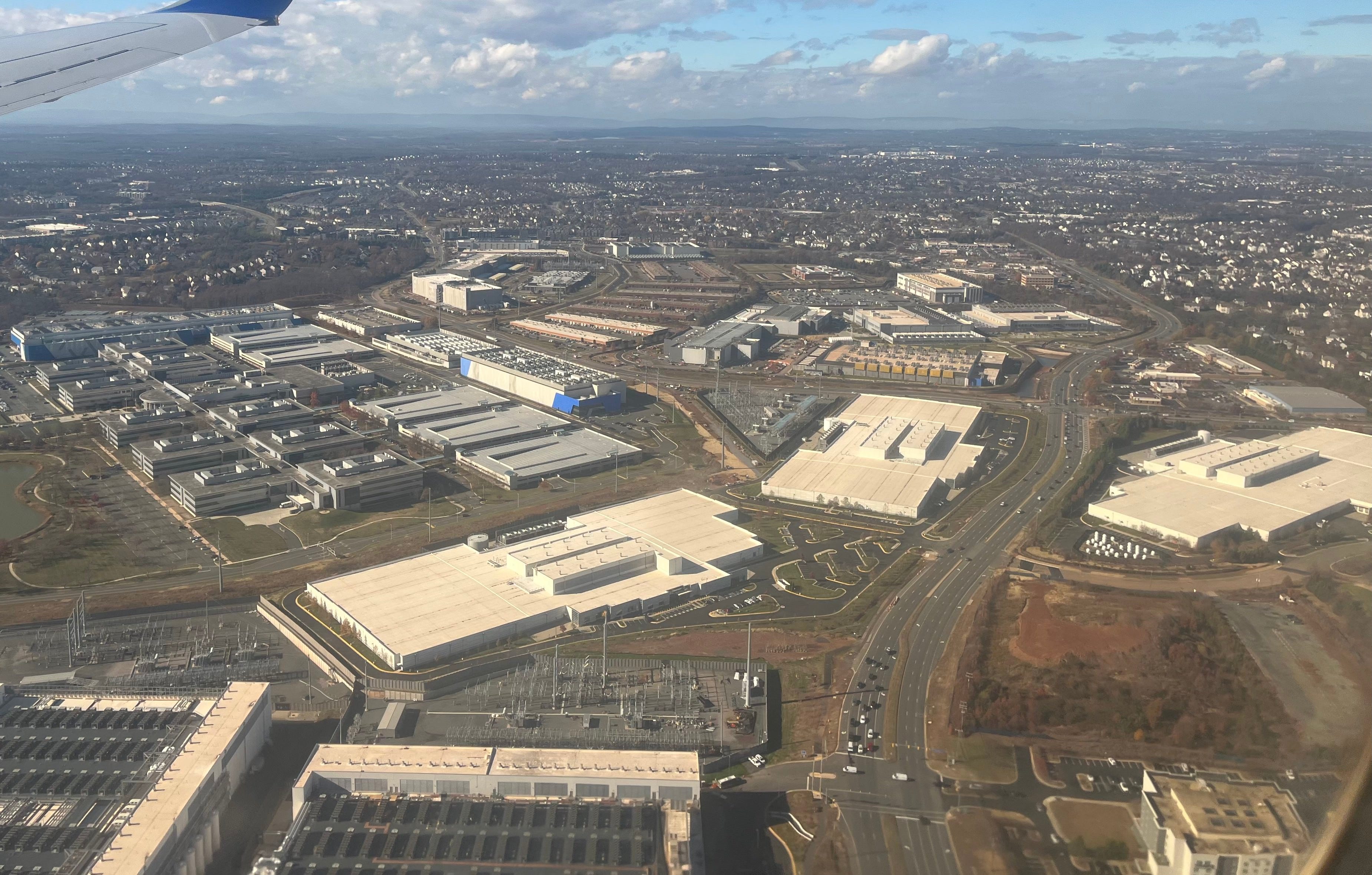
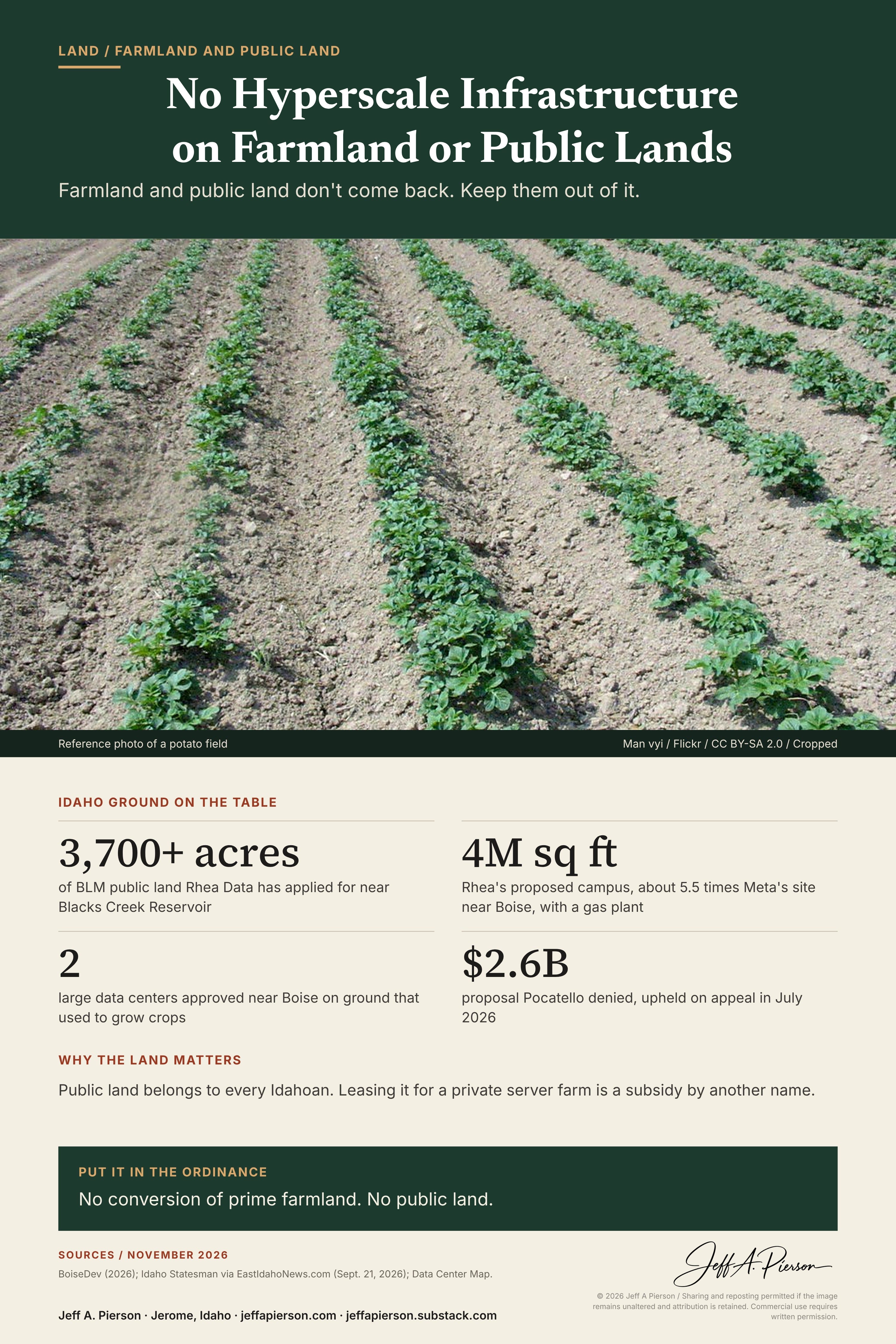
Idaho’s farmland, public lands, and residential areas are not industrial wastelands.
There are better places to put massive data centers and renewable energy projects (hyperscale infrastructure) than productive farmland, land within a few miles of residential neighborhoods, public lands, or ground over regional aquifers.
Before sacrificing productive farmland or public lands, developers should be required to show they have seriously considered suitable industrial sites, such as brownfields, military bases, or abandoned industrial zones.
Not every alternative will work, but protecting valuable land should be a priority, not an afterthought. Developers should also have to say what the project is for and whom it serves. There are important uses for AI and data centers. There are also a lot of uses that do more harm than good.
WHAT IT DOES TO THE LAND
Once thousands of acres are covered with concrete, roads, power infrastructure, server buildings, steel, solar panels, or wind turbines, restoring that land is neither easy nor cheap.
Experts have said it could take 30 to 70 years or more for public lands to recover, and that clock only starts after a project is properly removed. Sagebrush, plants, animals, and soil need decades to come back, and some may never return.
Farmland used for industrial-scale solar, wind turbines, or data centers may not return to its original productivity after those facilities are gone. Construction and demolition can damage soil structure, increase compaction, disrupt drainage, and destroy productive topsoil.
REFERENCES ON RECOVERY
👉 USDA Natural Resources Conservation Service lists soil compaction, erosion, water ponding, contamination, and loss of organic matter as concerns with utility-scale solar. Its March 2024 publication says construction methods, topsoil protection, and vegetation management are key to keeping land farmable.
👉 A Purdue University study of two Indiana wind farms found construction disturbed about 4.4 acres per turbine in the first year. Some poorly drained, fine-textured soils still hadn’t recovered after three years.
👉 North Carolina State University Extension lists soil fertility, compaction, hardpan, contamination, and reclamation costs as barriers to returning solar sites to farming. It also says there isn’t enough post-decommissioning evidence to predict outcomes.
Complete recovery is possible in some cases. It is not guaranteed.
Southern Idaho has limited farmland, and our soil is considered some of the best in the nation. Dedicating hundreds or thousands of acres of it to industrial and hyperscale projects is irresponsible, shortsighted, and so far outside existing zoning that it should be banned outright. The impact is large enough to change life for an entire rural community.
KEEPING GOVERNMENT ACCOUNTABLE
Local governments need to work with their citizens to decide what is acceptable and set clear zoning rules, including considering bans.
Citizens have good reason to worry about inappropriate influence. Federal corruption prosecutions have exposed developers buying favorable zoning and permitting decisions, and academic research shows developer campaign contributions can sway local land-use outcomes. That’s why we need transparent proceedings, independent technical review, conflict-of-interest disclosures, and zoning standards set BEFORE individual proposals come in.
EXAMPLES FROM HYPERSCALE DEVELOPMENT
📍 Saline Township, Michigan (2025 to 2026): Officials rejected rezoning about 575 acres of farmland for a proposed $43 billion data center involving Oracle and OpenAI. The developer sued, and the township settled. Evidence of heavy financial and legal pressure, not proof of bribery.
📍 Carroll County, Kentucky (2026): Kentucky Public Radio reported allegations that officials voted on data center matters where they had a financial stake, plus possible open-meetings violations. These are allegations, not findings of wrongdoing.
📍 Box Elder County, Utah (2026): Records obtained by The Salt Lake Tribune show Utah’s Military Installation Development Authority pushed back on the county’s request for $16.2 million upfront for public-service costs, on behalf of a data center and energy project tied to Kevin O’Leary. A public agency advocating for a private developer. Not criminal misconduct.
📍 Fort Worth, Texas (2026): An investigation examined Mayor Mattie Parker’s family connection to a lobbying firm representing a data center coalition. Three ethics experts said she wasn’t legally required to recuse, but recommended she abstain.
📍 Frederick County, Maryland (2026): A Federation of American Scientists review of ten community-benefit agreements found one deal with more than $110 million in developer contributions in exchange for the county freezing zoning laws during construction. Legal contracts, but they show how big money gets tied directly to regulatory decisions.
📍 FirstEnergy, Ohio: Proven bribery. FirstEnergy admitted to a scheme involving former Ohio House Speaker Larry Householder and former PUCO chairman Samuel Randazzo, and agreed to a $230 million criminal penalty. Householder was convicted and sentenced to federal prison. The scheme pushed through about $1 billion in nuclear plant subsidies.
THE BOTTOM LINE
Our farmland feeds people. Our public lands belong to all of us. Neither should be treated as disposable.
I personally advocate: Ban Hyperscale Data and Energy Projects on Farmland and Near Residences. Protect Public Lands.
-----------------------------------------
Listen on Substack (after 1PM Monday November 9th)
https://jeffapierson.substack.com/p/idahos-farmland-and-public-lands
-----------------------------------------
#Idaho #Farmland #PublicLands #DataCenters #LocalControl
References and Further Reading
1. Arivmed, O., Lauenroth, W. K., Burke, I. C., & Mobley, M. L. (2015). Sagebrush steppe recovery on 30–90-year-old abandoned oil and gas wells. Ecosphere, 6(7).https://doi.org/10.1890/ES14-00175.1
2. Belnap, J., & Gillette, D. A. (1998). Vulnerability of desert biological soil crusts to wind erosion: The influences of crust development, soil texture, and disturbance. Journal of Arid Environments, 39(2), 133–142.https://doi.org/10.1006/jare.1998.0388
3. Belnap, J., Kaltenecker, J. H., Rosentreter, R., Williams, J., Leonard, S., & Eldridge, D. (2001). Biological soil crusts: Ecology and management (Technical Reference 1730-2). Bureau of Land Management.https://www.ntc.blm.gov/krc/system/files/legacy/uploads/2939/CrustManual.pdf
4. Coates, P. S., O’Neil, S. T., Munoz, D. A., Dwight, I., & Tull, J. C. (2021). Sage-grouse population dynamics are adversely impacted by overabundant feral horses. The Journal of Wildlife Management, 85(6), 1132–1149.https://doi.org/10.1002/jwmg.22089
5. Cross, T. B., Tack, J. D., Naugle, D. E., Schwartz, M. K., Doherty, K. E., Oyler-McCance, S. J., Pritchert, R. D., & Fedy, B. C. (2023). The ties that bind the sagebrush biome: Integrating genetic connectivity into range-wide conservation of greater sage-grouse. Royal Society Open Science, 10(2), Article 220437.https://doi.org/10.1098/rsos.220437
6. Jahner, J. P., Gibson, D., Weitzman, C. L., Blomberg, E. J., Sedinger, J. S., & Parchman, T. L. (2016). Fine-scale genetic structure among greater sage-grouse leks in central Nevada. BMC Evolutionary Biology, 16, Article 127.https://doi.org/10.1186/s12862-016-0702-4
7. Lan, S., Elliott, D. R., Chamizo, S., Felde, V. J. M. N. L., & Thomas, A. D. (2024). Editorial: Biological soil crusts: Spatio-temporal development and ecological functions of soil surface microbial communities across different scales. Frontiers in Microbiology, 15, Article 1447058.https://doi.org/10.3389/fmicb.2024.1447058
8. Maxwell, L. M., Rutherford, T. K., Kleist, N. J., Teige, E. C., Lehrter, R. J., Gilbert, M. A., Wood, D. J. A., Johnston, A. N., Tull, J. C., Haby, T. S., & Carter, S. K. (2024). Effects of noise from oil and gas development on raptors and songbirds: A science synthesis to inform National Environmental Policy Act analyses (Scientific Investigations Report 2024-5087). U.S. Geological Survey.https://doi.org/10.3133/sir20245087
9. Ngo-Cong, D., Antille, D. L., van Genuchten, M. Th., Nguyen, H. Q., Tekeste, M. Z., Baillie, C. P., & Godwin, R. J. (2021). A modeling framework to quantify the effects of compaction on soil water retention and infiltration. Soil Science Society of America Journal, 85, 1931–1945.https://doi.org/10.1002/saj2.20328
10. Obour, P. B., & Ugarte, C. M. (2021). A meta-analysis of the impact of traffic-induced compaction on soil physical properties and grain yield. Soil and Tillage Research, 211, Article 105019.https://doi.org/10.1016/j.still.2021.105019
11. Pitt, R., Chen, S.-E., Clark, S. E., Swenson, J., & Ong, C. K. (2008). Compaction’s impacts on urban storm-water infiltration. Journal of Irrigation and Drainage Engineering, 134(5), 652–658.https://doi.org/10.1061/(ASCE)0733-9437(2008)134:5(652)
12. Prose, D. V., & Wilshire, H. G. (2000). The lasting effects of tank maneuvers on desert soils and intershrub flora (Open-File Report 00-512). U.S. Geological Survey.https://pubs.usgs.gov/of/2000/0512/
13. Rutherford, T. K., Maxwell, L. M., Kleist, N. J., Teige, E. C., Lehrter, R. J., Gilbert, M. A., Wood, D. J. A., Johnston, A. N., Mengelt, C., Tull, J. C., Haby, T. S., & Carter, S. K. (2023). Effects of noise from oil and gas development on ungulates and small mammals: A science synthesis to inform National Environmental Policy Act analyses (Scientific Investigations Report 2023-5114). U.S. Geological Survey.https://doi.org/10.3133/sir20235114
14. Sage-grouse National Technical Team. (2011). A report on national greater sage-grouse conservation measures. Bureau of Land Management.https://www.govinfo.gov/app/details/GOVPUB-A13-PURL-gpo90829
15. Sawyer, H., Middleton, A. D., Hayes, M. M., Kauffman, M. J., & Monteith, K. L. (2016). The extra mile: Ungulate migration distance alters the use of seasonal range and exposure to anthropogenic risk. Ecosphere, 7(10), Article e01534.https://doi.org/10.1002/ecs2.1534
16. Teige, E. C., Maxwell, L. M., Jordan, S. E., Rutherford, T. K., Dietrich, E. I., Samuel, E. M., Stoneburner, A. L., Kleist, N. J., Meineke, J. K., Selby, L. B., Foster, A. C., & Carter, S. K. (2023). Annotated bibliography of scientific research on greater sage-grouse published from October 2019 to July 2022 (Open-File Report 2023-1082). U.S. Geological Survey.https://doi.org/10.3133/ofr20231082
17. U.S. Geological Survey. (2023). Annotated bibliography of scientific research relevant to oil and gas reclamation best management practices in the western United States, published from 1969 through 2020 (Open-File Report 2023-1068).https://pubs.usgs.gov/publication/ofr20231068/full
18. Maguire, K., Tanner, S., & Winikoff, J. B. (2024, September 12). Agricultural land near solar and wind projects usually remained in agriculture after development. U.S. Department of Agriculture, Economic Research Service.https://www.ers.usda.gov/amber-waves/2024/september/agricultural-land-near-solar-and-wind-projects-usually-remained-in-agriculture-after-development
19. Maguire, K., Tanner, S., Winikoff, J. B., & Williams, R. (2024). Utility-scale solar and wind development in rural areas: Land cover change (2009–20) (Economic Research Report No. 330). U.S. Department of Agriculture, Economic Research Service.https://doi.org/10.32747/2024.8374829.ers
20. Carroll, M. (2021, October 12). Can solar energy production be converted to farmland? North Carolina Cooperative Extension.https://craven.ces.ncsu.edu/news/can-solar-energy-production-be-converted-to-farmland/
21. U.S. Department of Agriculture, Natural Resources Conservation Service. (2024). Conservation considerations for solar farms.https://www.nrcs.usda.gov/sites/default/files/2024-03/Conservation_Considerations_Solar_Farms.pdf
22. U.S. Department of Agriculture, Natural Resources Conservation Service. (2025). Conservation guidance for utility-scale solar projects.https://www.nrcs.usda.gov/sites/default/files/2025-04/Conservation-Guidance-for-Utility-Scale-Solar-Projects_2025415.pdf
23. U.S. Department of Energy. (n.d.). Wind energy end-of-service guide.https://www.energy.gov/cmei/systems/windexchange/wind-energy-end-service-guide
24. Gaudette, J., & de Benedictis-Kessner, J. (2025, September 23). Funding the growth machine: The effects of municipal campaign contributions on housing policy outcomes. Harvard Kennedy School.https://www.hks.harvard.edu/publications/funding-growth-machine-effects-municipal-campaign-contributions-housing-policy
25. Lo, L., & Freemark, Y. (2022, November 15). Influencers, bias, and equity in rezoning cases: An evaluation of developer-initiated zoning changes in Louisville, Kentucky. Urban Institute.https://www.urban.org/research/publication/influencers-bias-and-equity-rezoning-cases
26. U.S. Department of Justice, U.S. Attorney’s Office for the Central District of California. (2024, January 26). Former Los Angeles politician José Huizar sentenced to 13 years in federal prison for racketeering conspiracy and tax evasion.https://www.justice.gov/usao-cdca/pr/former-los-angeles-politician-jose-huizar-sentenced-13-years-federal-prison
27. U.S. Department of Justice, U.S. Attorney’s Office for the Central District of California. (2024). Former Los Angeles deputy mayor sentenced to 12 years in prison for racketeering conspiracy that corrupted city real estate projects.https://www.justice.gov/usao-cdca/pr/former-los-angeles-deputy-mayor-sentenced-12-years-prison-racketeering-conspiracy
28. U.S. Department of Justice, U.S. Attorney’s Office for the Central District of California. (2023, July 21). Real estate developer sentenced to 6 years in federal prison for paying $500,000 cash bribe to corrupt L.A. politician and official.https://www.justice.gov/usao-cdca/pr/real-estate-developer-sentenced-6-years-federal-prison-paying-500000-cash-bribe
29. Federation of American Scientists. (2026). A guide to better data center policy for local governments.https://fas.org/publication/before-breaking-ground/
30. New York State Department of Environmental Conservation. (n.d.). Full environmental assessment form, Part 2: Question 8, impact on agricultural resources.https://dec.ny.gov/regulatory/permits-licenses/seqr/eaf-workbooks/part-2-feaf/question-8
Author’s Note
I am not against data centers. I use AI and data centers daily, it is the field I work in and around. I am against sacrificing valuable land, public resources, and the right of citizens to control their local government.
© Copyright 2026, Jeff A Pierson JeffAPierson.com
Comments
Leave a Comment