
The Liberty Political Matrix
A Public Explanation from the Ordered Liberty Framework of Jeff A. Pierson
Introduction
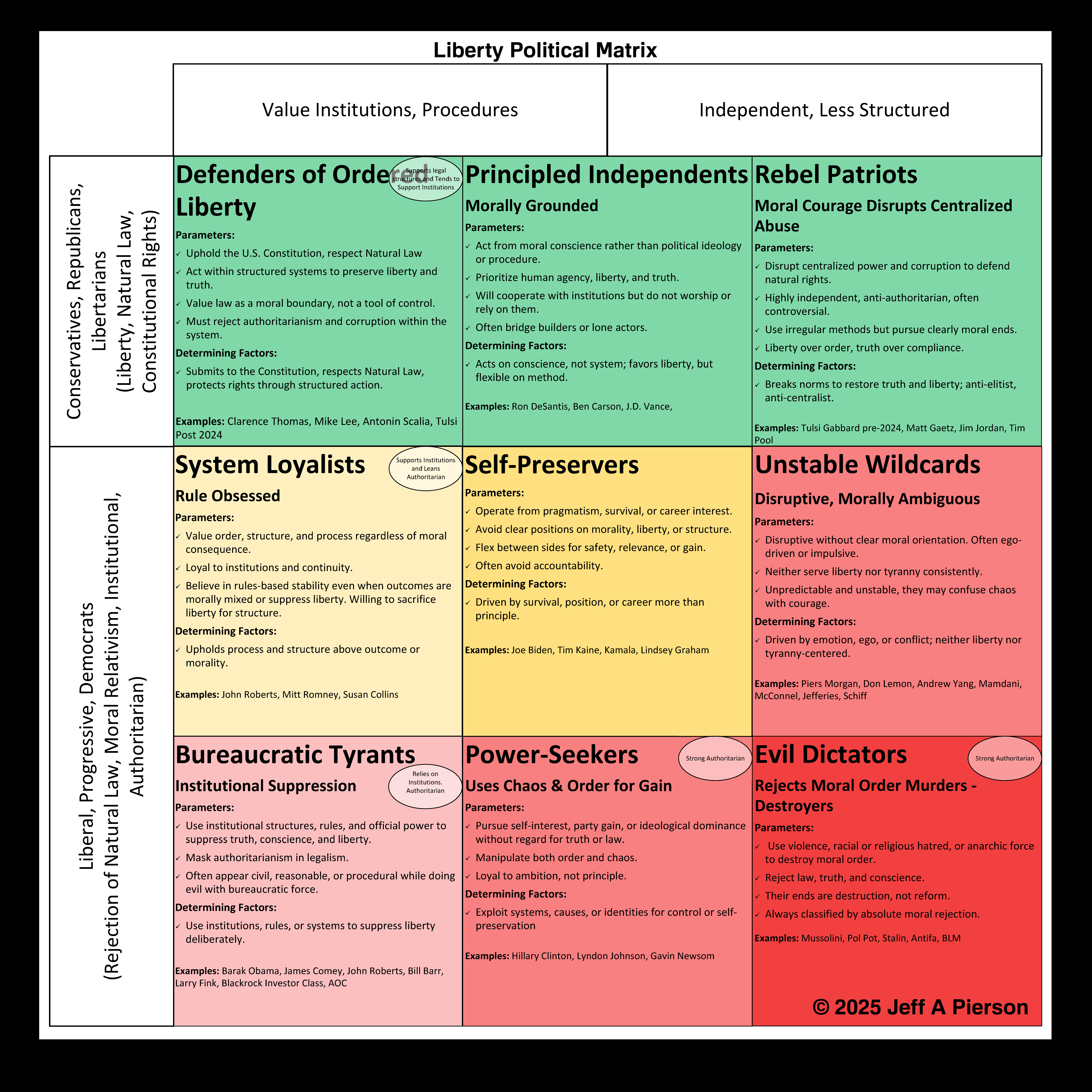
The Liberty Political Matrix is a classification tool grounded in the Ordered Liberty Framework. It addresses a central failure in modern political language: labels describe affiliation, not behavior. Terms such as conservative, liberal, or moderate do not explain how individuals act when power, law, and moral pressure converge.
Ordered liberty begins from a fixed premise. Liberty is not chaos, and order is not control. Liberty requires structure, but only just structure. Order requires authority, but only legitimate authority. The operative question is not identity, but conduct under pressure.
This matrix evaluates individuals and movements based on two independent variables: moral grounding and relationship to institutional power.
The Matrix
© 2026 Jeff A. Pierson. All Rights Reserved.
The Two Axes
Horizontal Axis: Institutional Dependence vs. Independence
On the left are actors who derive legitimacy from institutions, procedures, and established systems. On the right are actors who operate independently of institutions, either due to distrust, rejection, or perceived corruption.
Vertical Axis: Moral Orientation
The upper half reflects alignment with natural law, constitutional limits, and objective truth. The lower half reflects moral relativism, ideological primacy, or subordination of truth to power or outcome.
These axes are descriptive, not rhetorical. Their intersection produces behavioral categories.
Quadrant Analysis: Psychology & Political Characteristics
Defenders of Ordered Liberty
Institutional + Morally GroundedThese actors operate within institutions while remaining anchored to natural law. Their psychology is structured, disciplined, and boundary-aware. They believe in limits, both on themselves and on government. They are motivated by duty, continuity, and preservation of legitimate order.
They exhibit high tolerance for process, but only when that process serves truth. They are resistant to emotional swings and tend to rely on precedent, text, and principle. Their political behavior is consistent, rule-bound, and often cautious.
Psychology
Structured, conscientious, and obligation-driven. High impulse control. Strong internalized moral framework. Tendency toward conservatism of temperament as well as ideology. Motivated by stability and moral consistency. Values tradition not as nostalgia but as tested wisdom.
Behavior
Upholds the U.S. Constitution and respects Natural Law. Acts within structured systems to preserve liberty and truth. Values law as a moral boundary, not a tool of control. Must reject authoritarianism and corruption within the system. Submits to constitutional process and protects rights through structured action.
Political Profile
Aligns with constitutional originalism and limited government. Supports judicial restraint, federalism, and enumerated powers. Opposes executive overreach regardless of party. Will defend institutional integrity even against allies who seek to abuse it.
Principled Independents
Independent + Morally GroundedThese actors are grounded in moral law but not dependent on institutional validation. Their psychology is conscience-driven, internally anchored, and resistant to group pressure. They evaluate systems rather than assuming their legitimacy.
They are often bridge figures, capable of working across factions when principle aligns. They value truth over loyalty and are willing to dissent when necessary. Their political behavior reflects flexibility in method but rigidity in principle.
Psychology
Internally validated identity. High moral reasoning capability. Comfortable with solitude and dissent. Tends toward intellectual independence and critical analysis. Low need for social approval. Often reflective, principled decision-makers who test every claim before accepting it.
Behavior
Acts from moral conscience rather than political ideology or procedure. Prioritizes human agency, liberty, and truth. Will cooperate with institutions but does not worship or rely on them. Often bridge builders or lone actors. Acts on conscience, not system; favors liberty, but flexible on method.
Political Profile
May cross party lines on principle. Resistant to tribal loyalty tests. Often labeled inconsistent by partisans because they judge each issue on its merits. May support institutional reform without rejecting institutions entirely. Advocates for decentralization and individual sovereignty.
Rebel Patriots
Highly Independent + Morally GroundedThese actors combine strong moral conviction with institutional independence. Their psychology is resistant, confrontational, and action-oriented. They are typically activated by perceived injustice or corruption.
They are willing to disrupt systems to restore what they believe to be moral order. Their behavior prioritizes liberty over procedural compliance. They often emerge in periods of institutional failure.
Psychology
High agency, high conviction, low deference. Driven by a visceral sense of justice. Willing to absorb personal cost for moral stands. May exhibit elevated risk tolerance and confrontational instincts. Often viewed as radical, but motivated by restoration rather than revolution.
Behavior
Disrupts centralized power and corruption to defend natural rights. Highly independent, anti-authoritarian, often controversial. Uses irregular methods but pursues clearly moral ends. Prioritizes liberty over order, truth over compliance. Breaks norms to restore truth and liberty; anti-elitist, anti-centralist.
Political Profile
Populist energy with moral backbone. Challenges both left and right establishments. May support dramatic reform measures including nullification, civil disobedience, or direct confrontation with corrupt authority. Distrusts bureaucracy and media narratives equally.
System Loyalists
Institutional + Morally NeutralThese actors prioritize institutional stability above moral outcome. Their psychology is order-oriented, compliance-driven, and risk-averse. They derive security from structure and continuity.
They believe that adherence to rules produces legitimacy, even when outcomes are flawed. Their political behavior emphasizes procedure, precedent, and maintenance of systems.
Psychology
High need for certainty and predictability. Finds comfort in hierarchy and established rules. Low tolerance for ambiguity. Risk-averse personality that equates order with safety. May suppress moral judgment when it conflicts with institutional expectations. Often genuinely believes that following procedure is inherently moral.
Behavior
Values order, structure, and process regardless of moral consequence. Loyal to institutions and continuity. Believes in rules-based stability even when outcomes are morally mixed or suppress liberty. Willing to sacrifice liberty for structure. Upholds process and structure above outcome or morality.
Political Profile
Supports incumbent power structures by default. Reluctant to challenge leadership even when leadership errs. May appear conservative but lacks the moral conviction that defines true conservatism. Votes for stability over reform. Often found in career bureaucratic and judicial roles.
Self-Preservers
Center + Morally NeutralThese actors are driven primarily by survival, relevance, or advancement. Their psychology is adaptive, cautious, and opportunistic. They avoid firm commitments when those commitments carry risk.
They shift positions based on environment, incentives, or pressure. Their political behavior is characterized by ambiguity, hedging, and strategic alignment.
Psychology
Pragmatic survival instinct dominates all decisions. Highly attuned to social and political winds. May possess moral awareness but consistently subordinates it to self-interest. Skilled at reading rooms and adjusting positions. Often charming and politically savvy but fundamentally hollow in conviction.
Behavior
Operates from pragmatism, survival, or career interest. Avoids clear positions on morality, liberty, or structure. Flexes between sides for safety, relevance, or gain. Often avoids accountability. Driven by survival, position, or career more than principle.
Political Profile
Classic political weathervanes. Support whichever position carries the least risk at any given moment. May claim to be moderate or bipartisan but are actually unprincipled. Will abandon allies under pressure. Engage in strategic ambiguity to preserve optionality.
Unstable Wildcards
Independent + Morally AmbiguousThese actors operate independently but without consistent moral grounding. Their psychology is reactive, impulsive, and often ego-driven. They are drawn to disruption without a clear framework guiding their actions.
They may appear bold or courageous, but their behavior is inconsistent. They can support liberty or undermine it depending on circumstance.
Psychology
High emotional reactivity. May have narcissistic or attention-seeking tendencies. Driven by ego validation rather than coherent principle. Drawn to controversy and disruption for its own sake. Can exhibit charisma and energy but lacks the internal discipline to sustain a consistent moral position.
Behavior
Disruptive without clear moral orientation. Often ego-driven or impulsive. Neither serves liberty nor tyranny consistently. Unpredictable and unstable; may confuse chaos with courage. Driven by emotion, ego, or conflict; neither liberty nor tyranny-centered.
Political Profile
May shift across the political spectrum rapidly. Attracts attention but not lasting coalitions. Can be useful in breaking stagnant systems but equally capable of undermining good ones. Often adopted by media as useful provocateurs. Difficult to trust with institutional responsibility.
Bureaucratic Tyrants
Institutional + AuthoritarianThese actors use institutional power to suppress liberty while maintaining procedural legitimacy. Their psychology is control-oriented, technocratic, and often insulated from consequence.
They rely on rules, processes, and administrative authority to impose outcomes. Their behavior is incremental, calculated, and often masked as neutrality or professionalism.
Psychology
Cold, calculating, and process-obsessed. Derives power from complexity and opacity. Views citizens as subjects to be managed, not served. May exhibit authoritarian personality traits masked by professional demeanor. Comfortable with deception when it serves institutional goals. Rarely experiences moral dissonance because they have redefined morality as procedural compliance.
Behavior
Uses institutional structures, rules, and official power to suppress truth, conscience, and liberty. Masks authoritarianism in legalism. Often appears civil, reasonable, or procedural while doing evil with bureaucratic force. Uses institutions, rules, or systems to suppress liberty deliberately.
Political Profile
Thrives in administrative state roles, regulatory agencies, and judicial positions. Weaponizes process against political opponents. Creates regulatory barriers to suppress dissent. Expands government authority incrementally while claiming necessity. Exploits legal complexity to prevent accountability.
Power-Seekers
Center + Strong AuthoritarianThese actors pursue dominance through any available mechanism. Their psychology is strategic, opportunistic, and ambition-driven. They are not bound by consistent ideology.
They will use both order and chaos depending on which advances their position. Their behavior includes manipulation, narrative control, and exploitation of systems.
Psychology
Machiavellian intelligence combined with low empathy. Views all relationships as transactional. Highly skilled at reading and manipulating social dynamics. May present as charismatic or visionary, but every action serves personal advancement. Capable of long-term strategic deception. Views loyalty as a tool, not a value.
Behavior
Pursues self-interest, party gain, or ideological dominance without regard for truth or law. Manipulates both order and chaos. Loyal to ambition, not principle. Exploits systems, causes, or identities for control or self-preservation. Uses chaos and order interchangeably for gain.
Political Profile
Seeks positions of maximum influence with minimum accountability. Masters of political patronage and alliance-building. Will champion any cause that expands their power base. Controls narratives through media relationships and information asymmetry. Often surrounded by enablers and loyalists who benefit from proximity to power.
Evil Dictators
Independent + Rejects Moral OrderThese actors represent the complete rejection of moral order. Their psychology is domination-focused, coercive, and unconstrained by ethical limits.
They rely on force, fear, and destruction to maintain control. Their behavior is absolute, not reform-oriented, and often violent.
Psychology
Exhibits clinical traits associated with psychopathy or malignant narcissism: absence of empathy, grandiosity, willingness to use violence. Views human beings as instruments. Ideological conviction may be present but serves as justification for dominance, not as a genuine moral framework. Thrives on fear and submission.
Behavior
Uses violence, racial or religious hatred, or anarchic force to destroy moral order. Rejects law, truth, and conscience. Their ends are destruction, not reform. Always classified by absolute moral rejection. Murders, destroys, and subjugates to eliminate opposition to their will.
Political Profile
Operates through cults of personality, paramilitary force, or revolutionary movements. Eliminates institutional checks immediately upon gaining power. Rewrites history, controls information, and punishes dissent with violence. Represents the terminal outcome of unchecked authoritarian drift in any political system.
How to Use the Matrix
This framework evaluates behavior, not identity. Individuals may move between categories depending on context, incentives, and pressure. Classification must be based on observable actions, not stated affiliations.
Begin with facts. Determine whether actions align with natural law or subordinate it. Then evaluate whether the actor relies on institutions, operates independently, or manipulates both. Only then assign placement.
Glossary of Core Terms
- Ordered Liberty
- A condition where freedom exists within the bounds of just law rooted in natural rights. Authority is limited and accountable.
- Natural Law
- A fixed moral order independent of government, defining inherent rights and limits on authority.
- Institutional Authority
- Power exercised through formal systems such as government, courts, and bureaucracy.
- Moral Relativism
- The belief that truth and morality are flexible or determined by outcome.
- Authoritarianism
- Centralized power exercised without meaningful limits.
- Independence
- Action taken outside institutional structures.
- Proceduralism
- Elevation of process above moral outcome.
- Moral Grounding
- Adherence to objective standards of truth and justice.
- Corruption
- Use of power to violate moral law or suppress liberty.
- Civic Responsibility
- Duty to uphold and defend ordered liberty through lawful and moral action.
This matrix is a tool of accountability. It replaces labels with observable behavior and forces evaluation against fixed standards. It distinguishes between those who preserve ordered liberty, those who drift, and those who undermine it.
Applied honestly, it does not merely classify others. It exposes the position of the person applying it.
© 2026 Jeff A. Pierson. All Rights Reserved.