Lesson 4 of 10 · about 23 minutes
Perot's Platform and the Reform Party
You'll be able to
- Describe the main planks of Perot's platform on the deficit, taxes, government reform and trade
- Explain the 1993 NAFTA fight, including the Gore-Perot debate and the House and Senate votes
- Trace the path from the 1992 volunteers to United We Stand America and the Reform Party
- Explain why Perot was excluded from the 1996 debates, what the courts did, and how his vote fell
- Compare Perot's NAFTA predictions with what official and peer-reviewed studies found
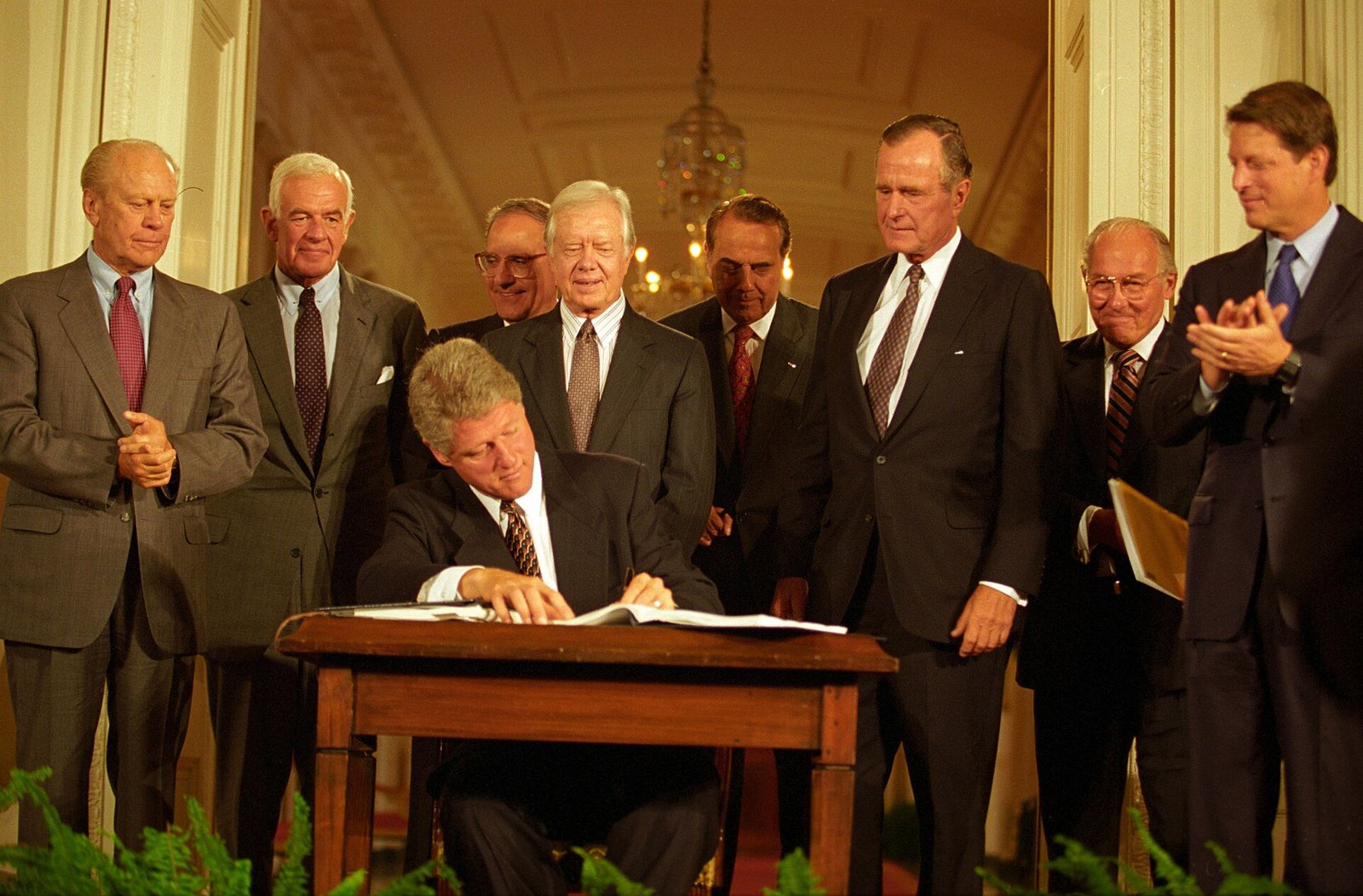
On September 14, 1993, four presidents stood together in the East Room of the White House. Bill Clinton was signing the labor and environmental side agreements to the North American Free Trade Agreement, and he had brought in Jimmy Carter, Gerald Ford and George Bush to help him sell it. The man they were selling against was not in the room. Ross Perot had just published a book with the economist Pat Choate predicting that the agreement would cost the country 5.9 million jobs. Carter called him "a demagogue who has unlimited financial resources," and the line brought Clinton, Bush and Ford to their feet in applause. Bush said opponents were "appealing to demagoguery." Clinton was milder: "Some of the assertions are not accurate that he has made."1
A year earlier Perot had been a candidate. Now he was something American politics rarely produces, a defeated independent whom every party still had to answer. This lesson takes his program plank by plank, follows his movement into a party and out the other side, and then checks his most famous prediction against thirty years of numbers.
Debt first
Everything in the Perot program started from one number. On September 30, 1992, the Treasury counted the total federal debt outstanding at $4,064,620,655,521.66.3 Perot rounded it the way he rounded everything, in plain terms an audience could hold. "Well, we're $4 trillion in debt," he said in the Richmond debate. "We're going into debt an additional $1 billion, little more than $1 billion every working day of the year." And, for the people in the hall: "while we sit here tonight we will go into debt an additional $50 million in an hour and a half."4
His campaign book, United We Stand, made balancing the budget its unifying theme. Even an economist who thought the idea dangerous conceded that much.5 Perot did not pretend it could be done painlessly. In the first debate, asked who would bear the cost, he said: "We're going to go through a period of shared sacrifice."6 The plan he defended that fall paired spending cuts with tax increases, which is the part his admirers tend to forget.
What the plan contained
The gasoline tax was the centerpiece and the hardest sell. Perot explained it on stage in St. Louis: "It's 10 cents a year cumulative. It finally gets to 50 cents at the end of the 5th year."6 He argued that it would conserve energy and reduce pollution, and he proposed relief for the workers who would be hit hardest by higher fuel prices.7 According to contemporary accounts of the plan, he also proposed raising the top income tax rate on the wealthiest households from 31 to 33 percent, taxing up to 85 percent of Social Security benefits for recipients with incomes of $25,000 or more instead of 50 percent, taxing part of employer-paid health insurance, doubling the cigarette tax, cutting military spending sharply and canceling the space station, which he mocked as "a vacation home in space."7
Not everyone liked a balanced budget as a goal. George Lee, a professor of international business at San Francisco State University, wrote in the Christian Science Monitor on October 16, 1992 that making a balanced budget the national goal was "inherently destabilizing." Cutting spending and raising taxes in a weak economy, he argued, would shrink demand and deepen and prolong the recession. He ranked Perot's plan the worst of the three candidates' approaches.5 Perot's answer, in his programs and debates, was that the debt was itself the threat, and that a country borrowing a billion dollars a working day was not choosing between pain and no pain. It was choosing when.
| End of fiscal year (Sept. 30) | Total federal debt outstanding | What was happening |
|---|---|---|
| 1992 | $4.06 trillion | Perot's first campaign |
| 1993 | $4.41 trillion | NAFTA fight; United We Stand America founded |
| 1996 | $5.22 trillion | Perot's second campaign, as Reform Party nominee |
| 2000 | $5.67 trillion | Reform Party split |
| 2001 | $5.81 trillion | The debt keeps growing |
| 2025 | $37.64 trillion | Most recent full fiscal year |
Total federal debt outstanding at the end of selected fiscal years, from the Treasury's Historical Debt Outstanding data, rounded.3 Perot's warning about the direction of the debt aged better than almost anything else he said.
Cleaning up Washington
The second half of the platform was about how Washington worked. Perot treated the influence of money and lobbyists as the reason the debt never got fixed. He opened his case in the first debate by pointing at himself. "I was not put on the ballot by any PAC money, by any foreign lobbyist money, by any special interest money," he said.6 In the last debate, in East Lansing, he charged that "both parties have foreign lobbyists on leaves in key roles in their campaigns."8 The reforms associated with his campaigns included abolishing political action committees, giving the president a line-item veto, restrictions on lobbying by former officials and a ban on broadcasting exit polls before voting ended.7
He also had a theory of government that explains why the reforms mattered to him. "Over time we have developed a government that comes at the people, that comes from the top down," he said in St. Louis.6 His cure was to turn it around, and the tool he kept naming was the electronic town hall. The idea was that a president would explain a major issue on television, citizens would respond by phone or by some other electronic means, and Congress would hear directly what the people thought. In the first debate he promised to "put together the framework for the town hall."6 He never got the chance to build one. But his half-hour programs, and the call-in shows where his campaign began, were a version of it: a man explaining charts to a national audience without a party in between.
On social questions Perot was harder to place. He favored some gun controls and more AIDS research, supported abortion rights, and was hesitant in 1992 about gay rights before supporting them more openly in 1996.7 Those positions did not fit the Republican Party of the 1990s, and his fiscal hawkishness and trade views did not fit the Democrats. Lesson 1's point about the single left-right line applies here exactly.
NAFTA and the giant sucking sound
Trade was the issue that outlived the 1992 campaign. President Bush had signed NAFTA on December 17, 1992, but it still needed implementing legislation from Congress.9 Clinton negotiated the side agreements and took up the fight in 1993. Perot fought it all year.
His argument had not changed since the Richmond debate, where he described an employer moving a factory to Mexico to pay "$1 an hour for your labor, have no health care," and "no environmental controls, no pollution controls and no retirement."4 In East Lansing he had put it in the form people remember: the agreement would produce "a giant sucking sound of jobs being pulled out of this country."8 On September 6, 1993 he and Choate published their case in book form.10 The Monitor reported that Perot projected the loss of 5.9 million American jobs and argued that companies would move production to Mexico, where wages were about one-ninth of American levels.1
The answer from free traders
Supporters answered him point by point. Michael Wilson of the Heritage Foundation published a rebuttal on September 30, 1993 that listed the book's claims with page numbers and answered each. The 5.9 million figure, Wilson wrote, should be weighed against an International Trade Commission projection of 200,000 more export-related jobs by 1995, and a study by Hufbauer and Schott that estimated 316,000 jobs created and 145,000 lost, a net gain of 171,000. He argued that labor was only 10 to 20 percent of production costs, so low wages alone would not pull plants south. He noted that American exports to Mexico had risen 228 percent since 1986, to $40.6 billion, and that Mexico's tariff on American cars was 20 percent while the American tariff on Mexican cars was 2.5 percent.9 The White House made a similar case: trade with Mexico had already added 400,000 American jobs, it said, and NAFTA would add 200,000 more in its first two years.1
Both sides were making forecasts, and forecasts can be tested. The last section of this lesson does that.
The Larry King debate
The fight peaked on November 9, 1993, when Vice President Al Gore debated Perot on Larry King Live.10 Gore came with a prop: a framed photograph of Smoot and Hawley, the men behind the 1930 Smoot-Hawley tariff, which he offered to Perot as a warning that protectionism had deepened the Depression. Perot was visibly angry. Gore also suggested that Perot's son stood to profit from the trade fight, which Perot called propaganda. A viewer poll afterward found 59 percent thought Gore had won and 32 percent Perot, and one report put support for NAFTA at 57 percent after the debate, up from 34.11
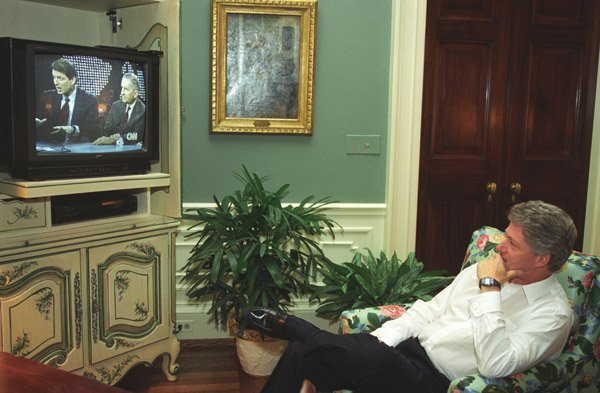
Eight days after the debate, at 10:36 on the night of November 17, the House passed the NAFTA Implementation Act, H.R. 3450, by 234 to 200. The breakdown shows why the issue never fit the party lines. Republicans voted 132 to 43 for it. Democrats voted 156 to 102 against it, against their own president. The House's lone independent voted no.13 The Senate passed the bill on November 20 by 61 to 38.14 NAFTA took effect January 1, 1994.15
United We Stand America
The volunteer network did not go home after the 1992 election. On January 11, 1993 Perot launched United We Stand America as a citizens' watchdog group, with chapters in every state.1016 It was a lobby without a party, built on the theory that a few million organized voters who belonged to neither side could make both sides listen.
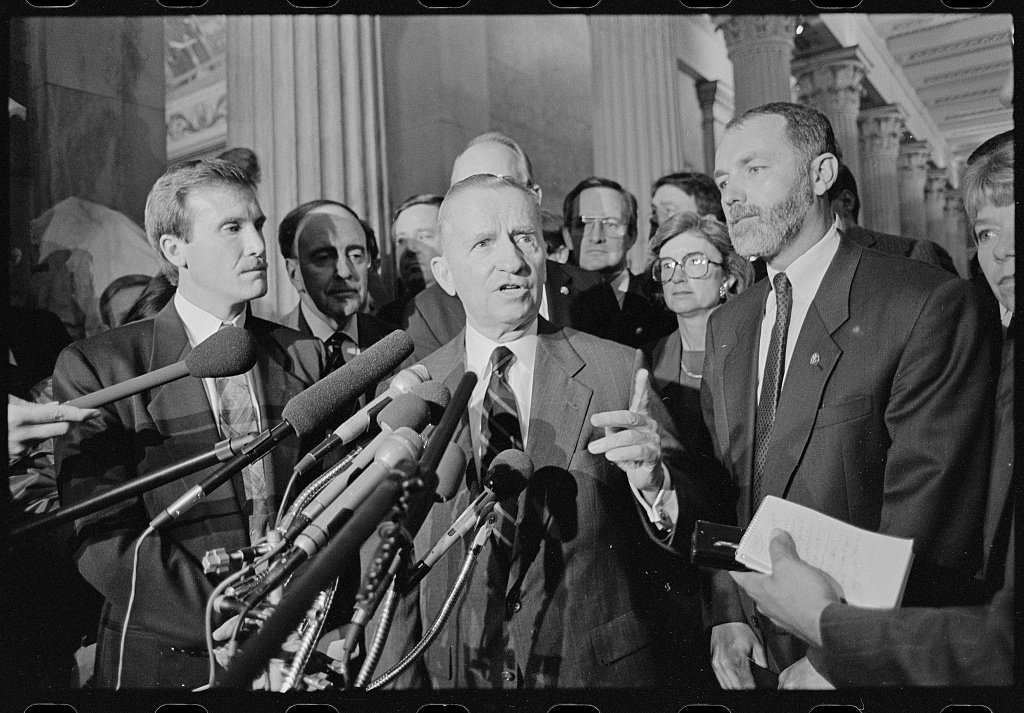
For a while it worked. On June 24, 1993 the group staged a demonstration on Capitol Hill and delivered 2.5 million signatures opposing tax increases. On August 1 Perot went on Meet the Press and urged Congress to reject Clinton's budget. The group spent the fall against NAFTA. In September 1994 a former United We Stand director, Orson Swindle, won a Republican House primary in Hawaii, and on October 4, 1994 Perot urged his followers to elect Republican majorities in Congress.10 They did. Republicans had been seeking his support since at least May 1993, when he appeared at the Capitol with the party's House freshmen.
The courtship did not last. Within a year Perot was moving toward a party of his own. From August 11 to 13, 1995 he hosted a United We Stand conference in Dallas where several Republican presidential hopefuls spoke. A New York Times and CBS News poll released that weekend found 55 percent of Americans wanted a third party. On Meet the Press on August 13 he said he could not rule out running again.10
The Reform Party and 1996
On September 25, 1995, again on Larry King Live, Perot announced that he would start a new party. Its working name was the Independence Party. It became the Reform Party, partly for legal reasons in states where the name it wanted was taken.1018 United We Stand's paid staff moved into a new group, Citizens for the Reform Party, which worked to petition the party onto state ballots.16 California certified the party's signatures on November 1, 1995, the first state to do so. On November 10 the party announced that it would skip the primaries and choose its nominee by convention.10
Perot did not have the field to himself. Richard Lamm, the former Democratic governor of Colorado, announced on July 9, 1996 that he would seek the nomination. Perot said on Larry King the next night that he would run if nominated. Ballots went out early in July to roughly 1.1 million people who had signed party petitions. They mentioned both men and left a blank for the voter's choice.10 The party reported Perot the winner with 32,145 votes to Lamm's 17,121. Lamm supporters complained that some of them never received ballots and that some voters received more than one.18 The candidates presented themselves in Long Beach, California on August 11, and Perot accepted the nomination at the second session in Valley Forge, Pennsylvania on August 18.10 In September he named Pat Choate, his coauthor on NAFTA, as his running mate.19
Taking public money
The biggest change from 1992 was money. Because Perot had won 19 percent of the vote in 1992, the FEC concluded in Advisory Opinion 1996-22 that he would be eligible for pre-election public funding as the Reform Party's nominee. On August 22, 1996 it certified a payment of $29.055 million to the Perot and Choate campaign. The FEC called it "another first for the public funding program": no minor-party nominee had received a general election grant before. Clinton and Dole each received $61.82 million.20 Taking the grant meant accepting its limits, including the $50,000 cap on a candidate's personal spending that had kept him out of the program in 1992.21 So the man who had paid for nearly the whole 1992 campaign himself ran the second one mostly on federal money and the donations of others.
Shut out of the debates
On September 17, 1996 the Commission on Presidential Debates announced its decision on who would be invited. The answer was Clinton and Dole. The commission said its aim was to give a forum to the candidates "from whom the American people actually will choose the next president." Bob Dole, whose campaign was pleased, summed up the reasoning: "They assume there was no realistic chance that anyone but myself or the president would be elected." An outraged Perot vowed to sue, and Reform Party coordinator Russell Verney said the party would file in federal court in Washington.22 The commission's co-chairman, Paul Kirk, said the decision rested on the view that only Clinton and Dole had a realistic chance of being elected.23
Perot and the Natural Law Party's nominee, John Hagelin, sued the FEC and the commission. They lost on jurisdiction, and the courts never reached the merits. The federal district court in Washington dismissed both suits on October 1, 1996, holding that the FEC had exclusive authority to hear complaints under the campaign finance law and that the plaintiffs had no private right of action against the commission. The court of appeals heard the case two days later and affirmed on October 4, two days before the first debate. On Perot's challenge to the FEC's debate regulations themselves, the appeals court sent the claim back to be dismissed without prejudice, leaving him free to sue again later.20
The two sides of this argument still face each other every four years. The commission's case is that debates are for choosing a president, that a stage crowded with candidates who cannot win makes them less useful to voters, and that it had to draw a line somewhere. Perot's case was that the line was drawn by two parties' veterans to protect two parties, and that his own history proved the point: in September 1992 he had polled around 14 percent, and after three debates he won nearly 19.24 The audiences show what was at stake. The two 1996 debates drew 46.1 million and 36.3 million viewers.25 The three 1992 debates with Perot had drawn between 62.4 and 69.9 million.26
The 1996 result
The FEC's official count for 1996 gives Clinton 47,402,357 votes (49.24 percent), Dole 39,198,755 (40.71 percent) and Perot 8,085,402 (8.40 percent). Ralph Nader of the Greens took 684,902, and the Libertarian Harry Browne 485,798.27 Clinton won 379 electoral votes and Dole 159. The National Archives, using a different count, credits Perot with 7,866,284 popular votes and no electoral votes.28
| 1992 (Independent) | 1996 (Reform) | |
|---|---|---|
| Popular vote | 19,742,267 | 8,085,402 |
| Share | 18.91% | 8.40% |
| Electoral votes | 0 | 0 |
| Best state | Maine, 30.43% | Maine, 14.19% |
| Next best | Alaska 28.42%, Utah 27.34%, Idaho 27.04% | Montana 13.56%, Idaho 12.71%, Wyoming 12.26% |
| In the debates | Yes, all three | No |
| Public funds | None; about $64.7 million spent, nearly all his own | $29.055 million grant |
Perot's two campaigns compared, from the FEC's official results and annual reports.272920
He lost more than half his voters. The geography held, though. Maine was again his best state, and the interior West again gave him some of his strongest numbers. Idaho was among his four best states both times. The 8.40 percent also carried a prize. Under the public funding law, a party whose nominee wins between 5 and 25 percent qualifies for a partial grant in the next election, so the Reform Party would go into 2000 with about $12.6 million in federal money waiting for whoever won its nomination.2030 That money did more to wreck the party than anything its enemies did.
Ventura, Buchanan and the breakup
The party's biggest win came two years later and a long way from Dallas. On November 3, 1998, Jesse Ventura was elected governor of Minnesota as the Reform nominee. He won 773,713 votes, 36.99 percent, to 717,350 for the Republican Norm Coleman and 587,528 for the DFL nominee, Skip Humphrey. Turnout was about 60 percent. He reportedly spent around $300,000.31 It showed that a Perot-style appeal could finish first in a three-way race where a plurality was enough.
The win did not hold the party together. About a year into his term Ventura left the national party amid internal fights for control, and the Minnesota party broke away and became the Independence Party of Minnesota.32
Then came 2000, and the $12.6 million. Pat Buchanan, a former Republican presidential candidate, sought the Reform nomination. At the party's convention an anti-Buchanan faction backed John Hagelin of the Natural Law Party, walked out and held a rival convention across the street. Both sides claimed the nomination and the money, and the FEC ruled that Buchanan was the legitimate nominee.18 On September 14, 2000 the FEC certified $12,613,452 in public funds for the Buchanan ticket. The amount, the commission explained, bore the same ratio to the major-party grant "as the number of popular votes received by Ross Perot (the Reform Party's candidate in 1996) bears to the average number of popular votes received by Clinton and Dole in 1996."30 Buchanan won about 0.4 percent of the vote. That was far below the 5 percent needed to keep public funding, and the party lost most of its ballot lines after the election.18
The decline after that was steady. The party endorsed Ralph Nader in 2004 and could offer him only seven ballot lines, down from 49 of 51 in 2000. Its nominee in 2008 received 481 votes, and its 2012 nominee fewer than 1,000. In September 2023 it lost its last state ballot line, in Florida. In 2024 it nominated Robert F. Kennedy Jr., who withdrew in August and endorsed Donald Trump.18 The party still lists a national chairman, Nicholas Hensley, but it has none of the money or reach it had in 1996.18
- Jan 1993 Perot launches United We Stand America.
- Sep 1993 Perot and Choate publish their anti-NAFTA book; Clinton signs the side agreements with three former presidents.
- Nov 1993 Gore-Perot debate on Larry King Live; House passes NAFTA 234 to 200; Senate 61 to 38.
- Jan 1994 NAFTA takes effect.
- Oct 1994 Perot urges voters to elect a Republican Congress.
- Sep 1995 Perot announces a new party on Larry King Live.
- Aug 1996 Perot wins the Reform nomination over Lamm; FEC certifies $29.055 million.
- Sep 1996 Debate commission leaves Perot out.
- Nov 1996 Perot wins 8.40 percent.
- Nov 1998 Jesse Ventura elected governor of Minnesota.
- Sep 2000 FEC certifies $12.6 million for Buchanan after the convention split.
- Jul 2020 The USMCA replaces NAFTA.
Sources: CNN AllPolitics timeline, House and Senate roll calls, FEC annual reports and releases, and USTR.10132033
Perot's forecast against the record
NAFTA ran for twenty-six and a half years. On July 1, 2020 the United States-Mexico-Canada Agreement entered into force, and in the words of the U.S. Trade Representative it "substituted the North America Free Trade Agreement."33 That is long enough to test the forecasts from 1993. The fairest way is to take each claim and look at the official numbers and the strongest studies.
Factory jobs
Perot's central prediction was that manufacturing jobs would flow to Mexico. The Bureau of Labor Statistics count of manufacturing employment shows something more complicated than either side forecast.
In January 1994, the month NAFTA took effect, American factories employed 16,855,000 people. The number rose to a peak of 17,637,000 in March 1998, more than four years into the agreement. It was still 17,105,000 in January 2001. Then it collapsed: 14,291,000 in January 2004, 11,447,000 in January 2010. It recovered only partly, to a preliminary 12,652,000 in September 2026.34 If NAFTA had produced Perot's giant sucking sound, the noise should have been loudest in the years right after 1994. Instead, factory employment grew. The great loss came after 2000.
That timing does not clear NAFTA, but it points elsewhere for most of the damage. The USITC's 2016 review of the research describes a study by Dixon and Rimmer that found, for American industries that shrank in the NAFTA years, that "the major cause in most cases was poor performance in non-NAFTA export markets or competition with non-NAFTA imports."35 Studies that use national data generally find small net effects on employment. One study the USITC cites, by Francis and Zheng, estimated that NAFTA actually lowered annual U.S. unemployment by about 0.2 percentage points.35 CBO's 2003 review said simply that NAFTA's "effects on employment are also small."36
Where Perot was right
Small national effects can hide large local ones, and here the record gives Perot real support. The economists John McLaren and Shushanik Hakobyan studied the industries and places most exposed to Mexican competition, those that had been protected by high tariffs before NAFTA or where Mexico's share of imports rose quickly. The USITC summarizes their finding plainly: an industry's vulnerability to Mexican imports "significantly lowered wage growth for blue-collar workers in the most affected industries and localities." Blue-collar workers in the most affected industries saw wage growth 16 percentage points lower than they would have, and workers without a high school diploma 8 points lower. The most vulnerable places outside agriculture included Georgia, North Carolina, South Carolina and Indiana, and the most exposed industries were footwear, textiles and plastics.35 Other studies the USITC reviewed found gains in some sectors and losses in others: increases in nonferrous metals, iron and steel and machinery, and the largest declines in sugar and apparel.35
That is close to what Perot described in Richmond: a worker in a low-wage, labor-heavy plant competing with a factory a few hundred miles south. He was wrong about the size and wrong about the timing. He was right that the costs would land on particular workers in particular towns, and that the gains, spread thinly across everyone else, would not be much comfort to them.
Trade and growth
The trade numbers moved in the direction both sides expected, only more so. American goods exports to Mexico rose from $41.6 billion in 1993 to $337.3 billion in 2025. Imports from Mexico rose faster, from $39.9 billion to $534.3 billion. The balance went from a surplus of $1.7 billion in 1993 to a deficit of $15.8 billion in 1995 and $197.0 billion in 2025.37 Perot's supporters point to that deficit. Most economists answer that trade agreements have little to do with it. CBO's 2016 review of trade agreements put the consensus this way: such agreements "have had little effect on the U.S. trade balance."38
The growth promised by NAFTA's champions was also smaller than advertised. CBO found in 2003 that NAFTA raised American exports to Mexico by 11.3 percent and imports by 7.7 percent by 2001, compared with what would have happened without it. Its conclusion on the economy as a whole was blunt: "NAFTA has increased annual U.S. GDP, but by a very small amount," probably "no more than a few billion dollars, or a few hundredths of a percent."36 The USITC's 2016 review agreed. "The literature has shown small increases in U.S. welfare and GDP as a result of NAFTA," it said, and it reported Dixon and Rimmer's estimate that of the cumulative 24.4 percent growth in American GDP from 1992 to 1998, only 0.2 percent was due to NAFTA. Caliendo and Parro found Mexico the biggest winner, with a 1.3 percent welfare gain, against 0.08 percent for the United States.35
| Forecast in 1993 | Who made it | What the record shows |
|---|---|---|
| 5.9 million American jobs lost | Perot and Choate | Manufacturing jobs rose from 16.9 million in Jan. 1994 to 17.6 million in 1998; most studies find small net employment effects. The large losses came after 2000 and are mostly tied to other causes. |
| Wages pushed down for factory workers | Perot | Supported for the most exposed industries and places: 16 points lower wage growth for blue-collar workers there. Studies of national averages find little or no effect. |
| 200,000 new export jobs by 1995; net job gains | White House, ITC, Hufbauer and Schott | Not confirmed at that scale; CBO calls employment effects small either way. |
| Much more trade with Mexico | Both sides | Confirmed: exports up eightfold and imports more than thirteenfold, 1993 to 2025, though most of that growth had other causes too. |
| A real boost to U.S. growth | NAFTA's supporters | Small: a few hundredths of a percent of GDP (CBO), 0.2 percent of 1992-98 growth (Dixon and Rimmer). |
Forecasts and results, from the CSM and Heritage accounts of 1993 and the BLS, Census, CBO and USITC records.1934373635
Myth: NAFTA destroyed American manufacturing
The BLS count shows manufacturing employment higher in 1998 and 2000 than in 1993, and the steepest losses in the decade after 2000.34 The opposite myth is just as wrong. NAFTA did not deliver large gains in growth, and it did lower wage growth for blue-collar workers in the industries and places most exposed to Mexican imports.35 Both sides of the 1993 argument oversold their case.
Perot died on July 9, 2019, a year before the USMCA took NAFTA's place.39 The agreement he fought lasted twenty-six years. The federal debt he charted on prime time in October 1992 was more than nine times as large by the end of fiscal 2025.3
Learn more
- CBO, The Effects of NAFTA on U.S.-Mexican Trade and GDP: The government's own 2003 accounting, short and readable.
- USITC 2016 report: Chapter 5 reviews the research on NAFTA's effects on GDP, jobs and wages.
- Heritage Foundation, 1993: The free-trade rebuttal to Perot's book, claim by claim.
- The East Room ceremony: The Monitor's account of Clinton and three former presidents taking on Perot.
- House roll call 575: How every member voted on NAFTA, by party.
- FEC Annual Report 1996: Perot's public grant and the debate lawsuits, from the agency that handled both.
- The 1996 debates: The two-candidate debates Perot was left out of.
- Federal Elections 96: The official returns, state by state.
- BLS manufacturing employment: The monthly series behind the chart in this lesson.
Notes
- Marshall Ingwerson, "Clinton, Aided by Predecessors, Challenges Perot Over NAFTA," Christian Science Monitor, September 16, 1993. Read it online. ↩
- Wikimedia Commons, "President Bill Clinton signs NAFTA.jpg," White House Photograph Office, Ralph Alswang, September 14, 1993, from the Clinton Presidential Library, public domain. Read it online. ↩
- U.S. Department of the Treasury, Fiscal Data, "Historical Debt Outstanding," records for September 30 of 1992, 1993, 1996, 2000, 2001 and 2025. Read it online. ↩
- Commission on Presidential Debates, "October 15, 1992 First Half Debate Transcript," University of Richmond. Read it online. ↩
- George Lee, "Perot's Misplaced Budget Priority," Christian Science Monitor, October 16, 1992 (opinion). Read it online. ↩
- Commission on Presidential Debates, "October 11, 1992 First Half Debate Transcript," Washington University, St. Louis. Read it online. ↩
- "Ross Perot," Wikipedia, sections on political positions and the 1992 campaign, citing contemporary press accounts of the Perot economic plan and reform proposals. The tax rates, Social Security, cigarette tax and space-station details are taken from this summary and have not been checked against Perot's own published plan. Read it online. ↩
- Commission on Presidential Debates, "October 19, 1992 Debate Transcript," Michigan State University, East Lansing. Read it online. ↩
- Michael Wilson, "Setting the Record Straight: Evaluating Ross Perot's Allegations Against the NAFTA," Heritage Foundation Backgrounder No. 959, September 30, 1993. Read it online. ↩
- CNN AllPolitics, "Perot Political Timeline," 1996, entries for January 11, June 24, August 1, September 6 and November 9, 1993; September 18 and October 4, 1994; August 11-13, August 12, August 13, September 25, November 1 and November 10, 1995; and June 20, July 2, July 9 and July 10, 1996. Read it online. ↩
- "Gore-Perot debate," Wikipedia, citing "Who Won TV Debate on NAFTA?," Deseret News, November 10, 1993, and Rupert Cornwell, The Independent, November 10, 1993. Read it online. ↩
- Wikimedia Commons, "Photograph of President William J. Clinton Watching Vice President Albert Gore and Ross Perot Debate the North American Free Trade Agreement (NAFTA) on Television at the White House," photographed by Ralph Alswang, National Archives and Records Administration, catalog date November 10, 1993, public domain. Read it online. ↩
- Office of the Clerk, U.S. House of Representatives, Roll Call 575, H.R. 3450, North American Free Trade Agreement Implementation Act, On Passage, November 17, 1993, 10:36 p.m. Read it online. ↩
- U.S. Senate, Roll Call Vote 395, 103rd Congress, 1st Session, On Passage of the Bill (H.R. 3450), November 20, 1993. Read it online. ↩
- "Giant sucking sound," Wikipedia, on NAFTA's effective date of January 1, 1994. Read it online. ↩
- "United We Stand America," Wikipedia, citing the Chicago Sun-Times, January 11, 1993, and Pat Benjamin, The Perot Legacy (2013), on the founding, the state chapters and the move of its staff to Citizens for the Reform Party. Read it online. ↩
- Wikimedia Commons, "Businessman Ross Perot with Republican freshmen Congress members speaking at a press conference in the U.S. Capitol.jpg," Maureen Keating, May 1993, CQ Roll Call photograph collection, Library of Congress (item 2015645152), no known restrictions. Read it online. ↩
- "Reform Party of the United States of America," Wikipedia, history section and nominee table, citing party records, the San Diego Union-Tribune, CNN, NPR and Ballot Access News for the 1996 primary count, the 2000 split, later nominees and the 2023 loss of the Florida ballot line. Read it online. ↩
- "Ross Perot 1996 presidential campaign," Wikipedia, on the September 10, 1996 selection of Pat Choate. Read it online. ↩
- Federal Election Commission, Annual Report 1996 (Washington, 1997), chapter one; "Presidential Public Funding," pp. 9-13, including AO 1996-22, the certification of about $29 million on August 22, and the district court (October 1, 1996) and appeals court (October 4, 1996) decisions in Perot '96 and Natural Law Party v. FEC, 97 F.3d 553 (D.C. Cir. 1996); and the chronology in the appendices ($29.055 million to Perot/Choate; $61.82 million each to Dole/Kemp and Clinton/Gore). Read it online. ↩
- Federal Election Commission, Annual Report 1992, "General Election-1992," note 8, on the pledge not to spend more than $50,000 in personal funds. Read it online. ↩
- Associated Press, "Debate Commission Says 'No' to Perot," The Michigan Daily, September 18, 1996. Read it online. ↩
- "Perot v. Federal Election Commission," Wikipedia, citing CNN, September 17, 1996, for co-chairman Paul Kirk's statement. Read it online. ↩
- "Ross Perot 1992 presidential campaign," Wikipedia, on September 1992 polling, and FEC, Federal Elections 92, for the result. Read it online. ↩
- Commission on Presidential Debates, "1996 Debates," viewership from Nielsen Media Research. Read it online. ↩
- Commission on Presidential Debates, "1992 Debates." Read it online. ↩
- Federal Election Commission, Federal Elections 96: Election Results for the U.S. President, the U.S. Senate and the U.S. House of Representatives (Washington, 1997), "1996 Popular Vote Summary," "1996 Electoral and Popular Vote Summary," and state tables. Read it online. ↩
- National Archives and Records Administration, "1996 Electoral College Results." Read it online. ↩
- Federal Election Commission, Federal Elections 92, "1992 Popular Vote Summary" and state tables. Read it online. ↩
- Federal Election Commission, "Commission Certifies General Election Public Funds for Buchanan Ticket," news release, September 14, 2000. Read it online. ↩
- "1998 Minnesota gubernatorial election," Wikipedia, results table citing the Minnesota Secretary of State's official returns. Read it online. ↩
- "Jesse Ventura," Wikipedia, introduction and section on the 1998 campaign. Read it online. ↩
- Office of the U.S. Trade Representative, "United States-Mexico-Canada Agreement." Read it online. ↩
- Bureau of Labor Statistics, Current Employment Statistics, series CES3000000001, All Employees, Manufacturing, seasonally adjusted, in thousands; values for January 1990 to January 2026, March 1998 and September 2026 (preliminary), retrieved October 2026. Read it online. ↩
- U.S. International Trade Commission, Economic Impact of Trade Agreements Implemented Under Trade Authorities Procedures, 2016 Report, Publication 4614 (June 2016), chapter 5, pp. 255-259, summarizing Dixon and Rimmer (2014), Caliendo and Parro (2015), Francis and Zheng (2011), De La Cruz and Riker (2014) and McLaren and Hakobyan, "Looking for Local Labor Market Effects of NAFTA" (2012). Read it online. ↩
- Congressional Budget Office, The Effects of NAFTA on U.S.-Mexican Trade and GDP (May 2003), Summary, pp. x, xiii-xiv. Read it online. ↩
- U.S. Census Bureau, Foreign Trade Division, "Trade in Goods with Mexico," annual totals 1985-2026, in millions of dollars, not seasonally adjusted. Read it online. ↩
- Congressional Budget Office, How Preferential Trade Agreements Affect the U.S. Economy (September 29, 2016). Read it online. ↩
- "Ross Perot, Billionaire and Former Presidential Candidate, Dies at 89," CNN, July 9, 2019. Read it online. ↩


Check yourself
1. How did Perot describe his proposed gasoline tax in the first 1992 debate?
In the October 11, 1992 debate Perot said, 'It's 10 cents a year cumulative. It finally gets to 50 cents at the end of the 5th year,' and spoke of 'a period of shared sacrifice.'
2. What was the House vote on the NAFTA Implementation Act on November 17, 1993?
House roll call 575 shows H.R. 3450 passing 234 to 200. Republicans voted 132 to 43 for it and Democrats 156 to 102 against.
3. What federal money did Perot accept in 1996 that he had not taken in 1992?
The FEC certified $29.055 million in public funds to the Perot and Choate campaign on August 22, 1996, the first such general election grant to a minor-party nominee, based on his 19 percent in 1992.
4. What reason did the Commission on Presidential Debates give in September 1996 for leaving Perot out?
The commission said its aim was a forum for candidates 'from whom the American people actually will choose the next president,' and co-chairman Paul Kirk said only Clinton and Dole had a realistic chance.
5. What did the Congressional Budget Office conclude in 2003 about NAFTA's effect on U.S. GDP?
CBO wrote that 'NAFTA has increased annual U.S. GDP, but by a very small amount,' probably 'no more than a few billion dollars, or a few hundredths of a percent,' and that its employment effects were also small.
6. Who won the Minnesota governor's race in 1998 as the Reform Party nominee?
Ventura won with 773,713 votes, 36.99 percent, ahead of Republican Norm Coleman and DFL nominee Skip Humphrey, according to the official Minnesota results.
Terms in this lesson
- Federal deficit and debt
- The deficit is the amount by which federal spending exceeds revenue in one year. The debt is the total the government owes from all past borrowing.
- NAFTA
- The North American Free Trade Agreement among the United States, Canada and Mexico, in force from January 1, 1994 until the USMCA replaced it on July 1, 2020.
- Side agreements
- The labor and environmental agreements negotiated by the Clinton administration in 1993 and added to NAFTA before Congress voted on it.
- Public funding
- The federal grant to presidential nominees from the Presidential Election Campaign Fund. A minor party whose nominee won 5 to 25 percent of the vote in the last election can qualify for a partial grant.
- Commission on Presidential Debates
- The private, nonprofit group, formed in 1987, that sponsored the general-election presidential debates of the 1990s and set the rules for who was invited.
- Electronic town hall
- Perot's idea of using television and telephone technology to let citizens hear a national issue explained and register their views directly.
- Trade balance
- The value of a country's exports minus its imports. A negative balance is a trade deficit.
Sources
- Federal Election Commission, Federal Elections 96 checked 2026-10
- Federal Election Commission, Annual Report 1996 checked 2026-10
- National Archives, 1996 Electoral College Results checked 2026-10
- Commission on Presidential Debates, 1996 Debates checked 2026-10
- U.S. House, Roll Call 575, H.R. 3450, November 17, 1993 checked 2026-10
- U.S. Senate, Roll Call Vote 395, 103rd Congress, 1st Session checked 2026-10
- Congressional Budget Office, The Effects of NAFTA on U.S.-Mexican Trade and GDP (2003) checked 2026-10
- U.S. International Trade Commission, Economic Impact of Trade Agreements Implemented Under Trade Authorities Procedures, 2016 Report checked 2026-10
- Bureau of Labor Statistics, All Employees, Manufacturing (CES3000000001) checked 2026-10
- U.S. Census Bureau, Trade in Goods with Mexico checked 2026-10
- Marshall Ingwerson, Clinton, Aided by Predecessors, Challenges Perot Over NAFTA (Christian Science Monitor, 1993) checked 2026-10
- Michael Wilson, Setting the Record Straight: Evaluating Ross Perot's Allegations Against the NAFTA (Heritage Foundation, 1993) checked 2026-10
- CNN AllPolitics, Perot political timeline (1996) checked 2026-10