Lesson 3 of 10 · about 22 minutes
1992: The Campaign
You'll be able to
- Trace the 1992 Perot campaign from the February 20 Larry King appearance to Election Day, with its key dates
- Explain why Perot withdrew on July 16, the reason he later gave, and what the evidence showed about that reason
- Describe how Perot used paid half-hour television programs and the three October debates
- Read the official FEC results for 1992 and explain where Perot was strongest and weakest
- Weigh the evidence from exit polls and peer-reviewed studies on whether Perot changed the outcome
On the night of February 20, 1992, a Dallas computer billionaire sat across from Larry King on CNN and was asked, not for the first time, whether he would run for president. Ross Perot said he did not want to. Then he set a condition. If ordinary people cared enough to put his name on the ballot in all fifty states, he would run.1 The Federal Election Commission noticed the effect within days. After that first appearance on King's program, its annual report says, the agency began receiving calls from people all over the country who wanted to know how to get Perot's name on the ballot in their states.2
Lesson 2 told the story of the man. This lesson follows the campaign, which lasted about eight and a half months, stopped dead in the middle, started again five weeks before the election, and ended with 19,742,267 votes and not one elector.
A dare on Larry King
It is easy to forget how odd the offer was. Perot had no party, no primary campaign and no staff for a national race. What he had was money, a reputation for getting things done at Electronic Data Systems and in Texas school reform, and a direct, folksy way of talking that played very well on a call-in show. What he asked of viewers was work: the signatures.
The response came fast. Perot set up a volunteer phone bank at his Dallas office on March 12. Associated Press reports from the time, as collected in the standard account of the campaign, say phone lines took up to 18,000 calls at once at the peak and that MCI logged more than a million calls in the first ten days.3 On March 18 he went to the National Press Club in Washington and said he would run as an independent if the volunteers delivered ballot access everywhere. Twelve days later, on March 30, he named a provisional running mate: James Stockdale, a retired Navy vice admiral and Medal of Honor recipient.13 Stockdale was meant to hold the place until a permanent choice was made. He stayed on the ticket to the end.
Perot also said he would pay for the campaign himself, and that he did not want donations larger than five dollars from supporters.3 That choice had legal consequences. Under the public funding law, a candidate who wants federal money for the general election must pledge not to spend more than $50,000 of personal funds. The FEC noted later that Perot never asked for public money and would not have qualified for it, because he spent far beyond that limit from his own pocket.2
Fifty states of petitions
Lesson 1 described the ballot rules that face anyone outside the two major parties: a different signature count, deadline and form in every state. The Perot volunteers met all of them. Draft Perot groups opened in every state, and the petition work was coordinated in large part by Perot's friend Tom Luce.3 Arizona was the last to certify him, on September 18.1 The FEC's annual report recorded the result in a single sentence: only four candidates were on the ballot in all fifty states and the District of Columbia in 1992. They were George Bush, Bill Clinton, Ross Perot and the Libertarian nominee, Andre Marrou.2
The ballot labels show how local the effort was. In Florida, Texas and most other states Perot appeared simply as an independent. In New York he ran on the line of the "No Party Party." In Pennsylvania the line read "Pennsylvanians for Perot," in Minnesota "Minnesota for Perot," in Connecticut "Americans for Perot," and in Louisiana "Prudence, Action, Results."4 Each label was the work of a state organization that had filed its own paperwork.
The spring lead
By late spring Perot was not a curiosity. He was leading. A Washington Post and ABC News poll released April 28 put him at 30 percent, close behind Bush at 36 and Clinton at 31.1 The Times Mirror Center for The People and The Press interviewed 3,517 adults between May 28 and June 10, and its June 16 report carried the headline "PEROT TOPS BUSH AND CLINTON, BUT SCHWARTZKOPF RUNS ALMOST AS STRONG." Among registered voters in the three-way race it found Perot at 36 percent, Bush at 31 and Clinton at 28.5 A Time magazine poll in mid-June had him at 37 percent to 24 for each of the others.3
A lead brings scrutiny, and the scrutiny went badly. On May 29, in an interview on ABC's 20/20, Perot made remarks about whether he would appoint gay Americans to his cabinet and about the military's ban on gay service members that drew protests for the rest of the year. On June 3 he hired two professionals from opposite camps, the Republican consultant Ed Rollins and Jimmy Carter's former chief of staff, the Democrat Hamilton Jordan. On June 21 news reports linked Perot to private investigations of George Bush in the 1980s. Perot blamed Republican "dirty tricks," and the Republican National Committee denied it. On July 11 his remarks to the NAACP convention drew criticism, and he apologized.1 On July 15 Rollins quit. He had argued for a large paid advertising campaign, and Perot had fired the advertising man, Hal Riney, whom Rollins had brought in.3
July 16: the exit
The next day Perot called reporters to a news conference in Dallas. The petitions were still coming in. Perot told the room he was out:
"Now that the Democratic Party has revitalized itself, I have concluded that we cannot win in November and that the election will be decided in the House of Representatives."
H. Ross Perot, news conference in Dallas, July 16, 1992. 6
His fear had a basis in the Constitution. If no candidate wins a majority of the electoral votes, the Twelfth Amendment sends the choice to the House, where "the votes shall be taken by states, the representation from each state having one vote."7 A three-way split could have done exactly that. But he did not tell the volunteers to stop. "I urge the volunteers to turn them in," he said of the petitions, and he asked New York's volunteers, whose signing period was opening that day, to finish the job.6 Asked when he had made the decision, he said, "I made it yesterday." Asked his plans, he said, "Go to work."6
President Bush was in Wyoming, at Secretary of State James Baker's ranch, and spoke to reporters by telephone. "I just called Ross Perot. On a very personal basis, I congratulated him," he said. "I told him that he had really and truly energized an awful lot of people."8
The volunteers did not take it gracefully. One sued Perot in federal court in Miami on July 20, saying he had broken a promise to run.1 Perot had spent about $12 million of his own money by the time he left.3 The organization of supporters stayed together under the name United We Stand America, and the petitions kept arriving at state election offices through August and September.
The wedding story
Perot offered a second explanation three months later, and it is part of the record because he gave it himself. On Sunday, October 25, nine days before the election, he told Lesley Stahl of CBS's 60 Minutes that he had left in July because of a plot by "the key people" in the Bush-Quayle campaign to smear his daughter with a doctored photograph and disrupt her summer wedding. "This was run at the top," he said.910
The evidence did not hold up. David Broder of the Washington Post, writing two days after the broadcast, summarized what CBS itself had established. Perot offered no proof. One source of the allegation was a man whom 60 Minutes said had been convicted of electronic eavesdropping and whom the FBI described as a publicity hound and a concocter of tall tales. When the FBI looked into the charges, it found nothing to support them. Robert Teeter, the Bush-Quayle campaign chairman, campaign counsel Bobby Burchfield and the White House all denied it. Broder also pointed out that on September 28, three days before Perot reentered the race, Perot had welcomed Teeter to a meeting in Dallas and put a friendly arm around his shoulders on camera.9
Perot's answer to Stahl was a father's answer. "I didn't want to destroy Caroline's wedding," he said, as Broder quoted him, and he admitted he could not prove the plot, but said "it was a risk I was not willing to take."9 Broder did not buy it. "Quitting the race was an extreme reaction to a dubious provocation," he wrote, and he argued that the July decision may have cost Perot a chance to win the presidency.9 The fairest summary is the one the sources allow. Perot said the threat drove him out. He never produced evidence for it, and the investigators who looked found none. His July explanation, given at the time, was about the Democrats and the House.
October 1: back in
The fall began with a strange courtship. Both major campaigns sent delegations to Dallas on September 28 to present their programs to Perot's state coordinators, as if applying for the volunteers' support.9 Three days later Perot announced that he was a candidate again. His reason, in his own words:
"The volunteers in all 50 states have asked me to run as a candidate for President of the United States."
H. Ross Perot, news conference, October 1, 1992. 11
He said they wanted him back because the parties had not responded to their concerns, and he added: "Neither political party has effectively addressed the issues that concern the American people."11 He had thirty-three days. His standing in the polls had fallen to the low teens over the summer, around 14 percent in September by the count in the standard campaign history.3 Many former supporters were angry, and the New York Times judged in an editorial that his chances were much worse than when he quit.3
Charts on prime time
Then he did something no one in modern politics had tried at that scale. Instead of rallies and thirty-second spots, he bought half-hour blocks of network time and lectured.
The first program aired the night of Tuesday, October 6. The student newspaper at Texas A&M described it the next morning: thirty minutes of Perot at a desk with charts tracking falling payrolls, production and consumer spending, and others showing more Americans working for government than in manufacturing. He blamed both parties for dodging the $4.1 trillion debt. "We got into trickle-down economics, but it didn't trickle down," he said. He warned that the country was headed into "deep voodoo" and said, "We must be a manufacturing superpower."12
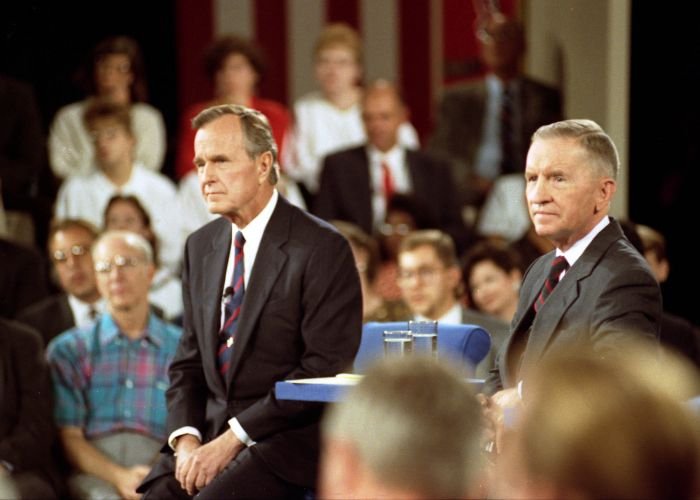
The ratings surprised the experts.14 John Dillin of the Christian Science Monitor reported on October 22 that the programs had drawn as many as 20 million viewers, and he described Perot pointing at his charts with what Perot called a "voodoo stick," lecturing like a stern professor.15 The campaign followed with a three-night run on ABC, NBC and CBS that week, including a biographical program about his business career.15 By October 26 the Monitor counted six half-hour programs aired and more than $17 million spent on television, all of it Perot's money. An hour on ABC on election eve, just before Monday Night Football, cost $940,000.14
The final bill was large by any standard. Perot's committee filed reports showing $64.7 million in general election spending, according to the FEC. For comparison, Bush and Clinton each received a public grant of $55.24 million, and each national party spent another $10.2 million in coordinated expenditures on its nominee.2 CNN's timeline, based on FEC filings released November 5, put the amount of Perot's own money at $65.6 million.1
What the charts were about
Perot's numbers were mostly right. When he said in the debates that the country was "$4 trillion in debt," he was close to the Treasury's own figure. Total federal debt outstanding on September 30, 1992, the last day of the fiscal year, was $4,064,620,655,521.66.16 His argument was about direction and speed as much as size, and Lesson 4 takes up the plan he offered to deal with it.
Three debates and a running mate
The Commission on Presidential Debates sponsored four debates in eight days, and Perot and Stockdale took part in all of them. The audiences were huge.
| Date | Place | Format and moderator | Viewers |
|---|---|---|---|
| October 11 | Field House, Washington University, St. Louis | Panel of three journalists; Jim Lehrer, PBS | 62.4 million |
| October 13 | Theater for the Arts, Georgia Tech, Atlanta | Vice-presidential debate; Hal Bruno, ABC | 51.2 million |
| October 15 | Robbins Field House, University of Richmond | Town hall with 209 uncommitted voters; Carole Simpson, ABC | 69.9 million |
| October 19 | Wharton Center, Michigan State University, East Lansing | Moderator, then a panel; Jim Lehrer, PBS | 66.9 million |
The 1992 debates as recorded by the Commission on Presidential Debates.17
St. Louis, October 11
The first debate gave Perot his best line of the campaign. Asked about the charge that he lacked government experience, he agreed. "I don't have any experience in running up a $4 trillion debt," he said, and he added that he had no experience in "gridlock government where nobody takes responsibility for anything." Then: "But I do have a lot of experience in getting things done."18 He also used the night to defend the way he had reached the ballot. "I was not put on the ballot by any PAC money, by any foreign lobbyist money, by any special interest money," he said.18 Several snap polls afterward named him the winner.3
Atlanta, October 13
The vice-presidential debate went the other way. James Stockdale opened with two questions: "Who am I? Why am I here?" He went on: "I'm not a politician," and "Thirty-seven years in the Navy, and only one of them up there in Washington."19 Later, asked to respond, he said, "You know, I didn't have my hearing aid turned on. Tell me again."19 Many viewers heard confusion, and contemporary coverage, Newsweek's among it, judged him unprepared on the issues.3 A decorated officer of real courage became, for many viewers, the symbol of a campaign that was not ready. That was unfair to Stockdale, and it was also real.
Richmond, October 15
The town-hall debate in Richmond, where uncommitted voters asked the questions, produced the most famous phrase Perot ever spoke. The first question was about jobs and the economy, and Perot said the subject was "right at the top of my agenda. We've shipped millions of jobs overseas." He then laid out the case against the proposed North American Free Trade Agreement with Mexico:
"If you're paying $12, $13, $14 an hour for a factory worker, and you can move your factory south of the border, pay $1 an hour for labor, hire a young, let's assume you've been in business for a long time. You've got a mature workforce. Pay $1 an hour for your labor, have no health care, that's the most expensive single element in making the car. Have no environmental controls, no pollution controls and no retirement. And you don't care about anything but making money. There will be a job-sucking sound going south."
Ross Perot, second presidential debate, Richmond, Virginia, October 15, 1992, as transcribed by the Commission on Presidential Debates. 20
The words are disputed by one syllable. The commission's transcript, and PBS's, have "job-sucking sound." The New York Times transcript published the next day has "giant sucking sound," and that is the version the country remembers.21 There is no dispute about what he said four nights later in East Lansing, where the commission's own transcript records him warning of "a giant sucking sound of jobs being pulled out of this country" if the agreement went through.22
East Lansing, October 19
The last debate also brought July back. Perot brushed it off. "Now, what happened in July we've covered again and again and again," he said, and he spoke straight to his volunteers: "I never quit supporting you as you put me on the ballot in the other 26 states; and when you asked me to come back in, I came back in."22 It was his best defense of the withdrawal. He had kept the organization alive and let the petitions go forward, so in a sense the campaign never fully died. Whether voters accepted that was another matter.
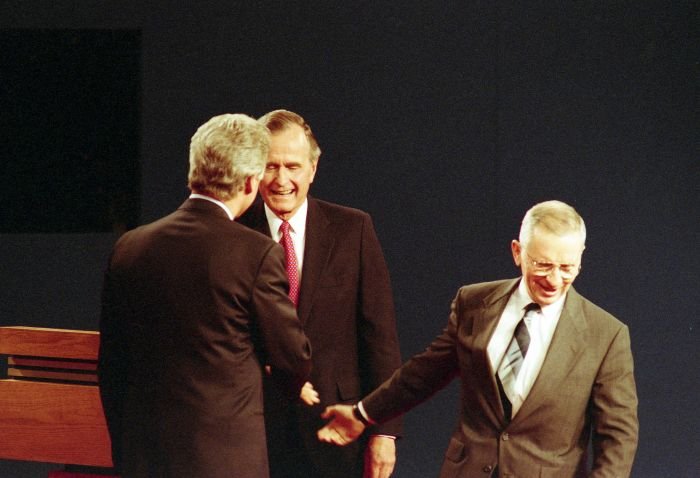
Election night
On November 3, 1992, 104,426,659 Americans voted for president, 55.24 percent of the voting-age population as the Census Bureau estimated it. The Federal Election Commission's official count gives Clinton 44,909,889 votes (43.01 percent), Bush 39,104,545 (37.45 percent) and Perot 19,742,267 (18.91 percent). The Libertarian Andre Marrou finished a distant fourth with 291,628, or 0.28 percent.4 In the Electoral College Clinton won 370 votes and Bush 168. The National Archives page on 1992, which uses its own slightly different popular count, says Perot "received 19,741,065 popular votes for President, but no electoral votes."24 The small difference between the two federal figures comes from late certifications and corrections. This lesson uses the FEC's numbers.
Lesson 1 explained why nearly one vote in five produced no electors: Perot's support was spread evenly, and he finished first nowhere. The state tables show the pattern clearly.
| Perot's best states | Perot share | Place | Perot's weakest | Perot share |
|---|---|---|---|---|
| Maine | 30.43% | 2nd | District of Columbia | 4.25% |
| Alaska | 28.42% | 3rd | Mississippi | 8.72% |
| Utah | 27.34% | 2nd | Tennessee | 10.08% |
| Idaho | 27.04% | 3rd | Arkansas | 10.43% |
| Kansas | 26.99% | 3rd | Alabama | 10.85% |
| Nevada | 26.18% | 3rd | South Carolina | 11.55% |
| Montana | 26.11% | 3rd | Louisiana | 11.81% |
| Wyoming | 25.56% | 3rd | Georgia | 13.34% |
Perot's eight strongest and eight weakest jurisdictions in 1992, from the FEC's state-by-state tables. Arkansas was Clinton's home state.4
The map is plain. Perot ran best in the thinly settled West, in northern New England and on the Great Plains. He ran worst in the Deep South, in Clinton's Arkansas and in the District of Columbia. He beat Bush in Maine by 316 votes and beat Clinton in Utah by about 20,000. Everywhere else he finished third.4
His total is the part that still stands out. It was the largest share for a candidate outside the two major parties since Theodore Roosevelt in 1912, and the largest number of votes any such candidate has ever received.3 And in 46 of the 51 jurisdictions that cast electoral votes, Perot's vote was larger than the gap between Clinton and Bush. Only in Arkansas, Maryland, Mississippi, New York and the District of Columbia did the winner's margin exceed Perot's total.25 That fact is the starting point of the argument that has followed the 1992 election ever since.
Who voted for Perot
The networks' pooled exit poll, run by Voter Research and Surveys, interviewed 15,490 voters as they left the polls. As tabulated by the Roper Center, Perot won 21 percent of men and 17 percent of women, 21 percent of white voters and 7 percent of Black voters. He did best among the young and the middle-aged: 21 percent of voters aged 18 to 24, 23 percent of those 25 to 29 and 21 percent of those 30 to 49, against 11 percent of voters 65 and older. By party, he took 30 percent of self-described independents, 17 percent of Republicans and 13 percent of Democrats. By ideology, he drew almost evenly: 18 percent of liberals, 21 percent of moderates and 18 percent of conservatives. Veterans gave him 22 percent. By region he was strongest in the West at 23 percent and weakest in the South at 16.26
That profile matters for the next question. A candidate whose voters were mostly Republicans or mostly conservatives would plainly have hurt one side. Perot's voters were neither. They were disproportionately independent, white, male, under fifty and moderate. They looked like the swing voters both parties were chasing.
Did Perot elect Clinton?
George Bush thought so. When Perot died in 2019, CNN recalled that Bush had said Perot "cost me the election," and noted that scholarly research has challenged the claim.27 Many Republicans have made the same argument. Their case is simple and deserves a fair statement. Perot spent the year attacking a sitting Republican president on the economy and the debt. He drew heavily from independents, and early in the year from Reagan Democrats and suburban conservatives.3 His votes exceeded the margin in nearly every state Clinton won. Take him off the ballot, the argument goes, and enough of those voters return to Bush to change the map.
The other side has the data. Here is what the main sources found.
The exit poll
Voters leaving the polls were asked what they would have done in a two-way race. Pollster Tim Hibbitts, writing in The Polling Report in 2012, gave the result: "38% of the Perot voters said they would have voted for Clinton in a two way race," and 38 percent would have voted for Bush, while 24 percent would not have voted at all.28 An even split leaves Clinton's lead where it was. Hibbitts also pointed out that Bush's poll numbers barely moved when Perot left the race in July or returned in October, and he concluded that Bush "would have lost, and handily."28
Alvarez and Nagler, 1995
Exit-poll second choices are a blunt tool, because people often say what sounds reasonable after the fact. Political scientists R. Michael Alvarez of Caltech and Jonathan Nagler built a statistical model of each voter's choice among the three candidates from the 1992 National Election Studies survey, which asks voters about issues, the economy and the candidates. They published it in the American Journal of Political Science in 1995. Their findings ran against the angry-voter story of the year. They found that the economy dominated, that "Clinton, not Perot, was the beneficiary of economic discontent," and that Perot "took more votes from Bush than he did from Clinton."29 Taking more votes from Bush is a narrower claim than costing Bush the election, and the next study shows why the difference matters.
Lacy and Burden, 1999
Dean Lacy, then at Ohio State, and Barry Burden, then at Louisiana State, added a fourth choice to the model: staying home. Their point was that many Perot voters would not have voted at all without him, and that the people who stay home are not a random sample. With only three choices, their model looked like the earlier work, and it found that "Perot hurt Bush at the polls, though not enough to change the election outcome." With abstention included, the picture changed. Without Perot, their model predicted Clinton winning 61.6 percent of the two-party vote to Bush's 38.4, a margin about seven points larger than in their survey sample.30 Their conclusion was blunt:
"In 1992 Ross Perot reduced rather than increased Bill Clinton's margin of victory over George Bush. Perot's candidacy increased turnout by nearly three percentage points, and one out of every five Perot supporters would not have voted had Perot not entered the race."
Dean Lacy and Barry C. Burden, "The Vote-Stealing and Turnout Effects of Ross Perot in the 1992 U.S. Presidential Election," American Journal of Political Science 43, no. 1 (January 1999). 30
They noted that their turnout estimate was higher than others. Paul Abramson, John Aldrich and David Rohde, working from exit-poll data in their book on the 1992 elections, had estimated that Perot raised turnout by about 1.5 points, and they admitted that figure was probably low.30 Either way, the studies agree on direction. Perot brought new people to the polls, and those people did not belong to Bush.
The state map
The national vote does not elect a president, so the real test is state by state. In 2023 the analysts Harrison Lavelle and Armin Thomas of the election site Split Ticket took the exit poll's second-choice answers for each state, dropped the voters who said they would have stayed home, and reassigned every state's actual Perot vote. Data were missing for Alaska, Idaho and Vermont. Their reallocation gave Clinton a national win of about 53 to 46 and changed only two states: Arizona would have moved to Clinton and Nevada to Bush, for a net loss to Bush of four electoral votes. They concluded that Perot voters "actually would have preferred Clinton over Bush."31
The FEC's own state table allows a simpler test. Assume, generously to the Bush argument, that every Perot voter would have voted for Bush or Clinton and none would have stayed home. How large a share of them would Bush have needed to carry each state Clinton won? Bush had 168 electoral votes and needed 270, so he needed 102 more.
The chart makes the Bush argument concrete, and it shows how hard it is. Bush could have gained Georgia, New Hampshire, Ohio, Montana and Nevada with only a modest lean among Perot's voters, from about 52 to 55 percent. Those five states carry 45 electoral votes, enough to make the race close but not enough to win it. To get over 270 he would have needed about three of every five Perot voters in Colorado and Wisconsin, and about two of every three in Iowa, and he would have needed all of it at the same time. The national version of the same arithmetic is familiar: Bush would have needed roughly two-thirds of the Perot vote nationwide to overtake Clinton.3 No exit poll, survey or model found anything like that.
That does not end every argument. The Bush camp can fairly say that Perot's year-long assault on the administration's economic record hurt Bush's standing before November, in ways no second-choice question can measure. Perot's critique of the debt and of Washington helped set the terms of the fall campaign. That influence is real, and it shows up in the next lesson, where both parties scramble for Perot's voters for the rest of the decade. But on the narrow question of whether Perot's name on the ballot handed the election to Clinton, the weight of the evidence says it did not. Clinton most likely wins without him, and possibly by more.
Myth: Perot voters were disappointed Republicans
The exit poll shows the opposite. Perot took 30 percent of independents and only 17 percent of Republicans and 13 percent of Democrats, and his voters split almost evenly among liberals, moderates and conservatives.26 Some of his voters were Republicans angry at Bush. About one in five, by one careful estimate, would not have voted at all without him.30
A timeline of the year
- Feb 20 On Larry King Live, Perot says he will run if volunteers put him on the ballot in all fifty states.
- Mar 18 National Press Club speech; volunteer drives spread nationwide.
- Mar 30 Retired Vice Admiral James Stockdale named provisional running mate.
- Jun 3 Ed Rollins and Hamilton Jordan hired.
- Jun 16 Times Mirror poll: Perot 36, Bush 31, Clinton 28 among registered voters.
- Jul 15 Rollins quits.
- Jul 16 Perot withdraws, saying the election would end up in the House.
- Sep 18 Arizona certifies him; he is on the ballot in all fifty states and D.C.
- Oct 1 Perot reenters the race.
- Oct 6 First half-hour paid program.
- Oct 11-19 Three presidential debates and one vice-presidential debate.
- Oct 25 On 60 Minutes, Perot blames a Republican plot against his daughter for the July exit.
- Nov 3 Election: Perot 19,742,267 votes, 18.91 percent, no electoral votes.
Sources: CNN AllPolitics timeline, the Times Mirror Center, the American Presidency Project and the FEC.154
What the campaign left behind
Perot lost, but the campaign left a structure and an argument. The structure was the volunteer network, which he turned into a membership organization in January 1993.1 The argument was that the deficit, the debt and the habits of Washington were the real issues, and that neither party would face them unless voters forced it. Both are the subject of Lesson 4.
The campaign also left a practical lesson for anyone thinking about an independent run. Money can buy television time and ballot access. Perot proved both. It cannot buy the one thing the Electoral College rewards, which is a first-place finish in a state. A candidate who wins a fifth of the vote everywhere wins nothing anywhere, and a candidate who quits in July, as Perot learned, does not get those months back.
Learn more
- Federal Elections 92: The FEC's official results, with every candidate and ballot label in every state.
- The 1992 debates: The Commission on Presidential Debates' record, with links to all four transcripts.
- Perot's July 16 news conference: The full statement and questions from the day he quit.
- Lacy and Burden, 1999: The study that counted staying home as a choice. Technical, but the conclusion is readable.
- Alvarez and Nagler on 1992: The working-paper version of their study of economics, issues and the Perot vote.
- How groups voted in 1992: The Roper Center's tables from the network exit poll.
- Tim Hibbitts on the Perot effect: A pollster's short, plain case that Perot did not cost Bush the election.
- Split Ticket's state reallocation: The state-by-state test using exit-poll second choices.
- Times Mirror, June 1992: The poll report from the month Perot led the race.
Notes
- CNN AllPolitics, "Perot Political Timeline," 1996 Reform Party convention coverage, entries for February 20, March 18, March 30, April 28, May 29, June 3, June 21-24, July 11, July 15, July 16, July 20, September 18, October 1 and November 5, 1992. Read it online. ↩
- Federal Election Commission, Annual Report 1992 (Washington, 1993), chapter one (on calls after the Larry King appearance and Perot's self-funding) and the section "General Election-1992," including note 8 on the $50,000 personal-funds limit and the list of candidates on the ballot in all fifty states and D.C. Read it online. ↩
- "Ross Perot 1992 presidential campaign," Wikipedia, citing Associated Press reports of March 27 and 30, 1992 (phone volume and the MCI count), the New York Times of March 7 and 29, 1992 (the $5 limit), Time, June 15, 1992 (the 37-24-24 poll), the New York Times of July 16 and 18, 1992 (Rollins, Riney and the $12 million spent), and later accounts of the September polls, the debate snap polls and the two-thirds threshold. Used here only for details not found in a primary source. Read it online. ↩
- Federal Election Commission, Federal Elections 92: Election Results for the U.S. President, the U.S. Senate and the U.S. House of Representatives (Washington, June 1993), "1992 Popular Vote Summary," p. 9, "1992 Electoral and Popular Vote Summary," p. 10, and the state-by-state tables with party labels. Read it online. ↩
- Times Mirror Center for The People and The Press, "Campaign '92: Survey VII, Year of the 'Outsiders,'" released June 16, 1992, telephone survey of 3,517 adults, May 28 to June 10, 1992. Read it online. ↩
- H. Ross Perot, "News Conference in Dallas on Decision Not to Enter the Election," July 16, 1992, in Gerhard Peters and John T. Woolley, The American Presidency Project, University of California, Santa Barbara. Read it online. ↩
- U.S. Constitution, Amendment XII, Constitution Annotated, Library of Congress. Read it online. ↩
- George Bush, "Remarks in Boulder, Wyoming, on Ross Perot's Withdrawal From the Presidential Campaign," July 16, 1992, Public Papers of the Presidents of the United States: George Bush, 1992, Book I. Read it online. ↩
- David S. Broder, "'Odd and Disturbing,'" Washington Post, October 27, 1992 (column), as distributed in the Post's Capitol Edition On-Line and archived at MIT. Read it online. ↩
- "Perot: Threats Drove Me Out," St. Petersburg Times (now Tampa Bay Times), October 26, 1992, reporting that Perot "said Sunday" the threat of dirty tricks against his daughter caused his July withdrawal. Read it online. ↩
- H. Ross Perot, "Excerpts of News Conference Announcing Decision to Campaign for President," October 1, 1992, The American Presidency Project. Read it online. ↩
- Gary P. Carroll, "Perot Launches First Television Ad," The Battalion (Texas A&M University), October 7, 1992, p. 1. Read it online. ↩
- Wikimedia Commons, "Second debate 3250.jpg," George Bush Presidential Library and Museum photograph, October 15, 1992, public domain as a work of the federal government. Read it online. ↩
- Scott Pendleton, "With Eight Days Left, Ross Perot Launches Blitz," Christian Science Monitor, October 26, 1992. Read it online. ↩
- John Dillin, "Ross Perot Takes His Schoolmaster Campaign Nationwide in Lectures," Christian Science Monitor, October 22, 1992. Read it online. ↩
- U.S. Department of the Treasury, Fiscal Data, "Historical Debt Outstanding," record for September 30, 1992. Read it online. ↩
- Commission on Presidential Debates, "1992 Debates," with dates, sites, moderators, formats and viewership. Read it online. ↩
- Commission on Presidential Debates, "October 11, 1992 First Half Debate Transcript," Washington University, St. Louis. Read it online. ↩
- Commission on Presidential Debates, "October 13, 1992 Debate Transcript," vice-presidential debate, Georgia Tech, Atlanta. Read it online. ↩
- Commission on Presidential Debates, "October 15, 1992 First Half Debate Transcript," University of Richmond. The transcript's dashes after "young" and after "health care" are shown here as commas. Read it online. ↩
- "Giant sucking sound," Wikipedia, citing "The 1992 Campaign; Transcript of 2d TV Debate Between Bush, Clinton and Perot," New York Times, October 16, 1992, and noting the "job-sucking" transcription by the Commission and PBS. Read it online. ↩
- Commission on Presidential Debates, "October 19, 1992 Debate Transcript," Michigan State University, East Lansing. Read it online. ↩
- Wikimedia Commons, "Third debate 3268.jpg," George Bush Presidential Library and Museum photograph, October 19, 1992, public domain as a work of the federal government. Read it online. ↩
- National Archives and Records Administration, "1992 Electoral College Results." Read it online. ↩
- Calculation from the FEC's "1992 Electoral and Popular Vote Summary," Federal Elections 92, p. 10. For each state Clinton carried, the share of Perot's vote Bush needed is one half plus Clinton's margin divided by twice Perot's vote, assuming every Perot voter chose one of the two. Example, Iowa: Clinton 586,353, Bush 504,891, Perot 253,468, so Bush needed 50% + 81,462 / 506,936, or 66.1%. Read it online. ↩
- Roper Center for Public Opinion Research, Cornell University, "How Groups Voted in 1992," from the Voter Research and Surveys exit poll of 15,490 voters, November 3, 1992. Read it online. ↩
- "Ross Perot, Billionaire and Former Presidential Candidate, Dies at 89," CNN, July 9, 2019. Read it online. ↩
- Tim Hibbitts, "The Man Who Supposedly Cost George H. W. Bush the Presidency," The Polling Report, January 30, 2012. Read it online. ↩
- R. Michael Alvarez and Jonathan Nagler, "Economics, Issues and the Perot Candidacy: Voter Choice in the 1992 Presidential Election," American Journal of Political Science 39 (1995): 714-744; quotations from the abstract of the working-paper version, "Voter Choice in 1992: Economics, Issues, and Anger," Caltech Social Science Working Paper 902 (1994), and the ICPSR study summary (ICPSR 1112). Read it online. ↩
- Dean Lacy and Barry C. Burden, "The Vote-Stealing and Turnout Effects of Ross Perot in the 1992 U.S. Presidential Election," American Journal of Political Science 43, no. 1 (January 1999): 233-255, abstract, pp. 250-251 and conclusion; the Abramson, Aldrich and Rohde estimate is as summarized there, from Change and Continuity in the 1992 Elections (CQ Press, 1995). Read it online. ↩
- Harrison Lavelle and Armin Thomas, "Examining Ross Perot's Impact on the 1992 Presidential Election Results," Split Ticket, April 1, 2023. Read it online. ↩


Check yourself
1. What reason did Perot give at his July 16, 1992 news conference for leaving the race?
The American Presidency Project transcript records him saying, 'Now that the Democratic Party has revitalized itself, I have concluded that we cannot win in November and that the election will be decided in the House of Representatives.' The claim about a threat to his daughter's wedding came later, on 60 Minutes in October.
2. According to the FEC's official count, what share of the 1992 popular vote did Perot receive?
Federal Elections 92 lists Ross Perot (Independent) with 19,742,267 votes, 18.91 percent of 104,426,659 cast. The 8.40 percent figure is his 1996 result, 13.53 is Wallace in 1968 and 27.40 is Theodore Roosevelt in 1912.
3. In which two states did Perot finish second?
The FEC tables show Perot ahead of Bush in Maine (206,820 to 206,504) and ahead of Clinton in Utah (203,400 to 183,429). He finished third everywhere else.
4. What did the 1992 exit poll, as reported by pollster Tim Hibbitts, find about Perot voters' choice in a two-way race?
Hibbitts, writing in The Polling Report in 2012, reported the exit poll result as an even split, 38 percent each, with 24 percent saying they would not have voted.
5. What did Dean Lacy and Barry Burden conclude in their 1999 American Journal of Political Science study?
Their four-choice model, which treats staying home as a choice, found that Perot's candidacy decreased Clinton's margin of victory by about seven points and increased turnout by nearly three percentage points.
6. Which vice-presidential candidate opened the October 13, 1992 debate with the words 'Who am I? Why am I here?'
The Commission on Presidential Debates transcript of the Atlanta debate records retired Vice Admiral James Stockdale, Perot's running mate, opening with those two questions and then describing his thirty-seven years in the Navy.
Terms in this lesson
- Petition drive
- The collection of voter signatures that state law requires before an independent candidate's name may appear on the ballot. Each state sets its own number and deadline.
- Infomercial
- A paid television program, usually thirty or sixty minutes long, that looks like regular programming. Perot used them to lecture on the federal debt with charts.
- Spoiler
- A candidate who cannot win but whose presence changes which of the leading candidates does. Whether Perot was one in 1992 is the main argument of this lesson's last section.
- Exit poll
- A survey of voters taken as they leave the polling place on Election Day. In 1992 the networks pooled theirs through Voter Research and Surveys.
- Counterfactual
- An estimate of what would have happened under conditions that did not occur, such as an election with Perot's name left off the ballot.
- Multinomial probit
- A statistical model for choices among three or more options. Political scientists used it to estimate how Perot voters would have divided without him.
- Plurality
- The largest number of votes in a race, even if it is less than half. Clinton won 1992 with a plurality of 43.01 percent.
Sources
- Federal Election Commission, Federal Elections 92 checked 2026-10
- National Archives, 1992 Electoral College Results checked 2026-10
- Federal Election Commission, Annual Report 1992 checked 2026-10
- Commission on Presidential Debates, 1992 Debates checked 2026-10
- American Presidency Project, Perot's News Conference in Dallas on Decision Not to Enter the Election (July 16, 1992) checked 2026-10
- American Presidency Project, Excerpts of Perot News Conference Announcing Decision to Campaign (October 1, 1992) checked 2026-10
- Dean Lacy and Barry C. Burden, The Vote-Stealing and Turnout Effects of Ross Perot (AJPS, 1999) checked 2026-10
- R. Michael Alvarez and Jonathan Nagler, Voter Choice in 1992 (Caltech working paper version) checked 2026-10
- Roper Center, How Groups Voted in 1992 checked 2026-10
- Times Mirror Center, Campaign '92: Year of the 'Outsiders' (June 16, 1992) checked 2026-10
- CNN AllPolitics, Perot political timeline (1996) checked 2026-10
- Tim Hibbitts, The Man Who Supposedly Cost George H. W. Bush the Presidency (Polling Report, 2012) checked 2026-10