Lesson 5 of 5 · about 16 minutes
Rooms, Reflections, Phase and Stereo
You'll be able to
- Explain reverb time (RT60) and why a bare room hurts a voice recording
- Explain comb filtering from a reflection or a second microphone
- Use the 3:1 rule when placing two or more microphones
- Check a stereo file for mono compatibility in SoundStudio
Read first: SoundStudio theory section 12, Stereo, phase and mono, plus the room tone row in the table in section 8, Noise. The tutorial covers panning, phase cancellation and the mono check. It does not cover rooms or microphone placement, because SoundStudio works on files that are already recorded. This lesson covers the part that happens before the file exists, which is where most of these problems are cheapest to fix.
A room is part of every recording
A microphone hears a voice plus every wall, window, tabletop and ceiling that voice bounced off on the way. The first bounces arrive a few milliseconds after the direct sound. Then thousands more arrive, weaker and blurred together, until the sound dies away. That tail is reverberation.
The standard measure is reverberation time, or RT60: how long a sound takes to fade by 60 dB after the source stops. Clap once in an empty gym and count; that is a long RT60. Clap in a closet full of coats and the clap just stops. Acoustics firms publish typical targets, and NTi Audio's table is a useful reference: about 0.3 seconds for a small recording studio, 0.4 to 0.6 seconds for a classroom, 1.4 to 2.0 seconds for a concert hall, and anywhere from 2 to 10 seconds for a church.
For spoken word, shorter is better. A bare room with hard walls and a wood floor can easily run near a second, and a voice recorded there sounds like it was taped in a stairwell. Noise reduction will not save it. AI tools can reduce reverb some, but they leave artifacts and they never fully restore the dry voice. So handle the room before you press record:
- Get closer. Halving the mic distance makes the direct voice much louder compared with the room. A speaking voice 6 to 8 inches from a mic beats the same voice at 3 feet in any room.
- Add soft stuff. Couches, rugs, curtains, a closet full of clothes. Bookshelves full of books break up reflections well.
- Stay off the walls. Do not record facing a bare wall from a foot away. The reflection comes straight back into the mic.
- Kill the noise makers. Fridge, furnace fan, air handler. Every one is rumble or hum you will spend time removing.
Comb filtering: when a sound meets itself
When a sound reaches a microphone twice, once directly and once a moment later off a hard surface, the two copies add together. At some frequencies the waves line up and get louder. At others, one wave is going up while the other is going down, and they cancel. The cancellations fall at regular spacing across the spectrum, which on a graph looks like the teeth of a comb. Hence comb filtering. It sounds hollow, thin, phasey, like the voice is coming through a tube.
You can predict the notches. Sound travels about 343 meters per second (about 1,125 feet). If the bounce travels 1 meter farther than the direct sound, it arrives about 2.9 milliseconds late. The first notch lands where that delay is half a cycle, about 171 Hz, then repeats every 343 Hz: about 514, 857, 1,200 Hz and up. Right through the middle of the voice.
Example: the tabletop interview
A reporter interviews a road bond organizer at a folding table in the Dunmore community hall. The phone sits flat on the table, a foot and a half from the organizer's mouth. Sound goes straight to the phone and also bounces off the table and the wall behind. The recording sounds hollow. On the Spectrum tab the voice curve has a series of regular dips that do not move when she speaks a different vowel.
Next time: a small stand that holds the phone up near mouth height, a folded jacket on the table under it, and the speaker 8 inches away. The reflection is weaker and the direct sound much stronger, so the comb's teeth get shallow enough to stop mattering.
Two microphones and the 3:1 rule
Two microphones open on the same voice do the same thing as a reflection. The voice arrives at the near mic first and the far mic a little later, and when you mix the two channels you get a comb filter. This is common in panels, interviews with two lavaliers, and bands with two vocal mics.
The fix has a name. Shure, the microphone maker, calls it the basic formula for miking any group: the 3:1 rule. Keep the distance between microphones at least three times the distance from each mic to its source. If a singer is 1 foot from her mic, the next mic should be at least 3 feet away. At that ratio the voice reaches the far mic quiet enough, compared with its own mic, that the comb filtering stays mild. Treat it as a rule of thumb. Closer miking always makes it easier to follow.
Mute or pull down any mic that is not in use, because an open mic on an empty chair is just a second path for everyone else's voice. When you have separate tracks, line them up or simply use the one close mic for each voice instead of blending both.
Stereo and mono
The tutorial covers this well. The short version: a sound equally loud in both channels seems to come from the center. If the left channel carries an exact upside-down copy of the right, adding them gives silence. That is the extreme case of a phase problem, and milder versions are common: a stereo widener plugin, two mics on a guitar at different distances, a wire swapped somewhere.
Phones, smart speakers and a lot of radios play mono. If your mix falls apart there, a large share of your audience hears the broken version. Spoken word is simple: record voices mono, keep them centered, and a lot of these problems never happen. Music and stereo ambience are where you need to check.
Try it: hear the room, catch the comb, check mono
You need a phone and SoundStudio.
- Record the same sentence three times on your phone: once in a bathroom or empty hallway from 3 feet away, once in the same room 6 inches away, once in a closet or near a couch 6 inches away. Clap once at the end of each take.
- Load all three. Press V to show Wave + Spectrogram. Look at the clap at the end. In the bathroom take you will see the clap's energy smear to the right for a long time; in the closet take it stops almost at once. Estimate how long each tail stays visible. That is a rough eyeball RT60.
- Select the same word in each take and use the Spectrum tab, Analyze Selection. The far bathroom take often shows regular dips across the midrange. That is comb filtering from the walls.
- Now a stereo test. Load any stereo song. In the Spectrum tab turn on Show L and R to see both channels. Then use Tools, Convert to Mono, as the tutorial suggests, and listen. Anything that gets quieter, hollow or swishy is out of phase between the channels. Ctrl+Z to go back.
- On the same song, try Tools, Left Only and then Right Only (Ctrl+Z between them). Hearing each side alone shows you what the stereo spread is made of, and which parts would be at risk if the two sides fought in mono.
Write down which of your three rooms you will record in from now on, and the one item in that room you will add or move to make it better.
Checklist
- Mic close: 6 to 8 inches for a speaking voice.
- Soft room, away from bare walls and tabletops.
- Two or more mics: follow 3:1 and mute the unused ones.
- Voices recorded mono and panned center.
- Every stereo mix checked with Convert to Mono before export.
Pictures, Numbers and Infographics
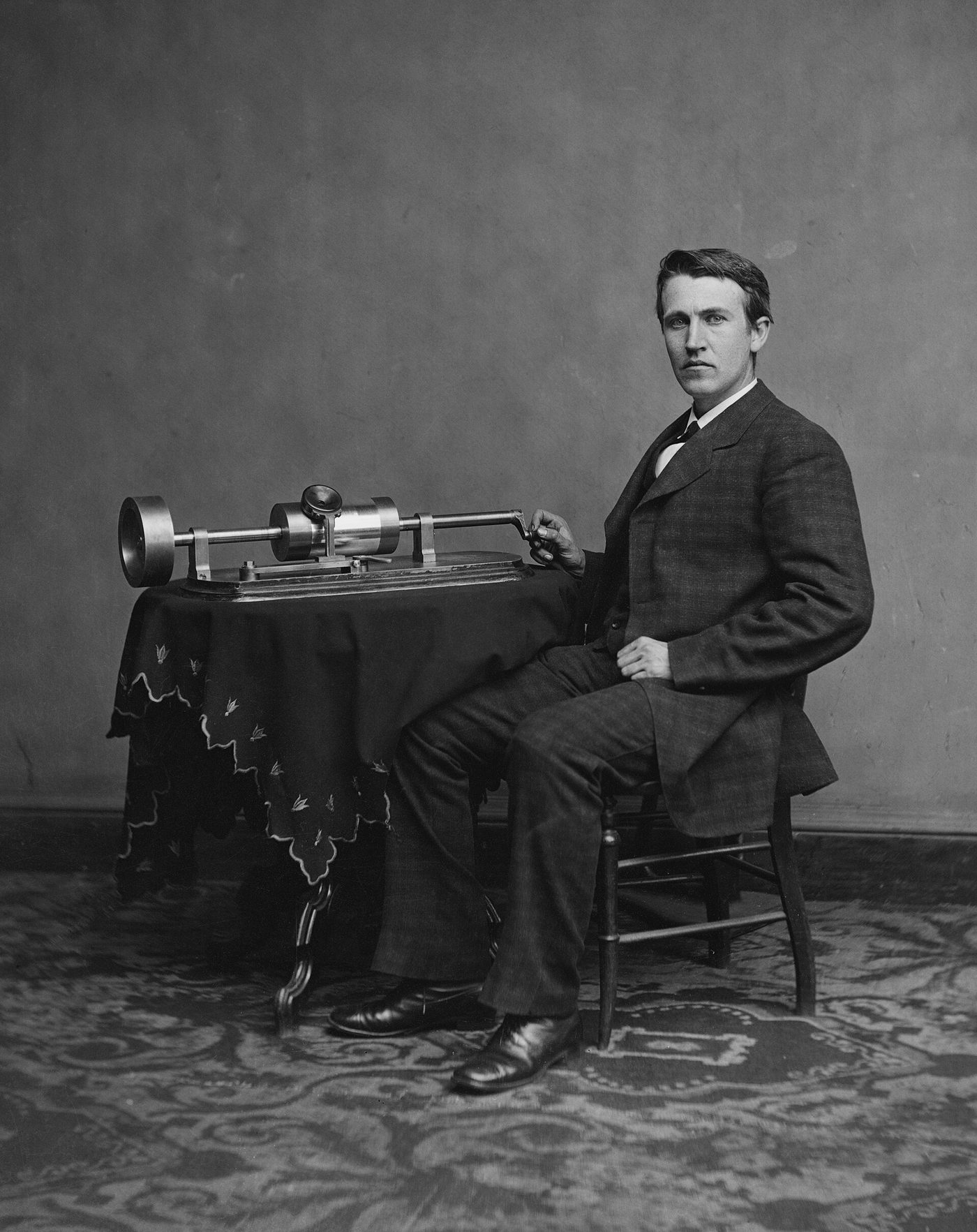
Sound is a pressure wave, and the first machine to record one is in the photograph below. The numbers are the reference values this module leans on: how fast sound travels, how loud a workplace may get and for how long, how common hearing loss is, and the loudness each outlet expects you to deliver.
By the numbers
- About 761 mph (1,100 feet per second): the speed of sound in air on a standard day at sea level. That is why a microphone a few feet farther from a voice hears it a few milliseconds later, the root of the comb filtering in lesson 5. NASA Glenn Research Center
- 90 dBA for 8 hours: the federal workplace noise limit. Each 5 dB louder cuts the allowed time in half, down to 15 minutes or less at 115 dBA. OSHA, 29 CFR 1910.95, Table G-16
- About 15% (37.5 million): American adults 18 and over who report some trouble hearing. National Institute on Deafness and Other Communication Disorders
- About 18% versus 5.5%: speech-frequency hearing loss in both ears among adults 20 to 69 with five or more years of very loud noise at work, compared with adults who report no noise at work. NIDCD
- -23.0 LUFS: the programme loudness target for European broadcast. EBU R 128, 2023 revision
- -24 LKFS: the target loudness for U.S. television content delivered without loudness metadata. ATSC A/85, July 2026 revision
- -16 LKFS, peaks under -1 dBFS: Apple's recommendation for podcast episodes, with a tolerance of plus or minus 1 dB. Apple Podcasts audio requirements
- -14 LUFS: the level Spotify turns tracks up or down to during playback. Spotify for Artists
Check yourself
1. What does RT60 measure?
Reverberation time is how long the sound takes to decay by 60 dB. A small recording studio aims for about 0.3 seconds; a church can run several seconds.
2. A voice is recorded at a table, and sound bounces off the tabletop into the mic a little later than the direct sound. What does that cause?
The direct sound and its delayed copy add at some frequencies and cancel at others, carving regular notches. The result sounds hollow or phasey.
3. Under the 3:1 rule, if each singer is 1 foot from their own mic, how far apart should the two mics be?
Keep the distance between microphones at least three times the distance from each mic to its source. One foot to the source means at least three feet between mics.
4. You fold a stereo mix to mono and the lead vocal almost disappears. What is the most likely cause?
When left and right carry the same sound with opposite polarity, adding them cancels it. A center-panned, in-phase vocal gets louder in mono, not quieter.
5. Why bother checking mono at all?
A big share of listening happens on single-speaker devices. If something cancels in mono, those listeners never hear it.
Terms in this lesson
- Reverberation time (RT60)
- How long sound in a room takes to fade by 60 dB after the source stops.
- Comb filtering
- Regular notches in the frequency response caused by mixing a sound with a slightly delayed copy of itself.
- Phase
- Where a wave is in its cycle at a given moment. Two copies out of step can reinforce or cancel.
- Polarity
- Whether a signal is upright or flipped upside down. Inverting polarity on one of two identical signals cancels them.
- Mono compatibility
- How well a stereo mix holds up when left and right are added together into one channel.
- 3:1 rule
- Place microphones at least three times as far from each other as each is from its own source.
Sources
- NTi Audio: Reverberation time (RT60 definition and recommended values by room type) checked 2026-10
- Shure: Of Mics and Monitors, live sound reinforcement tips for choirs (3:1 rule, comb filtering) checked 2026-10
- Comb filter (notch frequencies from a delayed copy) checked 2026-10
- Speed of sound (about 343 m/s in dry air at 20 C) checked 2026-10
- SoundStudio audio theory, section 12: Stereo, phase and mono checked 2026-10