Lesson 3 of 6 · about 18 minutes
The Two Axes: Moral Grounding and Institutional Power
You'll be able to
- Define the horizontal axis of the matrix, institutional dependence versus independence, in Pierson's words
- Define the vertical axis, moral orientation, and name what sits at its top and bottom
- Explain why neither end of the horizontal axis is good or bad on its own, using the Federalist and the Declaration as examples
- Describe how the matrix grew out of the nine-cell alignment grid from tabletop role-playing games and what Pierson changed
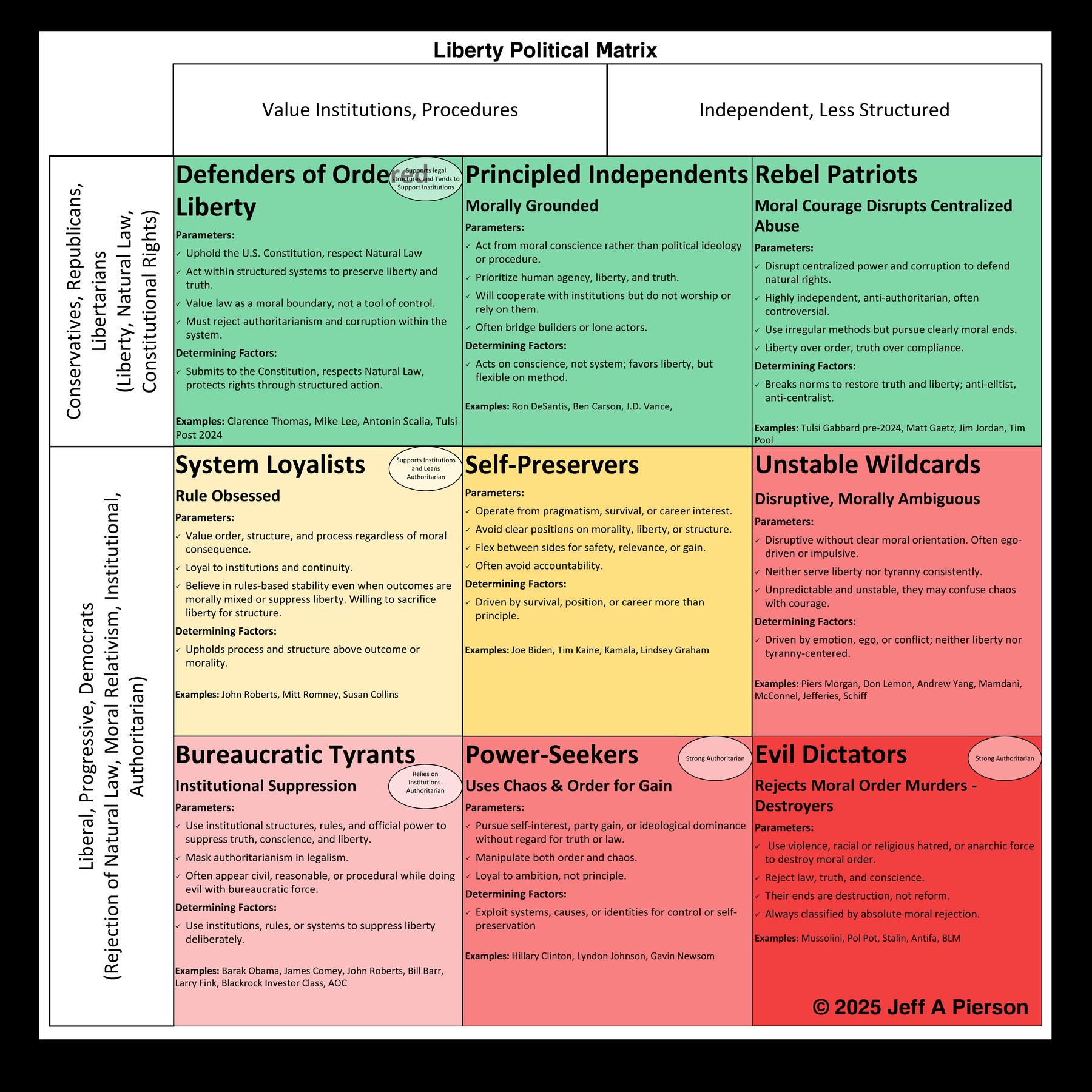
- Read the published chart and name the nine categories in their cells
Pierson's matrix evaluates people and movements on "two independent variables: moral grounding and relationship to institutional power."1 The word independent matters. Knowing where someone sits on one axis tells you nothing about where they sit on the other. That is what lets the matrix separate people the left-right line lumps together.
The Horizontal Axis: Institutions
Pierson defines it this way: "On the left are actors who derive legitimacy from institutions, procedures, and established systems. On the right are actors who operate independently of institutions, either due to distrust, rejection, or perceived corruption."1 The chart labels the two sides "Value Institutions, Procedures" and "Independent, Less Structured."
Read that axis carefully, because it is easy to assume one end is the good end. It is not. American history has honored people at both.
James Madison's case for the Constitution in Federalist No. 10 is an institutional argument. A republic, he wrote, would "refine and enlarge the public views, by passing them through the medium of a chosen body of citizens," and a large republic would make it harder for any one faction to take over.2 Madison trusted well-built institutions to restrain passion and protect rights.
The Declaration of Independence, eleven years earlier, is the other end of the axis. Its signers appealed past every institution they lived under, the king, Parliament and the colonial charters, to "the Laws of Nature and of Nature's God."3 They acted independently because they had concluded the institutions over them had been corrupted.
Both were right in their moment. The horizontal axis describes how a person relates to institutions. It does not say whether that relationship is a virtue. For that you need the second axis.
The Vertical Axis: Moral Orientation
"The upper half reflects alignment with natural law, constitutional limits, and objective truth. The lower half reflects moral relativism, ideological primacy, or subordination of truth to power or outcome."1
The top of this axis is where Pierson's whole framework lives. Natural law, in his glossary, is "a fixed moral order independent of government, defining inherent rights and limits on authority," and moral grounding is "adherence to objective standards of truth and justice." The bottom is defined by its opposite: moral relativism, "the belief that truth and morality are flexible or determined by outcome," shading into authoritarianism, "centralized power exercised without meaningful limits."4
On the published chart the three rows are colored to match: green across the top for the morally grounded, yellow and orange through the middle for the neutral and ambiguous, and red across the bottom, deepening toward the right corner, for the authoritarian.
Why two axes, and not one
With the two axes crossed, an institutional person can be morally grounded or not, and an independent person can be morally grounded or not. That gives four combinations the left-right line has no way to show:
- An official who works inside the system and keeps it honest.
- An official who works inside the system and follows it wherever it goes, including somewhere wrong.
- An outsider who breaks with the system to defend rights.
- An outsider who breaks with the system because breaking things is what he likes.
Add a center column and a middle row and you have nine cells. Pierson says it plainly: "These axes are descriptive, not rhetorical. Their intersection produces behavioral categories."1
Where the Grid Came From
Many readers will recognize the shape of the chart before they read a word of it. It is a three-by-three grid, and the first version Pierson drew in 2025 said openly where the grid came from. He called it "The Role Playing Political Matrix."5
The source is the alignment system of the Dungeons and Dragons role-playing game. The original 1974 game let players choose one of three alignments: lawful, neutral or chaotic. In 1976 Gary Gygax published an article in The Strategic Review that added a second axis, good against evil, and the 1977 Basic Set adopted the two-axis model. The result was nine alignments, from lawful good to chaotic evil, and the useful insight that a character could be lawful and evil at once, like a tyrant, or chaotic and good at once, like a rebel.6
Pierson's 2025 version explained the choice. The alignment grid, he wrote, "taps into a shared cultural language" and "communicates on a cultural level across multiple generations," from Boomers to Gen Z, people "who have internalized these archetypes through decades of media, gaming, and storytelling."5 People who have never read Locke already understand that a lawful evil villain hides behind the rules and a chaotic good hero breaks them for a reason.
What Pierson changed
The game's axes are abstract. Law and chaos describe temperament, and good and evil are left for players to argue about. Pierson fixed both axes to his framework. Law became the relationship to institutional power, and good became alignment with natural law and constitutional limits.
The 2025 version also carried a set of hard rules. "Anyone who rejects the U.S. Constitution cannot be Lawful," marked absolute. "Anyone who denies or violates Natural Law is Evil," also absolute. Override rules placed anyone who kills, tortures or imprisons on the basis of religion, or murders on the basis of race, in the worst cell regardless of anything else. And it named two high ideals: adherence to constitutional law and natural law, and "opposition to authoritarianism in any form."5
The 2026 public version renamed the cells in plain political language, Defenders of Ordered Liberty instead of Lawful Good, Bureaucratic Tyrants instead of Lawful Evil, and added a psychological and political profile for each. The next two lessons take the nine cells one row at a time.
Learn more
- Pierson, The Liberty Political Matrix: The full chart at high resolution, with the two axes and the glossary.
- The Federalist No. 10: Madison's argument for institutions that filter and restrain faction.
- The Declaration of Independence: The founding appeal past every existing institution to the laws of nature.
- Alignment in Dungeons and Dragons: The history of the nine-cell grid the matrix adapted.
Notes
- Jeff A. Pierson, "The Liberty Political Matrix: A Public Explanation from the Ordered Liberty Framework" (2026), "Introduction" and "The Two Axes." Read it online. ↩
- James Madison, The Federalist No. 10 (1787). Read it online. ↩
- The Declaration of Independence (1776), National Archives transcription. Read it online. ↩
- Pierson, "The Liberty Political Matrix," "Glossary of Core Terms." Read it online. ↩
- Jeff A. Pierson, "The Role Playing Political Matrix" (2025), the first version of the matrix, with its rules and its explanation of the alignment grid. ↩
- "Alignment (Dungeons and Dragons)," Wikipedia, section "History," on the three alignments of 1974, Gygax's 1976 article in The Strategic Review and the nine-alignment model in the 1977 Basic Set. Read it online. ↩
Terms in this lesson
- Horizontal axis (matrix)
- Institutional dependence versus independence. On the left are actors who derive legitimacy from institutions, procedures and established systems; on the right, actors who operate independently of them out of distrust, rejection or perceived corruption.
- Vertical axis (matrix)
- Moral orientation. The upper half reflects alignment with natural law, constitutional limits and objective truth; the lower half reflects moral relativism, ideological primacy, or the subordination of truth to power or outcome.
- Moral grounding
- In Pierson's glossary, adherence to objective standards of truth and justice.
- Proceduralism
- In Pierson's glossary, the elevation of process above moral outcome.
- Alignment grid
- The nine-cell chart from the Dungeons and Dragons role-playing game that crosses law and chaos with good and evil. Pierson's first version of the matrix, in 2025, adapted it for politics.
Sources
- Jeff A. Pierson, The Liberty Political Matrix: A Public Explanation from the Ordered Liberty Framework checked 2026-10
- Alignment (Dungeons and Dragons), Wikipedia checked 2026-10
- The Federalist No. 10, Avalon Project checked 2026-10
- The Declaration of Independence, National Archives checked 2026-10