Lesson 9 of 9 · about 18 minutes
How Big Industrial Projects Move Through Planning
You'll be able to
- Describe the routes a project can take when the use table does not name its use
- Explain how the 2026 water law for data centers changes where they can locate
- Tell a vague condition from an enforceable one for noise, backup generators, water and setbacks
- Estimate noise at a property line with the 6 dB per doubling rule
Most zoning codes were written for houses, stores, farms and the occasional factory. Then someone shows up wanting 200 acres for a building that draws as much power as a small city, runs around the clock, and keeps a row of diesel generators out back. Every tool from the earlier lessons gets used at once. This lesson walks through how, keeping it general. A separate data center planning course in this series covers that industry in depth, and the Data Centers in Your Community course covers power, water and money.
When the use table is silent
Search a typical Idaho county code for "data center" and you will probably find nothing. The tax code has a definition: Idaho Code 63-3622VV describes a data center as one or more buildings housing server equipment, with uninterruptible power supplies or generator power, sophisticated fire suppression, and enhanced physical security. Zoning ordinances often have no such entry. A project then has four main routes:
| Route | What happens | Character | Public hearing? |
|---|---|---|---|
| Staff interpretation | The planning director decides the use is "similar to" a listed one, such as warehouse or manufacturing | Administrative | Often none, unless appealed |
| Text amendment | The board adds the use to the table, with standards, in chosen zones | Legislative | Yes, under 67-6509 |
| Rezone, often with a plan amendment | Agricultural land becomes industrial, frequently with a development agreement | Quasi-judicial for a site-specific rezone | Yes |
| Conditional use permit | The use is conditional in the zone, and the board attaches conditions | Quasi-judicial | Yes, under 67-6512 |
Many codes include a clause letting staff classify an unlisted use. Find yours, and find out whether that interpretation can be appealed and by whom. A data center called a "warehouse" may be allowed outright in an industrial zone with no hearing at all, which surprises neighbors who expected one.
When a board thinks its code is not ready, it can pause. Idaho Code 67-6523 allows an emergency moratorium on selected permits for up to 182 days, with written findings of imminent peril, and no back-to-back renewals. Section 67-6524 allows an interim moratorium of up to one calendar year, again with written findings, while a plan or plan amendment is being prepared. The Attorney General's takings guidelines warn that moratoriums need those written findings to hold up.
A real Idaho example
One large industrial rezone that reached the Idaho Supreme Court involved a power plant rather than a data center, and it followed the same path. Alternate Energy Holdings contracted for about 5,000 acres in Payette County in 2009 for a proposed nuclear plant. It applied to amend the county plan from agricultural to industrial and to rezone about 500 acres from agricultural to I-2 heavy industrial, with a development agreement. The county amended its plan to add language on energy facility siting, approved the conditional rezone, and kept thousands of surrounding acres in agricultural zoning as a buffer. In 2015 the Supreme Court upheld all of it: the plan, the rezone against a spot zoning claim, and the notice process. The case is a useful template for how a county can move a large project through LLUPA.
Water: a 2026 change that moves the map
In 2026 the Legislature passed House Bill 895, adding Idaho Code 42-252. Data centers, as defined in the tax code, that begin construction on or after July 1, 2026 may not use water for cooling as a consumptive use unless the water comes from a municipal, water district, or water and sewer district system. The bill's findings declare that data center water use conflicts with the local public interest and is contrary to conservation of water resources for purposes of the state's water right permit and transfer statutes, and tell the Department of Water Resources director to consider those findings.
That is water law, administered by the state. It has a planning consequence anyway. A project that wants evaporative cooling now has to buy water from a city or a public water system. That pulls projects toward cities and their utilities, which brings in annexation (lesson 6), city zoning, and the city's own capacity to serve. Projects that use closed-loop or air cooling may still look at rural sites. Ask which kind of cooling a project plans before you say anything about its water.
Conditions that matter
Under 67-6512(d), a board can attach conditions minimizing impacts, controlling timing and duration, setting exact locations, requiring facilities and imposing stricter standards. For a large industrial project, the fights usually come down to a short list. A condition is only useful if it is measurable and someone checks it.
| Issue | Vague condition | Enforceable condition |
|---|---|---|
| Noise | Operations shall not be excessively loud | Not to exceed 50 dBA daytime and 45 dBA from 10 p.m. to 7 a.m. at any residential property line, verified by a third-party study at startup and annually |
| Backup generators | Generators used only as needed | Testing limited to weekdays, 9 a.m. to 4 p.m., one unit at a time; logs of every run hour provided to the county quarterly |
| Water | Adequate water shall be provided | Will-serve letter from the city before building permit; cooling method stated in the permit; annual water use reported |
| Setbacks and buffers | Appropriate buffering | Buildings at least 500 feet from residential zones; 30-foot berm with evergreen screening on the north and east lines, planted before occupancy |
| Lighting | Lighting shall be reasonable | Fully shielded, downward fixtures; no light trespass over 0.1 foot-candle at the property line |
| Construction traffic | Minimize traffic | Haul route designated; road repair bond posted with the highway district |
| Decommissioning | None | Removal plan and bond if the facility is idle for a set period |
The numbers in the right column are illustrations. They are not recommendations. Each one has to fit the local ordinance and the evidence in the record. And conditions requiring land, easements or money still need the nexus and rough proportionality the takings checklist describes.
Generators sit at the edge of county power. Federal rules in 40 CFR 60.4211(f) let emergency stationary engines run without limit in real emergencies and up to 100 hours a year for maintenance and readiness testing, with up to 50 hours of certain non-emergency operation counted inside that 100. Air permits come from state and federal regulators. Idaho Code 67-6522 says local ordinances cannot abrogate the statutory authority of a public health district or state or federal agency. A county can still set land use conditions like testing hours, fuel storage location and setbacks.
Worked example: will the neighbors hear it?
An invented project in Corvane County proposes a generator yard. The applicant's data show 75 dBA at 50 feet from the yard during testing. The nearest home is 400 feet away. The county's night limit is 45 dBA.
For a single point source in open air, sound drops about 6 dB each time distance doubles. (SoundStudio's decibel chapter explains why.)
| Distance | Doublings from 50 feet | Estimated level |
|---|---|---|
| 50 feet | 0 | 75 dBA |
| 100 feet | 1 | 69 dBA |
| 200 feet | 2 | 63 dBA |
| 400 feet | 3 | 57 dBA |
| 800 feet | 4 | 51 dBA |
| 1,600 feet | 5 | 45 dBA |
At the home, about 57 dBA, which is 12 dB over the night limit. Two identical units running together add about 3 dB, so 60 dBA. Meeting 45 dBA by distance alone would take about 1,600 feet. The realistic fixes are daytime-only testing, enclosures, barriers or moving the yard. Real sites differ: ground, terrain, wind and continuous sources such as cooling fans all change the answer, which is why boards ask for a professional study.
The arguments, fairly
| Property rights and development view | Neighbor and planning view |
|---|---|
| An owner of industrial or farm land should be able to sell to the highest bidder and put land to productive use | A use this large affects roads, water, power and quiet far beyond its fence line |
| Large projects bring construction jobs, permanent jobs and property tax base | Permanent jobs at some facilities are few relative to land and utility use, and tax incentives can shrink the base |
| Conditions and development agreements can manage impacts without saying no | Conditions only work if they are measurable and enforced, and many counties have little enforcement staff |
| Moratoriums and vague standards create uncertainty and can raise takings issues | A short, findings-based pause lets the county write clear standards before the first application sets the precedent |
Both columns contain claims that can be tested with numbers from the application, the assessor and the utility. Check them before you repeat them in testimony, at a meeting or online.
Common mix-ups
- Claim: If the code does not mention data centers, they are banned. What the evidence shows: Codes often let staff classify unlisted uses as similar to listed ones. Silence can mean "allowed as a warehouse."
- Claim: The county decides how much the generators can run. What the evidence shows: Federal and state air rules set operating limits. The county can add land use conditions but cannot override another agency's authority (67-6522).
- Claim: A new data center can drill its own well for cooling. What the evidence shows: Since July 1, 2026, a data center starting construction cannot use water for cooling as a consumptive use unless it comes from a municipal or district system (42-252).
Reporting angle
- Ask whether staff has issued a use interpretation for the project, and get it in writing. Ask who can appeal it and by when.
- Request any nondisclosure agreements signed by city or county officials, and correspondence using a project code name.
- Get the will-serve letters for water, sewer and power, and check the utility's stated capacity.
- Find the cooling method. Then check 42-252 and any water right filings with the Department of Water Resources.
- Compare conditions in the staff report, the motion and the signed permit or recorded development agreement.
Research angle
- Idaho Code 42-252: Limits on consumptive water use by data centers.
- 2026 House Bill 895: The bill text with its findings.
- Idaho Code 63-3622VV: The data center sales tax exemption.
- Idaho Code 67-6524: Interim ordinances and moratoriums.
- Idaho Code 67-6522: Combining of permits.
- 40 CFR 60.4211: Federal rules for stationary diesel engines.
Pictures, Numbers and Infographics
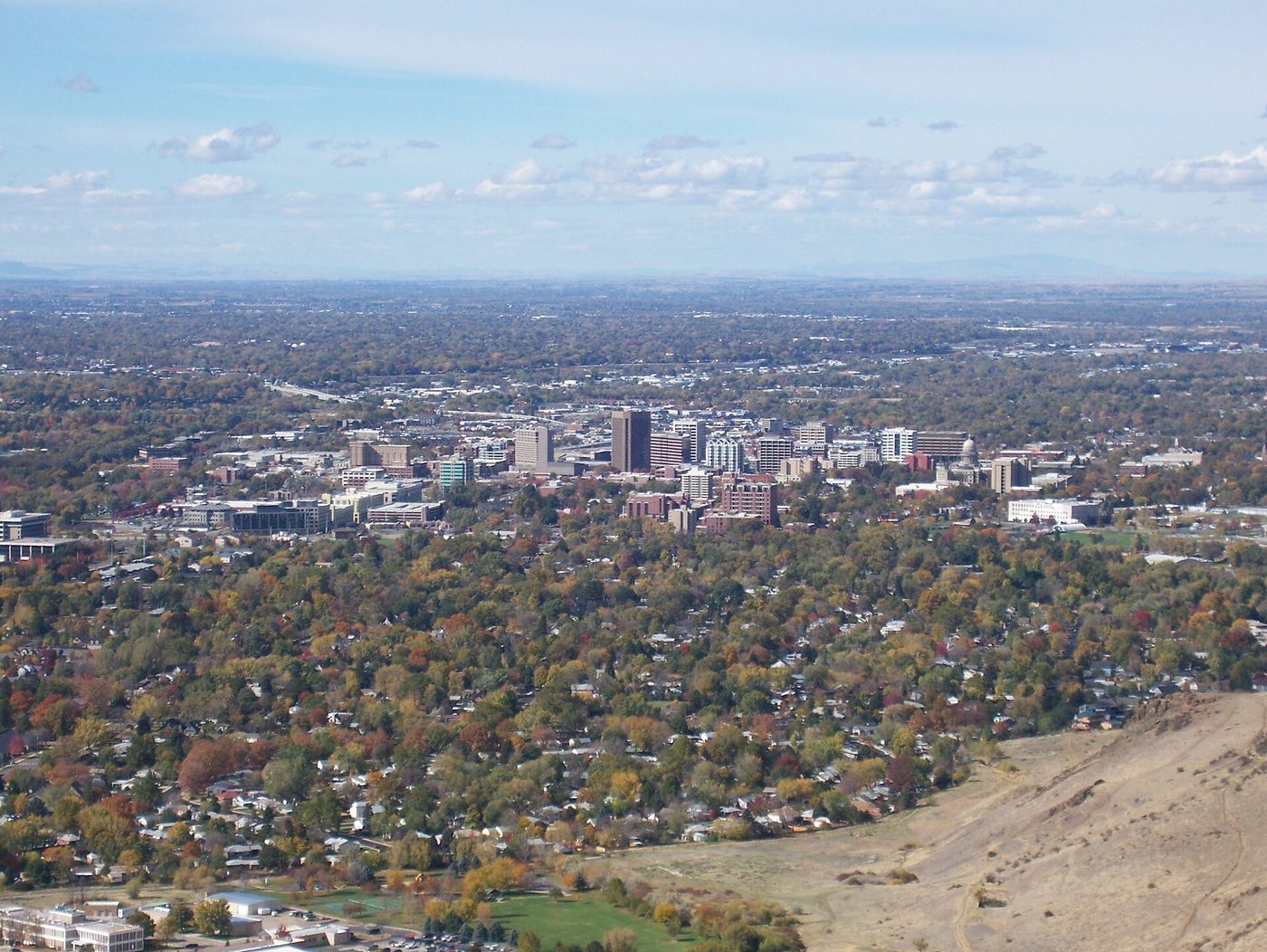
Idaho keeps adding people, and the growth bunches up in a few counties, which is where rezones, plats and annexations pile up on hearing agendas. The planning act sets the notice distances and deadlines every one of those hearings runs on.
By the numbers
- 1.4 percent: Idaho's statewide population growth in 2025. Thirty-six of the 44 counties grew, compared with 60 percent of counties nationally. Idaho Department of Labor, from Census Bureau estimates, March 31, 2026
- More than 75 percent: share of Idaho's 2025 growth that landed in Ada, Canyon and Kootenai counties, over 22,000 new residents. Ada alone added more than 10,000. Idaho Department of Labor, 2026
- 1.8 percent and 0.5 percent: 2025 growth in Idaho's urban counties and in its rural areas. The nine urban counties took 90 percent of the state's growth. Idaho Department of Labor, 2026
- 17: named components a city or county land use plan must address, from (a) property rights to (q) public airport facilities, unless the plan says why one does not apply. Idaho Code 67-6508
- 15 days and 300 feet: published notice must run at least 15 days before a plan or zoning hearing, and a zone boundary change also requires mailed notice to owners within 300 feet. When 200 or more owners must be notified, a local ordinance may allow another method. Idaho Code 67-6509 and 67-6511
- 14, 60 and 28 days: 14 days to ask for reconsideration of a final decision, 60 days for the written answer before the request is deemed denied, and 28 days after local remedies run out to seek judicial review. Idaho Code 67-6535
Check yourself
1. A county use table lists 'warehouse' and 'manufacturing' but not 'data center.' Which route requires a legislative decision?
A text amendment changes the ordinance for every parcel in the zone, which is legislative. Interpretations and permits apply existing rules to one project.
2. Under Idaho Code 42-252, added in 2026, what water limit applies to data centers that begin construction on or after July 1, 2026?
The statute bars consumptive use of water for cooling at new data centers unless supplied by one of those public systems.
3. A generator yard measures 75 dBA at 50 feet. Using the 6 dB per doubling rule for a point source, about what level would you expect at 400 feet?
50 to 100 to 200 to 400 feet is three doublings. 75 minus 3 times 6 is 57 dBA, before any barriers, ground effects or added sources.
4. Under the federal rule in 40 CFR 60.4211(f), how many hours per calendar year may an emergency stationary engine run for maintenance and readiness testing?
Emergency engines have no time limit in true emergencies, and up to 100 hours a year for maintenance and testing. Up to 50 hours of certain non-emergency operation counts toward the 100.
5. What did the Idaho Supreme Court decide in the 2015 case over a proposed nuclear plant in Payette County?
The court upheld the county's plan amendment, the conditional rezone and the notice process.
6. Why can't a county use a CUP condition to override a state air permit for backup generators?
Section 67-6522 bars local ordinances that abrogate the statutory authority of a public health district or state or federal agency. Counties can add land use conditions such as testing hours, but cannot cancel another agency's authority.
Terms in this lesson
- Unlisted use
- A use the zoning ordinance does not name. Codes handle it by staff interpretation, text amendment or not at all.
- Consumptive use
- Water that is used up, mostly by evaporation, and does not return to the stream or aquifer.
- dBA
- A decibel reading weighted to match human hearing, the usual unit in noise ordinances and permit conditions.
- Emergency stationary engine
- A backup generator engine that federal rules limit mainly to emergencies plus a capped number of testing hours.
- Will-serve letter
- A utility's written statement that it can and will provide water, sewer or power to a project, often required before approval.
Sources
- Idaho Code 42-252, Limitations on consumptive use, data centers (2026, ch. 291) checked 2026-10
- Idaho Legislature, 2026 House Bill 895, Data centers, water use, cooling (legislative findings) checked 2026-10
- Idaho Code 63-3622VV, Idaho information technology equipment (data center definition) checked 2026-10
- Idaho Code 67-6512, Special use permits, conditions, and procedures checked 2026-10
- Idaho Code 67-6522, Combining of permits checked 2026-10
- Idaho Code 67-6523, Emergency ordinances and moratoriums checked 2026-10
- Idaho Code 67-6524, Interim ordinances and moratoriums checked 2026-10
- Idaho Code 67-6508, Planning duties (power plant sites and transmission corridors) checked 2026-10
- 40 CFR 60.4211, Compliance requirements for stationary compression ignition engines (eCFR) checked 2026-10
- Idaho Supreme Court, Neighbors for the Preservation of the Big and Little Creek Community v. Board of County Commissioners of Payette County, Docket 41113 (2015) checked 2026-10
- Idaho Office of the Attorney General, Idaho Regulatory Takings Act Guidelines (January 2023) checked 2026-10