To Ban or to Build? The High-Stakes Dilemma of Rural Energy and Data Centers
THIS IS NOT SOMETHING BEING CONSIDERED OR USED IN JEROME COUNTY
THIS IS NOT SOMETHING BEING CONSIDERED OR USED IN JEROME COUNTY
To Ban or to Build? The High-Stakes Dilemma of Rural Energy and Data Centers
For many rural American counties, grid-scale energy facilities and hyperscale data centers have shifted from abstract future prospects to an immediate, high-stakes reality. Driven by national policy tailwinds and a wave of utility-scale solar and battery storage systems, hundreds of millions in capital are now arriving at the doorsteps of local planning offices. However, many local governments find themselves caught in a collision between 21st-century capital and 20th-century zoning standards that were never intended to manage such massive industrial shifts.
This lack of preparation often forces a binary choice: approve projects under inadequate, outdated rules or attempt a total ban. This exploration identifies when a ban serves as a legitimate tool of governance and when it represents a failure of policy.
A Ban That Fails in Court is an “Expensive Delay”
Enacting a ban is not as simple as passing an ordinance; it must survive a rigorous legal landscape. In Idaho, the Local Land Use Planning Act (LLUPA) grants counties broad authority, but it mandates that any exclusionary ordinance be grounded in a comprehensive plan and supported by specific findings. Critically, the plan must precede the ban. A policy of exclusion that is not firmly rooted in the county’s established long-term vision is legally fragile.
Without this foundation, a county faces significant risks, including preemption challenges where state law overrides local exclusion and constitutional “takings” claims. A “taking” is often triggered if a ban effectively eliminates the economic use of property already designated for industrial or agricultural use.
“A ban that cannot survive a legal challenge is not a protection. It is an expensive delay that ends with the same outcome, minus the county’s legal budget.”
Regulatory Capacity—The “Honest” Argument for Saying No
One of the most defensible reasons for a county to consider a ban is a lack of “Regulatory Capacity.” Many smaller counties with limited planning staff do not possess the technical expertise required to evaluate complex energy or data center applications. If a county cannot realistically conduct an independent technical review or afford outside experts, a regulated approval process can become more dangerous than a prohibition.
In these scenarios, approvals are often issued without meaningful oversight, leaving the public interest unprotected. While uncomfortable to admit, acknowledging that a county lacks the staff to evaluate and enforce conditions of approval is a form of honest governance. It is better to admit a lack of capacity than to issue a permit that the county cannot actually monitor or manage.
When the Resource Base is Truly Irreplaceable
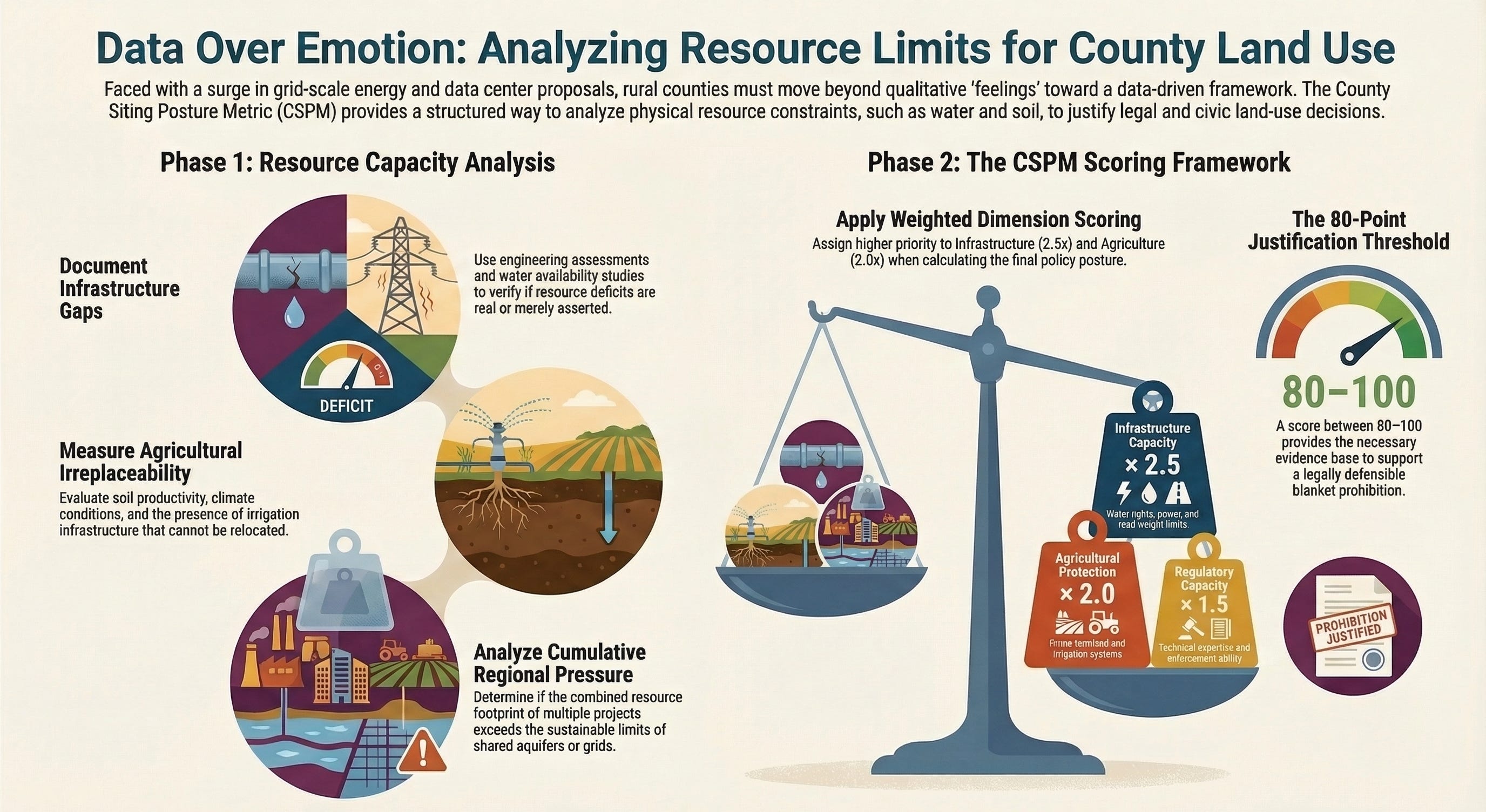
A ban is most defensible when the conversion of land is permanent and threatens a resource base that is truly irreplaceable. In regions like the Magic Valley of southern Idaho, specific soil, water, and climate conditions support a world-class agricultural economy. When grid-scale infrastructure competes directly with prime agricultural land, the county has a compelling interest in protection that moves the argument from mere aesthetic preference to a documented infrastructure gap.
To justify a ban on these grounds, a county must document the irreversibility of land conversion through three specific “foundation” studies:
Engineering assessments regarding road weight limits and transportation corridor constraints.
Water availability studies and aquifer sustainability reports.
Transmission capacity analyses to determine grid interconnection feasibility and public cost.
Regulation Provides More Leverage Than a Prohibition
While a ban is a “blunt instrument” that stops all activity, a regulated approval process—specifically a Conditional Use Permit (CUP)—is a “precision tool.” By choosing a ban, a county effectively walks away from the negotiating table, losing all ability to mandate specific protections.
Leverage vs. Loss: What a County Loses with a Ban
Decommissioning: A permit mandates a decommissioning bond; a ban leaves the county with no security against abandoned steel and panels at the end of the project’s life.
Water Use: A permit can set strict caps on water usage; a ban loses the opportunity to host a high-efficiency facility that provides significant tax revenue with minimal impact.
Emergency Response: A permit can mandate developer-funded specialized training and equipment for local fire/EMS; a ban leaves the county at its existing service levels.
Mitigation: A permit allows for precision standards like acoustic setbacks, noise limits, and agricultural buffers; a ban offers no middle ground.
The CSPM—A Data-Driven Way to Measure “Gut Feelings”
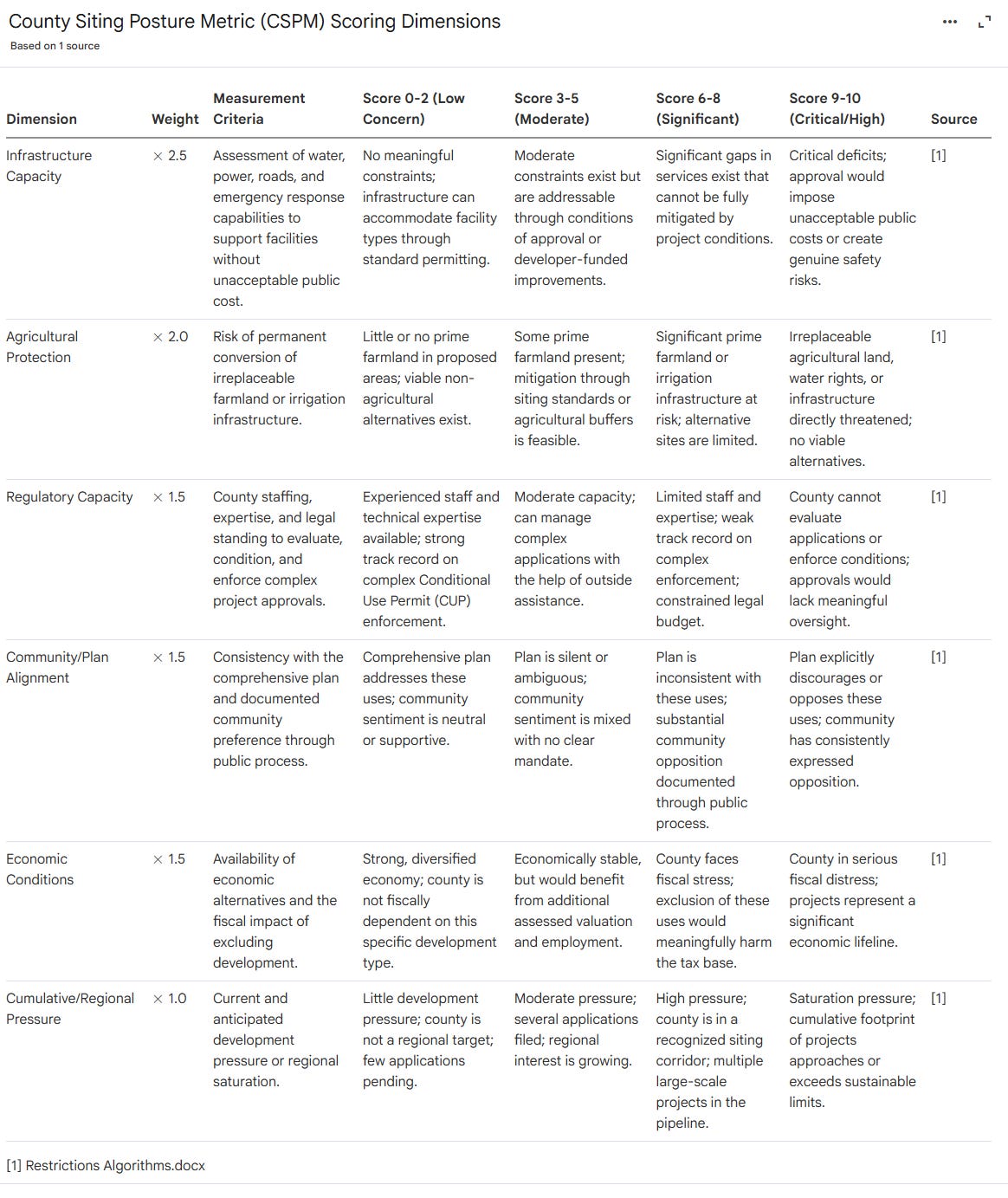
To move away from emotional reactions and toward evidence-based policy, counties can use the County Siting Posture Metric (CSPM). This 100-point discipline forces officials to evaluate six dimensions: Infrastructure, Agriculture, Regulatory Capacity, Community Alignment, Economic Conditions, and Cumulative Pressure.
To calculate the score, each dimension is rated on a 0–10 scale. However, the Economic Conditions dimension follows a specific “inversion” rule: because severe economic distress argues against a ban, the weighted contribution is calculated as (10 - raw score) x 1.5. This mathematical discipline ensures that the score reflects the reality that a county needing a tax base lifeline should have a higher bar for enacting a ban.
The process of scoring is as valuable as the result, as it requires documented findings for every point assigned.
The “Last Resort” Philosophy
A total ban should be viewed as a final response, not a first instinct. The most effective strategy for a rural community is to “build the standards first.” By establishing high technical and environmental bars rooted in community values, counties allow the market to self-regulate. Projects that cannot meet these rigorous standards—or cannot mitigate their impacts—will naturally self-select out of the process.
“The right question is not ‘should we allow these things’ but ‘what standards must a project meet to earn approval, and what conditions can we not mitigate at all’?”
Final Thoughts
The strongest defense for any county policy is transparency and rigorous documentation. Evidence-based governance ensures that decisions are grounded in reality rather than reaction. A ban is often a failure of imagination—an admission that a county cannot envision the standards necessary to protect itself.
As your community faces the arrival of unprecedented capital, the vital question remains: Is your local policy a shield of evidence, or just a wall of sand waiting for the first legal tide?
Sources
- Originally published on Substack: https://jeffapierson.substack.com/p/to-ban-or-to-build-the-high-stakes