The Trump Admin Sues Idaho: The Feds Want Your Water
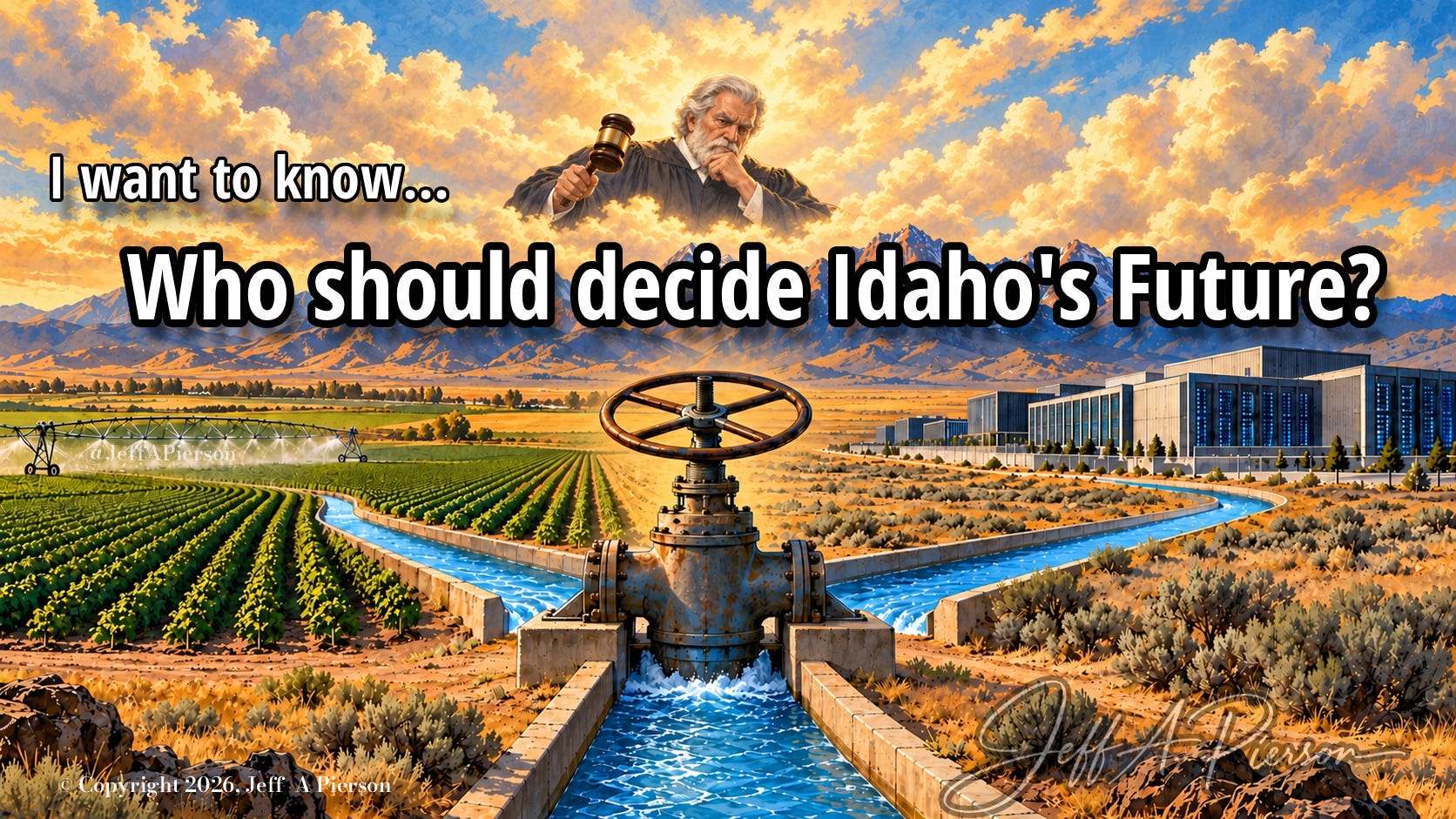
Could the federal government use a ruling in the feds favor to capture water rights for data centers on public land? Would that place that use out of the state’s control?
Background
On September 11, 2026, the United States, the Department of Energy, and the Department of the Navy sued the State of Idaho, the Idaho Department of Water Resources, and its director, Matthew Weaver, in federal district court. The dispute grew out of an Idaho water-curtailment order that included the Department of Energy’s water right at Idaho National Laboratory. Federal officials argue that Idaho cannot use its administrative process to restrict federal water use and that a cutoff could interfere with nuclear safety, research, and Navy operations. Case docket, Federal complaint
Idaho, represented by Attorney General Raúl Labrador’s office, disputes that claim and filed counterclaims on October 16. The state argues that federal water rights remain subject to administration that protects other users’ established rights during shortages. Although Idaho lifted DOE’s 2026 curtailment in July, the lawsuit seeks a broader ruling against state administration of federal water rights. That makes the case about more than one season’s water supply: it could determine how Idaho enforces water priorities when federal facilities and other users compete for limited water.
How far can the federal government go?
The federal government’s water lawsuit against Idaho raises numerous questions that reach beyond the laboratory at its center. For instance, could an argument built around nuclear safety make it harder for Idaho to restrict water use for future development on federal land?
Consider that latest threat… data centers! They are a reasonable example to consider.
The DOE has been pursuing privately funded AI data centers at INL. There is nothing that supports the idea that the feds have larger designs on Idaho water, but the lawsuit makes the potential reach an important consideration.
What exactly is DOE asking the courts for?
The federal complaint asks for more than relief from the curtailment order. Paragraph 75 seeks a declaration that Idaho’s Department of Water Resources lacks authority to administer federal water rights, along with an injunction barring the director from exercising state authority against the federal agencies.
Again, that request is not necessarily confined to the water needed to keep an existing reactor safe. The complaint identifies expansion of INL operations as an interest threatened by curtailment. Federal complaint, paragraphs 69 and 75
69. Curtailment of water use would prevent expansion of operations at the INL.
70. DOE asserts that it cannot comply with its obligations to safely operate nuclear Case 1:26-cv-00592-REP Document 1 Filed 09/11/26 Page 15 of 17 16 reactors and manage spent fuel at the INL without using water. The Navy asserts that it cannot comply with its obligations to support the nuclear fleet and manage spent fuel at the INL without using water. Yet, DOE and the Navy cannot comply with the State’s Order without cutting the use of water at INL to zero. The Order thus threatens national security and nuclear safety, and interferes with the operation of Congressionally mandated programs.
71. Accordingly, federal law impliedly preempts the Order, as it conflicts with DOE and the Navy’s ability to comply with federal law mandates. While the Order has been rescinded as to DOE in 2026, the State is actively seeking a declaration that it has the authority to curtail water use at INL in future years. It is accordingly likely that the State intends for curtailment to recur. FOURTH CLAIM FOR RELIEF (Property Clause)
72. The United States incorporates by reference its previous allegations as though fully set forth herein.
73. The Order purports to divest the United States and its agencies of vested property rights owned by the United States. The Property Clause of the United States Constitution, however, provides that the “[p]ower to release or otherwise dispose of the rights and property of the United States is lodged in the Congress.” Royal Indemnity Co. v. United States, 313 U.S. 289, 294 (1941).
FOURTH CLAIM FOR RELIEF (Property Clause)
74. Congress has exercised that power through the McCarran Amendment. By purporting to divest the United States and its agencies of property without compliance with congressional authorization, the Order violates the Property Clause of the United States Constitution. Case 1:26-cv-00592-REP Document 1 Filed 09/11/26 Page 16 of 17 17 PRAYER FOR RELIEF
PRAYER FOR RELIEF
75. Wherefore, the United States prays that the Court enter judgment in its favor and against the Defendants and award the following relief:
a. a declaration that the Order is invalid as applied to the United States and its agencies;
b. a declaration that IDWR lacks the authority to administer federal water rights;
c. an order permanently enjoining the Director of IDWR from exercising his authority under Idaho Code 42-237a(g), or any other state-law statutory authority, as to the United States or its agencies;
d. the United States’ costs; and
e. such other and further relief as the Court deems just and proper.
Am I reading more into this lawsuit that I should?
Paragraph 70 says, “…The Order thus threatens national security and nuclear safety, and interferes with the operation of Congressionally mandated programs.”
Remember that President Trump’s National Security Presidential Memorandum (NSPM-11) has made AI and data centers a national security issue. Specifically:
Strategic & Defense Approach to AI and Data Centers
National Security Priority: The administration views leadership in AI and the rapid construction of digital infrastructure as essential to military power and technological overmatch.
Defense Procurement & “Neutral” AI: The Department of Defense (DoD) has pushed to integrate commercial AI into a warfighting force while issuing strict guidelines requiring acquired AI models to be “ideological neutral” and “truth-seeking” (advancing the administration’s stance against ideological bias or DEI-aligned frameworks).
National Security Presidential Memorandum (NSPM-11): Establishes pillars to accelerate AI adoption in national security, adapt commercial or custom tech, ensure reliability and control, and build out private-sector security partnerships and computing roadmaps.
Source: Presidential NSPM11
How a future project could benefit
Consider a proposed data center on public land near Shoshone, Idaho. If the project is sponsored by a federal agency, a broad ruling could prevent Idaho’s water director from restricting water during a drought.
First in time, or Cutting in Line
A ruling in the federal government’s favor would not necessarily give the project legal priority over a farmer with an older right, but it could make the farmer’s priority harder to enforce.
The state or affected users would be forced to address the issue in federal court, and while the legal process was moving forward, disputed access to water might continue for months. During an irrigation season, delay can matter as much as the eventual judgment.
What a victory would not automatically authorize
“Capturing” water rights and escaping a particular enforcement process are not the same thing. This lawsuit will not transfer private rights to the federal government, and a favorable ruling would not enlarge an existing allocation, move its priority date backward, or authorize every proposed use. But it is a critical first step to something more dystopian.
I tend to look at worst-case scenarios. Readers shouldn’t assume that a private data center will be immune from state regulation simply because it is on BLM property. That said, given the national defense designation of nuclear power and the context of the lawsuit, the parallel designation of AI and data centers, Idahoans have a good reason to be concerned.
Questions Idahoans needs answered
Congress expressly addressed both adjudication and administration of water rights in the McCarran Amendment. It permits specified suits involving the United States and makes the government subject to the resulting court orders. This dispute concerns the reach of that consent.
Before any future project relies on this claimed protection, Idaho officials should demand public answers:
Which water right supplies it?
What quantity, purpose, and priority govern that right?
What happens when its pumping injures senior users?
Who can order relief, and how quickly?
For now, federal officials must answer this question: Why does protecting essential nuclear operations require the overly broad restriction on state authority requested in the complaint? If a narrower arrangement can protect safety while preserving enforcement of other users’ rights, the case for a wider exemption should never have been made.
Disclaimer: Once again, there is no established finding here that Washington is using INL as a pretext to obtain water for data centers. My concern is how much the federal government wants. That is enough to warrant scrutiny.
Idaho should not have to wait until a new project is pumping before learning whether it can protect the people already entitled to that water.
Note: I am not anti-Trump. I am a conservative and a constitutionalist. In my book, Ordered Liberty Reclaimed, I describe a view of civic life grounded in our duty to obey lawful authority, scrutinize government, and resist government action that exceeds constitutional boundaries. Those principles apply regardless of who holds office.
I generally oppose Governor Brad Little’s leadership, and I am disappointed in the Trump administration. I believe their recent policies on accepting nuclear waste and promoting AI and data centers are harming Idaho’s land, culture, and the rights of its people. My criticism comes from those convictions, not partisan loyalty.
Sources
- Originally published on Substack: https://jeffapierson.substack.com/p/the-trump-admin-sues-idaho-the-feds