Economic Development - Who Really Benefits from Incentives
Protect Citizens and Land from Mega-Corporations

Across the United States, state and local governments are giving away billions of dollars each year to attract corporate mega-projects that promise “growth” and “innovation.” Most of those projects never deliver what they sell. They use vast amounts of water and electricity, create few permanent jobs, and leave citizens with the bill for new infrastructure and higher rates.
The pattern has become predictable. A major corporation announces an investment. Officials celebrate with groundbreakings and headlines. The tax exemptions are quietly written into law, the construction jobs vanish within a year, and the community’s long-term tax base collapses. By the time residents realize the cost, the contracts are locked in for decades.
This is the new arithmetic of progress: public money out, private control in. The benefits concentrate in distant boardrooms while the costs stay behind—buried in ratepayer bills, depleted budgets, and the slow erosion of local independence. It is not a partnership. It is a transfer of power disguised as development.
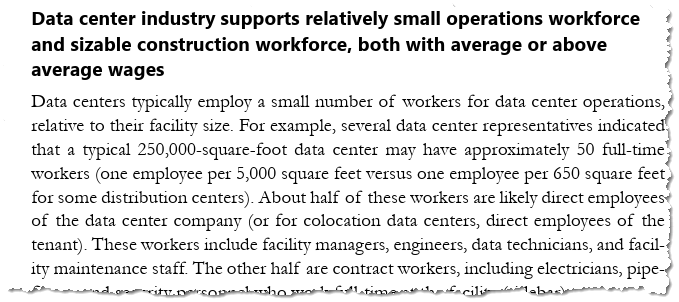
A billion-dollar data center or energy complex sounds like a windfall. Yet most employ fewer than 100 permanent workers once operational. In some cases, the number is closer to twenty. The rest of the “job creation” vanishes with the final delivery truck.
The Bureau of Labor Statistics tracks “data processing, hosting, and related services” as one of the fastest-growing sectors in national revenue and one of the smallest in local employment. Loudoun County, Virginia, has more than 200 centers consuming a quarter of the region’s electricity. Together, they employ roughly the number of people in a single high school.
2024 Report to the Governor and the General Assembly of Virginia
Ohio tells the same story. Microsoft’s $1 billion complex created just twenty jobs, each subsidized by more than $3.6 million in state tax breaks. Other projects by Meta and Google have cost more than $1 million per position. These are not investments in people. They are political trophies.
The Tax-Abatement Shell Game
To lure corporations, state and county officials hand out tax breaks under civic-sounding programs like the “Economic Development Incentive” or “Community Renewal Act.” In practice, they are little more than legalized revenue loss.
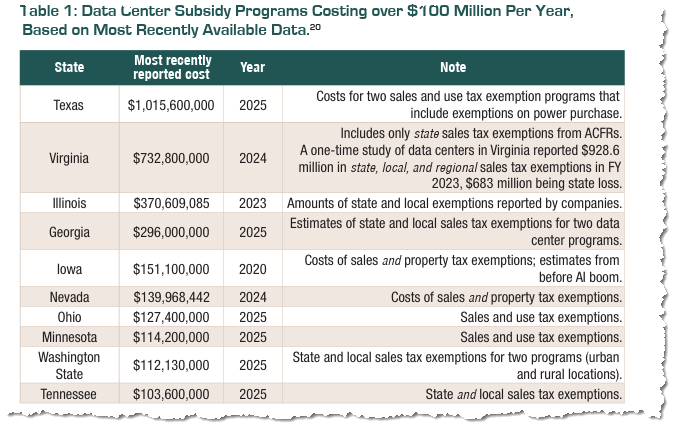
According to Good Jobs First, at least 10 states now lose more than $100 million per year to data center exemptions. Texas projects a loss of over $1 billion in fiscal year 2025. Virginia has already passed $730 million, and Illinois’s program expanded thirty-six-fold in just four years.
Good Jobs First
The numbers fluctuate wildly. Texas’s comptroller estimated the cost at $130 million one year, then revised it to $1 billion two years later. That kind of uncertainty would bankrupt any private business. For governments, it simply becomes “economic development.”
The truth is simpler: these policies don’t build communities. They build dependence.
The Double Burden on Citizens
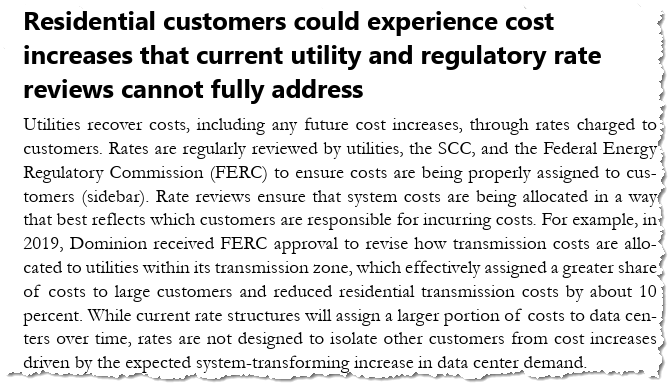
Residents pay twice for every mega-project. First, through the tax exemptions that strip local budgets, and then again through utility rate hikes. A single hyperscale data center can consume as much electricity as 25,000 homes. New substations, transformers, and cooling systems are built with public money or financed through utility rate increases.
In Virginia, Dominion Energy spent billions to expand data center capacity, delaying the retirement of fossil-fuel plants in the process. The Piedmont Environmental Council called the resulting rate hikes “a tax for Google and Amazon.”
Citizens lose on every side: higher bills, less tax revenue, and little to show for it beyond a fenced facility with company logos that no local resident can enter.
2024 Report to the Governor and the General Assembly of Virginia
The Illusion of Competition
Supporters claim that if one state refuses to subsidize, another will. That argument has trapped the entire country in a race to the bottom. Each state cuts deeper to “stay competitive,” and corporations collect incentives from all of them.
The competition is not between states. It is between political convenience and fiscal integrity. Officials trade permanent revenue for temporary headlines. The public pays for the photo opportunity.
Policy Reforms That Could Break the Cycle
End or Cap Tax Incentives.
No local or state government should abate more than a fixed percentage of its general fund for a single project. Incentives must expire automatically and require public reauthorization. When projected benefits fail to materialize, the contract should terminate by law.Require Independent Economic Impact Statements.
Developers seeking public incentives must pay for an independent impact analysis chosen by the local government, not by the company. That analysis must be published before any vote or approval.Link Utility Expansion to Public Benefit.
Infrastructure built for private industry must produce measurable benefits to the community, such as lowering rates.Make Data Centers and Mega Corporations Energy-Accountable. Large industrial consumers—especially hyperscale data centers- must be required to generate or procure their own electricity and finance the transmission and distribution infrastructure necessary to support their operations. Public utilities should not socialize private expansion costs. Any grid interconnection must be contingent on full cost recovery from the beneficiary company, not from ratepayers. This policy aligns with but offers stronger accountability and exceeds the Trump administration’s directions under the DOE Secretary’s letter to the Federal Energy Regulatory Commission (FERC) dated October 23, 2025
Restore Public Oversight of Regulated Utilities. All publicly regulated utilities, generation entities, and transmission owners must be required to open their books to the public. This includes full disclosure of contracts, rate structures, and cost-recovery mechanisms that affect ratepayers. They must be prohibited from making direct campaign contributions or participating, directly or indirectly, in political action committees. A regulated monopoly has no right to purchase influence in the government that regulates it.
The Moral Accounting
Economic development should serve citizens, not corporations. When local governments give away their tax base to projects that provide no durable benefit, they abandon the purpose of self-government.
The gains are abstract, the losses are real: higher rates, hollow budgets, and diminishing public control. That is the asymmetric footprint—wealth that accumulates upward while responsibility disappears.
Until public policy reclaims the principle of fairness, “growth” will remain another word for surrender.
Idaho 20 / 200 - Unrestrained, Unethical Progress Series, © 2025 Jeff A Pierson
Related
#EnergyAccountability
#PublicPowerNotPrivateProfit
#StopSubsidizingBigTech
#TransparentUtilities
#EndCorporateWelfare
#TaxpayerProtection
#FairRatesForAll
#EnergySovereignty
#DataCenterCosts
#OpenTheBooks
#NoMoreRateHikes
#UtilityReform
#InfrastructureIntegrity
#PublicInterestFirst
#FollowTheMoney
#CorporateTransparency
#ReclaimLocalControl
#EndRegulatoryCapture
#AccountabilityNow
#ProtectRatepayers
Sources
- Originally published on Substack: https://jeffapierson.substack.com/p/how-corporate-incentives-bankrupt