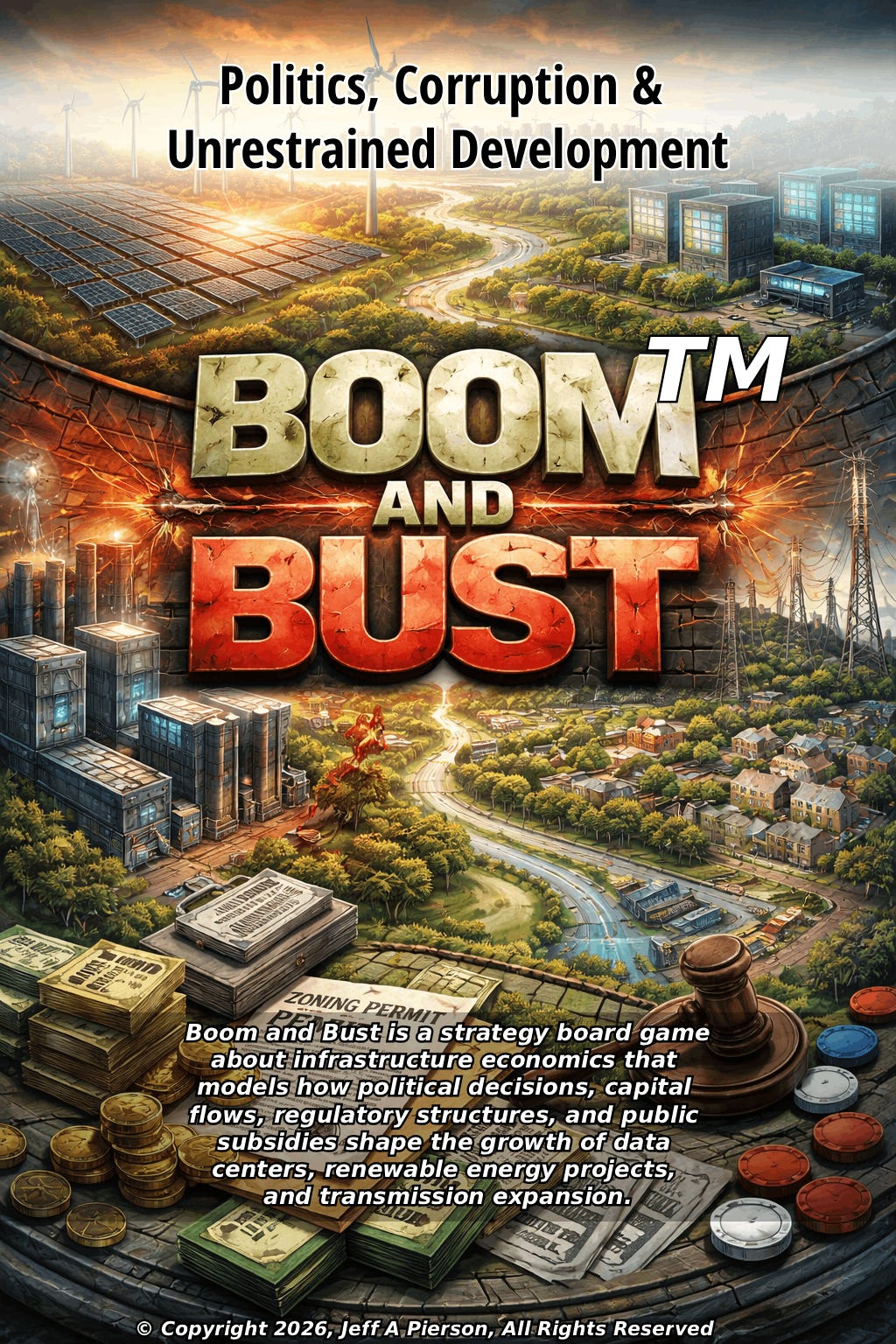
Boom and Bust™ Politics, Corruption, & Unrestrained Development
Is it a Game?
A New Concept in Gaming (The Public)
Boom and Bust is a strategic infrastructure economics board game that simulates the political, financial, and regulatory forces driving large-scale data centers, renewable energy buildouts, transmission expansion, and public subsidy regimes. Designed as both a competitive strategy game and an economic simulation, it exposes how incentives, leverage, zoning authority, and subsidy stacking can generate rapid growth followed by systemic instability.
The game models capital flows, regulatory discretion, ratepayer risk, community backlash, grid stress, water constraints, and the moral hazard embedded in public-private infrastructure partnerships. Players assume asymmetric roles within the system, each pursuing distinct objectives under shifting macroeconomic conditions. Boom phases reward expansion and leverage. Bust phases punish overexposure, regulatory shortcuts, and unsustainable debt structures.
Boom and Bust functions as a playable economic model. It is suitable for tabletop deployment, educational use, civic dialogue, and scalable digital simulation.
Overview
Boom and Bust combines the accessibility of a recognizable board layout with the depth of a modern asymmetric strategy game. It sits at the intersection of Monopoly-style movement mechanics, negotiation-driven political games, and macroeconomic simulation.
Target audiences include strategy gamers, policy enthusiasts, energy market professionals, law and public administration programs, and players interested in real-world systems modeling. The theme is contemporary and highly relevant: artificial intelligence-driven data center expansion, renewable energy mandates, transmission congestion, subsidy stacking, and municipal decision-making under capital pressure.
Replayability is driven by shifting macro conditions, event decks, asymmetric incentives, and dynamic system metrics. No two games unfold the same way. One session may reward aggressive leverage. Another may punish it abruptly through interest rate shocks or community backlash.
The design is expandable. Future modules can incorporate drought cycles, federal stimulus packages, AI demand spikes, nuclear additions, or supply chain disruptions without altering the base architecture. The system is modular, extensible, and digitally adaptable.
BOOM AND BUST
Infrastructure, Influence, and the Collapse of Overreach
I. Game concept and design philosophy
Boom and Bust is a strategic political economy board game modeling infrastructure expansion driven by capital markets, public subsidies, regulatory discretion, and technological hype. It simulates data center buildouts, renewable energy overexpansion, transmission bottlenecks, debt structuring, regulatory capture, zoning leverage, and the destabilization that can follow unrestrained growth.
The core thesis is incentive driven. When capital is abundant and regulatory frameworks are permissive, growth accelerates beyond real demand and local capacity. When the cycle reverses, costs are socialized, assets are stranded, and instability radiates outward.
Players do not merely accumulate property. They interact across asymmetric power structures. Each role represents an incentive position within a system. The game models moral hazard, capture risk, public backlash dynamics, and capital flight.
The tone is serious with restrained satire. The simulation is designed to feel realistic and occasionally uncomfortable.
II. Player roles
Each role has asymmetric powers and a distinct victory condition.
Hedge Fund / Private Equity
Starting capital: 500 units.
Power: Leverage multiplier up to 3x per project through bond issuance.
Special ability: Early Exit. Liquidate one sector during Boom Phase at +20 percent valuation.
Risk: Bankruptcy if leverage exceeds 300 percent when Bust triggers.
Win condition: Exit before Bust with the highest retained capital.
Data Center Developer
Starting capital: 300 units.
Power: Demand Projection tokens increase regional capacity price by 10 percent per token.
Special ability: Anchor Tenant card once per game guarantees a 5-turn fixed PPA.
Risk: Water shortfall or transmission denial reduces revenue by 50 percent.
Win condition: Deploy maximum operating capacity at time of Bust without insolvency.
Renewable Energy Developer
Starting capital: 250 units.
Power: Stack up to three subsidy certificates per project.
Special ability: Production Tax Credit doubles early return during Boom Phase.
Risk: Curtailment reduces effective revenue.
Win condition: Highest installed capacity before Grid Stability collapses.
Regulated Utility
Starting capital: 200 units.
Power: Rate adjustment authority based on Ratepayer Burden Index.
Special ability: Cost Recovery Rider shifts 50 percent of cost overruns to ratepayers.
Risk: Political backlash if Ratepayer Index exceeds threshold 80.
Win condition: Maintain Grid Stability above 60 and avoid Public Backlash above 70.
County Commissioner / Zoning Authority
Starts with 5 Political Influence tokens.
Power: Approve or deny zoning.
Special ability: Fast Track reduces project delay by 2 turns at cost of 10 Public Trust.
Risk: Ethics Investigation event.
Win condition: Maximize tax base while keeping Public Backlash under 60.
Ratepayer Advocate
Starts with 5 Legal Challenge cards.
Power: Trigger regulatory review.
Special ability: File injunction once per game to freeze a sector.
Win condition: Keep Ratepayer Burden below 70 and prevent Utility bankruptcy.
Transmission Operator
Starts with 100 capital and 3 Corridor rights.
Power: Expand transmission lines at 80 cost each.
Revenue tied to congestion index.
Risk: Overbuild leads to stranded corridor penalty.
Win condition: Maintain congestion fee income without triggering overcapacity collapse.
III. Game board design
The board is circular like Monopoly but sector based.
Sectors include:
Rural Farmland. Industrial Zone. Suburban Expansion Edge. Aquifer Sensitive Basin. Enterprise Tax District. Decommissioned Coal Plant Site. Urban Core. Transmission Corridor. State Regulatory Commission. Federal Subsidy Office.
Tracks along the outer perimeter:
Boom Index 0–100.
Grid Stability 0–100.
Ratepayer Burden 0–100.
Public Backlash 0–100.
Interest Rate Track 1–10 percent.
Bust triggers when Boom Index exceeds 85 and one secondary condition exceeds its threshold.
IV. Core economic mechanics
Turn structure
Capital Allocation.
Political Negotiation.
Zoning / Regulatory Decision.
Build Phase.
Revenue Collection.
Stability Adjustment.
Project cost formula
Base project cost.
Data Center = 120.
Solar = 80.
Wind = 90.
Transmission tie-in = 40.
Water rights = 20.
ROI formula per turn
ROI = (Demand Index × Capacity Deployed − Curtailment Penalty − Debt Service).
Debt Service = Principal × Interest Rate.
Leverage rule
Debt allowed up to 3× equity.
If Interest Rate Track reaches 7 or above, leveraged projects suffer -20 percent yield.
Subsidy stacking
Each subsidy certificate reduces effective cost by 15 percent but increases Boom Index by +3.
Curtailment
If installed renewable capacity exceeds grid capacity by 20 percent, renewable income reduces by 30 percent.
V. Boom and bust cycle mechanic
Boom increases when:
Subsidies issued: +2 each.
New data center: +3.
Transmission expansion: +2.
Debt issuance over 200 percent leverage: +5.
Bust triggers if:
Boom Index ≥ 85 and at least one of the following is true.
Interest Rate ≥ 7.
Public Backlash ≥ 70.
Grid Stability ≤ 50.
Bust consequences
Asset values reduced by 40 percent.
Leverage penalties double.
Ratepayer Burden +15.
Public Backlash +10.
Transmission overcapacity forces corridor devaluation.
Losses are applied immediately.
VI. Game pieces
Currencies
Capital tokens.
Political Influence chips.
Public Trust markers.
Grid Capacity cubes.
Water allocation markers.
Project pieces
Data center complexes.
Solar fields.
Wind farms.
Transmission lines.
Substations.
Certificates
Tax credit cards.
Bond certificates.
Rate adjustment permits.
Environmental challenge cards.
Event decks
Federal Policy deck.
Interest Rate deck.
Community Referendum deck.
Litigation deck.
VII. Negotiation and capture mechanics
Lobbying
Players may transfer capital to the County Commissioner for Influence tokens at 2 capital per token. The Commissioner gains a personal Influence pool. Public Trust decreases by 3 per undisclosed transfer.
Revolving door
At any time, the Commissioner may convert 3 Influence tokens into a board seat at the Utility, gaining revenue share. Public Backlash increases by 10.
Public records request
If drawn, forces disclosure of one hidden negotiation.
Ethics investigation
Triggers if Influence exceeds 15. Penalty includes Public Trust collapse.
VIII. Win conditions
Each player wins individually based on their defined metric.
Optional cooperative mode allows players to collectively attempt to avoid Bust for 15 turns.
In adversarial mode, Bust is expected and central to play.
IX. Educational application
Designed to teach:
Moral hazard. Regulatory capture. Concentrated benefit versus dispersed cost. Boom-bust cycles. Local government constraints. Debt-driven expansion economics. Infrastructure externalities.
A facilitator can freeze the game at Bust and conduct a debrief.
X. Board version versus online version
Board version uses fixed Boom multipliers and card decks.
Online version introduces dynamic demand simulation, real-time interest rate modeling, an AI regulator, variable consumer demand, map-based regional water modeling, and multi-county expansion.
Expansions
AI Demand Surge expansion.
Federal Green Stimulus expansion.
Supply Chain Crisis expansion.
Small Modular Nuclear add-on.
Drought and Water Crisis pack.
XI. Balance principles
No role has full control.
Developers depend on zoning. Utility depends on rate approval. Hedge funds depend on timing. Commissioners depend on trust thresholds. Transmission depends on real demand. System instability is a balancing mechanism.
XII. Ethical framework
The game explores tension between private reward and public risk, short-term growth and long-term stability, subsidy dependency and market discipline, local land use and national demand, and capital efficiency and community cost.
XIII. Art and visual style
Industrial utility map aesthetic. Subdued palette. Grid overlays and zoning demarcations. No cartoon caricatures. Subtle realism.
XIV. Prototype rulebook outline
Setup
Each player selects a role.
Place Boom Index at 20.
Interest Rate at 3 percent.
Grid Stability at 90.
Ratepayer Burden at 20.
Public Backlash at 10.
Round flow
Roll movement die.
Resolve the space landed.
Enter the negotiation window.
Build or expand if approved.
Collect revenue.
Adjust system metrics.
Example sequence
Turn 1: Renewable Developer builds Solar in Rural Farmland and stacks 2 subsidy credits. Cost reduced from 80 to 56. Boom Index increases from 20 to 26. Grid Stability drops from 90 to 85 due to intermittency.
Turn 3: Hedge Fund finances 2 data centers at 3× leverage. Boom Index jumps to 60. An Interest Rate card increases the track to 6 percent.
Turn 5: Public Backlash reaches 70 after a water shortfall event. Bust triggers. Asset values collapse. The Hedge Fund goes bankrupt. The Utility increases rates. The Ratepayer Advocate wins under its metric.
BOOM AND BUST™
Copyright © 2026 Jeff A. Pierson. All Rights Reserved.
Sources
- Originally published on Substack: https://jeffapierson.substack.com/p/boom-and-bust-politics-corruption