A Response to Those Who Think Questioning Data Centers Is Ignorance or Hypocrisy
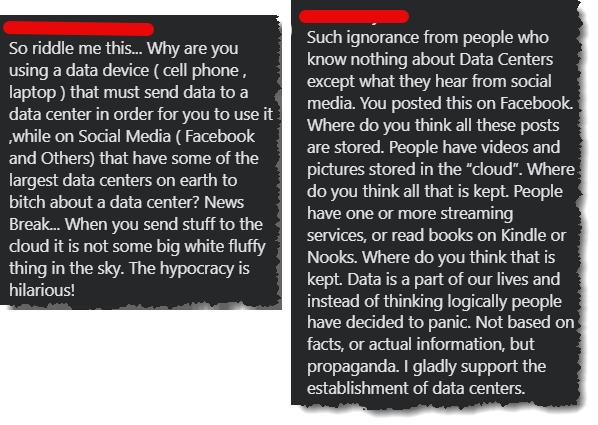
By that reasoning, anyone who drives a car has no right to question where a highway is constructed. Anyone who uses electricity cannot object to the location of a power plant. And anyone who buys groceries should remain silent when productive farmland is converted into an industrial complex. (JAP2026)
A Response to Those Who Think Questioning Data Centers Is Ignorance or Hypocrisy
There is a shallow, reoccurring theme in the criticism of concerns I and others have about hyperscale data centers.
Folks like me who question these projects are accused of being ignorant and uninformed. I have been told I am falling prey to propaganda, that I am a conspiracy theorist, or that I am hypocritical because I use computers, cell phones, social media, and artificial intelligence. It has even been suggested that I am being influenced by China. The China connection is hilarious and I wish I had time to explain the irony of that accusation towards me, maybe another day.
It is annoying as hell to be told I couldn’t possibly know what I am talking about. Whether it is someone in the community or a federal official, these attacks are essentially name calling and fail to address legitimate questions. Personally, I have not heard one single federal official even attempt to answer the questions we have. I don’t think they can.
Let me offer a little perspective. I have worked in information technology and telecommunications for approximately 30 years. I have designed and built networks, storage systems, servers, worked with almost every form of broadband technology, worked inside data centers, and spent a good portion of my professional life dealing with the technology and infrastructure that makes it all work.
Today, I make part of my living using artificial intelligence. Over the past year, I have easily spent more than a thousand hours working with AI professionally, developing solutions, researching technical issues, and evaluating the capabilities and limitations of these systems.
I am very familiar with the technology and I understand what data centers are, what they do, and why they exist. I am not opposed to data centers!
Some data centers are essential to modern civilization. Hospitals, emergency medical services, 911 dispatch centers, banking, financial transactions, national defense, scientific research, weather forecasting, communications, and critical government infrastructure depend on computing and data storage.
Not all data centers are essential, though, and some are even parasitic. Many data centers and AI systems support the porn industry. Even more support advertising, consumer profiling, mass data aggregation, and surveillance systems. One of the most corrupt uses, in my opinion, is cryptocurrency mining farms subsidized by government incentives. It is public risk and private profit, as the profits go to hedge funds. Then there are the speculative AI ventures and other commercial operations that have little to do with essential public services.
A company may have every right to pursue those businesses. That does not mean a rural community has an obligation to subsidize them, surrender productive farmland, absorb new infrastructure costs, or accept the environmental and economic consequences.
The central issue
The fact that society needs data centers does not mean that every proposed data center is necessary, that every location is appropriate, that every project benefits the community, or that every project rises to the level of nationally strategic.
I have been told that because I use Facebook, cloud services, and AI, I am somehow a hypocrite for questioning hyperscale development.
By that reasoning, anyone who drives a car has no right to question where a highway is constructed. Anyone who uses electricity cannot object to the location of a power plant. And anyone who buys groceries should remain silent when productive farmland is converted into an industrial complex.
Using a technology does not require unquestioning acceptance of every industrial project proposed to support it.
There are also legitimate alternatives to building hyperscale and grid scale facilities on agricultural land, undeveloped public lands, or inside local communities.
The EPA reports more than 1,000 Superfund sites nationwide already support some form of reuse. Thousands of brownfields and former industrial properties have been identified for redevelopment. Some offer existing industrial zoning, electrical infrastructure, transportation access, utility connections, and other advantages that undeveloped rural properties may lack.
Not all are suitable or available for hyperscale development, but they should be considered first. Decommissioned power plants, abandoned industrial complexes, and appropriately remediated properties should be evaluated before anyone is allowed to sacrifice agricultural land or permanently destroying intact natural landscapes.
Of course, the locations I am talking about may not offer the tax incentives, inexpensive electricity, or other financial advantages developers seek in rural communities and that is half the reason developers choose rural communities and that is precisely why the public should be asking questions.
Who benefits from the project? Who pays for the electrical infrastructure? What happens to electricity rates? How much water will be consumed? What happens if the business fails? How many permanent local jobs will actually be created? What tax incentives are being offered? Who pays for decommissioning? What happens to neighboring property owners? How big will the project get? What guarantees will you put in writing?
The most important question: Why is this location necessary?
These are not the sort of questions ignorant people ask, but they are the types of questions that many hyperscale developers, politicians, and landowners will avoid. These are basic questions of economics, property rights, and land use.
As citizens of Idaho and the United States, we have a duty to scrutinize plans that affect whole communities or entire regions. It is the basis of public accountability and responsible government. (JAP2026)
There is no shame in asking questions and being skeptical, but those who quickly attack PEOPLE for asking questions should be ashamed.
I have been impressed by the knowledge and experience residents of our small Idaho communities have brought to these discussions. Whether it was Lava Ridge, SWIP-N, or any number of large-scale projects in the region, the folks in southern Idaho come prepared. Many have researched these projects extensively. Some have decades of experience in agriculture, engineering, utilities, construction, finance, technology, and public administration.
Dismissing those people as ignorant because they question a developer’s claims or have concerns about attempts to rezone property and plow under farmland is both unfair and counterproductive.
It isn’t my intent to attack anyone personally. I simply want those making these accusations to consider how their statements are perceived by people who have invested substantial time and effort in understanding these projects.
Disagreement is perfectly reasonable and supporting data center development is a completely legitimate position. But support should be based on the facts surrounding each project.
No one who knows me would consider me anti-technology, anti-business, or anti-development. I believe there are appropriate places for these facilities, and I recognize that some will provide substantial benefits.
But I will say it again and again, I do not believe productive farmland and undeveloped public lands should be treated as disposable industrial real estate.
I also do not believe that taxpayers or electric ratepayers should be expected to subsidize private ventures simply because a developer promises jobs and economic growth.
I do believe that communities should be more cautious now than ever in regards to hyperscale projects and their related infrastructure. The AI bubble continues to grow and the economics of AI and hyperscale projects has come under considerable criticism by economists.
If a project is genuinely beneficial, its cheerleaders should be able to demonstrate add defend the benefist with clear, concise, evidence; transparent financial arrangements, realistic employment projections, and enforceable protections for the surrounding community.
And if a developer cannot or will not answer those questions completely, without hesitation, the problem is not that residents are asking them.
The burden of proving that a project is appropriate belongs to those proposing it. It belongs to the developer who lives off a trust fund in another state, not to the citizens who will have to live with its consequences.
Jeff A Pierson © 2026
Sources
- Originally published on Substack: https://jeffapierson.substack.com/p/a-response-to-those-who-think-questioning