SWIP-N: Corporate Welfare Today, Broken Promises Tomorrow - Idaho Families Left Without Recourse
The debate isn’t about whether the grid needs stability
The debate isn’t about whether the grid needs stability. The real questions are why it has become unstable, at what cost, who will pay, and what risks Idaho must carry. The details matter.
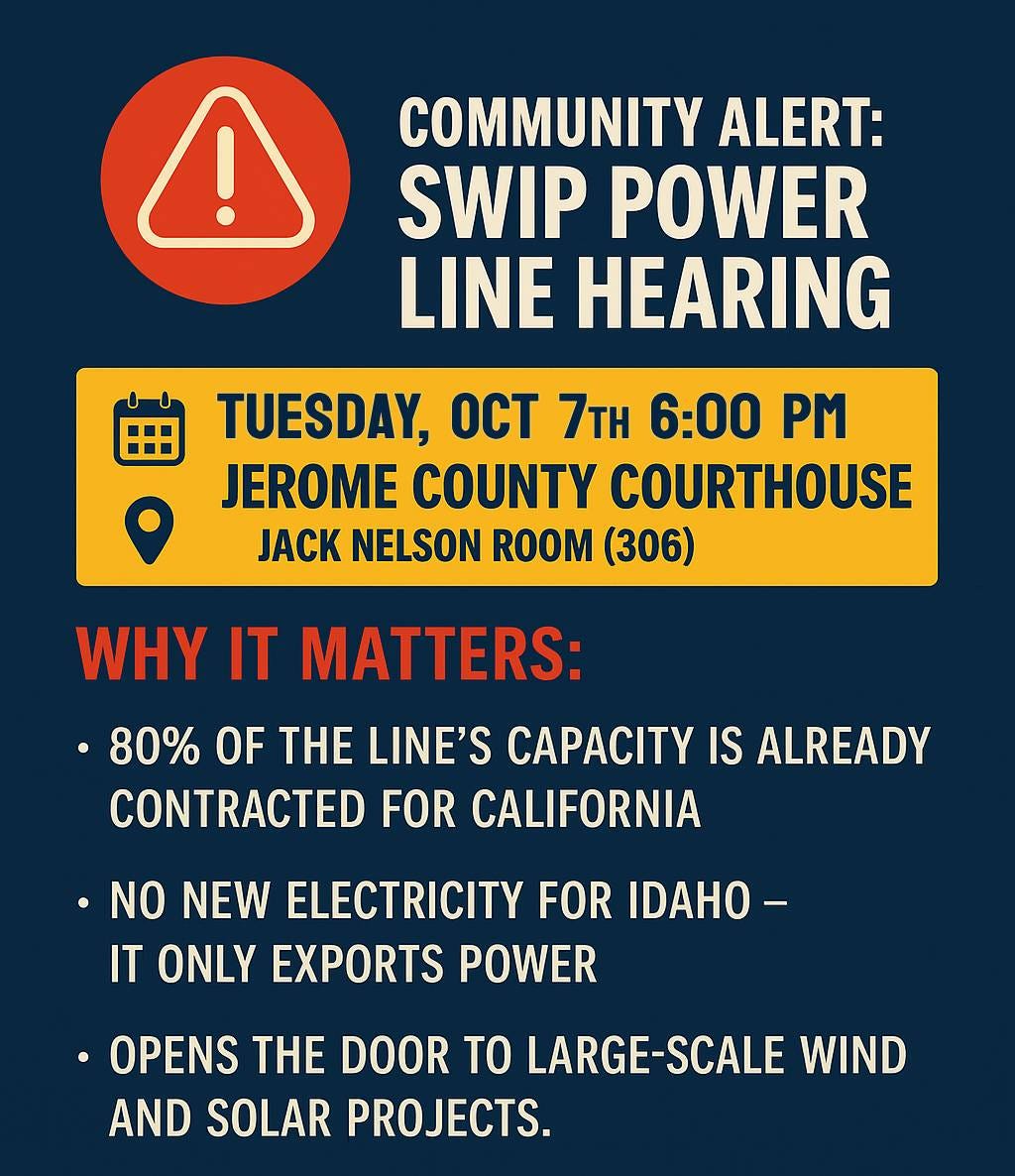
At a recent hearing, Great Basin Transmission admitted that 80% of the line’s capacity is already contracted to send power south. Under current agreements, that energy won’t strengthen Idaho; it will subsidize California’s failed energy policies.
The negative risks for Idaho tied to the Southwest Intertie Project North (SWIP-N) appear again and again in the appeal filings and public comments. They fall into four categories:
Economic exposure
Most of the line’s capacity is destined for California. Idaho ratepayers and landowners will bear the siting costs, construction disturbance, and long-term impacts while the benefits flow out of state. That imbalance could drive utilities like Idaho Power to prioritize export profits over local reliability, leaving Idaho families and businesses with higher prices and tighter margins.
System reliability
California’s grid has grown unstable because of its heavy reliance on intermittent wind and solar while phasing out dependable baseload generation. SWIP-N links Idaho directly into that market. The danger is that California’s shortages will spill into Idaho’s system, straining capacity during peak demand and importing the consequences of California’s energy policies into our grid.
Land use and environmental costs
The project requires massive towers and wide easements cutting across farmland, rangeland, and wildlife habitat in Jerome County and beyond. Landowners face property devaluation, interference with aerial crop spraying, and restrictions on land use that last for decades. To many, this looks like Idaho land being sacrificed for someone else’s gain.
Legal and governance risks
Opponents argue that Jerome County may not have fully followed its own ordinances or Idaho’s Local Land Use Planning Act in approving the project. If true, it sets a precedent that large corporations can push projects through without meeting the standards meant to protect local health, safety, and welfare. That erodes county authority and undermines public trust.
In short, Idaho’s risks are financial (paying for a line that serves California), systemic (tying into California’s unstable grid), local (loss of property value and land use), and institutional (weakening county authority). Taken together, these risks explain why opponents see SWIP-N as a net negative for Idaho even if it benefits regional utilities.
Options Ignored
Idaho does have options for power generation, energy policy, and grid stability. But too often, those solutions are sidelined in favor of deals that reward corporations while shifting risks to families. They depend on western states and the federal government holding California accountable for its own energy choices. Instead, money and political power prefer the easy path, handing out corporate welfare in exchange for promises that my children will never be able to hold those corporations or politicians accountable for.
Related
Sources
- Originally published on Substack: https://jeffapierson.substack.com/p/swip-n-corporate-welfare-today-broken