SWIP-N: Meeting California's Renewable Goals
How California’s Renewable Energy Ambitions Threaten Idaho’s Energy Independence
The Devil is in the Details
While reading through the 2022–2023 California Independent System Operator (CAISO) Transmission Plan, one phrase stood out: “regional, policy-driven project.” The term appears again in CAISO’s November 22, 2024 Transmittal Letter to FERC.
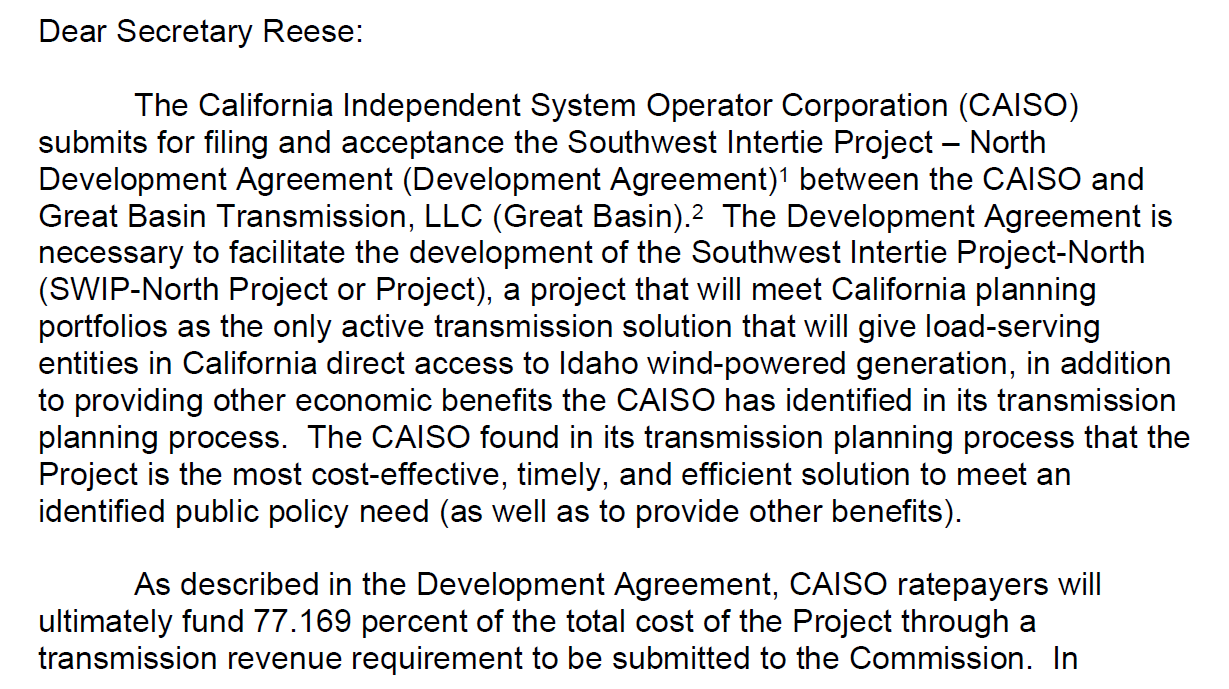
In its 2021–2023 Transmission Plans, CAISO had described the Southwest Intertie Project–North (SWIP-N) as a candidate for further study or “potential interregional coordination.” By 2023, CAISO’s Board considered SWIP-N “the most cost-effective, timely, and efficient solution to meet an identified public policy need.” In its 2024 filing to the Federal Energy Regulatory Commission under Section 205 of the Federal Power Act, CAISO confirmed the regional designation, explicitly stating that it was pursuing the project under its own tariff as a “voluntary agreement,” not as part of an interregional coordination process.
At first glance, the phrase “regional, policy-driven project” sounds like bureaucratic jargon. In reality, it defines how authority and responsibility are distributed. It means the project is not being pursued solely for market efficiency or grid reliability, but to advance specific state renewable energy policies, primarily California’s. In other words, this is not just about transmitting electricity. It is about who decides where that power goes, whose priorities shape the grid, and who ultimately bears the financial and operational risks.

Regional vs Interregional
Under the regional classification, California, acting through CAISO and its development partner Great Basin Transmission (a subsidiary of LS Power), gained full planning authority over a 500-kilovolt transmission corridor that runs through Idaho and Nevada. Idaho Power and the Idaho Public Utilities Commission (IPUC) remain involved only at the margins. They can regulate local costs, but they no longer share in the planning or decision-making process that determines how the project functions or whom it ultimately serves.
If SWIP-North had been classified as an interregional project, Idaho, Nevada, and California would have been legally required to coordinate planning, share costs, and jointly approve the project through their respective public utilities commissions. Each state would have retained authority over its portion of the costs and benefits, and Idaho would have had the right to evaluate the project’s economic and environmental justification.
By designating SWIP-North as regional, CAISO and LS Power avoided that process entirely. Idaho and Nevada have effectively become corridor states. Their land and transmission corridors are used, but their public representatives no longer have equal authority in deciding how the line operates or what share of capacity their ratepayers may access.
CAISO and LS Power now operate the project under California’s tariff, subject to FERC approval but not to joint state oversight. This structure allows California to decide how the line is built, how capacity is allocated, and how its market rules apply. The project is therefore shaped primarily to serve California’s policy goals rather than the shared reliability and affordability objectives that once defined regional interconnection.
California’s renewable-energy mandates and carbon-reduction targets now dictate the direction and justification of SWIP-North. It is not a partnership. It is a jurisdictional imbalance presented as “regional coordination.”
Related Article:
Op-Ed: Why Idahoans Are Paying More for Their Power Bills by David Leavitt
Market Effects: From Stability to Exposure
As SWIP-N comes under CAISO’s tariff, every megawatt transmitted through it can be priced according to CAISO’s locational marginal pricing (LMP) system. This algorithm determines energy prices based on supply, demand, and transmission congestion across CAISO’s network.
For Idaho Power, this means wholesale electricity traded through SWIP-N will no longer rely solely on bilateral contracts or cost-of-service pricing. Instead, prices will fluctuate with California’s real-time grid conditions. Even limited participation ties Idaho Power’s financial exposure to California’s market volatility.
The risk is most pronounced near the Harry Allen–Eldorado corridor in southern Nevada, one of the most congested points within CAISO’s footprint. Exports from Idaho could face rising congestion fees, while imports back into Idaho could become more expensive when California’s demand spikes.
Bonneville Power Administration (BPA) customers are also indirectly exposed. As CAISO expands its regional influence through projects like SWIP-N, market effects ripple northward through the Western Energy Imbalance Market and day-ahead market integration. Increased California-driven congestion and price volatility can elevate transmission costs for BPA’s balancing operations and influence wholesale rates for public utilities across the Northwest. As CAISO’s policy-driven pricing model extends its reach, traditionally stable hydro-based regions like those served by BPA may face new exposure to California’s market dynamics.
Idaho’s Limited Control
The Idaho Public Utilities Commission (IPUC) retains jurisdiction over Idaho Power’s cost recovery. Idaho Power cannot charge its customers for participation in SWIP-N unless it can demonstrate that the investment is prudent and provides a measurable benefit to Idaho ratepayers.
The IPUC can still:
Approve or reject Idaho Power’s requests to recover costs through retail rates.
Review the prudence of expenses related to CAISO market participation.
Require transparency and accounting for any market settlements tied to SWIP-N.
In practical terms, Idaho still decides what its residents pay. However, because SWIP-N is not an interregional project, Idaho no longer has authority over the line’s planning, sizing, or operation. Those decisions now rest with CAISO, which determines:
How transmission capacity is allocated among California, Nevada, and Idaho users.
How congestion and tariffs are priced within its market system.
How energy flows are prioritized under California’s renewable integration policies.
Important Related Information and Updates:
IPUC Order No. 36800 (October 2025) initiates the Certificate of Public Convenience and Necessity
ER25-3372-000 titled “§ 205(d) Rate Filing: RS 182—SWIP N Participation and Joint Ownership Agreement
Bottom Line
SWIP-N changes Idaho’s role in the western power grid. Instead of remaining an independent actor within a shared regional system, Idaho becomes a secondary participant in California’s market.
This alignment introduces three long-term vulnerabilities:
Price volatility: Idaho’s historically stable rates will begin to mirror California’s fluctuating grid conditions.
Revenue risk: Idaho Power’s transmission investments could underperform during periods of renewable oversupply or curtailment.
Policy dependence: California’s energy mandates, not Idaho’s, will determine the long-term value of Idaho’s transmission infrastructure.
The shift is subtle but significant. It transforms Idaho from a sovereign regulator into a dependent market participant.
SWIP-N, once promoted as a regional project intended to enhance shared reliability, now functions as a California-controlled conduit for renewable imports. Idaho retains authority over what its ratepayers are charged, but not over how those prices are formed. That distinction defines the new imbalance in the western grid.
Dictionary /Acronyms
CAISO – California Independent System Operator
A nonprofit corporation established under California law that operates most of the state’s high-voltage grid and wholesale energy markets. CAISO manages the day-ahead and real-time markets and determines locational marginal prices (LMP) across its system. It has authority over the operation and pricing of SWIP-N under its tariff, approved by the Federal Energy Regulatory Commission (FERC).
Congestion Costs
Charges arising when transmission capacity is insufficient to meet market demand. CAISO calculates these through LMP differences between zones. Idaho Power could face higher delivered-energy costs when exporting or importing power through congested CAISO hubs such as the Harry Allen and Eldorado corridor.
Curtailment
A market condition in which CAISO orders generators to reduce output during oversupply events such as high solar production. Curtailment reduces export opportunities for Idaho resources and can lower the value of Idaho Power’s transmission rights.
FERC – Federal Energy Regulatory Commission
An independent federal agency that regulates interstate transmission of electricity, natural gas, and oil. FERC approves CAISO’s tariffs and determines whether projects like SWIP-N meet federal requirements for market structure, reliability, and cost allocation.
Great Basin Transmission LLC
A subsidiary of LS Power responsible for developing and operating SWIP-N. It acts as the project owner and transmission provider under the CAISO tariff structure, partnering with CAISO to deliver renewable energy imports from Idaho and Nevada into California.
Interregional Transmission Project
A project jointly planned and funded by multiple regional transmission organizations or states. Interregional projects require coordination of costs, operations, and approvals across jurisdictions. CAISO determined that SWIP-N did not meet this definition, reducing Idaho’s formal role in planning and cost allocation.
IPUC – Idaho Public Utilities Commission
The state agency regulating Idaho Power’s rates and investment recovery. IPUC can review and approve whether SWIP-N-related costs are prudent and beneficial to Idaho customers but cannot change the CAISO tariff or market rules that generate those costs.
Kilovolt (kV)
A unit of electrical potential equal to one thousand volts. Transmission lines such as SWIP-N operate at high voltages, typically 500 kilovolts, to efficiently move large quantities of electricity over long distances with minimal energy loss.
LMP – Locational Marginal Pricing
The pricing mechanism CAISO uses to determine electricity prices at specific nodes, based on real-time supply, demand, and transmission congestion. Once SWIP-N operates under CAISO’s tariff, power flowing across it will be priced through LMP, exposing Idaho Power to California’s congestion and volatility.
LS Power
An independent energy developer that owns Great Basin Transmission. LS Power’s involvement positions SWIP-N as a merchant transmission project, meaning it earns revenue through transmission rights rather than rate-based returns.
Market Participation
When a utility such as Idaho Power uses CAISO’s market to buy or sell power. Participation provides access to broader market liquidity but subjects the utility to CAISO’s tariff pricing and dispatch rules, which are beyond Idaho’s regulatory control.
Megawatt (MW)
A unit of power equal to one million watts. One megawatt can supply approximately 750 to 1,000 homes depending on demand. SWIP-N has a transfer capacity of about 2,000 megawatts, allowing large-scale energy movement between Idaho, Nevada, and California.
Policy-Driven Transmission Solution
A transmission project justified primarily by policy mandates such as renewable integration or carbon reduction rather than by economic congestion relief. SWIP-N was identified by CAISO as a policy-driven solution serving California’s renewable portfolio standards.
Regional Policy-Driven Project
A project designed to meet policy goals within a single transmission operator’s jurisdiction. In this case, SWIP-N serves California’s renewable integration goals under CAISO’s control, without requiring participation or approval from Idaho or Nevada.
SWIP-N – Southwest Intertie Project North
A 500-kilovolt (kV) transmission line developed by Great Basin Transmission, a subsidiary of LS Power. The line connects Idaho and Nevada, forming part of a larger network linking the Pacific Northwest to the California market. CAISO classified it as a regional policy-driven project rather than an interregional project, granting California greater control over its operation.
Tariff (CAISO Tariff)
The formal, FERC-approved rulebook governing how CAISO operates its markets, sets prices, allocates transmission capacity, and manages congestion. All participants in the CAISO market, including Idaho Power through SWIP-N, must operate under this tariff.
References
California Independent System Operator (CAISO). (2024). 2023–2024 Transmission Planning Process Report.
Federal Energy Regulatory Commission (FERC). (2025, January 21). Order accepting development agreement between Great Basin Transmission LLC and CAISO regarding SWIP-N (Docket No. ER25-543). Washington, D.C.
Idaho Public Utilities Commission (IPUC). (2023). Integrated Resource Planning Guidelines. Boise, ID.
LS Power. (2024). Southwest Intertie Project Overview.
Disclaimer
This analysis represents opinion based on public filings from CAISO, FERC, and Idaho Power as of October 2025. It is for informational purposes only and does not constitute legal or regulatory advice.
Sources
- Originally published on Substack: https://jeffapierson.substack.com/p/swip-n-and-the-quiet-transfer-of