Who Pays for Idaho Power’s New Plants? You Might!
New Power Generation Cost Allocation Decisions Are Being Made Soon!
from Feeding the Beast
Watch This First (1 minute)
The Idaho Public Utilities Commission (IPUC) is deciding right now how the cost of new power plants and transmission lines gets split among Idaho Power customers.
How these costs are allocated will directly affect your future electric bills. The more you learn about what led up to this, the better prepared you will be (and you might be a little upset as well).
Links to the IPUC
The new plants and lines are going up mostly for big new customers like data centers and chip plants. Idaho Power’s own model for a hypothetical 300-megawatt customer doesn’t charge it the full $219 million a year in generation costs it would add. The rest of us pick up part of it.
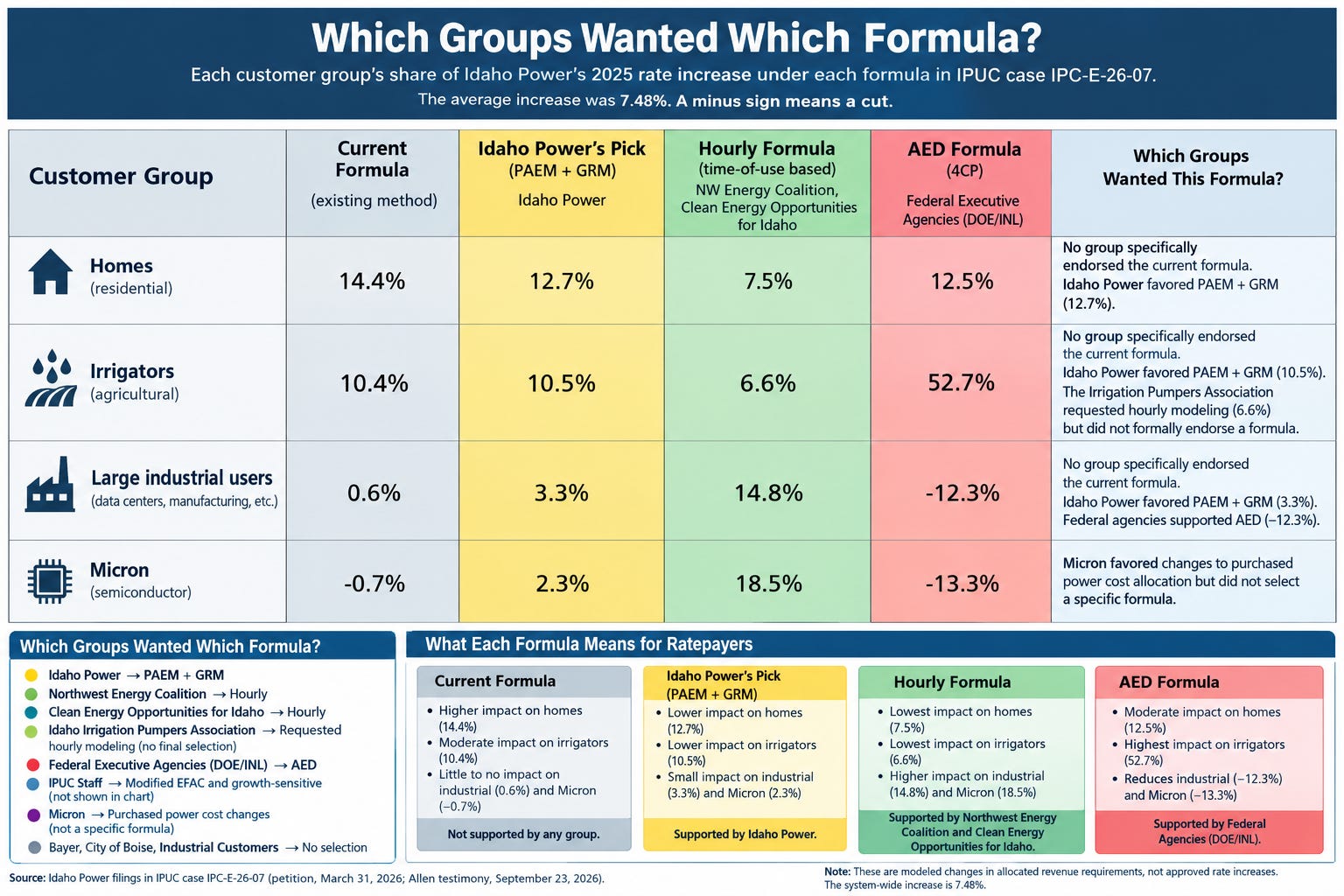
The formula the Commission picks decides how big that part is. Using 2025 numbers, Idaho Power’s own comparison shows the Hourly formula putting 7.5% on residential customers and 6.6% on irrigators. Under AED-4CP, the Department of Energy and INL would get a 16.6% cut and Micron a 13.3% cut. Irrigators would eat a 52.7% increase. Actual rates get set in future rate cases.
What You Can Do
Comment by December 14. Go to puc.idaho.gov, click “Case Comment Form” and enter case IPC-E-26-07. Tell the Commission that the customers who need new plants and lines should pay for them. Homeowners and irrigators should back the Hourly formula.
Call your legislators. Find your legislator by address. HB 911, the 2026 ratepayer protection law, came out weaker than the bills before it. Ask them to restore the 20-megawatt threshold and require exit fees and minimum monthly bills in the 2027 session.
Skip the Deep Dive go Learn the Basics
The Deep Dive
A Legislative Attempt at Cost Allocation
Idaho tried to pass several laws in 2025 and 2026 that would have protected Idaho electricity customers from bearing certain costs associated with new or expanded power generation and delivery. Specifically, these bills were about how costs are allocated and what protections you have as a homeowner.
The law we ended up with, HB 911, is not what we should have gotten, but it does provide some protections against data centers and other large power users raising everyone else’s electric bills.
House Bill 911, titled “New Large Load and Ratepayer Protection,” took effect on July 1, 2026. Under HB 911, the Idaho Public Utilities Commission (IPUC) must review and approve electricity service contracts between a regulated electric utility and a new or expanding large electricity customer when both of the following conditions are met:
The customer’s contracted electricity demand increases by 50 megawatts (MW) or more within any consecutive 60-month period.
The service contract was entered into on or after July 1, 2026.
HB 756: The Effort Started Strong
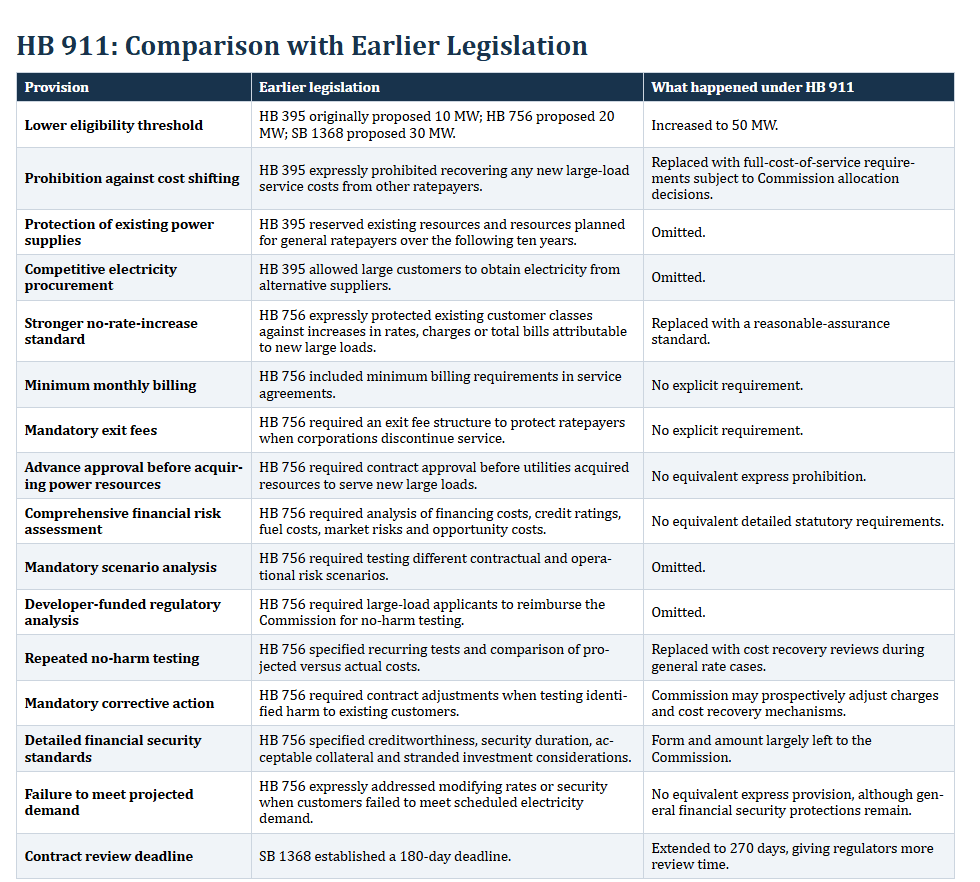
An earlier bill, HB 756, introduced February 24, 2026, required that no existing customer class experience higher rates, charges or total bills as a result of serving a new or expanded large load. Sounds like a great goal, doesn’t it?
The law that passed, HB 911, instead requires “reasonable assurance” that new large loads will not cause other customers’ rates to increase. The Idaho Public Utilities Commission determines what constitutes reasonable assurance.
I am sure you will agree that reasonable assurance is a significantly weaker standard than the one HB 756 reached for. It is just one example of how several proposed bills could have provided protections to many Idaho Power customers.
How the Protections Got Watered Down
The bill history shows that there has been little legislative support for strong protections for homeowners and small electricity users.
As you read the timeline below, keep in mind that Idaho Power and related energy PACs have supported many of our legislators by contributing significantly to their campaigns.
2025 - HB 395: HB 395, introduced March 10, 2025, started the IPUC review threshold at 10 MW. HB 395 was later amended to 30 MW, passed the House and died in a Senate committee.
February 2026 - HB 756: Rep. Stephanie Mickelsen introduced HB 756. This bill placed the review threshold at 20 MW and required exit fees and minimum monthly bills for large power users. It never got out of committee.
2026 - SB 1368: SB 1368 proposed a 30 MW threshold and an approach more closely aligned with existing utility regulatory practices. That bill died in committee.
March 2026 - HB 911: The final bill, the one that became law, HB 911, passed with a 50 MW threshold and without the explicit exit fee and minimum billing requirements of HB 756. It passed 65-3 in the House and 34-1 in the Senate.
Exit fees: Require large electricity customers to compensate the utility for unrecovered infrastructure costs if they close, relocate or terminate their contracts early, rather than leaving existing ratepayers to cover those costs.
Minimum billing: Requires large electricity customers to pay a minimum monthly amount regardless of how much electricity they actually use, protecting existing ratepayers from having to cover infrastructure costs when projected electricity demand fails to materialize.
Both provisions are intended to keep the financial risks of corporate development with the corporations rather than transfer them to existing ratepayers.
Idaho Power’s parent company, IDACORP, told investors the law (HB 911) “effectively codified the way we currently develop large load contracts with one change.” That change was the establishment of a 270-day deadline for the Commission to approve or deny large-load electricity contracts.
Before HB 911, there was no statutory deadline, which gave the Idaho Public Utilities Commission more room to thoroughly examine complex electricity contracts.
HB 911 does provide financial security requirements, a no-harm assessment, protections against artificially splitting electrical loads to evade the law, and periodic contract reviews. However, its higher threshold and less prescriptive protections leave existing ratepayers exposed to potential cost shifting. So does its exclusion of older contracts.
Below the Threshold
Customers adding less than 50 MW within five years generally aren’t covered. Idaho Power’s own rules already require a special contract once a customer passes 20 megawatts, about 15,000 homes’ worth of electricity. The new law starts well above that.
Contracts entered into before July 1, 2026, are also not covered by the new law.
Under the wire
Several new large-load contracts came in just under the wire, before the new law took effect.
Idaho Power filed Micron’s contract for its new chip plant in December 2024, and the Commission ruled on it May 8, 2026.
Idaho Power filed its Chobani contract on June 8, 2026, three weeks before the cutoff.
Are contract amendments an exception?
Meta’s original electricity contract, through its subsidiary Brisbie LLC, was filed for Commission approval December 22, 2021. The Commission approved it, subject to modifications, on May 11, 2023. Idaho Power filed a third amendment to Meta’s contract on September 1, 2026, after the new law took effect.
While contract amendments, like Meta’s, should be scrutinized under the new law, it is not clear whether that will happen. Idaho Power maintains that the new law does not apply because the original contract was signed in 2021 and the amendment does not increase contracted electricity demand or establish a new service arrangement.
Paying for New Power Generation & Transmission Systems
Finding clarity
Think about who pays for a new subdivision.
The developer pays for the street into the neighborhood. If the county needs to widen the highway to accommodate the additional traffic, the question becomes how much the developer should pay and how much everyone else should pay.
The developer created the additional demand on the highway. Shouldn’t the developer be responsible for the costs associated with accommodating that demand?
The same question applies to large electricity users. If their arrival creates the need for new power plants, transmission lines and substations, how much of that cost should they bear, and how much should be passed on to existing ratepayers?
Idaho Power’s View
In testimony filed September 23, 2026, Idaho Power modeled a hypothetical new 300-megawatt customer that would add approximately $219 million in annual generation-related revenue requirement.
Idaho Power’s own witness, Connor Allen, stated:
“Accordingly, the NLL [new large load] GRM [Growth Responsibility Method] Model does not allocate the entire $219 million of incremental generation-related revenue requirement to the hypothetical NLL or directly assign a specific generation resource to that class.”
That means that under Idaho Power’s cost-allocation model, the hypothetical new large-load customer would not be allocated the entire $219 million in additional annual generation-related costs.
Instead, a portion of those costs would be allocated to other customer classes (such as residential electricity customers) because the new generating facilities would become part of Idaho Power's shared electrical system.
How much will the corporation creating the new demand pay, and how much will everyone else be expected to pay? That is not clear.
Idaho Power says large-load customers “very much pay their own way” and that the Commission already prevents cost shifting. It also told investors that revenue from large customers is helping it avoid filing another general rate case in 2026. Maybe so. But the new law was supposed to replace the company’s word with a rule.
Idaho’s new law leaves the IPUC considerable discretion in making similar decisions about power plants and transmission lines. This is why public comments are so important.
Idaho Power’s Cost Allocation Table
The table below was prepared by Idaho Power for its filings in IPUC Case IPC-E-26-07. The table illustrates how different accounting formulas would have distributed Idaho Power’s 2025 system-wide revenue requirement increase of 7.48% among different customer groups.
These are not actual electricity rate increases, but comparative calculations provided by Idaho Power itself. The Idaho Public Utilities Commission is now considering which formula should be used in future rate cases. As you consider your position, think back to the new subdivision analogy.
Submit your public comments at https://puc.idaho.gov before December 14, 2026.
The Hourly Formula: Benefits Residential and Irrigation Customers
The Hourly formula examines electricity consumption and system costs hour by hour. Of the formulas presented, it is the most favorable to homeowners and irrigation pumpers. It would have allocated increases of 7.5% to residential customers and 6.6% to irrigators, while allocating a substantially larger share of costs to large industrial customers.
The Northwest Energy Coalition and Clean Energy Opportunities for Idaho favor consideration of the Hourly formula.
The Hourly formula produces the most favorable results for homeowners and irrigators, but it is not the most favorable formula for every customer group. Remember, though, that the new generation driving these costs is being built mainly for large-load users. Large-load customers fare better under the Average and Excess Demand (AED) formula.
Average and Excess Demand (AED): Benefits Large-Load Users and Federal Agencies
AED is an electricity cost-allocation method that considers both a customer class’s average electricity demand and its demand above that average during peak periods.
AED-4CP stands for Average and Excess Demand with Four Coincident Peaks. This is the specific version being considered in Idaho Power’s cost-allocation proceeding, IPC-E-26-07.
The federal executive agencies, represented by the Department of Energy, support consideration of the AED formula, citing established industry accounting practices.
Look at who benefits. Under AED, the Department of Energy and Idaho National Laboratory customer class would receive a 16.6% reduction in allocated costs, Micron a 13.3% reduction, and large power customers a 12.3% reduction. Meanwhile, irrigation pumpers would face a whopping 52.7% increase in allocated costs.
It is easy to see that the federal government has a considerable financial interest in the outcome because it is itself a large electricity consumer. Although the federal agencies have not formally demanded adoption of AED, Idaho Power’s own calculations show the substantial financial benefit they could receive.
Homeowners and irrigation pumpers have good reason to advocate for the Hourly formula while insisting that new large-load customers pay their full attributable costs, as intended by Idaho Code § 61-335. If they do not make their voices heard, they could see significant rate increases.
IMPORTANT: The decision has not been made. Submit your comments to the IPUC.
What happens next
How new electrical generation and transmission costs get split among homes, farms, businesses and big industrial users is being decided now in case IPC-E-26-07. The Commission is taking public comments until December 14, 2026. A hearing with witnesses starts January 19, 2027.
What you can do
Step 1: Let the IPUC know what you think
Submit a public comment by December 14, 2026. Go to https://puc.idaho.gov, click “Case Comment Form,” and enter case number IPC-E-26-07. You may want to review the ‘Reference Content’ below to better guide your comments.
Tell the Commission that power plants and other infrastructure required by big new customers should be paid for by those customers. Demand that existing ratepayers be protected against cost shifting and the financial risks of speculative industrial development.
Homeowners and irrigation pumpers should also consider supporting the Hourly formula.
Step 2: Then call your legislators. (Find your legislator)
Ask them to revisit Idaho’s ratepayer protection law during the 2027 legislative session.
Ask them to restore the 20-megawatt threshold and require exit fees and minimum monthly bills. The no-harm requirement needs teeth too.
Let them know that Idaho families and farmers should not be forced to subsidize the expansion of large corporations. Neither should small businesses.
Read more about the individual bills and how far each one got on the Idaho Legislature’s website: HB 395 (2025), HB 756 (2026), SB 1368 (2026) and HB 911 (2026).
More information is available in the articles Companion Reference
Jeff A. Pierson · Jerome, Idaho · jeffapierson.com · jeffapierson.substack.com
Sources
- Originally published on Substack: https://jeffapierson.substack.com/p/idaho-public-utilities-commission